


Report Overview
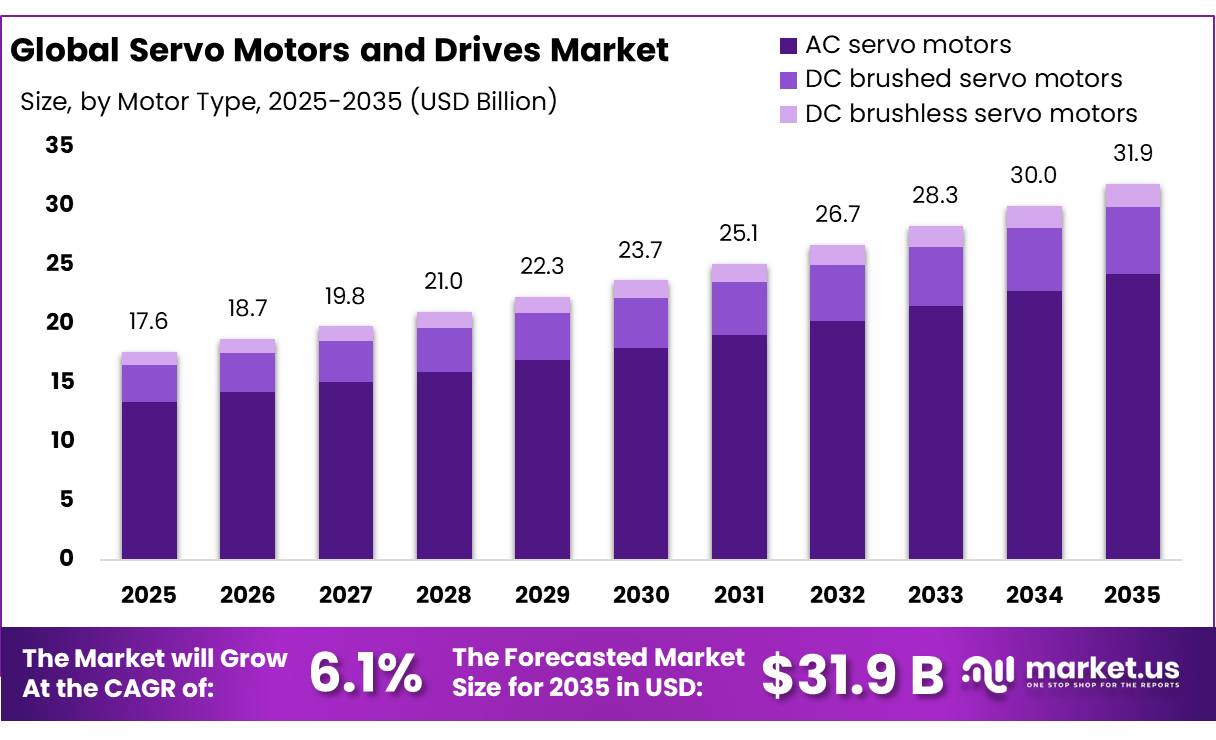
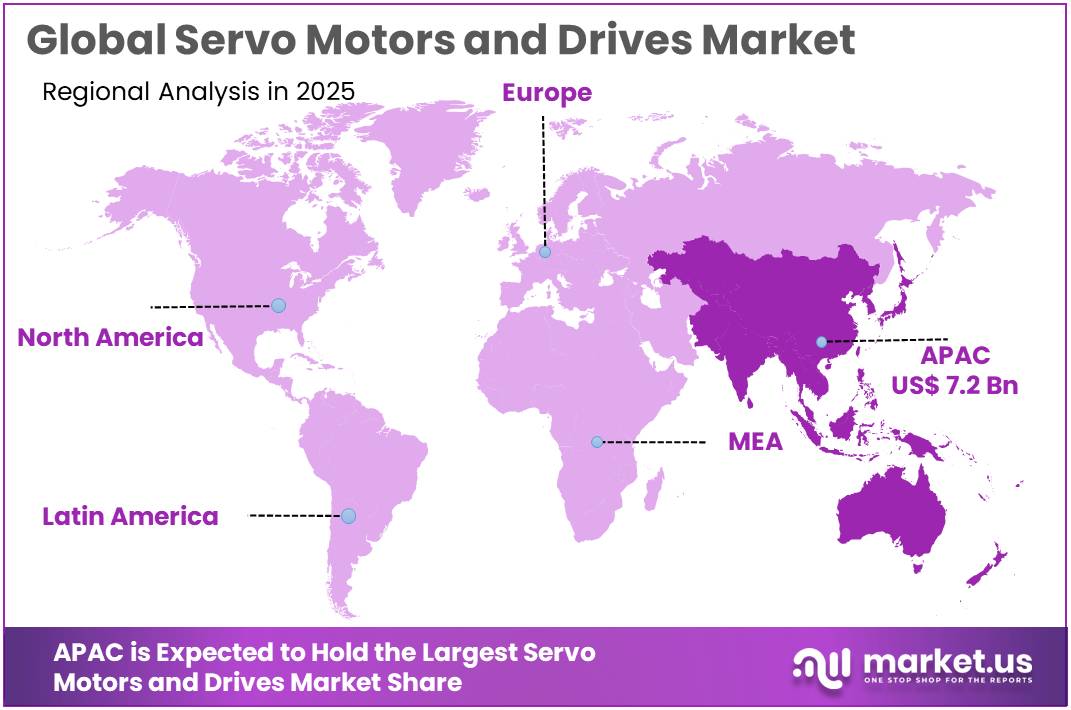
The Global Servo Motors and Drives Market size is expected to be worth around USD 31.9 Billion by 2035, from USD 17.6 Billion in 2025, growing at a CAGR of 6.1% during the forecast period from 2026 to 2035. In 2025, Asia Pacific held a dominant market position, capturing more than a 35.90% share, holding USD 0.5 Billion revenue.
Servo motors and drives play an important role in modern industrial automation by providing accurate control over speed, position, torque, and movement. These systems are widely used in robotics, packaging machinery, machine tools, semiconductor manufacturing, printing equipment, and automated assembly lines. A servo motor converts electrical energy into controlled mechanical motion, while a servo drive regulates the motor’s performance according to signals received from a controller.
- Manufacturers are integrating servo technology into machinery that requires repeatable movements, flexible production settings, and shorter operating cycles. Industrial and commercial motor systems rated at 1 horsepower or higher consume more than 1,000 terawatt-hours (TWh) of electricity annually in the United States, representing approximately 29% of the country’s electricity demand.
The major factors supporting market growth include rising labor costs, demand for higher manufacturing precision, increasing use of industrial robots, and the need to improve equipment productivity. Servo motors support controlled acceleration and deceleration, while advanced drives help maintain stable performance under changing loads. The U.S. Department of Energy reports that motor-driven machine applications account for approximately 54% of industrial electricity consumption in the U.S. manufacturing sector, highlighting the importance of efficient motor selection and system optimization.
Energy efficiency requirements are also influencing product development and purchasing decisions. The International Electrotechnical Commission’s IEC 61800-9-2 standard establishes methods for assessing and classifying losses in power drive systems, including drive modules and motor systems. Such standards encourage manufacturers to consider complete system performance rather than evaluating the motor alone.
Future growth opportunities are expected in collaborative robotics, automated warehouses, precision electronics manufacturing, electric vehicle production, and smart factories. Manufacturers can expand their offerings through compact servo drives, integrated motor-drive units, real-time condition monitoring, and software-enabled predictive maintenance. Advances in power electronics, including silicon carbide technologies, may further support the development of efficient and high-performance industrial drive systems.
Key Takeaways
- Servo Motors and Drives Market size is expected to be worth around USD 31.9 Billion by 2035, from USD 17.6 Billion in 2025, growing at a CAGR of 6.1%.
- Servo motors held a dominant market position, capturing more than a 63.47% share.
- AC servo motors held a dominant market position, capturing more than a 76.05% share.
- Rotary systems held a dominant market position, capturing more than a 78.00% share.
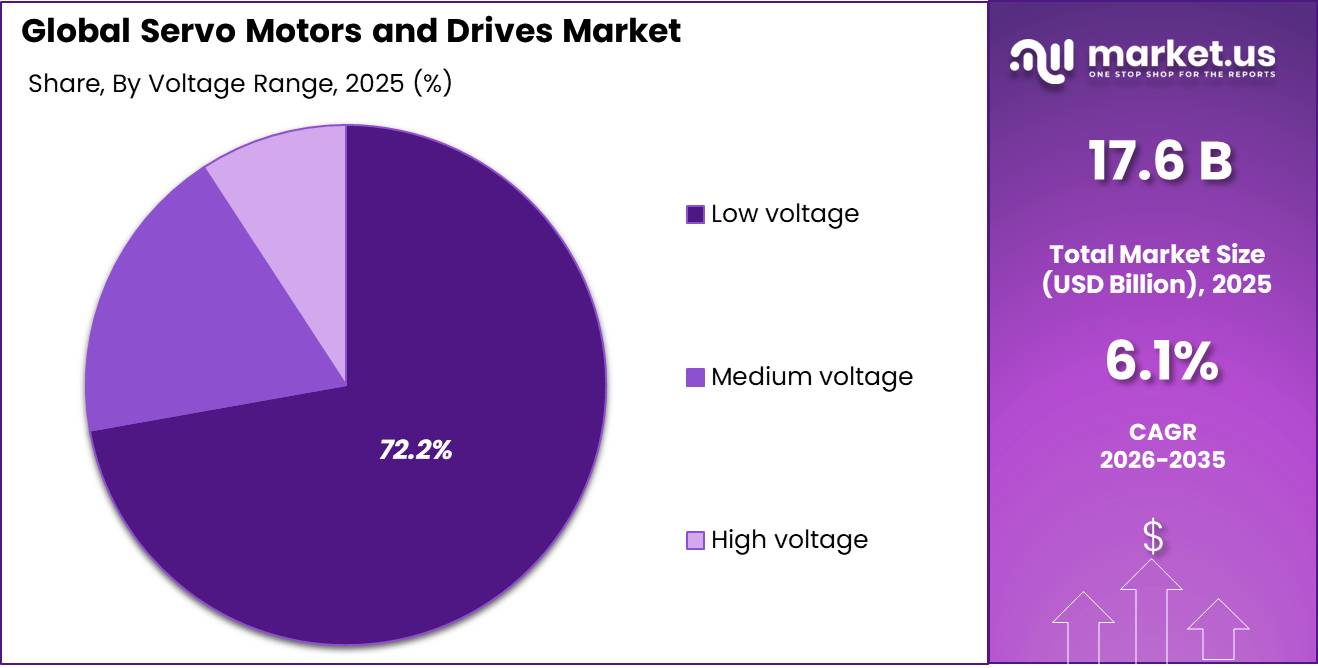
- Low voltage held a dominant market position, capturing more than a 72.23% share.
- Hardware held a dominant market position, capturing more than an 81.00% share.
- Automotive and transportation held a dominant market position, capturing more than a 27.91% share.
- North America is a key region in the Servo Motors and Drives Market, accounting for a reported 35.90% share, with a market value of 6.3 billion.
By Product Type Analysis
Servo motors dominate the market through precise motion control, reliable performance, and wide use in industrial automation.
In 2025, “Servo motors” held a dominant market position, capturing more than a 63.47% share of the Servo Motors and Drives Market by product type. Their leading position is supported by growing demand for accurate positioning, controlled speed, and repeatable movement across manufacturing operations. Servo motors are widely used in robotics, CNC machinery, packaging equipment, and automated assembly lines, where consistent motion helps improve product quality and reduce production errors. Their ability to respond quickly to changing commands makes them suitable for applications that require high precision and frequent start-stop cycles.
Servo drives play an important role in the Servo Motors and Drives Market by regulating the power supplied to servo motors and controlling their speed, torque, and position. In 2025, demand for servo drives was supported by their use in industrial robotics, CNC machines, packaging systems, and automated production lines. Their ability to coordinate motor movement and respond to changing operating conditions makes them essential for precision-based manufacturing.
Advanced robotics and automation could deliver an estimated $40.1 billion in annual cost savings by addressing identified technical gaps. This figure applies to the broader automation sector, not servo drives alone, but highlights the potential value of improved industrial automation. Growing interest in smart factories, connected machinery, and predictive maintenance is expected to create further opportunities for servo drive manufacturers.
By Motor Type Analysis
AC servo motors dominate the market due to their precise control, dependable operation, and suitability for modern automated machinery.
In 2025, “AC servo motors” held a dominant market position, capturing more than a 76.05% share of the Servo Motors and Drives Market by motor type. Their strong position is supported by their ability to deliver accurate speed and position control across demanding industrial applications. AC servo motors are widely used in robotics, CNC machinery, packaging equipment, and automated assembly systems, where consistent movement and quick response are important.
DC brushed servo motors use brushes and a commutator to transfer electrical current and produce controlled motion. In 2025, these motors continued to serve applications where simple control systems, practical installation, and established technology were important considerations. They can be used in small automation equipment, positioning systems, laboratory instruments, and selected industrial machines. However, brush wear and regular maintenance can make them less suitable for applications requiring continuous operation with minimal servicing.
Electric motor systems offer significant opportunities for improving industrial energy efficiency through better equipment selection, maintenance, and system-level optimization. This government resource covers industrial motor systems broadly rather than DC brushed servo motors specifically. As manufacturers increasingly prioritize lower maintenance and longer operating life, DC brushed servo motors may face competition from brushless alternatives, although their straightforward control characteristics can support demand in suitable applications.
By System Type Analysis
Rotary systems dominate the market due to their versatility, precise rotational movement, and widespread use in automated machinery.
In 2025, “Rotary systems” held a dominant market position, capturing more than a 78.00% share of the Servo Motors and Drives Market by system type. Their leading position is supported by extensive use in industrial robots, CNC machines, packaging equipment, printing machinery, and automated assembly lines. Rotary servo systems provide controlled angular movement, accurate speed adjustment, and reliable torque delivery, making them suitable for applications that require consistent production quality.
Linear systems are used in applications that require direct movement along a straight path, including automated material handling, semiconductor equipment, precision assembly, and packaging machinery. In 2025, demand for linear systems was supported by manufacturers seeking accurate positioning, smooth movement, and improved production efficiency. These systems can reduce the need for mechanical components used to convert rotary motion into linear motion, depending on the design. Their use in automated inspection, pick-and-place equipment, and advanced manufacturing creates opportunities for further adoption.
Manufacturing automation can improve productivity, production capacity, consistency, and product quality. While this government source does not provide a specific market statistic for linear servo systems, it highlights the wider industrial benefits supporting their adoption. Growing investment in robotics and precision machinery is expected to support demand for linear systems, particularly where fast, repeatable, and controlled movement is essential.
By Voltage Range Analysis
Low-voltage servo systems dominate the market due to their broad use in factory automation, robotics, and precision machinery.
In 2025, “Low voltage” held a dominant market position, capturing more than a 72.23% share of the Servo Motors and Drives Market by voltage range. This leading position is supported by the widespread use of low-voltage systems in packaging machines, electronic assembly equipment, industrial robots, and material-handling applications. These systems offer accurate speed and position control for machinery that requires reliable performance and flexible operation. Their compatibility with compact equipment and automated production lines makes them suitable for a wide range of manufacturing environments.
Medium-voltage systems are used in selected heavy industrial applications where equipment requires higher power capacity and dependable control. Their potential applications include large manufacturing machinery, specialized processing equipment, and industrial systems with demanding operating requirements. In 2025, medium-voltage servo solutions continued to represent an alternative for applications where low-voltage systems may not meet specific power requirements.
Electric motors used for machine drives account for approximately 54% of industrial electricity consumption in the U.S. manufacturing sector. This figure covers industrial motors broadly and does not refer specifically to medium-voltage servo systems. The growing focus on energy efficiency, equipment reliability, and industrial automation creates opportunities for medium-voltage solutions in suitable applications. However, higher equipment costs and system integration requirements may influence adoption, making application-specific performance and operating needs important factors in purchasing decisions.
By Offering Analysis
Hardware dominates the market because servo motors, drives, controllers, and feedback devices form the core of industrial motion control systems.
In 2025, “Hardware” held a dominant market position, capturing more than an 81.00% share of the Servo Motors and Drives Market by offering. Its strong position reflects the essential role of physical components in controlling machine speed, torque, and positioning. Servo motors and drives are widely used in robotics, packaging equipment, CNC machinery, and automated assembly lines, where accurate movement and consistent performance are necessary.
Software is an important part of the Servo Motors and Drives Market because it helps manufacturers configure motion profiles, adjust operating parameters, monitor equipment performance, and identify potential faults. In 2025, demand for servo software was supported by the growing use of connected machinery, smart factories, and digital manufacturing tools. Motion-control software also helps coordinate multiple axes, improve positioning accuracy, and simplify machine setup.
Software sales for digital twin implementation were distributed across 39.9% for predictive maintenance, 25.3% for business optimization, and 17.8% for performance monitoring. These figures relate to digital twin software rather than servo software specifically, but they demonstrate the value manufacturers place on monitoring and optimizing industrial equipment. As production systems become more connected, opportunities are expected to grow for servo configuration tools, diagnostic software, and predictive maintenance solutions.
By End-Use Industry Analysis
Automotive and transportation leads demand through its growing use of automated assembly, precision machinery, and advanced vehicle manufacturing.
In 2025, “Automotive and transportation” held a dominant market position, capturing more than a 27.91% share of the Servo Motors and Drives Market by end-use industry. The segment benefits from the use of servo systems in vehicle assembly lines, robotic welding, painting equipment, component handling, and precision manufacturing. These systems help automotive manufacturers maintain consistent production quality, control machine movements, and reduce positioning errors. The shift toward electric vehicle production and more automated manufacturing processes is also supporting demand for reliable motion-control equipment.
Semiconductor and electronics manufacturers use servo motors and drives in wafer handling, chip placement, electronic assembly, inspection equipment, and automated packaging. These systems help control movement accurately, reduce positioning errors, and maintain consistent production quality. In 2025, demand from this industry was supported by the expansion of semiconductor manufacturing and rising requirements for electronic components used in computers, communications equipment, and advanced technologies.
The CHIPS and Science Act supported more than $230 billion in investment and incentives for semiconductor-related development, research, and production capacity. Although this figure covers the broader semiconductor industry rather than servo motors specifically, it highlights the scale of investment supporting advanced manufacturing. As semiconductor facilities expand and electronics production becomes more automated, demand for reliable servo motion-control systems is expected to gain further support.
Key Market Segments
By Product Type
- Servo motors
- Servo drives
By Motor Type
- AC servo motors
- DC brushed servo motors
- DC brushless servo motors
By System Type
- Rotary systems
- Linear systems
By Voltage Range
- Low voltage
- Medium voltage
- High voltage
By Offering
- Hardware
- Software
- Services
By End-Use Industry
- Automotive and transportation
- Semiconductor and electronics
- Packaging
- Food and beverage
- Oil and gas
- Chemicals and petrochemicals
- Others
Driver Analysis
Robotics-Led Motion Demand
Industrial robot deployments are translating directly into multi-axis servo demand because each articulated robot commonly requires one closed-loop motor-drive pair per controlled joint, while auxiliary axes for grippers, positioners, conveyors, and vision-guided handling enlarge the motion-control bill of materials beyond the robot arm itself; factories installed 603,000 industrial robots in 2025, up 11%, lifting the operating stock to 5.079 million units, and the International Federation of Robotics expects 655,000 installations in 2026 and 806,000 by 2029.
China installed approximately 354,000 robots in 2025, while the United States deployed about 38,400 and India roughly 10,500, concentrating immediate servo-volume capture in China but widening the replacement and service pool in North America and emerging Asia. At six primary servo axes per standard robot, the 2026 installation outlook implies a theoretical requirement near 3.9 million core motor-drive axis sets before external tracks or end-of-arm motion are included; this is an upper-bound equipment-intensity indicator rather than a shipment forecast because some systems use integrated actuators or alternative motor architectures.
Commercially, the driver moves suppliers away from selling isolated motors toward matched motor-drive-encoder packages, safety functions, tuning software, and multi-year spares contracts, increasing revenue per robot cell and raising switching costs once motion profiles, safety validation, and machine code are qualified around one control ecosystem.
Drivers Impact Analysis
| Driver | (~) % Impact on CAGR | Geographic Relevance | Impact Timeline |
|---|---|---|---|
| Robotics-led motion demand | +2.4% | China core; US, Korea, India | Short term (≤ 2 years) |
| EV and battery-line automation | +1.8% | China, EU, India, Southeast Asia | Medium term (2-4 years) |
| Semiconductor equipment expansion | +1.5% | Taiwan, Korea, China, US, Japan | Short term (≤ 2 years) |
| Energy-efficiency retrofit cycle | +1.3% | EU core; North America, APAC | Long term (≥ 4 years) |
| Reshoring and labor substitution | +1.1% | US core; EU, Mexico, India | Medium term (2-4 years) |
| Networked smart-motion adoption | +0.9% | EU, Japan, China, North America | Medium term (2-4 years) |
Restraint Analysis
Rare-Earth Magnet Supply Risk
High-performance permanent-magnet servo motors depend on NdFeB magnets, with heavy rare-earth additions such as dysprosium or terbium used where thermal stability and coercivity are critical; this creates a concentrated upstream exposure that became commercially visible when China imposed export controls on seven heavy rare-earth elements and related magnets in April 2025, causing export volumes to fall sharply in April-May and forcing some automotive plants outside China to reduce utilization or temporarily stop production.
The IEA reports that later controls announced in October 2025 were suspended for one year rather than eliminated and that China tightened controls on dual-use exports to Japan in January 2026, leaving sourcing risk embedded in 2026 procurement decisions. By September 2026, benchmark NdPr oxide was about CNY 738,000 per tonne—79% above January 2025—while Chinese rare-earth exports in August were down 18% year over year; Chinese permanent magnets entering the United States also faced a 25% Section 301 duty from 1 January 2026.
The result is not an outright inability to build every servo motor, because induction motors, ferrite-assisted designs, lower-temperature NdFeB grades, and redesigned magnetic circuits remain available, but high-torque-density models face longer qualification cycles, higher inventory buffers, and regional price premiums; manufacturers must therefore dual-source magnets, redesign around reduced heavy-rare-earth content, and localize magnet-to-rotor assembly, while customers may defer premium-axis upgrades or select larger, less power-dense motors, supporting an estimated -1.7 percentage-point medium-term CAGR drag outside China.
Restraint Impact Analysis
| Restraint | (~) % Impact on CAGR | Geographic Relevance | Impact Timeline |
|---|---|---|---|
| Rare-earth magnet supply risk | -1.7% | US, EU, Japan; China-linked chains | Medium term (2-4 years) |
| Power-semiconductor allocation | -1.4% | Global; EU, Japan, APAC hubs | Short term (≤ 2 years) |
| Automation financing pressure | -1.1% | EU core; global SMEs | Short term (≤ 2 years) |
| Industrial capex cyclicality | -1.0% | North America, EU, China | Medium term (2-4 years) |
| Low-cost drive commoditization | -0.8% | China, India, Southeast Asia | Long term (≥ 4 years) |
| Trade and localization friction | -0.7% | US-China, EU-China, Japan-China | Medium term (2-4 years) |
Opportunity Analysis
Humanoid Actuator Platforms
Humanoid and general-purpose physical-AI robots form an adjacent actuator category rather than a current baseline driver because nearly 7,000 full-size humanoids were sold in 2025, versus 603,000 conventional industrial-robot installations, and IFR characterizes the segment as still moving from laboratories into pilots rather than scaled commercial deployment; nevertheless, IFR identified 174 humanoid manufacturers, more than half located in China, demonstrating a large design-win pool before actuator architectures consolidate.
A humanoid can require roughly 25-40 actively controlled joints, implying that only 100,000 annual units at 30 axes would create theoretical demand for 3 million compact actuator sets—comparable to the six primary axes in about 500,000 conventional robot arms—although this is a scenario calculation, not a shipment forecast.
The white space is not the sale of standard factory servo motors but co-designed joint modules combining frameless motors, harmonic or cycloidal gearing, dual encoders, brakes, force/torque sensing, thermal models, and safety electronics in high-torque-density packages; suppliers that secure five to ten anchor-platform design wins during 2026-2028 could earn prototype engineering fees, premium pilot pricing, and later volume royalties while reducing customer acquisition cost through common modules reused across robot families.
NVIDIA reported that humanoid developers and established robot vendors are integrating physical-AI simulation and edge-compute platforms, while IFR identifies reliability, cycle time, energy use, safety, and maintenance economics as the gates to industrial scale, making validated actuator life and thermal performance the defensible value layer rather than commodity motor output alone.
Opportunity Impact Analysis
| Opportunity | (~) % Potential CAGR Upside | Geographic Relevance | Execution Window |
|---|---|---|---|
| Humanoid actuator platforms | +2.2% | China, US, Japan, Korea, EU | Medium term (2-4 years) |
| Motion-as-a-Service | +1.5% | North America, EU, Japan | Short term (≤ 2 years) |
| Digital-twin motion licensing | +1.3% | EU, US, Japan, Korea | Medium term (2-4 years) |
| Integrated decentralized axes | +1.1% | EU, Japan, China, North America | Short term (≤ 2 years) |
| Magnet-free servo platforms | +0.9% | EU, US, Japan, India | Long term (≥ 4 years) |
| Compliance software services | +0.8% | EU core; global exporters | Short term (≤ 2 years) |
Challenges Analysis
Motion Skills Deficit
The structural vulnerability is not merely a shortage of factory labor but a thin pool of engineers and technicians able to size inertia, tune nested current-speed-position loops, suppress resonance, validate functional safety, diagnose encoders, and integrate deterministic networks across increasingly software-defined machines; US manufacturing may require 3.8 million workers during 2024-2033, with 1.9 million positions potentially unfilled, while BLS projects 16,300 electrical/electronics-engineer openings and 8,100 electrical/electronic-technician openings annually over 2025-2035.
The demand profile is also changing: 81% of surveyed manufacturers said pressures were accelerating digital transformation, 95% had invested or planned to invest in AI/ML, and nearly half rated the ability to apply AI as extremely important, up from 10% one year earlier, meaning scarce controls personnel must now combine servo physics with analytics, cybersecurity, and simulation.
Operationally, a hypothetical machine builder with 20 qualified motion engineers losing two people carries a 10% capacity reduction before training replacements, potentially stretching an eight-week controls program by roughly one week even before debugging spillovers; at fleet scale, inconsistent tuning elevates RMS current, heat, settling time, and field-call rates rather than preventing equipment shipment outright.
Sustained mitigation requires application academies, simulation-based commissioning, auto-tuning with explainable limits, certified integrator networks, reusable software blocks, and remote expert centers, but because tacit troubleshooting skill matures over multiple machine launches, the deficit remains a long-horizon drag estimated at -1.5 percentage points to maximum CAGR.
Challenges Impact Analysis
| Challenge | (~) % CAGR Friction Drag | Geographic Relevance | Mitigation Horizon |
|---|---|---|---|
| Motion skills deficit | -1.5% | North America, EU, Japan, APAC | Long term (≥ 4 years) |
| Protocol integration burden | -1.0% | Global; EU/US/Japan OEM hubs | Medium term (2-4 years) |
| Thermal-density trade-offs | -0.9% | Robotics hubs; semiconductor/EV lines | Long term (≥ 4 years) |
| Cybersecure lifecycle support | -0.8% | EU core; global connected plants | Medium term (2-4 years) |
| Installed-base obsolescence | -0.7% | North America, EU, Japan | Long term (≥ 4 years) |
| Precision quality scaling | -0.6% | China, Japan, Korea, EU | Medium term (2-4 years) |
Geopolitical Impact Analysis
Geopolitical Impact of Ongoing Wars on the Servo Motors and Drives Market
The ongoing conflicts in the Middle East and continued security risks around major shipping routes are creating uncertainty for the global Servo Motors and Drives Market. These systems depend on electronic components, power semiconductors, copper, steel, and other industrial materials, which may face higher transportation costs and delayed deliveries when supply routes are disrupted. In 2026, the United Nations Conference on Trade and Development reported that the Middle East conflict had increased energy and shipping pressures, with oil prices rising by more than 60% and gas prices more than doubling following the escalation of hostilities.
Higher energy, freight, and insurance costs may increase manufacturing expenses for servo motor and drive suppliers, while uncertainty could delay automation investments among industrial customers. However, demand from essential manufacturing, automotive production, and semiconductor facilities may provide some support. The U.S. National Institute of Standards and Technology also highlights the importance of reliable semiconductor supply chains for economic and national security.
Regional Insights
Asia Pacific is a key region in the Servo Motors and Drives Market, accounting for a reported 39.90% share, with a market value of 6.3 billion. Regional demand is supported by automotive manufacturing, industrial robotics, semiconductor production, aerospace equipment, and factory automation. The United States contributes significantly through investments in advanced manufacturing and production modernization, while Canada and Mexico support demand through machinery and automotive supply chains.
Servo motors and drives help manufacturers achieve accurate positioning, consistent production quality, and better equipment control. According to the U.S. Bureau of Economic Analysis, new foreign direct investment expenditures in the United States reached $232.2 billion in 2025, up 49.5% from 2024. Manufacturing accounted for $121.8 billion, indicating substantial investment activity that can support demand for industrial automation equipment.
North America also offers opportunities through robotics adoption, electric vehicle manufacturing, warehouse automation, and semiconductor facility expansion. The U.S. Census Bureau collects data on industrial robots and capital expenditure by manufacturing establishments, highlighting the importance of automation in production investment.
Key Regions and Countries Insights
- North America
- US
- Canada
- Europe
- Germany
- France
- The UK
- Spain
- Italy
- Rest of Europe
- Asia Pacific
- China
- Japan
- South Korea
- India
- Australia
- Rest of APAC
- Latin America
- Brazil
- Mexico
- Rest of Latin America
- Middle East & Africa
- GCC
- South Africa
- Rest of MEA
Key Players Analysis
Siemens AG is a major industrial technology provider offering motion control, factory automation, and digital manufacturing solutions. Its servo-related portfolio supports precise movement and coordinated machine operations across automotive, electronics, and general manufacturing industries. In fiscal 2025, Siemens reported total group revenue of €78.9 billion and net income of €10.4 billion. Its Digital Industries business generated revenue of €17.788 billion, reflecting its role in industrial automation and software.
Yaskawa Electric Corporation is a Japanese manufacturer specializing in AC servo motors, servo drives, industrial robots, and motion-control technologies. Its products support precision positioning, speed regulation, and automated operations in manufacturing facilities. In fiscal 2025, Yaskawa recorded revenue of ¥542.1 billion, an increase of 0.8% from the previous fiscal year. Operating profit reached ¥47.3 billion, while profit attributable to owners of the parent company stood at ¥35.2 billion.
Mitsubishi Electric Corporation supplies servo motors, servo amplifiers, controllers, and factory automation equipment for precision manufacturing. Its motion-control solutions are used in electronics production, automotive manufacturing, robotics, and industrial machinery. In fiscal 2025, its Industry and Mobility business area recorded revenue of ¥1,644.8 billion, including ¥725.6 billion from factory automation systems and ¥919.2 billion from automotive equipment.
Top Key Players Outlook
- Siemens AG
- Yaskawa Electric Corporation
- Mitsubishi Electric Corporation
- Rockwell Automation, Inc.
- ABB Ltd.
- Schneider Electric SE
- FANUC Corporation
- Bosch Rexroth AG
- Delta Electronics, Inc.
- Panasonic Industry Co., Ltd.
- OMRON Corporation
- Parker Hannifin Corporation
- Kollmorgen Corporation
- Beckhoff Automation GmbH & Co. KG
- Nidec Corporation
Recent Developments
- In October 2026, Schneider Electric announced an agreement to acquire PTC for approximately US$22.6 billion in equity value, subject to closing conditions.
- In March 2026, FANUC reported consolidated net sales of ¥857.8 billion and 10,040 employees.
Report Scope
| Report Features | Description |
|---|---|
| Market Value (2025) | USD 17.6 Bn |
| Forecast Revenue (2035) | USD 31.9 Bn |
| CAGR (2026-2035) | 6.1% |
| Base Year for Estimation | 2025 |
| Historic Period | 2020-2024 |
| Forecast Period | 2026-2035 |
| Report Coverage | Revenue Forecast, Market Dynamics, Competitive Landscape, Recent Developments |
| Segments Covered | By Product Type (Servo motors, Servo drives), By Motor Type (AC servo motors, DC brushed servo motors, DC brushless servo motors), By System Type (Rotary systems, Linear systems), By Voltage Range (Low voltage, Medium voltage, High voltage), By Offering (Hardware, Software, Services), By End-Use Industry (Automotive and transportation, Semiconductor and electronics, Packaging, Food and beverage, Oil and gas, Chemicals and petrochemicals, Others) |
| Regional Analysis | North America – US, Canada; Europe – Germany, France, The UK, Spain, Italy, Rest of Europe; Asia Pacific – China, Japan, South Korea, India, Australia, Singapore, Rest of APAC; Latin America – Brazil, Mexico, Rest of Latin America; Middle East & Africa – GCC, South Africa, Rest of MEA |
| Competitive Landscape | Siemens AG, Yaskawa Electric Corporation, Mitsubishi Electric Corporation, Rockwell Automation, Inc., ABB Ltd., Schneider Electric SE, FANUC Corporation, Bosch Rexroth AG, Delta Electronics, Inc., Panasonic Industry Co., Ltd., OMRON Corporation, Parker Hannifin Corporation, Kollmorgen Corporation, Beckhoff Automation GmbH & Co. KG, Nidec Corporation |
| Customization Scope | Customization for segments, region/country-level will be provided. Moreover, additional customization can be done based on the requirements. |
| Purchase Options | We have three licenses to opt for: Single User License, Multi-User License (Up to 5 Users), Corporate Use License (Unlimited User and Printable PDF) |





































