Report Overview
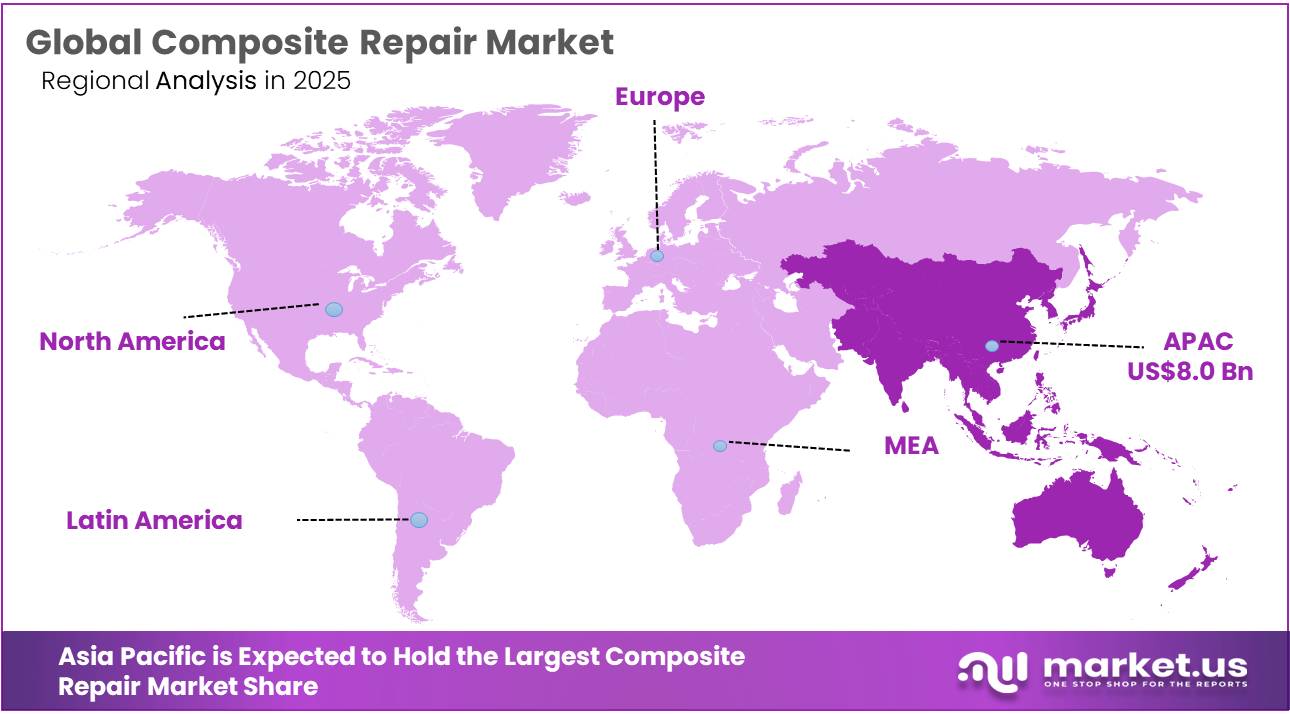
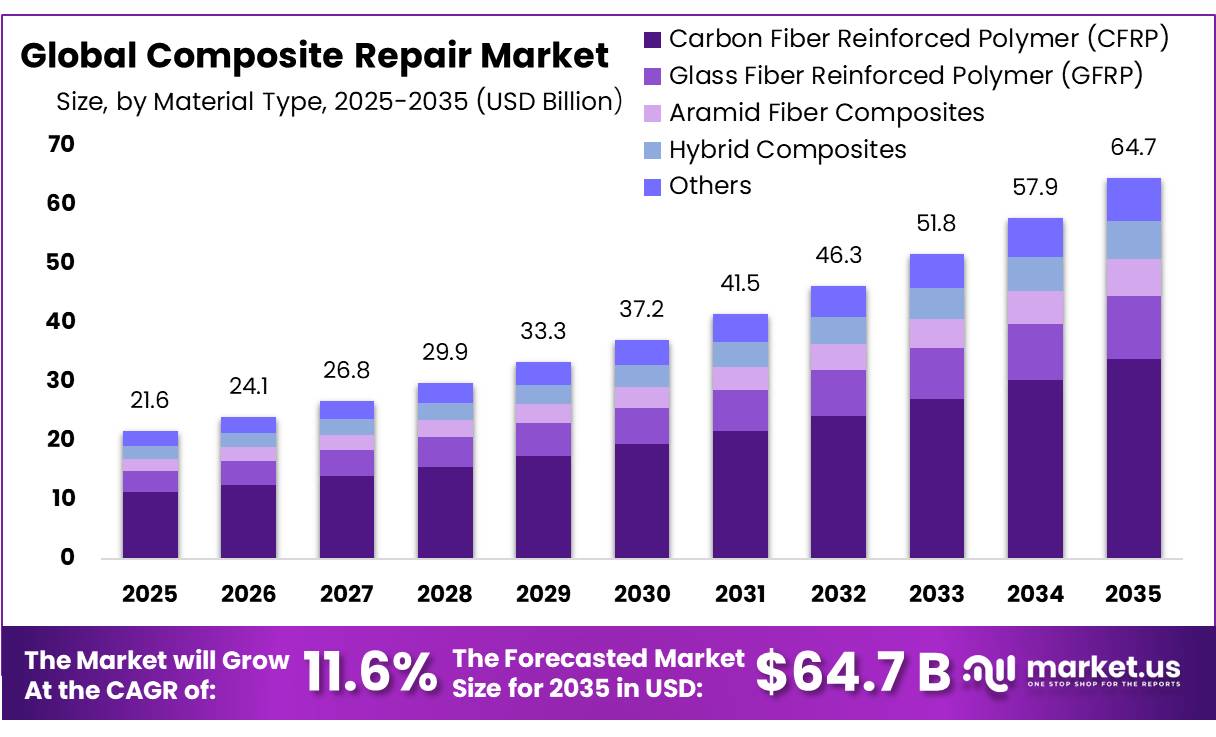
In 2025, the Global Composite Repair Market was valued at USD 21.6 billion, and between 2026 and 2035, this market is estimated to register a CAGR of 11.6%, reaching about USD 64.7 billion by 2035. In 2025, North America held a dominant market position, capturing more than a 32.4% share, holding USD 8.0 Billion revenue.
Composite repair involves restoring damaged carbon-fiber, glass-fiber, aramid, or hybrid composite structures using prepregs, resin systems, adhesives, fabrics, patches, and curing equipment. The technology is increasingly important in aerospace, wind energy, pipelines, marine structures, transportation, and civil infrastructure because it can extend asset life without replacing an entire component.
- Hexcel’s HexPly® M20 aerospace repair prepreg cures at 130°C (265°F) and is qualified across multiple aircraft OEM applications, supporting standardized fleet-repair operations.
Aerospace remains one of the most demanding application areas. Airbus delivered 793 commercial aircraft to 91 customers in 2025, increasing deliveries by 4%, while its year-end commercial aircraft backlog reached 8,754 units. This expanding installed fleet increases future inspection, maintenance, and structural-repair requirements, particularly as carbon-fiber-intensive aircraft remain in service for decades.
- Government aviation programs are also supporting repair technology development. The U.S. Federal Aviation Administration’s FY2025 research program included the final year of an ongoing 5-year activity evaluating fatigue, damage tolerance, bonded composite structures, and associated maintenance practices. The work is intended to improve validated procedures for composite repairs and strengthen safety across aircraft maintenance operations.
Wind energy provides another large repair opportunity because turbine blades face erosion, lightning strikes, surface damage, and fatigue during long operating periods. Europe installed 19.1 GW of new wind capacity in 2025, bringing total installed capacity to 304 GW. WindEurope expects another 151 GW to be installed during 2026–2030. A larger turbine fleet creates continuous requirements for blade inspection, structural reinforcement, adhesive repair, and erosion protection.
Infrastructure rehabilitation also creates room for composite strengthening systems. The U.S. Federal Highway Administration recorded 624,193 bridges in its 2025 inventory, including 41,685 classified in poor condition and 62,441 posted for load restrictions. Fiber-reinforced polymer wraps, laminates, and bonded reinforcement can provide lightweight alternatives for strengthening selected concrete and steel structures without major reconstruction.
Key Takeaways
- The global composite repair market was valued at USD 21.6 billion in 2025.
- The global market is projected to grow at a CAGR of 11.6% and is estimated to reach USD 64.7 billion by 2035.
- On the basis of material types, steel roofing dominated the market, constituting 55.6% of the total market share.
- Based on the product type, panels dominated the Composite Repair market, with a substantial market share of around 45.6%.
- Based on the installation type, new construction led the market, comprising 65.7% of the total market.
- Among the applications, residential uses held a major share in the Composite Repair market, 40.5% of the market share.
- In 2025, North America was the most dominant region in the Composite Repair market, accounting for 32.4% of the total global consumption.
Material Types Analysis
Carbon Fiber Reinforced Polymer (CFRP) is a Prominent Segment in the Market.
Carbon fiber reinforced polymer (CFRP) holds the dominant position in the composite repair market, accounting for 52.3% of material usage. CFRP’s high strength-to-weight ratio, superior stiffness, and resistance to fatigue make it the preferred choice in aerospace, automotive, and wind energy applications. Commercial aircraft such as the Boeing 787 and Airbus A350 incorporate significant amounts of CFRP in primary structures, driving the need for specialized repair solutions to maintain safety and performance.
In automotive applications, CFRP is increasingly used in lightweight components to enhance fuel efficiency and meet regulatory standards. The repair of CFRP structures requires precise techniques such as autoclave curing, vacuum infusion, and hand lay-up, along with trained personnel to ensure structural integrity. Its widespread adoption and critical role in high-performance applications underpin CFRP’s dominance in the composite repair market.
Product Type Analysis
Structural Composite Repair Dominated the Market.
Structural components represent the largest segment in the composite repair market, accounting for 42.4% of product usage. These components, which include aircraft fuselages, wind turbine blades, automotive chassis, and critical marine hull sections, are subject to high mechanical stresses and environmental loads, making reliable repair solutions essential. Maintaining the integrity of structural composites is crucial to ensure safety, longevity, and operational performance.
Repairs often involve advanced techniques such as autoclave curing, vacuum infusion, and precise adhesive bonding to restore the original strength and stiffness. The emphasis on structural repair is particularly prominent in aerospace and renewable energy sectors, where component failure can lead to significant operational disruptions. The criticality of these applications and the complexity of the repair processes reinforce the segment’s dominance within the composite repair market.
Repair Process Analysis
Hand Lay-up Held a Major Share of the Composite Repair Market.
Hand lay-up is the dominant repair process in the composite repair market, accounting for 36.7% of usage. This technique is widely employed due to its flexibility, cost-effectiveness, and adaptability across various composite materials, including CFRP, GFRP, and hybrid laminates. Hand lay-up is particularly suitable for on-site repairs of structural and semi-structural components in aerospace, automotive, marine, and wind energy applications, where precision and customization are critical.
The process involves manually placing resin-impregnated fibers onto damaged areas, followed by controlled curing to restore mechanical integrity. Its simplicity, minimal equipment requirements, and ability to address complex geometries make hand lay-up a preferred choice for both routine maintenance and emergency repair scenarios. Consequently, it maintains a leading position in composite repair workflows.
End-user Industry Analysis
Composite Repair is Widely Utilized in the Aerospace & Defense Sector.
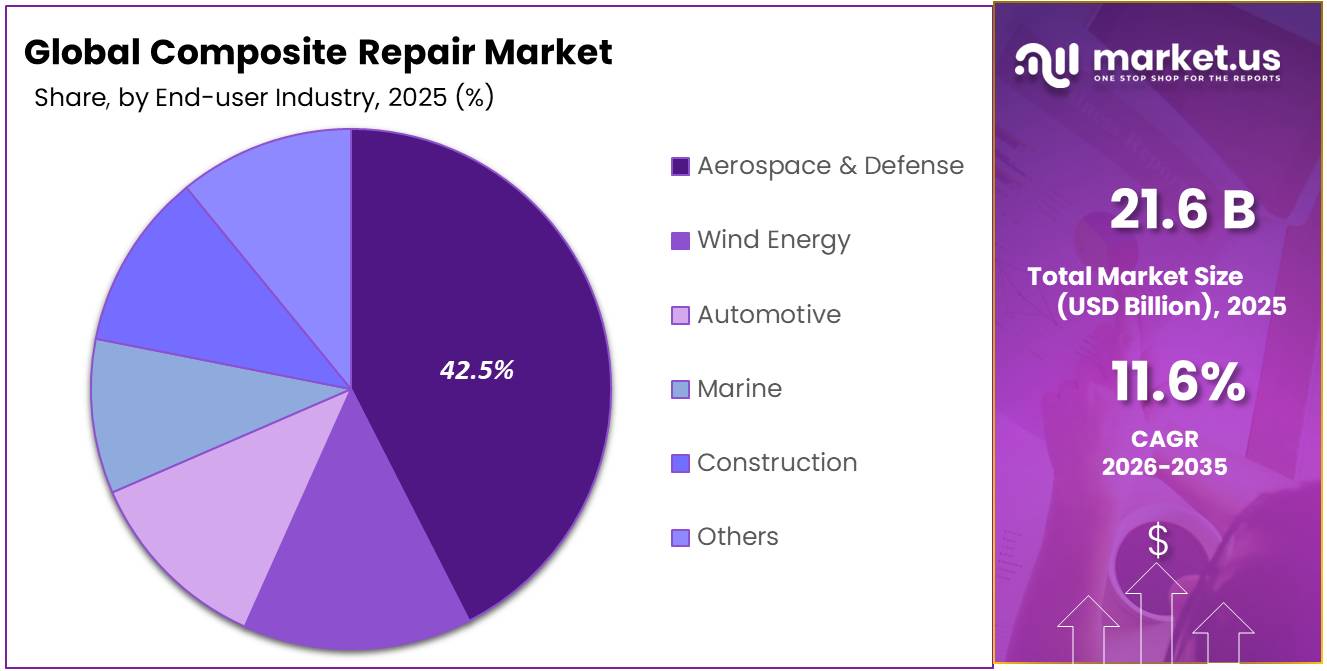
Aerospace & defense is the leading end-user segment in the composite repair market, accounting for 42.5% of usage. The sector’s extensive adoption of advanced composites, particularly CFRP, in aircraft fuselages, wings, and military platforms drives significant demand for specialized repair solutions. High structural performance requirements, stringent safety standards, and regulatory compliance necessitate precise repair techniques, including autoclave curing, vacuum infusion, and hand lay-up, often performed by certified technicians.
Additionally, defense applications require maintenance of critical assets under operational stress and harsh environmental conditions, further emphasizing the importance of reliable composite repair. The combination of large-scale fleet operations, frequent maintenance cycles, and complex component geometries solidifies aerospace and defense as the dominant driver of demand in the composite repair market.
Key Market Segments
By Material Type
- Carbon Fiber Reinforced Polymer (CFRP)
- Glass Fiber Reinforced Polymer (GFRP)
- Aramid Fiber Composites
- Hybrid Composites
- Others
By Product Type
- Structural
- Semi-structural
- Cosmetic
By Repair Process
- Hand Lay-up
- Vacuum Infusion
- Autoclave
- Others
By End-user Industry
- Aerospace & Defense
- Wind Energy
- Automotive
- Marine
- Construction
- Others