


Report Overview
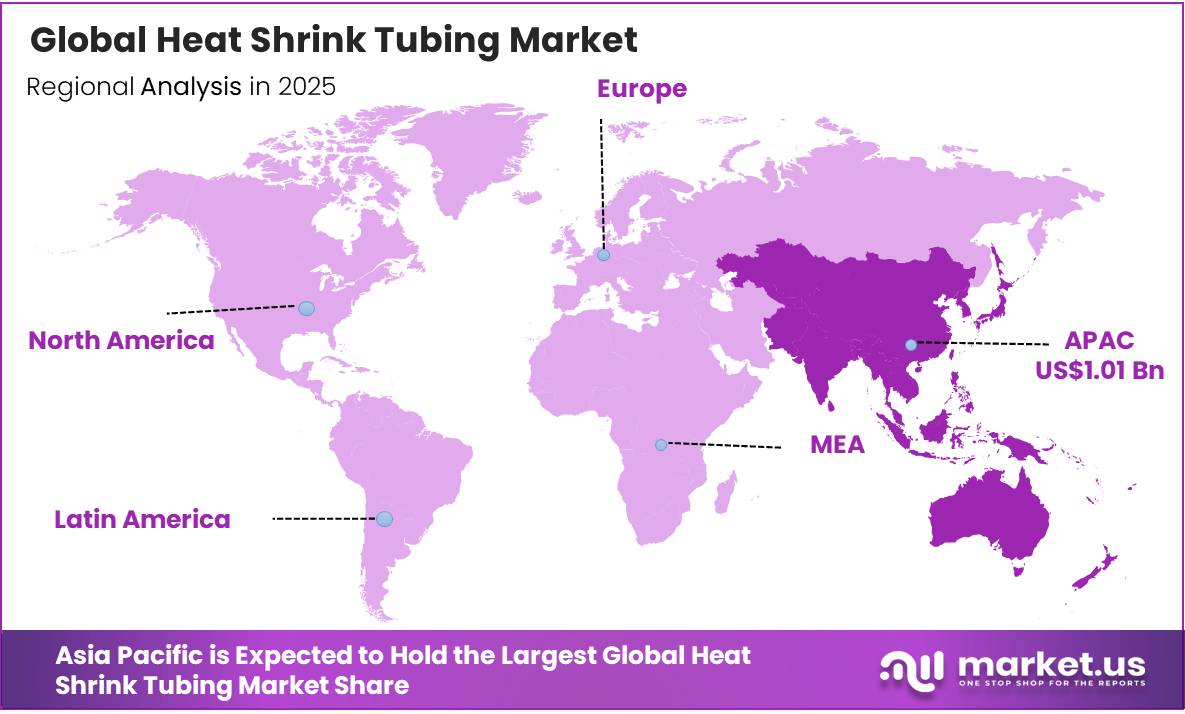
In 2025, the Global Heat Shrink Tubing Market was valued at USD 23.6 billion, and between 2026 and 2035, this market is estimated to register a CAGR of 6.4%, reaching about USD 44.1 billion by 2035. In 2025, Asia Pacific held a dominant market position, capturing more than a 38.7% share, holding USD 1.01 Billion revenue.
Heat shrink tubing has become an essential component across multiple industrial and technological applications due to its ability to provide electrical insulation, mechanical protection, and environmental resistance. Its adoption is strongly influenced by the rising complexity of wiring systems in electric vehicles, aerospace, and consumer electronics, where dense assemblies require durable insulation solutions capable of withstanding thermal, chemical, and mechanical stress.
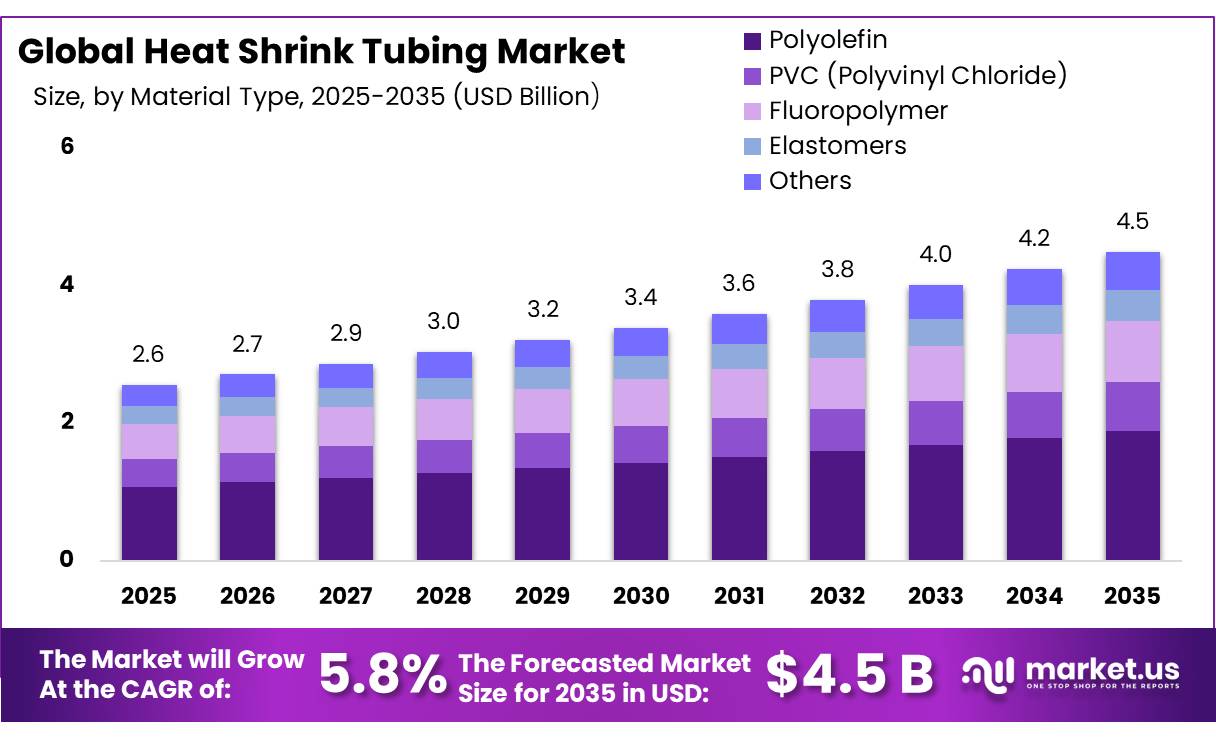
Material innovations, including high-performance polyolefins, fluoropolymers, and elastomers, enable use in extreme environments and specialized applications, such as renewable energy systems and smart infrastructure projects. Supply chain dynamics, including volatility in raw material prices and geopolitical disruptions affecting petrochemical feedstocks, directly impact production planning and operational continuity.
Regionally, the Asia Pacific represents a significant hub, driven by large-scale EV manufacturing, electronics production, and infrastructure modernization initiatives. These factors illustrate a market shaped by technological complexity, material advancement, and regional industrial activity, emphasizing the critical role of heat shrink tubing in ensuring safety, reliability, and efficiency.
Key Takeaways
- The global Heat Shrink Tubing market was valued at USD 23.6 billion in 2025.
- The global market is projected to grow at a CAGR of 6.4% and is estimated to reach USD 44.1 billion by 2035.
- On the basis of material types, polyolefin tubing dominated the market, constituting 42.3% of the total market share.
- Based on the shrink ratio, tubing with a 2:1 shrink ratio dominated the heat shrink tubing market, with a substantial market share of around 40.5%.
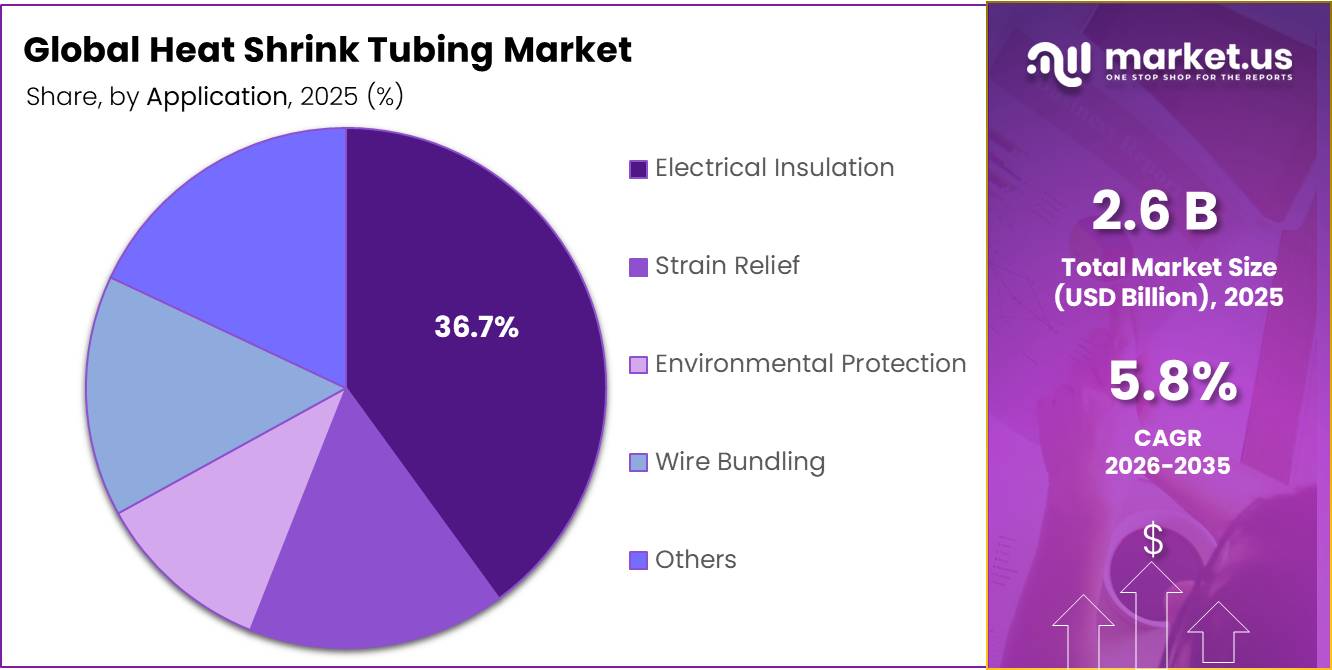
- Based on the applications, electrical insulation led the market, comprising 36.7% of the total market.
- Among the end-use industries, the electrical & electronics sector held a major share in the heat shrink tubing market, 35.4% of the market share.
- In 2025, the Asia Pacific was the most dominant region in the heat shrink tubing market, accounting for 38.7% of the total global consumption.
Material Type Analysis
Polyolefin Tubing is a Prominent Segment in the Market.
Polyolefin represents the largest segment in the heat shrink tubing market, accounting for 42.3% of material usage. Its dominance is driven by a combination of versatility, cost-effectiveness, and reliable performance across a wide range of applications.
Polyolefin tubing offers excellent electrical insulation, mechanical protection, and chemical resistance, making it suitable for automotive wiring harnesses, consumer electronics, and industrial cabling. Its ability to accommodate various shrink ratios, coupled with ease of installation and flexibility in complex assemblies, reinforces its widespread adoption.
Furthermore, advancements in cross-linking technology have enhanced thermal stability and dimensional recovery, enabling polyolefin tubing to perform effectively under high-temperature and high-stress conditions. The balance of affordability and functional performance positions polyolefin as the preferred choice among manufacturers and end-users, underpinning its sustained prominence in the global heat shrink tubing market.
Shrink Ratio Analysis
Tubing with a 2:1 Shrink Ratio Dominated the Heat Shrink Tubing Market.
The 2:1 shrink ratio segment holds the largest share in the heat shrink tubing market, accounting for 40.5% of usage. Its prevalence is attributed to its versatility and suitability for a wide range of standard applications, including electrical insulation, wire bundling, and strain relief. The 2:1 ratio allows tubing to effectively conform to varied cable diameters while maintaining consistent insulation and mechanical protection, making it ideal for both industrial and consumer electronics assemblies.
In addition, its ease of installation, combined with reliable shrink performance under moderate thermal and mechanical stress, contributes to widespread adoption. Additionally, the balance between cost-efficiency and functional reliability ensures that 2:1 shrink ratio tubing meets the performance requirements of automotive, aerospace, and telecommunication sectors, reinforcing its position as the preferred choice among end-users and manufacturers.
Application Analysis
Electrical Insulation Held a Major Share of the Heat Shrink Tubing Market.
Electrical insulation represents the largest application segment in the heat shrink tubing market, accounting for 36.7% of usage. This dominance is driven by the critical role of tubing in safeguarding wires and cables against short circuits, electrical leakage, and mechanical abrasion. Heat shrink tubing provides reliable dielectric strength and conforms tightly to conductors, ensuring consistent insulation even in complex or compact assemblies.
Its application spans diverse industries, including automotive, aerospace, telecommunications, and consumer electronics, where electrical safety and system integrity are paramount. As electrical systems become increasingly sophisticated and miniaturized, heat shrink tubing continues to serve as a preferred solution for maintaining safe and efficient electrical connectivity across industrial and commercial applications.
End-Use Industry Analysis
Heat Shrink Tubing is Widely Utilized for Electrical & Electronics Applications.
The electrical and electronics sector accounts for the largest share in the heat shrink tubing market, representing 35.4% of end-use applications. The segment’s prominence is driven by the increasing complexity and miniaturization of electronic devices, which require reliable insulation, strain relief, and protection for intricate wiring assemblies. Heat shrink tubing is widely utilized in circuit boards, connectors, sensors, and consumer electronic devices to ensure electrical safety, prevent short circuits, and enhance mechanical stability.
Its adaptability across various shrink ratios and materials enables precise application in compact and high-density systems. Additionally, compliance with regulatory standards for electrical safety and environmental resistance further reinforces its adoption in this sector. The combination of functional versatility, durability, and performance reliability positions the electrical and electronics industry as the leading driver of heat shrink tubing utilization globally.
Key Market Segments
By Material Type
- Polyolefin
- PVC (Polyvinyl Chloride)
- Fluoropolymer
- Elastomers
- Others
By Shrink Ratio
- 2:1 Shrink Ratio
- 3:1 Shrink Ratio
- 4:1 Shrink Ratio
- 6:1 and Above
By Application
- Electrical Insulation
- Strain Relief
- Environmental Protection
- Wire Bundling
- Others
By End-Use Industry
- Electrical & Electronics
- Automotive
- Aerospace & Defense
- Telecommunications
- Oil & Gas
- Healthcare
- Construction & Industrial
- Others
Driver Analysis
EV High-Voltage Harness Growth
Global electric-car sales exceeded 20 million units in 2025, representing about 25% of all new-car sales and a 20% increase from 2024, while the IEA expects sales to reach around 23 million in 2026, or approximately 28% of the global light-vehicle market.
The value shift is more significant than the unit-volume effect: automotive manufacturers are moving away from basic polyolefin tubing toward cross-linked polyolefin, PVDF, PTFE, FEP, and specialty elastomer systems rated for 125–200°C, 600–1,000 V dielectric conditions, fluid resistance, and multi-year thermal cycling.
This pushes tubing suppliers toward automotive qualification cycles of 12–24 months, IATF 16949 production systems, PPAP documentation, automated cut-and-shrink processing, and local supply agreements, producing an estimated +2.4 percentage-point CAGR contribution across China, Europe, North America, India, Japan, and South Korea.
Drivers Impact Analysis
| Driver(~) | % Impact on CAGR Forecast | Geographic Relevance | Impact Timeline |
|---|---|---|---|
| EV high-voltage harness growth | +2.4% | China, EU, North America, India | Short term (≤ 2 years) |
| Grid upgrade cable protection | +1.9% | North America, EU, India, APAC | Medium term (2-4 years) |
| Renewable interconnection buildout | +1.6% | China, EU, U.S., India, MENA | Medium to long term |
| Fire-safe low-smoke materials | +1.3% | EU, UK, North America, GCC | Short term (≤ 2 years) |
| Data-center power density | +1.2% | U.S., EU, India, Singapore | Short term (≤ 2 years) |
| Aerospace and defense wiring | +0.9% | U.S., EU, India, Japan, Korea | Medium term (2-4 years) |
Restraint Analysis
Resin Cost Volatility
A 15% increase in cross-linked polyolefin resin cost can raise the cash manufacturing cost of a standard 2:1 tubing product by approximately 7–10%, while a 20% increase in fluoropolymer feedstock pricing can lift the conversion cost of PVDF, PTFE, FEP, or ETFE tubing by 10–16% because material content is higher and scrap from extrusion, irradiation, and post-shrink dimensional rejection is more expensive to recover.
Commodity tubing sellers often operate with only 10–18% gross margins and 30–90-day customer price contracts, meaning a two-quarter resin spike can absorb 300–700 basis points of margin before surcharges are accepted; this causes smaller manufacturers to defer inventory purchases, reduce SKU availability, or substitute lower-performance compounds.
The restraint is strongest in China, India, Southeast Asia, Europe, and North America, where manufacturers must manage 30–60-day resin inventory, 4–10-week purchase-to-delivery cycles, and variable freight costs, producing an estimated -1.8 percentage-point deduction from baseline CAGR until procurement becomes more index-linked and specialty-grade suppliers improve pass-through mechanisms.
Restraint Impact Analysis
| Restraint(~) | % Impact on CAGR Forecast | Geographic Relevance | Impact Timeline |
|---|---|---|---|
| Resin cost volatility | -1.8% | Global, APAC supply hubs | Short term (≤ 2 years) |
| PFAS material uncertainty | -1.5% | EU core, UK, North America | Medium term (2-4 years) |
| Tariff-led import inflation | -1.3% | U.S. core, North America | Short term (≤ 2 years) |
| Long OEM qualification cycles | -1.2% | Global automotive, aerospace | Medium term (2-4 years) |
| Fire-test compliance costs | -1.0% | EU, UK, North America, GCC | Short term (≤ 2 years) |
| Commodity price competition | -0.9% | China, India, ASEAN, Latin America | Medium term (2-4 years) |
Opportunity Analysis
High-Voltage EV Protection
The highest-value future opportunity is to move beyond conventional wire bundling into integrated high-voltage protection systems for 400 V, 800 V, and emerging 1,000 V-plus EV architectures, because baseline tubing demand captures only basic harness growth while the unpenetrated value pool lies in functional-safety-qualified sleeves, busbar insulation, battery-pack sealing, orange identification systems, EV charging-cable protection, inverter connections, and repairable service kits.
High-voltage heat shrink products rated from 600 V to 1,000 V and above must retain dielectric integrity through thousands of thermal cycles, moisture exposure, abrasion, vibration, road-salt contact, and coolant or electrolyte contamination, while 800 V vehicle designs raise clearance, creepage, temperature, and insulation requirements compared with earlier 400 V platforms.
Global EV sales exceeded 20 million in 2025 and are projected to approach 23 million in 2026, but suppliers can generate materially higher content per vehicle by targeting 15–30 meters of specialty tubing and molded shrink components per battery-electric vehicle rather than competing for low-cost low-voltage harness sleeves.
A premium high-voltage tube, dual-wall adhesive-lined sleeve, or molded breakout can realize 2–6 times the unit price of standard 2:1 polyolefin tubing, while a high-voltage system package can increase supplier content per EV from roughly $8–15 for basic tubing toward $25–50 where safety-rated protection, labeling, fluid sealing, and automated application tooling are bundled.
This is an opportunity rather than a current driver because it requires dedicated 800 V qualification, OEM and Tier-1 PPAP approval, IATF 16949 process control, validated orange pigmentation, 125–150°C thermal performance, and in-region production; successful positioning could add an estimated +2.3 percentage points to CAGR across China, Europe, North America, India, Japan, and South Korea.
Opportunity Impact Analysis
| Opportunity(~) | % Potential CAGR Upside | Geographic Relevance | Execution Window |
|---|---|---|---|
| High-voltage EV protection | +2.3% | China, EU, North America, India | Short term (≤ 2 years) |
| PFAS-free specialty tubing | +1.9% | EU, UK, North America, Japan | Medium term (2-4 years) |
| Digital traceability sleeves | +1.6% | EU, UK, GCC, North America | Medium term (2-4 years) |
| Pre-engineered field-install kits | +1.5% | India, ASEAN, MENA, Latin America | Short to medium term |
| Circular polymer recovery | +1.2% | EU, North America, Japan, Korea | Long term (≥ 4 years) |
| M&A-led specialty platforms | +1.1% | North America, EU, APAC | Short to medium term |
Challenges Analysis
Cross-Linking Capacity Constraints
Heat shrink tubing production is constrained by the technically specialized, capital-intensive cross-linking stage that converts extruded thermoplastic tubing into shape-memory material, because electron-beam irradiation or chemical cross-linking must be precisely controlled before the tube is thermally expanded and cooled into its final recoverable form; the standard production sequence is extrusion, irradiation, and expansion, with radiation-based cross-linking commonly requiring a dose window of roughly 50–150 kGy depending on polymer chemistry, wall thickness, shrink ratio, and end-use requirements.
Underdosing can reduce thermal endurance, tensile retention, shrink recovery, and solvent resistance, while overdosing can embrittle the polymer, increase gel content, distort color, reduce elongation, and generate post-installation cracking; a 5–10% production-yield loss on high-value adhesive-lined or fluoropolymer tubing can consume 200–500 basis points of gross margin because resin, adhesive, irradiation, and extrusion cost are already embedded before final inspection.
Cross-linking capacity is geographically concentrated and not rapidly expandable, as electron-beam accelerators require high-voltage equipment, radiation shielding, dosimetry systems, throughput handling, specialized maintenance, regulatory permissions, and typically 12–24 months of installation and customer qualification, while outsourced irradiation adds transport, queue, and minimum-batch constraints.
Manufacturers must mitigate this -1.3 percentage-point CAGR friction through dual-site irradiation partnerships, inline dosimetry, production scheduling by wall thickness and dose requirement, captive accelerator investment above stable demand thresholds, and formulation development that widens the processing window without sacrificing UL, automotive, or high-voltage performance.
Challenges Impact Analysis
| Challenge(~) | % CAGR Friction | Geographic Relevance | Mitigation Horizon |
|---|---|---|---|
| Cross-linking capacity constraints | -1.3% | EU, North America, India, APAC | Medium term (2-4 years) |
| Specialty polymer formulation | -1.1% | EU, U.S., Japan, Korea, China | Medium term (2-4 years) |
| Multi-standard qualification burden | -1.0% | Global automotive, aerospace, grid | Long term (≥ 4 years) |
| Traceability data readiness | -0.8% | EU, UK, North America, GCC | Medium term (2-4 years) |
| Field-installation variability | -0.8% | India, ASEAN, MENA, Latin America | Medium term (2-4 years) |
| Technical workforce scarcity | -0.7% | Global manufacturing hubs | Long term (≥ 4 years) |
Geopolitical Impact Analysis
Geopolitical Disruptions and Their Influence on Heat Shrink Tubing Supply Chains.
Recent geopolitical tensions have influenced supply chains and material availability relevant to the heat shrink tubing industry. The U.S. Department of Energy reported that the global supply of petrochemical feedstocks, including ethylene and propylene used in polyolefin production, experienced disruptions in 2022 due to sanctions on key exporting nations and associated trade restrictions.
The U.S. International Trade Administration (ITA) documented that import volumes of PVC and other specialty polymers from sanctioned regions decreased in early 2022, leading to constrained raw material availability for industrial applications. The high-performance fluoropolymers, which rely on PTFE intermediates, are often sourced from regions affected by export controls and faced extended lead times and logistical delays.
Additionally, the energy-intensive polymer production in Europe and Asia encountered cost escalations due to rising natural gas prices driven by geopolitical conflicts. These developments collectively illustrate that international tensions are directly affecting the procurement, scheduling, and operational planning of heat shrink tubing production and deployment across multiple industrial sectors.
Regional Analysis
Asia Pacific Held the Largest Share of the Global Heat Shrink Tubing Market.
In 2025, the Asia Pacific dominated the global heat shrink tubing market, holding about 38.7% of the total global consumption. Asia Pacific hosts extensive manufacturing and industrial activity, contributing to its position as the largest market for heat shrink tubing.
- The International Energy Agency reported that China sold over 11 million electric vehicles in 2024, the highest globally, requiring extensive wiring harnesses protected by heat shrink tubing for insulation, strain relief, and thermal management.
Similarly, India’s Ministry of Power indicated that grid modernization projects, including the installation of smart meters and advanced transmission lines, involve miles of insulated cabling, where heat shrink solutions are critical to ensuring durability and environmental protection. Japan’s Ministry of Economy, Trade and Industry highlights the country’s focus on miniaturized electronics, robotics, and high-performance automotive components, all of which rely on compact, high-durability wiring assemblies.
Additionally, South Korea’s Ministry of Trade, Industry, and Energy notes the increasing deployment of renewable energy systems, including solar and wind, which utilize heat shrink tubing for outdoor and high-voltage electrical insulation. These developments collectively underscore the region’s concentration of applications driving consistent demand for protective tubing solutions.
Key Regions and Countries
- North America
- The US
- Canada
- Europe
- Germany
- France
- The UK
- Spain
- Italy
- Russia & CIS
- Rest of Europe
- APAC
- China
- Japan
- South Korea
- India
- ASEAN
- Rest of APAC
- Latin America
- Brazil
- Mexico
- Rest of Latin America
- Middle East & Africa
- GCC
- South Africa
- Rest of MEA
Key Players Analysis
Manufacturers of heat shrink tubing focus on enhancing product performance and broadening application capabilities to strengthen their competitive position. This includes developing high-performance materials such as fluoropolymers, elastomers, and specialized polyolefins with superior thermal, chemical, and environmental resistance for demanding industries such as aerospace, automotive, and renewable energy.
Companies further invest in expanding regional production capacities, particularly in the Asia Pacific, to ensure timely supply and meet local regulatory requirements. Strategic collaborations with automotive, electronics, and infrastructure manufacturers facilitate customized solutions tailored to specific wiring, insulation, or environmental protection needs.
The Major Players in The Industry
- TE Connectivity
- 3M Company
- Sumitomo Electric Industries
- HellermannTyton
- Panduit Corporation
- Alpha Wire
- Zeus Company
- Parker Hannifin
- DSG-Canusa
- Molex
- ABB (Thomas & Betts)
- Amphenol Corporation
- Littelfuse Inc.
- Qualtek Electronics
- Insultab Inc.
- Junkosha
- Other Key Players
Key Development
- In September 2025, Junkosha launched new optically clear, peelable heat-shrink tubing (PHST) for catheters, designed to improve visual inspection during laser-welding processes.
Report Scope
| Report Features | Description |
|---|---|
| Market Value (2025) | US$2.6 Bn |
| Forecast Revenue (2035) | US$4.5 Bn |
| CAGR (2026-2035) | 5.8% |
| Base Year for Estimation | 2025 |
| Historic Period | 2020-2024 |
| Forecast Period | 2026-2035 |
| Report Coverage | Revenue Forecast, Market Dynamics, Competitive Landscape, Recent Developments |
| Segments Covered | By Material Type (Polyolefin, PVC (Polyvinyl Chloride), Fluoropolymer, Elastomers, and Others), By Shrink Ratio (2:1 Shrink Ratio, 3:1 Shrink Ratio, 4:1 Shrink Ratio, and 6:1 and Above), By Application (Electrical Insulation, Strain Relief, Environmental Protection, Wire Bundling, and Others), By End-Use Industry (Electrical & Electronics, Automotive, Aerospace & Defense, Telecommunications, Oil & Gas, Healthcare, Construction & Industrial, and Others) |
| Regional Analysis | North America – The US & Canada; Europe – Germany, France, The UK, Spain, Italy, Russia & CIS, Rest of Europe; APAC– China, Japan, South Korea, India, ASEAN & Rest of APAC; Latin America– Brazil, Mexico & Rest of Latin America; Middle East & Africa– GCC, South Africa, & Rest of MEA |
| Competitive Landscape | TE Connectivity, 3M Company, Sumitomo Electric Industries, HellermannTyton, Panduit Corporation, Alpha Wire, Zeus Company, Parker Hannifin, DSG-Canusa, Molex, ABB (Thomas & Betts), Amphenol Corporation, Littelfuse Inc., Qualtek Electronics, Insultab Inc., Junkosha, and Other Players. |
| Customization Scope | Customization for segments, region/country-level will be provided. Moreover, additional customization can be done based on the requirements. |
| Purchase Options | We have three licenses to opt for: Single User License, Multi-User License (Up to 5 Users), Corporate Use License (Unlimited Users and Printable PDF) |





































