


Report Overview
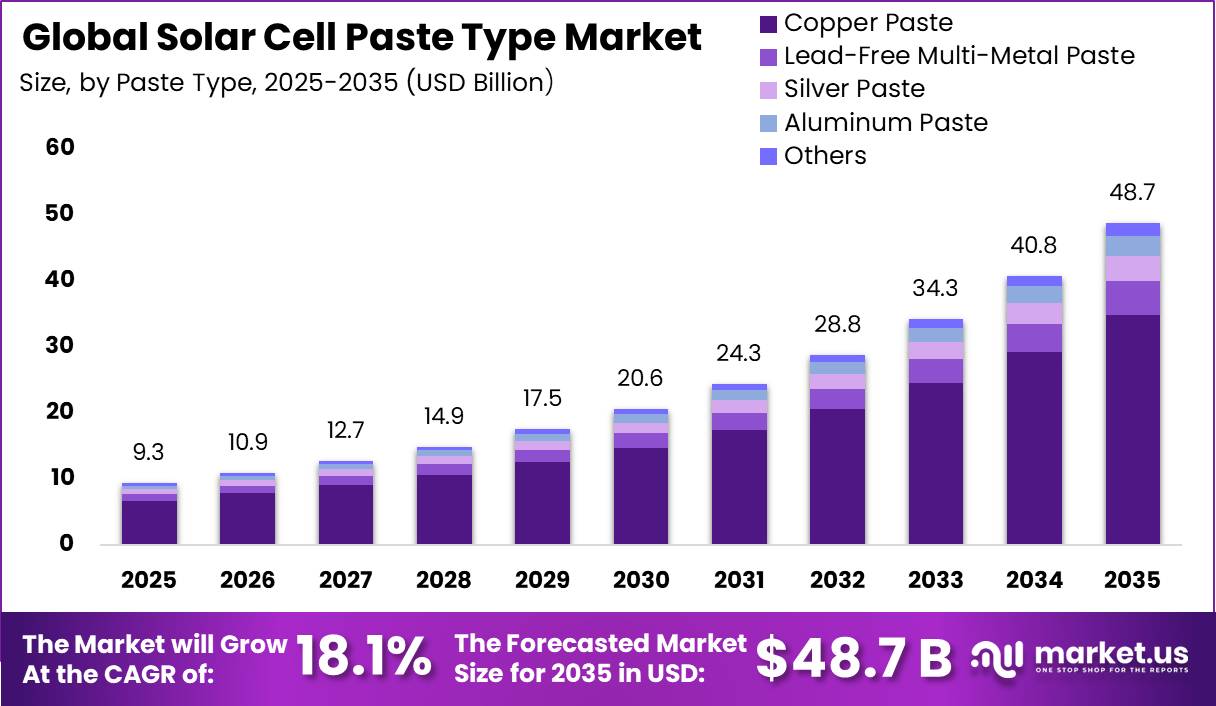
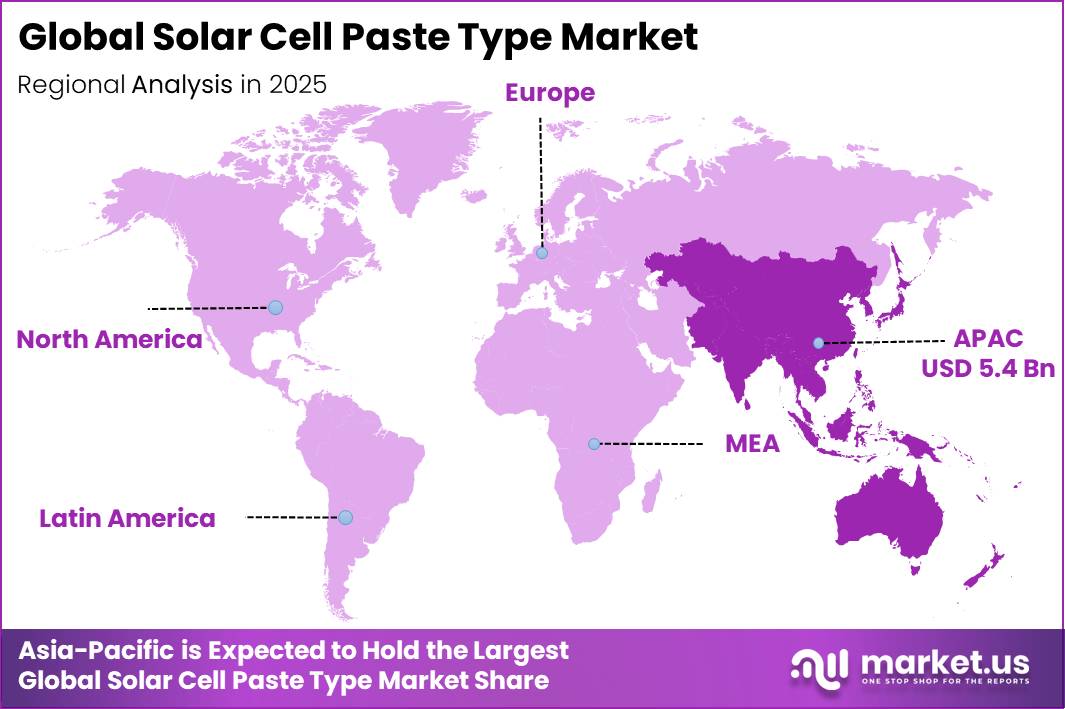
In 2025, the Global Solar Cell Paste Market was valued at USD 9.3 billion, and between 2026 and 2035, this market is estimated to register a CAGR of 18.1%, reaching about USD 48.7 billion by 2035. In 2025, Asia-Pacific led the market, achieving over 57.7% share with a revenue of USD 5.4 billion.
The solar cell paste type industry forms a critical input in photovoltaic manufacturing. Conductive pastes are screen-printed onto solar cells to create electrical contacts that collect and transfer current. Silver paste remains widely used because of its conductivity and reliable contact formation, while aluminum paste is used for rear contacts in conventional silicon cells. Silver-aluminum, silver-copper, low-temperature silver, and emerging copper formulations are gaining importance as producer’s balance efficiency, firing temperature, adhesion, line width, and material cost.
- The industrial environment is supported by unprecedented photovoltaic deployment. IRENA reported that total renewable power capacity reached 5,149 GW in 2025 after 692 GW of additions, representing annual growth of 15.5% and 85.6% of total power-capacity expansion.
Key Takeaways
- The Global Solar Cell Paste Market was valued at US$9.3 billion in 2025.
- The market is projected to grow at a CAGR of 18.1% and is estimated to reach US$48.7 billion by 2035.
- On the basis of paste type, Copper Paste dominated the market, constituting 71.5% of the total market share.
- Based on the application, Monocrystalline Cells dominated the market, with a substantial market share of around 58.5%.
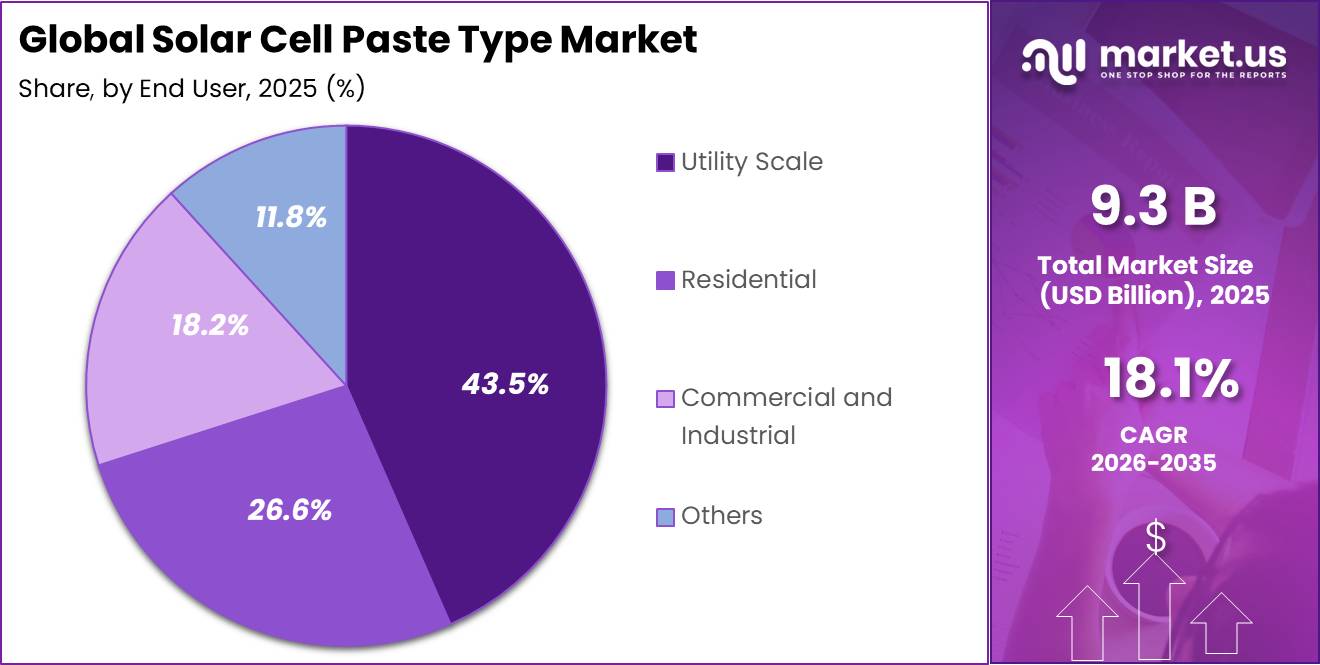
- Based on the end user, Utility Scale led the market, comprising 43.5% of the total market.
- In 2025, Asia-Pacific was the most dominant region in the market, accounting for over 57.7% of the total global consumption.
Material availability and cost are reshaping product development. The Silver Institute reported that industrial silver demand rose 4% to a record 680.5 million ounces in 2024, while the global silver market recorded a 148.9-million-ounce deficit. This pressure is encouraging thinner printed fingers, multi-busbar designs, improved rheology, and partial substitution with copper.
- In April 2025, Fraunhofer ISE produced silicon heterojunction cells using only 1.4 milligrams of silver per watt through silver-copper paste on the front and copper paste on the rear, below the 2-milligram-per-watt level considered suitable for long-term multi-terawatt production.
Government-supported manufacturing programs are reinforcing commercialization. The U.S. Department of Energy’s FY2025–27 laboratory program includes development of silver-free, screen-printable copper metallization for TOPCon cells. In Europe, the Net-Zero Industry Act targets domestic manufacturing capacity equal to at least 40% of annual deployment needs for strategic technologies by 2030. These measures support localized paste production, qualification testing, and collaboration among chemical suppliers, equipment makers, and cell producers.
Future growth is expected to center on fine-line pastes, low-temperature formulations for heterojunction cells, copper-based systems, and pastes compatible with tandem and back-contact architectures. Suppliers that can reduce precious-metal intensity without sacrificing contact resistance, adhesion, reliability, or production speed are likely to gain stronger positions as photovoltaic manufacturing moves toward terawatt-scale output.
Paste Type Analysis
Copper Paste dominates with a 71.5% share due to its cost efficiency and reliable electrical performance.
In 2025, Copper Paste held a dominant market position, capturing more than a 71.5% share of the Solar Cell Paste Type Market. Its strong position was supported by manufacturers’ efforts to reduce dependence on expensive silver while maintaining efficient electrical contact inside solar cells. Copper paste is suitable for screen-printing processes and offers the conductivity required for advanced silicon cells.
- In April 2025, Germany’s Fraunhofer Institute for Solar Energy Systems produced silicon heterojunction cells using silver-copper paste on the front and pure copper paste on the rear, reducing silver consumption to 1.4 milligrams per watt peak. This technical progress strengthened the commercial potential of copper-based pastes in large-scale solar cell production.
Lead-Free Multi-Metal Paste is the fastest-growing segment in the Solar Cell Paste Type Market. Its growth is supported by increasing demand for paste formulations that combine different conductive metals while reducing the use of conventional materials with environmental or supply concerns. These pastes can support good adhesion, stable electrical contact and compatibility with advanced solar cell structures.
Application Analysis
Monocrystalline Cells dominate with a 58.5% share due to their higher efficiency and strong use in modern solar modules.
In 2025, Monocrystalline Cells held a dominant market position, capturing more than a 58.5% share of the Solar Cell Paste Type Market by application. Their leading position was supported by the growing production of high-efficiency solar modules for rooftop, commercial, and utility-scale projects. These cells require well-designed conductive pastes to form reliable electrical contacts, reduce resistance, and collect electricity efficiently. The U.S. Department of Energy identifies monocrystalline silicon as the most commonly manufactured silicon-cell structure and notes that electrical contacts are added during cell production to carry the generated electricity.
- In March 2026, according to the U.S. Energy Information Administration, utility-scale solar plants generated 296,000 GWh of electricity in 2025, representing a 34% increase from 2024. This strong growth supports higher production of efficient monocrystalline cells and the conductive pastes required to create reliable electrical contacts.
Polycrystalline Cells are the fastest-growing segment in the Solar Cell Paste Type Market by application. Their growth is supported by continued demand from solar-panel producers seeking practical cell designs that can be manufactured through established production and screen-printing lines. Conductive paste remains important in these cells because it creates the electrical pathways needed to collect and transfer the current generated by the silicon surface.
End User Analysis
Utility Scale dominates with a 43.5% share as large solar projects require high volumes of conductive paste.
In 2025, Utility Scale held a dominant market position, capturing more than a 43.5% share of the Solar Cell Paste Type Market. Large solar power plants use millions of photovoltaic cells, creating substantial demand for silver, copper, and other conductive pastes used in cell electrodes. Utility developers also favour high-efficiency solar cells because even small improvements in electricity conversion can raise the total output of a large project.
- According to the Federal Energy Regulatory Commission’s March 2026 report, utility-scale solar projects represented 787 GW of capacity in U.S. generator interconnection queues at the end of 2025, accounting for 37% of the total queued capacity and making solar the largest individual resource category. This strong project pipeline supports continued paste consumption by large solar installations.
Residential is the fastest-growing segment of the Solar Cell Paste Type Market. In 2025, growth was supported by wider rooftop solar use, rising household interest in controlling electricity expenses, and increasing demand for high-output panels suited to limited roof space. Solar cell paste plays an important role in residential modules by supporting efficient current collection, stable electrical connections, and reliable panel performance over a long operating period.
Key Market Segments
By Paste Type
- Copper Paste
- Lead-Free Multi-Metal Paste
- Silver Paste
- Aluminum Paste
- Others
By Application
- Monocrystalline Cells
- Polycrystalline Cells
- Thin-Film Cells
- Heterojunction Cells
- Others
By End User
- Utility Scale
- Residential
- Commercial and Industrial
- Others
Driver Analysis
EU resilience funding and NZIA-linked solar manufacturing support.
Europe’s policy framework is creating a smaller but strategically important premium market for specialized paste types tied to resilient local manufacturing. The European Solar Charter, signed in April 2024, was designed specifically to reinforce the competitiveness and resilience of the EU solar value chain, and the Commission states that the NZIA seeks manufacturing capacity sufficient to meet up to 40% of annual deployment needs by 2030.
Financial support is no longer symbolic: the Commission reports €3.8 billion in clean-tech manufacturing budget across Innovation Fund topics for 2022–2025, €445 million already funded for solar PV manufacturing, a further €1 billion earmarked for clean-tech manufacturing in the December 2025 Net-Zero Technologies Call, and around €600 million planned under Horizon Europe 2026–2027 for fit-for-deployment projects, alongside €165 million already dedicated to PV manufacturing R&D and pilot lines during 2021–2025.
Drivers Impact Analysis
| Driver | (~) % Impact on CAGR Forecast | Geographic Relevance | Impact Timeline |
|---|---|---|---|
| TOPCon/SHJ metallization intensity raising paste value per cell | +2.4% | APAC core, EU premium lines, North America scale-up | Short term (≤ 2 years) |
| Silver thrift and copper-substitution paste innovation expanding addressable mix | +1.9% | China, EU, North America, advanced APAC fabs | Medium term (2-4 years) |
| U.S. tariffs and domestic-content manufacturing push reshaping paste sourcing | +1.6% | North America core, Southeast Asia reroute, China export chain | Short term (≤ 2 years) |
| EU resilience funding and NZIA-linked solar manufacturing support | +1.3% | EU core, neighboring EEA spill-over | Medium term (2-4 years) |
| Fine-line printing and higher-efficiency cell roadmaps increasing premium paste demand | +1.5% | APAC core, EU pilot lines, North America technology entrants | Medium term (2-4 years) |
| Supply-chain localization and raw-material risk management for metallization inputs | +1.1% | China, EU, North America, India emerging base | Long term (≥ 4 years) |
Restraint Analysis
High silver price volatility & intensity.
Silver remains the dominant conductor in front-side and, in many architectures, rear-side solar cell pastes, and the combination of high loading (typically 80–90 grams of silver per kilowatt of conventional p-type modules) and price volatility introduces a structural restraint on paste producers’ margins and pricing flexibility. The International Energy Agency has highlighted that solar PV accounts for a rapidly rising share of global silver demand, with PV-related silver consumption more than doubling over the past decade, and this demand growth has kept the silver cost component at roughly 10–15 percent of total module costs even as other BoM items have deflated.
In practice this means that a 20–25 percent swing in silver prices within a year, which has been observed multiple times over the last cycle, can compress gross margins on paste by 300–500 basis points unless producers reprice contracts quarterly, but cell makers often operate on 6–12 month offtake agreements, creating a timing mismatch.
For high-efficiency cell segments such as TOPCon and HJT, where line widths are reduced but contact structure complexity increases, paste formulations often still require higher-purity and more expensive silver powders, and the incremental paste cost can add 0.5–0.8 cents per watt to the cell, which downstream buyers resist passing through in saturated module markets. As result, even incremental innovations to reduce silver loading by 5–10 percent per cell can take 12–18 months to be adopted at scale, meaning the system is slow to structurally de-risk from silver price spikes.
Restraint Impact Analysis
| Restraint | (~) % Impact on CAGR Forecast | Geographic Relevance | Impact Timeline |
|---|---|---|---|
| High silver price volatility & intensity | -1.5% | EU, North America, China, APAC export hubs | Medium term (2-4 years) |
| China-centric paste & PV supply concentration | -1.2% | EU, North America, India, ASEAN | Medium term (2-4 years) |
| Trade remedies, AD/CVD duties & local content | -0.8% | US, EU, India | Short to medium term (≤ 4 years) |
| Domestic content mandates raising BoM cost | -0.7% | India, emerging APAC | Short term (≤ 2 years) |
| CapEx & energy cost overhang for new paste lines | -0.6% | EU, North America, India | Long term (≥ 4 years) |
| Regulatory & EHS compliance tightening | -0.5% | EU, North America, China | Medium to long term (≥ 2 years) |
Opportunity Analysis
Copper paste substitution
This is an opportunity rather than a current driver because mainstream cell output in 2026 still relies heavily on silver-bearing metallization, while DOE/NREL and OSTI evidence shows copper screen-printable or plated alternatives are technically advancing but not yet fully monetized at scale, creating a white space for suppliers that can commercialize bankable conversion kits, reliability guarantees, and yield-stabilization services around copper migration. NREL notes silver paste use fell from roughly 200 mg per cell in 2010 to 80–100 mg per cell around 2020 and could move toward 50 mg by 2030, while JRC flags copper as the main silver substitution candidate and highlights continuing concern over silver availability in PV scale-up scenarios.
For paste vendors, that implies a defendable adjacent TAM in retrofit-compatible copper paste, seed-layer chemistries, and hybrid Ag-Cu stacks that can capture customers trying to reduce metallization bill-of-material exposure by 20%–35%, lower precious-metal working-capital intensity by an estimated 15%–25%, and secure 150–250 basis points of gross-margin expansion versus commodity silver-paste contracts if they bundle process transfer and performance warranties.
Opportunity Impact Analysis
| Opportunity | (~) % Potential CAGR Upside | Geographic Relevance | Execution Window |
|---|---|---|---|
| Copper paste substitution | +2.8% | China, India, U.S., EU | Medium term (2-4 years) |
| HJT/Tandem premium pastes | +2.3% | EU, U.S., Korea, Japan | Medium term (2-4 years) |
| Silver recovery loop | +1.7% | EU core, U.S., Japan | Short term (≤ 2 years) |
| Domestic localization contracts | +1.9% | U.S., India, EU | Short term (≤ 2 years) |
| Low-silver specialty formulations | +2.1% | APAC core, EU, U.S. | Short term (≤ 2 years) |
| Paste-plus process licensing | +1.5% | Global tier-2/3 makers | Long term (≥ 4 years) |
Challenges Analysis
Silver cost volatility
Dependence on silver as the primary conductive phase in solar cell pastes leaves manufacturers structurally exposed to commodity price cycles, with USGS and industry statistics indicating that PV already accounts for roughly 15–20 percent of global silver demand and could exceed 30 percent by 2030 in net-zero aligned pathways, which, combined with a 21 percent year-on-year rise in average silver prices to around 28.3 USD per troy ounce in 2024, creates a recurring 4–7 percent swing in metallization paste input costs and translates into an estimated 1.4 percentage point drag on attainable market CAGR as producers reprioritize margin protection over aggressive expansion.
Volatility in silver pricing, driven by its dual role as an industrial and monetary asset, forces paste formulators to carry higher working capital buffers, often equivalent to 20–30 days of silver inventory, adding 1–2 percent to financing costs on material positions and prompting more conservative contracting with cell manufacturers that can delay capacity debottlenecking decisions by 6–12 months, especially for smaller producers.
At a process level, incremental silver thrifting in screen-printed pastes (for example, reducing laydown from roughly 120 milligrams to 80–90 milligrams of silver per cell over several product generations) requires continuous line requalification, with each design-of-experiment cycle consuming 2–3 months of pilot line time and 1–2 million USD in process development budgets, thereby slowing the pace at which new paste formulations can be industrialized and contributing to the medium-term mitigation horizon as recycling integration and alternative metallization technologies gradually compress the industry’s silver intensity.
Challenges Impact Analysis
| Challenge | (~) % CAGR Friction Drag | Geographic Relevance | Mitigation Horizon |
|---|---|---|---|
| Silver cost volatility | -1.4% | Global PV hubs | Medium term (2–4 years) |
| China-centric PV capacity | -1.2% | APAC, EU, NA | Long term (≥ 4 years) |
| Policy-driven sourcing shifts | -0.9% | India, US, EU | Medium term (2–4 years) |
| Paste tech transition risk | -0.8% | EU, East Asia | Medium term (2–4 years) |
| Metallization energy intensity | -0.7% | China, India | Long term (≥ 4 years) |
| Skilled workforce constraints | -0.6% | Global manufacturing | Long term (≥ 4 years) |
Geopolitical Impact Analysis
Geopolitical Tensions and Trade Disruptions Reshape the Solar Cell Paste Type Market
The Solar Cell Paste Type market is experiencing noticeable changes as ongoing geopolitical conflicts, including the Russia-Ukraine war and continued instability in the Middle East, affect global supply chains and industrial costs. Precious metals such as silver, a key raw material used in conductive solar cell paste, have witnessed price fluctuations due to supply concerns and higher investor demand. At the same time, rising freight charges and shipping delays through the Red Sea have increased transportation costs for manufacturers supplying Europe, Asia, and North America.
Trade restrictions and export controls on advanced clean energy technologies have also encouraged several countries to strengthen domestic production of photovoltaic materials, including solar cell paste. Companies are expanding manufacturing facilities outside traditional production hubs to reduce dependence on a single region and improve supply security.
Despite these short-term challenges, global investments in renewable energy remain strong as governments continue to support energy independence and carbon reduction goals. Demand for high-efficiency solar cells is encouraging research into advanced silver and copper paste formulations that improve performance while reducing material costs.
Regional Analysis
Asia-Pacific Dominates the Solar Cell Paste Type Market
Asia-Pacific accounted for 57.7% of the global Solar Cell Paste Type market in 2025, representing a market value of approximately USD 5.4 billion, making it the leading regional market. The region’s dominance is supported by its strong photovoltaic manufacturing ecosystem, with China producing over 80% of the world’s solar modules and remaining the largest manufacturer of solar cells and related materials.
- According to the International Energy Agency (IEA), China added more than 270 GW of new solar PV capacity in 2024, while countries such as Japan, South Korea, and Taiwan continue to invest in advanced photovoltaic technologies.
Europe is expected to register the fastest growth in the Solar Cell Paste Type market during the forecast period, driven by expanding renewable energy investments and efforts to strengthen regional solar manufacturing. The European Union’s REPowerEU strategy and the Net-Zero Industry Act are encouraging local production of photovoltaic components to reduce dependence on imports.
- According to SolarPower Europe, the region installed around 66 GW of new solar PV capacity in 2024, reflecting continued momentum in clean energy deployment. Germany, Spain, Italy, France, and the Netherlands remain key contributors, supported by government incentives and rising investments in next-generation solar technologies.
Key Regions and Countries Covered
- North America
- The US
- Canada
- Europe
- Germany
- France
- The UK
- Spain
- Italy
- Russia & CIS
- Rest of Europe
- APAC
- China
- Japan
- South Korea
- India
- ASEAN
- Rest of APAC
- Latin America
- Brazil
- Mexico
- Rest of Latin America
- Middle East & Africa
- GCC
- South Africa
- Rest of MEA
Key Players Analysis
Heraeus Photovoltaics has historically competed through silver metallization pastes designed to improve solar-cell efficiency and processing yields. Heraeus also joined HoloSolis, whose French factory targets 5 GW of annual capacity, 10 million panels, 1,700 employees, and investment exceeding €700 million. The wider Heraeus Group employs approximately 16,400 people across 40 countries and maintains extensive technical reach.
InkTec competes through nanomaterial expertise and a printed-electronics portfolio covering inkjet inks, hybrid silver pastes, coating inks, and printing inks for laboratory and mass-production processes. Established in 1992, the company reported 2025 revenue of KRW 73,789 million, compared with KRW 67,903 million in 2024, representing approximately 8.7% annual growth.
Monocrystal maintains a focused position in photovoltaic metallization materials, supplying silver and aluminum pastes for TOPCon, PERC, BSF, and HJT solar-cell designs. Founded in 1999, the company operates 3 manufacturing facilities in Russia and China, maintains 5 sales offices, employs more than 1,500 people, and supplies customers in 25 countries. Its EFX-9X aluminum paste series can deliver up to a 0.1% efficiency gain in PERC cells, supporting differentiation through measurable performance, production yield, and material-use improvements for manufacturers worldwide.
Ferro Corporation now operates within Vibrantz Technologies after Prince acquired it in April 2022 for $22.00 per share in a transaction valued at approximately $2.1 billion. The combined business initially generated about $2 billion in sales and operated 64 manufacturing sites. Vibrantz currently reports around 4,500 employees, 55 manufacturing facilities across 6 continents, and more than 13,000 customers.
The Major Players in The Industry
- Heraeus Photovoltaics
- DuPont Microcircuit Materials
- Giga Solar Materials
- Rutech
- Daejoo Electronic Materials
- Samsung SDI
- Alpha Assembly (MacDermid Alpha)
- Dongjin Semichem
- InkTec
- Toyo Aluminium K.K.
- Monocrystal
- Ferro Corporation
- Other Key Players
Key Development
- In September 2025, DuPont Microcircuit Materials company has new-product work focused on reducing printed finger width by 2–4 micrometres and developing Ag-Ni and silver-coated copper pastes that could lower silver content by up to 90% while maintaining cell efficiency.
- In January 2025, Heraeus Photovoltaics agreed to sell 100% ownership of 3 photovoltaic businesses in Shanghai and Singapore to Haitian Group for CNY 502 million, or about US$68.6 million. Before completion, Heraeus planned capital injections of CNY 200 million, CNY 130 million and US$5 million into the respective subsidiaries, supporting their financial position and continued operations.
Report Scope
| Report Features | Description |
|---|---|
| Market Value (2025) | USD 9.3 Bn |
| Forecast Revenue (2035) | USD 48.7 Bn |
| CAGR (2026-2035) | 18.1% |
| Base Year for Estimation | 2025 |
| Historic Period | 2020-2024 |
| Forecast Period | 2026-2035 |
| Report Coverage | Revenue Forecast, Market Dynamics, Competitive Landscape, Recent Developments |
| Segments Covered | By Paste Type (Copper Paste, Lead-Free Multi-Metal Paste, Silver Paste, Aluminum Paste, and Others), By Application (Monocrystalline Cells, Polycrystalline Cells, Thin-Film Cells, Heterojunction Cells, and Others), By End User (Utility Scale, Residential, Commercial and Industrial, and Others) |
| Regional Analysis | North America – The US & Canada; Europe – Germany, France, The UK, Spain, Italy, Russia & CIS, Rest of Europe; APAC– China, Japan, South Korea, India, ASEAN & Rest of APAC; Latin America– Brazil, Mexico & Rest of Latin America; Middle East & Africa– GCC, South Africa, & Rest of MEA |
| Competitive Landscape | Heraeus Photovoltaics, DuPont Microcircuit Materials, Giga Solar Materials, Rutech, Daejoo Electronic Materials, Samsung SDI, Alpha Assembly (MacDermid Alpha), Dongjin Semichem, InkTec, Toyo Aluminium K.K., Monocrystal, Ferro Corporation |
| Customization Scope | Customization for segments, region/country-level will be provided. Moreover, additional customization can be done based on the requirements. |
| Purchase Options | We have three licenses to opt for: Single User License, Multi-User License (Up to 5 Users), Corporate Use License (Unlimited Users and Printable PDF) |





































