


Report Overview
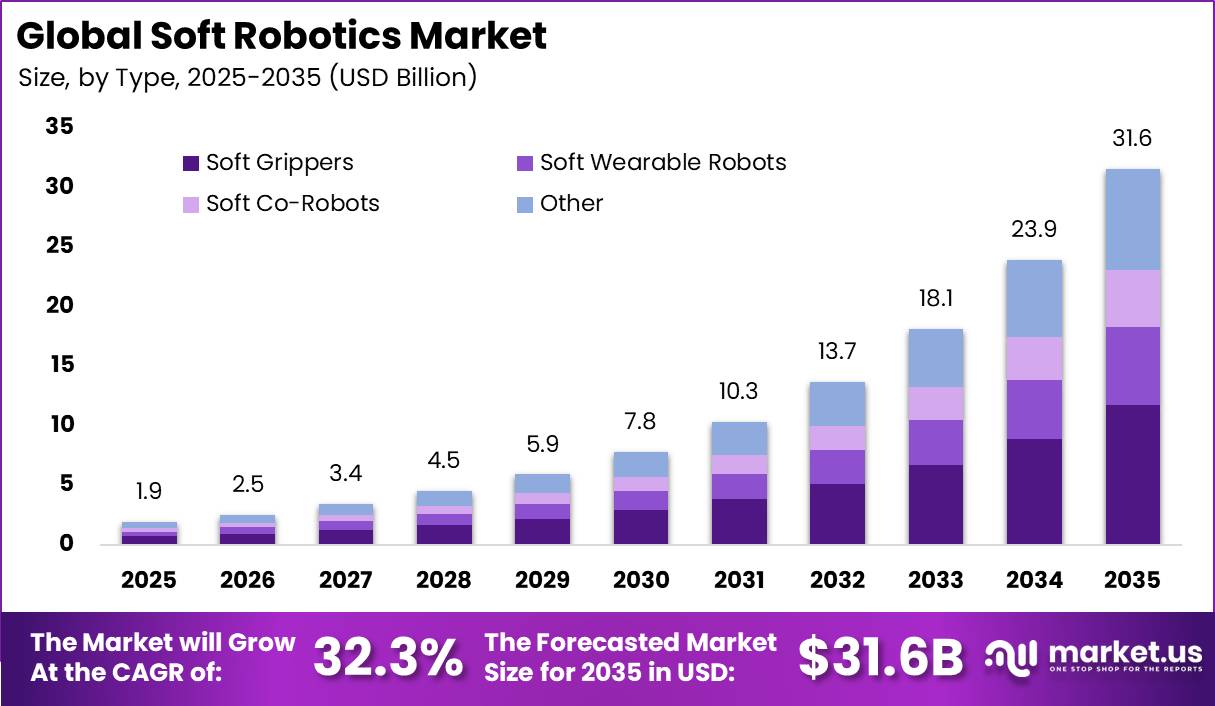
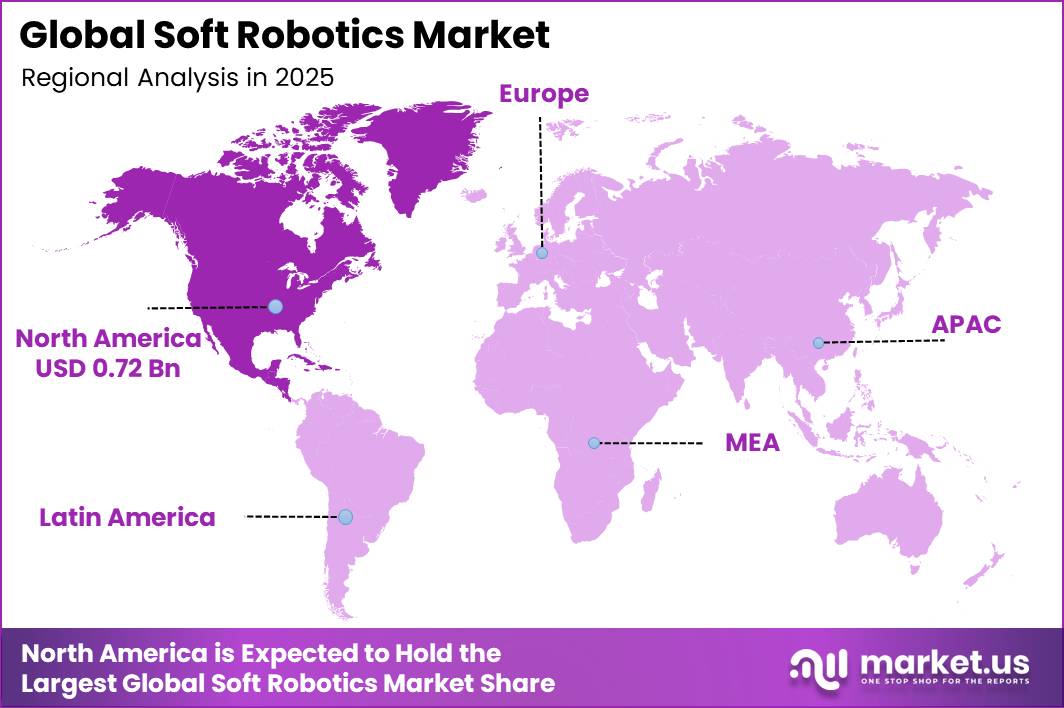
In 2025, the Global Soft Robotics Market was valued at USD 1.9 billion. The market is projected to grow at a CAGR of 32.3% during 2026–2035, reaching approximately USD 31.6 billion by 2035. North America dominated the global market in 2025, accounting for more than 38% of the total market share and generating approximately USD 0.72 billion in revenue.
Growth is being supported by rising automation across manufacturing, warehouses, healthcare, food processing, and agriculture. According to the International Federation of Robotics, global industrial robot installations reached 542,076 units in 2024, more than 2 times the level recorded 10 years earlier. Annual installations have also remained above 500,000 units for 4 consecutive years, showing the strong pace of industrial automation worldwide.
Professional service robot sales reached nearly 199,000 units globally in 2024, increasing 9% year over year. Logistics and transportation robots accounted for 102,900 units, rising 14%, while agricultural robot sales reached nearly 19,500 units. These applications create demand for soft grippers, flexible sensors, and compliant robotic arms that can safely handle fragile and irregular products.
Healthcare and e-commerce are also supporting market expansion. Global medical robot sales increased 91% to around 16,700 units in 2024. In addition, U.S. retail e-commerce sales reached USD 340.2 billion in the second quarter of 2026. Higher online sales are increasing the need for automated picking, packing, sorting, and returns handling, where soft robots can manage products of different shapes and sizes with lower risk of damage.
Key Takeaway
- The Soft Robotics Market was valued at USD 1.9 billion in 2025 and is projected to reach USD 31.6 billion by 2035, growing at a CAGR of 32.3%.
- Soft grippers led the market by type with a 37.2% share, driven by demand for safe handling of fragile and irregular products.
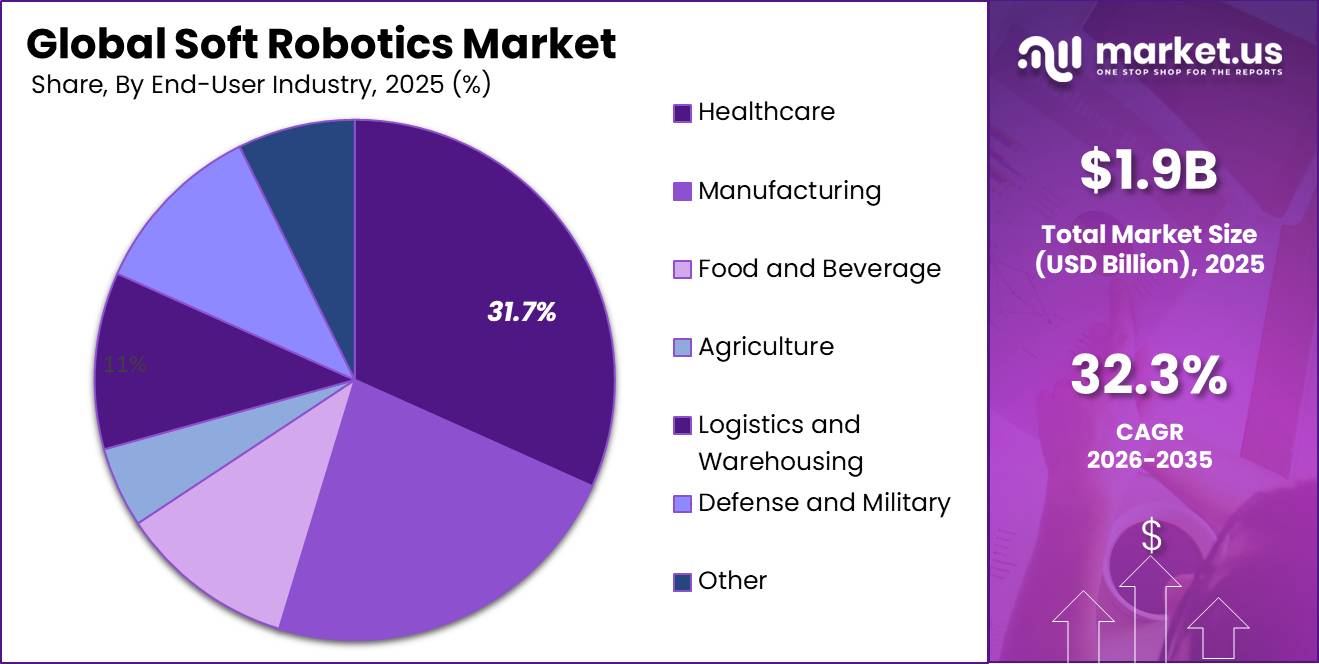
- Healthcare led the market by end-user industry with a 31.7% share, supported by rising demand for rehabilitation and mobility-assistance devices.
- North America led the market in 2025 with more than a 38% share and around USD 0.72 billion in revenue.
Market Statistics and Data Insights
- Professional service-robot sales reached almost 200,000 units in 2024, increasing 9%. Transportation and logistics represented 102,900 units, up 14%, meaning more than half of professional service robots were used for logistics and material transport.
- U.S. industrial robot installations increased 11% to 38,000 units in 2025. Food-industry robot adoption jumped 30% to around 3,000 installations, highlighting stronger automation of food picking, packing, handling, and processing operations where compliant grippers have practical value.
- IFR identified 944 service-robot manufacturers worldwide, and 80% were small or medium-sized enterprises with no more than 500 employees. This fragmented supplier structure can limit production scale, certification resources, service networks, and commercialization capacity for specialized soft-robotics companies.
- U.S. retail e-commerce sales reached USD 340.2 billion in Q2 2026, increasing 12.2% year over year and accounting for 17.1% of total retail sales on a seasonally adjusted basis. Higher online-order volumes support automated picking, packing, sorting, and returns handling.
- Festo’s 2026 HPSX adaptive soft gripper operates at frequencies of up to 5 Hz and produces a total gripping force of 5 N, providing a current industrial benchmark for compact pneumatic soft gripping.
- The same 2026 Festo soft gripper provides a working stroke of 0–55 mm and is designed to grip objects with diameters from 30 mm to 55 mm.
- U.S. manufacturing had 481,000 seasonally adjusted job openings in June 2026, compared with 517,000 in May 2026. The not-seasonally-adjusted June figure was 477,000 openings. Persistent vacancies strengthen the business case for automation in repetitive handling operations.
- Around 2.4 billion people worldwide live with a health condition that could benefit from rehabilitation. WHO estimates indicate rehabilitation need increased 63%, from 1.48 billion people in 1990 to 2.41 billion. This creates a substantial addressable patient base for rehabilitation exosuits, gloves, assistive robots, and mobility systems.
- Medical robot sales increased 91% to around 16,700 units in 2024. Within this category, rehabilitation and non-invasive therapy robot sales increased 106%, surgical robots increased 41%, and diagnostic and medical laboratory robots increased 610%.
- Around 19,500 agricultural service robots were sold in 2024. Although sales declined 6%, agriculture remained the fourth-largest professional service-robot application measured by IFR, supporting future soft-gripper applications in harvesting and delicate crop handling.
- Europe installed 85,006 industrial robots in 2024, with EU countries accounting for 67,819 units, or 80% of European installations. This provides another large potential retrofit base for safer and more flexible robotic handling systems.
- In November 2025, RightHand Robotics reported that its AI-driven piece-picking platform had completed more than 80 million production picks across 200,000+ unique SKUs while operating at 99.97% autonomy. Its gripper combines suction with compliant fingers, making the data directly relevant to soft/adaptive robotic handling.
- In a 2026 study of 10 older adults, a tendon-driven soft hip exosuit increased 1-minute sit-to-stand performance by an average of 1.8 repetitions and reduced walking metabolic cost by 13.6% versus the assistance-off condition.
By Type
Soft Grippers lead the Soft Robotics Market with a 37.2% share, mainly because they can safely handle fragile, soft, irregular, and differently sized products. Their flexible fingers and pressure-controlled gripping systems spread force across a wider surface, helping reduce crushing, scratching, slipping, and product damage compared with rigid grippers.
Demand is especially strong in food processing, agriculture, electronics, consumer goods, and medical applications. According to the Food and Agriculture Organization, global fruit and vegetable production reached about 2.1 billion tonnes in 2023, including approximately 952 million tonnes of fruit and 1.2 billion tonnes of vegetables.
These products differ widely in shape, size, ripeness, and surface condition, making soft gripping useful for harvesting, grading, sorting, packing, and palletizing. Food and beverage operations represented around 4% of global industrial robot installations in 2024, while the plastic and chemical products industry accounted for about 5%. These industries frequently handle bottles, trays, pouches, flexible packs, and sensitive components.
By End-User Industry
The Healthcare segment leads the Soft Robotics Market with a 31.7% share, supported by growing demand for devices that can safely assist, support, and interact with the human body. Soft robotic systems use flexible materials, controlled force, and body-friendly designs, making them suitable for rehabilitation wearables, mobility support, prosthetics, surgical assistance, and therapy equipment.
According to the World Health Organization, around 2.4 billion people worldwide live with health conditions that could benefit from rehabilitation, representing a 63% increase from 1.4 billion people in 1990. This large patient population is creating strong demand for safer and more comfortable rehabilitation technologies.
The ageing population is also supporting segment growth. The global population aged 60 years and above is projected to increase from 1 billion in 2020 to 1.4 billion by 2030, while the population aged 80 years and above is expected to reach 426 million by 2050. As mobility limitations and long-term care needs rise, soft robotic exosuits and rehabilitation systems are gaining importance because they provide controlled assistance with less weight and stiffness than conventional rigid devices.
Key Market Segments
By Type
- Soft Grippers
- Soft Wearable Robots
- Soft Co-Robots
- Other
By End-User Industry
- Healthcare
- Manufacturing
- Food and Beverage
- Agriculture
- Logistics and Warehousing
- Defense and Military
- Other
Geopolitical Impact Analysis
Geopolitical disruptions are increasing production costs and supply-chain risks for the Soft Robotics Market. Soft robotic systems depend on global supplies of silicone, elastomers, pneumatic valves, sensors, microcontrollers, batteries, motors, and semiconductor-based control units. UN Trade and Development reported that Red Sea diversions added around 12 sailing days to the Shanghai–Rotterdam route, increasing transit time by nearly 30%.
The disruption also reduced effective global container-shipping capacity by about 9%, while Suez Canal transits fell 42% from their 2023 peak. These delays can increase inventory requirements, extend manufacturing schedules, and create delivery risks for healthcare, warehouse, and industrial automation customers.
Trade tensions are also affecting component sourcing and pricing. U.S. trade actions added a 20% tariff on Chinese imports in March 2025, following an earlier 10% duty. Previous Section 301 measures covered around USD 360 billion of Chinese imports, with tariff rates ranging from 7.5% to 25%. This can raise the landed cost of electronics, motors, cables, sensors, and control hardware used in soft robotic systems.
Energy and freight volatility add further pressure. The U.S. Energy Information Administration reported that rerouting a Persian Gulf-to-Europe tanker around the Cape of Good Hope increased travel time from 19 days via Suez to nearly 35 days. Some clean-tanker freight rates also increased 20% in December 2023 compared with November. These pressures are encouraging manufacturers to adopt dual sourcing, regional assembly, and higher local inventory levels.
Regional Analysis
North America led the global Soft Robotics Market in 2025, accounting for more than 38% of total revenue and generating around USD 0.72 billion. The region benefits from advanced manufacturing, warehouse automation, medical technology, aerospace, food processing, and strong robotics research. The United States remains the key contributor due to high technology investment and early adoption of collaborative automation.
According to the International Federation of Robotics, U.S. factories operated around 393,700 industrial robots in 2024, increasing 3% from the previous year, while annual installations reached approximately 34,200 units. North America also recorded a robot density of 204 robots per 10,000 manufacturing employees.
Asia Pacific is expected to be the fastest-growing regional market, supported by rising automation investment, higher labor costs, and expanding electronics, automotive, and high-volume manufacturing industries. Asia accounted for 74% of global industrial robot deployments in 2024, compared with 9% in the Americas.
China alone installed around 295,000 industrial robots, representing 54% of global installations, and operated approximately 2.027 million robots in factories. Its robot density increased 17% year over year to 166 robots per 10,000 manufacturing workers, creating strong opportunities for soft robotic systems in electronics assembly, battery handling, food packing, sorting, and precision manufacturing.
Key Regions and Countries
North America
- US
- Canada
Europe
- Germany
- France
- The UK
- Spain
- Italy
- Rest of Europe
Asia Pacific
- China
- Japan
- South Korea
- India
- Australia
- Rest of APAC
Latin America
- Brazil
- Mexico
- Rest of Latin America
Middle East & Africa
- GCC
- South Africa
- Rest of MEA
Market Dynamics
Drivers
| Driver | (~) % CAGR | Geographic Relevance | Impact Timeline |
|---|---|---|---|
| Adaptive Warehouse Automation | +4.2% | North America, Europe, Asia Pacific | Short term (2 years or less) |
| Medical Rehabilitation Demand | +3.8% | North America, Europe, Japan | Medium term (2 to 4 years) |
| Flexible Food Handling | +2.7% | Asia Pacific, Europe, North America | Short term (2 years or less) |
| Collaborative Factory Deployment | +2.5% | Global | Medium term (2 to 4 years) |
| Electronics Assembly Complexity | +2.1% | China, South Korea, Taiwan, Japan | Medium term (2 to 4 years) |
Adaptive Warehouse Automation
Warehouse automation is a major growth driver for soft robotics because mixed-SKU fulfillment requires robots that can handle bags, apparel, packaged goods, and fragile items without fixed tooling. The International Federation of Robotics reported 199,000 professional service robots sold globally in 2024, up 9%, with transport and logistics accounting for 102,900 units and growing 14%.
The U.S. Census Bureau reported that e-commerce represented 15.5% of U.S. retail sales in the first quarter of 2026. Industrial robot installations also remained above 500,000 units for 4 consecutive years through 2024. This growing automation base supports demand for soft grippers and compliant end-effectors, while creating recurring revenue opportunities from tooling replacement, software integration, maintenance, and application engineering.
Restraints
| Restraint | (~) % CAGR | Geographic Relevance | Impact Timeline |
|---|---|---|---|
| High System Acquisition Cost | -3.6% | Global, especially small and medium enterprises | Short term (2 years or less) |
| Clinical Reimbursement Limits | -2.9% | North America, Europe | Medium term (2 to 4 years) |
| Capital Budget Deferrals | -2.4% | Europe, North America, emerging economies | Short term (2 years or less) |
| Safety Certification Expense | -1.9% | Europe, North America, Japan | Medium term (2 to 4 years) |
| Limited Payback Visibility | -1.7% | Global | Short term (2 years or less) |
High System Acquisition Cost
High upfront system cost remains a key restraint for soft robotics because deployments require grippers or wearable devices, sensors, machine vision, controls, integration, validation, and operator training. The U.S. Bureau of Labor Statistics recorded 477,000 manufacturing job openings in 2026, showing that labor shortages support automation demand but do not remove investment barriers for smaller manufacturers.
The World Bank projected global energy prices to decline 12% in 2025 and another 10% in 2026, with Brent crude averaging around USD 60 per barrel in 2026. In addition, only 9% of new industrial robot deployments in 2024 occurred in the Americas. High integration costs and fragmented demand can therefore delay capital approvals and concentrate early adoption among financially stronger companies.
Challenges
| Challenge | (~) % CAGR | Geographic Relevance | Mitigation Horizon |
|---|---|---|---|
| Component Supply Volatility | -2.8% | Global supply chains | Medium term (2 to 4 years) |
| Durability Validation Burden | -2.5% | Global | Medium term (2 to 4 years) |
| Robotics Skills Gap | -2.2% | North America, Europe, Asia Pacific | Long term (4 years or more) |
| Interoperability Standards Gap | -1.8% | Global | Medium term (2 to 4 years) |
| Data Security Exposure | -1.6% | Europe, North America, Japan | Medium term (2 to 4 years) |
Component Supply Volatility
Soft robotics faces a supply-chain challenge because systems depend on elastomers, valves, pumps, flexible sensors, microcontrollers, batteries, and precision parts sourced globally. UN Trade and Development reported that Red Sea rerouting added about 12 days to Shanghai–Rotterdam sailings, while a Persian Gulf-to-Europe voyage could increase from 19 days via Suez to nearly 35 days around the Cape of Good Hope.
Maritime transport carries around 80% of global goods trade, making logistics disruption important for component availability and working capital. Asia also accounted for 74% of new industrial robot deployments in 2024. To reduce risk, manufacturers are increasing dual sourcing, safety stock, modular designs, and regional assembly to prevent longer lead times from delaying customer installations.
Opportunities
| Opportunity | (~) % CAGR | Geographic Relevance | Execution Window |
|---|---|---|---|
| Rehabilitation Robotics as Service | +4.0% | North America, Europe, Japan | Medium term (2 to 4 years) |
| Soft Gripper Retrofit Programs | +3.1% | Global manufacturing hubs | Short term (2 years or less) |
| Automated Produce Harvesting | +2.8% | North America, Europe, Asia Pacific | Long term (4 years or more) |
| AI-Enabled Wearable Therapy | +2.4% | North America, Europe | Long term (4 years or more) |
| Regional Integration Partnerships | +1.9% | India, Southeast Asia, Latin America | Medium term (2 to 4 years) |
Rehabilitation Robotics as Service
Rehabilitation robotics-as-a-service remains a future growth opportunity, as many providers still purchase equipment through capital budgets. The World Health Organization estimates that 2.4 billion people could benefit from rehabilitation, while the population aged 60 years and above is projected to rise from 1.0 billion in 2019 to 1.4 billion by 2030. Medical robot sales reached nearly 16,700 units in 2024, increasing 91%, but adoption remains small compared with the potential patient base.
Subscription and managed-service models could lower upfront costs and improve equipment use across clinics. They can also create recurring revenue from software, maintenance, remote monitoring, and therapy analytics. With higher utilization, shared-service models may improve provider gross margins by around 5% to 10%, although wider adoption will depend on reimbursement support and integration into clinical workflows.
Key Players Analysis
The Soft Robotics Market is led by Tier-1 automation companies such as ABB Ltd., Yaskawa Electric Corporation, and Festo AG, supported by large manufacturing networks, established customers, advanced control systems, and global distribution. ABB generated USD 33.2 billion in revenue in 2025 and invested USD 1.31 billion in R&D, equal to 4.0% of revenue.
Its Robotics & Discrete Automation business generated around USD 3.3 billion. In October 2025, ABB agreed to sell its Robotics division to SoftBank Group in a deal valued at approximately USD 5.4 billion.
Yaskawa reported JPY 542.1 billion in FY2025 revenue, compared with JPY 537.7 billion in FY2024, and planned JPY 58.0 billion in FY2026 capital expenditure. Tier-1 companies are estimated to represent around 35–45% of addressable soft-robotics spending when complete robotic cells, motion controls, and end-of-arm tools are included.
Tier-2 companies, including Soft Robotics Inc., RightHand Robotics, Ekso Bionics, ReWalk Robotics, Bioservo Technologies, Roam Robotics, and Pneubotics, compete mainly through specialized applications. Each typically holds below 5% of the addressable market. Ekso Bionics reported a 29% decline in 2025 revenue to USD 12.8 million, while R&D spending fell 22% to USD 3.03 million.
Top Key Players in the Market
- Soft Robotics Inc.
- RightHand Robotics Inc.
- Ekso Bionics Holdings Inc.
- Rewalk Robotics Ltd
- Yaskawa Electric Corporation
- Bioservo Technologies AB
- Festo AG
- Roam Robotics
- ABB Ltd.
- Pneubotics Inc.
Recent Developments
- In 2025, ABB agreed in October to sell its Robotics division to SoftBank Group for an enterprise value of USD 5.375 billion. ABB expects approximately USD 5.3 billion in net cash proceeds and a pre-tax book gain of around USD 2.4 billion. The Robotics division generated USD 2.3 billion in revenue in 2024 and employed about 7,000 people.
- In 2025, Ekso Bionics announced a registered direct offering of approximately USD 3.7 million in October. The company agreed to sell 769,490 shares at USD 4.81 per share. Ekso stated that the proceeds would support general corporate needs, including research and development, strategic initiatives, and working capital.
Report Scope
| Report Features | Description |
|---|---|
| Market Value (2025) | USD 1.9 Billion |
| Forecast Revenue (2035) | USD 31.6 Billion |
| CAGR (2026-2035) | 32.3% |
| Base Year for Estimation | 2025 |
| Historic Period | 2020-2024 |
| Forecast Period | 2026-2035 |
| Report Coverage | Revenue Forecast, Market Dynamics, Competitive Landscape, Recent Developments |
| Segments Covered | By Type (Soft Grippers, Soft Wearable Robots, Soft Co-Robots, Other); By End-User Industry (Healthcare, Manufacturing, Food and Beverage, Agriculture, Logistics and Warehousing, Defense and Military, Other) |
| Regional Analysis | North America – US, Canada; Europe – Germany, France, The UK, Spain, Italy, Rest of Europe; Asia Pacific – China, Japan, South Korea, India, Australia, Singapore, Rest of APAC; Latin America – Brazil, Mexico, Rest of Latin America; Middle East & Africa – GCC, South Africa, Rest of MEA |
| Competitive Landscape | Soft Robotics Inc., RightHand Robotics Inc., Ekso Bionics Holdings Inc., Rewalk Robotics Ltd., Yaskawa Electric Corporation, Bioservo Technologies AB, Festo AG, Roam Robotics, ABB Ltd., Pneubotics Inc. |
| Customization Scope | Customization for segments and region/country-level will be provided. Additional customization can be done based on requirements. |
| Purchase Options | We have three licenses to opt for: Single User License, Multi-User License (Up to 5 Users), Corporate Use License (Unlimited Users and Printable PDF) |





























