


Report Overview
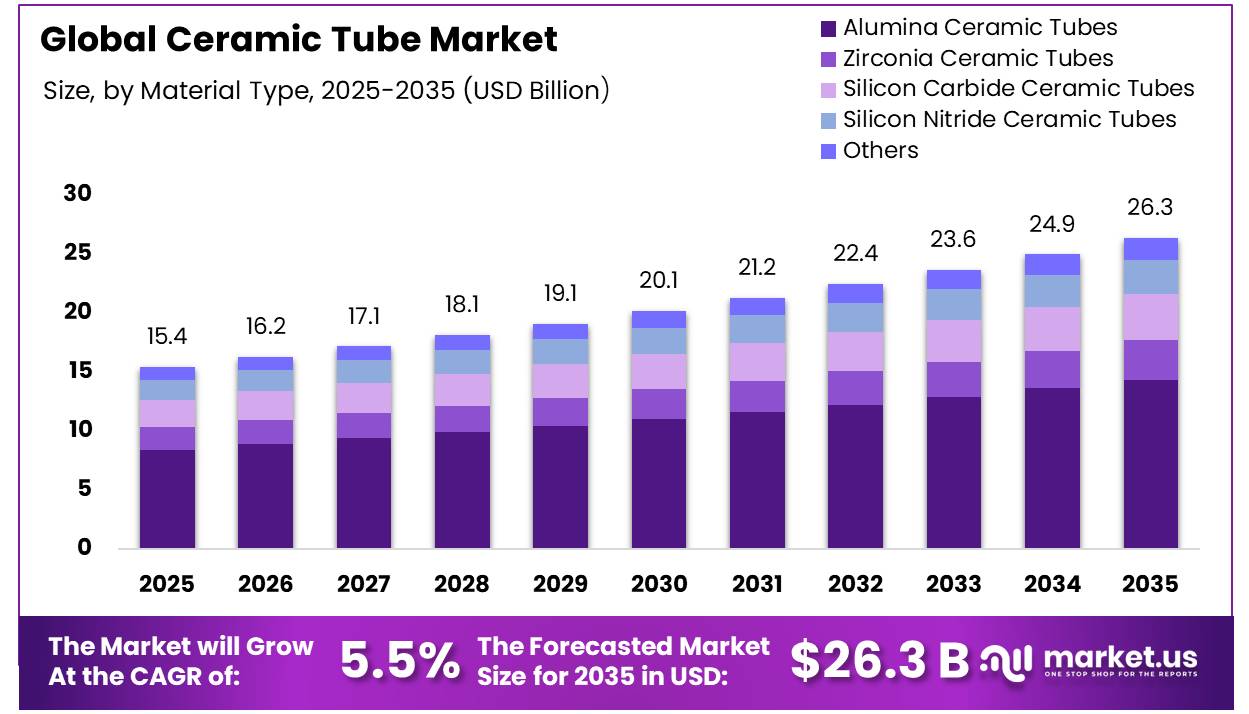
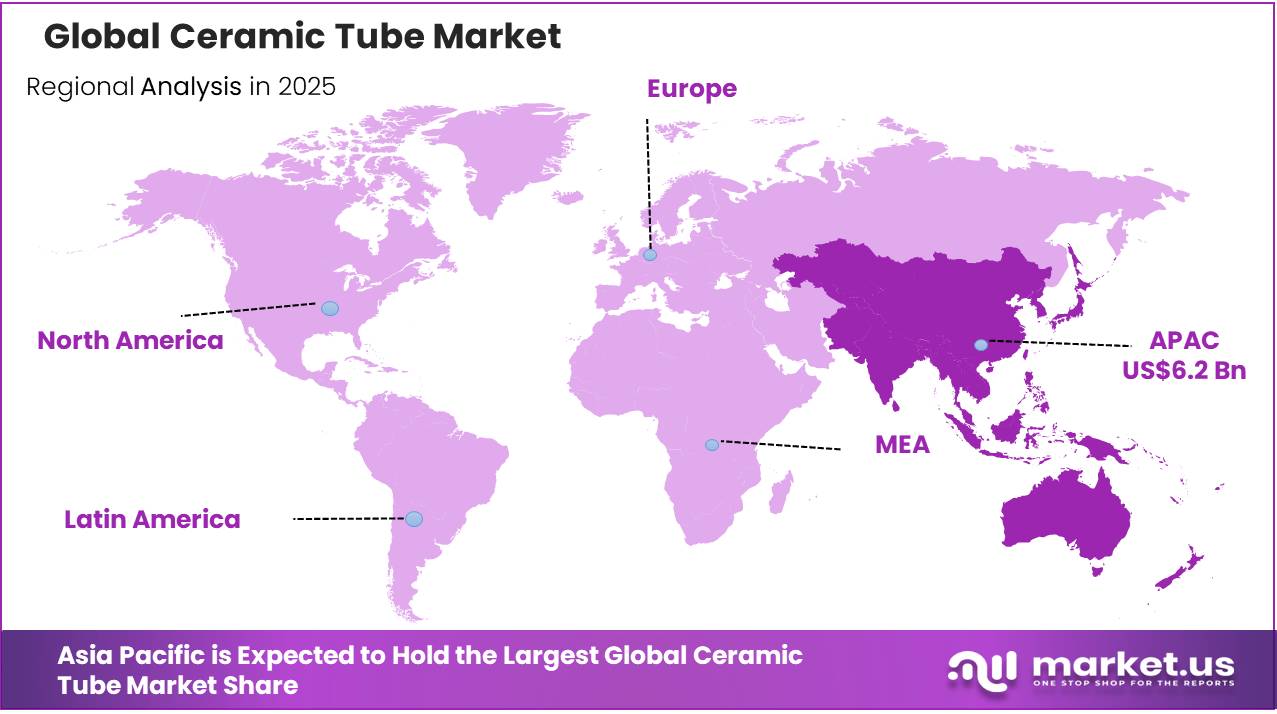
In 2025, the Global Ceramic Tube Market was valued at USD 15.4 billion, and between 2026 and 2035, this market is estimated to register a CAGR of 5.5%, reaching about USD 26.3 billion by 2035. In 2025, Asia Pacific held a dominant market position, capturing more than a 40.1% share, holding USD 6.2 Billion revenue.
The ceramic tubes market is driven by demand for materials that withstand high temperatures, corrosive environments, and mechanical stress across industries such as metallurgy, chemical processing, power generation, aerospace, and healthcare. Materials such as alumina, zirconia, silicon carbide, and silicon nitride dominate due to their thermal stability, chemical inertness, and mechanical strength.
- CeramTec reports that its ceramic protection and insulating tubes can operate in aggressive industrial environments at temperatures reaching 1,700°C. These tubes protect thermocouples and resistance-temperature detectors used in furnaces, metal processing, chemical plants, and heat-treatment equipment.
Global steel production alone reached 1,849.4 million tonnes in 2025, while the 70 countries tracked by the World Steel Association produced 149.2 million tonnes of crude steel in July 2026. Such large-scale thermal-processing activity maintains demand for reliable ceramic temperature-measurement and insulation components.
Semiconductor manufacturing is becoming another major growth driver. Kyocera states that semiconductor equipment increasingly requires ceramics with plasma resistance, low particle generation, and heat resistance of 600°C or higher, including chamber tubes and plasma-introduction tubes.
Global semiconductor sales reached USD 791.7 billion in 2025, increasing 25.6%, while second-quarter 2026 sales reached USD 403.3 billion, up 35.1% from the first quarter. Increasing wafer-fabrication capacity therefore creates opportunities for ultra-high-purity alumina, sapphire, and plasma-resistant ceramic tubing.
- Government manufacturing programs are further supporting this demand. The U.S. CHIPS for America program provides USD 50 billion, including USD 39 billion for manufacturing incentives and USD 11 billion for semiconductor R&D.
By early 2025, the program had helped catalyze nearly USD 450 billion in private investment and supported construction plans for 17 new semiconductor fabs with around 6.8 million square feet of cleanroom space. Expansion of these facilities increases requirements for high-purity ceramic components used in wafer processing and thermal equipment.
Key Takeaways
- The global ceramic tube market was valued at USD 15.4 billion in 2025.
- The global market is projected to grow at a CAGR of 5.5% and is estimated to reach USD 26.3 billion by 2035.
- On the basis of material type, alumina ceramic tubes dominated the market, constituting 54.5% of the total market share.
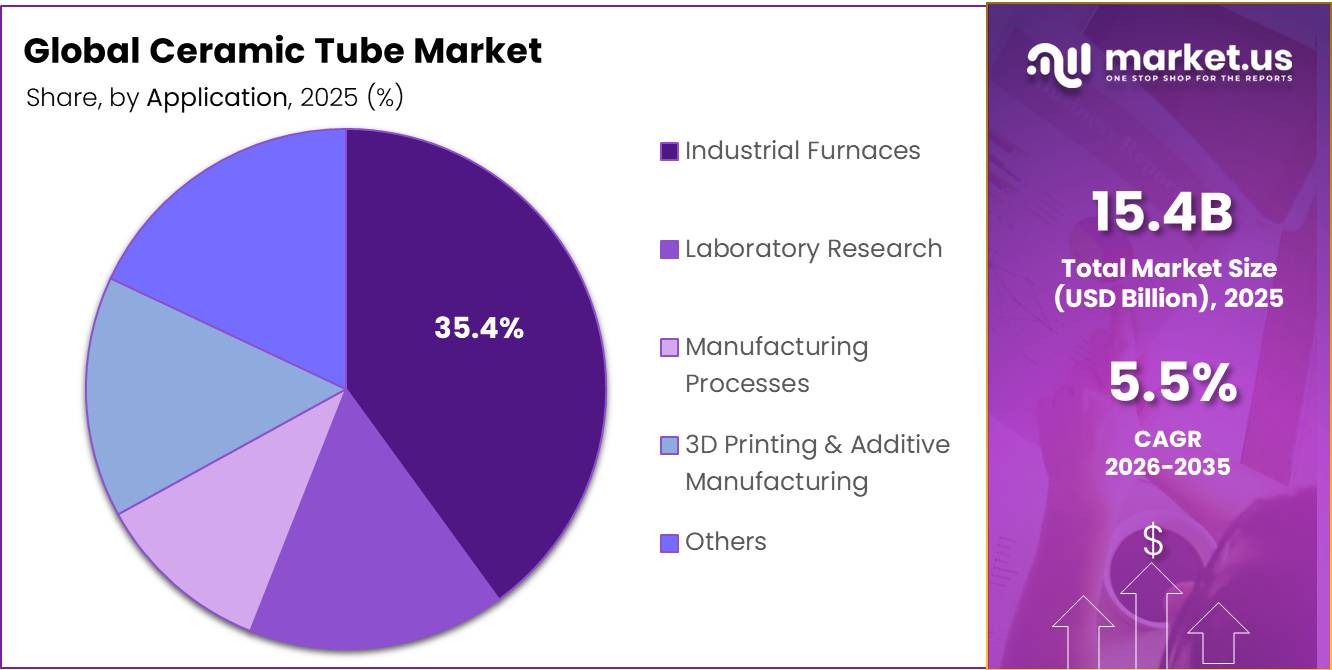
- Among the applications, industrial furnaces held a major share in the ceramic tube market, 35.4% of the market share.
- Among the end-use industries, the electrical & electronics sector is the most considerable within the market, accounting for around 37.5% of the revenue.
- In 2025, the Asia Pacific was the most dominant region in the ceramic tube market, accounting for 40.1% of the total global consumption.
Material Type Analysis
Alumina Ceramic Tubes are a Prominent Segment in the Market.
Alumina ceramic tubes hold a dominant position in the ceramic tubes market, accounting for 54.5% of the material segment. Their widespread adoption is attributed to high thermal stability, excellent electrical insulation, and resistance to corrosion and wear. These tubes are extensively used in industrial furnaces, chemical processing reactors, and laboratory equipment where sustained high temperatures and harsh chemical exposure are common. Alumina’s mechanical strength and dimensional stability enable reliable performance under thermal shock and continuous operation, reducing maintenance requirements.
Additionally, the material’s compatibility with precision manufacturing and integration with additive manufacturing techniques facilitates the production of complex, application-specific tube designs. The combination of durability, versatility, and process reliability reinforces alumina ceramic tubes as the preferred choice across multiple industrial and research applications, maintaining their market leadership within the material segment.
Application Analysis
Industrial Furnaces Held a Major Share of the Ceramic Tube Market.
Industrial furnaces represent the largest application segment in the ceramic tubes market, accounting for 35.4% of total usage. Ceramic tubes are widely employed in these furnaces due to their exceptional thermal resistance, chemical inertness, and ability to withstand sustained high temperatures. Alumina, silicon carbide, and silicon nitride tubes are commonly used to line furnace chambers, protect sensitive components, and facilitate uniform heat distribution in metallurgical, chemical, and power generation processes.
Their durability under thermal shock minimizes maintenance downtime and ensures operational reliability, particularly in continuous or batch production settings. The adoption of high-performance ceramic tubes also supports energy efficiency and safety by preventing equipment degradation and chemical corrosion. The combination of thermal resilience, structural stability, and long-term reliability under extreme operating conditions reinforces industrial furnaces as the leading application for ceramic tubes across multiple sectors.
End-Use Industry Analysis
Ceramic Tubes Are Mostly Utilized in the Electrical & Electronics Sector.
The electrical and electronics sector accounts for the largest share in the ceramic tubes market, representing 37.5% of end-use applications. Ceramic tubes are widely utilized for their excellent electrical insulation, thermal stability, and mechanical strength, making them ideal for high-voltage components, electronic sensors, and precision instruments. Alumina and zirconia tubes, in particular, are employed in insulating supports, feedthroughs, and electronic connectors, where reliable performance under elevated temperatures and electrical stress is critical.
The integration of ceramic tubes in advanced electronic assemblies enhances operational safety, longevity, and signal integrity. As electronics continue to advance toward miniaturization and higher efficiency, the demand for precision-engineered ceramic tubes increases, reinforcing their role as essential components in the design, fabrication, and protection of modern electrical and electronic systems.
Key Market Segments
By Material Type
- Alumina Ceramic Tubes
- Zirconia Ceramic Tubes
- Silicon Carbide Ceramic Tubes
- Silicon Nitride Ceramic Tubes
- Others
By Application
- Industrial Furnaces
- Laboratory Research
- Manufacturing Processes
- 3D Printing & Additive Manufacturing
- Others
By End-Use Industry
- Electrical & Electronics
- Automotive
- Aerospace & Defense
- Healthcare & Biotechnology
- Power Generation
- Metallurgy & Foundry
- Chemical & Petrochemical
- Others
Driver Analysis
EV Battery Thermal Management and Power Electronics Substrates
Ceramic tubes and rod-based components are increasingly specified inside EV battery packs and inverters for dielectric insulation, flame resistance, and thermal conduction, exemplified by coating and substrate programs such as the CeraBEV collaboration that enable lighter aluminum and composite battery enclosures to replace steel without compromising safety certification.
With global EV sales having surged past 10 million units in 2023 and continuing to scale through 2025-2026, the bill-of-materials pressure on OEMs is shifting ceramic component sourcing from bespoke, low-volume aerospace-grade supply toward higher-volume, cost-engineered automotive-grade production lines. This transition compresses per-unit ceramic component costs through scale but simultaneously widens the addressable volume, as power electronics inverters, onboard chargers, and battery heater cores each require multiple insulating or thermally conductive ceramic tube elements per vehicle.
The strategic shift here is from a project-based aerospace/defense supply model to a platform-based automotive OEM model requiring PPAP-style quality certification and multi-year volume contracts, concentrated in China’s EV manufacturing base, the EU’s battery gigafactory corridor, and North American EV assembly hubs.
Drivers Impact Analysis
| Driver | (~) % Impact on CAGR | Geographic Relevance | Impact Timeline |
|---|---|---|---|
| Semiconductor fab expansion lifting SiC diffusion tube demand | +2.1% | APAC core (Taiwan, South Korea, China), US fabs | Medium term (2-4 years) |
| Water/wastewater discharge regulation driving ceramic membrane tube adoption | +1.8% | North America, EU, APAC industrial corridors | Long term (≥ 4 years) |
| EV battery thermal management and power electronics substrates | +1.5% | China, EU, North America | Medium term (2-4 years) |
| Industrial furnace and sintering capacity upgrades in metals/ceramics processing | +1.2% | China, India, ASEAN | Short term (≤ 2 years) |
| Miniaturization of electronic insulators and high-voltage components | +0.9% | Global, APAC-weighted | Short term (≤ 2 years) |
| Renewable energy and grid modernization insulation demand | +0.8% | EU, North America, South America spill-over | Long term (≥ 4 years) |
Restraint Analysis
Alumina and Precursor Price Volatility Compressing Margins
Alumina, the dominant feedstock for the majority of industrial and technical ceramic tube grades, has swung sharply within a roughly 300-395 dollar per metric ton band across 2025-2026, falling from an average near 395 dollars per tonne in 2025 to approximately 305-317 dollars per tonne by early Q1 2026 before further softening to around 300 dollars per tonne by mid-March, a peak-to-trough movement exceeding 20-24% within roughly two quarters; this volatility, driven by oversupply from expanded Chinese and Indonesian refining capacity colliding with intermittent bauxite-linked disruptions, forces tube manufacturers operating on 60-90 day raw-material inventory cycles to either absorb margin compression of an estimated 150-250 basis points during price spikes or pass through cost increases that risk losing price-sensitive furnace and electronics-insulation customers to lower-grade substitutes; because most mid-tier ceramic tube producers lack the balance-sheet depth to hedge alumina exposure through long-dated forward contracts the way integrated aluminum majors do, this restraint disproportionately erodes EBITDA margins for independent tube fabricators by an estimated 100-180 basis points annually, delaying reinvestment in furnace and extrusion capacity upgrades and constraining the sector’s ability to fully capture demand-side tailwinds.
Restraint Impact Analysis
| Restraint | (~) % Impact on CAGR Forecast | Geographic Relevance | Impact Timeline |
|---|---|---|---|
| Alumina and precursor price volatility compressing margins | -1.4% | Global, APAC production-weighted | Short term (≤ 2 years) |
| China’s rare earth and dual-use export licensing regime | -1.1% | China-dependent global supply chains, US, EU | Medium term (2-4 years) |
| European energy price volatility raising kiln/furnace operating costs | -1.6% | EU core, UK spill-over | Short term (≤ 2 years) |
| High capital intensity and long qualification cycles limiting new entrants | -0.8% | Global, APAC and US fab corridors | Long term (≥ 4 years) |
| Substitution by polymer, metal, and composite alternatives in cost-sensitive uses | -0.9% | North America, EU, price-sensitive APAC segments | Medium term (2-4 years) |
| Tariff and trade-policy fragmentation disrupting cross-border sourcing | -1.0% | US-China corridor, EU import channels | Short term (≤ 2 years) |
Opportunity Analysis
Solid Oxide Electrolyzer and Green Hydrogen Tube Components
Unlike the mature furnace and semiconductor verticals already embedded in baseline demand, solid oxide electrolyzer cells (SOECs) represent a nascent, largely uncaptured TAM for tubular and planar ceramic components, since the broader water electrolyzer component market is projected to expand at a roughly 25% CAGR between 2025 and 2036 while SOEC-specific ceramic electrolyte and interconnect tube demand remains structurally under-served relative to alkaline and PEM designs that dominate current installed capacity; ceramic tube producers who proactively qualify yttria-stabilized zirconia and doped-ceria tubular electrolyte formats for SOEC stack integrators today could capture first-mover positioning in a segment where component suppliers currently number in the single digits globally, translating into gross margins potentially 8-12 percentage points above commodity industrial tube margins given the premium engineering specification required; because green hydrogen electrolyzer capacity is still overwhelmingly alkaline-based today, this is not a driver already reflected in baseline forecasts but a genuine adjacent-vertical bet requiring 2-3 years of joint qualification work with electrolyzer OEMs in the EU, Japan, and South Korea before volume orders materialize, making early design-partner agreements the key strategic lever.
Opportunity Impact Analysis
| Opportunity | (~) % Potential CAGR Upside | Geographic Relevance | Execution Window |
|---|---|---|---|
| Solid oxide electrolyzer and green hydrogen tube components | +2.3% | EU, APAC (China, Japan, South Korea), North America emerging | Medium term (2-4 years) |
| Ceramic additive manufacturing for custom, low-volume tube geometries | +1.6% | Global, EU/APAC innovation hubs | Medium term (2-4 years) |
| Servitization and outcome-based membrane/tube-as-a-service contracts | +1.4% | North America, EU utilities | Long term (≥ 4 years) |
| Circular economy roll-up of ceramic scrap reclamation and remanufacturing | +1.1% | EU (EPR-driven), APAC | Long term (≥ 4 years) |
| M&A consolidation of fragmented regional tube fabricators | +0.9% | APAC (China, India), North America mid-market | Short term (≤ 2 years) |
| White-space penetration into medical implant and diagnostic device tubing | +1.2% | North America, EU, APAC medtech hubs | Medium term (2-4 years) |
Challenges Analysis
Skilled Ceramics Workforce Shortage
The structural vulnerability stems from an aging technical workforce combined with insufficient inflow of new ceramics engineers, kiln technicians, and process-control specialists, evidenced by US manufacturing sector data showing average unfilled-role rates near 4.1% in Q1 2026 and roughly one in four manufacturers reporting vacancy rates above 5%, with production-line wages having crossed 30.10 dollars per hour by April 2026 as employers bid up pay for scarce skilled trades; within ceramics specifically, specialized roles such as sintering-process engineers and refractory-materials specialists face even tighter labor pools than general manufacturing, since NAM and Deloitte project a broader manufacturing shortfall approaching 1.9 million unfilled skilled roles by the early 2030s, compounding recruitment timelines that already average 70-plus days for technical positions.
The quantitative friction manifests as extended new-hire ramp times of 12-18 months to reach full sintering-process proficiency, elevated overtime costs of an estimated 15-20% above baseline labor budgets at facilities running below full staffing, and higher scrap-related costs when under-experienced operators run high-temperature kilns without adequate supervision; navigating this durably requires multi-year investment in apprenticeship pipelines, partnerships with technical colleges, and augmented-reality-assisted training systems that compress institutional-knowledge transfer, none of which resolve the shortage within a single product cycle and collectively point to a mitigation horizon extending beyond four years.
Challenges Impact Analysis
| Challenge | (~) % CAGR Friction Drag | Geographic Relevance | Mitigation Horizon |
|---|---|---|---|
| Skilled ceramics workforce shortage | -1.3% | North America, EU industrial belts | Long term (≥ 4 years) |
| Yield and defect-rate variability in high-precision tubes | -0.9% | APAC production hubs, global | Medium term (2-4 years) |
| Multi-tier logistics and lead-time unpredictability | -1.0% | Global, APAC-to-West corridors | Short term (≤ 2 years) |
| Fragmented quality certification across end-markets | -0.7% | EU, North America, APAC export lanes | Medium term (2-4 years) |
| Technology transition risk from legacy firing methods | -0.8% | China, India, EU legacy plants | Long term (≥ 4 years) |
| Working-capital strain from extended customer qualification cycles | -0.6% | Global, semiconductor/medtech corridors | Medium term (2-4 years) |
Geopolitical Impact Analysis
Supply Chain Vulnerabilities in Ceramic Tube Production Amid Geopolitical Tensions.
The ongoing geopolitical tensions have affected the sourcing and distribution of raw materials and high-performance ceramics used in advanced tube manufacturing. The U.S. Geological Survey reports that China produces over 60% of global rare-earth oxides and high-purity alumina, essential for alumina and zirconia ceramic tubes, while exports have been periodically restricted due to trade policies.
The European Commission noted that sanctions and import restrictions on Russia disrupted the supply of silicon carbide and silicon nitride powders, critical for high-temperature industrial applications, particularly in metallurgical and aerospace sectors. The lead times for high-purity ceramic powders extended by 20-30% in 2022 due to border closures and logistical bottlenecks. The U.S. Department of Energy highlights that energy-intensive manufacturing plants experienced delays in upgrading furnace and reactor components because key ceramic materials were unavailable on schedule.
Additionally, transport disruptions in maritime routes connecting Asia, Europe, and North America, as reported by the International Maritime Organization, have increased inventory management challenges for high-performance ceramic tubes. These factors collectively create operational constraints, emphasizing the need for diversified supply chains and strategic material sourcing in industrial applications.
Regional Analysis
Asia Pacific Held the Largest Share of the Global Ceramic Tube Market.
In 2025, the Asia Pacific dominated the global ceramic tube market, holding about 40.1% of the total global consumption, due to the concentration of energy-intensive and high-tech industries. According to the Ministry of Industry and Information Technology of China, over 60% of the country’s steel and chemical production facilities operate with modernized high-temperature furnaces, extensively utilizing alumina and silicon carbide tubes. India’s Ministry of Heavy Industries reports that industrial boiler installations and chemical processing plants expanded by approximately 12% annually between 2019 and 2023, driving the adoption of high-temperature and corrosion-resistant ceramic components.
There is a widespread use of zirconia and silicon nitride tubes in laboratory and semiconductor applications, emphasizing precision and thermal stability. The availability of raw materials, such as high-purity alumina from China and silicon carbide from Japan, supports localized production. These factors, combined with ongoing industrial modernization and infrastructure development, reinforce Asia Pacific’s role as the largest regional market for ceramic tubes across multiple sectors.
Key Regions and Countries
- North America
- The US
- Canada
- Europe
- Germany
- France
- The UK
- Spain
- Italy
- Russia & CIS
- Rest of Europe
- APAC
- China
- Japan
- South Korea
- India
- ASEAN
- Rest of APAC
- Latin America
- Brazil
- Mexico
- Rest of Latin America
- Middle East & Africa
- GCC
- South Africa
- Rest of MEA
Key Players Analysis
Manufacturers of ceramic tubes focus on enhancing product quality and diversifying material offerings to gain a competitive edge. Several companies emphasize the development of specialized ceramic composites, such as silicon carbide-alumina hybrids, to meet demanding industrial requirements. Integration with additive manufacturing and 3D printing enables the production of complex, customized tubes for laboratory, aerospace, and industrial applications.
Firms further invest in localized production and secure raw material sourcing to mitigate supply chain risks. Additionally, collaborations with research institutions and end-users facilitate the development of application-specific solutions, while robust quality assurance and testing protocols reinforce reliability, operational efficiency, and long-term adoption in high-performance industrial environments.
The Major Players in The Industry
- Kyocera Corporation
- CoorsTek Inc.
- Morgan Advanced Materials
- CeramTec GmbH
- Carborundum Universal Ltd.
- Rauschert Group
- 3M (Ceradyne)
- Saint-Gobain Ceramics
- Heraeus Holding GmbH
- Materion Corporation
- Schunk Ingenieurkeramik GmbH
- Vesuvius plc
- Precision Ceramics
- Ortech Advanced Ceramics
- Xiamen Innovacera Advanced Materials Co, Ltd
- Mantec Technical Ceramics
- LSP Industrial Ceramics Inc.
- Other Key Players
Key Development
- In March 2026, Luxinar launched the E70 water-cooled ceramic-tube CO2 laser source from its Eternity series. The 70 W laser is designed for compact platforms, enhancing automated web systems, laser scanner modules, and small workstations with high process repeatability.
Report Scope
| Report Features | Description |
|---|---|
| Market Value (2025) | US$15.4 Bn |
| Forecast Revenue (2035) | US$26.3 Bn |
| CAGR (2026-2035) | 5.5% |
| Base Year for Estimation | 2025 |
| Historic Period | 2020-2024 |
| Forecast Period | 2026-2035 |
| Report Coverage | Revenue Forecast, Market Dynamics, Competitive Landscape, Recent Developments |
| Segments Covered | By Material Type (Alumina Ceramic Tubes, Zirconia Ceramic Tubes, Silicon Carbide Ceramic Tubes, Silicon Nitride Ceramic Tubes, and Others), By Application (Industrial Furnaces, Laboratory Research, Manufacturing Processes, 3D Printing & Additive Manufacturing, and Others), By End-Use Industry (Electrical & Electronics, Automotive, Aerospace & Defense, Healthcare & Biotechnology, Power Generation, Metallurgy & Foundry, Chemical & Petrochemical, and Others) |
| Regional Analysis | North America – The US & Canada; Europe – Germany, France, The UK, Spain, Italy, Russia & CIS, Rest of Europe; APAC– China, Japan, South Korea, India, ASEAN & Rest of APAC; Latin America– Brazil, Mexico & Rest of Latin America; Middle East & Africa– GCC, South Africa, & Rest of MEA |
| Competitive Landscape | Kyocera Corporation, CoorsTek Inc., Morgan Advanced Materials, CeramTec GmbH, Carborundum Universal Ltd., Rauschert Group, 3M (Ceradyne), Saint-Gobain Ceramics, Heraeus Holding GmbH, Materion Corporation, Schunk Ingenieurkeramik GmbH, Vesuvius plc, Precision Ceramics, Ortech Advanced Ceramics, Xiamen Innovacera Advanced Materials Co Ltd, Mantec Technical Ceramics, LSP Industrial Ceramics Inc., and Other Players. |
| Customization Scope | Customization for segments, region/country-level will be provided. Moreover, additional customization can be done based on the requirements. |
| Purchase Options | We have three licenses to opt for: Single User License, Multi-User License (Up to 5 Users), Corporate Use License (Unlimited Users and Printable PDF) |





































