


Report Overview
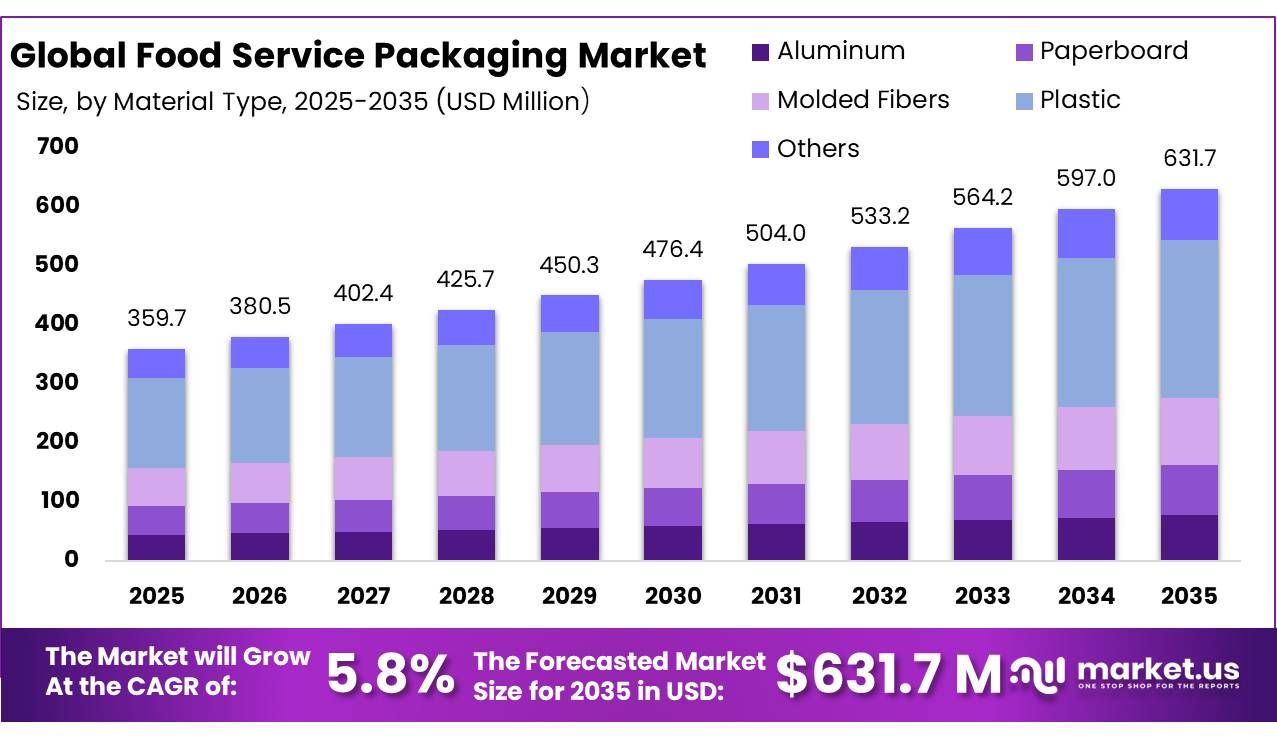
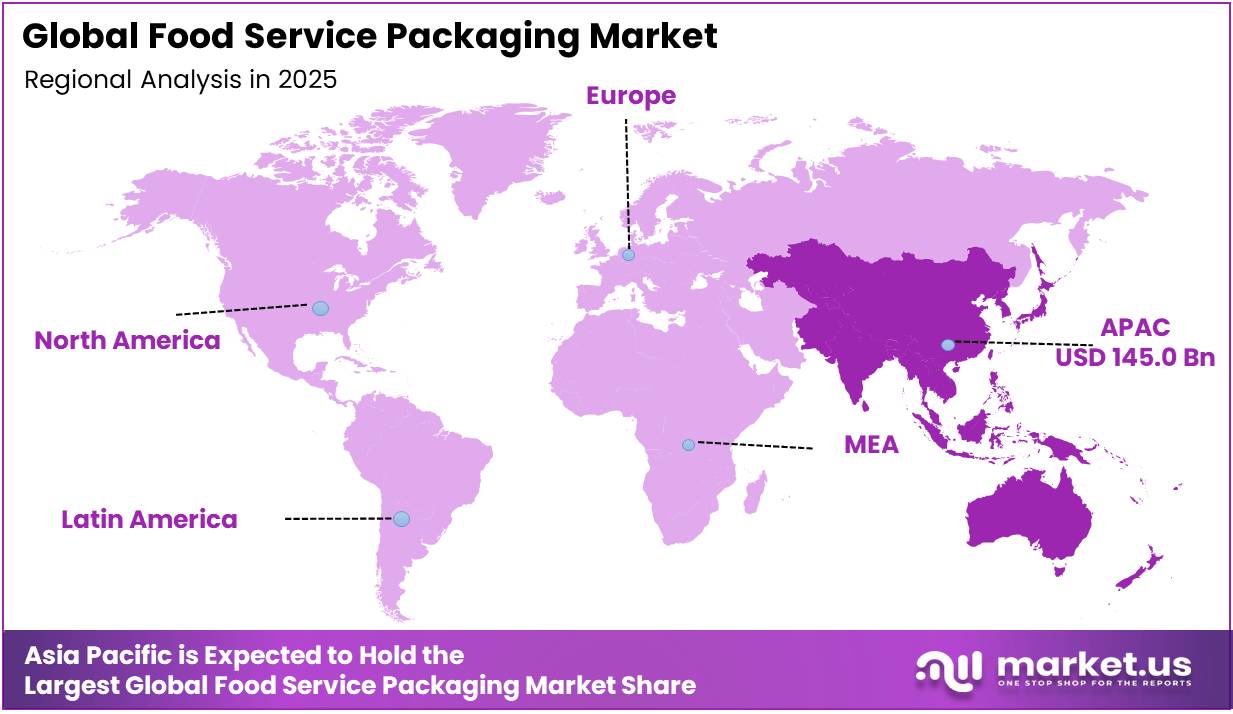
In 2025, the Global Food Service Packaging Market was valued at USD 359.7 billion, and between 2026 and 2035, this market is estimated to register a CAGR of 5.8%, reaching about USD 631.7 billion by 2035. In 2025, Asia Pacific held a dominant market position, capturing more than a 40.3% share, holding USD 145.0 Billion revenue.
The food service packaging market is shaped by the growing reliance on ready-to-eat meals, takeaway consumption, and digitally enabled food delivery systems. Increasing urbanization and time-constrained lifestyles have shifted consumption away from dine-in formats toward portable meal solutions, intensifying demand for packaging that ensures food safety, thermal stability, and convenience during transit.
- According to the US Department of Agriculture (USDA), in 2024, U.S. consumers spent an average of 10.4% of their disposable personal incomes on food.
Key Takeaways
- The global food service packaging market was valued at USD 359.7 billion in 2025.
- The global market is projected to grow at a CAGR of 5.8% and is estimated to reach USD 631.7 billion by 2035.
- On the basis of material type, plastics dominated the market, constituting 42.5% of the total market share.
- Based on the product type, containers dominated the food service packaging market, with a substantial market share of around 34.5%.
- Based on the packaging type, rigid packaging led the market, comprising 62.4% of the total market.
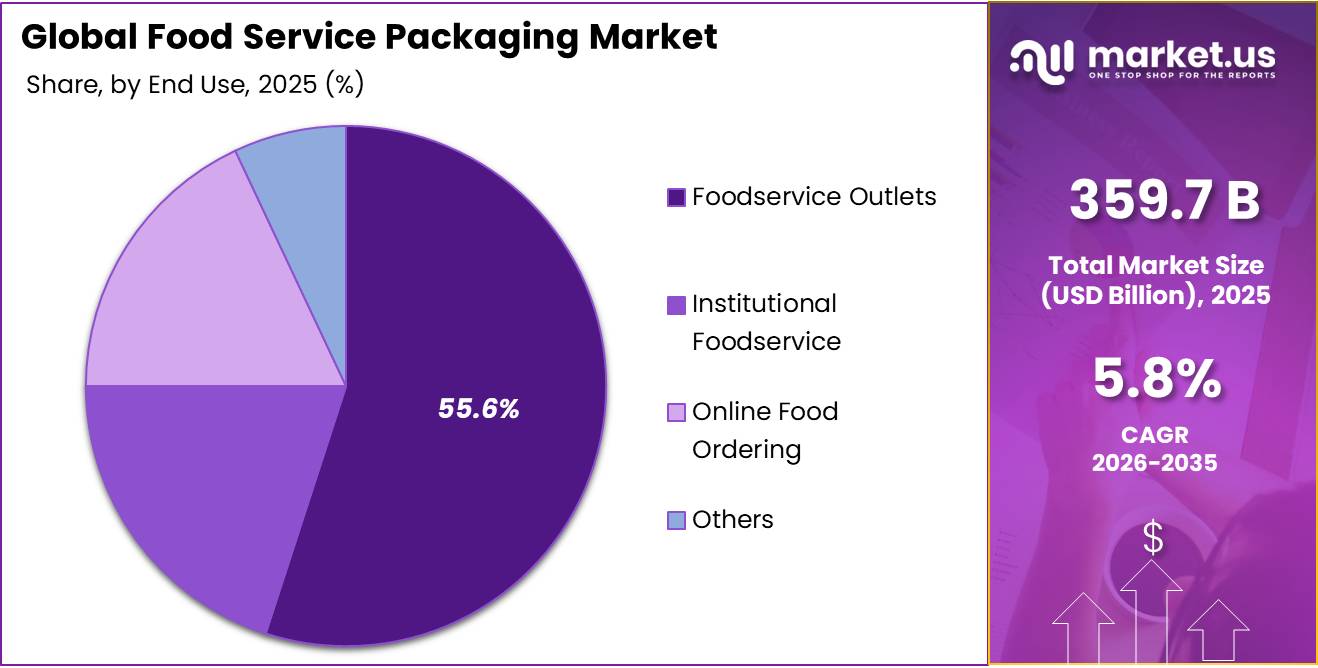
- Among the End-Uses, Foodservice Outlets held a major share in the Food Service Packaging market, 55.6% of the market share.
- Among the fabrication processes, thermoforming is the most considerable within the market, accounting for around 45.6% of the revenue.
- In 2025, the Asia Pacific was the most dominant region in the food service packaging market, accounting for 40.3% of the total global consumption.
Material selection is increasingly influenced by environmental regulation and corporate sustainability commitments, prompting a gradual movement toward recyclable paper-based formats, molded fibers, and bio-based plastics alongside conventional polymer solutions such as polypropylene and polyethylene. Similarly, performance requirements related to heat resistance, barrier properties, and cost efficiency continue to sustain demand for traditional materials, creating a balance between sustainability goals and functional reliability.
- According to the National Restaurant Association, 58.5% of total food expenditures in 2024 in the US alone were for food away from home, underscoring the significance of restaurants in consumer spending and the importance of food packaging.
Manufacturing advancements in thermoforming, injection molding, and extrusion processes are enabling lightweight and resource-efficient packaging formats. The expansion of cloud kitchens, online food ordering platforms, and quick-service restaurant networks further reinforces packaging consumption intensity. Asia Pacific remains a dominant demand hub due to its large consumer base, high food delivery penetration, and rapid growth in organized foodservice infrastructure.
Material Type Analysis
Plastics are a Prominent Segment in the Market.
Plastic emerges as the dominant material segment in the food service packaging market, accounting for approximately 42.5% share. Its widespread adoption is supported by a combination of cost efficiency, lightweight characteristics, and versatility across diverse packaging applications. Plastics such as polyethylene, polypropylene, polystyrene, and polyethylene terephthalate are extensively used in containers, cups, lids, wraps, and flexible packaging formats due to their strong barrier properties, moisture resistance, and ability to preserve food quality during storage and transit.
The material’s adaptability to high-volume manufacturing processes such as injection molding and thermoforming further strengthens its commercial viability for large-scale foodservice operations. Additionally, its durability and design flexibility enable compatibility with evolving consumption patterns, particularly in takeaway and delivery-focused models. Despite growing environmental scrutiny, ongoing innovations in recyclable and lightweight plastic formats continue to sustain its leadership position within the market.
Product Type Analysis
Containers Dominated the Food Service Packaging Market.
Containers represent the dominant product type in the food service packaging market, accounting for approximately 34.5% share. Their leadership is driven by their essential role in a wide range of foodservice applications, particularly in takeaway, delivery, and ready-to-eat meal formats. Containers are extensively used across quick-service restaurants, cloud kitchens, and institutional catering due to their ability to maintain food integrity, prevent leakage, and support portion control.
Their structural versatility allows compatibility with both hot and cold food items, enhancing their functional applicability across cuisines and service models. Materials such as plastic, paperboard, and molded fiber are commonly used, enabling manufacturers to balance cost efficiency with performance requirements.
Packaging Type Analysis
Rigid Packaging is the Most Widely Utilized Packaging.
Rigid packaging represents the dominant segment in the food service packaging market, accounting for approximately 62.4% share. Its strong position is driven by superior structural integrity, product protection, and the ability to maintain food quality during storage, handling, and transportation. Rigid formats such as containers, trays, cups, and clamshells are widely used across quick-service restaurants, institutional catering, and takeaway services where durability and spill resistance are critical.
Rigid packaging further supports functional enhancements such as tamper evidence, microwave compatibility, and stackability, which are increasingly important in delivery-driven consumption models. Despite rising interest in flexible alternatives, rigid formats continue to dominate due to their reliability, performance consistency, and suitability for high-volume foodservice operations.
Fabrication Process Analysis
Thermoforming Held a Major Share of the Food Service Packaging Market.
Thermoforming is the dominant fabrication process in the food service packaging market, accounting for approximately 45.6% share. Its leadership is driven by high production efficiency, design flexibility, and suitability for large-scale manufacturing of lightweight yet durable packaging solutions. The process enables the conversion of plastic sheets into a wide range of product formats, including containers, trays, cups, and clamshells, which are extensively used in takeaway and delivery applications.
Thermoforming supports cost-effective mass production while maintaining consistent dimensional accuracy and structural strength, making it highly compatible with high-volume foodservice demand. It further allows efficient material utilization, reducing waste and improving operational efficiency for manufacturers. The process is widely adopted for polymers such as polypropylene, polystyrene, and polyethylene terephthalate, further reinforcing its relevance.
End Use Analysis
Food Service Packaging is Mostly Utilized by the Foodservice Outlets.
Foodservice outlets represent the dominant end-use segment in the food service packaging market, accounting for approximately 55.6% share. This dominance is supported by the extensive presence of quick-service restaurants, cafés, full-service restaurants, and fast-casual dining establishments, all of which rely heavily on standardized packaging solutions for both dine-in and takeaway operations. The segment benefits from high transaction frequency and large-scale food preparation, which collectively drive continuous packaging consumption.
The growing preference for takeaway and hybrid dining models within foodservice outlets further strengthens packaging demand. Additionally, brand differentiation through customized and visually appealing packaging has become increasingly important, encouraging higher adoption rates. The consistent expansion of organized foodservice networks continues to reinforce this segment’s leading position in overall market consumption.
Key Market Segments
By Material Type
- Aluminum
- Paperboard
- Molded Fibers
- Plastic
- Polystyrene
- Polypropylene
- Polyethylene
- Polyethylene Terephthalate
- Others
- Others
By Product Type
- Containers
- Cups & Lids
- Plates
- Wraps & Films
- Bags & Pouches
- Boxes & Cartons
- Cutlery
- Others
By Packaging Type
- Rigid Packaging
- Flexible Packaging
By Fabrication Process
- Thermoforming
- Die Cutting
- Injection Molding
By End Use
- Foodservice Outlets
- Institutional Foodservice
- Online Food Ordering
- Others
Driver Analysis
PPWR Circular-Packaging Conversion
The EU Packaging and Packaging Waste Regulation, Regulation (EU) 2025/40, is a major demand catalyst because it converts circular design from a voluntary brand claim into a formal market-access requirement for food service packaging sold in the European Union. The regulation entered into force on February 11, 2025 and applies generally from August 12, 2026, covering all packaging and packaging waste regardless of material, origin, or whether it is used for industrial, commercial, household, or food-service purposes.
For food service operators, the cost impact may be modest per unit — often an additional $0.02-0.10 per item depending on the material transition — but becomes material across high-volume restaurant, airline-catering, retail-delivery, and quick-service chains; for packaging producers, the value is in redesign, tooling, compliance testing, food-contact documentation, and long-term supply contracts.
Suppliers that secure recyclability and PFAS-compliance validation in 2026-2027 can capture accelerated conversion demand before the 2030 deadline, creating an estimated +1.5 percentage-point uplift to baseline CAGR across EU markets and export suppliers serving them.
Drivers Impact Analysis
| Driver | (~) % Impact on CAGR Forecast | Geographic Relevance | Impact Timeline |
|---|---|---|---|
| PPWR circular-packaging conversion | +1.5% | EU core, EU import suppliers | Short term (≤ 2 years) |
| Food-delivery and ghost-kitchen growth | +1.3% | APAC, North America, EU, Latin America | Medium term (2-4 years) |
| Recycled-content and EPR mandates | +1.1% | North America, EU, APAC corridors | Short term (≤ 2 years) |
| Tamper-evident delivery packaging | +0.9% | North America, APAC, EU urban hubs | Short term (≤ 2 years) |
| Fiber-based plastic substitution | +0.8% | EU, North America, Japan, APAC | Medium term (2-4 years) |
| Reuse and refill service models | +0.6% | EU core, North America, APAC cities | Long term (≥ 4 years) |
Restraint Analysis
Food-Grade PCR Supply Gap
The availability of food-contact-compliant post-consumer recycled plastic remains a direct restraint because restaurant chains, beverage operators, and packaging converters are being asked to raise recycled content while food-grade recycled PET and HDPE supply depends on approved feedstock, controlled collection, advanced sorting, decontamination, traceability, and regulator-accepted recycling processes.
The pressure intensifies under the EU Packaging and Packaging Waste Regulation: from 2030, contact-sensitive PET packaging must contain 30% post-consumer recycled content, contact-sensitive packaging made from materials other than PET must contain 10%, and plastic packaging not otherwise categorized must contain 35%, with higher 2040 thresholds. In US markets, state requirements also raise demand for compliant recycled material, including Washington’s 25% PCR requirement for plastic beverage containers in 2026 and California’s 25% PCR requirement for glass and plastic beverage bottles by 2025.
The commercial effect is a premium and allocation risk: a converter using 10,000 tonnes of food-contact resin annually may need to secure 1,000-3,500 tonnes of certified PCR by 2030, but unstable supply can create material premiums of 15-40%, force lower-margin spot procurement, or delay conversion of food service formats.
Packaging suppliers must build long-term recycler contracts, invest in closed-loop collection, diversify food-safe resin sources, and redesign toward lower-PCR-dependence materials such as fiber or mono-material recyclable formats; until decontamination capacity scales, the shortfall is modeled to deduct 1.2 percentage points from attainable CAGR through 2028-2030.
Restraint Impact Analysis
| Restraint | (~) % Impact on CAGR Forecast | Geographic Relevance | Impact Timeline |
|---|---|---|---|
| Food-grade PCR supply gap | -1.2% | EU, North America, APAC importers | Medium term (2-4 years) |
| Pulp and polymer cost inflation | -1.1% | Global, EU, APAC, North America | Short term (≤ 2 years) |
| PPWR single-use restrictions | -1.0% | EU core, EU import suppliers | Medium term (2-4 years) |
| Reuse-system cost burden | -0.8% | EU cities, North America, APAC metros | Long term (≥ 4 years) |
| Food-contact compliance friction | -0.7% | EU, North America, Japan | Medium term (2-4 years) |
| Recycling infrastructure mismatch | -0.6% | APAC, Latin America, EU regions | Long term (≥ 4 years) |
Opportunity Analysis
Reuse-as-a-Service Networks
PPWR requires HORECA operators to allow customers to use their own containers without additional charge from February 12, 2027, while takeaway businesses must offer at least 10% of relevant products in reusable formats from 2030; certain beverage reuse requirements rise toward 40% by 2040. A reusable food container typically costs 5-15 times as much as a disposable unit but can be designed for 50-200 cycles, implying lower effective per-use cost when return rates remain above approximately 85%, loss stays below 5-10%, and collection/washing costs are held below $0.15-0.30 per turn.
The strategic white space is most viable in closed or dense networks — university campuses, airports, stadiums, office districts, food courts, railway stations, and delivery-platform catchments — where return logistics can be pooled; suppliers can charge restaurants per completed turn, retain deposits, sell analytics, and operate washing hubs, potentially generating 20-35% recurring service margin rather than low single-digit commodity-packaging margins.
Companies that establish infrastructure partnerships before 2030 reuse targets drive mass tender activity can add an estimated +1.4 percentage points to Food Service Packaging Market CAGR above baseline in Europe, North America, and selected high-density APAC cities.
Opportunity Impact Analysis
| Opportunity | (~) % Potential CAGR Upside | Geographic Relevance | Execution Window |
|---|---|---|---|
| Reuse-as-a-service networks | +1.4% | EU, North America, APAC metros | Medium term (2-4 years) |
| Digital-watermark packaging systems | +1.1% | EU core, North America, Japan | Medium term (2-4 years) |
| PFAS-free barrier-material platforms | +1.2% | EU, UK, North America, APAC exporters | Short term (≤ 2 years) |
| Food-grade PCR closed loops | +1.0% | EU, North America, Japan, South Korea | Long term (≥ 4 years) |
| Delivery-integrity smart packaging | +0.8% | APAC, North America, EU cities | Short term (≤ 2 years) |
| Packaging-services M&A roll-ups | +0.7% | India, Southeast Asia, EU, North America | Medium term (2-4 years) |
Challenges Analysis
PFAS-Free Barrier Performance
PPWR restrictions apply from August 12, 2026 and prohibit food-contact packaging that contains 25 ppb or more of any targeted PFAS, 250 ppb or more of the sum of targeted PFAS, or 50 ppm or more of total PFAS including polymeric PFAS. The technical gap is material: USDA analysis notes that alternatives such as starch, plant proteins, and chitosan can offer adequate oil resistance but may not match PFAS performance against moisture, while OECD-related analysis found that achieving greaseproof-paper performance through additional refining can slow production by approximately 30% and alternative chemistry can cost about 11% more.
Even promising polysaccharide coatings are highly formulation-sensitive: a carboxymethyl-cellulose/chitosan system achieved the top TAPPI T559 Kit No. 12 grease-resistance rating only around pH 4.5, whereas comparable formulations around pH 5.5-6.5 failed grease resistance testing.
The corporate response requires material-specific food migration testing, supplier qualification, coat-weight optimization, coating-line adjustments, barrier-performance warranties, and customer trials across hot, oily, acidic, and moist foods; however, balancing cost, recyclability, compostability, sealability, and high-temperature performance keeps PFAS-free conversion as a -0.9 percentage-point medium-term drag on maximum market growth.
Challenges Impact Analysis
| Challenge | (~) % CAGR Friction Drag | Geographic Relevance | Mitigation Horizon |
|---|---|---|---|
| PFAS-free barrier performance | -0.9% | EU, UK, North America, APAC exporters | Medium term (2-4 years) |
| High-speed converting automation | -0.8% | North America, EU, China, India | Medium term (2-4 years) |
| Food-contact data traceability | -0.7% | EU, North America, Japan, Korea | Medium term (2-4 years) |
| Recovery-stream material sorting | -0.7% | EU, North America, APAC, Latin America | Long term (≥ 4 years) |
| Packaging labor and skills gap | -0.6% | North America, EU, India, APAC | Long term (≥ 4 years) |
| Reuse reverse-logistics integration | -0.5% | EU cities, North America, APAC metros | Long term (≥ 4 years) |
Geopolitical Impact Analysis
Geopolitical Disruptions and Their Cascading Effects on Food Service Packaging Supply Chains.
Current geopolitical tensions are exerting measurable pressure on the food service packaging market through raw material volatility, supply chain disruptions, and cost transmission effects. Packaging materials, particularly plastics and paper, are closely linked to energy and petrochemical supply chains, making them highly sensitive to conflict-driven shocks. The tensions in West Asia have disrupted petrochemical production, including shutdowns of polyethylene and propylene units in India, directly constraining inputs used in flexible and rigid food packaging.
- Reports indicate that polyethylene and related resin prices have increased by up to 50% amid supply disruptions and shipping constraints, while plastic input costs in some sectors rose from INR100/kg to INR170/kg before partial correction. Paper-based packaging has been further affected, with kraft paper prices increasing by INR3-4 per kg and corrugated box costs rising by around 10% due to higher energy and freight expenses.
Moreover, logistics disruptions further compound these effects. Trade route instability, particularly around the Strait of Hormuz, has increased freight costs and led to supply uncertainty for food-grade resins. As the majority of consumer packaging in several countries relies on flexible plastics, such disruptions have cascading implications across foodservice supply chains. These factors increase input cost variability, extend lead times, and necessitate supply chain reconfiguration, reinforcing structural uncertainty in packaging procurement and production.
Regional Analysis
Asia Pacific Held the Largest Share of the Global Food Service Packaging Market.
In 2025, the Asia Pacific dominated the global food service packaging market, holding about 40.3% of the total global consumption, supported by high population density, rapid urbanization, and a structurally large food consumption base. Within food service-specific applications, the region has demonstrated sustained expansion driven by organized dining formats and takeaway-oriented consumption. Consumption patterns are increasingly shaped by digital food delivery platforms and ready-to-eat food penetration, particularly in metropolitan clusters across China, India, and Southeast Asia.
- According to a study by the USDA, India’s foodservice market includes cafes, cloud kitchens, and quick service restaurants and was estimated at US$77.5 billion for 2024 and is projected to reach US$125 billion by 2029.
Flexible packaging formats dominate due to their suitability for transport, cost efficiency, and adaptability across varied cuisines and portion sizes. Rapid expansion of quick-service restaurants, cloud kitchens, and institutional catering further amplifies packaging intensity per transaction, reinforcing the region’s structural dominance in global demand.
Key Regions and Countries Covered
- North America
- The US
- Canada
- Europe
- Germany
- France
- The UK
- Spain
- Italy
- Russia & CIS
- Rest of Europe
- APAC
- China
- Japan
- South Korea
- India
- ASEAN
- Rest of APAC
- Latin America
- Brazil
- Mexico
- Rest of Latin America
- Middle East & Africa
- GCC
- South Africa
- Rest of MEA
Key Players Analysis
Companies in the food service packaging market focus on strengthening material innovation, operational efficiency, and supply chain integration to differentiate themselves. A key priority is the development of sustainable and high-performance materials such as recyclable paper-based solutions, molded fibers, and lightweight plastics that balance cost, durability, and regulatory compliance.
Firms further invest in advanced manufacturing technologies such as thermoforming, injection molding, and extrusion to improve scalability, precision, and cost control. Strategic partnerships with foodservice operators, cloud kitchens, and delivery platforms are increasingly common to co-develop customized packaging that enhances user experience and brand visibility. Additionally, companies emphasize geographic expansion and localized production to reduce logistics costs and improve responsiveness.
The Major Players in The Industry
- Pactiv Evergreen Inc.
- Dart Container Corporation
- Amhil North America
- Genpak LLC
- Huhtamaki Oyj
- Novolex Holdings LLC
- Sabert Corporation
- Silgan Holdings Inc.
- Graphic Packaging Holding Company
- Amcor plc
- Sonoco Products Company
- Anchor Packaging LLC
- Smurfit WestRock
- Georgia-Pacific LLC
- Other Key Players
Key Development
- In April 2025, Novolex completed its US$6.7 billion merger with Pactiv Evergreen, creating a leader in food, beverage, and specialty packaging products.
- In July 2025, Huhtamaki launched new ice cream cups designed to be both recyclable and compostable. The packaging expands its sustainable portfolio, offering solutions suitable for home and industrial composting while targeting improved environmental performance in the ice cream packaging segment.
Report Scope
| Report Features | Description |
|---|---|
| Market Value (2025) | USD 359.7 Bn |
| Forecast Revenue (2035) | USD 631.7 Bn |
| CAGR (2026-2035) | 5.8% |
| Base Year for Estimation | 2025 |
| Historic Period | 2020-2024 |
| Forecast Period | 2026-2035 |
| Report Coverage | Revenue Forecast, Market Dynamics, Competitive Landscape, Recent Developments |
| Segments Covered | By Material Type (Aluminum, Paperboard, Molded Fibers, Plastic, and Others), By Product Type (Containers, Cups & Lids, Plates, Wraps & Films, Bags & Pouches, Boxes & Cartons, Cutlery, and Others), By Packaging Type (Rigid Packaging and Flexible Packaging), By Fabrication Process (Thermoforming, Die Cutting, and Injection Molding), By End Use (Foodservice Outlets, Institutional Foodservice, Online Food Ordering, and Others) |
| Regional Analysis | North America – The US & Canada; Europe – Germany, France, The UK, Spain, Italy, Russia & CIS, Rest of Europe; APAC– China, Japan, South Korea, India, ASEAN & Rest of APAC; Latin America– Brazil, Mexico & Rest of Latin America; Middle East & Africa– GCC, South Africa, & Rest of MEA |
| Competitive Landscape | Pactiv Evergreen Inc., Dart Container Corporation, Amhil North America, Genpak LLC, Huhtamaki Oyj, Novolex Holdings LLC, Sabert Corporation, Silgan Holdings Inc., Graphic Packaging Holding Company, Amcor plc, Sonoco Products Company, Anchor Packaging LLC, Smurfit WestRock, Georgia-Pacific LLC, and Other Players. |
| Customization Scope | Customization for segments, region/country-level will be provided. Moreover, additional customization can be done based on the requirements. |
| Purchase Options | We have three licenses to opt for: Single User License, Multi-User License (Up to 5 Users), Corporate Use License (Unlimited Users and Printable PDF) |





































