One Stop Shop For Reports One Stop Shop For Reports
  • All Reports
  • All Sectors
    • Chemicals & Materials
      • Advanced Materials
      • Bulk Chemicals
      • Coatings | Paints and Additives
      • Composites
      • Renewable | Speciality chemicals
    • Consumer Goods
      • Baby Products
      • Consumer Electronics
      • Consumer Packaging
      • Cosmetics & Personal Care
      • Homecare & Decor
      • Luxury & premium products
    • Energy and Power
      • Energy Efficiency and Conservation
      • Green | Renewable Energy
      • Non Renewable | Conventional Energy
      • Power Equipment and Devices
    • Life Science
      • Biotechnology
      • Diagnostics
      • Healthcare
      • Healthcare IT
      • Medical Devices & Supplies
      • Pharmaceuticals
    • Food and Beverage
      • Agriculture & Agri Products
      • Beverages
      • Food Ingredients
      • Food Services and Hospitality
      • Nutraceutical | Wellness Food
      • Processed & Frozen Foods
    • Automotive and Transportation
      • Automotive components
      • Automotive Logistics
      • Automotive systems and accessories
    • Information and Communications Technology
      • E Commerce and Outsourcing
      • Entertainment & Media
      • High Tech | Enterprise & Consumer IT
      • Information & Network Security
      • Mobility | Telecom & Wireless
      • Software and Services
    • Semiconductor and Electronics
      • Semiconductor Materials and Components
      • Display Technology
      • Electronics System and Components
      • Emerging technologies
      • Security and Surveillance
      • Sensors and Controls
    • Building and Construction
      • Construction Materials
      • HVAC
      • Residential Construction and Improvement
      • Roads & Highways
    • Manufacturing
      • Manufacturing Services
      • Heavy Manufacturing
      • Packaging
      • Engineering | Equipment and Machinery
  • Who Trust Us
  • [email protected]
  • +1 718 874 1545 (International)
  • +91 78878 22626 (Asia)

More Results

One Stop Shop For Reports One Stop Shop For Reports
  • All Reports
  • All Sectors
    • Chemicals & Materials
      • Advanced Materials
      • Bulk Chemicals
      • Coatings | Paints and Additives
      • Composites
      • Renewable | Speciality chemicals
    • Consumer Goods
      • Baby Products
      • Consumer Electronics
      • Consumer Packaging
      • Cosmetics & Personal Care
      • Homecare & Decor
      • Luxury & premium products
    • Energy and Power
      • Energy Efficiency and Conservation
      • Green | Renewable Energy
      • Non Renewable | Conventional Energy
      • Power Equipment and Devices
    • Life Science
      • Biotechnology
      • Diagnostics
      • Healthcare
      • Healthcare IT
      • Medical Devices & Supplies
      • Pharmaceuticals
    • Food and Beverage
      • Agriculture & Agri Products
      • Beverages
      • Food Ingredients
      • Food Services and Hospitality
      • Nutraceutical | Wellness Food
      • Processed & Frozen Foods
    • Automotive and Transportation
      • Automotive components
      • Automotive Logistics
      • Automotive systems and accessories
    • Information and Communications Technology
      • E Commerce and Outsourcing
      • Entertainment & Media
      • High Tech | Enterprise & Consumer IT
      • Information & Network Security
      • Mobility | Telecom & Wireless
      • Software and Services
    • Semiconductor and Electronics
      • Semiconductor Materials and Components
      • Display Technology
      • Electronics System and Components
      • Emerging technologies
      • Security and Surveillance
      • Sensors and Controls
    • Building and Construction
      • Construction Materials
      • HVAC
      • Residential Construction and Improvement
      • Roads & Highways
    • Manufacturing
      • Manufacturing Services
      • Heavy Manufacturing
      • Packaging
      • Engineering | Equipment and Machinery
  • Who Trust Us
Home ➤ Energy and Power ➤ Ultrasonic Flow Meter Market
Ultrasonic Flow Meter Market
Published date: Oct 2026 • Formats:
[email protected] +1 718 874 1545
Request Sample Schedule a Call
Table of Contents
  • Report Overview
  • Key Takeaways
  • By Product Type Analysis
  • By Number of Paths Analysis
  • By Application Analysis
  • By End User Analysis
  • By Distribution Channel Analysis
  • Key Market Segments
  • Driver Analysis
  • Restraint Analysis
  • Opportunity Analysis
  • Challenges Analysis
  • Geopolitical Impact Analysis
  • Regional Insights
  • Key Players Analysis
  • Recent Developments
  • Report Scope
  • Home ➤ Energy and Power ➤ Ultrasonic Flow Meter Market

Ultrasonic Flow Meter Market Size, Share And Report Analysis By Product Type (Spool piece, Insertion, Clamp-on, Others), By Number of Paths (One path, Two paths, Three paths, Four paths, Five paths, Six or more paths), By Application (Natural gas, Petroleum liquids, Non-petroleum liquids, Others), By End User (Oil and gas, Water and wastewater, Power generation, Chemicals, Food and beverages, Pharmaceuticals, Pulp and paper, Others), By Distribution Channel (Direct sales, Distributors, Online sales) , By Region and Companies - Industry Segment Outlook, Market Assessment, Competition Scenario, Trends, and Forecast 2026-2035

  • Published date: Oct 2026
  • Report ID: 195094
  • Number of Pages: 268
  • Format:
Fact Checked
Ultrasonic Flow Meter Market https://market.us/report/ultrasonic-flow-meter-market/
Cite this Research
  • Overview
  • Table of Contents
  • Segmentation
  • currency-icon
    Revenue, 2025 (US$B)
    2.8 Bn
    growth-icon
    Forecast, 2035 (US$B)
    5.0 Bn
    chart-icon
    CAGR, 2025 - 2035
    5.8%
    globe-icon
    Leading Region
    Asia Pacific

    Quick Navigation

    • Report Overview
    • Key Takeaways
    • By Product Type Analysis
    • By Number of Paths Analysis
    • By Application Analysis
    • By End User Analysis
    • By Distribution Channel Analysis
    • Key Market Segments
    • Driver Analysis
    • Restraint Analysis
    • Opportunity Analysis
    • Challenges Analysis
    • Geopolitical Impact Analysis
    • Regional Insights
    • Key Players Analysis
    • Recent Developments
    • Report Scope

    Report Overview

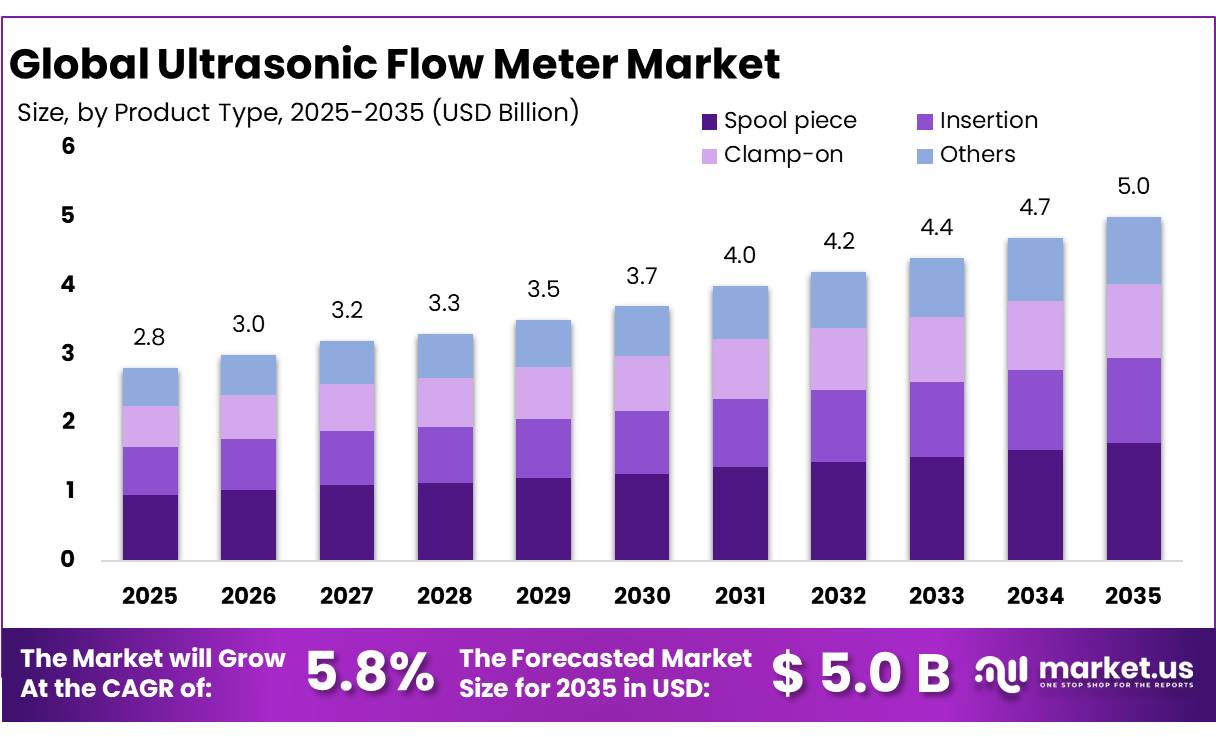
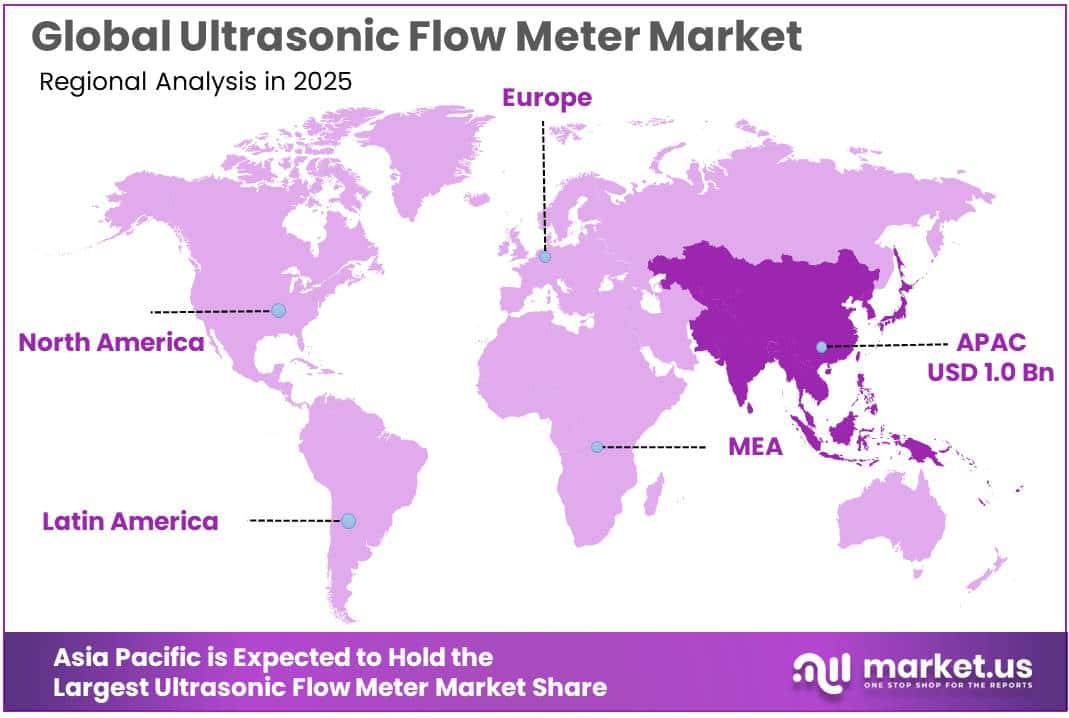
    The Global Ultrasonic Flow Market size is expected to be worth around USD 5.0 Billion by 2035, from USD 2.8 Billion in 2025, growing at a CAGR of 5.8% during the forecast period from 2026 to 2035. In 2025, Asia Pacific held a dominant market position, capturing more than a 38.00% share, holding USD 1.0 Billion revenue.

    Ultrasonic flow meters are advanced instruments used to measure the flow rate of liquids and gases through pipelines using ultrasonic sound waves. These meters are widely used in water and wastewater treatment, chemicals, oil and gas, power generation, pharmaceuticals, food processing, and industrial manufacturing. Depending on the design, they measure flow using transit-time or Doppler technology. Clamp-on ultrasonic flow meters are particularly useful because they can be installed outside a pipe, reducing the need to interrupt operations or cut into pipelines.
    • According to the United States Geological Survey (USGS), self-supplied industrial water withdrawals in the United States reached approximately 14.8 billion gallons per day in 2015, representing about 5% of total water withdrawals. The USGS also reported that industrial water withdrawals had declined by approximately 43% between 1985 and 2015, reflecting changes in manufacturing activity, process efficiency, and water reuse.
    Ultrasonic Flow Meter Market

    Driving factors for the ultrasonic flow meter industry include stricter resource-management practices, industrial automation, demand for accurate process measurements, and the need to reduce maintenance costs. The United States Environmental Protection Agency (EPA), through its WaterSense at Work guidance updated in November 2023, recommends metering and submetering to identify excessive water consumption, detect leaks, and monitor the results of water-efficiency improvements. The EPA also identifies clamp-on ultrasonic meters as non-intrusive devices that require relatively little maintenance and do not create pressure drops in the pipeline.

    Key Takeaways

    • Ultrasonic Flow Market size is expected to be worth around USD 5.0 Billion by 2035, from USD 2.8 Billion in 2025, growing at a CAGR of 5.8%.
    • Spool piece held a dominant market position, capturing more than a 34.00% share.
    • One path held a dominant market position, capturing more than a 38.00% share.
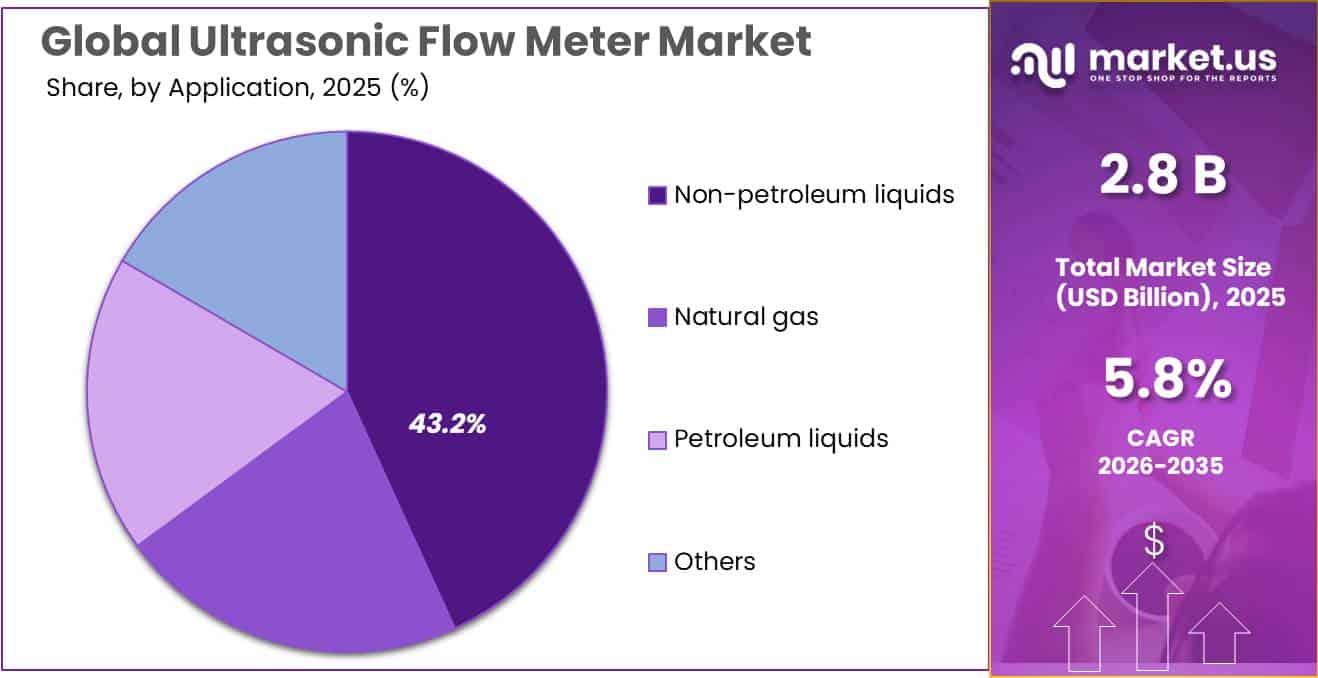
    • Non-petroleum liquids held a dominant market position, capturing more than a 43.00% share.
    • Oil and gas held a dominant market position, capturing more than a 28.00% share.
    • Direct sales held a dominant market position, capturing more than a 53.50% share.
    • Asia Pacific held a dominant position in the Ultrasonic Flow Meter Market, accounting for 38.00% of the market, with a reported value of USD 1.0 billion.

    By Product Type Analysis

    Spool Piece: 34.00% Share in 2025 Supported by Reliable, In-Line Flow Measurement
    In 2025, “Spool piece” held a dominant market position, capturing more than a 34.00% share of the Ultrasonic Flow Meter Market by product type. Spool-piece ultrasonic flow meters are installed directly into pipelines and are suitable for applications that require consistent flow measurement and reliable process monitoring. Their fixed installation supports continuous measurement in water treatment, chemical processing, oil and gas, and industrial fluid-handling systems. These meters are particularly useful where measurement accuracy and dependable operation are important for process control. Their adoption is supported by the need to monitor fluid movement and improve operating efficiency.
    Insertion ultrasonic flow meters are used to measure fluid flow by inserting sensors into a pipeline while avoiding the need for a full spool-piece replacement. They can be suitable for large pipelines and industrial systems where installation cost, maintenance access, and continuous operation are important considerations. In 2025, demand for insertion meters was supported by industrial requirements for water monitoring, process control, and efficient fluid management. The United States Geological Survey explains that industrial water-use monitoring covers manufacturing activities such as processing, washing, cooling, and transporting products, highlighting the importance of reliable flow measurement.

    By Number of Paths Analysis

    One Path: 38.00% Share in 2025 Supported by Simple Design and Cost-Effective Flow Measurement
    In 2025, “One path” held a dominant market position, capturing more than a 38.00% share of the Ultrasonic Flow Meter Market by number of paths. One-path ultrasonic flow meters offer a practical solution for applications that require straightforward installation and dependable flow measurement. Their simpler design can help reduce equipment complexity and make them suitable for water distribution, industrial process monitoring, and general fluid-handling operations. These meters are attractive to facilities seeking reliable measurement without the additional complexity of multiple acoustic paths. Their use is supported by the wider need for effective water monitoring and industrial process control.
    Two-path ultrasonic flow meters use two acoustic measurement paths to assess fluid movement through a pipeline. This configuration can improve measurement reliability by providing additional flow information compared with a single-path design, particularly where flow profiles are uneven.
    In 2025, two-path systems served industrial applications that required dependable monitoring, including water treatment, chemical processing, and energy operations. Their suitability depends on pipeline conditions, installation quality, and the required measurement accuracy. The United States Geological Survey provides official information on industrial water use and measurement practices, demonstrating the importance of monitoring water movement in industrial facilities.

    By Application Analysis

    Non-Petroleum Liquids: 43.00% Share in 2025 Driven by Industrial Fluid Monitoring
    In 2025, “Non-petroleum liquids” held a dominant market position, capturing more than a 43.00% share of the Ultrasonic Flow Meter Market by application. These flow meters are used to measure liquids such as water, treated wastewater, and various industrial process fluids. Their ability to measure flow without moving parts makes them suitable for applications that require dependable monitoring and low maintenance. Demand is supported by water treatment facilities, chemical processing plants, and industrial manufacturers seeking better control over fluid movement and resource use. The segment’s reported 43.00% share reflects its position in the supplied market data.
    Natural gas ultrasonic flow meters are used to measure gas movement across transmission pipelines, distribution networks, processing facilities, and industrial plants. In 2025, demand for these meters was supported by the need for accurate gas measurement, operational monitoring, and efficient pipeline management. According to the United States Energy Information Administration (EIA), the United States natural gas pipeline network comprises approximately 3 million miles of mainline and other pipelines, demonstrating the scale of infrastructure requiring flow monitoring. Ultrasonic technology is suitable for natural gas applications because it measures gas flow without relying on moving mechanical parts. As pipeline operators focus on operational efficiency and reliable gas delivery, ultrasonic flow meters offer opportunities for improved measurement and digital monitoring.

    By End User Analysis

    Oil and Gas: 28.00% Share in 2025 Driven by Pipeline Monitoring Needs
    In 2025, “Oil and gas” held a dominant market position, capturing more than a 28.00% share of the Ultrasonic Flow Meter Market by end user. The oil and gas industry uses ultrasonic flow meters to monitor fluid movement across processing facilities, pipelines, and gas distribution systems. These meters support operational control by measuring flow without moving mechanical parts, helping reduce routine maintenance requirements. Their ability to support continuous monitoring makes them useful in facilities where measurement reliability and process efficiency are important. The segment’s reported 28.00% share reflects the supplied market data.
    Water and wastewater utilities use ultrasonic flow meters to monitor water distribution, wastewater treatment, pumping operations, and water reuse systems. In 2025, demand was supported by the need to improve flow measurement, identify water losses, and maintain efficient treatment operations. According to the United States Environmental Protection Agency (EPA), its 2022 Clean Watersheds Needs Survey identified USD 630.1 billion in clean-water infrastructure investment needs over the following 20 years. The survey also identified 17,544 publicly owned treatment works serving 270.4 million people in the United States as of January 2022.
    Ultrasonic Flow Meter Market Share

    By Distribution Channel Analysis

    Direct Sales: 53.50% Share in 2025 Supported by Direct Customer Relationships
    In 2025, “Direct sales” held a dominant market position, capturing more than a 53.50% share of the Ultrasonic Flow Meter Market by distribution channel. Direct sales allow manufacturers to work closely with industrial customers, understand their measurement requirements, and recommend suitable flow meter configurations. This channel is particularly useful for oil and gas facilities, chemical plants, and water treatment operators that may require technical guidance, product customization, installation support, and after-sales service. Direct communication also helps manufacturers address application-specific requirements and build long-term customer relationships.
    Distributors support the ultrasonic flow meter market by connecting manufacturers with industrial buyers across different locations and sectors. In 2025, this channel remained relevant for customers seeking product availability, local technical assistance, and access to flow measurement equipment for water treatment, manufacturing, and energy applications. Distributors can also help buyers compare suitable products and coordinate delivery and servicing. The United States Census Bureau reported that wholesale trade sales reached approximately USD 12.0 trillion in 2023, illustrating the substantial role of wholesale distribution in the wider US economy.

    Key Market Segments

    By Product Type

    • Spool piece
    • Insertion
    • Clamp-on
    • Others

    By Number of Paths

    • One path
    • Two paths
    • Three paths
    • Four paths
    • Five paths
    • Six or more paths

    By Application

    • Natural gas
    • Petroleum liquids
    • Non-petroleum liquids
    • Others

    By End User

    • Oil and gas
    • Water and wastewater
    • Power generation
    • Chemicals
    • Food and beverages
    • Pharmaceuticals
    • Pulp and paper
    • Others

    By Distribution Channel

    • Direct sales
    • Distributors
    • Online sales

    Driver Analysis

    Water-Loss Digitization
    Water-network digitization is the strongest 2026 ultrasonic flow meter demand driver because utilities need continuous district-metered-area balancing, minimum-night-flow diagnostics and non-revenue-water measurement without cutting pipework or accepting the pressure loss and maintenance burden of mechanical meters.
    The EU Drinking Water Directive requires Member States to assess leakage for suppliers delivering at least 10,000 m³/day or serving at least 50,000 people, communicate results by 12 January 2026, and will require the Commission to set a Union leakage threshold by 12 January 2028; suppliers above that threshold will have two years to file reduction action plans, establishing a 2026–2030 procurement runway for permanent bulk ultrasonic meters, clamp-on survey equipment and SCADA-integrated telemetry.
    India adds a high-volume deployment pathway: Jal Jeevan Mission 2.0 guidelines were published in May 2026 and state-level programmes such as Uttar Pradesh’s dashboard already track scheme integration, operations and automation status, raising demand for flow instrumentation at source, treatment, reservoir and distribution-node levels. An analyst model indicates that a 300-DMA utility replacing annual manual surveys with 2–4 permanent flow points per DMA can deploy 600–1,200 meters; identifying even a 1% improvement in billed-water recovery in a 100 million m³/year system can protect 1 million m³ of sellable water, making a USD 1,500–6,000 meter-and-telemetry installation commercially defensible.
    The shift redirects suppliers from one-time meter hardware toward recurring diagnostic software, verification services and asset-management contracts, supporting an estimated +1.8-percentage-point contribution to ultrasonic flow meter CAGR across Europe, North America, India and Gulf utilities through 2030.

    Drivers Impact Analysis

    Driver (~) % Impact on CAGR Geographic Relevance Impact Timeline
    Water-Loss Digitization +1.8 pp EU; North America; India; Gulf Medium term (2–4 years)
    Oil & Gas Methane MRV +1.5 pp EU; North America; Middle East Short term (≤ 2 years)
    Smart Utility Metering +1.3 pp India; China; Southeast Asia; LatAm Medium term (2–4 years)
    Non-Invasive Retrofit Demand +1.1 pp Global industrial plants Short term (≤ 2 years)
    Industrial Process Automation +1.0 pp China; EU; North America; Japan Medium term (2–4 years)
    Hydrogen & CCUS Metering +0.8 pp EU; North America; Gulf; Australia Long term (≥ 4 years)

    Restraint Analysis

    High Installed-System Cost
    Ultrasonic flow meters face an immediate procurement restraint because their purchase price, transmitter, transducers, installation engineering, communication module, site survey and commissioning typically cost 2–6 times more than a basic mechanical turbine, positive-displacement or electromagnetic alternative for comparable utility duty, particularly in smaller pipe sizes where the technical benefits of non-intrusive measurement do not always offset upfront CapEx.
    An analyst model places a mechanically metered DN20–DN40 connection at USD 40–120, versus USD 100–250 for a basic ultrasonic unit and USD 180–450 for a connected solid-state design; at the industrial level, a fixed clamp-on installation can cost USD 4,000–15,000 and a custody-grade gas ultrasonic package USD 25,000–150,000 once pressure, temperature, data acquisition and site works are included.
    Legal-metrology compliance compounds the initial outlay: EU Measuring Instruments Directive 2014/32/EU requires technical documentation, risk and conformity assessment, CE and supplementary metrology marking, and notified-body involvement for relevant measuring instruments, while OIML R 49:2024 requires electrical and electronic water meters to meet defined metrological and technical standards.
    For a utility replacing 50,000 residential meters, an incremental USD 75 per ultrasonic meter adds USD 3.75 million before AMI communications, installation and systems integration, forcing public buyers to phase deployment despite expected reductions in reading costs, leakage and maintenance. Suppliers must therefore finance leases, performance contracts or metering-as-a-service arrangements, but the working-capital burden and tender focus on lowest purchase price constrain near-term volume, generating an estimated -1.6-percentage-point drag on 2026–2028 CAGR across North America, Europe and emerging APAC.

    Restraint Impact Analysis

    Restraint (~) % Impact on CAGR Geographic Relevance Impact Timeline
    High Installed-System Cost -1.6 pp North America; EU; emerging APAC Short term (≤ 2 years)
    Low-Cost Mechanical Substitutes -1.3 pp India; China; Southeast Asia; Africa Medium term (2–4 years)
    Certification and Approval Burden -1.1 pp EU; North America; Gulf; Japan Medium term (2–4 years)
    Semiconductor Supply Exposure -0.9 pp Global electronics supply chains Short term (≤ 2 years)
    Installation Condition Sensitivity -0.8 pp Global industrial retrofit sites Medium term (2–4 years)
    Municipal Budget Constraints -0.7 pp Africa; LatAm; South Asia; U.S. rural Long term (≥ 4 years)

    Opportunity Analysis

    Flow-Data SaaS

    Flow-data software is an underexploited monetization layer because ultrasonic-meter suppliers still derive most revenue from a one-time instrument sale, whereas a secure cloud platform can convert meter telemetry, diagnostics, consumption patterns, pressure context and alarm history into recurring subscriptions for leakage detection, meter-health monitoring, billing validation and energy optimization.

    This is future upside—not a current driver—because it requires vendors to move from proprietary device protocols to open APIs, managed connectivity and customer success operations; an analyst model estimates that a USD 1,500–5,000 municipal or industrial meter can support USD 10–50 per month in software, data retention and analytics fees, lifting 10-year customer revenue by 25–60% while software gross margins can reach 65–80% after platform scale.

    The regulatory timing is favourable: EU Member States had to submit national leakage assessments by 12 January 2026, and the Commission must set an EU-wide leakage threshold by 12 January 2028, after which Member States above the threshold must submit reduction plans, creating a data-management need beyond physical measurement. A 500,000-connection utility with 1,000 district flow and pressure points could create an analyst-estimated USD 0.5–1.5 million annual software addressable revenue for dashboards, event detection and regulatory reporting, while an additional 1–2% reduction in non-revenue water can fund the subscription through recovered billable volume.

    Suppliers that integrate cybersecurity, telemetry, hydraulics and billing data can reduce customer acquisition costs through embedded hardware channels and protect accounts against meter commoditization, potentially adding +1.7 percentage points above baseline CAGR in North America, Europe, Gulf utilities and digitalizing APAC markets over 2026–2030.

    Opportunity Impact Analysis

    Opportunity (~) % Potential CAGR Geographic Relevance Execution Window
    Flow-Data SaaS +1.7 pp North America; EU; Gulf; APAC Medium term (2–4 years)
    Leakage Performance Contracts +1.5 pp EU; India; LatAm; Africa Medium term (2–4 years)
    Methane-MRV Metering Skids +1.4 pp EU; Middle East; North America Short term (≤ 2 years)
    Hydrogen-Ready Retrofits +1.2 pp EU; Gulf; Australia; Japan Long term (≥ 4 years)
    Clamp-On Rental Networks +1.0 pp Global industrial corridors Short term (≤ 2 years)
    OEM Digital-Twin Bundles +0.9 pp EU; North America; China; Japan Medium term (2–4 years)

    Challenges Analysis

    Installation-Profile Variability

    Ultrasonic meter accuracy is continuously exposed to field variability because transit-time and Doppler systems depend on stable acoustic paths and representative velocity profiles, while real pipelines contain partially full sections, aeration, suspended solids, corrosion, scaling, coatings, ovality, pumps, reducers, valves and closely spaced bends that distort signal quality and flow distribution without fully stopping deployment.

    OIML R 49:2024 requires water meters to remain compliant under specified disturbed velocity fields, requires repeatability where the standard deviation of three readings at the same flow does not exceed one-third of the maximum permissible error, and directs manufacturers to specify flow-profile sensitivity when upstream and downstream disturbances can affect accuracy.

    In an analyst installation model, 10–20% of clamp-on survey sites require transducer repositioning or a different frequency, 5–10% need pipe-wall thickness verification or surface remediation, and 3–7% are unsuitable without installing flow conditioners or switching to insertion/in-line technology; each exception can add USD 1,000–5,000 in engineering, travel and lost commissioning time, while a 1–2% error at a 5 million m³/year transfer point creates 50,000–100,000 m³ of annual reconciliation uncertainty.

    Suppliers must build digital pipe libraries, pre-installation ultrasound-thickness surveys, AI-assisted signal-quality diagnostics and certified installer networks, but changing industrial and municipal asset conditions mean this remains an operational calibration burden rather than an immediate barrier, producing an estimated -1.0-percentage-point CAGR friction drag globally over two to four years.

    Challenges Impact Analysis

    Challenge (~) % CAGR Friction Geographic Relevance Mitigation Horizon
    Installation-Profile Variability -1.0 pp Global retrofit sites Medium term (2–4 years)
    Calibration Capacity Gaps -0.8 pp Africa; LatAm; South Asia Long term (≥ 4 years)
    Electronics Supply Volatility -0.8 pp Global; APAC supply chains Medium term (2–4 years)
    Digital Integration Fragmentation -0.7 pp EU; North America; APAC utilities Medium term (2–4 years)
    Application Engineering Scarcity -0.6 pp Global industrial markets Long term (≥ 4 years)
    Cybersecurity Lifecycle Burden -0.5 pp EU; North America; advanced APAC Medium term (2–4 years)

    Geopolitical Impact Analysis

    Geopolitical Impact of the Middle East War on the Ultrasonic Flow Meter Market

    The ongoing Middle East conflict in 2026, alongside the Russia-Ukraine war, is creating uncertainty for the ultrasonic flow meter market through energy price volatility, shipping delays, and higher industrial operating costs. Ultrasonic flow meters are used in oil and gas pipelines, chemical plants, water treatment facilities, and energy infrastructure, making demand closely linked to industrial investment and maintenance activity. According to the United Nations, Middle East oil production fell by at least 9 million barrels per day in March 2026, compared with estimated February production of 26 million barrels per day.

    For flow meter manufacturers, higher freight charges, component shortages, and longer delivery times may increase production costs, particularly for products requiring specialized electronics, sensors, and precision-engineered components. Energy companies may delay non-essential equipment purchases when budgets become uncertain, although pipeline monitoring and maintenance requirements can support continued demand. The International Energy Agency reported that global energy investment was expected to reach USD 3.4 trillion in 2026, reflecting continued investment despite geopolitical risks.

    Regional Insights

    Dominating Region: Asia Pacific

    In 2025, Asia Pacific held a dominant position in the Ultrasonic Flow Meter Market, accounting for 38.00% of the market, with a reported value of USD 1.0 billion. Regional demand is supported by industrial manufacturing, expanding water treatment infrastructure, energy projects, and increasing adoption of automated process monitoring. China, Japan, South Korea, and Southeast Asian economies contribute through their chemical, power, electronics, and industrial processing sectors.

    Ultrasonic flow meters help operators monitor liquid and gas movement, improve process control, and reduce maintenance needs. The International Energy Agency highlights the importance of integrated energy and water management in improving industrial resource efficiency, supporting the long-term relevance of flow measurement technologies.

    Southeast Asia offers growth opportunities as governments and industries invest in water security, wastewater treatment, energy infrastructure, and manufacturing modernization. Ultrasonic flow meters can support these projects by providing accurate flow readings without moving mechanical parts, making them useful for industrial pipelines and water management systems.

    According to the Asian Water Development Outlook 2025, Asia and the Pacific require an estimated USD 3.998 trillion in water-related investment, equivalent to approximately USD 249.8 billion annually, based on the report’s investment estimates. This regional requirement highlights the scale of infrastructure development that can support demand for monitoring equipment.
    Ultrasonic Flow Meter Market Regional Analysis

    Key Regions and Countries Insights

    • North America
      • US
      • Canada
    • Europe
      • Germany
      • France
      • The UK
      • Spain
      • Italy
      • Rest of Europe
    • Asia Pacific
      • China
      • Japan
      • South Korea
      • India
      • Australia
      • Rest of APAC
    • Latin America
      • Brazil
      • Mexico
      • Rest of Latin America
    • Middle East & Africa
      • GCC
      • South Africa
      • Rest of MEA

    Key Players Analysis

    Emerson Electric Co. is a key participant in the ultrasonic flow meter market, offering measurement and automation technologies for industrial applications, including oil and gas, chemicals, and water management. Its instrumentation portfolio supports accurate flow monitoring and process control. In 2025, Emerson reported net sales of USD 18.016 billion, compared with USD 17.492 billion in 2024, representing approximately 3% growth. Its global presence and industrial automation expertise support its competitive position in flow measurement solutions.

    Siemens AG competes in industrial automation and digital infrastructure, providing technologies that support process monitoring and efficient industrial operations. Its automation systems can integrate flow measurement data into wider plant-control platforms, helping operators monitor processes and improve efficiency. In fiscal 2025, Siemens generated revenue of EUR 78.9 billion, up 4% on a nominal basis, while net income reached EUR 10.4 billion. The company also reported EUR 88.4 billion in orders, reflecting demand across its industrial businesses.

    Endress+Hauser Group specializes in process measurement and automation equipment, including flow measurement solutions for water, chemicals, energy, and other industries. Its ultrasonic measurement technologies support reliable monitoring of liquids and gases across industrial processes. In 2025, the company reported net sales of EUR 4.01 billion, an increase of 7.2% from the previous year. It invested EUR 370.8 million in buildings, plants, information technology, and software, and employed 18,306 people at year-end. These investments support product development and its global measurement technology business.

    Top Key Players Outlook

    • Emerson Electric Co.
    • Siemens AG
    • Endress+Hauser Group
    • KROHNE Group
    • ABB Ltd.
    • Baker Hughes Company
    • Honeywell International Inc.
    • Yokogawa Electric Corporation
    • Fuji Electric Co., Ltd.
    • Badger Meter, Inc.
    • Danfoss A/S
    • FLEXIM Instruments GmbH
    • ifm electronic GmbH
    • Aichi Tokei Denki Co., Ltd.
    • Bronkhorst High-Tech B.V.

    Recent Developments

    • In February 2026, Honeywell amended its agreement to acquire Johnson Matthey’s Catalyst Technologies business, reducing the proposed consideration to GBP 1.325 billion and extending the transaction deadline.
    • In February 2026, ABB published its 2025 annual reporting suite, reporting group revenue of USD 33.22 billion and describing its Measurement & Analytics business as a supplier of smart instrumentation for measuring flow, pressure, temperature, and level.

    Report Scope

    Report Features Description
    Market Value (2025) USD 2.8 Bn
    Forecast Revenue (2035) USD 5.0 Bn
    CAGR (2026-2035) 5.8%
    Base Year for Estimation 2025
    Historic Period 2020-2024
    Forecast Period 2026-2035
    Report Coverage Revenue Forecast, Market Dynamics, Competitive Landscape, Recent Developments
    Segments Covered By Product Type (Spool piece, Insertion, Clamp-on, Others), By Number of Paths (One path, Two paths, Three paths, Four paths, Five paths, Six or more paths), By Application (Natural gas, Petroleum liquids, Non-petroleum liquids, Others), By End User (Oil and gas, Water and wastewater, Power generation, Chemicals, Food and beverages, Pharmaceuticals, Pulp and paper, Others), By Distribution Channel (Direct sales, Distributors, Online sales)
    Regional Analysis North America – US, Canada; Europe – Germany, France, The UK, Spain, Italy, Rest of Europe; Asia Pacific – China, Japan, South Korea, India, Australia, Singapore, Rest of APAC; Latin America – Brazil, Mexico, Rest of Latin America; Middle East & Africa – GCC, South Africa, Rest of MEA
    Competitive Landscape Emerson Electric Co., Siemens AG, Endress+Hauser Group, KROHNE Group, ABB Ltd., Baker Hughes Company, Honeywell International Inc., Yokogawa Electric Corporation, Fuji Electric Co., Ltd., Badger Meter, Inc., Danfoss A/S, FLEXIM Instruments GmbH, ifm electronic GmbH, Aichi Tokei Denki Co., Ltd., Bronkhorst High-Tech B.V.
    Customization Scope Customization for segments, region/country-level will be provided. Moreover, additional customization can be done based on the requirements.
    Purchase Options We have three licenses to opt for: Single User License, Multi-User License (Up to 5 Users), Corporate Use License (Unlimited User and Printable PDF)
    keyboard_arrow_up
  • Segments Sub-segments
    By Product Type
    • Spool piece
    • Insertion
    • Clamp-on
    • Others
    By Number of Paths
    • One path
    • Two paths
    • Three paths
    • Four paths
    • Five paths
    • Six or more paths
    By Application
    • Natural gas
    • Petroleum liquids
    • Non-petroleum liquids
    • Others
    By End User
    • Oil and gas
    • Water and wastewater
    • Power generation
    • Chemicals
    • Food and beverages
    • Pharmaceuticals
    • Pulp and paper
    • Others
    By Distribution Channel
    • Direct sales
    • Distributors
    • Online sales
     
    North America Europe Asia Pacific Latin America Middle East & Africa
    • US
    • Canada
    • Germany
    • France
    • The UK
    • Spain
    • Italy
    • Rest of Europe
    • China
    • Japan
    • South Korea
    • India
    • Australia
    • Rest of APAC
    • Brazil
    • Mexico
    • Rest of Latin America
    • GCC
    • South Africa
    • Rest of MEA
Ultrasonic Flow Meter Market
Published date: Oct 2026
add_shopping_cartBuy Now get_appDownload Sample

Related Reports

  • Train Battery Market
  • Oil and Gas Pumps Market
  • Gas Utility Management Market
  • Liquid Lithium Ion Battery Market
  • Automotive Energy Recovery Systems Market
  • Electric and Hybrid Construction Equipment Market
  • E-fuels Market
  • Offshore Wind Installations Market
  • Ancillary Services for Power Market
  • Natural Gas Power Generation Market
Ultrasonic Flow Meter Market
  • 195094
  • Oct 2026
    • ★★★★★
      ★★★★★
Buy Now
Trusted by more than 17382 organizations globally
  • Client Logo
  • Client Logo
  • Client Logo
  • Client Logo
  • Client Logo
  • Client Logo
  • Client Logo
  • Client Logo
  • Client Logo
  • Client Logo
  • Client Logo
  • Client Logo
  • Client Logo
  • Client Logo
  • Client Logo
  • Client Logo

Our Clients

philips
pentair
suez
ecowater
ergobaby
fabricato
genomatica
lenzing
lilly
siemens
honeywell
valspar
pactiv
petsure
schweitzer-online
sappi
pfizer
unilabs
lonza
BD
mckinsey
hilti
✖
Request a Sample Report
We'll get back to you as quickly as possible
CAPTCHA Code

✖
Request a Sample Report
We'll get back to you as quickly as possible
CAPTCHA Code

  • location_on420 Lexington Avenue, Suite 300 New York City, NY 10170,
    United States
  • phone+1 718 874 1545 (International)
  • phone+91 78878 22626 (Asia)
  • email[email protected]
  • Facebook Logo
  • Twitter Logo
  • LinkedIn Logo
Find Help
  • Contact Us
  • How to Order
Legal
  • Privacy Policy
  • Refund Policy
  • Frequently Asked Questions
  • Terms and Conditions
Explore
  • About Us
  • Our Clients
  • Media Mentions
  • Infographics
  • Statistics and Facts
  • Research Methodology
  • Why Choose Us?
Secured Payment Options

© 2026 Market.Us. All Rights Reserved.