


Report Overview
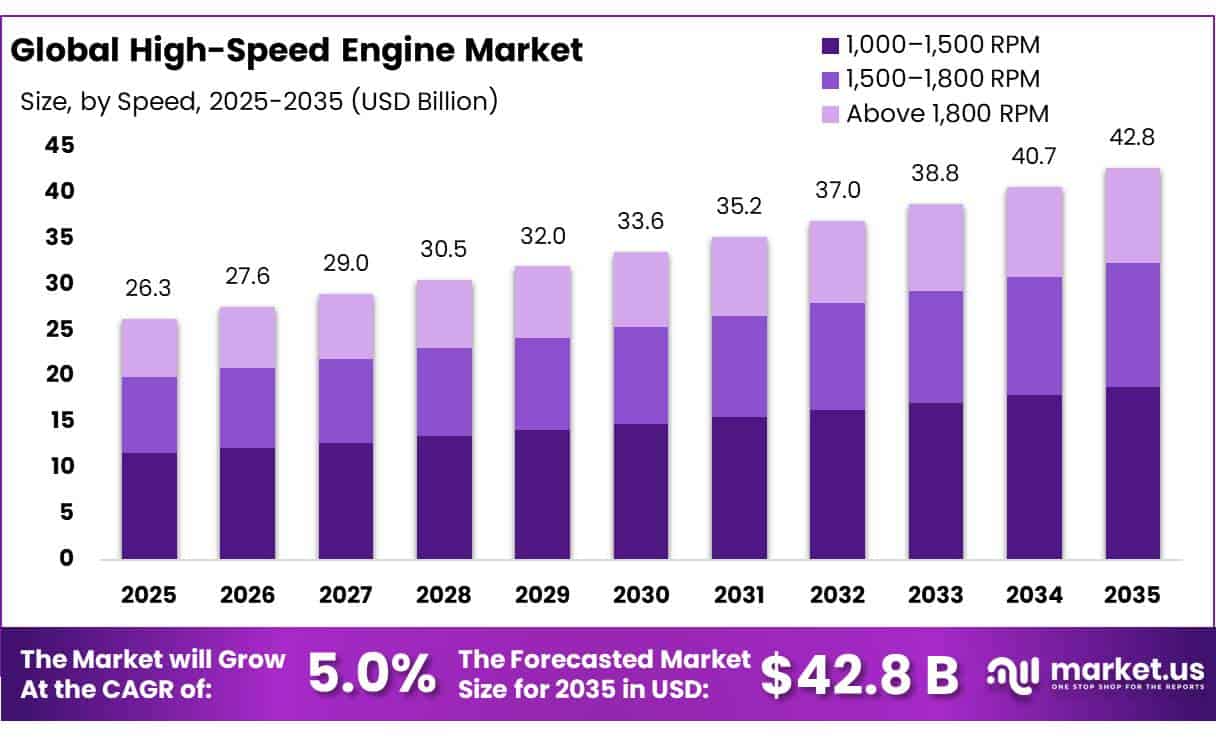
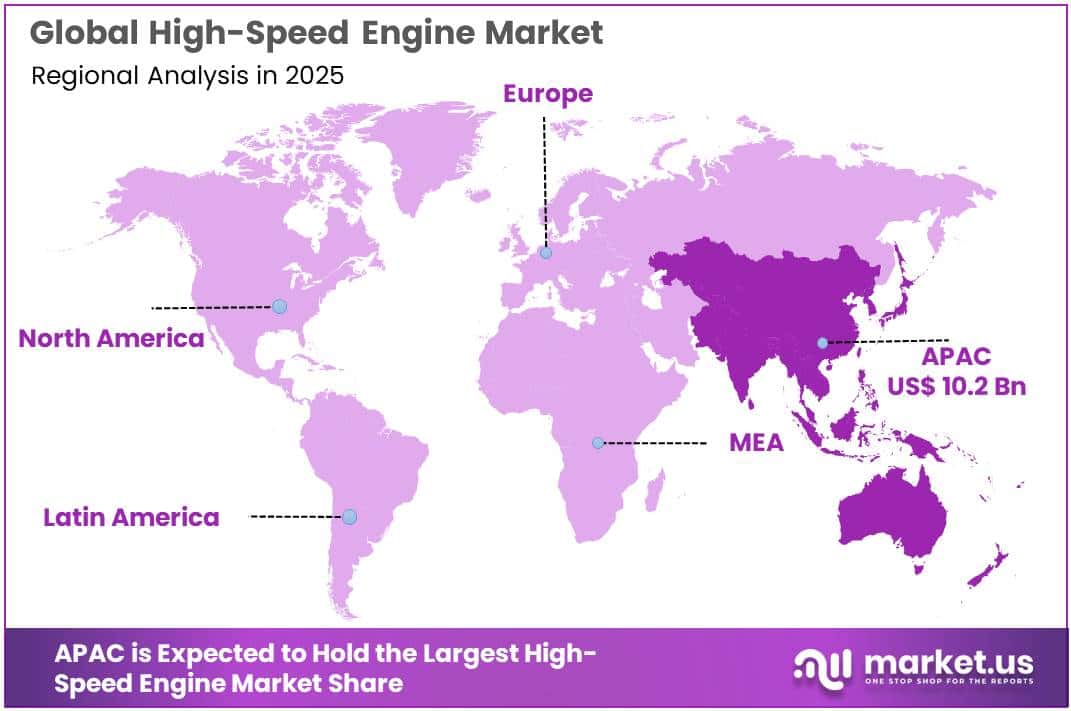
The Global High-Speed Engine Market size is expected to be worth around USD 42.8 Billion by 2035, from USD 26.3 Billion in 2025, growing at a CAGR of 5.0% during the forecast period from 2026 to 2035. In 2025, Asia Pacific held a dominant market position, capturing more than a 39.00% share, holding USD 10.2 Billion revenue.
The high-speed engine industry remains an important part of global power generation, marine propulsion, construction machinery, mining equipment, agricultural machinery, rail applications, and emergency power systems. These engines are generally valued for their high power-to-weight ratio, compact design, rapid response, and ability to operate under variable loads. Diesel continues to hold an important position, while natural gas, renewable diesel, hydrogen-ready technologies, and hybrid powertrains are gradually reshaping engine development.
- Cummins reported USD 10.875 billion in total Engine segment sales during 2025, while off-highway engine sales reached USD 1.843 billion. The company also recorded USD 4.928 billion in power-generation sales through its Distribution segment, compared with USD 3.961 billion a year earlier. These figures indicate continued demand for reciprocating engines and generator systems across industrial and standby-power applications.
Data-center expansion is becoming a particularly important growth driver. Rolls-Royce announced a USD 24 million investment in Minnesota in June 2025 to more than double production capacity for mtu Series 4000 backup generator systems. The project includes a 250,000-square-foot logistics facility and is expected to create more than 100 jobs. Rolls-Royce also reported that data centers represented more than 80% of its Power Systems power-generation revenue, highlighting the rising requirement for high-performance standby engines.
Environmental regulation is simultaneously changing engine design. The U.S. Environmental Protection Agency’s Tier 4 framework applies stringent limits to nonroad compression-ignition engines used in generators, pumps, compressors, construction machinery, and other equipment. EPA requirements reduced sulfur in nonroad diesel fuel by more than 99%, resulting in ultra-low-sulfur diesel containing a maximum of 15 parts per million sulfur. Modern engines increasingly use selective catalytic reduction, diesel particulate filters, oxidation catalysts, electronic fuel injection, and turbocharging to meet these requirements.
Marine applications are also creating new technology opportunities. The International Maritime Organization reported in 2025 that global shipping consumes about 350 million tonnes of fuel oil annually, while the industry is preparing for stronger decarbonization requirements. This transition is encouraging engine producers to develop systems capable of using lower-carbon fuels and hybrid configurations while maintaining high reliability.
Future opportunities are expected around data-center backup power, decentralized generation, hybrid marine propulsion, low-carbon fuels, connected engine monitoring, and higher-efficiency combustion systems. Wärtsilä stated that rising electricity consumption, industrial expansion, renewable-energy deployment, and increasing data-center capacity supported stronger demand for engine-based balancing solutions during 2025.
Key Takeaways
- High-Speed Engine Market size is expected to be worth around USD 42.8 Billion by 2035, from USD 26.3 Billion in 2025, growing at a CAGR of 5.0%.
- 1,000–1,500 RPM held a dominant market position, capturing more than a 44.00% share.
- 0.56–1 MW held a dominant market position, capturing more than a 44.00% share.
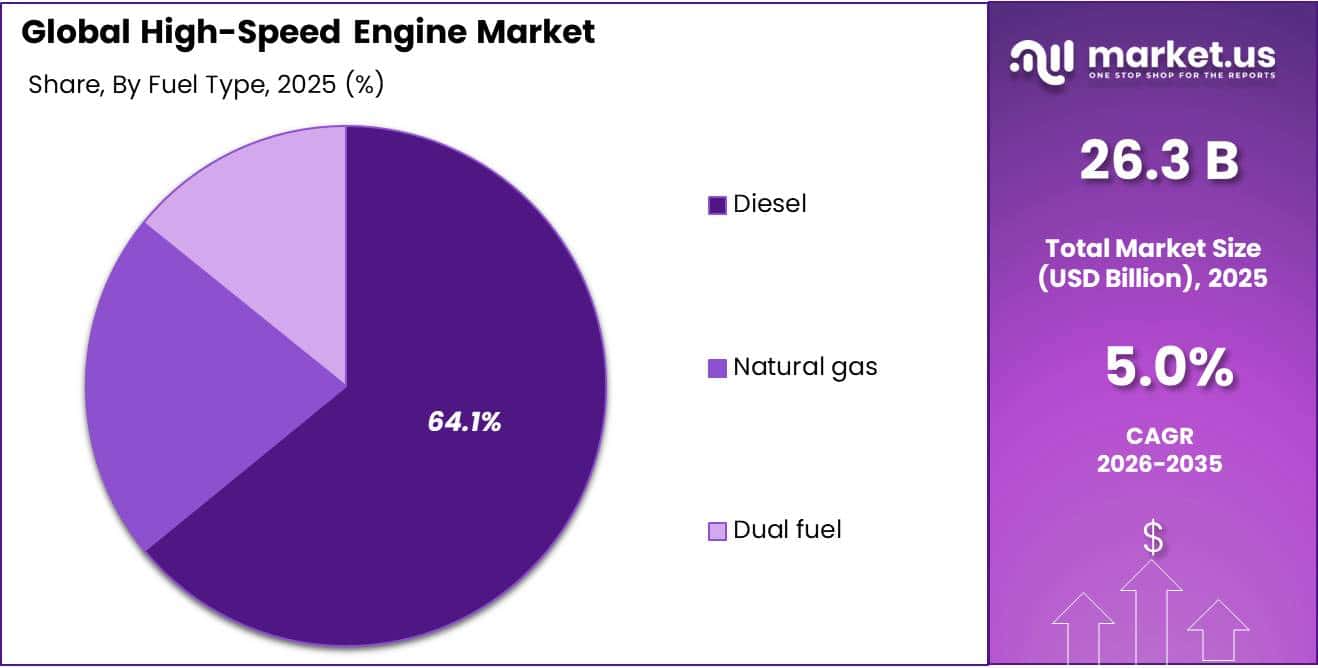
- Diesel held a dominant market position, capturing more than a 64.00% share.
- Marine held a dominant market position, capturing more than a 30.00% share.
- Asia Pacific held a dominant market position, capturing more than a 39.00% share and reaching USD 10.2 billion.
By Speed Analysis
1,000–1,500 RPM Engines Lead the Market with 44.00% Share
In 2025, “1,000–1,500 RPM” held a dominant market position, capturing more than a 44.00% share of the High-Speed Engine Market by speed. This range is widely used in stationary power generation and industrial applications because it provides a practical balance between engine life, fuel efficiency, load response, and continuous operating performance.
The U.S. EPA’s Combined Heat and Power technology guidance states that smaller reciprocating-engine generator sets in regions using 50 Hz electricity typically operate at 1,500 RPM, supporting the importance of this speed range for commercial and industrial generation. Environmental requirements are also influencing engine design. Current EPA Tier 4 rules cover diesel engines used in generators, pumps, compressors, construction equipment, and other nonroad machinery, while ultra-low-sulfur diesel is limited to 15 parts per million sulfur.
1,500–1,800 RPM engines remain an important segment of the High-Speed Engine Market, particularly in generator sets, combined heat and power systems, standby installations, industrial facilities, and critical infrastructure. In 2026, their relevance remained closely connected with fixed-frequency power generation. U.S. EPA technical guidance explains that smaller engine-generator sets typically operate at 1,800 RPM in countries using 60 Hz electricity, while 1,500 RPM is common in 50 Hz systems.
This makes the speed range suitable for equipment that must maintain stable generator frequency under changing electrical loads. The U.S. Department of Energy’s Oak Ridge National Laboratory has similarly documented 1,800 RPM as a common operating speed for U.S. diesel generator sets. As industries expand backup power, distributed generation, data-center infrastructure, and automated facilities, engines within this range can benefit from requirements for rapid starting, stable electrical output, long operating life, and compatibility with increasingly strict emission-control systems.
By Power Output Analysis
0.56–1 MW Engines Lead the High-Speed Engine Market with 44.00% Share
In 2025, “0.56–1 MW” held a dominant market position, capturing more than a 44.00% share of the High-Speed Engine Market by power output. This range remains widely suited to industrial facilities, commercial buildings, food-processing plants, hospitals, standby systems, and distributed power applications because it offers a practical combination of compact installation, fast response, and dependable electrical output.
U.S. EPA technical guidance shows that reciprocating engines are widely used for power generation and that high-speed units can cover applications up to 1.5 MW and above, depending on engine type. The EPA also presents a typical industrial CHP example using multiple 500–800 kW engine-generator sets, directly supporting the operating relevance of this power class. These characteristics continue to support demand where facilities require reliable on-site generation, emergency power, or combined heat and power with flexible load operation.
0.50–0.56 MW engines represent an important power-output segment because they provide compact generation capacity for factories, commercial sites, processing facilities, warehouses, and backup-power installations. U.S. EPA technical data identifies reciprocating engines as suitable for standby, emergency, peaking, baseload, and combined heat and power duties.
A typical food-processing CHP configuration cited by the EPA uses individual engine-generator sets in the 500–800 kW range, showing how equipment beginning around the 0.50 MW level can support industrial electricity and process-heat requirements. The same example indicates that a 2 MW food-processing CHP system can approach 75% overall efficiency when recovered heat is used for processing and washdown.
By Fuel Type Analysis
Diesel Leads the High-Speed Engine Market with 64.00% Share
In 2025, “Diesel” held a dominant market position, capturing more than a 64.00% share of the High-Speed Engine Market by fuel type. Diesel engines remain widely used in backup generators, construction equipment, marine systems, pumps, compressors, and industrial machinery because they provide strong torque, fast starting, dependable operation, and good performance under heavy loads. U.S. EPA regulations cover diesel-powered generators and other nonroad compression-ignition equipment under Tier 4 standards.
The agency states that ultra-low-sulfur diesel used in these applications contains a maximum of 15 parts per million sulfur, while the broader diesel standards reduce harmful emissions from onroad and nonroad sources by more than 90%. These requirements are encouraging manufacturers to combine high-speed diesel engines with improved fuel injection, particulate control, electronic management, and advanced after-treatment systems.
Natural gas is becoming an important fuel option for high-speed engines used in distributed generation, combined heat and power, industrial facilities, and continuous-power applications. In 2025, natural gas accounted for about 41% of U.S. utility-scale electricity generation and 40.0% of utility-scale generating capacity, showing the strong role of gas in the power system. U.S. Department of Energy technical data shows that natural-gas reciprocating engines can operate from around 500 kW to 4.5 MW, with net electrical efficiency rising from about 36.3% at 500 kW to 40.6% at 4.5 MW.
In 2025, U.S. electric-power-sector natural gas consumption averaged 35.8 billion cubic feet per day, up from 27.3 billion cubic feet per day in 2016. These conditions support wider use of natural-gas high-speed engines where operators seek lower local emissions, flexible power output, and reliable distributed generation.
By End User Analysis
Marine Leads the High-Speed Engine Market with 30.00% Share
In 2025, “Marine” held a dominant market position, capturing more than a 30.00% share of the High-Speed Engine Market by end user. High-speed engines are widely used in ferries, patrol vessels, offshore support ships, workboats, fishing vessels, and auxiliary marine power because they offer compact size, rapid acceleration, and reliable operation under changing loads.
UN Trade and Development reported that maritime transport carries more than 80% of international merchandise trade by volume, underlining the scale of engine-dependent vessel activity worldwide. Its 2025 review also noted that more than 90% of the active global fleet still operated on conventional fuels, while alternative-fuel vessels represented over half of new-order tonnage. These conditions continue to support demand for efficient, durable, and increasingly fuel-flexible marine engines.
Power generation remains an important end-use area for high-speed engines because reciprocating units can provide emergency, standby, distributed, and combined heat and power electricity for industrial plants, hospitals, commercial buildings, and critical infrastructure. U.S. Department of Energy technical guidance states that reciprocating-engine CHP systems are available from about 1 kW to 10 MW, while multiple engines can be combined for larger installations. Around 75% of reciprocating-engine CHP systems are below 1 MW, showing their suitability for decentralized power applications.
In 2025, total U.S. utility-scale electricity generation reached about 4,429 billion kWh, while installed utility-scale generation capacity reached roughly 1.28 million MW. This large power requirement continues to create opportunities for high-speed engines in flexible generation, backup systems, peak-load support, and industrial CHP installations.
Key Market Segments
By Speed
- 1,000–1,500 RPM
- 1,500–1,800 RPM
- Above 1,800 RPM
By Power Output
- 0.50–0.56 MW
- 0.56–1 MW
- 1–2 MW
- 2–4 MW
- Above 4 MW
By Fuel Type
- Diesel
- Natural gas
- Dual fuel
By End User
- Power generation
- Marine
- Railway
- Mining
- Oil and gas
- Construction
- Others
Driver Analysis
Marine Fuel-Transition Retrofits
IMO’s Net-Zero Framework was approved in principle at MEPC 83 in April 2025 and is designed to combine a global greenhouse-gas fuel-intensity standard with a pricing-and-reward mechanism for ships above 5,000 gross tonnage, which account for about 85% of international-shipping emissions; formal adoption was deferred, with the IMO session continuing in October 2026 and entry into force possible from March 2028 at the earliest.
The commercial effect begins before legal enforcement because operators need 18–36 months to specify engines, fuel systems, tanks, ventilation, class approvals, shore-support arrangements, crew training, and dry-dock slots; a medium-speed or high-speed marine engine retrofit can cost USD 0.5–5 million per vessel when dual-fuel injection, controls, fuel-conditioning, exhaust aftertreatment, safety systems, and shipyard work are included.
High-speed OEMs capture value through methanol-ready, biofuel-compatible, LNG-capable, ammonia-prepared, hydrogen-blend-capable, and battery-hybrid engine packages, with service contracts priced at USD 20,000–250,000 per engine annually and retrofit engineering often carrying higher gross margin than new-build hardware.
A 10-vessel ferry or offshore fleet replacing or remanufacturing 2–4 engines per vessel represents 20–40 engine units and USD 10–100 million of potential propulsion-system demand, while lifecycle fuel savings, carbon-cost avoidance, and compliance readiness improve purchase economics. The market is shifting from diesel-engine sales toward packaged decarbonization systems combining engines, fuel control, batteries, power electronics, digital monitoring, and long-term maintenance. Marine transition retrofits are estimated to add +2.1 percentage points to market CAGR across European, Chinese, Korean, Japanese, Singaporean, and Gulf maritime clusters during 2026–2030.
Drivers Impact Analysis
| Driver | (\~) % Impact on CAGR Forecast | Geographic Relevance | Impact Timeline |
|---|---|---|---|
| Marine fuel-transition retrofits | +2.1 pp | Europe, China, Korea, Japan, Singapore, Gulf | Medium term (2–4 years) |
| Data-center backup power | +1.8 pp | North America, EU, China, India, ASEAN | Short term (≤ 2 years) |
| Stage V off-highway renewal | +1.5 pp | EU core, UK, Türkiye, export OEMs | Short term (≤ 2 years) |
| Defence mobility modernization | +1.3 pp | North America, Europe, India, East Asia, MENA | Medium term (2–4 years) |
| Aviation efficiency upgrades | +1.1 pp | North America, EU, China, global aviation hubs | Long term (≥ 4 years) |
| Hybrid propulsion integration | +0.9 pp | Europe, Japan, Korea, China, North America | Medium term (2–4 years) |
Restraint Analysis
Alternative-Power Substitution
A 1–5 MW diesel generator operating fewer than 100–300 hours annually can be replaced or materially downsized by a battery system capable of bridging 15–120 minutes, combined with grid redundancy and demand management, while electric excavators, forklifts, light construction equipment, port vehicles, inland vessels, and short-route ferries remove high-speed engine units from the addressable market rather than merely changing fuel choice.
The policy direction reinforces this substitution: EU Stage V already imposes particle-number limits of 1×10¹² particles per kWh and particulate-mass limits of 0.015 g/kWh for many 56–560 kW non-road engines, increasing the cost and packaging burden of diesel-powered equipment relative to electrified alternatives. Engine OEMs face a unit-economics problem because a 300 kW combustion package can generate USD 40,000–150,000 of engine, aftertreatment, cooling, and service value, but a battery-electric platform can shift much of that value toward cells, inverters, motors, chargers, and software; even when the engine remains as a range extender, its rated power, operating hours, spare-parts consumption, and overhaul revenue may fall 20–60%.
The substitution risk is strongest in urban construction, warehouse-adjacent equipment, ports, municipal fleets, data-center short-duration backup, and inland marine routes, where noise and local-emission constraints carry commercial value. OEM mitigation requires hybrid platforms, generator-battery packages, renewable-fuel compatibility, power electronics, energy-management software, service bundles, and selective focus on high-duty, remote, heavy, maritime, and defence segments where energy-density requirements remain difficult for batteries. Alternative-power substitution is estimated to reduce attainable high-speed-engine CAGR by -2.0 percentage points across the EU, China, North America, Japan, South Korea, and electrification-leading markets over the long term.
Restraint Impact Analysis
| Restraint | (\~) % Impact on CAGR Forecast | Geographic Relevance | Impact Timeline |
|---|---|---|---|
| Alternative-power substitution | -2.0 pp | EU, China, North America, Japan, Korea | Long term (≥ 4 years) |
| Emissions-compliance cost | -1.7 pp | EU, North America, Japan, export OEM hubs | Short term (≤ 2 years) |
| Fuel-transition uncertainty | -1.4 pp | Europe, Asia maritime hubs, Gulf, global shipping | Medium term (2–4 years) |
| Critical-component shortages | -1.2 pp | North America, EU, China, India, ASEAN | Medium term (2–4 years) |
| High-capex fleet renewal | -1.0 pp | Emerging markets, small operators, marine fleets | Medium term (2–4 years) |
| Certification-cycle delays | -0.8 pp | EU, U.S., aviation, marine, defence markets | Long term (≥ 4 years) |
Opportunity Analysis
Distributed-Power Service Platforms
This is not the baseline data-center or backup-power driver: rising demand creates engine units, but the strategic upside arises when OEMs convert an installed 1–5 MW engine into a recurring power-as-a-service asset with annual service revenue equal to 5–12% of original equipment value and renewal rates potentially above 85–90%.
A 10 MW industrial microgrid with four 2.5 MW generator sets can represent USD 4–12 million of initial equipment value; bundling digital monitoring, service technicians, fuel polishing, emissions reporting, parts, and guaranteed availability can create USD 0.3–1.2 million in yearly contract revenue, generating lifetime revenue of USD 3–12 million across a decade before repowering.
OEMs that build 24/7 remote operations centres, standardized service modules, financing partnerships, regional parts hubs, and performance-based SLAs can gain 10–20 percentage points of lifecycle value beyond equipment-only sales. This opportunity could add +2.0 percentage points to high-speed-engine CAGR across North America, Europe, India, ASEAN, MENA, Africa, and remote industrial regions within two years.
Opportunity Impact Analysis
| Opportunity | (\~) % Potential CAGR Upside | Geographic Relevance | Execution Window |
|---|---|---|---|
| Distributed-power service platforms | +2.0 pp | North America, EU, India, ASEAN, MENA | Short term (≤ 2 years) |
| Fuel-flexible retrofit kits | +1.7 pp | Europe, Asia maritime hubs, Gulf, Latin America | Medium term (2–4 years) |
| Hybrid power-system integration | +1.5 pp | Europe, Japan, Korea, China, North America | Medium term (2–4 years) |
| Defence sustainment contracts | +1.3 pp | North America, Europe, India, East Asia, MENA | Short term (≤ 2 years) |
| Data-center microgrid leasing | +1.2 pp | North America, India, ASEAN, EU, Gulf | Short term (≤ 2 years) |
| Remanufacturing circular networks | +1.0 pp | EU, North America, China, India, Latin America | Long term (≥ 4 years) |
Challenges Analysis
Multi-Fuel Engineering Complexity
Multi-fuel engineering complexity is a sustained operational challenge because high-speed-engine OEMs must concurrently support conventional diesel, renewable diesel, biodiesel blends, LNG, bio-LNG, methanol, bio-methanol, hydrogen blends, synthetic fuels, and hybrid power architectures across applications with radically different duty cycles, fuel-quality profiles, storage conditions, injection pressures, ignition properties, safety requirements, and service capabilities. The IMO Net-Zero Framework creates the directional pressure: the draft architecture couples a global fuel-intensity standard with a GHG pricing mechanism, applies to large ocean-going ships above 5,000 gross tonnage, and requires lifecycle “well-to-wake” carbon treatment rather than simple exhaust-pipe measurement.
For a 1–5 MW marine engine, shifting from diesel to dual-fuel or methanol-ready operation can add 20–80% to propulsion-system cost once fuel pumps, injectors, tanks, piping, ventilation, gas detection, explosion protection, control software, class documentation, and crew training are included; maintaining 4–6 fuel variants can raise development, testing, inventory, documentation, and warranty budgets by an analyst-estimated USD 20–100 million per major platform family. The operational burden continues after sale: a dealer network may need 20–50 specialized parts, diagnostic routines, safety tools, and technician certifications per fuel architecture, while weak fuel quality or blending consistency can shorten injector, seal, lubrication, and aftertreatment life by 10–30% and increase field claims.
The commercial result is lower platform standardization, longer 12–36-month engineering cycles, reduced component scale, and customer hesitation when fuel availability varies by port, region, or contract. OEMs must converge around modular fuel rails, software-configurable ECU maps, common blocks and crankcases, standardized safety skids, regional fuel partnerships, and field-upgrade kits, but broad fuel neutrality remains a long-term engineering and validation task. This challenge is estimated to reduce achievable CAGR by -1.5 percentage points across Europe, Singapore, China, Japan, South Korea, the Gulf, and global maritime OEM ecosystems over four or more years.
Challenges Impact Analysis
| Challenge | (\~) % CAGR Friction Drag | Geographic Relevance | Mitigation Horizon |
|---|---|---|---|
| Multi-fuel engineering complexity | -1.5 pp | Europe, Asia maritime hubs, Gulf, global OEMs | Long term (≥ 4 years) |
| Precision-component supply volatility | -1.3 pp | North America, EU, China, Japan, India, ASEAN | Medium term (2–4 years) |
| Skilled-service technician deficit | -1.1 pp | North America, EU, Japan, Korea, remote regions | Long term (≥ 4 years) |
| In-use emissions validation | -1.0 pp | EU core, UK, Türkiye, export OEMs | Medium term (2–4 years) |
| Hybrid-system integration burden | -0.9 pp | Europe, China, Japan, Korea, North America | Medium term (2–4 years) |
| Certification evidence cycles | -0.8 pp | Aviation, marine, defence, EU, U.S. | Long term (≥ 4 years) |
Geopolitical Impact Analysis
Ongoing Wars Reshape Demand and Supply Conditions for High-Speed Engines
The ongoing Russia-Ukraine war and wider Middle East conflicts are influencing the High-Speed Engine Market through higher defence spending, shipping disruption, fuel-price volatility, and stronger demand for reliable power systems. High-speed diesel and gas engines are widely used in patrol vessels, military support equipment, emergency generators, mobile power units, and critical infrastructure, making geopolitical tension relevant to engine demand.
- In 2026, EU member states are expected to spend about €454 billion on defence, while defence investment is projected to reach nearly €163 billion, creating additional opportunities for engine suppliers serving naval, transport, and auxiliary-power applications.
At the same time, conflict-related disruption in the Strait of Hormuz caused ship transits to fall by around 95% in 2026 and increased oil, gas, marine-fuel, freight, and insurance costs. UNCTAD also reported that maritime trade growth was expected to slow to only 0.5% in 2025, as vessels were rerouted and supply chains became less predictable. These conditions raise manufacturing and operating costs, but they also support investment in fuel-efficient, durable, dual-fuel, and digitally monitored high-speed engines for defence, marine, backup-power, and distributed-generation applications.
Regional Insights
Asia Pacific Leads with 39.00% Share, While North America Shows Strong Growth Potential
In 2025, Asia Pacific held a dominant market position, capturing more than a 39.00% share and reaching USD 10.2 billion in the High-Speed Engine Market. Regional demand is supported by large marine fleets, shipbuilding activity, industrial power requirements, and expanding electricity consumption. UNCTAD reported that 7 of the world’s 10 most connected maritime economies were located in Asia in June 2025, with China, South Korea, Singapore, and Malaysia occupying the first four positions.
China also represented 12.4% of the value of the global commercial fleet at the start of 2025, while Japan accounted for 10.1% and South Korea for 3.7%. These large shipping and marine operations support demand for compact high-speed propulsion and auxiliary engines. Electricity demand in China also increased by about 5.1% in 2025, supporting engine-based standby and distributed-power applications.
North America is developing as a fast-growing regional market, supported by data centers, backup generation, industrial expansion, emergency-power requirements, and modern marine applications. U.S. electricity demand increased by 2.1% in 2025, while data centers accounted for around 50% of the country’s electricity-demand growth, according to the International Energy Agency. Electricity consumption in the United States is expected to increase by close to 2% annually through 2030, with data-center expansion remaining a major driver.
The U.S. Energy Information Administration also reported that electricity demand grew at approximately 1.7% annually between 2020 and 2025, compared with only 0.1% annually during 2005–2019. Rising requirements for resilient power at data centers, hospitals, manufacturing facilities, and critical infrastructure are creating stronger opportunities for high-speed diesel and natural-gas engines used in standby, distributed, and combined heat and power systems.
Key Regions and Countries Insights
- North America
- US
- Canada
- Europe
- Germany
- France
- The UK
- Spain
- Italy
- Rest of Europe
- Asia Pacific
- China
- Japan
- South Korea
- India
- Australia
- Rest of APAC
- Latin America
- Brazil
- Mexico
- Rest of Latin America
- Middle East & Africa
- GCC
- South Africa
- Rest of MEA
Key Players Analysis
Caterpillar Inc. holds a strong position in high-speed engines through diesel and natural-gas engines used in marine, power generation, industrial, and oil & gas applications. In 2025, Caterpillar recorded USD 67.6 billion in sales and revenues, its highest annual level. Power & Energy sales reached USD 9.4 billion in Q4 2025, including USD 3.238 billion from power generation and USD 1.523 billion from transportation-related applications. The company also expanded large-engine capacity and introduced the Cat G3500K natural-gas generator platform.
Cummins Inc. remains a major high-speed engine supplier across heavy-duty transport, off-highway machinery, marine, industrial, and power-generation applications. In 2025, the company generated USD 33.67 billion in total net sales. Its Engine segment reported USD 10.875 billion in sales, including USD 1.843 billion from off-highway applications, while Power Systems recorded USD 7.463 billion in total segment sales. Cummins also shipped about 554,200 engines during the year, showing the scale of its global high-speed engine manufacturing base.
Rolls-Royce Holdings plc serves the high-speed engine market mainly through its mtu brand within Power Systems, supplying diesel, gas, and hybrid engines for marine, defence, industrial, and power-generation applications. In 2025, Power Systems generated £4.892 billion in underlying revenue, up 19% organically, while operating profit reached £852 million, rising 60%. Original-equipment revenue reached £3.433 billion and services revenue £1.459 billion. Data centres represented more than 80% of power-generation revenue, while key defence markets carried about 30% market share.
Top Key Players Outlook
- Caterpillar Inc.
- Cummins Inc.
- Rolls-Royce Holdings plc / mtu
- MAN Energy Solutions SE
- Wärtsilä Corporation
- Volvo Penta
- Mitsubishi Heavy Industries, Ltd.
- Yanmar Holdings Co., Ltd.
- Weichai Power Co., Ltd.
- DEUTZ AG
- HD Hyundai Heavy Industries Co., Ltd.
- Doosan Infracore Co., Ltd.
- Kohler Co.
- Anglo Belgian Corporation
- Daihatsu Infinearth Mfg. Co., Ltd.
Recent Developments
- In May 2025, MAN Energy Solutions SE was selected to supply 6 gas engines for a Texas power plant with 124 MW total capacity, with engine delivery planned for mid-2026. Its 2025 sustainability data showed €4.862 billion in turnover, €144 million in investments, and €258 million in R&D spending.
- In May 2026, Wärtsilä Corporation announced an additional EUR 90 million investment to expand technical production capacity by 30%, taking the planned increase to 65% above 2025 capacity.
Report Scope
| Report Features | Description |
|---|---|
| Market Value (2025) | USD 26.3 Bn |
| Forecast Revenue (2035) | USD 42.8 Bn |
| CAGR (2026-2035) | 5.0% |
| Base Year for Estimation | 2025 |
| Historic Period | 2020-2024 |
| Forecast Period | 2026-2035 |
| Report Coverage | Revenue Forecast, Market Dynamics, Competitive Landscape, Recent Developments |
| Segments Covered | By Speed (1,000–1,500 RPM, 1,500–1,800 RPM, Above 1,800 RPM), By Power Output (0.50–0.56 MW, 0.56–1 MW, 1–2 MW, 2–4 MW, Above 4 MW), By Fuel Type (Diesel, Natural gas, Dual fuel), By End User (Power generation, Marine, Railway, Mining, Oil and gas, Construction, Others) |
| Regional Analysis | North America – US, Canada; Europe – Germany, France, The UK, Spain, Italy, Rest of Europe; Asia Pacific – China, Japan, South Korea, India, Australia, Singapore, Rest of APAC; Latin America – Brazil, Mexico, Rest of Latin America; Middle East & Africa – GCC, South Africa, Rest of MEA |
| Competitive Landscape | Caterpillar Inc., Cummins Inc., Rolls-Royce Holdings plc / mtu, MAN Energy Solutions SE, Wärtsilä Corporation, Volvo Penta, Mitsubishi Heavy Industries, Ltd., Yanmar Holdings Co., Ltd., Weichai Power Co., Ltd., DEUTZ AG, HD Hyundai Heavy Industries Co., Ltd., Doosan Infracore Co., Ltd., Kohler Co., Anglo Belgian Corporation, Daihatsu Infinearth Mfg. Co., Ltd. |
| Customization Scope | Customization for segments, region/country-level will be provided. Moreover, additional customization can be done based on the requirements. |
| Purchase Options | We have three licenses to opt for: Single User License, Multi-User License (Up to 5 Users), Corporate Use License (Unlimited User and Printable PDF) |





































