


Report Overview
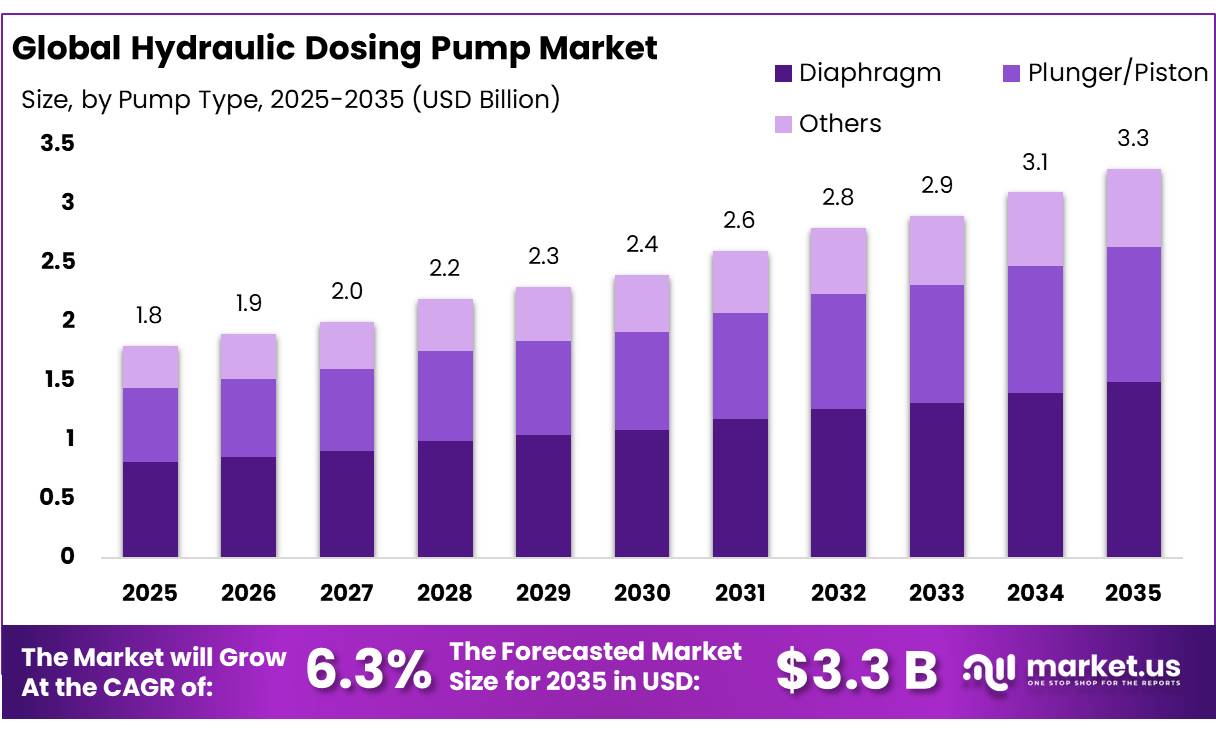
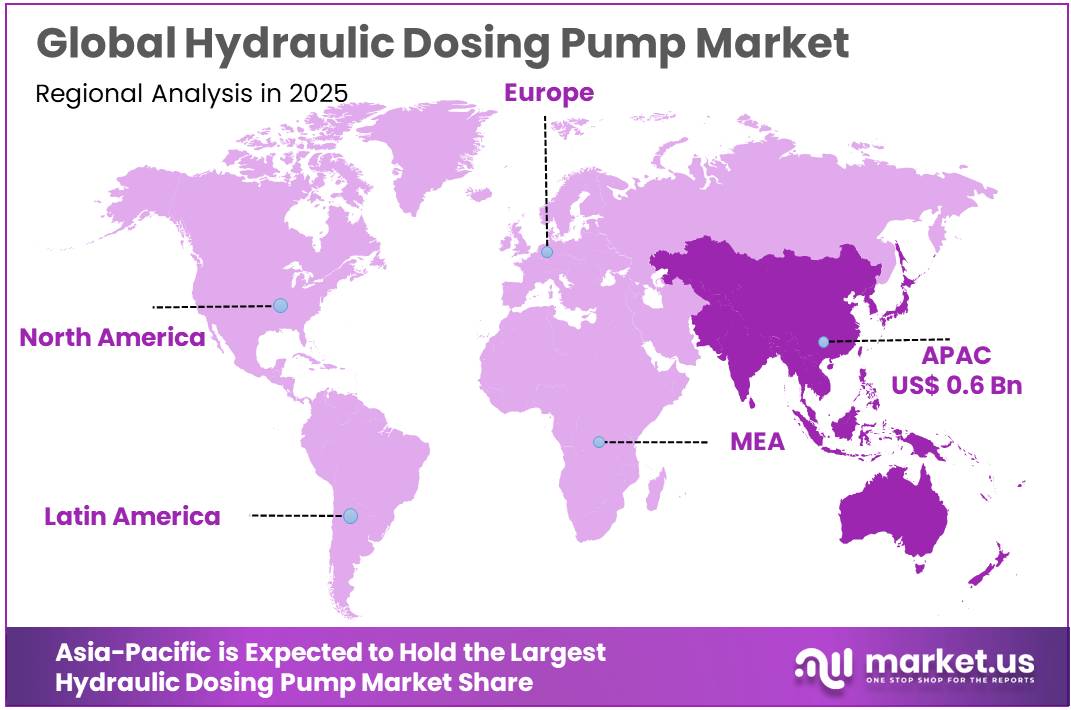
The Global Hydraulic Dosing Pump Market size is expected to be worth around USD 3.3 Billion by 2035, from USD 1.8 Billion in 2025, growing at a CAGR of 6.3% during the forecast period from 2026 to 2035. In 2025, Asia-Pacific held a dominant market position, capturing more than a 38.34% share, holding USD 0.6 Billion revenue.
Hydraulic dosing pumps are precision fluid-handling systems used to inject controlled quantities of chemicals, additives, and treatment agents into industrial processes. Their operating principle allows chemical fluids to be delivered at controlled pressure and flow, making them suitable for water treatment, chemical processing, oil and gas, power generation, food processing, and industrial manufacturing.
- The industrial scenario remains closely linked with chemical manufacturing and water infrastructure. The American Chemistry Council reported that U.S. chemical manufacturing activity improved in the first quarter of 2026, with production, capacity utilization, supplier delivery times, order backlogs, and new orders reaching their highest levels since the survey began in 2023. Capital spending, overall company activity, and major-customer demand also reached their highest levels since 2024.
The U.S. Environmental Protection Agency stated that the Bipartisan Infrastructure Law provides $50 billion for drinking water, wastewater, and stormwater infrastructure, described by the agency as the largest federal investment in water infrastructure. The funding supports modernization of treatment systems and infrastructure, creating opportunities for equipment used to control chemical addition and treatment processes. In November 2025, EPA also announced $6.5 billion in newly available WIFIA funding, along with another $550 million for state infrastructure financing authorities.
Future opportunities are expected to come from advanced water treatment, chemical manufacturing, emissions-control systems, and industrial automation. EPA’s FY 2025 planning included approximately $2.78 billion in water infrastructure spending, including $1.24 billion for the Clean Water State Revolving Fund and $1.126 billion for the Drinking Water State Revolving Fund. Such infrastructure investment can create demand for dependable chemical metering equipment.
Key Takeaways
- Hydraulic Dosing Pump Market size is expected to be worth around USD 3.3 Billion by 2035, from USD 1.8 Billion in 2025, growing at a CAGR of 6.3%.
- Diaphragm held a dominant market position, capturing more than a 45.23% share.
- Automatic held a dominant market position, capturing more than a 54.22% share.
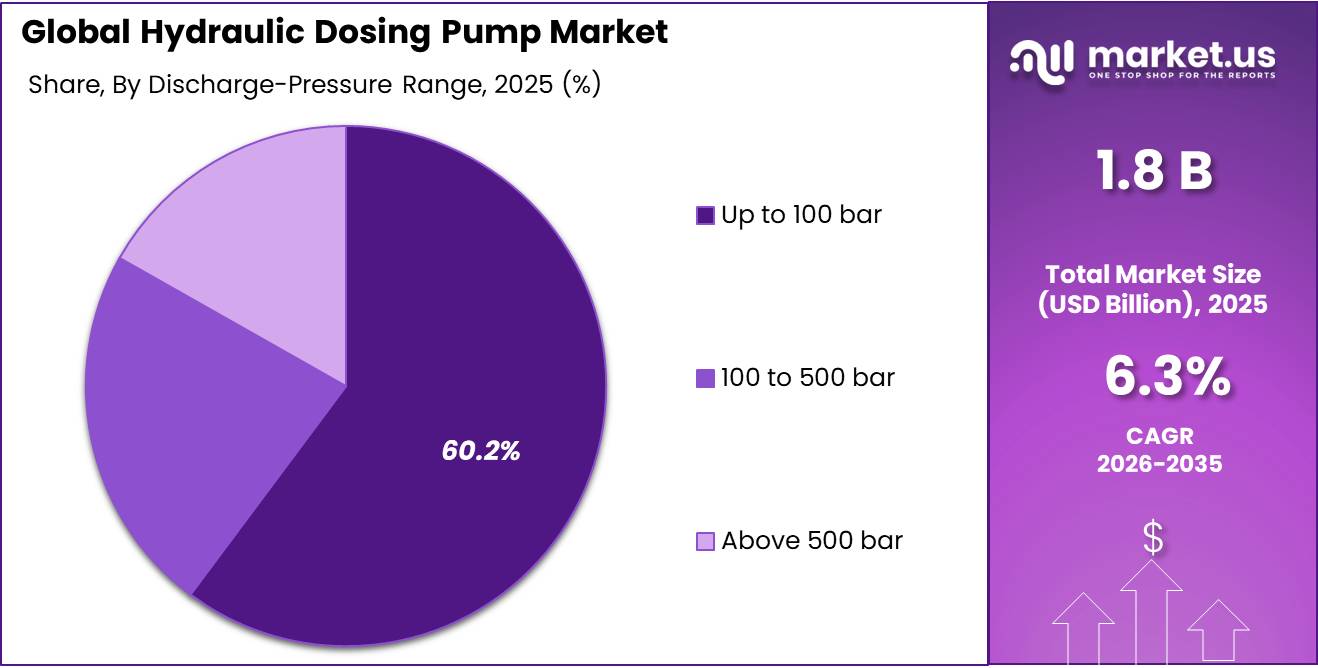
- Up to 100 bar held a dominant market position, capturing more than a 60.02% share.
- Water and Wastewater Treatment held a dominant market position, capturing more than a 37.21% share.
- Asia-Pacific held a dominant position in the Hydraulic Dosing Pump market, accounting for 38.34% and reaching approximately USD 0.6 billion.
By Pump Type Analysis
Diaphragm dominates the market through reliable chemical dosing and process control
In 2025, “Diaphragm” held a dominant market position, capturing more than a 45.23% share. The segment remains important because diaphragm dosing pumps can handle corrosive, hazardous, and chemically aggressive fluids while maintaining controlled chemical delivery. Their sealed pumping arrangement also helps reduce the risk of process fluid leakage, making them suitable for water treatment, chemical processing, wastewater treatment, and other industrial applications.
Government investment in water infrastructure continued to support this application base in 2025. In November 2025, the U.S. Environmental Protection Agency announced $6.5 billion in Water Infrastructure Finance and Innovation Act funding, together with another $550 million available through the State WIFIA program. The funding supports water systems and projects involving drinking water, wastewater, water reuse, and infrastructure modernization, areas where chemical dosing equipment can play an important operating role.
In 2025, “Plunger/Piston” represented an important pump type within the hydraulic dosing pump market. No additional market-share figure is introduced because the provided data does not specify a percentage for this segment. Plunger and piston pumps are generally suited to applications where controlled chemical delivery is required at higher pressures and where consistent flow performance is important.
By Stroke-Adjustment Method Analysis
Automatic dominates through precise dosing control and easier process operation
In 2025, “Automatic” held a dominant market position, capturing more than a 54.22% share. Automatic stroke-adjustment systems are increasingly important in hydraulic dosing pumps because they allow chemical feed rates to be adjusted according to changing process requirements. This makes them useful in water treatment, wastewater treatment, chemical processing, and other industrial operations where dosing accuracy needs to remain stable during changing flow conditions.
Government investment in water infrastructure continued to create a strong application base for automated dosing equipment in 2025. In November 2025, the U.S. Environmental Protection Agency announced $6.5 billion in WIFIA funding for water systems, together with $550 million through the State WIFIA program. EPA stated that the funding would support drinking-water systems, pollution reduction, water-sector innovation, and other infrastructure priorities.
In 2025, “Manual” remained an important stroke-adjustment method within the hydraulic dosing pump market. No market-share percentage is added because no share was provided for this segment. Manual stroke adjustment continues to be relevant in applications where operators prefer direct control over dosing rates or where process conditions remain relatively stable. It can also suit smaller treatment systems, basic industrial processes, and installations where a simple operating arrangement is preferred over automated control.
By Discharge-Pressure Range Analysis
Up to 100 bar dominates through broad water and industrial treatment applications
In 2025, “Up to 100 bar” held a dominant market position, capturing more than a 60.02% share. This pressure range benefits from its suitability for a wide variety of chemical dosing applications where extremely high discharge pressure is not required. Hydraulic dosing pumps operating up to 100 bar can support water treatment, wastewater treatment, chemical processing, cooling-water systems, and general industrial operations.
Government investment in water infrastructure continued to support the application environment for this segment in 2025. In November 2025, the U.S. Environmental Protection Agency announced $6.5 billion in WIFIA funding for water systems and another $550 million through the State WIFIA program. EPA said the funding would support safe drinking water, pollution reduction, water-sector innovation, and local and regional water priorities.
In 2025, “100 to 500 bar” remained an important pressure range for hydraulic dosing pump applications, particularly where chemical injection must be maintained against higher system pressure. No market-share figure is added because no percentage was provided for this segment. Pumps in this range are suited to demanding industrial processes where stable dosing and pressure handling are important.
By End Use Industry Analysis
Water and wastewater treatment dominates as infrastructure investment increases
In 2025, “Water and Wastewater Treatment” held a dominant market position, capturing more than a 37.21% share. Hydraulic dosing pumps are widely suited to this industry because treatment facilities need controlled chemical injection for disinfection, pH adjustment, coagulation, scale control, and other water-quality processes. The requirement for steady and accurate dosing makes these pumps an important part of treatment operations. Diaphragm and other hydraulic dosing designs can also handle different chemicals and operating conditions, making them useful across municipal and industrial treatment facilities.
Government spending provided additional support to this application area in 2025. In November 2025, the U.S. Environmental Protection Agency announced $6.5 billion in WIFIA funding for water systems, along with $550 million through the State WIFIA program. EPA said the funding would support safe drinking water, pollution reduction, water-sector innovation, and local and regional water priorities.
In December 2025, EPA also announced more than $351 million for Fort Worth water and recycling infrastructure, including a $347 million WIFIA loan for wastewater collection and treatment and beneficial water reuse. The project included a new water reclamation facility intended to treat wastewater for industrial and irrigation reuse.
In 2025, “Oil and Gas” remained an important end-use industry for hydraulic dosing pumps. No market-share percentage is added because no share was provided for this segment. Oil and gas facilities use dosing pumps for applications such as corrosion inhibition, scale control, chemical treatment, water treatment, and process-fluid conditioning. These operations require controlled chemical delivery because inconsistent dosing can affect equipment reliability and process performance.
Key Market Segments
By Pump Type
- Plunger/Piston
- Diaphragm
- Others
By Stroke-Adjustment Method
- Manual
- Automatic
By Discharge-Pressure Range
- Up to 100 bar
- 100 to 500 bar
- Above 500 bar
By End Use Industry
- Water and Wastewater Treatment
- Oil and GasFastest Growing
- Chemicals and Petrochemicals
- Power Generation
- Food and Beverage
- Others
Driver Analysis
PFAS Water-Treatment Compliance
PFAS compliance is the strongest 2026 demand driver for hydraulic dosing pumps because water systems and industrial facilities are shifting from broad contaminant control toward ultra-low-concentration treatment chemistry that depends on precise, continuous, corrosion-resistant chemical injection rather than coarse feed systems.
EPA’s 2024 drinking-water rule set enforceable maximum contaminant levels of 4.0 ppt for PFOA and 4.0 ppt for PFOS, requires initial monitoring by 2027 and corrective action by 2029, while the 2026 proposal preserves those two core standards and creates only a limited pathway for some systems to extend compliance to 2031, meaning capital planning is still underway rather than cancelled.
EPA is also coupling drinking-water enforcement with point-source control through PFAS OUT, proposed effluent limits for industrial dischargers, annual destruction-and-disposal guidance updates, and billions of dollars of revolving-fund and WIFIA support, all of which increase demand for multi-point oxidant, pH, coagulant, polymer, antiscalant, and cleaning-chemical feed skids.
In an analyst demand model, a mid-sized PFAS treatment train typically needs 6–20 dosing points, each requiring 0.5–50 L/h accuracy with less than 1% repeatability error, and a 50–100 MLD municipal retrofit can embed USD 80,000–300,000 of hydraulic dosing content; if only 10–15% of high-risk North American systems move from manual or diaphragm-electromagnetic setups to redundant hydraulic metering packages, OEM revenue capture can rise 12–18% with aftermarket chemical-wet-end replacement attachments of 4–7% annually. This driver also shifts business models toward packaged compliance systems, remote calibration contracts, and material upgrades to PVDF, PTFE, Hastelloy, or duplex alloys, supporting an estimated +2.2 percentage-point addition to baseline CAGR across North America and adjacent EU regulatory markets.
Drivers Impact Analysis
| Driver | (~) % Impact on CAGR Forecast | Geographic Relevance | Impact Timeline |
|---|---|---|---|
| PFAS water-treatment compliance | +2.2% | North America core, EU spill-over | Medium term (2-4 years) |
| Industrial wastewater automation | +1.8% | China, India, Southeast Asia, LatAm | Short term (≤ 2 years) |
| Biopharma sterile-process precision | +1.5% | U.S., EU, Singapore, Korea | Short term (≤ 2 years) |
| Desalination chemical-feed growth | +1.3% | GCC, North Africa, India, Spain | Medium term (2-4 years) |
| Battery and critical-minerals treatment | +1.1% | China, North America, Australia, EU | Medium term (2-4 years) |
| Energy-efficient digital retrofits | +0.9% | North America, EU, mature APAC | Short term (≤ 2 years) |
Restraint Analysis
Metal Tariff Cost Shock
Metal tariff escalation is an immediate pricing restraint because hydraulic dosing pumps depend on stainless-steel housings, forged heads, shafts, valves, fasteners, motor casings, copper windings, and skid frames, while U.S. Section 232 measures expanded in 2026 across steel, aluminum, copper, and derivative products. U.S. Customs guidance states that the April and June 2026 proclamations imposed additional duties of 10–50% on the full customs value of defined metal articles and derivatives, effective from April 6 and with additional classifications entering scope from June 8; covered products include numerous metal-intensive finished articles rather than only raw inputs.
For a hydraulic dosing pump package with 35–55% metal and electro-mechanical bill-of-material exposure, an analyst model indicates that a 25% duty applied to imported assemblies or derivative subcomponents can raise delivered cost by 7–14%, while a 50% duty scenario can lift it by 12–20% after freight, brokerage, inventory carrying, and scrap effects; on a USD 25,000 skid, this equates to USD 1,750–5,000 of incremental cost before distributor margins.
Suppliers face an unattractive choice between passing through 6–15% price increases, losing municipal and industrial tenders to lower-cost alternatives, or absorbing the increase and reducing gross margin by 300–800 basis points, while localizing fabrication requires USD 0.5–3.0 million of tooling, qualification, and working-capital investment and typically 9–18 months of execution. The result is delayed replacement demand, lower bid-conversion rates, and increased preference for refurbishing existing pumps, producing an estimated -1.7 percentage-point drag on 2026–2028 CAGR in North America and globally exposed import supply chains.
Restraint Impact Analysis
| Restraint | (~) % Impact on CAGR Forecast | Geographic Relevance | Impact Timeline |
|---|---|---|---|
| Metal tariff cost shock | -1.7% | North America core, import supply chains | Short term (≤ 2 years) |
| Fluoropolymer regulatory uncertainty | -1.4% | EU, UK, global export OEMs | Medium term (2-4 years) |
| Chemical-sector capex weakness | -1.2% | EU, China, North America | Medium term (2-4 years) |
| Municipal budget constraints | -1.0% | North America, EU, LatAm, Africa | Medium term (2-4 years) |
| Low-cost pump substitution | -0.9% | India, China, ASEAN, LatAm | Short term (≤ 2 years) |
| Corrosive-material lead times | -0.8% | Global specialty-pump supply chains | Medium term (2-4 years) |
Opportunity Analysis
PFAS Compliance-as-a-Service
PFAS compliance-as-a-service is an untapped monetization opportunity rather than the baseline regulatory demand driver because most hydraulic dosing pump OEMs still sell equipment into engineer-procure-construct packages, leaving recurring value in system design, chemical optimization, remote verification, operator training, calibration, audit-ready records, and performance guarantees unmonetized. EPA’s 2026 PFAS OUT initiative is actively assisting water systems with PFOA and PFOS exposure, while nearly USD 1 billion in Emerging Contaminants grants, USD 4 billion in Drinking Water State Revolving Fund commitments, and more than USD 6.5 billion in WIFIA financing are available for qualifying projects; that funding can support treatment infrastructure but does not assure chemical-feed reliability after handover.
An analyst model estimates that a PFAS treatment facility requires 8–24 critical dosing loops for pH adjustment, coagulant, polymer, oxidant, antiscalant, carbon-media conditioning, and cleaning chemistry; converting a USD 150,000–500,000 equipment sale into a five-year managed dosing contract priced at 8–12% of installed value annually can increase customer lifetime value by 1.7–2.6 times, raise gross margin from 28–35% for hardware to 42–55% for remote service, and reduce churn through quarterly calibration and compliance reporting.
Suppliers should bundle dual-diaphragm hydraulic pumps, flow verification, chemical inventory monitoring, secure telemetry, certified technician visits, and guaranteed dosage accuracy within plus or minus 1%, creating a lower-risk offer for smaller systems that lack process engineers. This is future upside rather than a present driver because it demands service-network investment, liability underwriting, analytics, and outcome-based contracting; early adoption in the United States and Europe could add an estimated +2.1 percentage points above baseline CAGR over the next two years.
Opportunity Impact Analysis
| Opportunity | (~) % Potential CAGR Upside | Geographic Relevance | Execution Window |
|---|---|---|---|
| PFAS compliance-as-a-service | +2.1% | North America core, EU | Short term (≤ 2 years) |
| Water-reuse skid platforms | +1.7% | EU, GCC, India, China | Medium term (2-4 years) |
| Closed-loop biopharma dosing | +1.5% | U.S., EU, Singapore, Korea | Medium term (2-4 years) |
| Digital installed-base monetization | +1.3% | North America, EU, mature APAC | Short term (≤ 2 years) |
| Battery-materials treatment suites | +1.2% | China, North America, EU, Australia | Medium term (2-4 years) |
| Specialty pump service roll-ups | +0.9% | North America, EU, East Asia | Medium term (2-4 years) |
Challenges Analysis
Chemical-Compatibility Validation
Chemical-compatibility validation remains a persistent engineering challenge because hydraulic dosing pumps must meter acids, caustics, hypochlorite, oxidants, polymers, solvents, coagulants, biocides, antiscalants, and PFAS-treatment reagents with stable accuracy across changing concentration, temperature, pressure, and shear conditions, while a material choice that works in one application may suffer swelling, embrittlement, permeation, cracking, crystallisation, or diaphragm fatigue in another.
The EU’s ongoing PFAS restriction assessment includes machinery and sealing applications among the detailed sectors under review, covers manufacturing, placing on the market, and use of PFAS, and contemplates either restrictions or use-specific derogations with management-plan, labeling, monitoring, and reporting obligations; accordingly, suppliers must validate alternate wet-end materials even before final regulatory design is known.
An analyst qualification model estimates that a new diaphragm, valve-seat, O-ring, or liner material needs 500–2,000 hours of chemical exposure and pressure-cycle testing across 10–30 representative media combinations, costing USD 75,000–400,000 per product family and requiring 6–18 months before commercial release; a 1–2% diaphragm swell rate or 5% loss in valve-seating performance can move dosing accuracy from plus or minus 1% toward plus or minus 3–5%, enough to create compliance failure or chemical waste in high-risk installations.
The commercial friction includes 2–6% higher warranty reserves, duplicate inventory of legacy and substitute components, and 4–10 weeks of delayed project approval while end users test chemical compatibility; mitigation requires a digital material-compatibility library, accelerated test rigs, modular wet-end design, and co-validation with chemical suppliers, but the breadth of substances and evolving fluoropolymer regulation means this imposes an estimated -1.3 percentage-point drag on maximum CAGR globally over the long term.
Challenges Impact Analysis
| Challenge | (~) % CAGR Friction | Geographic Relevance | Mitigation Horizon |
|---|---|---|---|
| Chemical-compatibility validation | -1.3% | EU, North America, global exporters | Long term (≥ 4 years) |
| Skilled service talent gap | -1.1% | North America, EU, mature APAC | Medium term (2-4 years) |
| Variable influent process control | -1.0% | India, China, ASEAN, LatAm | Medium term (2-4 years) |
| Corrosion-component sourcing | -0.9% | Global chemical-duty supply chains | Medium term (2-4 years) |
| Fragmented compliance specifications | -0.8% | North America, EU, GCC, APAC | Long term (≥ 4 years) |
| Cybersecure pump integration | -0.7% | North America, EU, advanced APAC | Medium term (2-4 years) |
Geopolitical Impact Analysis
Ongoing wars increase supply risks and strengthen demand for reliable dosing equipment
The ongoing Russia–Ukraine war and the 2026 Middle East conflict are creating a more uncertain environment for the Hydraulic Dosing Pump market. Energy supply disruptions, higher transportation costs, and risks to industrial infrastructure can delay projects and increase the cost of pumps, metals, electronic controls, and other components.
The conflict in the Middle East has also affected oil and gas transportation through the Strait of Hormuz, increasing pressure on energy-intensive industries and chemical supply chains. The U.S. Energy Information Administration reported that oil flows through the Strait averaged 20.9 million barrels per day during the first half of 2025, equal to about 20% of global petroleum liquids consumption.
In Europe, the European Commission reported that EU LNG import capacity increased by 76 billion cubic meters between 2021 and 2025, reaching 242 billion cubic meters per year, as the region diversified away from Russian energy supplies. This infrastructure expansion supports demand for dependable chemical dosing systems used in water treatment, LNG facilities, chemical processing, and industrial operations. Through 2026, manufacturers are likely to focus more on durable equipment, local supply chains, efficient maintenance, and reliable operation under unstable market conditions.
Regional Insights
Asia-Pacific leads the market as water infrastructure and industrial investment expand
In 2025, Asia-Pacific held a dominant position in the Hydraulic Dosing Pump market, accounting for 38.34% and reaching approximately USD 0.6 billion. The region’s position is supported by large water-treatment requirements, expanding industrial activity, urbanization, and continued investment in water and sanitation infrastructure.
The Asian Development Bank reported in 2025 that 2.7 billion people across Asia and the Pacific had moved out of extreme water insecurity since 2013, while the region still requires an estimated USD 4 trillion in water, sanitation, and hygiene investment through 2040. This infrastructure requirement creates a broad application base for dosing pumps used in disinfection, pH control, chemical treatment, and wastewater processes. In 2025, ADB also supported 7 water projects worth more than USD 620 million, adding to its long-term water investment activity across the region.
Key Regions and Countries Insights
- North America
- US
- Canada
- Europe
- Germany
- France
- The UK
- Spain
- Italy
- Rest of Europe
- Asia Pacific
- China
- Japan
- South Korea
- India
- Australia
- Rest of APAC
- Latin America
- Brazil
- Mexico
- Rest of Latin America
- Middle East & Africa
- GCC
- South Africa
- Rest of MEA
Key Players Analysis
Dover Corporation remained a major industrial pump and process-equipment supplier in 2025, supported by its Pumps & Process Solutions segment. The company reported USD 8.09 billion in total revenue in 2025, while Pumps & Process Solutions generated USD 2.15 billion, up 13.4% from 2024. The segment provides specialty pumps, flow meters, fluid-transfer equipment, and digital controls for chemical, industrial, oil and gas, clean-energy, and other applications. Dover also had approximately 24,000 employees globally.
ProMinent GmbH is a specialist in dosing technology, water treatment, and disinfection systems, making it directly relevant to hydraulic dosing pump applications. Its portfolio includes metering pumps, controllers, sensors, and complete dosing systems used across water treatment and industrial processes. In 2025–2026, the company continued focusing on precise chemical dosing, digital process control, and water-treatment solutions. Its business covers 100+ countries, supporting international demand for controlled chemical injection equipment.
Grundfos continued strengthening its position in water and fluid-management technologies in 2025. The company reported EUR 4.7 billion in sales, representing 5.7% sales growth, while EBIT before special items reached EUR 492 million. Grundfos reported that its solutions helped 20 million people gain access to safe water, while estimated end-user water savings reached 1.6 billion m³. Its dosing and water-treatment technologies support municipal and industrial applications, making the company an important participant in the hydraulic dosing pump landscape.
Top Key Players Outlook
- Dover Corporation
- ProMinent GmbH
- Grundfos Holding A/S
- Nikkiso Co., Ltd.
- Iwaki Co., Ltd.
- IDEX Corporation
- Milton Roy LLC
- Lewa GmbH
- SEKO S.p.A.
- SPX FLOW Inc.
- Watson-Marlow Fluid Technology Group
- Xylem Inc.
- Blue-White Industries
- Other Key Players
Recent Developments
- In February 2026, IDEX reported full-year 2025 sales of USD 3.5 billion, up 6%, operating cash flow of USD 680 million, and free cash flow of USD 617 million; it also used USD 248 million for share repurchases. In April 2026, IDEX reported first-quarter FMT sales of USD 301.5 million, up 4%, with organic sales growth of 2%; higher volumes in municipal water, semiconductor, and mining businesses partly offset lower chemical and general-industrial volumes.
- In June 2026, Nikkiso Vietnam started a solar system with 8,525 panels, expected to generate 6,134 MWh annually and reduce CO₂ emissions by 4,103 tons per year.
- In May 2026, IWAKI released FY2026 results, and in June 2026 it announced a capital increase for a consolidated subsidiary, supporting its group-level investment and operating structure. As of March 31, 2026, IWAKI had 1,146 consolidated employees, JPY 1.045 billion in capital, and its business remained focused solely on the development, manufacture, and sale of chemical pumps and other fluid-control products.
Report Scope
| Report Features | Description |
|---|---|
| Market Value (2025) | USD 1.8 Bn |
| Forecast Revenue (2035) | USD 3.3 Bn |
| CAGR (2026-2035) | 6.3% |
| Base Year for Estimation | 2025 |
| Historic Period | 2020-2024 |
| Forecast Period | 2026-2035 |
| Report Coverage | Revenue Forecast, Market Dynamics, Competitive Landscape, Recent Developments |
| Segments Covered | By Pump Type (Plunger/Piston, Diaphragm, Others), By Stroke-Adjustment Method (Manual, Automatic), By Discharge-Pressure Range (Up to 100 bar, 100 to 500 bar, Above 500 bar), By End Use Industry (Water and Wastewater Treatment, Oil and GasFastest Growing, Chemicals and Petrochemicals, Power Generation, Food and Beverage, Others) |
| Regional Analysis | North America – US, Canada; Europe – Germany, France, The UK, Spain, Italy, Rest of Europe; Asia Pacific – China, Japan, South Korea, India, Australia, Singapore, Rest of APAC; Latin America – Brazil, Mexico, Rest of Latin America; Middle East & Africa – GCC, South Africa, Rest of MEA |
| Competitive Landscape | Dover Corporation, ProMinent GmbH, Grundfos Holding A/S, Nikkiso Co., Ltd., Iwaki Co., Ltd., IDEX Corporation, Milton Roy LLC, Lewa GmbH, SEKO S.p.A., SPX FLOW Inc., Watson-Marlow Fluid Technology Group, Xylem Inc., Blue-White Industries, Other Key Players |
| Customization Scope | Customization for segments, region/country-level will be provided. Moreover, additional customization can be done based on the requirements. |
| Purchase Options | We have three licenses to opt for: Single User License, Multi-User License (Up to 5 Users), Corporate Use License (Unlimited User and Printable PDF) |





































