Report Overview
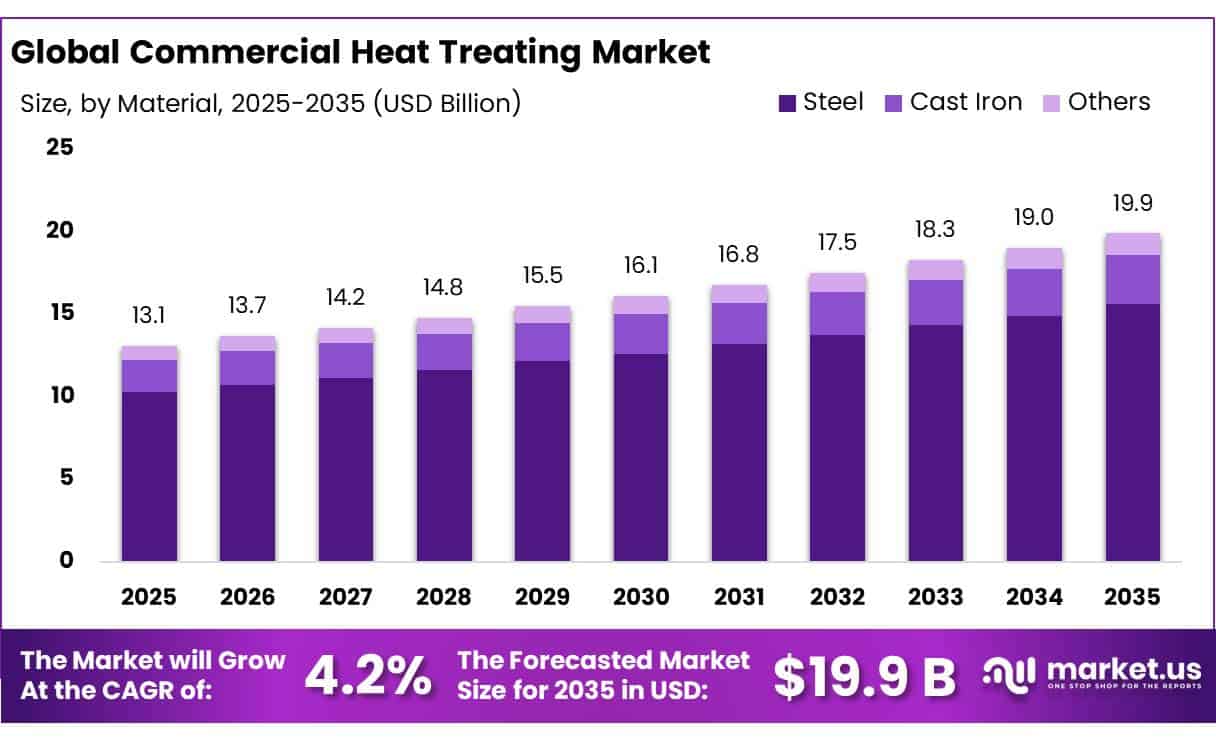
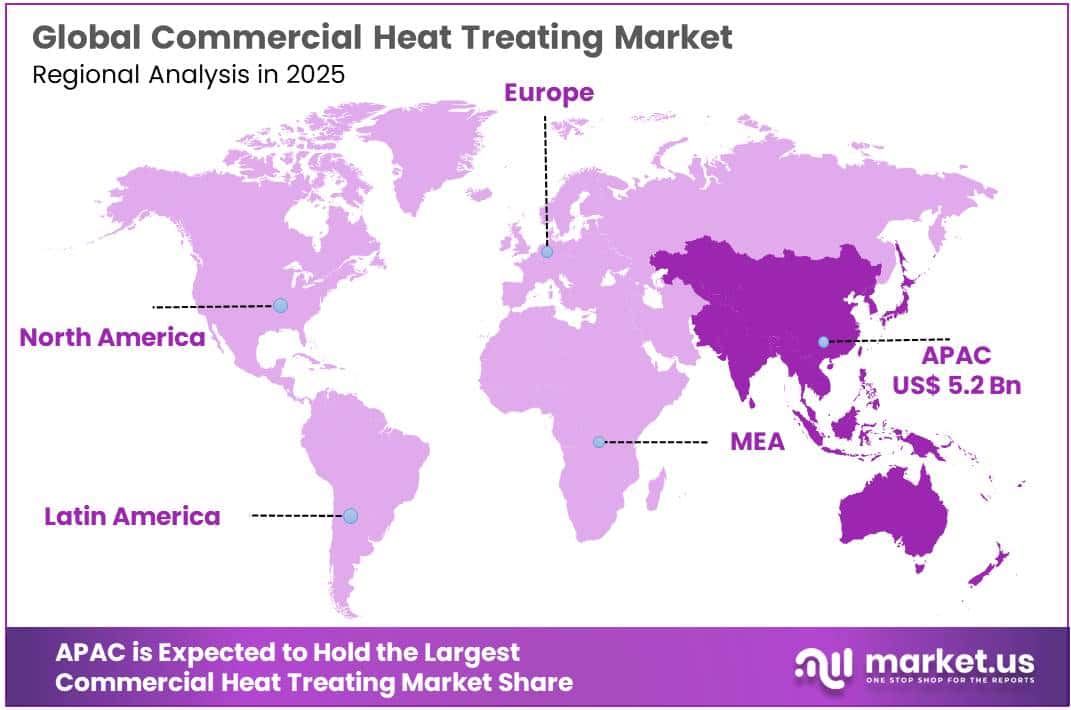
The Global Commercial Heat Treating Market size is expected to be worth around USD 19.9 Billion by 2035, from USD 13.1 Billion in 2025, growing at a CAGR of 4.2% during the forecast period from 2026 to 2035. In 2025, Asia-Pacific held a dominant market position, capturing more than a 39.78% share, holding USD 5.2 Billion revenue.
Commercial heat treating is an important industrial service that improves the mechanical properties, strength, hardness, toughness, wear resistance, and durability of metal components through controlled heating and cooling processes. The industry primarily serves automotive, aerospace, defense, machinery, construction equipment, energy, oil and gas, and general metalworking manufacturers. Common processes include annealing, hardening, tempering, carburizing, nitriding, brazing, and cryogenic treatment.
- These processes help manufacturers improve component performance, extend product life, and maintain consistent quality. According to the U.S. Census Bureau, commercial metal heat treating is classified under NAICS 332811, which specifically covers establishments providing heat treatment services, including annealing, tempering, brazing, and cryogenic treatment of metals for other businesses.
The industrial scenario reflects the importance of outsourced metal processing in modern manufacturing. Commercial heat treaters allow manufacturers to access specialized furnaces, controlled atmospheres, temperature-monitoring systems, and metallurgical expertise without investing in dedicated treatment facilities.
- According to U.S. Census Bureau data published through the Federal Reserve Bank of St. Louis, the metal heat treating industry’s annual payroll reached approximately USD 1.23 billion in 2024, compared with USD 1.25 billion in 2023. This demonstrates the industry’s established workforce and operating base. Separately, the broader U.S. coating, engraving, heat treating, and allied activities industry recorded approximately USD 30.50 billion in sectoral output in 2025. This broader figure includes activities beyond heat treating alone.
Demand from automotive and aerospace manufacturers remains a major driving factor for commercial heat treating services. Automotive manufacturers require heat-treated gears, transmission components, crankshafts, bearings, fasteners, and suspension parts to withstand repeated mechanical stress and friction. Aerospace manufacturers depend on specialized thermal processing to improve the fatigue strength and reliability of engine components, landing gear, turbine parts, and structural materials.
- According to the U.S. Bureau of Labor Statistics, the broader coating, engraving, heat treating, and allied activities industry employed 4,010 heat treating equipment operators in May 2023. Aerospace product and parts manufacturing accounted for another 620 workers in this occupation.
Energy efficiency and production consistency are also influencing industry development. Heat treatment requires precise temperature control, controlled furnace atmospheres, and reliable cooling systems. The U.S. Department of Energy reports that process heating accounted for approximately 51% of onsite manufacturing energy consumption in 2018. It also identifies opportunities in electromagnetic heating, industrial heat pumps, waste heat recovery, and advanced furnace controls.
Government initiatives supporting industrial electrification and lower-emission manufacturing are creating additional opportunities. The U.S. Department of Energy’s Industrial Heat Shot initiative targets the development of cost-competitive industrial heating technologies with at least 85% lower greenhouse gas emissions by 2035. This direction is encouraging equipment suppliers and commercial heat treatment companies to explore electric furnaces, advanced heating technologies, digital monitoring, and improved thermal management systems.
Key Takeaways
- Commercial Heat TreatingA Market size is expected to be worth around USD 19.9 Billion by 2035, from USD 13.1 Billion in 2025, growing at a CAGR of 4.2%.
- Steel held a dominant market position, capturing more than a 78.45% share.
- Hardening & tempering held a dominant market position, capturing more than a 36.78% share.
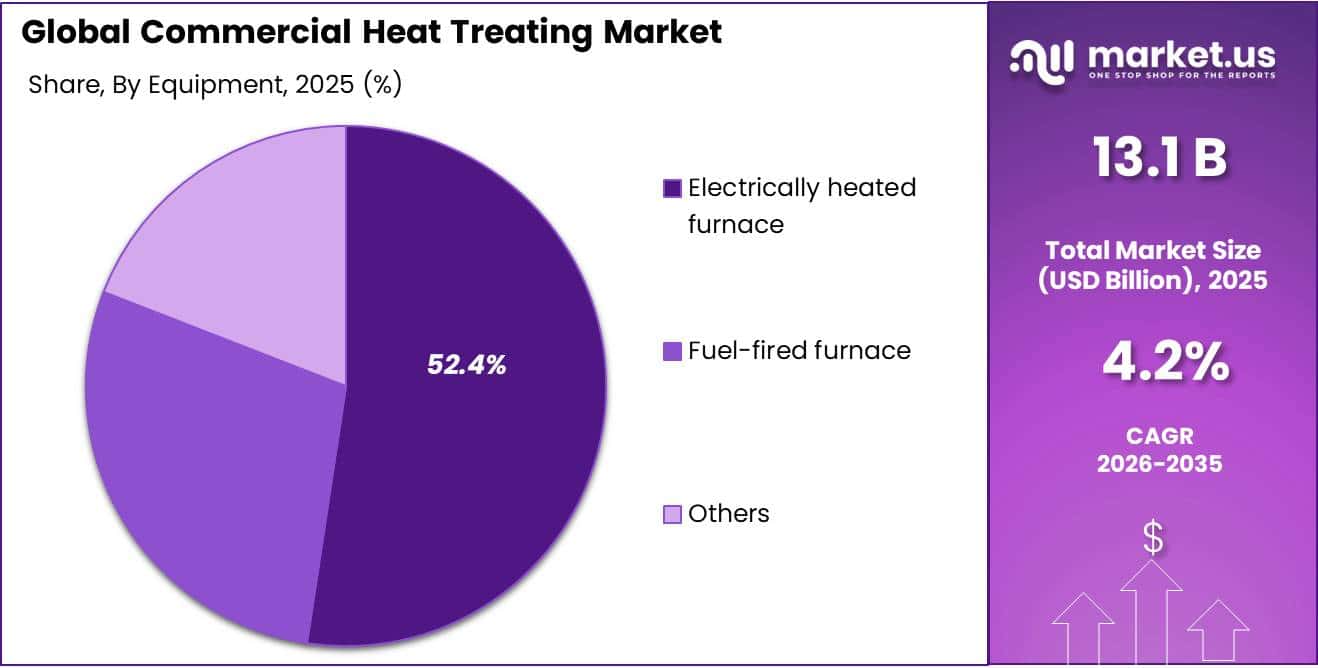
- Electrically heated furnace held a dominant market position, capturing more than a 52.45% share.
- Automotive held a dominant market position, capturing more than a 34.21% share.
- Asia-Pacific holds the leading position in the Commercial Heat Treating Market, accounting for 39.78% of the global market, valued at USD 5.2 billion.
By Material Analysis
Steel dominates the market due to its extensive use in automotive, aerospace, machinery, construction equipment, and industrial components.
In 2025, “Steel” held a dominant market position, capturing more than a 78.45% share of the Commercial Heat Treating Market by Material. Steel remains the leading material because of its wide industrial applications, strength, durability, and suitability for different heat treatment processes. Commercial heat treating improves the hardness, wear resistance, tensile strength, and fatigue performance of steel components.
Processes such as carburizing, annealing, hardening, tempering, and nitriding support the production of reliable gears, shafts, bearings, fasteners, and machine parts. The growing requirement for high-performance automotive components, industrial machinery, and precision-engineered products continues to support demand for steel heat treatment services.
“Cast Iron” represents an important material segment in the Commercial Heat Treating Market, supported by its applications in automotive parts, industrial machinery, pumps, valves, agricultural equipment, and construction machinery. Heat treatment helps improve cast iron’s hardness, wear resistance, machinability, and structural performance.
In 2025, demand from manufacturers of engine blocks, brake components, machine bases, and heavy-duty equipment continued to support the need for specialized cast iron treatment services. The segment also benefits from the use of ductile iron and high-strength cast iron in applications requiring durability and resistance to mechanical stress.
By Process Analysis
Hardening and tempering dominate due to their ability to improve metal strength, toughness, and resistance to wear.
In 2025, “Hardening & tempering” held a dominant market position, capturing more than a 36.78% share of the Commercial Heat Treating Market by Process. This process remains widely used because it improves the strength, hardness, and durability of steel components used in automotive, aerospace, industrial machinery, construction equipment, and heavy engineering applications.
These treatments are particularly important for gears, shafts, bearings, cutting tools, and other components exposed to repeated mechanical stress. In 2025, demand for reliable and durable industrial components supported the adoption of commercial hardening and tempering services.
Case hardening is an important process segment in the Commercial Heat Treating Market because it improves the surface strength of metal components while maintaining a comparatively tough and ductile core. The process is widely used in automotive gears, transmission parts, shafts, bearings, heavy machinery, and industrial equipment.
According to the U.S. Bureau of Labor Statistics, approximately 14,000 heat treating equipment setters, operators, and tenders were employed across the United States in 2025. This workforce figure highlights the importance of specialized heat treatment operations in industrial manufacturing, including processes used for surface hardening. Additionally, the U.S. Geological Survey reported approximately 82 million tons of raw steel production in 2025, reflecting the substantial domestic steel manufacturing base that supports downstream metal processing requirements.
By Equipment Analysis
Electrically heated furnaces dominate due to their precise temperature control, clean operation, and consistent heating performance.
In 2025, “Electrically heated furnace” held a dominant market position, capturing more than a 52.45% share of the Commercial Heat Treating Market by Equipment. Electrically heated furnaces are widely used because they provide accurate temperature control, uniform heat distribution, and reliable processing conditions for different metal components.
“Fuel-fired furnace” represents an important equipment segment in the Commercial Heat Treating Market because it provides high-temperature processing capabilities for large metal components and continuous production requirements. These furnaces commonly use natural gas and other industrial fuels to generate heat for annealing, hardening, tempering, and carburizing applications. They are widely used in automotive manufacturing, heavy engineering, steel processing, foundries, and industrial machinery production.
In 2025, demand for fuel-fired furnaces continued to be supported by manufacturers requiring high thermal capacity, established furnace infrastructure, and reliable performance for large production batches. According to the U.S. Department of Energy, fuel-based process heating consumes approximately 4.8 quadrillion British thermal units (Btu) annually in the United States, representing around 51% of total industrial primary energy consumption.
Government statistical reference for the dominant electrically heated furnace segment: According to the U.S. Geological Survey’s 2026 report, the United States produced approximately 82 million tons of raw steel in 2025. Electric arc furnaces accounted for production at 102 minimills operated by 47 companies. Although these figures relate to steelmaking rather than commercial heat treatment, they demonstrate the established industrial use of electrically powered furnace technology.
By Application Analysis
Automotive dominates the market due to the high demand for durable, wear-resistant, and high-strength vehicle components.
In 2025, “Automotive” held a dominant market position, capturing more than a 34.21% share of the Commercial Heat Treating Market by Application. The automotive industry relies on commercial heat treating to improve the strength, hardness, and durability of critical vehicle components, including transmission gears, crankshafts, camshafts, bearings, axles, and engine parts.
“Machine” represents an important application segment in the Commercial Heat Treating Market, driven by the use of treated metal components in industrial machinery, manufacturing equipment, pumps, compressors, turbines, bearings, gears, and machine tools. Heat treatment improves the hardness, toughness, fatigue resistance, and dimensional stability of these components, helping machinery operate under heavy loads and continuous working conditions.
Government statistical reference for the dominating automotive segment: According to the U.S. Census Bureau’s December 2025 manufacturing report, shipments of motor vehicles and parts reached approximately USD 796.6 billion in 2025, compared with USD 786.9 billion in 2024, representing an increase of 1.2%. This growth reflects continued manufacturing activity in the automotive supply chain and supports demand for metal components requiring specialized heat treatment.
Key Market Segments
By Material
- Steel
- Cast Iron
- Others
By Process
- Case hardening
- Hardening & tempering
- Annealing
- Normalizing
- Others
By Equipment
- Electrically heated furnace
- Fuel-fired furnace
- Others
By Application
- Automotive
- Machine
- Construction
- Aerospace
- Metalworking
- Others
Driver Analysis
Civil Aircraft Production
Higher aircraft production increases recurring thermal-processing requirements across eligible forgings, castings, fasteners, landing-gear components and other qualified metal parts, while long order books support investment in approved processing capacity. Airbus delivered 793 commercial aircraft in 2025, approximately 4% more than in 2024, and ended the year with 8,754 aircraft in backlog, including 1,124 widebodies.
Bodycote’s 2025 results independently identify accelerating aerospace and defense demand, providing evidence that stronger end-market activity is reaching a commercial processor.
In an illustrative supplier program, annual output rising from 100,000 to 110,000 eligible components increases volume by 10%; if 70% is commercially processed at an average USD 25 per component, annual attributable revenue rises from USD 1.75 million to USD 1.925 million, adding USD 175,000 at unchanged processing mix.
The assumed charge is not an industry average and excludes component value. Commercially, program qualification and repeatable processing support longer customer relationships and capacity reservations, but the benefit depends on executable schedules rather than backlog size alone. The +1.1 pp contribution assumes 22% revenue exposure grows 5.0 percentage points faster through civil-aircraft production-related processing, excluding defense work, unconverted orders and separately allocated specialist mix.
Drivers Impact Analysis
| Driver | (~) % Impact on CAGR Forecast | Geographic Relevance | Impact Timeline |
|---|---|---|---|
| Civil aircraft production | +1.1 pp | US, France, Germany, UK | Short term (≤ 2 years) |
| Defense manufacturing demand | +0.8 pp | US, UK, France, Germany | Short term (≤ 2 years) |
| Gas-turbine component demand | +0.8 pp | US, Germany, Japan, UK | Medium term (2–4 years) |
| Qualified processing outsourcing | +0.7 pp | US, Germany, France, India | Medium term (2–4 years) |
| Specialist processing intensity | +0.5 pp | US, Germany, Japan, South Korea | Medium term (2–4 years) |
Restraint Analysis
Automotive Order Weakness
Weak automotive manufacturing demand reduces the number of components requiring commercial thermal processing, directly constraining furnace loading and sales rather than merely increasing delivery complexity. Bodycote’s July 2026 interim results reported a 4% decline in its automotive market, particularly reflecting challenging Western European conditions, while industrial markets were broadly stable at approximately 1% growth.
In an illustrative processor generating USD 20 million annually from one million comparable automotive components at USD 20 each, a 6% production-related order decline removes USD 1.2 million of revenue before any recovery or price changes. If variable operating costs equal 45% of the affected revenue and fixed costs remain unchanged, contribution available to cover fixed costs falls by USD 660,000. The resulting margin pressure can restrict expansion, but margin deterioration itself is not an additional market-revenue deduction.
Suppliers can rebalance capacity, yet furnaces qualified for one material or process cannot necessarily absorb unrelated work without further investment. The −0.60 pp contribution assumes 20% revenue exposure grows 3.0 percentage points more slowly through cyclical automotive order weakness, excluding the separate structural effect of powertrain redesign and crediting orders subsequently recovered within the forecast period.
Restraint Impact Analysis
| Restraint | (~) % Impact on CAGR Forecast | Geographic Relevance | Impact Timeline |
|---|---|---|---|
| Automotive order weakness | −0.60 pp | Germany, France, US | Short term (≤ 2 years) |
| Powertrain processing displacement | −0.45 pp | China, Germany, Japan, South Korea | Medium term (2–4 years) |
| Economical captive processing | −0.40 pp | China, Germany, US, Japan | Medium term (2–4 years) |
| Missing customer process approvals | −0.30 pp | US, UK, France, Germany | Medium term (2–4 years) |
| Uneconomic small-lot outsourcing | −0.25 pp | US, Germany, France, India | Short term (≤ 2 years) |
Opportunity Analysis
Additive Post-Processing Packages
Commercial processors could win additional metal-additive-manufacturing programs by offering a single qualified thermal route covering stress relief, hot isostatic pressing and subsequent heat treatment, reducing the burden of coordinating separate process providers. Bodycote already describes combined post-build heat-treatment and HIP capabilities, with HIP used to address internal porosity and improve material properties; this establishes technical feasibility, not a universal requirement to HIP every printed component or evidence that the entire application remains untapped.
The incremental opportunity is converting programs that otherwise remain captive, fail to qualify or do not proceed because fragmented thermal processing is uneconomic—not simply bundling services already purchased externally. In an illustrative program screening 50 manufacturers, a 20% conversion rate produces ten accounts. At 10,000 eligible parts annually per account and USD 35 of attributable thermal-processing revenue per part, gross obtainable sales are USD 3.5 million. If 60% replaces existing commercial processing, net additional category revenue is USD 1.4 million.
Assuming a 35% contribution margin on incremental work, annual contribution reaches USD 490,000 before qualification expense, depreciation and overhead; a USD 500,000 reusable process-development investment would require approximately one year of steady-state contribution to recover.
Suppliers must validate each alloy, geometry and acceptance route rather than promise universal densification or performance improvement. The +0.40 pp coefficient assumes 8% revenue exposure grows 5.0 percentage points faster through newly converted additive programs, excluding printing, machining, coatings, existing bundled work and medical programs assigned below.
Opportunity Impact Analysis
| Opportunity | (~) % Potential CAGR Upside | Geographic Relevance | Execution Window |
|---|---|---|---|
| Additive post-processing packages | +0.40 pp | US, Germany, UK, France | Medium term (2–4 years) |
| Managed customer-site processing | +0.35 pp | US, Germany, India, Japan | Medium term (2–4 years) |
| Pooled small-lot processing | +0.30 pp | Germany, France, US, India | Short term (≤ 2 years) |
| Verified low-carbon contracts | +0.25 pp | Germany, France, Sweden, UK | Medium term (2–4 years) |
| Medical qualification platforms | +0.20 pp | US, Ireland, Switzerland, Germany | Medium term (2–4 years) |
Challenges Analysis
Energy and Atmosphere Optimization
Heat treaters must continuously coordinate furnace loading, heating cycles, process-gas consumption and energy procurement, because lower utility expenditure cannot come at the expense of the required metallurgical outcome.
Bodycote’s 2025 ESG supplement identifies energy intermittency and price volatility as operating risks, while a 2025 customer case study demonstrates why electricity alone is an incomplete efficiency measure: energy input represented approximately 25% of that component’s assessed carbon footprint and process gases 48%; gas optimization reduced the latter contribution by approximately one-third. These are application-specific emissions figures, not industry cost shares or guaranteed savings.
In an illustrative USD 20 million processing business with USD 3 million of annual energy and process-gas expenditure, a 15% increase in that cost basket adds USD 450,000. Recovering 60% through contractual adjustments leaves USD 180,000 of residual annual exposure; the recovery affects nominal revenue and should not be mistaken for constant-price growth. Separately, if 20% of consumption is associated with avoidable hot-idle operation and half of that portion can be removed, theoretical consumption savings equal 10% before implementation constraints.
Operators need load-level metering, leak detection, cycle review and energy-contract discipline, rather than assuming electrification or tariff negotiation alone resolves the issue. The −0.30 pp contribution assumes 15% revenue exposure grows 2.0 percentage points more slowly through residual dispatch disruption and constrained expansion, excluding pure margin effects and low-carbon contracts already allocated to opportunities.
Challenges Impact Analysis
| Challenge | (~) % CAGR Friction Drag | Geographic Relevance | Mitigation Horizon |
|---|---|---|---|
| Energy and atmosphere optimization | −0.30 pp | Germany, France, UK, US | Medium term (2–4 years) |
| Pyrometry and process consistency | −0.30 pp | US, UK, France, Germany, Japan | Long term (≥ 4 years) |
| Mixed-load scheduling complexity | −0.25 pp | US, Germany, France, India | Medium term (2–4 years) |
| Furnace reliability and maintenance | −0.20 pp | US, Germany, China, India | Long term (≥ 4 years) |
| Specialist workforce continuity | −0.20 pp | US, Germany, UK, Japan | Long term (≥ 4 years) |
Geopolitical Impact Analysis
Geopolitical Impact Analysis: Impact of Ongoing Wars on the Commercial Heat Treating Market
The ongoing Russia-Ukraine war and instability in the Middle East are creating cost and supply chain challenges for the Commercial Heat Treating Market. These conflicts affect natural gas, electricity, industrial metals, transportation, and chemical supplies required for heat treatment operations. Fuel-fired furnace operators face higher energy cost risks, while electrically heated furnace operators remain exposed to changes in electricity prices.
The impact is visible in recent energy data. According to the International Energy Agency’s 2026 Global Gas Security Review, global liquefied natural gas supply is expected to decline by 3% in 2026, while European gas prices increased by almost 70% year-on-year between March and October 2026. These developments increase operating cost pressure on energy-intensive heat treatment facilities.
The U.S. Energy Information Administration reported that Brent crude prices averaged USD 124 per barrel in October 2026, reflecting the impact of Middle East supply uncertainty. To manage these risks, commercial heat treaters are focusing on energy-efficient furnaces, alternative fuel arrangements, local sourcing, and better inventory planning. These investments can help reduce supply disruptions and protect production continuity.
Regional Insights
Dominating Region: Asia-Pacific – 39.78% Market Share | USD 5.2 Billion
Asia-Pacific holds the leading position in the Commercial Heat Treating Market, accounting for 39.78% of the global market, valued at USD 5.2 billion. The region benefits from its strong automotive, steel, machinery, aerospace, and industrial equipment manufacturing base. High demand for treated steel components, transmission parts, gears, bearings, and heavy machinery supports commercial heat treatment services.
Southeast Asia is emerging as an important growth area for commercial heat treating services due to expanding automotive production, machinery manufacturing, industrial equipment investments, and steel processing activities. The region’s growing manufacturing base is increasing the need for heat-treated gears, shafts, bearings, machine tools, and precision metal components.
According to the Organisation for Economic Co-operation and Development (OECD), ASEAN steel production is projected to increase from 60.2 million tonnes in 2025 to 90.6 million tonnes by 2030, representing a projected compound annual growth rate of 8.5%. This expansion is expected to create additional opportunities for commercial heat treatment providers. Vietnam, Indonesia, Thailand, and Malaysia are becoming important manufacturing locations, supporting demand for specialized thermal processing, automated furnaces, and improved metal component quality.
Key Regions and Countries Insights
- North America
- US
- Canada
- Europe
- Germany
- France
- The UK
- Spain
- Italy
- Rest of Europe
- Asia Pacific
- China
- Japan
- South Korea
- India
- Australia
- Rest of APAC
- Latin America
- Brazil
- Mexico
- Rest of Latin America
- Middle East & Africa
- GCC
- South Africa
- Rest of MEA
Key Players Analysis
Bluewater Thermal Solutions LLC is a major North American provider of commercial heat treating, brazing, and metal processing services. The company operates 12 locations across the United States and serves more than 2,000 customers across automotive, aerospace, energy, and industrial manufacturing. Its service portfolio includes hardening, tempering, carburizing, nitriding, vacuum heat treatment, and stress relieving.
Bodycote is one of the world’s largest providers of thermal processing services, offering precision heat treatment and specialist technologies for automotive, aerospace, defense, energy, and industrial customers. In 2025, the company reported total revenue of £727.1 million, including £459.3 million from its Precision Heat Treatment division. Its precision heat treatment revenue recorded 1.3% organic growth during the year. The company also invested £77 million in capital expenditure in 2025 to support operational improvements and future expansion.
East-Lind Heat Treat Inc. is a specialized heat treatment service provider based in Madison Heights, Michigan, serving automotive, aerospace, military, oil and gas, tooling, and precision machining industries. The company has nearly 40 years of operating experience and serves more than 700 local companies. Its services cover heat treatment of ferrous and non-ferrous metals, including specialized processing for gears, cutting tools, dies, and industrial components.
Top Key Players Outlook
- Bluewater Thermal Solutions LLC
- Bodycote
- East-Lind Heat Treat Inc.
- General Metal Commercial Heat Treating
- Shanghai Fengdong Heat Treatment Engineering Co., Ltd.
- Pacific Metallurgical, Inc.
- Aalberts N.V.
- Unitherm Engineers Limited
- TRIAD ENGINEERS
- HighTemp Furnaces Limited
- Deck India Engineering Pvt. Ltd.
- Other Key Players
Recent Developments
- In February 2026, Aalberts reported full-year 2025 revenue of EUR 3,091 million, EBITA of EUR 410 million, and free cash flow of EUR 361 million. In July 2026, the company reported first-half revenue of EUR 1,560 million, representing 5.0% organic growth, and continued investment in manufacturing capabilities across North America, Europe, and Southeast Asia.
- In January 2026, Unitherm Engineers Limited the joint venture formally inaugurated the Pune facility, strengthening its services for cutting tools, dies, moulds, automotive, and aerospace components. The company also benefits from its existing 50:50 joint venture with Aichelin Group, Austria, through Aichelin Unitherm Heat Treatment Systems India, which supports access to advanced furnace technology and equipment.
Report Scope
| Report Features | Description |
|---|---|
| Market Value (2025) | USD 13.1 Bn |
| Forecast Revenue (2035) | USD 19.9 Bn |
| CAGR (2026-2035) | 4.2% |
| Base Year for Estimation | 2025 |
| Historic Period | 2020-2024 |
| Forecast Period | 2026-2035 |
| Report Coverage | Revenue Forecast, Market Dynamics, Competitive Landscape, Recent Developments |
| Segments Covered | By Material (Steel, Cast Iron, Others), By Process (Case hardening, Hardening & tempering, Annealing, Normalizing, Others), By Equipment (Electrically heated furnace, Fuel-fired furnace, Others), By Application (Automotive, Machine, Construction, Aerospace, Metalworking, Others) |
| Regional Analysis | North America – US, Canada; Europe – Germany, France, The UK, Spain, Italy, Rest of Europe; Asia Pacific – China, Japan, South Korea, India, Australia, Singapore, Rest of APAC; Latin America – Brazil, Mexico, Rest of Latin America; Middle East & Africa – GCC, South Africa, Rest of MEA |
| Competitive Landscape | Bluewater Thermal Solutions LLC, Bodycote, East-Lind Heat Treat Inc., General Metal Commercial Heat Treating, Shanghai Fengdong Heat Treatment Engineering Co., Ltd., Pacific Metallurgical, Inc., Aalberts N.V., Unitherm Engineers Limited, TRIAD ENGINEERS, HighTemp Furnaces Limited, Deck India Engineering Pvt. Ltd., Other Key Players |
| Customization Scope | Customization for segments, region/country-level will be provided. Moreover, additional customization can be done based on the requirements. |
| Purchase Options | We have three licenses to opt for: Single User License, Multi-User License (Up to 5 Users), Corporate Use License (Unlimited User and Printable PDF) |