Report Overview
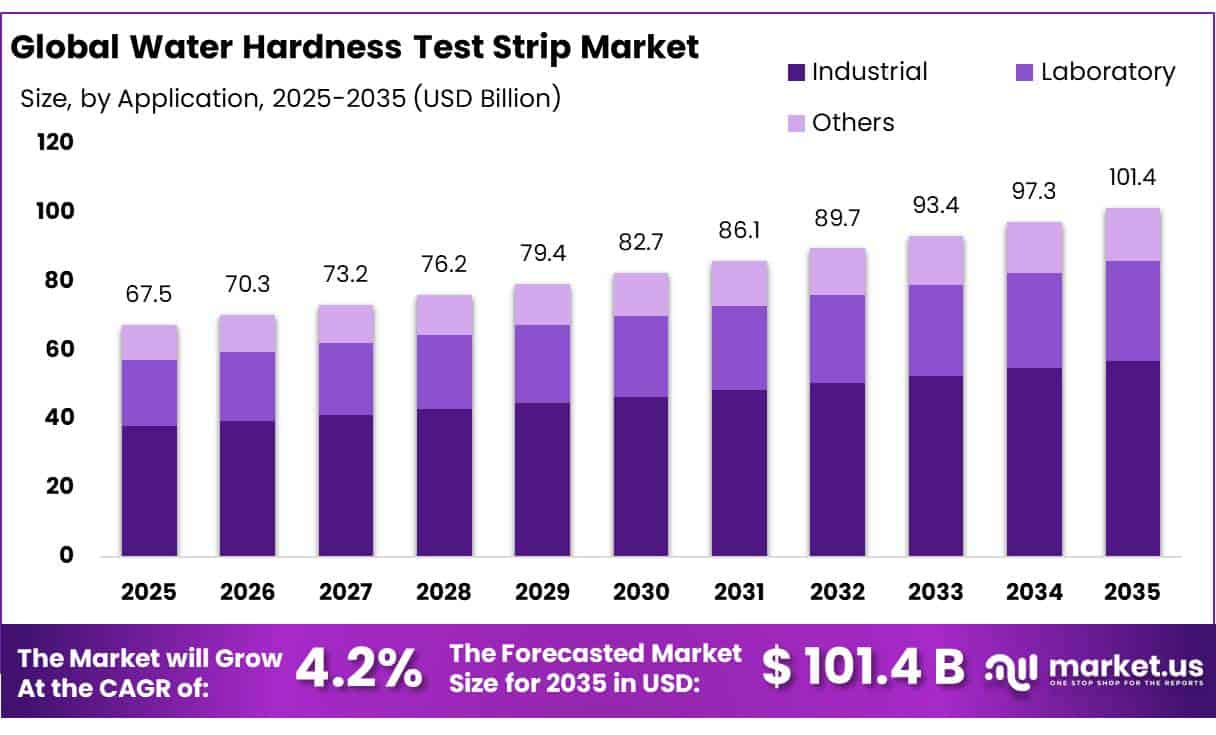
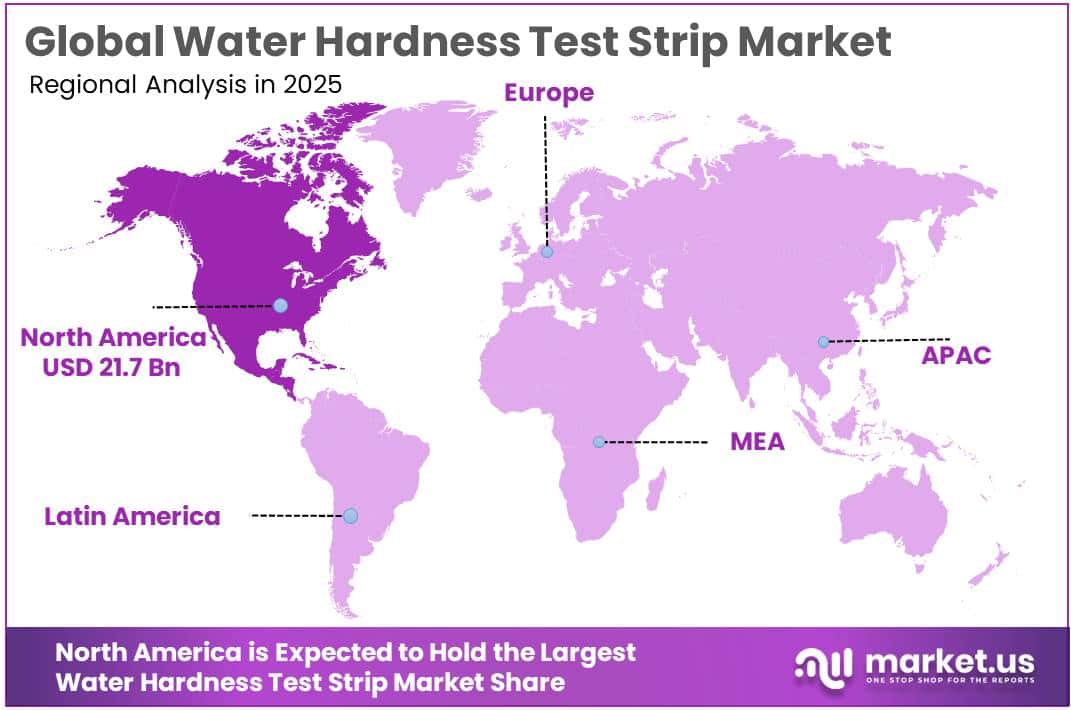
The Global Water Hardness Test Strip Market size is expected to be worth around USD 101.4 Billion by 2035, from USD 67.5 Billion in 2025, growing at a CAGR of 4.2% during the forecast period from 2026 to 2035. In 2025, North America held a dominant market position, capturing more than a 32.12% share, holding USD 21.7 Billion revenue.
Water hardness test strips are simple chemical testing products used to estimate the concentration of dissolved calcium and magnesium in water. They provide quick results through a color change, allowing users to compare the strip with a reference chart and identify whether water is soft, moderately hard, hard, or very hard. These strips are used in residential water treatment, swimming pools, aquariums, commercial cleaning, and industrial water management.
- Their affordability, portability, and ease of use make them useful for routine screening without requiring expensive laboratory equipment. The United States Geological Survey (USGS) classifies water with hardness of 0–60 mg/L as calcium carbonate as soft, 61–120 mg/L as moderately hard, 121–180 mg/L as hard, and above 180 mg/L as very hard.
The industrial scenario is shaped by the need to monitor mineral deposits in plumbing systems, water heaters, boilers, and industrial processing equipment. Hard water can reduce cleaning efficiency, increase detergent consumption, and create scale that affects equipment performance. The USGS identifies scale formation as a major operational problem associated with hard water in heating systems and industrial equipment. Test strips help households, maintenance teams, and service providers check water before selecting or adjusting water-softening treatments.
A major driving factor is the need for convenient water-quality monitoring across residential and commercial settings. The Australian National Health and Medical Research Council recommends that total hardness in drinking water should not exceed 200 mg/L as calcium carbonate to minimize undesirable scale buildup in hot-water systems. Such guidance encourages water treatment operators and consumers to understand hardness levels and maintain suitable treatment conditions.
Future growth opportunities include improved color comparison systems, digital interpretation through smartphone cameras, multi-parameter water testing kits, and more convenient packaging for household and professional users. Manufacturers can also expand distribution through water treatment suppliers, home improvement retailers, pool maintenance businesses, and e-commerce channels.
Key Takeaways
- Water Hardness Test Strip Market size is expected to be worth around USD 101.4 Billion by 2035, from USD 67.5 Billion in 2025, growing at a CAGR of 4.2%.
- Calcium Concentration Measurement held a dominant market position, capturing more than a 77.45% share.
- Industrial held a dominant market position, capturing more than a 56.34% share.
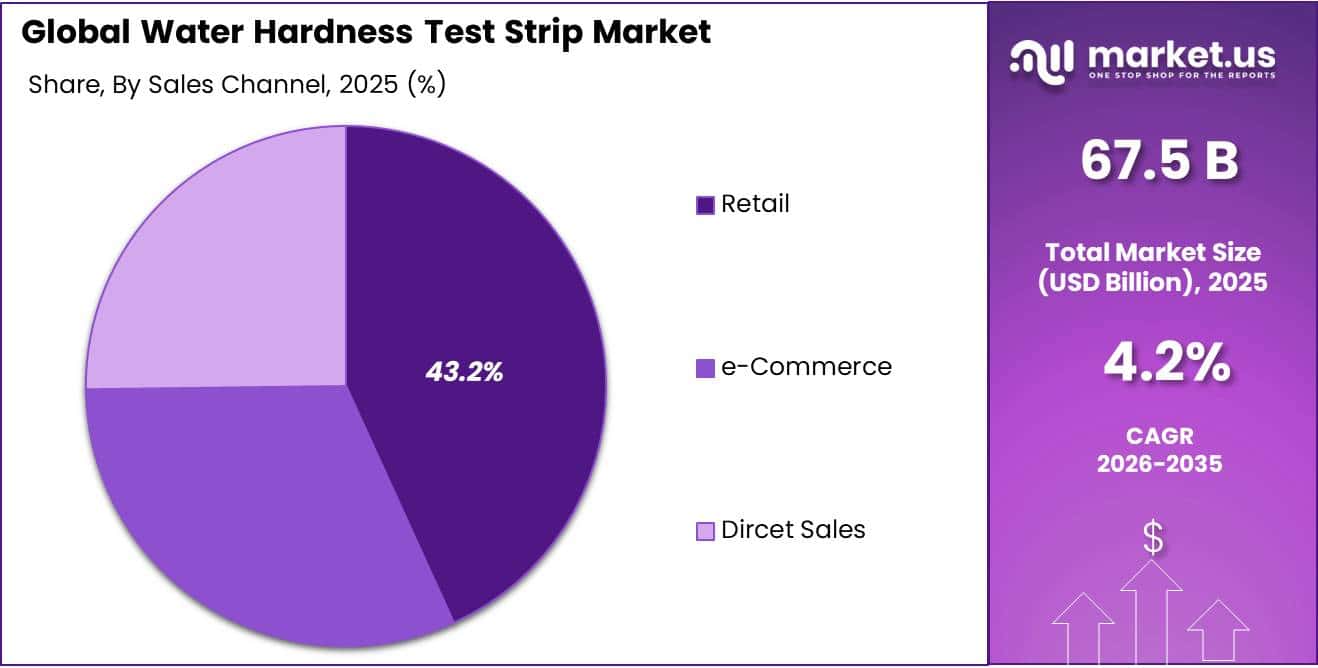
- Retail held a dominant market position, capturing more than a 43.23% share.
- North America held the dominant position in the Water Hardness Test Strip Market, with a reported share of 32.12% and a market value of USD 21.7 billion
By Type Analysis
Calcium Concentration Measurement leads with a 77.45% share in 2025, driven by its importance in routine water hardness checks.
In 2025, “Calcium Concentration Measurement” held a dominant market position, capturing more than a 77.45% share of the Water Hardness Test Strip Market by Type. Calcium measurement is important because calcium is one of the main minerals responsible for water hardness and scale formation in pipes, water heaters, and other equipment. Test strips provide a quick and convenient way for households, maintenance teams, and water treatment operators to check calcium-related hardness and assess whether water softening may be needed.
Magnesium Concentration Measurement is an important segment of the Water Hardness Test Strip Market because magnesium, along with calcium, contributes to overall water hardness. In 2025, magnesium testing remained relevant for residential water treatment, swimming pools, aquariums, and industrial water systems where mineral buildup can affect equipment and cleaning performance. Test strips offer a convenient method for routine screening, helping users determine whether further water treatment or laboratory analysis is required.
By Application Analysis
Industrial applications lead with a 56.34% share in 2025, driven by the need to monitor mineral buildup in equipment and water systems.
In 2025, “Industrial” held a dominant market position, capturing more than a 56.34% share of the Water Hardness Test Strip Market by Application. Industrial facilities use water hardness test strips for routine screening of process water, boiler feedwater, cooling systems, and water treatment operations. Excess calcium and magnesium can contribute to scale formation, reduce heat-transfer efficiency, and increase equipment maintenance requirements.
Laboratories use water hardness test strips for preliminary checks of water samples and for routine monitoring in educational, environmental, and industrial testing settings. In 2025, these products remained useful where rapid results and simple handling were preferred before more detailed analysis. Test strips can help indicate whether calcium and magnesium levels may require further investigation, although they do not replace precise analytical methods when accurate concentration measurements are necessary.
By Sales Channel Analysis
Retail leads with a 43.23% share in 2025, supported by easy product access and immediate availability.
In 2025, “Retail” held a dominant market position, capturing more than a 43.23% share of the Water Hardness Test Strip Market by Sales Channel. Retail stores provide consumers and professional users with convenient access to water hardness test strips for household water treatment, swimming pools, aquariums, and routine equipment maintenance.
In 2025, e-commerce supported the distribution of water hardness test strips by allowing households, laboratories, pool maintenance providers, and industrial users to compare product specifications and order supplies remotely. Online channels can offer a wider choice of pack sizes, testing ranges, and multi-parameter kits, while repeat purchasing helps users maintain regular testing routines. Digital product descriptions also make it easier to review instructions and intended applications before purchase.
The United States Census Bureau reported that U.S. retail e-commerce sales reached approximately USD 1.23 trillion in 2025, demonstrating the scale of online retail distribution.
Key Market Segments
By Type
- Calcium Concentration Measurement
- Magnesium Concentration Measurement
By Application
- Laboratory
- Industrial
- Others
By Sales Channel
- Retail
- e-Commerce
- Dircet Sales
Driver Analysis
India JJM Community Field Testing
India’s Jal Jeevan Mission (JJM) has created the world’s largest program of community water testing, and field test kits that include hardness strips are a core part of it. The program has trained 24.80 lakh (2.48 million) women in 5.07 lakh (507,000) villages to test water with these kits (IANS; PIB). In the first months of 2025-26 alone, 21.92 lakh (2.19 million) samples from 1.52 lakh (152,000) villages were tested with field kits, alongside lab testing. A network of 2,843 laboratories tested 38.78 lakh (3.88 million) samples across 4.5 lakh (450,000) villages.
On March 10, 2026, the Cabinet extended JJM to December 2028 and raised its outlay to ₹8.69 lakh crore, shifting the focus to long-term service delivery (PM India; DD News). That moves testing from a one-time setup activity to recurring surveillance. We estimate that if each village runs 4 to 8 field tests a year, 5 lakh villages need 2 to 4 million hardness tests annually. Kit refills at ₹3 to ₹8 per strip create a recurring market for domestic strip makers. States buy through annual tenders, so suppliers compete on price per test and on refill logistics to village level.
Drivers Impact Analysis
| Driver | (~) % Impact on CAGR | Geographic Relevance | Impact Timeline |
|---|---|---|---|
| India JJM Community Field Testing | +1.2% | India core, South Asia spill-over | Medium term (2-4 years) |
| Home Water Treatment Adoption | +1.0% | North America core, UK, EU | Short term (≤ 2 years) |
| Appliance-Bundled Hardness Strips | +0.9% | EU core, UK, North America, APAC | Short term (≤ 2 years) |
| Pool and Spa Installed Base | +0.7% | U.S. Sun Belt, Southern Europe, Australia | Short term (≤ 2 years) |
| Data Center Cooling Water Monitoring | +0.7% | U.S. hubs, EU, APAC | Medium term (2-4 years) |
| App-Read Digital Strip Platforms | +0.6% | Global, B2B food and industrial | Medium term (2-4 years) |
Restraint Analysis
Online Analyzer and Smart Softener Substitution
Continuous analyzers and connected softeners are replacing manual strip checks in higher-value applications. Hach’s EZ Series analyzers monitor hardness online by colorimetric or titrimetric methods. Its SP510 monitor flags hardness breakthrough at set trip points from 0.3 to 100 mg/L CaCO₃ to trigger regeneration automatically. In homes, GE Appliances launched the Profile Professional Smart Valve softener in February 2025 with app connectivity and leak shutoff.
In India, Ion Exchange’s ZeroB Smart Tech app monitors and configures softeners through IoT. We estimate one online analyzer replaces 300 to 1,500 manual strip tests a year at a boiler or cooling site, and the analyzer’s $3,000 to $10,000 cost pays back within 1 to 3 years where downtime is expensive. In smart softeners, strips are used only at installation, not repeatedly. Strip makers lose 10% to 20% of industrial volume and become a backup consumable sold with analyzers rather than the main monitoring tool.
Restraint Impact Analysis
| Restraint | (~) % Impact on CAGR | Geographic Relevance | Impact Timeline |
|---|---|---|---|
| Online Analyzer and Smart Softener Substitution | -0.9% | North America, EU, India industrial | Medium term (2-4 years) |
| Free Utility Hardness Data | -0.7% | UK, EU, U.S. | Long term (≥ 4 years) |
| JJM Funding Cuts and Halts | -0.7% | India core | Short term (≤ 2 years) |
| Pool Retail Contraction | -0.7% | U.S. Sun Belt | Short term (≤ 2 years) |
| Accuracy and Method Standing Limits | -0.5% | Global regulated users | Long term (≥ 4 years) |
| U.S. Tariff Volatility on Imports | -0.5% | U.S., China supply corridors | Short term (≤ 2 years) |
Opportunity Analysis
Heat Pump Fill-Water Checks
This market is not yet served because installers test fill water with their own titration kits or skip the test, and no strip maker sells kits designed for heat pump commissioning. That is why it is an opportunity rather than one of the appliance-bundling or home treatment drivers. Dimplex heat pump manuals require fill and make-up water to meet VDI 2035, with a maximum of 11 °dGH in some systems and on-site checks of hardness, conductivity and pH.
In the UK, BS 7593:2019 adds testing of system water at regular intervals and redosing of inhibitor after five years. Heat pump sales reached 2.9 million in 21 European countries in 2025, up 13%, with an installed stock of 29.3 million; German sales rose 50% and heat pumps reached half of German heating sales. The UK recorded more than 60,000 certified installations, its highest ever.
We estimate that a three-test commissioning pack (fill water, system water after flushing, annual service) used on 40% of new European installations would mean about 3.5 million tests a year. A further 2 to 3 million annual service tests could come from the installed base. At €1.50 to €3.00 per installer-grade test, that is a €10M to €20M opportunity, with 45% to 55% gross margins through wholesalers and inhibitor brands.
Opportunity Impact Analysis
| Opportunity | (~) % Potential CAGR Upside | Geographic Relevance | Execution Window |
|---|---|---|---|
| Heat Pump Fill-Water Checks | +0.7% | EU (Germany core), UK | Medium term (2-4 years) |
| Private Well Owner Programs | +0.6% | U.S. rural | Medium term (2-4 years) |
| Foodservice Equipment Protection | +0.5% | EU, UK, North America | Short term (≤ 2 years) |
| Strip Maker Roll-Ups | +0.5% | North America | Short term (≤ 2 years) |
| Farm Irrigation and Livestock Water | +0.5% | India, U.S. poultry belt | Long term (≥ 4 years) |
| Dialysis Softener Hardness Checks | +0.4% | U.S., EU | Medium term (2-4 years) |
Challenges Analysis
Field Kit Testing Capacity Gaps
India’s community water testing depends on trained volunteers and on states keeping kits stocked, and both are slipping even though the funding restraint is a separate issue. About 24.80 lakh women have been trained to use field test kits, but samples tested with these kits fell from about 93.84 lakh in 2024-25 to 47.59 lakh in 2025-26 as of March 12, 2026, a drop of about 49%. A CAG audit found mobile labs in two test-checked districts out of service because of staff shortages and missing testing materials, and none of the six test-checked districts met the JJM testing target.
The rules require every source and two tail-end delivery points in each habitation to be tested every month. We estimate 25% to 35% of trained testers drop out each year. Retraining costs ₹300 to ₹600 per tester, and kit refill cycles are delayed by 4 to 8 months. As a result, strips are used at only 40% to 55% of the rate tenders assume. Suppliers will need to offer bundled refill and training contracts, upload test results to the government water quality portal on the user’s behalf, and use district-level stocking agents. These steps cost 6% to 10% of contract value but make repeat orders more reliable.
Challenges Impact Analysis
| Challenge | (~) % CAGR Friction | Geographic Relevance | Mitigation Horizon |
|---|---|---|---|
| Field Kit Testing Capacity Gaps | -0.7% | India core | Medium term (2-4 years) |
| Humidity and Shelf-Life Degradation | -0.7% | South Asia, tropical APAC, U.S. South | Medium term (2-4 years) |
| Packaging Compliance Cost Burden | -0.6% | EU, India | Medium term (2-4 years) |
| Red Sea Freight Disruption | -0.6% | Asia-EU, India-EU, Asia-U.S. East | Short term (≤ 2 years) |
| Reagent Input Supply Concentration | -0.5% | China, U.S., EU | Medium term (2-4 years) |
| Color Reading Error Variance | -0.4% | Global | Long term (≥ 4 years) |
Geopolitical Impact Analysis
Geopolitical Impact of the Ongoing Middle East Conflict on the Water Hardness Test Strip Market
The ongoing Middle East conflict in 2026 may affect the Water Hardness Test Strip Market through higher transportation costs, supply chain delays, and price fluctuations for chemical reagents, packaging materials, and laboratory supplies. Water hardness test strips rely on chemical indicators and treated paper or plastic components, making consistent access to raw materials important for manufacturers.
The scale of the disruption is reflected in data from the U.S. Energy Information Administration, which reported that crude oil tanker rates from the Middle East reached their highest levels since records began in November 2005 during March 2026. U.S. EIA. These pressures may raise freight and packaging costs for test strip suppliers and delay deliveries to retailers and industrial customers. In response, manufacturers may diversify suppliers, maintain higher safety stocks, and source materials from alternative regions.
However, the impact on test strip demand remains indirect, and the conflict does not necessarily increase consumption. Longer-term opportunities may emerge for manufacturers that maintain reliable supply chains and offer affordable, readily available water testing products.
Regional Insights
North America: Dominant Region
In 2025, North America held the dominant position in the Water Hardness Test Strip Market, with a reported share of 32.12% and a market value of USD 21.7 billion, based on the supplied market figures. Regional demand is supported by household water treatment, industrial equipment maintenance, swimming pool care, and routine water-quality monitoring.
The United States Geological Survey explains that hard water is common in parts of the east-central and western United States because of local geology and mineral-rich aquifers. It also notes that hardness can cause mineral buildup in plumbing and water heaters, creating a practical need for routine testing. These conditions support demand for convenient water hardness test strips among households, maintenance providers, and water treatment businesses.
Asia-Pacific is a promising region for future market expansion, supported by growing water treatment requirements, industrial activity, and wider adoption of simple water-quality testing products. Demand can come from commercial facilities, swimming pool operators, equipment maintenance services, and households using water softeners. Hardness test strips offer a low-cost way to screen water before treatment decisions are made. The United Nations’ Sustainable Development Goal 6 promotes access to safe water and improved water management, supporting wider attention to water quality.
Key Regions and Countries Insights
- North America
- US
- Canada
- Europe
- Germany
- France
- The UK
- Spain
- Italy
- Rest of Europe
- Asia Pacific
- China
- Japan
- South Korea
- India
- Australia
- Rest of APAC
- Latin America
- Brazil
- Mexico
- Rest of Latin America
- Middle East & Africa
- GCC
- South Africa
- Rest of MEA
Key Players Analysis
Thermo Fisher Scientific supports water analysis and laboratory testing through analytical instruments, chemical analysis products, and laboratory consumables. In 2025, the company reported annual revenue of USD 44.56 billion and research and development investment of USD 1.4 billion. Its analytical technologies can support detailed water-quality assessment, although its overall revenue does not represent water hardness test strip sales specifically. The company’s broad laboratory portfolio strengthens its position in the wider water testing and analytical instruments industry.
Merck KGaA participates directly in the Water Hardness Test Strip Market through its MQuant® product range. Its total hardness test strips measure hardness associated with calcium and magnesium using color changes, with results available within seconds. The product range includes measuring scales of 3–21 °d, 4–26 °e, and 5–37 °f, supporting routine water checks. These strips are suitable for drinking water, groundwater, surface water, and equipment maintenance.
Danaher participates in the wider water quality testing industry through its Hach business, which supplies water analysis instruments, reagents, and testing solutions. In 2025, Danaher reported annual revenue of USD 24.568 billion, up 3.0% from 2024. Hach’s water analysis portfolio supports monitoring of water quality in industrial and municipal applications, making it relevant to the broader hardness testing sector. However, the reported revenue covers the entire group, not water hardness test strips specifically. Source: Danaher 2025 financial results.
Top Key Players Outlook
- Thermo Fisher Scientific Inc
- Merck KGaA
- Danaher
- LaMotte Company
- Johnson Test Papers Ltd
- Serim Research Corporation
- Avantor, Inc.
- ISOLAB Laborgeräte GmbH
- Aqua Cure Ltd.
- Cole Parmer Instrument Company, LLC
- Spectris
- Industrial Test Systems, Inc.
- US WATER SYSTEMS INC
- Bartovation LLC
- Other Key Players
Recent Developments
- In March 2026, ISOLAB participated in analytica 2026 in Munich, presenting its wider laboratory product portfolio to the international laboratory sector. The company reports a 4,000 m² facility, more than 10,000 products, and exports to over 100 countries.
- In March 2026, Aqua Cure promoted its participation in the Water Dispenser & Hydration Association Spring Conference, showcasing Enviro+ water treatment technology, updated Hydro+ carbon filtration elements, and Aqua Dosa sanitisation products.
Report Scope
| Report Features | Description |
|---|---|
| Market Value (2025) | USD 67.5 Bn |
| Forecast Revenue (2035) | USD 101.4 Bn |
| CAGR (2026-2035) | 4.2% |
| Base Year for Estimation | 2025 |
| Historic Period | 2020-2024 |
| Forecast Period | 2026-2035 |
| Report Coverage | Revenue Forecast, Market Dynamics, Competitive Landscape, Recent Developments |
| Segments Covered | By Type (Calcium Concentration Measurement, Magnesium Concentration Measurement), By Application (Laboratory, Industrial, Others), By Sales Channel( Retail, e-Commerce, Dircet Sales) |
| Regional Analysis | North America – US, Canada; Europe – Germany, France, The UK, Spain, Italy, Rest of Europe; Asia Pacific – China, Japan, South Korea, India, Australia, Singapore, Rest of APAC; Latin America – Brazil, Mexico, Rest of Latin America; Middle East & Africa – GCC, South Africa, Rest of MEA |
| Competitive Landscape | Thermo Fisher Scientific Inc, Merck KGaA, Danaher, LaMotte Company, Johnson Test Papers Ltd, Serim Research Corporation, Avantor, Inc., ISOLAB Laborgeräte GmbH, Aqua Cure Ltd., Cole Parmer Instrument Company, LLC, Spectris, Industrial Test Systems, Inc., US WATER SYSTEMS INC, Bartovation LLC, Other Key Players |
| Customization Scope | Customization for segments, region/country-level will be provided. Moreover, additional customization can be done based on the requirements. |
| Purchase Options | We have three licenses to opt for: Single User License, Multi-User License (Up to 5 Users), Corporate Use License (Unlimited User and Printable PDF) |