


Report Overview
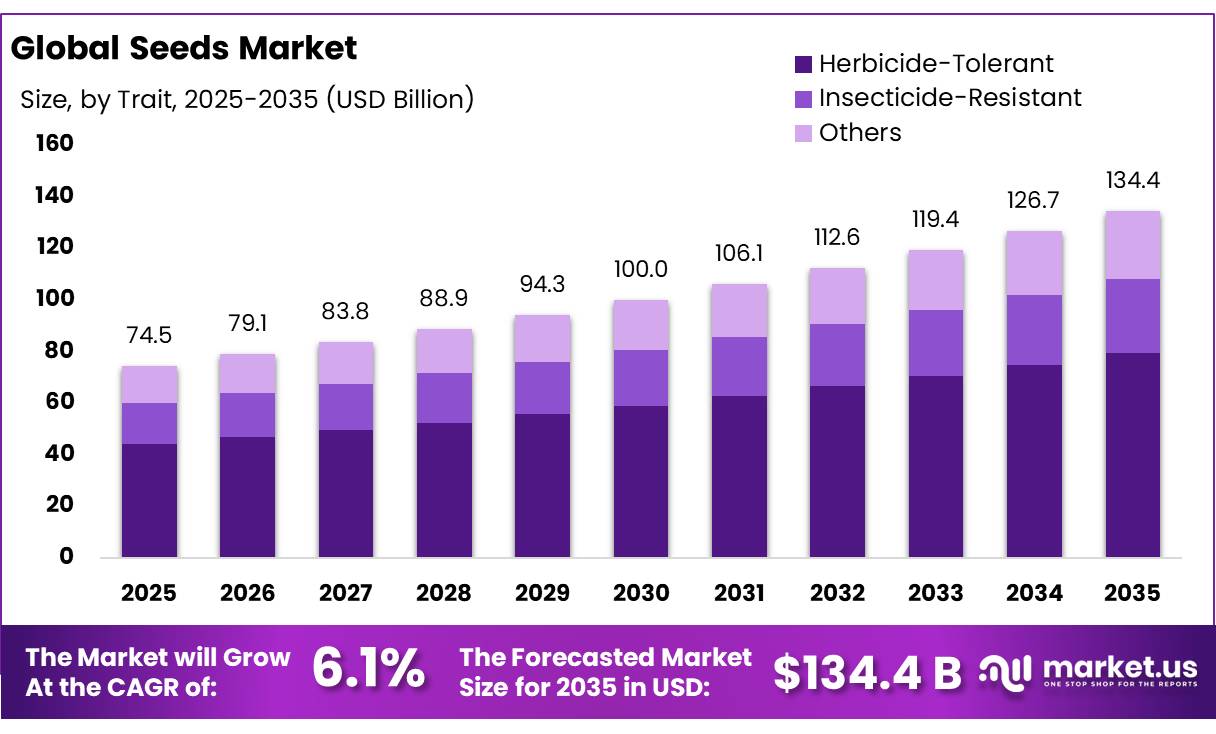
The Global Seeds Market size is expected to be worth around USD 134.4 Billion by 2035, from USD 74.5 Billion in 2025, growing at a CAGR of 6.1% during the forecast period from 2026 to 2035. In 2025, Asia-Pacific held a dominant market position, capturing more than a 41.23% share, holding USD 3.6 Billion revenue.
The global seeds industry forms the foundation of modern agricultural production, supplying improved genetics for cereals, oilseeds, vegetables, fruits, forage crops, and other commercial crops. Seed developers are increasingly focused on higher yield, disease resistance, drought tolerance, input efficiency, and traits that support changing climatic conditions.
- The OECD-FAO Agricultural Outlook projects global cereal production to reach 3.24 billion tonnes by 2035, while average cereal yields are expected to increase by about 0.9% annually and reach 4.2 tonnes per hectare. These productivity improvements are expected to rely increasingly on crop genetics and improved seed technologies rather than major expansion of cultivated land.
The present industrial scenario shows strong commercial demand for technologically advanced seed varieties. In the United States, USDA reported 95.2 million acres planted with corn in 2025, representing a 5% increase from 2024, while 94% of planted corn acreage used biotech varieties. Soybean planting reached 83.4 million acres.
Large agricultural and chemical companies are also strengthening investment in seeds and traits. Corteva reported USD 9.898 billion in Seed net sales during 2025, up 4% from USD 9.545 billion in 2024, while Seed operating EBITDA increased 19% to USD 2.636 billion. North American Seed sales alone reached USD 6.271 billion. The company operates around 120 R&D facilities and approximately 95 production and manufacturing facilities, demonstrating the industry’s significant research and commercial infrastructure.
Innovation represents a major driving factor. Syngenta reports having 12,000 seed specialists, more than 150 R&D and production sites, and approximately USD 1.4 billion of annual investment supporting agricultural innovation. Its seed-production network also works with about 90,000 production growers across 35 countries.
Key Takeaways
- Seeds Market size is expected to be worth around USD 134.4 Billion by 2035, from USD 74.5 Billion in 2025, growing at a CAGR of 6.1%.
- Conventional held a dominant market position, capturing more than a 54.21% share.
- Herbicide-Tolerant held a dominant market position, capturing more than a 59.90% share.
- Cereals & Grains held a dominant market position, capturing more than a 52.12% share.
- Asia-Pacific held a dominant Seeds Market position, capturing more than a 41.23% share and reaching USD 3.6 billion.
By Type Analysis
Conventional Seeds dominate with more than a 54.21% share, supported by broad use across non-biotech and traditional crop production.
In 2025, “Conventional” held a dominant market position, capturing more than a 54.21% share. Conventional seeds remained important because they can be used across a wide range of cereals, vegetables, pulses, forage crops, and other agricultural systems without genetically engineered traits.
Their strong position is also supported by established breeding programs, easier acceptance in markets where genetically modified crops face regulatory restrictions, and continued demand for locally adapted varieties. USDA data show that conventional seed production continues alongside biotechnology adoption; its 2025 Acreage report specifically separates conventionally bred herbicide-resistant varieties from biotechnology varieties when measuring seed adoption.
Genetically Modified seeds represent an important technology-driven segment of the seeds market, particularly in large-scale corn, soybean, and cotton farming. Adoption remains strong because biotechnology can provide herbicide tolerance, insect resistance, or combined traits that help growers manage weeds and pests more efficiently.
In 2025, the U.S. Department of Agriculture reported that 94% of U.S. corn acreage was planted with biotech varieties, while 96% of soybean acreage used herbicide-resistant seed varieties. USDA also reported biotechnology adoption across Upland cotton production, showing that genetically modified genetics remain firmly established in major commercial crops.
By Trait Analysis
Herbicide-Tolerant seeds dominate with more than a 59.90% share, supported by their broad use for effective weed control in major field crops.
In 2025, “Herbicide-Tolerant” held a dominant market position, capturing more than a 59.90% share. The segment benefits from strong farmer preference for seeds that simplify weed management and support efficient large-scale crop production. Herbicide-tolerant traits allow crops to withstand selected herbicides, helping growers control competing weeds without damaging the crop.
USDA data show particularly strong adoption in the United States, where 96% of soybean acreage was planted with herbicide-resistant seed varieties in 2025. USDA Economic Research Service data also show that herbicide-tolerant varieties were used on approximately 92% of U.S. corn acreage and 93% of Upland cotton acreage in 2025. This high adoption supports continued demand for herbicide-tolerant seed genetics across commercial farming systems.
Insecticide-Resistant seeds continue to hold an important position in the seed industry, particularly in corn and cotton production. These varieties generally contain traits derived from Bacillus thuringiensis (Bt), enabling the plant to produce proteins that protect against targeted insects and reduce crop losses. In 2025, USDA Economic Research Service reported that 87% of U.S. corn acreage was planted with Bt insect-resistant seeds, while 91% of U.S. cotton acreage used genetically engineered insect-resistant varieties.
USDA also reported that 84% of corn acreage used stacked varieties combining herbicide-tolerant and insect-resistant traits, showing how insect protection is increasingly integrated with additional seed technologies. Growing pressure from corn rootworm, corn earworm, bollworm, and related pests continues to support the commercial importance of insect-resistant seed traits.
By Crop Type Analysis
Cereals & Grains dominate the Seeds Market with more than a 52.12% share, supported by large planting areas and steady demand for corn, wheat, and other staple crops.
In 2025, “Cereals & Grains” held a dominant market position, capturing more than a 52.12% share. The segment remained strong because cereal crops are planted on extensive farmland and require regular seed replacement to maintain yield, quality, and resistance characteristics. In the United States, USDA reported that corn growers planted 95.2 million acres in 2025, while the area expected to be harvested for grain reached 86.8 million acres.
Corn production was later forecast at 16.7 billion bushels, supported by an average yield of 188.8 bushels per acre. Wheat also maintained a large production base, with total U.S. wheat production reaching 1.98 billion bushels in 2025 and harvested area totaling 37.2 million acres.
Oilseeds & Pulses represent an important crop segment in the Seeds Market, supported by widespread soybean cultivation and expanding demand for protein-rich pulse crops. In 2025, USDA estimated U.S. soybean planted area at 83.4 million acres, with approximately 82.5 million acres expected to be harvested. Soybean production was forecast at 4.29 billion bushels, while average yield was projected at a record 53.6 bushels per acre.
Pulse crops also recorded significant production activity. USDA estimated 2025 lentil production at 10.6 million cwt, up 17% from the previous season, while chickpea production reached 6.84 million cwt, an increase of 20%. Dry edible pea production reached 18.5 million cwt, while dry edible bean production stood at 26.9 million. 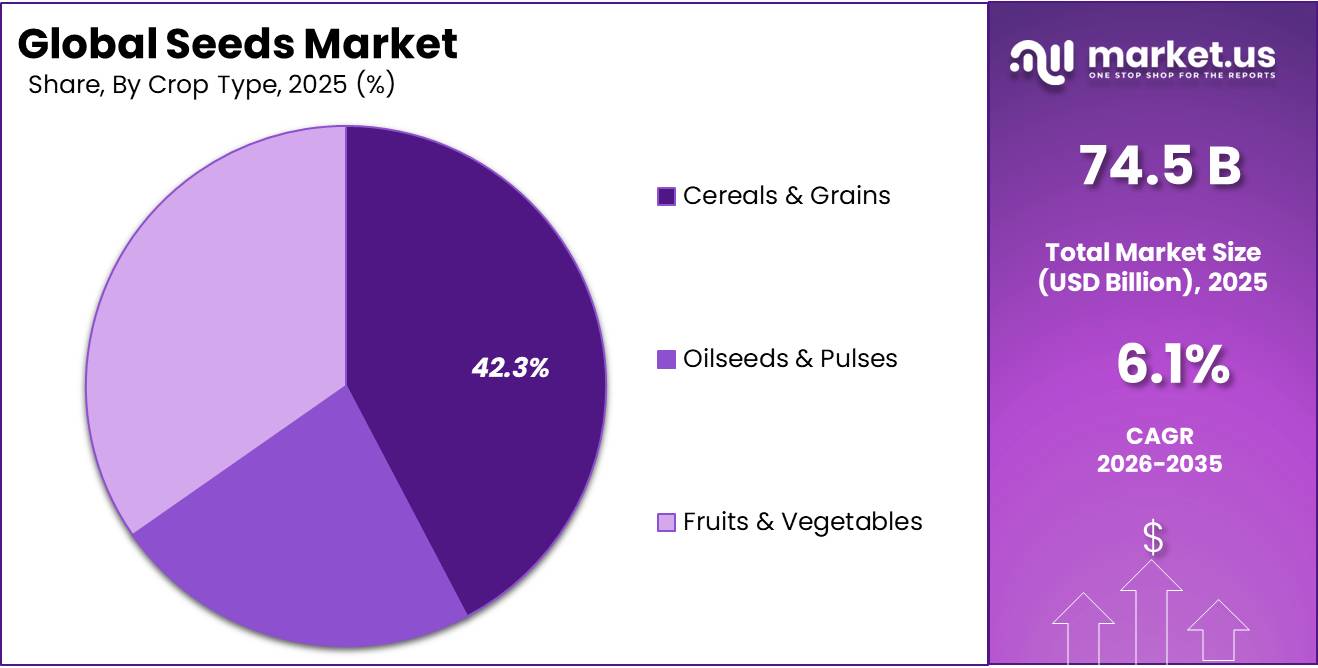
Key Market Segments
By Type
- Conventiona
- Genetically Modified
By Trait
- Herbicide-Tolerant
- Insecticide-Resistant
- Others
By Crop Type
- Cereals & Grains
- Oilseeds & Pulses
- Fruits & Vegetables
Driver Analysis
Climate-resilient variety replacement
The commercial effect is a higher varietal refresh rate: if replacement cycles in stressed geographies move from roughly 5–6 years toward 3–4 years, seed developers can raise annualized turnover of commercial genetics by 25–40% without needing comparable acreage expansion.
Even a modest 2–4% realized yield-protection advantage in drought-exposed cereals or maize can justify a 10–20% premium in farm-level seed spend because seed typically represents only about 3–8% of total crop production cost but influences 100% of harvest potential; that asymmetry improves gross-margin resilience for suppliers despite higher breeding and field-trial expense.
FAO-backed programmes in regions such as Comoros and Central Asia also show that climate adaptation is now being operationalized through seed multiplication, local certification, and digital monitoring, which broadens the addressable market from elite commercial growers to national resilience programs and donor-backed procurement.
This driver therefore shifts competition from volume-led commodity seed to adaptive trait portfolios, local germplasm partnerships, and faster trial-to-launch cycles, and it is estimated to add about +2.3 percentage points to seeds-market CAGR across Africa, South Asia, Southeast Asia, Latin America, and climate-stressed European zones over the next two years.
Drivers Impact Analysis
| Driver | (~) % Impact on CAGR Forecast | Geographic Relevance | Impact Timeline |
|---|---|---|---|
| Climate-resilient variety replacement | +2.3% | APAC corridors, Africa, LATAM, Southern EU | Short term (≤ 2 years) |
| EU NGT commercialization pathway | +1.9% | EU core, UK spill-over, advanced EEA hubs | Medium term (2-4 years) |
| Yield-intensity productivity push | +1.7% | Global row-crop core, India, Brazil, U.S. | Medium term (2-4 years) |
| Certified seed formalization | +1.4% | North America core, EU, Africa, South Asia | Short term (≤ 2 years) |
| Trait and biotech premiumization | +1.3% | U.S., Brazil, Argentina, selective APAC | Medium term (2-4 years) |
| Export-grade testing harmonization | +0.9% | North America, EU, APAC trade corridors | Short term (≤ 2 years) |
Restraint Analysis
Farmer Affordability Pressure
In rain-fed smallholder markets, a USD 10–30 per-hectare premium for certified or hybrid seed can consume 5–15% of annual cash input budgets, even when the product offers a potential yield advantage; this forces growers to optimize for purchase affordability rather than expected lifetime return. The problem is amplified where credit costs exceed 12–25%, crop insurance penetration remains below 10–20%, and input distributors require cash payment at planting, converting higher-value genetics into a working-capital constraint rather than a pure agronomic decision.
A 15% seed-price increase can reduce formal-volume demand by an analyst-modelled 4–10% among smallholders and 1–4% among commercial farmers, while manufacturers cannot fully absorb inflation in parental-line multiplication, field labor, drying, treatment chemicals, packaging, testing, and freight without sacrificing gross margin.
The drag is most pronounced in Africa, South Asia, ASEAN, and Latin America, where seasonal income and input-credit gaps are largest, and is estimated to deduct -2.0 percentage points from seeds-market CAGR through 2028. FAO notes that effective seed systems depend on farmers having timely access to affordable quality seed, underscoring why purchasing power remains central to formal seed-market expansion.
Restraint Impact Analysis
| Restraint | (~) % Impact on CAGR Forecast | Geographic Relevance | Impact Timeline |
|---|---|---|---|
| Farmer affordability pressure | -2.0 pp | Africa, South Asia, LATAM, ASEAN | Short term (≤ 2 years) |
| Informal saved-seed reliance | -1.7 pp | Africa, South Asia, LATAM | Medium term (2-4 years) |
| Regulatory approval lag | -1.5 pp | EU, China, India, Africa | Medium term (2-4 years) |
| Seed-production climate shocks | -1.3 pp | U.S., EU, India, Brazil, Australia | Short term (≤ 2 years) |
| Counterfeit seed leakage | -1.1 pp | Africa, India, ASEAN, LATAM | Short term (≤ 2 years) |
| Import compliance friction | -0.9 pp | North America, EU, APAC corridors | Medium term (2-4 years) |
Opportunity Analysis
Climate-Resilience Seed Subscriptions
A subscription priced at USD 20–120 per hectare per season could bundle drought- or heat-tolerant hybrids, locally recommended maturity groups, seed treatment, mobile planting alerts, replant insurance, weather-triggered seed credits, and agronomy support; for a 100,000-hectare enrolled base, a USD 40 blended annual fee creates USD 4 million of recurring revenue before physical seed margin, while a 15–25% reduction in distributor inventory uncertainty can improve working-capital turns by 0.3–0.8x.
This is distinct from normal climate-resilient seed demand because the value capture comes from converting one-off genetic sales into contracted performance and risk-management revenue, lowering annual customer-acquisition cost by an analyst-modelled 15–30% through pre-season renewal and improving retention from 50–65% in transactional channels to 75–85% where growers receive clear planting and replant benefits.
Suppliers would need weather-data partnerships, localized trial networks, claims reserves equal to roughly 2–6% of subscription revenue, and transparent performance exclusions, but climate volatility makes these service layers commercially valuable where growers face increasing yield uncertainty. This opportunity could add +2.1 percentage points above baseline CAGR in Africa, India, ASEAN, Latin America, and climate-exposed secondary agricultural markets over the next two years.
Opportunity Impact Analysis
| Opportunity | (~) % Potential CAGR Upside | Geographic Relevance | Execution Window |
|---|---|---|---|
| Climate-resilience seed subscriptions | +2.1 pp | Africa, India, ASEAN, LATAM | Short term (≤ 2 years) |
| NGT trait-pipeline acceleration | +1.8 pp | EU core, EEA, UK, advanced APAC | Medium term (2-4 years) |
| Digital seed-traceability platforms | +1.5 pp | Africa, India, LATAM, ASEAN | Short term (≤ 2 years) |
| Regenerative-input seed bundles | +1.3 pp | North America, EU, Brazil, Australia | Medium term (2-4 years) |
| Regional multiplication roll-ups | +1.1 pp | Africa, India, LATAM, Eastern Europe | Medium term (2-4 years) |
| Certified-seed export corridors | +0.9 pp | North America, EU, APAC, Africa | Long term (≥ 4 years) |
Challenges Analysis
Climate-Volatile Multiplication Yields
For hybrid maize, sunflower, vegetable, and forage seed, an analyst-modelled 15–30% multiplication-yield loss in one concentrated production zone can translate into a 10–25% shortfall in the following commercial season because rejected lots cannot be recreated immediately; a supplier with USD 100 million of seasonal seed revenue and 40% of multiplication exposure in one corridor could place USD 8–20 million of sales at risk, while emergency contracting, retesting, rebagging, and airfreight may reduce gross margin by 300–900 basis points.
Maintaining two or three geographically distinct multiplication zones lowers concentration risk but adds USD 0.05–0.20 per kilogram through duplicated grower contracts, field inspections, parent-line inventory, agronomy teams, irrigation, drying, and laboratory testing; moreover, qualifying a new multiplication site typically requires 2–4 crop cycles to prove genetic purity, disease status, and reliable production.
Companies must build climate-risk maps at field level, maintain 15–30% parental-line safety stock, diversify hemisphere and altitude exposure, automate flowering and irrigation monitoring, and use weather-triggered grower incentives, yet weather correlation across major regions makes full hedging impractical. This systemic production risk is estimated to reduce maximum global seeds-market CAGR by -1.5 percentage points through at least 2030.
Challenges Impact Analysis
| Challenge | (~) % CAGR Friction Drag | Geographic Relevance | Mitigation Horizon |
|---|---|---|---|
| Climate-Volatile Multiplication Yields | -1.5 pp | U.S., EU, India, Brazil, Australia | Long term (≥ 4 years) |
| Parent-Line Supply Concentration | -1.2 pp | Global hybrid seed corridors | Medium term (2-4 years) |
| Breeding Talent Scarcity | -1.0 pp | North America, EU, China, India, Brazil | Long term (≥ 4 years) |
| Fragmented Seed Quality Systems | -0.9 pp | Africa, South Asia, ASEAN, LATAM | Long term (≥ 4 years) |
| Trait-IP Licensing Complexity | -0.8 pp | North America, EU, Brazil, China | Medium term (2-4 years) |
| Cross-Border Phytosanitary Delays | -0.7 pp | APAC, Africa, EU, Americas corridors | Medium term (2-4 years) |
Geopolitical Impact Analysis
Russia–Ukraine War Continues to Disrupt Seed Supply, Farm Access and Input Costs
The ongoing Russia–Ukraine war continues to affect the global Seeds Market through higher farming costs, restricted field access, labour shortages and pressure on agricultural input availability. Ukraine remains an important producer of cereals and oilseeds, so disruption to planting activity can influence demand for corn, wheat, sunflower and other commercial seeds.
- In 2025, the Food and Agriculture Organization reported that 55% of Ukrainian crop producers identified seeds as a major production need, while 82% required fertilizers and 45% required fuel. At the same time, 18% of crop enterprises reported farmland affected by mines or unexploded ordnance, limiting normal sowing activity. FAOHome
The pressure remained visible in 2026. FAO estimated Ukraine’s 2025 cereal production at about 60.8 million tonnes, while approximately 5.4 million hectares were planted with winter cereals for the 2026 season. Continued war-related restrictions on access to agricultural land are keeping planting conditions uncertain. FAOHome
Rising input costs are also affecting European growers. The European Commission reported that EU nitrogen fertilizer prices in April 2026 were 71% above the 2024 average. These conditions can encourage farmers to prioritize reliable, high-yielding and stress-tolerant seeds while increasing supply-chain and production risks for seed companies.
Regional Insights
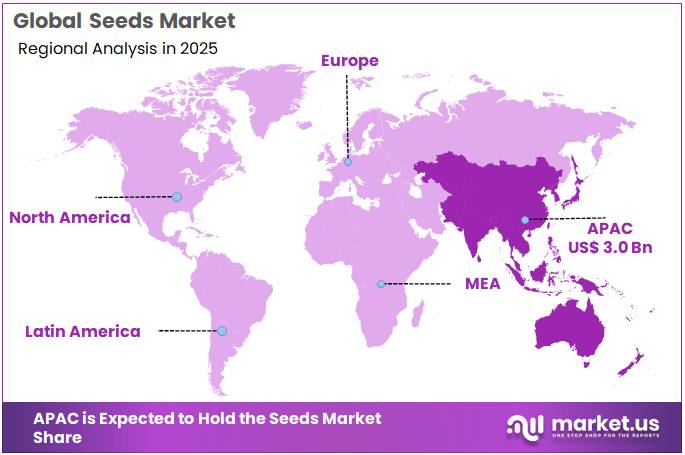
Asia-Pacific Leads the Seeds Market with 41.23% Share and USD 3.6 Billion Value
In 2025, Asia-Pacific held a dominant Seeds Market position, capturing more than a 41.23% share and reaching USD 3.6 billion. The region benefits from its large agricultural base, extensive cereal cultivation, rising food requirements, and continuous adoption of improved crop varieties.
OECD-FAO projects cereal production in Asia to increase by around 0.9% annually through 2034. Asia is also expected to contribute 42 million tonnes of the projected global increase in wheat production, highlighting sustained requirements for productive seed varieties.
Asia-Pacific also presents a strong long-term growth opportunity for seed producers as agricultural output increasingly depends on yield improvement rather than major farmland expansion. OECD-FAO estimates that the region will contribute about 54% of additional global agricultural output through 2034.
China will remain an important contributor, while Southeast Asian economies are expected to increase cereal and food production to meet growing domestic consumption. Global cereal output is projected to reach around 3.2 billion tonnes by 2034, supported mainly by better yields.
Key Regions and Countries Insights
- North America
- US
- Canada
- Europe
- Germany
- France
- The UK
- Spain
- Italy
- Rest of Europe
- Asia Pacific
- China
- Japan
- South Korea
- India
- Australia
- Rest of APAC
- Latin America
- Brazil
- Mexico
- Rest of Latin America
- Middle East & Africa
- GCC
- South Africa
- Rest of MEA
Key Players Analysis
Advanta Seeds maintains a broad position in the global seed industry through hybrid crop genetics and a large commercial network. The company reports 1,200 employees, commercial presence across 84 countries, and 24 seed production and processing sites across 21 countries. Around 19% of its workforce is involved in plant genetics research, supporting new seed technologies.
Bayer AG holds a major position in the global Seeds Market through its Crop Science division and strong corn, soybean, vegetable and cotton seed businesses. In 2025, Crop Science generated EUR 21.622 billion in sales. Corn Seed & Traits sales reached EUR 7.149 billion, increasing 13.2% on a currency- and portfolio-adjusted basis. Vegetable Seeds generated EUR 788 million, while Soybean Seed & Traits contributed EUR 2.214 billion.
DLF Seeds A/S is a major global supplier of forage, turf and specialty seeds. In fiscal 2024/25, the company reported revenue of DKK 7.6 billion and EBIT of DKK 474 million, with EBIT increasing 10%. DLF employs more than 2,000 people and supplies locally adapted seed products to over 100 countries.
Top Key Players Outlook
- Advanta Seeds
- Bayer AG
- DLF Seeds A/S
- DowDuPont Inc.
- Groupe Limagrain
- KWS SAAT SE and Co. KGaA
- Land O’Lakes, Inc.
- Maharashtra Hybrid Seeds Co.
- Sakata Seed Corporation
- Syngenta AG
- Other Key Players
Recent Developments
- In September 2026, Vylor introduced a corn innovation pipeline targeting about USD 2 billion in incremental revenue by 2035; field trials showed average yield gains of roughly 3 bushels per acre, with increases reaching 10 bushels per acre in some trials.
- In March 2026, Limagrain reported EUR 2.452 billion in 2024–2025 revenue, plus EUR 767 million from activities conducted jointly with strategic partners, while the cooperative represented around 1,300 farmer members. In May 2026, the European Investment Bank approved a EUR 300 million loan to support Limagrain’s seed innovation and sustainable agriculture programs.
Report Scope
| Report Features | Description |
|---|---|
| Market Value (2025) | USD 74.5 Bn |
| Forecast Revenue (2035) | USD 134.4 Bn |
| CAGR (2026-2035) | 6.1% |
| Base Year for Estimation | 2025 |
| Historic Period | 2020-2024 |
| Forecast Period | 2026-2035 |
| Report Coverage | Revenue Forecast, Market Dynamics, Competitive Landscape, Recent Developments |
| Segments Covered | By Type (Conventiona, Genetically Modified), By Trait (Herbicide-Tolerant, Insecticide-Resistant, Others), By Crop Type (Cereals & Grains, Oilseeds & Pulses, Fruits & Vegetables) |
| Regional Analysis | North America – US, Canada; Europe – Germany, France, The UK, Spain, Italy, Rest of Europe; Asia Pacific – China, Japan, South Korea, India, Australia, Singapore, Rest of APAC; Latin America – Brazil, Mexico, Rest of Latin America; Middle East & Africa – GCC, South Africa, Rest of MEA |
| Competitive Landscape | Advanta Seeds, Bayer AG, DLF Seeds A/S, DowDuPont Inc., Groupe Limagrain, KWS SAAT SE and Co. KGaA, Land O’Lakes, Inc., Maharashtra Hybrid Seeds Co., Sakata Seed Corporation, Syngenta AG, Other Key Players |
| Customization Scope | Customization for segments, region/country-level will be provided. Moreover, additional customization can be done based on the requirements. |
| Purchase Options | We have three licenses to opt for: Single User License, Multi-User License (Up to 5 Users), Corporate Use License (Unlimited User and Printable PDF) |





































