


Report Overview
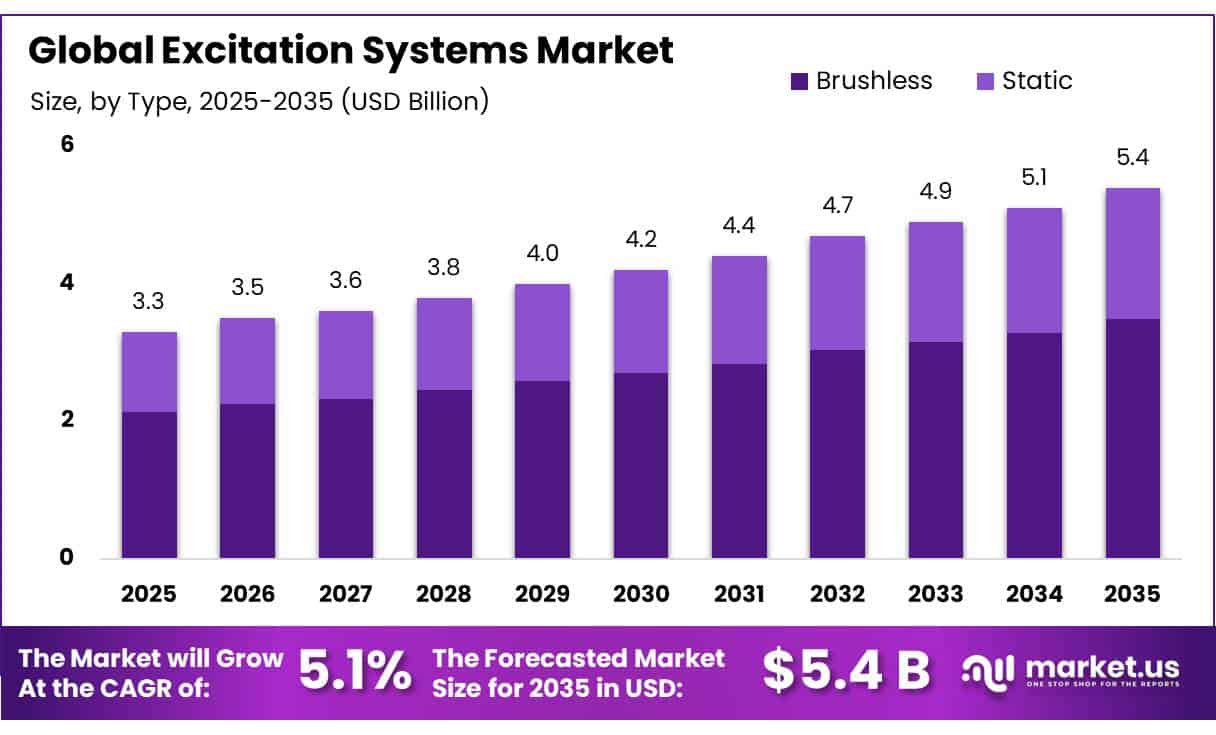
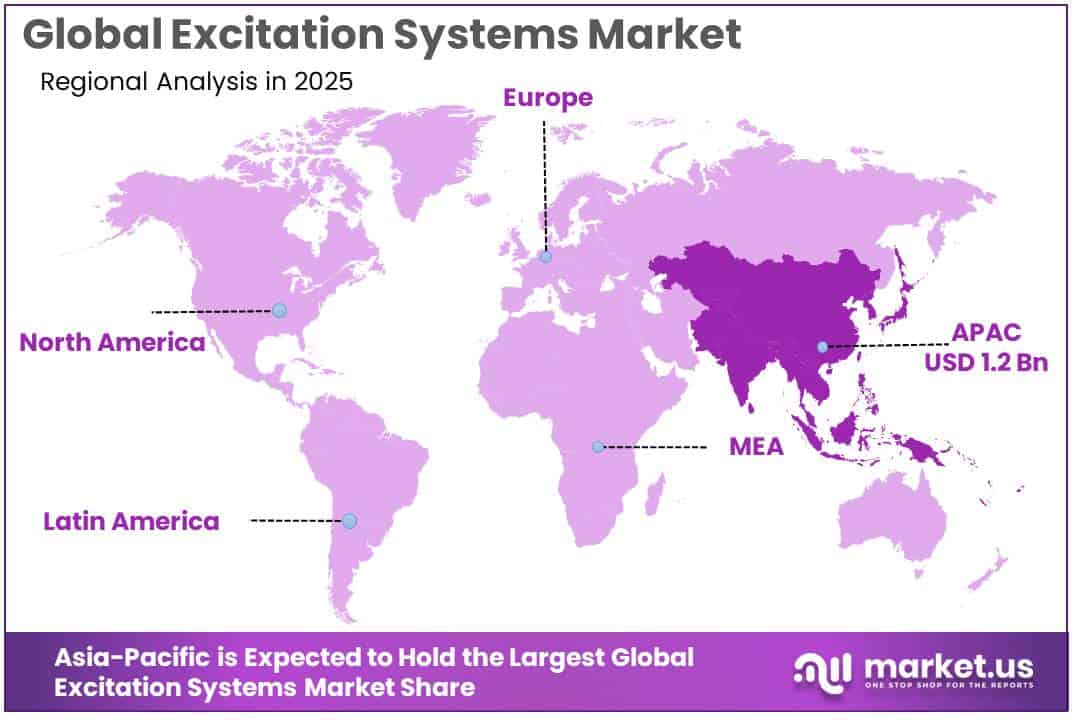
The Global Excitation Systems Market size is expected to be worth around USD 5.4 Billion by 2035, from USD 3.3 Billion in 2025, growing at a CAGR of 5.1% during the forecast period from 2026 to 2035. In 2025, Asia-Pacific held a dominant market position, capturing more than a 38.54% share, holding USD 1.2 Billion revenue.
Excitation systems are a critical part of synchronous generators because they control the direct current supplied to the generator field winding and help maintain terminal voltage, reactive power, and grid stability. These systems are widely used in thermal, hydroelectric, nuclear, and large industrial power plants, as well as synchronous condensers. Modern excitation platforms increasingly combine digital automatic voltage regulators, protection functions, monitoring software, and fast-response control.
- According to the International Energy Agency, global electricity demand increased by around 3% in 2025, adding nearly 800 TWh of consumption. Electricity demand reached approximately 28,200 TWh in 2025 and is expected to increase to 33,600 TWh by 2030. Rising power requirements from manufacturing, data centres, transport electrification, and commercial buildings are increasing the need for stable generation assets and stronger voltage-control systems.
Renewable integration is another major driver. IRENA reported that global renewable power capacity reached 4,448 GW at the end of 2024, representing 46.4% of total installed power capacity. Solar capacity reached 1,865 GW, wind stood at 1,133 GW, and hydropower totaled 1,283 GW. As inverter-based solar and wind generation expands, utilities require stronger voltage regulation, reactive-power management, and system-inertia support, creating opportunities for advanced excitation controls and synchronous condenser installations.
- The IEA reported that renewable electricity generation increased by about 8.5% during the year, while renewables accounted for 34% of global electricity production. Wind and solar together reached a 17% generation share, and solar PV output increased by around 600 TWh. These changes increase the importance of rapid-response excitation systems capable of supporting voltage during grid disturbances and maintaining generator stability under changing operating conditions.
Government grid investment is also supporting future opportunities. The U.S. Department of Energy administers a US$10.5 billion Grid Resilience and Innovation Partnerships program, while nearly US$2 billion of additional federal investment was announced in March 2026 for advanced transmission upgrades. DOE’s 2025 infrastructure update also indicated that grid investments could enable 67 GW of new capacity and resources while supporting more than 4,375 miles of transmission upgrades by 2031.
Key Takeaways
- Excitation Systems Market size is expected to be worth around USD 5.4 Billion by 2035, from USD 3.3 Billion in 2025, growing at a CAGR of 5.1%.
- Brushless held a dominant market position, capturing more than a 64.56% share.
- Digital held a dominant market position, capturing more than a 61.45% share.
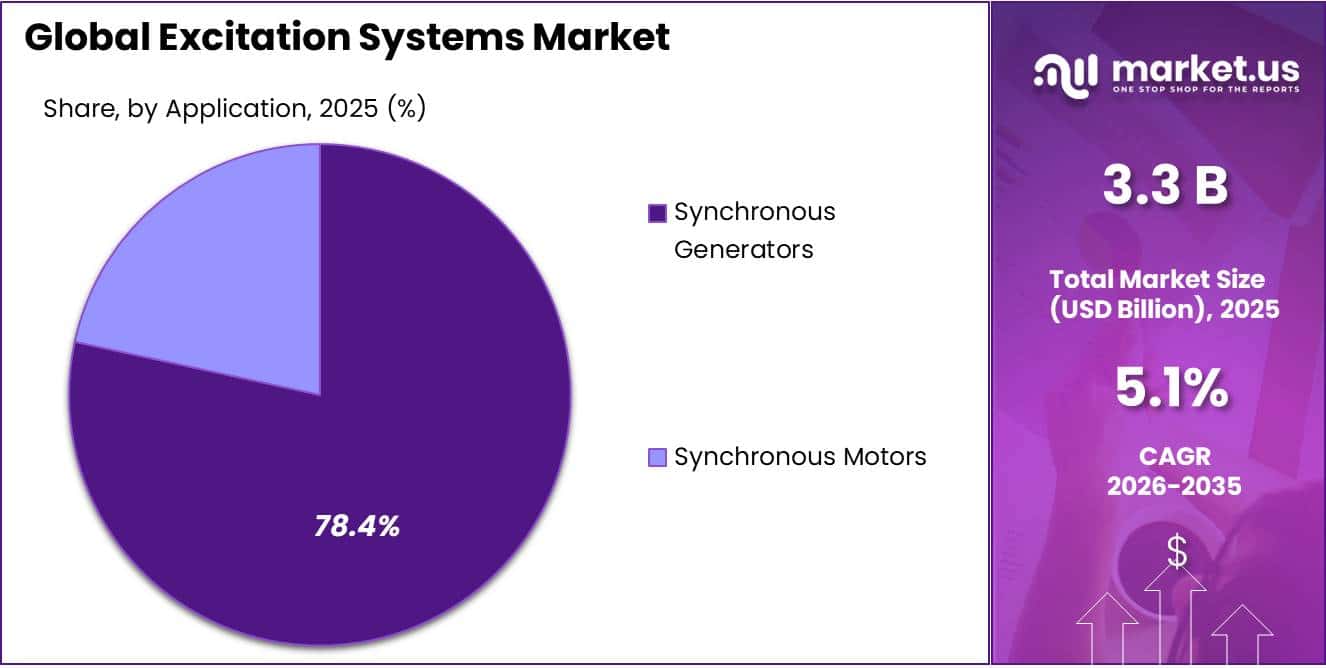
- Synchronous Generators held a dominant market position, capturing more than a 78.45% share.
- Asia-Pacific held a dominant market position, capturing more than a 38.54% share and reaching approximately USD 1.2 billion.
By Type Analysis
Brushless Excitation Systems Lead with 64.56% Share, Supported by Low Maintenance and High Generator Reliability
In 2025, “Brushless” held a dominant market position, capturing more than a 64.56% share in the Excitation Systems Market by type. Brushless excitation systems are widely used in gas, steam, and hydroelectric generators because they remove the need for collector brushes in the main generator field circuit, helping lower routine maintenance and improve operating reliability.
Siemens Energy states that its brushless excitation technology supports generators ranging from 1 MVA to more than 1,000 MVA, while more than 1,700 systems have been operating across power-generation applications. GE Vernova also uses integrated brushless excitation in industrial synchronous machines with output ratings reaching 40 MW, supporting applications requiring reliable continuous operation. The wider power environment remains supportive, as global electricity demand increased by about 3% in 2025, encouraging utilities to maintain and modernize dependable generator-control equipment.
Static excitation systems remained an important segment in 2025, particularly in large thermal, hydroelectric, nuclear, and synchronous-condenser applications where rapid voltage response and strong reactive-power control are required. Static systems supply excitation directly through stationary power-electronic equipment, allowing generators to respond quickly to changing grid conditions.
Siemens Energy reports that its static excitation systems can serve synchronous generators from approximately 1 MVA to more than 1,200 MVA, covering low- to high-output power plants. GE Vernova’s static excitation technology supports generators from 20 MW to 1,000 MW, with field current capability reaching 8,000 A and peak capability of 12,000 A. As electricity systems integrate more renewable generation and require stronger voltage support, static excitation systems remain important for generator upgrades, synchronous condensers, and grid-stability projects.
By Nature Analysis
Digital Controllers Lead with 61.45% Share as Power Plants Shift Toward Automated Voltage and Grid Control
In 2025, “Digital” held a dominant market position, capturing more than a 61.45% share in the Excitation Systems Market by controller type. Digital excitation controllers are increasingly used in hydro, gas, steam, and nuclear generators because they provide faster voltage regulation, better fault monitoring, easier diagnostics, and closer integration with plant-control systems. GE Vernova reports an installed base of more than 10,000 excitation units across 70 countries, highlighting the large global base moving toward modern software-enabled generator controls.
Siemens Energy’s DIGUREG 2 digital voltage regulator supports continuous currents of 16 A and 34 A, showing the flexibility of digital control across different generator configurations. Government grid modernization is also supporting this shift. In 2026, the U.S. Department of Energy announced around US$1.9 billion for advanced transmission upgrades, while its broader GRIP program provides up to US$10.5 billion for grid resilience and innovation.
Analog excitation controllers remained relevant in 2025, particularly across older generating stations where existing equipment continues to operate reliably and complete digital replacement may not yet be economical. These systems are commonly maintained in legacy hydro, thermal, and industrial generator installations where operators favor proven architecture and straightforward servicing.
However, aging components and limited spare-part availability are encouraging gradual modernization. GE Vernova offers Digital Front-End upgrades that retain existing power-conversion bridges while replacing aging control sections, allowing plants to modernize without changing the entire excitation system. Siemens Energy also notes that modern excitation systems can serve generators from 1 MVA to more than 1,200 MVA, creating a wide retrofit opportunity for plants still operating older analog controls.
By Distribution Channel Analysis
Synchronous Generators Lead with 78.45% Share as Grid Stability and Large-Scale Power Generation Remain Critical
In 2025, “Synchronous Generators” held a dominant market position, capturing more than a 78.45% share in the Excitation Systems Market by application. These generators depend directly on excitation systems to maintain terminal voltage, reactive power, and stable operation during changing grid conditions. Their use remains strong across hydro, gas, steam, and nuclear power plants.
- Siemens Energy reports that its static excitation systems support synchronous generators from 1 MVA to more than 1,200 MVA, while brushless solutions cover units from 1 MVA to above 1,000 MVA. The company also has more than 1,700 brushless excitation systems operating globally. GE Vernova states that its generator excitation portfolio has an installed base of more than 10,000 units across 70 countries, covering gas, steam, and hydro applications.
Synchronous Motors continued to hold an important position in 2025, particularly in large compressors, pumps, mills, industrial drives, and synchronous condenser applications where precise speed control and reactive-power management are required. Excitation systems allow these motors to regulate field current and maintain stable operation under varying load conditions.
GE Vernova’s static excitation systems provide field current up to 8,000 A, with peak capability of 12,000 A, supporting demanding synchronous-machine applications. As industries invest in electrification, high-efficiency drives, and stronger grid support, synchronous motors are expected to remain a relevant application area for modern excitation systems.
Key Market Segments
By Type
- Static
- Brushless
By Controller Type
- Analog
- Digital
By Application
- Synchronous Generators
- Synchronous Motors
Driver Analysis
Renewable-Grid Stability Upgrades
An excitation-system retrofit on a 100–500 MW generator typically costs an analyst-modelled USD 0.5–3.0 million including digital AVR, power-potential transformer interfaces, protection coordination, commissioning, and controls integration, yet it can improve voltage-response performance from multi-second manual or analog behavior to sub-second automated control, raise reactive-power operating range by 5–15%, and reduce forced deratings caused by obsolete regulation equipment by 1–4 percentage points.
The commercial model is shifting from selling a replacement exciter toward grid-code-compliance packages that combine IEEE/IEC testing, power-system studies, power-system-stabilizer tuning, cybersecurity hardening, remote diagnostics, and 10–20 years of lifecycle service; this can increase revenue per installed generator by 30–70% and expand aftermarket contribution from 10–15% to 20–35% of contract value.
FERC Order No. 2023 reinforces the interconnection need by requiring transmission providers to use cluster studies, impose timing penalties for delayed studies, apply stricter financial-readiness requirements, and support co-located resources such as solar-plus-storage and wind-plus-storage, all of which increase system-planning attention on voltage and stability impacts. This driver is estimated to add +2.2 percentage points to CAGR across Europe, North America, China, India, Australia, and renewable-heavy grids over two to four years.
Drivers Impact Analysis
| Driver | (~) % Impact on CAGR Forecast | Geographic Relevance | Impact Timeline |
|---|---|---|---|
| Renewable-grid stability upgrades | +2.2 pp | EU, North America, China, India, Australia | Medium term (2–4 years) |
| Aging generator retrofit cycles | +1.8 pp | North America, EU, Japan, GCC, LATAM | Short term (≤ 2 years) |
| Grid digitalization investments | +1.5 pp | EU, North America, China, Korea, Japan | Medium term (2–4 years) |
| Synchronous condenser deployment | +1.3 pp | EU, UK, Australia, U.S., MENA | Medium term (2–4 years) |
| Industrial captive-power expansion | +1.1 pp | India, ASEAN, GCC, Africa, LATAM | Short term (≤ 2 years) |
| Hydro rehabilitation programs | +0.9 pp | LATAM, South Asia, Africa, Canada, Nordics | Long term (≥ 4 years) |
Restraint Analysis
Generator Retirement Exposure
A 200 MW thermal unit with 25–40 years of service life remaining may technically justify a USD 1–2 million excitation retrofit, but if its expected dispatch falls from 5,000–7,000 hours to 1,500–3,000 hours annually, the availability, ancillary-service, and fuel-efficiency benefit may not meet a 3–5-year capital-payback hurdle; the owner can instead defer modernization, cannibalize spares, or retire the machine. This risk is most visible in regions where grid modernization is accelerating: the European Commission estimates that EUR 584 billion of grid investment is needed by 2030 and that 40% of EU distribution grids are more than 40 years old, conditions that can favor renewables, storage, transmission, and flexible alternatives rather than life extension of every legacy generating asset.
Retirement decisions can remove USD 0.5–2.5 million of excitation addressable value per unit, and a 10-unit site closure can eliminate USD 5–25 million of deferred retrofit opportunity plus 10–20 years of spare-part and service revenue; suppliers also face 6–18 months of lost engineering utilization when planned upgrades are cancelled late in the outage-planning cycle.
The strategic response is to redirect the installed base toward synchronous-condensing conversion, hydro modernization, black-start packages, grid-forming support, and selective life-extension projects where capacity payments or reactive-power revenues support investment, but not all plants can be repurposed economically. This restraint is estimated to deduct -1.8 percentage points from attainable excitation-systems CAGR across Europe, North America, Japan, South Korea, and mature thermal-power markets over two to four years.
Restraint Impact Analysis
| Restraint | (~) % Impact on CAGR Forecast | Geographic Relevance | Impact Timeline |
|---|---|---|---|
| Generator retirement exposure | -1.8 pp | EU, North America, Japan, Korea | Medium term (2–4 years) |
| Grid-project permitting delays | -1.5 pp | EU, U.S., India, Australia | Medium term (2–4 years) |
| Retrofit outage constraints | -1.3 pp | Global utility fleets, industrial plants | Short term (≤ 2 years) |
| Electronics supply concentration | -1.1 pp | Global OEMs, China-linked supply chains | Short term (≤ 2 years) |
| Price-led retrofit procurement | -1.0 pp | Emerging markets, LATAM, Africa, ASEAN | Medium term (2–4 years) |
| Cybersecurity compliance costs | -0.8 pp | North America, EU, Japan, Korea | Long term (≥ 4 years) |
Opportunity Analysis
Grid-Forming Retrofit Packages
NERC’s PRC-030-1 became effective on 1 October 2026 for applicable bulk-electric-system inverter-based resources and requires owners to identify output changes of at least 20 MW and 10% of nameplate occurring within four seconds, analyze applicable events, and preserve supporting evidence for 36 months; this raises the commercial value of synchronous-machine assets that can provide dependable voltage support when inverter-based fleets face disturbance-performance scrutiny.
For a 200–500 MW generator, a USD 0.8–3.5 million packaged retrofit can improve AVR response from multi-second legacy control behavior to sub-second regulation, raise usable reactive-power capability by an analyst-estimated 5–15%, and generate USD 0.2–1.5 million annually through availability gains, reduced deratings, voltage-support payments, and avoided grid-code penalties; adding digital models, harmonic studies, test support, and a five-year performance agreement can increase supplier lifetime revenue by 40–80% versus a USD 0.4–1.5 million equipment-only AVR replacement.
The strongest near-term addressable base is in grids with high renewable penetration, retiring thermal plants, weak interconnections, and rising ancillary-service procurement, notably the U.S., Canada, EU, UK, Australia, India, Chile, and South Africa. Capturing this upgrade category could add approximately +2.1 percentage points to global excitation-system CAGR over two to four years.
Opportunity Impact Analysis
| Opportunity | (~) % Potential CAGR Upside | Geographic Relevance | Execution Window |
|---|---|---|---|
| Grid-forming retrofit packages | +2.1 pp | North America, EU, Australia, India | Medium term (2–4 years) |
| Synchronous condenser conversions | +1.8 pp | EU, UK, U.S., Australia, MENA | Medium term (2–4 years) |
| Excitation-as-a-service | +1.5 pp | North America, EU, GCC, Japan | Short term (≤ 2 years) |
| Digital fleet-performance platforms | +1.4 pp | EU, U.S., China, Japan, Korea | Short term (≤ 2 years) |
| Repowered hydro-control packages | +1.2 pp | LATAM, Canada, Nordics, South Asia, Africa | Long term (≥ 4 years) |
| Controls-service M&A roll-ups | +1.0 pp | North America, EU, India, ASEAN | Long term (≥ 4 years) |
Challenges Analysis
Legacy Fleet Data Gaps
A 100–500 MW unit can contain 500–2,000 excitation, protection, auxiliary, and control I/O points, and tracing just 10–20% of undocumented interfaces can require 80–300 site-engineering hours, USD 20,000–150,000 of survey and testing cost, and 4–16 weeks before design freeze; if field-current, saturation, ceiling-voltage, or transformer data is incorrect by 5–15%, the new AVR, PSS, limiter, or protection coordination may require rework after commissioning.
For an excitation OEM, incomplete data adds 10–25% to bid engineering, can reduce first-pass commissioning success from an analyst-modelled 85–95% to 60–75%, and creates USD 100,000–1.0 million of warranty, delay, or remobilization exposure on a USD 0.5–3.0 million retrofit package; customers respond by deferring modernization into the next 3–6-year outage cycle.
Suppliers must establish fleet-digitization teams, standardize laser scanning and signal-tracing methods, use portable disturbance recorders, develop digital twins from tests rather than drawings, and price uncertainty through structured discovery phases, but converting fragmented legacy records into validated models requires repeated site access and years of accumulated datasets. This data deficit is estimated to impose a -1.4-percentage-point CAGR friction across North America, Europe, Japan, South Korea, Latin America, and aging generator fleets over four or more years.
Challenges Impact Analysis
| Challenge | (~) % CAGR Friction Drag | Geographic Relevance | Mitigation Horizon |
|---|---|---|---|
| Legacy fleet data gaps | -1.4 pp | North America, EU, Japan, LATAM | Long term (≥ 4 years) |
| Grid-model validation burden | -1.3 pp | North America, EU, Australia, India | Medium term (2–4 years) |
| Controls engineering talent shortage | -1.2 pp | Global utility hubs, GCC, APAC | Long term (≥ 4 years) |
| Power-electronics supply volatility | -1.1 pp | Global OEMs, APAC supply corridors | Medium term (2–4 years) |
| Outage-window coordination | -1.0 pp | Global thermal, hydro, industrial fleets | Medium term (2–4 years) |
| Cybersecure integration complexity | -0.9 pp | North America, EU, Japan, Korea | Long term (≥ 4 years) |
Geopolitical Impact Analysis
Ongoing Wars Increase Grid-Rebuilding Demand and Supply-Chain Pressure for Excitation Systems
The Russia–Ukraine war and continuing Middle East conflict are affecting the Excitation Systems Market through grid damage, higher energy costs, supply-chain uncertainty, and stronger demand for reliable power-generation equipment. Excitation systems are closely linked with synchronous generators, turbines, transformers, and power electronics, so disruption in electrical steel, copper, semiconductors, and transport can delay generator modernization projects.
The International Energy Agency reported in 2026 that 11 of 20 critical minerals important to the energy sector had faced export controls during 2025, while supply risks also affected transformers and power-electronic equipment.
Ukraine’s damaged electricity infrastructure is also creating replacement and modernization demand. The U.S. Department of Energy reported that Ukraine had lost around 51% of its pre-war power-generation capacity, while the U.S. Congress had provided US$738.8 million since 2022 to support critical energy infrastructure resilience and nuclear-risk reduction.
Regional Insights
Asia-Pacific Leads the Excitation Systems Market with 38.54% Share and USD 1.2 Billion Value
In 2025, Asia-Pacific held a dominant market position, capturing more than a 38.54% share and reaching approximately USD 1.2 billion in the Excitation Systems Market. Regional leadership is supported by large hydro, thermal, nuclear, and renewable power fleets requiring dependable voltage regulation and reactive-power control. IRENA reported that Asia added 513.3 GW of renewable capacity during 2025, representing 74.2% of worldwide renewable additions, while its total installed renewable capacity reached 2,891 GW.
The Asian Development Bank also reported that clean-energy investment in developing Asia had reached USD 729.4 billion, accounting for around 45% of global investment. Increasing generator capacity, transmission development, and grid modernization support continued demand for digital, brushless, and static excitation systems across regional power networks.
Fastest-Growing Regional Opportunity – Asia-Pacific: Asia-Pacific also presents a strong growth environment for excitation-system suppliers as countries strengthen transmission networks and integrate larger volumes of renewable generation. In 2026, ADB launched a plan to support USD 70 billion in new energy and digital infrastructure initiatives through 2035, including the Pan-Asia Power Grid for greater cross-border electricity connectivity.
ADB also committed USD 29.3 billion from its own resources during 2025, representing a 20% increase from the previous year. Meanwhile, Southeast Asian electricity demand increased by approximately 3% in 2025, according to the IEA. Rising renewable penetration and interconnected grids are increasing requirements for generator stability, automatic voltage regulation, synchronous condensers, and advanced excitation controllers.
Key Regions and Countries Insights
- North America
- US
- Canada
- Europe
- Germany
- France
- The UK
- Spain
- Italy
- Rest of Europe
- Asia Pacific
- China
- Japan
- South Korea
- India
- Australia
- Rest of APAC
- Latin America
- Brazil
- Mexico
- Rest of Latin America
- Middle East & Africa
- GCC
- South Africa
- Rest of MEA
Key Players Analysis
ABB Ltd. remains a major participant in generator control, automation, and power-electronics technologies that support excitation-system applications. In 2025, ABB recorded US$33.22 billion in revenue, US$36.77 billion in orders, and US$6.31 billion in operational EBITA. The company invested US$1.32 billion in R&D and US$1.00 billion in capital expenditure, while operating more than 160 manufacturing sites. This scale supports continued development of digital control, electrification, and industrial power-management solutions used alongside synchronous machines and excitation equipment.
Siemens Energy holds a strong position in excitation systems for hydro, gas, steam, and nuclear generators. In fiscal 2025, the company generated €39.1 billion in revenue and secured €58.9 billion in orders, while its order backlog reached about €138 billion. Its static excitation systems support generators from 1 MVA to more than 1,200 MVA, while brushless excitation solutions cover machines from 1 MVA to above 1,000 MVA. These capabilities strengthen Siemens Energy’s role in generator modernization and grid-stability projects.
GE Vernova is an important supplier of generator controls and excitation technologies serving large power-generation fleets. In 2025, the company recorded about US$38 billion in revenue and US$59 billion in orders, while its total backlog increased to US$150 billion. GE Vernova also generated US$3.2 billion in adjusted EBITDA and US$3.7 billion in free cash flow. Its installed base includes more than 7,000 gas turbines, creating a substantial service and modernization opportunity for generator control and excitation systems.
Top Key Players Outlook
- ABB Ltd
- Siemens Energy
- GE
- ANDRITZ Group
- Nidec Corporation
- Emerson
- Mitsubishi Electric Corporation
- Basler Electric
- NR Electric Co.
- PLUTON Group
- Excitation & Engineering Services
- Voith Group
- Other Key Players
Recent Developments
- In March 2026, ITT completed its acquisition of SPX FLOW for US$4.775 billion; SPX FLOW had generated more than US$1.3 billion in 2025 revenue, achieved 14% organic order growth, and brought approximately 3,900 employees into ITT.
- In June 2026, Grundfos began expanding its Brookshire, Texas manufacturing campus, while during the first half of 2026 it announced a DKK 400 million investment to expand high-efficiency motor production capacity by 50% at plants in Mexico and Hungary.
Report Scope
| Report Features | Description |
|---|---|
| Market Value (2025) | USD 3.3 Bn |
| Forecast Revenue (2035) | USD 5.4 Bn |
| CAGR (2026-2035) | 5.1% |
| Base Year for Estimation | 2025 |
| Historic Period | 2020-2024 |
| Forecast Period | 2026-2035 |
| Report Coverage | Revenue Forecast, Market Dynamics, Competitive Landscape, Recent Developments |
| Segments Covered | By Type (Static, Brushless), By Controller Type (Analog, Digital), By Application (Synchronous Generators, Synchronous Motors) |
| Regional Analysis | North America – US, Canada; Europe – Germany, France, The UK, Spain, Italy, Rest of Europe; Asia Pacific – China, Japan, South Korea, India, Australia, Singapore, Rest of APAC; Latin America – Brazil, Mexico, Rest of Latin America; Middle East & Africa – GCC, South Africa, Rest of MEA |
| Competitive Landscape | ABB Ltd, Siemens Energy, GE, ANDRITZ Group, Nidec Corporation, Emerson, Mitsubishi Electric Corporation, Basler Electric, NR Electric Co., PLUTON Group, Excitation & Engineering Services, Voith Group , Other Key Players |
| Customization Scope | Customization for segments, region/country-level will be provided. Moreover, additional customization can be done based on the requirements. |
| Purchase Options | We have three licenses to opt for: Single User License, Multi-User License (Up to 5 Users), Corporate Use License (Unlimited User and Printable PDF) |





































