Report Overview
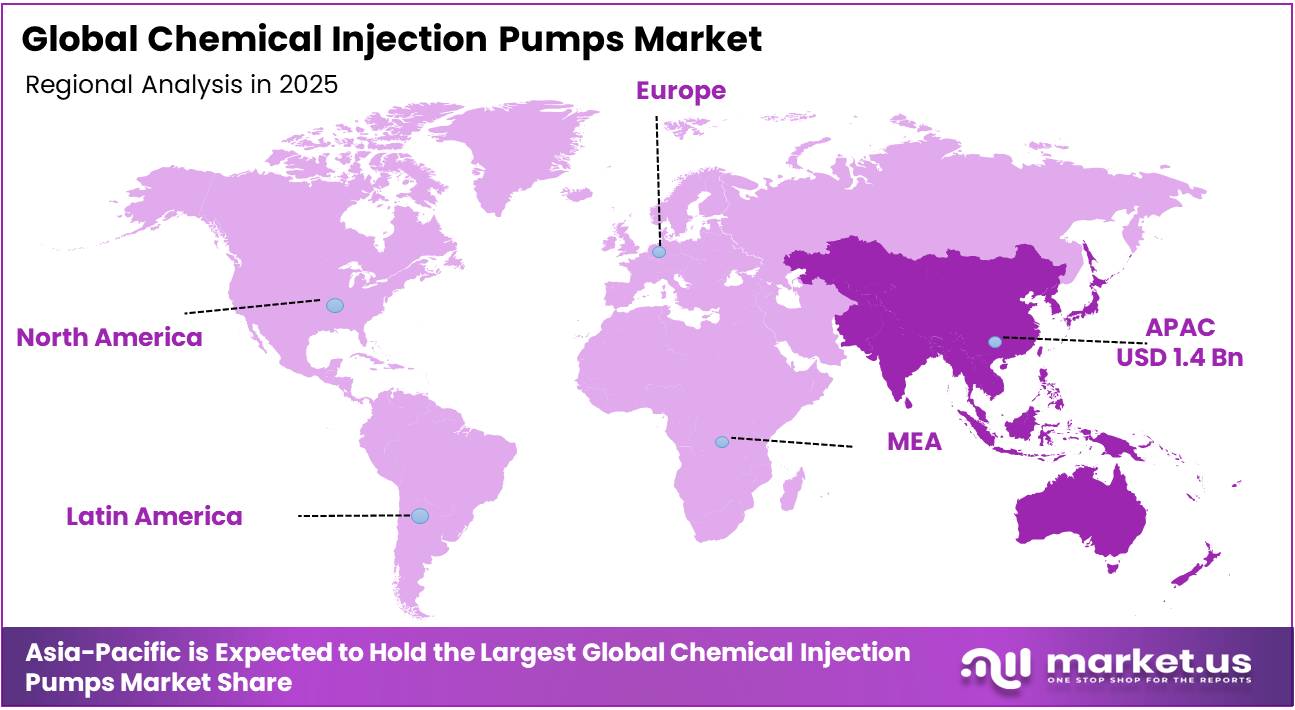
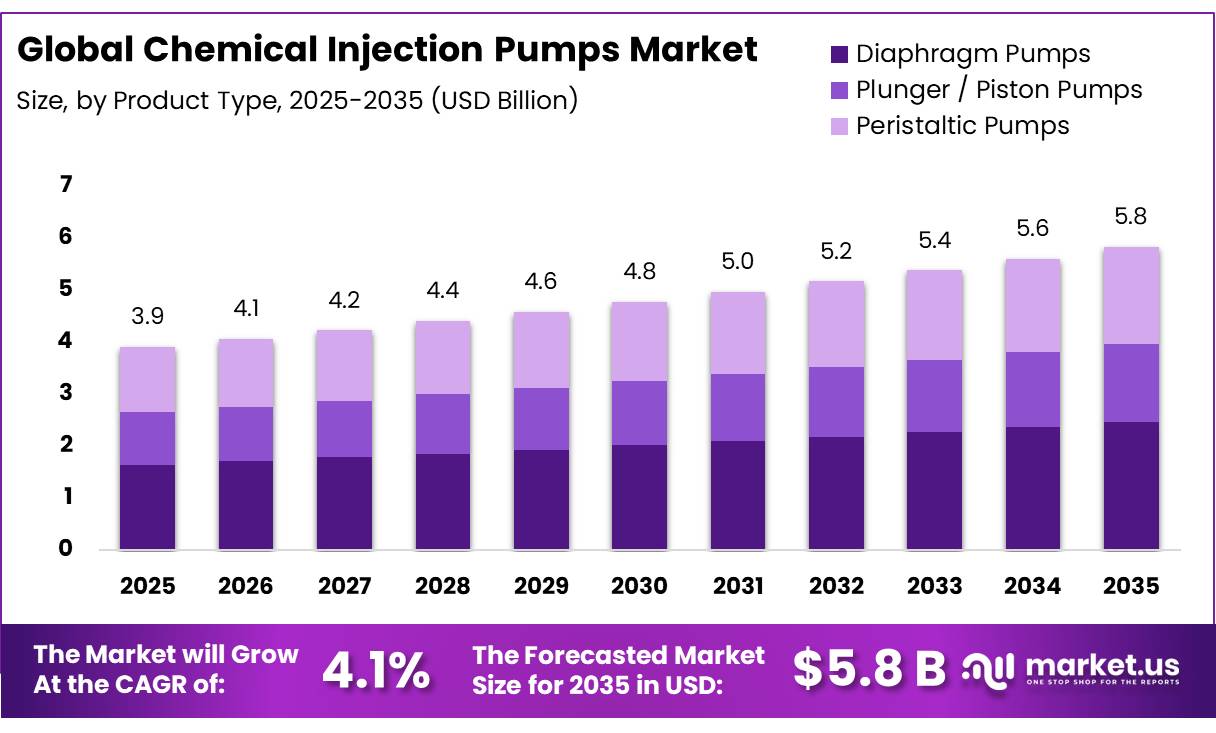
In 2025, the Global Chemical Injection Pumps Market was valued at USD 3.9 billion, and between 2026 and 2035, this market is estimated to register a CAGR of 4.1%, reaching about USD 5.8 billion by 2035. In 2025, Asia Pacific held a dominant market position, capturing more than a 35.4% share, holding USD 1.4 Billion revenue.
Chemical injection pumps are precision dosing systems used to introduce controlled quantities of chemicals into oil and gas streams, water-treatment systems, refineries, chemical plants, power facilities, and mining operations. Common applications include corrosion inhibitors, biocides, scale inhibitors, coagulants, catalysts, acids, and disinfectants. Modern pumps increasingly use diaphragm designs because they isolate hazardous fluids from mechanical components.
- Milton Roy reports dosing accuracy of approximately ±1%, operating pressures reaching 1,035 bar, and diaphragm service life exceeding 20,000 hours for selected metering-pump technologies.
Oil and gas remain major industrial users because chemicals must be injected continuously for corrosion control, hydrate prevention, scale management, produced-water treatment, and refinery processing.
- The International Energy Agency reported in February 2026 that global refinery crude throughput was forecast to average 84.6 million barrels per day in 2026, increasing by approximately 790,000 barrels per day. Global oil supply was projected to reach 108.6 million barrels per day, while demand was expected to increase by another 850,000 barrels per day.
Water and wastewater infrastructure provides another strong demand base. In 2026, the U.S. Environmental Protection Agency announced approximately USD 7.2 billion for states, tribes, and territories through the Clean Water and Drinking Water State Revolving Funds. These programs finance drinking-water and wastewater treatment systems where chemical pumps are required for chlorination, pH adjustment, coagulation, fluoridation, nutrient removal, and contaminant treatment.
- EPA’s 2025 WIFIA program closed about USD 900 million of loans supporting USD 1.8 billion in water infrastructure projects. Communities additionally requested more than USD 6 billion in financing for projects representing approximately USD 13 billion of total infrastructure investment. Such modernization supports demand for automated chemical-injection skids, digital controls, remote monitoring, and high-accuracy dosing equipment.
Chemical manufacturing is another important driver. The American Chemistry Council reported that global chemical production increased 2.6% in 2025 and is expected to expand another 1.9% in 2026. U.S. specialty-chemical production increased 4.3% in 2025, while basic-chemical output is forecast to rise 1.2% in 2026. Chemical plants require accurate injection of catalysts, reactants, additives, pH-control agents, and treatment chemicals, making dosing reliability directly important to product quality and process safety.
Key Takeaways
- The global chemical injection pumps market was valued at USD 3.9 billion in 2025.
- The global market is projected to grow at a CAGR of 4.1% and is estimated to reach USD 5.8 billion by 2035.
- On the basis of product type, diaphragm pumps dominated the market, constituting 42.3% of the total market share.
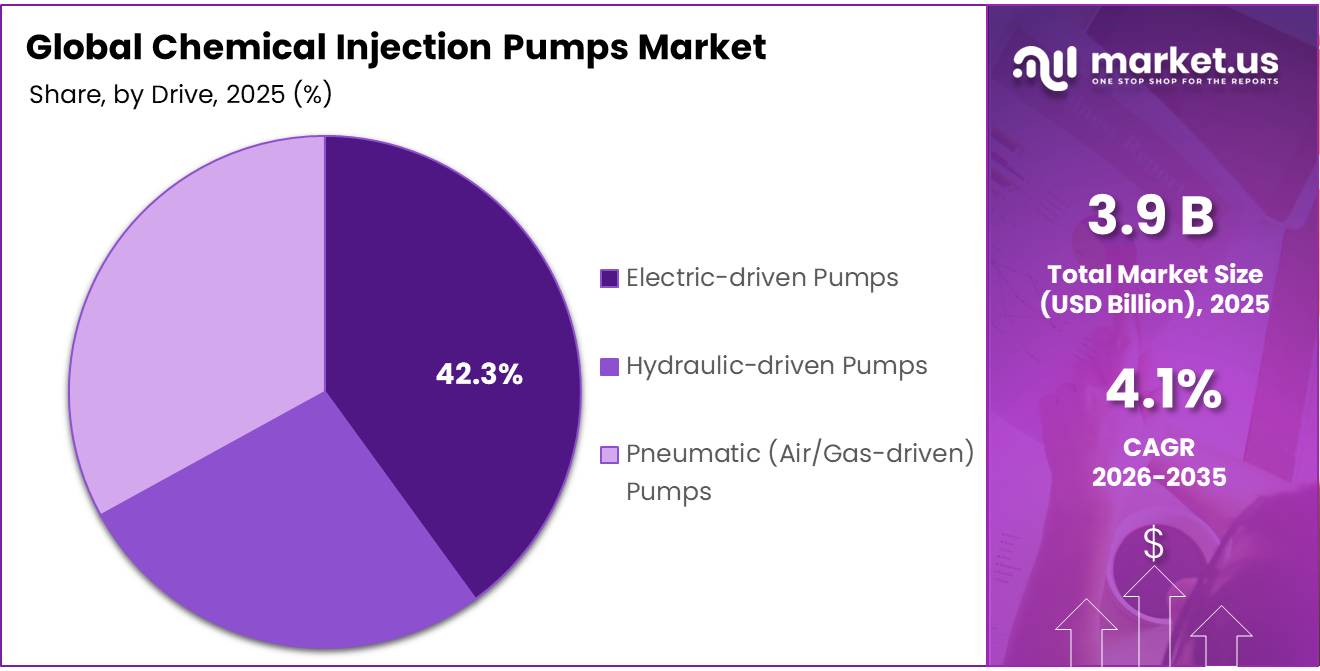
- Based on the drive, electric-driven pumps led the market, comprising 40.3% of the total market.
- Among the end-use industries, the oil & gas sector held a major share in the chemical injection pumps market, 42.3% of the market share.
- In 2025, the Asia Pacific was the most dominant region in the chemical injection pumps market, accounting for 35.4% of the total global consumption.
Product Type Analysis
Diaphragm Pumps are a Prominent Segment in the Market.
Diaphragm pumps account for the largest share of the chemical injection pumps market, representing 42.3% of the product segment. Their dominance is attributed to their robust design, ability to handle corrosive and abrasive chemicals, and high dosing accuracy, which is critical in water treatment, oil and gas, and chemical processing applications. These pumps operate with minimal leakage risk due to their sealed construction, ensuring safety and regulatory compliance in sensitive environments.
Additionally, diaphragm pumps can manage varying viscosities and pressures, making them versatile for both batch and continuous operations. Their adaptability to electric, hydraulic, and pneumatic drives further enhances their applicability across diverse industrial setups, reinforcing their position as the preferred choice for operators seeking reliability, precision, and durability in chemical injection processes.
Drive Analysis
Electric-driven Pumps Held a Major Share of the Chemical Injection Pumps Market.
Electric-driven pumps lead the drive segment of the chemical injection pumps market, accounting for 40.3% of installations. Their prominence stems from precise flow control, energy efficiency, and ease of integration with automated and digitally monitored systems. Electric drives offer consistent performance for both low- and high-viscosity fluids, making them suitable for water treatment, chemical processing, and oil and gas operations.
The ability to interface with IoT-enabled monitoring and predictive maintenance tools enhances operational reliability, reduces downtime, and supports regulatory compliance by maintaining accurate chemical dosing. Furthermore, electric-driven pumps require less manual intervention compared with pneumatic or hydraulic counterparts, reducing labor dependency and minimizing operational risk. Their combination of precision, automation compatibility, and operational efficiency has made electric-driven pumps the preferred choice across diverse industrial applications.
End-Use Industry Analysis
Chemical Injection Pumps Are Widely Utilized in the Oil & Gas Sector.
The oil and gas sector represents the largest end-use segment in the chemical injection pumps market, accounting for 42.3% of consumption. The sector’s reliance on precise chemical dosing is driven by the need to prevent corrosion, scale formation, and hydrate accumulation in pipelines, as well as to maintain optimal operational efficiency in upstream, midstream, and downstream processes. Plunger, diaphragm, and peristaltic pumps are widely deployed to deliver corrosion inhibitors, biocides, and scale inhibitors with high accuracy.
Robust construction, resistance to harsh chemical environments, and compatibility with remote monitoring systems are critical for reliability in offshore and onshore operations. These factors underscore the central role of chemical injection pumps in ensuring process integrity, safety, and compliance across the oil and gas value chain.
Key Market Segments
By Product Type
- Diaphragm Pumps
- Plunger / Piston Pumps
- Peristaltic Pumps
By Drive
- Electric-driven Pumps
- Hydraulic-driven Pumps
- Pneumatic (Air/Gas-driven) Pumps
By End-Use Industry
- Oil & Gas
- Water & Wastewater Treatment
- Chemical Processing
- Food & Beverage
- Pharmaceuticals
- Agriculture
- Others