


Report Overview
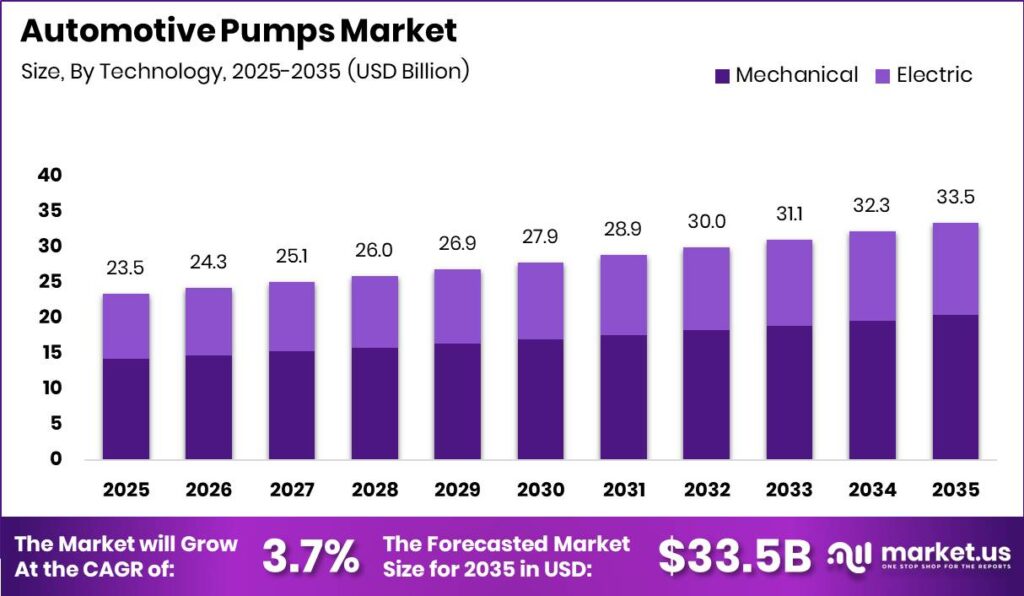
Global Automotive Pumps Market size is expected to be worth around USD 33.50 Billion by 2035 from USD 23.50 Billion in 2025, growing at a CAGR of 3.7% during the forecast period 2026 to 2035. This trajectory reflects steady volume expansion across both original equipment and replacement channels as vehicle production scales globally.
The Automotive Pumps Market encompasses fluid-handling components that manage fuel delivery, engine cooling, lubrication, transmission fluid, and brake vacuum assistance across all vehicle powertrain architectures. The market spans mechanical belt-driven pump assemblies alongside electronically controlled pumps designed for hybrid and battery-electric platforms. Suppliers serve two primary routes to market: direct OEM supply for new vehicle production and the aftermarket channel covering replacement and repair demand across aging fleets.
Key Takeaways
- The global Automotive Pumps Market was valued at USD 23.50 Billion in 2025 and is forecast to reach USD 33.50 Billion by 2035, at a CAGR of 3.7%.
- By Technology, Mechanical pumps dominate with a 61.0% share, reflecting their continued presence across internal combustion and hybrid platforms.
- By Pump Type, Fuel Injection Pumps hold a 27.0% share, the largest individually tracked sub-segment within the pump type category.
- By Application, Passenger Vehicles account for 61.9% of market demand, driven by the largest global vehicle production segment.
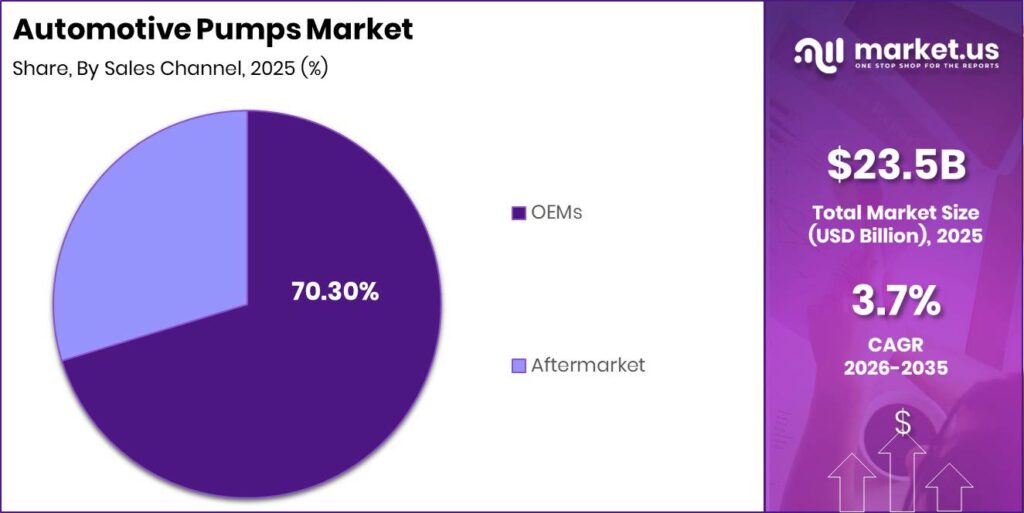
- By Sales Channel, OEMs represent 70.3% of total revenue, confirming that new vehicle production remains the primary demand anchor.
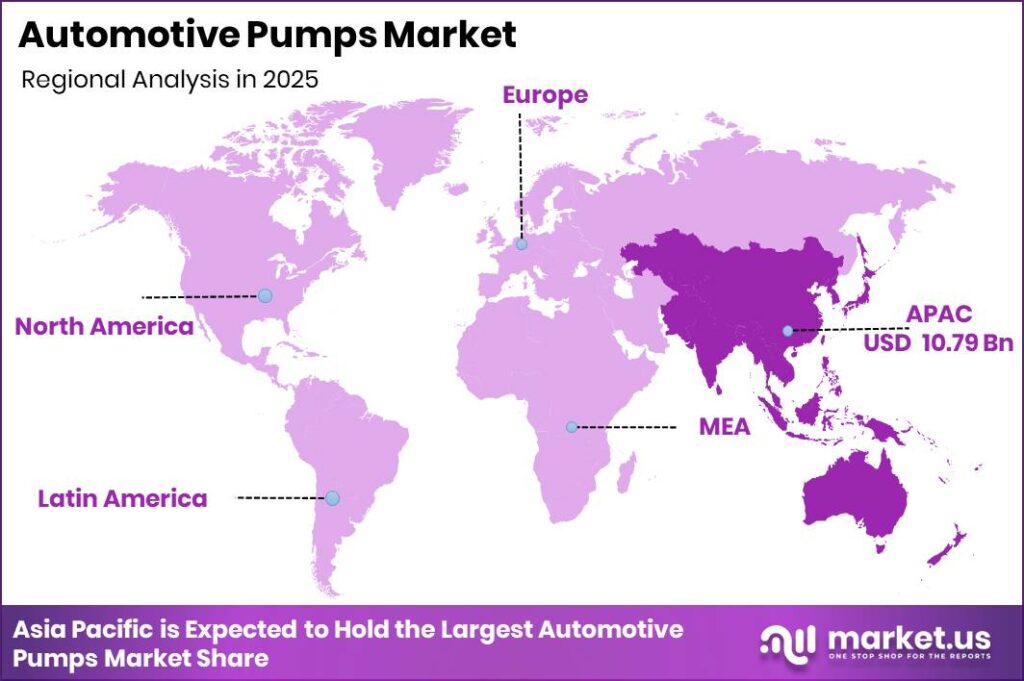
- Asia Pacific is the dominant region with a 46.0% share, valued at USD 10.79 Billion, underpinned by high vehicle production volumes across China, India, and Japan.
Regulatory pressure on fuel system performance is reshaping product specifications across multiple jurisdictions. Euro 7 provisions taking effect in 2026, China 6b standards, and India’s BS VI Phase 2 mandate progressively higher gasoline direct injection pressures. These requirements push OEMs to source pumps engineered for next-generation pressure thresholds. Suppliers that qualify compliant platforms early gain a structural advantage in securing long-term production contracts before competitors complete their certification cycles.
Product safety enforcement is also creating measurable replacement demand. A 2025 U.S. fuel-pump recall, NHTSA campaign 25V455000, covered approximately 850,000 vehicles due to low-pressure fuel pump failure risk. This volume of recalled units generates a concentrated aftermarket replacement cycle that benefits certified OEM-grade pump suppliers. As per our research, FCA’s June 2026 electric-hydraulic power-steering-pump recall covered 1,076,999 Jeep Wrangler and Gladiator vehicles from model years 2021 to 2025, signaling that recall-driven demand is expanding into electrified fluid-handling segments beyond conventional fuel systems.
Technology Analysis
Mechanical pumps dominate with 61.0% due to high ICE platform production volumes globally.
In 2025, Mechanical pumps held a dominant market position in the By Technology segment of the Automotive Pumps Market, with a 61.0% share. OICA global vehicle production data shows over 85 million light vehicles were assembled in 2024, the majority on internal combustion or hybrid platforms that retain belt-driven mechanical pump systems for fuel, oil, and coolant functions. Mechanical pump dominance reflects installed base inertia across markets where ICE fleet volumes remain structurally high, giving incumbent suppliers a durable volume floor through the forecast period.
Electric pumps represent the fastest-growing sub-segment within the By Technology category, driven by mandatory thermal management requirements on battery-electric and plug-in hybrid platforms. ITU and IEA infrastructure tracking confirms that EV charging network density is expanding across Asia Pacific and Europe, accelerating BEV fleet accumulation and increasing per-vehicle electric pump content. UCAL’s 2025 electric coolant pump range spans power consumption from 4.2 W to 144 W across four pump variants, illustrating the breadth of specification that OEM procurement teams now require. Suppliers offering scalable electric pump platforms across wattage tiers position themselves to capture share as EV architecture diversity widens.
Pump Type Analysis
Fuel Injection Pump dominates with 27.0% due to mandatory GDI adoption across regulated markets.
In 2025, Fuel Injection Pumps held a dominant market position in the By Pump Type segment of the Automotive Pumps Market, with a 27.0% share. UN Comtrade trade flow data under HS code 8413 shows fuel injection pump exports from Germany, Japan, and China collectively exceeded USD 9 billion in 2023, reflecting high unit volumes tied to gasoline direct injection mandates across major automotive markets. Regulatory-driven GDI adoption ensures that fuel injection pump demand remains structurally anchored to new vehicle production cycles, giving tier-1 suppliers a defensible revenue base in this sub-segment.
Fuel Supply Pumps serve as the upstream delivery component in both port-injection and direct-injection fuel architectures, transferring fuel from the tank to the high-pressure injection system. The Motor and Equipment Manufacturers Association estimates that the North American replacement fuel pump market processes several million units annually, reflecting the combined pressure of aging ICE fleet size and recall-driven replacement cycles. Suppliers in this sub-segment benefit from recurring aftermarket demand that partially offsets new-vehicle production volatility.
Vacuum Pumps support brake booster and emissions control functions across diesel and gasoline platforms, and their role expands in hybrid vehicles where engine-off periods eliminate natural manifold vacuum. Transmission Oil Pumps maintain hydraulic pressure within automatic and dual-clutch gearboxes, and UNIDO manufacturing output data confirms that automatic transmission production has grown consistently across Asia Pacific assembly plants over the past five years. Fuel Supply Pumps, Vacuum Pumps, Transmission Oil Pumps, and the Others sub-segment collectively hold the remaining share of the By Pump Type category.
Application Analysis
Passenger Vehicles dominate with 61.9% due to highest global vehicle production and sales volume.
In 2025, Passenger Vehicles held a dominant market position in the By Application segment of the Automotive Pumps Market, with a 61.9% share. OICA production statistics confirm that passenger cars accounted for more than 70 million units of global vehicle output in 2024, representing the single largest demand source for automotive pump assemblies across fuel, coolant, oil, and power-steering systems. Passenger vehicle pump demand benefits from both new production volume and a large global replacement market, making this sub-segment the most structurally resilient in the portfolio.
Light Commercial Vehicles represent a secondary application tier, covering vans, pickups, and small trucks used in last-mile logistics, construction support, and small business operations. World Bank transport sector data shows that commercial vehicle registrations in emerging economies across South and Southeast Asia grew at above-average rates through 2023 and 2024, reflecting infrastructure investment cycles and expanding e-commerce logistics networks. This growth lifts pump demand across fuel delivery, power steering, and thermal management sub-systems within LCV powertrains.
Heavy Commercial Vehicles including long-haul trucks and buses require high-durability pump assemblies built for extended duty cycles, higher fuel system pressures, and more demanding thermal loads than passenger applications. IEA freight transport data confirms that diesel-powered heavy trucks remain the dominant long-haul freight mode globally, sustaining demand for high-pressure fuel injection and transmission oil pump variants. Light Commercial Vehicles and Heavy Commercial Vehicles together hold the balance of the By Application segment share beyond the passenger vehicle majority.
Sales Channel Analysis
OEMs dominate with 70.3% due to direct integration into new vehicle assembly programs.
In 2025, OEMs held a dominant market position in the By Sales Channel segment of the Automotive Pumps Market, with a 70.3% share. Corporate annual reports from major Tier-1 automotive suppliers confirm that OEM supply agreements typically span vehicle model lifecycles of 5 to 7 years, locking in volume commitments that provide revenue predictability unavailable in the spot-driven aftermarket channel. OEM channel dominance signals that supplier qualification cycles and long-term production nominations remain the primary competitive battleground for pump manufacturers seeking stable revenue bases.
The Aftermarket channel holds the remaining share of the By Sales Channel segment and delivers structurally different economics, with higher per-unit pricing and shorter order cycles than OEM programs. In March 2025, AISIN Aftermarket launched new engine oil pumps for Toyota and Lexus vehicles and new water pumps for Toyota, Lexus, Honda, and Acura applications, expanding its aftermarket automotive pump portfolio. This product expansion illustrates that OEM-affiliated suppliers are actively capturing aftermarket share in addition to their production-line positions, compressing the space available to independent aftermarket distributors and creating pricing pressure on non-OEM replacement parts.
Key Market Segments
By Technology
- Mechanical
- Electric
By Pump Type
- Fuel Supply Pump
- Fuel Injection Pump
- Vacuum Pump
- Transmission Oil Pump
- Others
By Application
- Passenger Vehicles
- Light Commercial Vehicles
- Heavy Commercial Vehicles
By Sales Channel
- OEMs
- Aftermarket
Regional Analysis
Asia Pacific Dominates the Automotive Pumps Market with a Market Share of 46.0%, Valued at USD 10.79 Billion
Asia Pacific commands 46.0% of global automotive pump revenue, valued at USD 10.79 Billion in 2025. China, Japan, South Korea, and India collectively host the world’s highest concentration of vehicle assembly capacity, generating demand across every pump type from fuel injection to electric coolant systems. The region’s combination of high-volume ICE production and accelerating EV adoption creates dual demand streams that no other region replicates at this scale. Suppliers with local manufacturing presence in Asia Pacific gain both cost and supply-chain responsiveness advantages over import-dependent competitors.
Europe represents the fastest-growing regional market for electric and fuel system pumps, driven by Euro 7 emission standards taking effect in 2026 and the continent’s progressive shift toward electrified vehicle architectures. In 2026, Ford recall 26S17 potentially affected 7,105 commercial vehicles whose high-pressure fuel pumps could fail due to biodiesel deposits on drivetrain roller components, highlighting that fuel system reliability remains a compliance and warranty cost issue for OEMs operating in markets with alternative fuel mandates. This recall dynamic reinforces aftermarket demand for certified replacement fuel pump assemblies across the European commercial vehicle parc.
North America sustains demand through a large in-service vehicle fleet and active regulatory enforcement that generates replacement cycles. Latin America and the Middle East and Africa represent smaller but developing segments where rising vehicle ownership and expanding dealer service networks are gradually formalizing aftermarket pump distribution. These regions collectively hold the balance of global automotive pump revenue outside Asia Pacific and Europe, and represent medium-term expansion opportunities for suppliers seeking geographic diversification beyond their current core markets.
Key Regions and Countries
North America
- US
- Canada
Europe
- Germany
- France
- The UK
- Spain
- Italy
- Rest of Europe
Asia Pacific
- China
- Japan
- South Korea
- India
- Australia
- Rest of APAC
Latin America
- Brazil
- Mexico
- Rest of Latin America
Middle East and Africa
- GCC
- South Africa
- Rest of MEA
Market Dynamics
Market Opportunity Analysis - Underpenetrated electric pump sub-segments and emerging regional aftermarkets signal the next growth frontier
The Electric pump sub-segment within the By Technology category is the fastest-growing position in the market yet remains under-resourced relative to its structural demand trajectory. As established in the Technology Analysis, BEV platforms require between 3 and 5 dedicated electric pumps per vehicle versus 1 to 2 mechanical units in comparable ICE architectures. Suppliers that have not yet retooled toward brushless DC pump production lines face a widening content-value gap as EV fleet penetration expands. This segment rewards early capital commitment over late catch-up investment.
The Aftermarket Sales Channel, which holds the minority share beyond OEMs’ 70.3%, is structurally underexploited in India, Southeast Asia, and Latin America, where vehicle parc growth outpaces organized replacement part distribution infrastructure. As established in the Regional Analysis, these regions represent developing market tiers where formalizing aftermarket pump distribution creates a first-mover advantage before vertically integrated OEM-affiliated suppliers extend their aftermarket reach. Digital distribution platforms and regional distribution roll-ups represent the primary entry mechanism for new participants in these geographies.
Heavy Commercial Vehicles represent a lower-penetration application tier within the By Application segment compared to the dominant Passenger Vehicle base. HCV pump assemblies carry higher unit value due to durability requirements and elevated fuel system pressure specifications. IEA freight data confirms that diesel-powered heavy trucks remain the primary long-haul freight mode globally, sustaining a recurring replacement demand that is structurally less price-sensitive than passenger vehicle aftermarket channels. New entrants that qualify HCV-grade pump variants gain access to a stickier, higher-margin demand base than the passenger vehicle mass market.
The Hydrogen fuel cell vehicle pump opportunity, while a long-term execution window, is geographically concentrated in Europe, Japan, and South Korea, where government hydrogen infrastructure programs create visible demand runways. Rheinmetall’s February 2025 EUR 26 million production order for CWA 2000 high-voltage coolant pumps designed for 800 V fuel-cell vehicles confirms that commercial orders in this sub-segment are already materializing before mainstream volume arrives. Suppliers that secure early qualification positions in hydrogen pump programs establish switching-cost barriers that are extremely difficult for late entrants to overcome once platform nominations close.
Technology and Innovation Landscape - Electric pump precision, thermal modeling advances, and modular architecture define the next competitive edge
Bosch’s electric coolant pump PDE platform illustrates how product architecture is evolving to cover a wider thermal management specification range from a single product family. The PDE is offered in three electrical ratings covering 110 W, 150 W, and 200 W for automotive thermal management applications, delivering 30 to 65 W of hydraulic power from a 12 V vehicle electrical system. This multi-rating modular approach allows OEM procurement teams to source thermal coverage across distinct vehicle classes without qualifying separate pump platforms, reducing supplier development costs and shortening program timelines.
Thermal performance modeling tools are compressing engineering development cycles for Electric Vehicle Thermal Management pump systems. A 2025 SAE technical study reported that a one-dimensional thermo-fluid model of an EV traction-inverter cooling system predicted thermal performance within 5% of full computational-fluid-dynamics results. This accuracy level enables faster pump and cooling-loop validation without full CFD compute cycles, reducing simulation time and allowing suppliers to iterate cooling architectures more rapidly during the platform development phase. Engineers that deploy these tools gain measurable time-to-market advantages over teams still relying on full CFD-only validation pipelines.
High-pressure fuel injection pump technology continues advancing in production volume and operating parameters. Bosch’s CP4 platform has surpassed 60 million units produced, supports injection pressures up to 2,700 bar, and is engineered for up to 500,000 start-stop cycles. These specifications define the benchmark that competing high-pressure fuel pump suppliers must meet or exceed to win OEM nominations on next-generation GDI platforms. The production volume milestone also confirms that CP4-class technology has crossed the scale threshold where per-unit manufacturing costs are difficult to undercut without equivalent volume commitments.
Electric coolant pump specifications are expanding across both power consumption range and operating temperature tolerance as EV thermal demands intensify. UCAL’s 2025 coolant pump range covers power consumption from 4.2 W to 144 W across four pump variants, with operating temperature envelopes extending from minus 20 degrees C to 150 degrees C on its higher-output models. This temperature ceiling expansion reflects the thermal stress profiles of next-generation 800 V battery architectures and fast-charging systems. Suppliers that can certify pump operation across this extended temperature range access a qualifying criterion that filters out competitors still limited to narrower thermal envelopes.
Drivers
EV and hybrid vehicle architectures structurally increase pump content per vehicle. IEA Global EV Outlook tracking shows EV sales penetration climbed from roughly 14% of global light-vehicle sales in 2024 to approximately 18% in 2025. Each BEV platform requires between 3 and 5 dedicated electric pumps versus 1 to 2 mechanical pumps in a comparable ICE vehicle per SAE International benchmarking. This raises average pump content value per vehicle by an estimated 40% to 60%, directly expanding the addressable revenue opportunity for electric pump suppliers on every new EV unit produced.
Regulatory pressure on fuel injection systems, engine downsizing trends, and vehicle production growth in emerging markets add further structural demand layers. Emerging-market vehicle production expansion across Asia Pacific and Latin America contributes an estimated +0.7% to CAGR, while aging fleet replacement demand in North America and Europe adds +0.4%. Electric pump gross margins of 26% to 28% compare favorably to roughly 18% for conventional mechanical assemblies per supplier earnings disclosures, incentivizing capital reallocation toward electronically controlled pump platforms across Tier-1 supplier portfolios.
| Driver | (~) % Impact on CAGR Forecast | Geographic Relevance | Impact Timeline |
|---|---|---|---|
| EV/HEV powertrain electric pump proliferation | +1.3% | Global | Short term (2 years or less) |
| Regulatory-driven GDI fuel pressure escalation | +0.8% | Europe, China, India, North America | Short term (2 years or less) |
| Engine downsizing and turbocharging duty cycles | +0.5% | Global | Medium term (2 to 4 years) |
| Emerging market vehicle production growth | +0.7% | Asia Pacific, Latin America | Short term (2 years or less) |
| Aging fleet aftermarket replacement demand | +0.4% | North America, Europe | Medium term (2 to 4 years) |
Restraints
Battery-electric vehicle adoption in China and Europe is eliminating the functional slot for belt-driven mechanical pumps on new platforms. New-energy vehicle penetration in China reached approximately 40% of light-vehicle sales in 2025 per China Association of Automobile Manufacturers data. Mechanical pump unit shipments in China’s light-vehicle segment declined roughly 12% to 15% year-on-year through 2025, and OEM cancellation of conventional-pump procurement requests forces suppliers to write off tooling programs with 18 to 24 month qualification lead times already committed.
Tier-1 suppliers carrying more than 60% of revenue in legacy mechanical pump lines face gross margin compression of roughly 300 to 500 basis points per supplier annual report disclosures. Raw material cost volatility in copper and rare earth magnets, cross-border tariff exposure in North America and China, and type-approval certification delays in Europe and India add further friction. These combined restraints subtract an estimated 2.5 percentage points from potential CAGR, creating real financial pressure on suppliers that delay transition toward electrified pump platforms.
| Restraint | (~) % Impact on CAGR Forecast | Geographic Relevance | Impact Timeline |
|---|---|---|---|
| EV cannibalization of mechanical pump volumes | -0.7% | China, Europe | Short term (2 years or less) |
| High interest rate constraint on CapEx retooling | -0.6% | Global | Short term (2 years or less) |
| Raw material cost volatility (copper, rare earth magnets) | -0.5% | Global | Short term (2 years or less) |
| Cross-border auto parts tariff exposure | -0.4% | North America, China | Short term (2 years or less) |
| Type-approval and certification lead-time delays | -0.3% | Europe, India | Short term (2 years or less) |
Challenges
OEMs must simultaneously qualify pumps against non-harmonized regulatory regimes across major markets. Euro 7 provisions take effect in 2026, China 6b, India’s BS VI Phase 2, and US EPA/CAFE standards each mandate distinct gasoline direct injection pressure tiers, ranging from the current 200 to 350 bar band toward 500 bar and above in next-generation systems per SAE International technical standards benchmarks. This fragmentation multiplies R&D validation cycles by an estimated 2.5x to 3x per platform, extending pump qualification lead times from around 14 months to 22 to 26 months.
A talent deficit in power-electronics and calibration engineering globally, flagged by the Motor and Equipment Manufacturers Association, diverts headcount away from next-generation electric pump development programs. Semiconductor lead-time volatility subtracts an estimated 0.4% from CAGR by disrupting electronic pump controller supply. Aftermarket counterfeit component erosion, concentrated in Asia Pacific and Latin America, applies a further 0.3% CAGR drag. Suppliers that adopt modular, software-configurable pump architectures recalibrated across regulatory zones without full hardware requalification will recover the most R&D return on investment as compliance complexity compounds.
| Challenge | (~) % CAGR Friction Drag | Geographic Relevance | Mitigation Horizon |
|---|---|---|---|
| Fragmented global regulatory specifications | -0.6% | Global | Medium term (2 to 4 years) |
| Power electronics talent shortage | -0.5% | Global | Medium term (2 to 4 years) |
| Multi-pump EV thermal integration complexity | -0.5% | Global | Medium term (2 to 4 years) |
| Semiconductor lead-time volatility | -0.4% | Global | Short term (2 years or less) |
| Aftermarket counterfeit component erosion | -0.3% | Asia Pacific, Latin America | Long term (4 years or more) |
Opportunities
Next-generation dual-loop and dielectric-fluid immersion cooling modules represent a commercially unaddressed segment within the broader Automotive Thermal Management space. Today’s conventional single-loop glycol architectures serve less than 10% of global BEV production volume at immersion cooling specification levels per IEA electrification tracking. Rising cell-to-pack energy density targets of 250 Wh/kg and above, combined with fast-charging rates approaching 350 kW under emerging SAE J3400 standards, generate thermal loads that conventional pump sets cannot adequately manage. Suppliers that invest ahead of mainstream adoption capture per-vehicle thermal module content value roughly 25% to 35% higher than conventional coolant pump sets.
Smart connected pump predictive-maintenance subscriptions in North America and Europe offer a recurring software-revenue layer with gross margin potential above 30%, compared to the mid-20% range typical of standard electric water pumps. Aftermarket digitalization and distribution consolidation across India, Southeast Asia, and Latin America add a medium-term upside of +0.4% to CAGR. Hydrogen fuel cell vehicle pump systems in Europe, Japan, and South Korea represent a long-term opportunity, while localized manufacturing under reshoring incentives in the United States and India opens a +0.4% CAGR upside window for suppliers that establish domestic production capacity ahead of policy deadlines.
| Opportunity | (~) % Potential CAGR Upside | Geographic Relevance | Execution Window |
|---|---|---|---|
| Advanced battery immersion/dual-loop thermal modules | +0.8% | Global | Medium term (2 to 4 years) |
| Smart connected pump predictive-maintenance subscriptions | +0.5% | North America, Europe | Long term (4 years or more) |
| Aftermarket digitalization and distribution roll-ups | +0.4% | India, Southeast Asia, Latin America | Medium term (2 to 4 years) |
| Hydrogen fuel cell vehicle pump systems | +0.3% | Europe, Japan, South Korea | Long term (4 years or more) |
| Localized manufacturing under reshoring incentives | +0.4% | United States, India | Medium term (2 to 4 years) |
Key Company Insights
Robert Bosch GmbH anchors its automotive pump position on high-pressure fuel injection technology at scale. The company’s CP4 high-pressure pump platform has surpassed 60 million units produced, supports injection pressure up to 2,700 bar, and is engineered for up to 500,000 start-stop cycles. This production depth gives Bosch a cost-per-unit advantage that smaller qualified suppliers cannot replicate without equivalent volume commitments from OEM partners over multi-year platform nominations.
Denso Corporation maintains a dual-channel position across OEM production supply and recall-replacement programs that creates recurring aftermarket revenue alongside its new-vehicle business. Toyota’s January 2025 recall covered 858 vehicles fitted with defective Denso fuel pumps across Toyota Camry and Lexus product lines. Recall exposure of this nature creates short-term reputational and warranty cost pressure, but Denso’s deep OEM integration across Toyota and Lexus platforms means replacement volume flows back through authorized Denso supply channels rather than to competing aftermarket parts suppliers.
Key Players
- Robert Bosch GmbH
- Denso Corporation
- Aisin Corporation
- Continental AG
- BorgWarner Inc.
- Delphi Technologies
- Johnson Electric Holdings Limited
- Magna International Inc.
- Rheinmetall AG (Pierburg)
- ZF Friedrichshafen AG
- Valeo SA
- Hitachi Astemo, Ltd.
- Hella GmbH and Co. KGaA
- Schaeffler AG
- SHW AG
Recent Developments
- February 2025: Rheinmetall received a EUR 26 million series production order for its CWA 2000 high-voltage coolant pumps from a major Asian manufacturer. The pumps are designed for 800 V fuel-cell vehicles and stationary fuel-cell systems, confirming commercial production entry into the hydrogen-compatible thermal management segment.
- March 2025: Continental reported that its aftermarket portfolio expansion would reach approximately 700 part numbers by mid-2025, covering fuel pump units, water pumps, and related engine-management products. The expansion increased average vehicle coverage by 50%, broadening Continental’s serviceable fleet base across the European and North American aftermarket.
- April 2025: ABC Technologies completed its acquisition of TI Fluid Systems, and the combined entity announced it would operate under the TI Automotive brand. TI Fluid Systems supplies automotive fluid handling, thermal management, and coolant delivery systems used alongside vehicle pump technologies, making this a consolidation move that expands thermal systems integration capability under a single ownership structure.
- September 2025: Porsche’s high-pressure fuel pump recall involved 107 vehicles, with NHTSA reporting an estimated defect rate of 100%. The recall highlights the zero-tolerance quality exposure that high-performance fuel system suppliers face when defect rates reach total population levels.
- April 2025: Isuzu’s EV cooling pump recall covered 73 model-year 2025 NRR-EV trucks, with NHTSA estimating that 100% of the recalled population contained the defect. This event signals that electric coolant pump quality assurance processes in commercial EV platforms require further maturation before volume scaling.
Geopolitical Impact Analysis
Cross-border automotive parts tariffs are directly raising input costs for pump manufacturers that rely on globally distributed supply chains. According to WTO trade policy monitoring, the United States applied tariff rates on imported auto parts that reached up to 25% on selected categories under Section 232 automotive provisions reviewed through 2025, compressing margins for pump suppliers sourcing components across North American borders. IMF trade impact assessments confirm that tariff-exposed automotive component suppliers face landed-cost increases of 8% to 12% on affected part families, forcing either price renegotiation with OEM customers or domestic sourcing investments that carry higher unit costs during the ramp phase.
Freight rate volatility and logistics rerouting driven by ongoing Red Sea shipping disruptions are extending delivery lead times for pump components shipped from Asia Pacific manufacturing hubs to European assembly plants. Data from the World Shipping Council shows that container shipping rates on Asia-to-Europe lanes experienced sustained elevated levels through 2024 and into 2025 as vessels rerouted around the Cape of Good Hope, adding an estimated 10 to 14 days to transit times. This means that just-in-time pump supply chains designed for two-to-three week replenishment windows are absorbing buffer inventory costs that were not modeled in supplier contracts negotiated before the disruption. Consequently, suppliers are accelerating regional inventory positioning and dual-sourcing strategies to reduce single-lane logistics dependency.
Report Scope
| Report Features | Description |
|---|---|
| Market Value (2025) | USD 23.50 Billion |
| Forecast Revenue (2035) | USD 33.50 Billion |
| CAGR (2026-2035) | 3.7% |
| Base Year for Estimation | 2025 |
| Historic Period | 2020-2024 |
| Forecast Period | 2026-2035 |
| Report Coverage | Revenue Forecast, Market Dynamics, Market Opportunity Analysis, Technology and Innovation Landscape, Competitive Landscape, Recent Developments |
| Segments Covered | By Technology (Mechanical, Electric); By Pump Type (Fuel Supply Pump, Fuel Injection Pump, Vacuum Pump, Transmission Oil Pump, Others); By Application (Passenger Vehicles, Light Commercial Vehicles, Heavy Commercial Vehicles); By Sales Channel (OEMs, Aftermarket) |
| Regional Analysis | North America (US and Canada), Europe (Germany, France, The UK, Spain, Italy, and Rest of Europe), Asia Pacific (China, Japan, South Korea, India, Australia, and Rest of APAC), Latin America (Brazil, Mexico, and Rest of Latin America), Middle East and Africa (GCC, South Africa, and Rest of MEA) |
| Competitive Landscape | Robert Bosch GmbH, Denso Corporation, Aisin Corporation, Continental AG, BorgWarner Inc., Delphi Technologies, Johnson Electric Holdings Limited, Magna International Inc., Rheinmetall AG (Pierburg), ZF Friedrichshafen AG, Valeo SA, Hitachi Astemo Ltd., Hella GmbH and Co. KGaA, Schaeffler AG, SHW AG |
| Customization Scope | Customization for segments, region / country-level will be provided. Additional customization can be done based on requirements. |
| Purchase Options | We have three licenses to opt for: Single User License | Multi-User License (Up to 5 Users) | Corporate Use License (Unlimited User and Printable PDF) |





































