


Report Overview
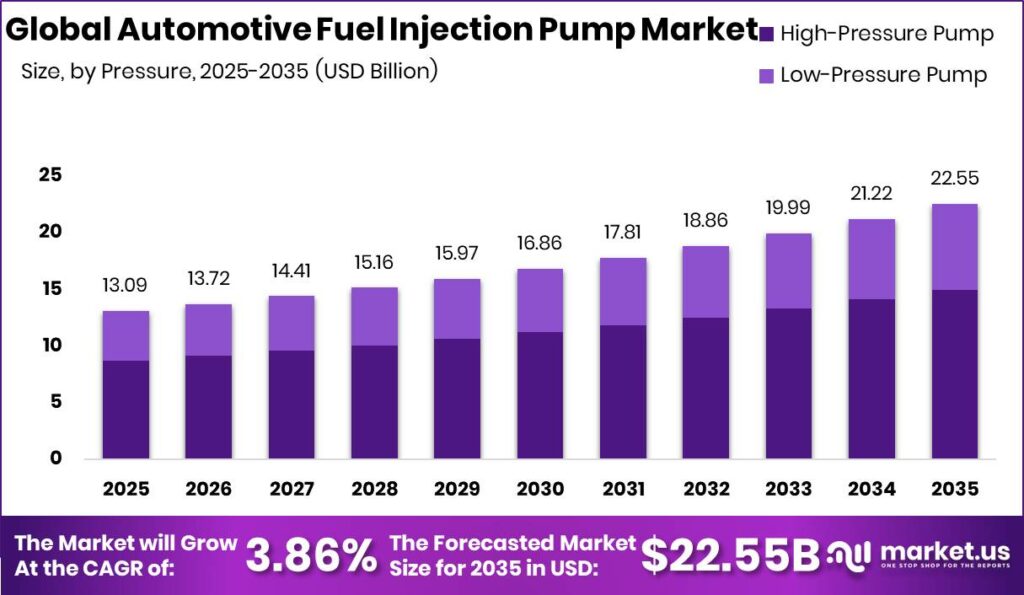
Global Automotive Fuel Injection Pump Market size is expected to be worth around USD 22.55 Billion by 2035 from USD 13.09 Billion in 2025, growing at a CAGR of 3.86% during the forecast period 2026 to 2035. This trajectory reflects a market anchored by durable demand from commercial vehicle fleets, off-highway equipment, and combustion engine platforms that require precise, high-pressure fuel delivery for both performance and emissions compliance.
The automotive fuel injection pump market encompasses devices that pressurize and meter fuel into internal combustion engines at controlled rates and intervals. This market covers common rail systems, rotary distributor pumps, in-cylinder configurations, and outside-cylinder designs. By pressure class, the market spans high-pressure and low-pressure assemblies. End applications range from passenger cars and light commercial vehicles to heavy commercial fleets. Sales occur through original equipment manufacturer channels and aftermarket distribution networks globally.
Key Takeaways
- The global Automotive Fuel Injection Pump Market was valued at USD 13.09 Billion in 2025 and is forecast to reach USD 22.55 Billion by 2035.
- The market is projected to expand at a CAGR of 3.86% from 2026 to 2035.
- By Type, Common Rail Fuel Injection Pump dominates with a 58.00% share, the largest segment.
- By Pressure, High-Pressure Pump holds the largest segment at 66.50% share.
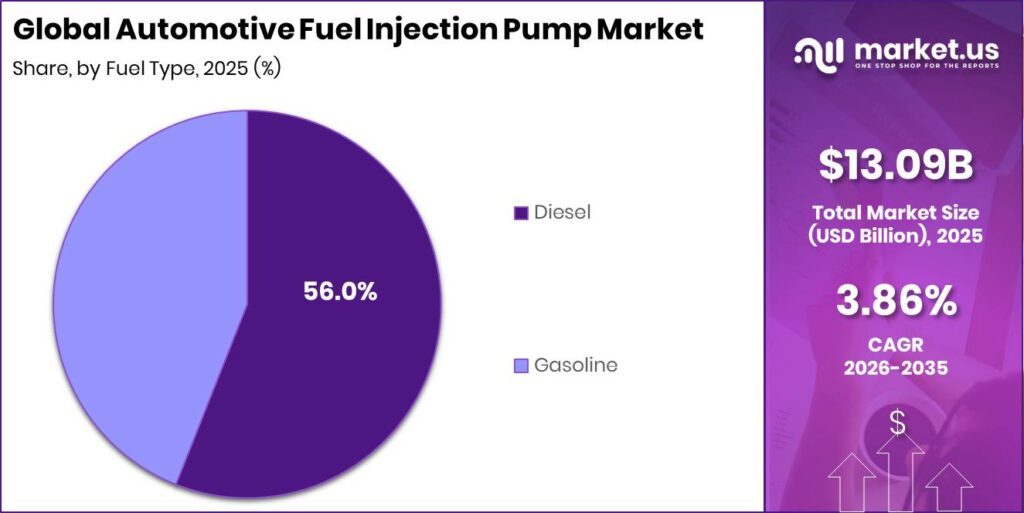
- By Fuel Type, Diesel leads with a 56.00% share, the largest segment.
- By Vehicle Type, Passenger Cars command the largest segment at 61.00% share.
- By Application, Direct Injection Systems dominate with a 71.50% share.
- By Sales Channel, OEM leads with a 73.55% share, the largest segment.
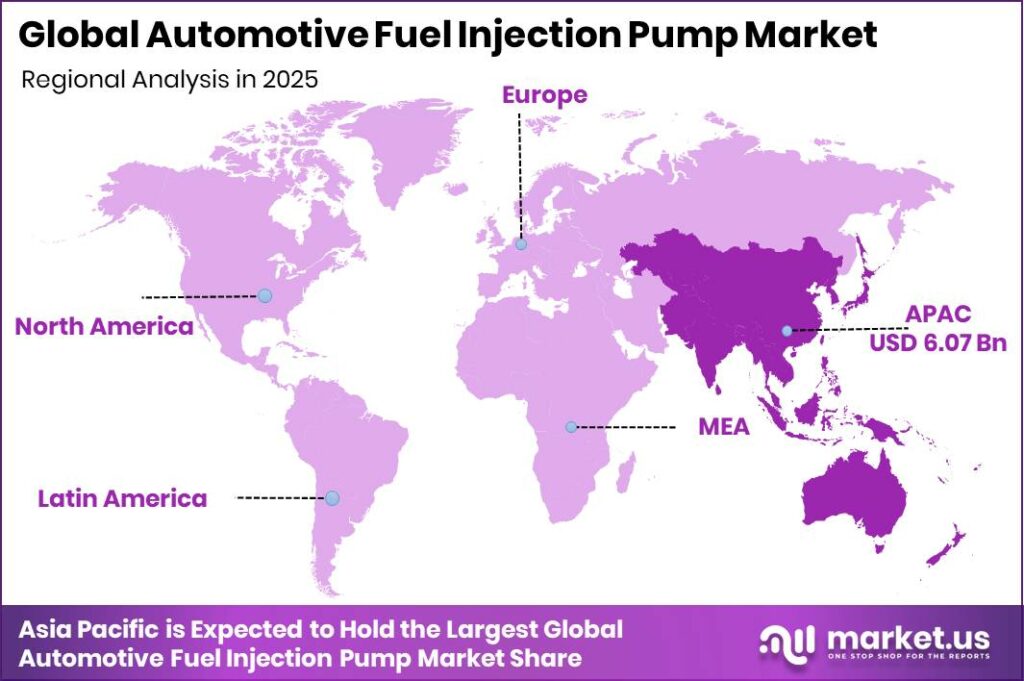
- Asia Pacific dominates the regional landscape with a 46.40% share, valued at USD 6.07 Billion.
Government bodies across North America, Europe, and Asia are tightening emissions frameworks for both light-duty and heavy-duty vehicles. The U.S. EPA’s heavy-duty standards covering model years 2027 to 2032 require advanced combustion calibration, which keeps high-pressure injection hardware central to compliance strategies for diesel and gasoline powertrains. This regulatory pressure creates sustained demand for precision pump components that meet evolving certification thresholds across multiple markets simultaneously.
As per our research, the aftermarket channel is the fastest-growing sales segment in this market, driven by aging commercial fleets requiring recurring fuel system maintenance and calibration. This growth signal favors suppliers with established distribution networks, certified exchange programs, and service-linked revenue models. Vendors that expand aftermarket coverage will capture recurring revenue streams rather than depending entirely on new-vehicle production cycles, which are exposed to powertrain transition risk.
Off-highway equipment mechanization across India, Southeast Asia, and Latin America is connecting Internal Combustion Engine demand to agricultural and construction fleet expansion in cost-sensitive regions. As per our research, common rail adoption is also accelerating in China and Europe, where engine manufacturers seek lower NOx outputs without abandoning diesel combustion platforms entirely. These parallel trends ensure the fuel injection pump market maintains broad demand across both mature and developing economies through the forecast period.
Type Analysis
Common Rail Fuel Injection Pump dominates with 58.00% due to precise multi-injection diesel combustion control.
In 2025, Common Rail Fuel Injection Pump held a dominant market position in the By Type segment of the Automotive Fuel Injection Pump Market, with a 58.00% share. An energy journal study published in 2025 found that common rail systems with optimized injection timing achieved substantial NOx reductions compared with conventional timing, making these pumps the preferred choice for diesel engines under modern emissions mandates. Automakers integrating common rail hardware gain a direct compliance advantage, which tightens their supplier dependencies and reinforces the segment’s commercial lead.
Rotary Distributor Fuel Injection Pumps serve established diesel applications where mechanical simplicity and cost-efficiency outweigh the precision advantages of electronic common rail systems. These pumps remain active across mid-range commercial vehicles and agricultural machinery in markets where electronic control adds unnecessary complexity. According to UNIDO industrial production data, manufacturing output for mechanical injection components has remained stable in developing economies where lower vehicle technology tiers dominate fleet composition. This stability provides a reliable, if non-premium, revenue base for traditional pump manufacturers serving those markets.
In-Cylinder Pumps are used in gasoline direct injection configurations, where the pump pressurizes fuel directly inside the combustion chamber for precise spray atomization. A 2022 experimental study from Chalmers University of Technology tested fuel injection pressures up to 150 MPa in ultra-high-pressure GDI systems, confirming that in-cylinder pump hardware can operate reliably at that level to improve spray formation and warm-up performance. This technical ceiling creates a differentiation opportunity for suppliers capable of manufacturing pumps that sustain extreme pressure cycles without exceeding failure-rate thresholds.
Outside-Cylinder Pumps support port fuel injection and lower-pressure applications in gasoline engines, functioning as upstream pressurization units that feed fuel to the injectors at lower rail pressures than GDI systems require. These pumps are widely used in older vehicle platforms and entry-level powertrains where cost constraints limit technology upgrades. Industry trade association data from OICA confirms that passenger vehicle production remains substantial in markets where port injection platforms are still volume-dominant, preserving demand for outside-cylinder units in the near term while GDI penetration advances gradually.
Pressure Analysis
High-Pressure Pump dominates with 66.50% due to diesel and GDI engine emissions compliance requirements.
In 2025, High-Pressure Pump held a dominant market position in the By Pressure segment of the Automotive Fuel Injection Pump Market, with a 66.50% share. A reliability optimization study published in Sciendo found that high-pressure fuel pumps on multi-cylinder engines recorded failure rates as low as 5.0763×10⁻⁵ failures per hour under optimized conditions, demonstrating the measurable reliability gains achievable through engineering investment. Suppliers that document and certify failure rate improvements create a defensible quality narrative that supports premium pricing in OEM procurement negotiations.
Low-Pressure Pumps serve fuel transfer and pre-pressurization roles in port-injected gasoline engines and diesel supply circuits, where moderate rail pressures are sufficient for engine operation. These pumps are standard across a broad base of passenger vehicles, light commercial platforms, and hybrid powertrains that retain combustion assist. According to World Bank economic indicators, vehicle ownership rates continue rising in lower-income markets where entry-level, port-injected gasoline platforms are prevalent, sustaining demand for low-pressure pump units. This creates a volume-led revenue segment even as per-unit margins remain thinner than high-pressure alternatives.
Fuel Type Analysis
Diesel dominates with 56.00% due to heavy commercial fleet and off-highway diesel engine dependency.
In 2025, Diesel held a dominant market position in the By Fuel Type segment of the Automotive Fuel Injection Pump Market, with a 56.00% share. A failure analysis study examining 89 diesel fuel pumps from transport utility vehicles found that actual failures occurred at an average of 70,536 km, significantly below the 200,000 km design lifespan, quantifying the real-world replacement frequency that drives aftermarket demand. This durability gap means fleet operators require recurring pump replacements well before end-of-vehicle life, creating a predictable and recurring revenue cycle for diesel pump suppliers.
Gasoline is the fastest-growing fuel type in this market, propelled by expanding GDI adoption across passenger car segments where fuel economy regulations pressure manufacturers toward direct injection architectures. A technical project on a single-cylinder GDI engine documented 8 to 22% higher fuel economy compared with port-fuel injection, directly attributing the gain to precise high-pressure fuel metering. Automakers seeking compliance without transitioning to full electrification are accelerating GDI deployment, which converts gasoline platforms into high-value customers for advanced pump hardware and increases per-vehicle injection system content.
Vehicle Type Analysis
Passenger Cars dominate with 61.00% due to global production volume and GDI platform expansion.
In 2025, Passenger Cars held a dominant market position in the By Vehicle Type segment of the Automotive Fuel Injection Pump Market, with a 61.00% share. According to OICA global vehicle production statistics, passenger cars account for the largest share of annual automotive output worldwide, consistently exceeding 60 million units in recent production years. This production volume converts directly into pump demand across both OEM installation and post-sale aftermarket service channels, making passenger cars the single most consequential end-use category for fuel injection pump suppliers by total unit intake.
Light Commercial Vehicles represent a structurally important sub-segment because delivery vans, pickups, and small trucks operate on compressed fuel and maintenance schedules that increase pump replacement frequency relative to private passenger use. UN Comtrade trade data confirms active cross-border flows of automotive fuel system components targeting light commercial markets in Europe, North America, and Asia, reflecting the geographic breadth of this demand base. Suppliers with validated fitment coverage across dominant LCV platforms hold a distribution advantage that limits non-certified competitors from capturing high-frequency fleet replacement orders.
Heavy Commercial Vehicles anchor the high-pressure diesel pump segment because long-haul trucks, construction equipment, and agricultural machinery require extreme fuel delivery precision across extended duty cycles. A 2025 diesel engine service guide recommends fuel system inspection every 5,000 to 7,500 miles for road vehicles, creating a dense maintenance schedule that generates recurring pump-related service revenue. Fleets that run millions of annual kilometers across large vehicle counts translate this maintenance frequency into material and predictable aftermarket demand for heavy-duty injection components.
Application Analysis
Direct Injection Systems dominate with 71.50% due to mandatory fuel economy and emissions engineering requirements.
In 2025, Direct Injection Systems held a dominant market position in the By Application segment of the Automotive Fuel Injection Pump Market, with a 71.50% share. A GDI development study reported that switching to direct injection with a high-pressure pump reduced CO₂ emissions proportionally alongside the 8 to 22% fuel economy improvement documented for the same engine configuration. Regulatory frameworks in Europe and North America that mandate CO₂ fleet averages make direct injection hardware a non-negotiable engineering choice, locking pump content into combustion platforms that automakers cannot easily retire without incurring compliance penalties.
Multi-Point Fuel Injection systems retain a meaningful share of the application market because they serve established gasoline platforms across emerging markets and entry-level vehicle segments where direct injection adds manufacturing cost that buyers cannot absorb. According to ITU and national statistical office data on industrial output, MPFI-compatible pump production continues across Asia and Latin America where technology tier constraints favor simpler fuel delivery architectures. For pump suppliers, MPFI volume provides a stable, lower-risk revenue base while direct injection programs generate higher-value unit economics that improve overall portfolio margins.
Sales Channel Analysis
OEM dominates with 73.55% due to platform-integrated pump supply and long-term production contracts.
In 2025, OEM held a dominant market position in the By Sales Channel segment of the Automotive Fuel Injection Pump Market, with a 73.55% share. According to corporate annual reports from major automotive component manufacturers, OEM supply agreements typically span multiple vehicle model cycles and require suppliers to meet platform-specific pressure ratings, calibration standards, and production volume commitments simultaneously. This contractual structure makes OEM relationships capital-intensive to win and difficult to displace, concentrating market share among a small number of vertically integrated tier-one pump suppliers with the engineering depth to meet these requirements.
The Aftermarket channel is the fastest-growing sales segment in this market, reflecting the expanding installed base of aging vehicles requiring pump replacement and recalibration outside the original warranty period. A 2025 fuel injection maintenance guide recommends professional service including high-pressure pump calibration every 1,000 to 1,500 operating hours, defining a structured and recurring replacement interval that systematically generates aftermarket demand. Suppliers that build certified exchange programs, invest in technician training networks, and cover broad vehicle fitment ranges will capture disproportionate aftermarket share as the OEM-installed fleet matures globally.
In April 2025, PHINIA Inc. launched 17 new fuel management components covering more than 5 million vehicles in operation across North America, signaling how leading suppliers are aggressively expanding aftermarket fitment to pre-empt competitors in high-frequency replacement categories. This portfolio expansion strategy confirms that the aftermarket is becoming a primary growth battleground where speed of product coverage, not OEM contract incumbency, determines revenue capture.
Key Market Segments
By Type
- Common Rail Fuel Injection Pump
- Rotary Distributor Fuel Injection Pump
- In-Cylinder Pump
- Outside-Cylinder Pump
By Pressure
- High-Pressure Pump
- Low-Pressure Pump
By Fuel Type
- Diesel
- Gasoline
By Vehicle Type
- Passenger Cars
- Light Commercial Vehicles
- Heavy Commercial Vehicles
By Application
- Direct Injection Systems
- Multi-Point Fuel Injection (MPFI)
By Sales Channel
- OEM
- Aftermarket
Regional Analysis
Asia Pacific Dominates the Automotive Fuel Injection Pump Market with a Market Share of 46.40%, Valued at USD 6.07 Billion
Asia Pacific commands the largest regional share of the global Automotive Fuel Injection Pump Market, driven by China’s massive passenger vehicle production base, India’s expanding commercial fleet, and Japan’s established tier-one supplier ecosystem. According to OICA, Asia Pacific consistently accounts for more than half of global vehicle production by unit count, making the region the primary origin point for both OEM pump demand and the installed base that feeds aftermarket replacement cycles. Investors targeting volume-led growth strategies will find Asia Pacific the most structurally productive region in this market through the forecast period.
The fastest-growing regional opportunity in this market sits across India, Southeast Asia, and select Latin American markets, where off-highway equipment mechanization and freight network expansion are pulling new diesel and gasoline injection pump demand into segments historically underserved by certified supply chains. As per our research, CNG Powertrain adoption in parts of South Asia is also creating adjacent fuel system investment, indicating that injection hardware suppliers must prepare multi-fuel product strategies to address the full scope of powertrain diversification in high-growth markets. Early movers that establish distribution and service networks in these markets before consolidation occurs will lock in structural advantages.
North America and Europe retain material market positions supported by heavy-duty fleet renewal cycles, stringent emissions compliance engineering requirements, and active aftermarket demand from large installed fleets of aging commercial vehicles. Both regions face medium-term volume pressure from light-duty combustion phase-down mandates and battery-electric displacement, but the commercial vehicle and off-highway segments provide a durable demand floor that limits downside exposure for pump suppliers with diversified portfolios. Suppliers active in both regions benefit from higher per-unit revenue from advanced pump assemblies compared with the volume-led economics dominant in Asia Pacific.
Key Regions and Countries
North America
- US
- Canada
Europe
- Germany
- France
- The UK
- Spain
- Italy
- Rest of Europe
Asia Pacific
- China
- Japan
- South Korea
- India
- Australia
- Rest of APAC
Latin America
- Brazil
- Mexico
- Rest of Latin America
Middle East and Africa
- GCC
- South Africa
- Rest of MEA
Market Dynamics
Market Opportunity Analysis - Underserved vehicle segments and emerging regions offer high-return entry points for focused pump suppliers
The aftermarket sales channel is the fastest-growing segment in this market, yet coverage gaps remain across emerging economies where certified fitment programs are limited and unverified replacement parts dominate. Suppliers that established Task 2 data on aftermarket service intervals, specifically the 1,000 to 1,500 operating hour calibration schedule, can use that maintenance frequency to build recurring revenue models in markets where OEM warranties expire earlier than in mature economies. First movers that deploy certified exchange programs in these underserved geographies will face minimal direct competition for years.
Light Commercial Vehicles represent a structurally underdeveloped opportunity relative to their fleet size and replacement frequency. This sub-segment sits below the heavy-duty focus of most tier-one OEM suppliers and above the entry-level economics of passenger car aftermarket programs, creating a gap that mid-tier pump manufacturers can address with targeted fitment coverage and competitive pricing. As established in the Vehicle Type analysis, LCV pump demand draws from a globally distributed fleet with active cross-border trade flows, meaning suppliers with flexible logistics and multi-country approvals hold an immediate advantage over locally focused competitors.
The Middle East and Africa region holds a consistently underexploited position in the global fuel injection pump landscape. This region maintains a large installed base of diesel commercial vehicles in logistics, construction, and extraction sectors, yet certified pump service infrastructure is concentrated in a small number of urban centers. Therefore, suppliers willing to establish regional distribution hubs and technician training programs in the GCC and sub-Saharan Africa can access high-frequency diesel pump replacement demand with limited competitive pressure from established global players, who remain focused on the more immediately profitable Asia Pacific and European markets.
Renewable-fuel-compatible pump platforms are an early-stage opportunity with a long execution window but a first-mover structural reward. Europe, North America, and Brazil are expanding biodiesel and hydrotreated vegetable oil mandates, and conventional pump seals and materials are not always validated for these fuel blends. Suppliers that invest now in material compatibility engineering and secure regulatory approval for HVO and high-blend biodiesel compatibility will be positioned to supply both new-vehicle programs and retrofit markets as renewable fuel mandates tighten over the forecast period. This segment remains largely unclaimed at the platform certification level.
Technology and Innovation Landscape - Ultra-high-pressure engineering, predictive monitoring, and fuel compatibility innovation define the next competitive frontier
Ultra-high-pressure pump technology is advancing as a primary differentiator in the gasoline direct injection segment. A Chalmers University experimental study tested GDI fuel injection pressures up to 150 MPa and confirmed that pumps and injectors can operate reliably at this level, improving spray formation and warm-up behavior in automotive engines. For pump manufacturers, this technical frontier defines the next product generation for GDI platforms. Suppliers that demonstrate validated high-pressure endurance performance in OEM qualification testing will secure platform slots ahead of competitors still operating within lower pressure envelopes.
Predictive maintenance technology is moving from concept to commercial application through IoT-integrated pump designs from manufacturers including Bosch and Delphi. A 2025 maintenance article describes these pumps as using integrated sensors to continuously track rail pressure and temperature, sending alerts when values deviate from specified operating ranges such as the 25,000 psi benchmark for Bosch CP4 systems. This real-time monitoring capability reduces unplanned downtime for fleet operators and positions pump suppliers to offer performance-linked service contracts rather than reactive replacement sales, shifting the commercial relationship toward recurring revenue.
Reliability engineering through optimized maintenance planning is a quantified technology lever for high-pressure fuel pump operators. A Sciendo reliability-optimization study showed that applying an optimized maintenance schedule raised projected operational availability above 95% for high-pressure pump systems, compared with lower availability levels under unoptimized schedules. For fleet operators, this data-backed improvement in uptime has direct cost implications across large vehicle populations. Pump suppliers that package maintenance optimization tools alongside hardware sales can differentiate on total cost of ownership rather than competing purely on unit price.
Rebuilt and remanufactured pump technology is emerging as a validated performance segment, not merely a cost substitute. A 2025 industry assessment of rebuilt pumps, including the Bosch CP3, reported reliability of 90 to 95% across 150,000 to 200,000 miles in fleet operations when rebuilt to certified standards. This documented performance level narrows the reliability gap between remanufactured and new pump units, enabling certified rebuilders to compete directly with OEM replacement supply in heavy-duty and commercial markets where lifecycle cost management governs procurement decisions.
Drivers
Heavy-duty fleet renewal is the most material active demand driver because trucks, buses, construction equipment, and agricultural machinery continue to depend on compression-ignition powertrains where fuel-delivery precision determines combustion efficiency and emissions performance. According to ACEA vehicle-fleet statistics, trucks in the European Union averaged 14.1 years of age in 2023, with Greece reporting an average truck age of 22.6 years. This aging installed base is entering higher-maintenance and replacement phases, generating durable pump demand for suppliers focused on heavy commercial segments.
Stringent emissions compliance engineering is reinforcing injection pump content per vehicle because advanced combustion technology remains an eligible compliance route under new regulatory frameworks. The U.S. EPA’s heavy-duty standards for model years 2027 through 2032 increase the engineering value of precisely metered fuel systems. This pushes pump suppliers toward higher-pressure assemblies, electronically managed modules, and calibration-linked service packages, allowing a portion of volume growth to translate into greater revenue per installed engine rather than relying solely on unit shipments.
| Driver | (~) % Impact on CAGR Forecast | Geographic Relevance | Impact Timeline |
|---|---|---|---|
| Heavy-duty fleet renewal cycle | +1.10% | North America, Europe, China, India | Short term (2 years or less) |
| Stringent emissions-compliance engineering | +0.85% | North America, Europe, Japan, South Korea | Short term (2 years or less) |
| Off-highway equipment mechanization | +0.65% | India, Southeast Asia, Latin America, Africa | Medium term (2 to 4 years) |
| High-pressure common-rail adoption | +0.55% | China, Europe, North America, Japan | Medium term (2 to 4 years) |
| Commercial diesel aftermarket demand | +0.45% | Europe, North America, Middle East, Africa | Short term (2 years or less) |
| Emerging-market freight expansion | +0.35% | India, ASEAN, Latin America, Middle East | Medium term (2 to 4 years) |
Restraints
Battery-electric powertrain substitution is the strongest direct restraint because a battery-electric vehicle eliminates the internal combustion engine entirely, removing demand for the injection pump, high-pressure fuel rail, and associated pump-control hardware. According to IEA Global EV Outlook tracking, global electric-car sales surpassed 17 million units in 2024, rising more than 25% from the preceding year and representing more than 20% of global new-car sales. This structural displacement lowers prospective OEM pump volumes on passenger vehicle programs and weakens scale economies for suppliers dependent on combustion platform production.
The U.S. EPA’s final rule announced in March 2024 applies more protective light-duty and medium-duty standards from model year 2027 through model year 2032, accelerating manufacturer incentives to allocate platform investments toward electrified architectures. IEA forecasts released in 2025 projected electric-car sales exceeding 20 million units, accounting for more than one-quarter of worldwide car sales. This compresses supplier margins where fixed machining, testing, and compliance costs must be absorbed across fewer combustion-engine platforms, making cost discipline and portfolio diversification essential for pump manufacturers navigating this transition.
| Restraint | (~) % Impact on CAGR Forecast | Geographic Relevance | Impact Timeline |
|---|---|---|---|
| Battery-electric powertrain displacement | -1.30% | China, Europe, North America | Medium term (2 to 4 years) |
| Light-duty combustion phase-down mandates | -0.85% | Europe, California, Canada, China | Medium term (2 to 4 years) |
| Passenger diesel registration decline | -0.55% | Europe, Japan, South Korea | Short term (2 years or less) |
| Hybrid system content dilution | -0.40% | Japan, China, Europe, North America | Medium term (2 to 4 years) |
| Urban zero-emission access restrictions | -0.35% | Europe, China, North America | Medium term (2 to 4 years) |
| Alternative-fuel fleet procurement | -0.25% | North America, Europe, China | Long term (4 years or more) |
Challenges
Precision-component supply volatility is a persistent production challenge because automotive fuel injection pumps require hardened plungers, barrels, delivery valves, seals, sensors, and tightly controlled machining processes. A shortfall in any one qualified component prevents shipment of a complete assembly. According to OECD supply-chain resilience analysis, manufacturing exposure intensifies when critical intermediate inputs are geographically concentrated and alternate sources require lengthy requalification, a direct risk for components operating under high pressure and strict emissions-calibration tolerances.
Per World Bank commodity-market monitoring, industrial manufacturers remain exposed to fluctuations in energy, metals, and transport costs without the ability to immediately adjust fixed-price vehicle platform contracts. This mismatch forces suppliers to carry additional safety stock, qualify dual sources, and localize selected machining operations. Consequently, delayed delivery or expedited freight use reduces contribution margins and impedes the ability to translate demand into the full 3.86% baseline market growth rate, making supply chain resilience a direct financial performance variable for pump manufacturers.
| Challenge | (~) % CAGR Friction Drag | Geographic Relevance | Mitigation Horizon |
|---|---|---|---|
| Precision-component supply volatility | -0.75% | Global, concentrated in Asia and Europe | Medium term (2 to 4 years) |
| Ultra-high-pressure wear control | -0.60% | Global | Medium term (2 to 4 years) |
| Fuel-quality contamination exposure | -0.50% | Emerging markets, off-highway segments | Short term (2 years or less) |
| Calibration software integration | -0.45% | North America, Europe, China, Japan | Medium term (2 to 4 years) |
| Skilled precision-machining shortage | -0.40% | Europe, North America, Japan | Long term (4 years or more) |
| Regional certification fragmentation | -0.30% | Global | Medium term (2 to 4 years) |
Opportunities
Certified pump remanufacturing networks represent a high-value white-space opportunity because a large installed fleet requires recurring fuel-system maintenance, yet much of the replacement market remains fragmented among unverified repairs and transaction-based parts sales. According to ACEA, European Union trucks averaged 14.1 years in 2023, with country-level fleet age reaching 22.6 years in Greece. This long vehicle-retention profile enlarges the opportunity for lifecycle-based pump service after original-equipment warranties expire, particularly in markets where new-vehicle acquisition is capital-constrained.
A supplier that converts returned pump cores into certified exchange units shifts unit economics from one-off replacement sales to recurring service revenue. This model reduces exposure to new-material input costs and improves gross-margin potential through core recovery and testing reuse. Per the U.S. Environmental Protection Agency, the heavy-duty emissions framework spanning model years 2027 to 2032 increases the commercial importance of fuel-system restoration that preserves calibrated combustion performance, adding a compliance-driven incentive for fleet operators to choose certified remanufactured pumps over non-certified substitutes. An estimated incremental 1.00% CAGR upside above the 3.86% baseline is achievable where distribution coverage and core-collection discipline are executed effectively.
| Opportunity | (~) % Potential CAGR Upside | Geographic Relevance | Execution Window |
|---|---|---|---|
| Certified pump remanufacturing networks | +1.00% | North America, Europe, India, Latin America | Short term (2 years or less) |
| Predictive fuel-system maintenance | +0.80% | North America, Europe, China, Japan | Medium term (2 to 4 years) |
| Off-highway service-network expansion | +0.65% | India, Africa, Latin America, Middle East | Medium term (2 to 4 years) |
| Renewable-fuel compatible pump platforms | +0.60% | Europe, North America, Brazil, Southeast Asia | Long term (4 years or more) |
| Localized exchange-part production | +0.45% | India, Southeast Asia, Latin America | Medium term (2 to 4 years) |
| Fleet pump-as-a-service contracts | +0.35% | North America, Europe, China | Medium term (2 to 4 years) |
Key Company Insights
Robert Bosch GmbH holds a structural leadership position in the global fuel injection pump market through its HDP-series high-pressure gasoline direct injection pumps, which support fuel rail pressures up to 350 bar for modern GDI passenger vehicle powertrains. This pressure capability positions Bosch at the engineering frontier of emissions compliance for combustion platforms globally. However, the company’s heavy OEM concentration means its revenue base is directly exposed to combustion platform phase-down risk in European and Chinese light-duty markets.
Denso Corporation operates a vertically integrated fuel system supply chain that spans injector design, pump manufacturing, and calibration software, giving it a cross-selling advantage in OEM procurement competitions where system-level integration reduces automaker coordination costs. Denso’s established presence across Japanese, North American, and Asian OEM relationships provides geographic revenue diversification that limits its exposure to single-region combustion phase-down policies. By contrast, its aftermarket footprint remains less developed than its OEM scale, leaving an exploitable gap for aftermarket-focused competitors.
Key Players
- Robert Bosch GmbH
- Denso Corporation
- Continental AG
- BorgWarner Inc.
- PHINIA Inc.
- Hitachi Astemo Ltd.
- Delphi Technologies
- Stanadyne LLC
- Cummins Inc.
- Yanmar Co., Ltd.
- ZF Friedrichshafen AG
- Schaeffler Technologies AG & Co. KG
- Marelli Holdings Co., Ltd.
- TI Fluid Systems plc
- Aisan Industry Co., Ltd.
- Aisin Corporation
- Mikuni Corporation
- Carter Fuel Systems, LLC
- Rheinmetall AG
- Keihin Corporation
- Walbro Corporation
- Hitachi Ltd.
- Infineon Technologies
- Johnson Electric
- Mitsubishi Electric
- Valeo
- MAHLE GmbH
Recent Developments
- April 2025: PHINIA Inc. launched 17 new fuel management components, including fuel pump module assemblies, fuel transfer units, and fuel tank sending units, expanding its aftermarket fuel system portfolio with first-to-market parts covering more than 5 million vehicles in operation across North America.
- August 2025: Delphi expanded its fuel management portfolio with 40 new SKUs, including fuel pump hanger assemblies, fuel pump module assemblies, fuel tank sending units, and fuel transfer units, adding first-to-market solutions for vehicle platforms from Chevrolet, Hyundai, Mercedes-Benz, and Volkswagen.
Geopolitical Impact Analysis
Trade tensions between major manufacturing economies are directly elevating input costs for precision automotive components. According to WTO tariff monitoring, industrial goods tariffs between the United States and China have reached rates exceeding 100% on selected categories since 2025, increasing landed costs for steel alloys, microelectronics, and machined assemblies that fuel injection pump manufacturers source across borders. This cost pressure is particularly acute for pump suppliers with China-concentrated supply chains who cannot rapidly qualify alternative sources without incurring multi-month requalification delays and significant engineering expenditure.
Global shipping disruption continues to extend lead times for automotive component logistics. Data from the World Shipping Council indicates that transit delays on key Asia-to-Europe and Asia-to-North-America container routes have added an average of 7 to 14 days to standard delivery windows during peak disruption periods since 2024. For fuel injection pump manufacturers that operate lean inventory models, these extended transit times increase working capital requirements and raise the risk of production line stoppages at OEM customers. Suppliers that invest in regional warehousing and localized sub-assembly capabilities will absorb less disruption cost than those relying on centralized single-origin production models.
Report Scope
| Report Features | Description |
|---|---|
| Market Value (2025) | USD 13.09 Billion |
| Forecast Revenue (2035) | USD 22.55 Billion |
| CAGR (2026-2035) | 3.86% |
| Base Year for Estimation | 2025 |
| Historic Period | 2020-2024 |
| Forecast Period | 2026-2035 |
| Report Coverage | Revenue Forecast, Market Dynamics, Market Opportunity Analysis, Technology and Innovation Landscape, Competitive Landscape, Recent Developments |
| Segments Covered | By Type (Common Rail Fuel Injection Pump, Rotary Distributor Fuel Injection Pump, In-Cylinder Pump, Outside-Cylinder Pump), By Pressure (High-Pressure Pump, Low-Pressure Pump), By Fuel Type (Diesel, Gasoline), By Vehicle Type (Passenger Cars, Light Commercial Vehicles, Heavy Commercial Vehicles), By Application (Direct Injection Systems, Multi-Point Fuel Injection), By Sales Channel (OEM, Aftermarket) |
| Regional Analysis | North America (US and Canada), Europe (Germany, France, The UK, Spain, Italy, and Rest of Europe), Asia Pacific (China, Japan, South Korea, India, Australia, and Rest of APAC), Latin America (Brazil, Mexico, and Rest of Latin America), Middle East and Africa (GCC, South Africa, and Rest of MEA) |
| Competitive Landscape | Robert Bosch GmbH, Denso Corporation, Continental AG, BorgWarner Inc., PHINIA Inc., Hitachi Astemo Ltd., Delphi Technologies, Stanadyne LLC, Cummins Inc., Yanmar Co., Ltd., ZF Friedrichshafen AG, Schaeffler Technologies AG & Co. KG, Marelli Holdings Co., Ltd., TI Fluid Systems plc, Aisan Industry Co., Ltd., Aisin Corporation, Mikuni Corporation, Carter Fuel Systems LLC, Rheinmetall AG, Keihin Corporation, Walbro Corporation, Hitachi Ltd., Infineon Technologies, Johnson Electric, Mitsubishi Electric, Valeo, MAHLE GmbH |
| Customization Scope | Customization for segments, region / country-level will be provided. Additional customization can be done based on requirements. |
| Purchase Options | We have three licenses to opt for: Single User License | Multi-User License (Up to 5 Users) | Corporate Use License (Unlimited User and Printable PDF) |





































