


Report Overview
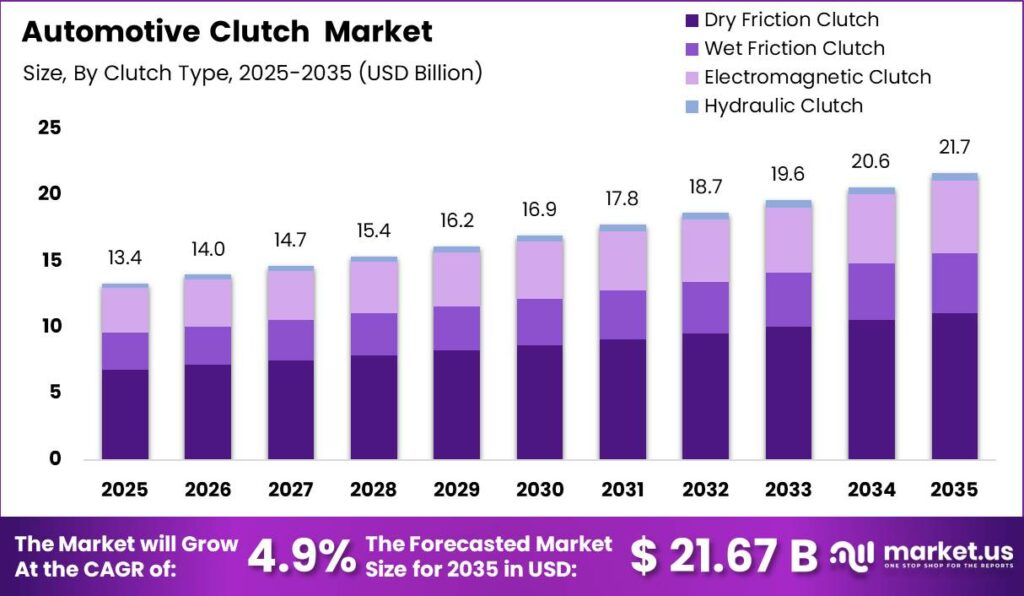
Global Automotive Clutch Market size is expected to be worth around USD 21.67 Billion by 2035 from USD 13.36 Billion in 2025, growing at a CAGR of 4.96% during the forecast period 2026 to 2035. According to the International Organization of Motor Vehicle Manufacturers, global motor vehicle production reached approximately 92.5 million units in 2024, providing a strong production base for OEM clutch demand across passenger cars, commercial vehicles, and hybrid platforms. This output scale confirms that clutch assembly volumes remain structurally tied to ICE and hybrid production rates for at least the next decade.
The automotive clutch market covers friction-based and electronically actuated torque-transfer assemblies used across manual, automated manual, dual-clutch, and hybrid transmission architectures. Products span dry single-disc clutches, wet multi-plate packs, electromagnetic assemblies, and hydraulic clutch systems. The market serves OEM drivetrain programs as well as the global replacement parts channel, with demand structured around vehicle production volumes, transmission mix shifts, and fleet aging cycles across passenger and commercial vehicle segments.
Key Takeaways
- Market size in 2025: USD 13.36 Billion
- Market forecast in 2035: USD 21.67 Billion
- CAGR (2026–2035): 4.96%
- Dominant clutch type: Dry Friction Clutch with 51.20% share
- Dominant transmission type: Manual Transmission (MT) with 48.60% share
- Dominant vehicle type: Passenger Cars with 63.60% share
- Dominant sales channel: OEM with 62.10% share
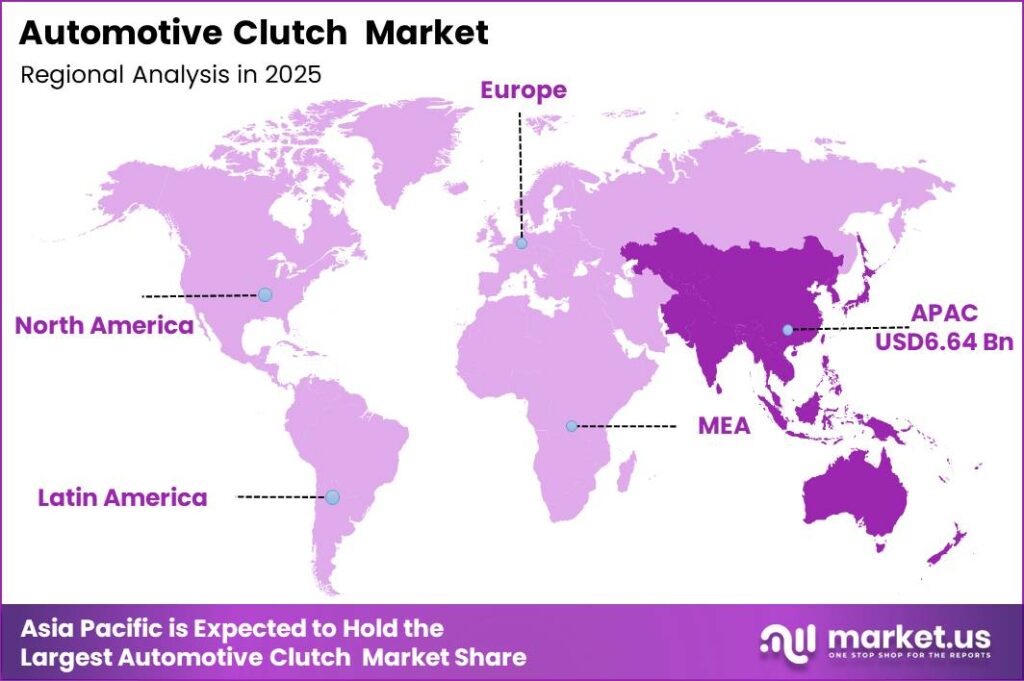
- Dominant region: Asia Pacific with 49.70% share, valued at USD 6.64 Billion
Regulatory policy is reshaping clutch technology requirements across major production markets. India’s BS6 Phase II and TREM IV emission norms are accelerating adoption of advanced clutch systems in commercial vehicles, while Europe’s CO2 fleet average compliance targets are driving OEM investment in hybrid transmission architectures that require disconnect clutch modules. These regulatory pressures are converting clutch systems from commodity components into engineered sub-systems with higher per-unit value and longer OEM qualification cycles.
As reported by the European Automobile Manufacturers’ Association, hybrid-electric vehicles accounted for 30.9% of all new passenger car registrations in the European Union during 2024. This powertrain shift creates sustained demand for wet clutch packs, engine-disconnect modules, and electrically actuated clutch systems across European OEM programs. Suppliers without hybrid clutch engineering capability face a structural revenue gap as platform mix in Europe continues rotating away from conventional dry clutch applications.
According to Reuters, citing official ACEA registration data, electrified vehicles accounted for 67% of all EU vehicle registrations in December 2025, compared with 57.8% in December 2024. This acceleration confirms that hybrid and plug-in hybrid platforms, which retain clutch content per vehicle, are absorbing a growing share of the electrified mix. Clutch suppliers with hybrid-specific product lines are positioned to capture replacement volume that pure-BEV adoption is simultaneously removing from the conventional dry clutch segment.
Clutch Type Analysis
Dry Friction Clutch dominates with 51.20% due to low cost and wide ICE compatibility.
In 2025, Dry Friction Clutch held a dominant market position in the By Clutch Type segment of the Automotive Clutch Market, with a 51.20% share. Dry single-disc clutches remain the default specification for manual and automated manual transmissions across passenger cars, light commercial vehicles, and two-wheelers globally. According to the International Labour Organization’s industrial production tracking, the automotive parts manufacturing sector employs over 8 million workers globally, with dry friction clutch component production concentrated in China, India, Germany, and Japan. ACEA data confirms new EU passenger car registrations grew 4.0% in the first five months of 2026, sustaining OEM demand for dry clutch assemblies. Suppliers maintaining low-cost dry disc production at scale retain volume leadership even as hybrid architectures expand.
Wet Friction Clutch systems serve dual-clutch transmissions and hybrid disconnect applications requiring continuous lubrication and higher thermal load tolerance. The World Bank’s manufacturing value-added data for East Asia confirms that DCT-equipped vehicle output in China exceeded 12 million units annually by 2024, generating sustained demand for wet clutch packs in passenger and light commercial vehicle drivetrains. Wet clutch assemblies carry a 2.5 to 4 times higher per-unit value than comparable dry disc assemblies, making this sub-segment the primary margin-expansion lever for Tier-1 clutch suppliers reorienting away from conventional ICE programs.
Electromagnetic Clutch and Hydraulic Clutch sub-segments serve specialized applications including four-wheel-drive transfer cases, agricultural equipment, and industrial off-highway machinery. The FAO’s agricultural mechanization index for South and Southeast Asia recorded tractor and power equipment sales exceeding 900,000 units annually in India alone by 2024, underpinning demand for electromagnetic and hydraulic clutch assemblies in non-automotive drivetrain applications. These sub-segments collectively hold the remaining share of the clutch type market and represent a structurally stable demand base insulated from passenger vehicle electrification trends.
Transmission Type Analysis
Manual Transmission dominates with 48.60% due to low-cost vehicle dominance in emerging markets.
In 2025, Manual Transmission (MT) held a dominant market position in the By Transmission Type segment of the broader automotive transmission , with a 48.60% share. Manual transmissions remain the default specification across entry-level passenger vehicles, light commercial vehicles, and two-wheelers in India, Southeast Asia, Latin America, and Sub-Saharan Africa. The World Bank’s vehicle fleet data for low- and middle-income countries confirms that over 70% of registered light vehicles in these markets use manual transmissions, creating a structurally large and recurring aftermarket clutch replacement base. Clutch suppliers with MT-focused product lines retain volume resilience in markets where AT penetration remains below 25%.
Automated Manual Transmission (AMT) systems are expanding rapidly in India and China as OEMs seek to deliver automatic driving convenience at near-manual production cost. SIAM data confirms AMT-equipped passenger vehicles in India crossed 500,000 annual units by 2024, with AMT penetration in the entry-level hatchback segment reaching approximately 18%. Each AMT unit requires a precision-actuated dry clutch assembly with electronic control compatibility, raising per-vehicle clutch content value relative to standard MT specifications and opening a higher-margin product tier for suppliers capable of meeting AMT actuation tolerances.
The dual-clutch transmission segment is expanding across premium and mid-range passenger vehicles in China, South Korea, and Europe, with DCT-equipped models requiring two clutch packs per transmission unit. Continuously Variable Transmission (CVT) systems, which use belt-and-pulley mechanisms rather than friction disc clutches, hold the remaining transmission type share and represent the segment with the lowest per-vehicle clutch content requirement among conventional powertrain architectures.
Vehicle Type Analysis
Passenger Cars dominate with 63.60% due to highest global production volume share.
In 2025, Passenger Cars held a dominant market position in the By Vehicle Type segment of the Automotive Clutch Market, with a 63.60% share. Passenger cars account for the largest share of global vehicle production and generate the broadest clutch product demand across dry single-disc, wet dual-disc, and hybrid disconnect specifications. According to ACEA, new passenger car registrations in the European Union increased by 4.0% during the first five months of 2026, confirming continued production and replacement activity supporting transmission component demand. Suppliers covering multiple clutch specifications across passenger car platforms maintain the widest OEM program exposure and the most resilient revenue base during powertrain mix transitions.
Light Commercial Vehicles (LCV) represent a structurally stable clutch demand category driven by last-mile logistics fleet growth across Asia Pacific, the Middle East, and Latin America. UNCTAD’s trade and transport infrastructure reports confirm that e-commerce parcel volumes in emerging Asia grew at over 20% annually between 2021 and 2024, directly accelerating LCV fleet expansion and replacement clutch demand in urban delivery applications. LCV platforms use predominantly manual and AMT transmissions, ensuring consistent dry and electronically actuated clutch content per vehicle.
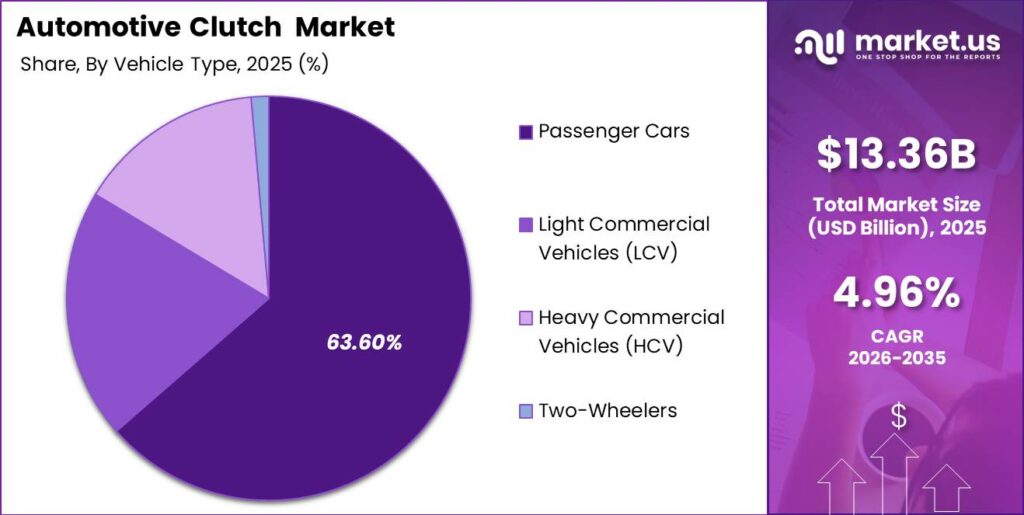
Heavy Commercial Vehicles (HCV) generate the highest per-unit clutch assembly value in the market, with heavy-duty dry clutch and AMT wet clutch systems priced at 3 to 6 times the equivalent passenger car specification. Two-Wheelers hold the remaining vehicle type share and represent a high-volume, low-value clutch demand base concentrated in India, Indonesia, Vietnam, and China, where annual two-wheeler production exceeds 50 million units collectively, sustaining demand for centrifugal and manual two-wheeler clutch assemblies.
Sales Channel Analysis
OEM channel dominates with 62.10% due to long-term platform supply agreements.
In 2025, OEM held a dominant market position in the By Sales Channel segment of the Automotive Clutch Market, with a 62.10% share. OEM supply relationships provide clutch manufacturers with multi-year volume commitments tied to vehicle platform production cycles, delivering revenue visibility that aftermarket channels cannot replicate. The World Bank’s global manufacturing output data confirms automotive components accounted for approximately 8% of total global manufacturing value-added in 2024, with OEM-direct supply chains absorbing the majority of precision drivetrain component output. Suppliers holding OEM nomination letters on high-volume platforms in China, India, and Europe maintain the strongest competitive barriers against new entrant displacement.
The Aftermarket channel holds the remaining 37.90% share and represents a structurally growing revenue base as global vehicle fleet age rises. ACEA data confirms the average passenger vehicle age in Europe reached 12.3 years in 2024, directly expanding replacement clutch demand for friction disc kits, pressure plates, and flywheel assemblies across European independent aftermarket distributors. Aftermarket clutch revenue carries higher gross margins than OEM supply in most markets, making channel diversification toward branded aftermarket a strategic priority for suppliers seeking to offset OEM program revenue pressure from BEV platform transitions.
Key Market Segments
By Clutch Type
- Dry Friction Clutch
- Wet Friction Clutch
- Electromagnetic Clutch
- Hydraulic Clutch
By Transmission Type
- Manual Transmission (MT)
- Automated Manual Transmission (AMT)
- Dual Clutch Transmission (DCT)
- Continuously Variable Transmission (CVT)
By Vehicle Type
- Passenger Cars
- Light Commercial Vehicles (LCV)
- Heavy Commercial Vehicles (HCV)
- Two-Wheelers
By Sales Channel
- OEM
- Aftermarket
Regional Analysis
Asia Pacific Dominates the Automotive Clutch Market with a Market Share of 49.70%, Valued at USD 6.64 Billion
Asia Pacific holds the largest share of the global automotive clutch market at 49.70%, valued at USD 6.64 Billion in 2025. China and India drive this dominance through combined annual vehicle production exceeding 40 million units, with both markets sustaining high manual and AMT transmission penetration across entry-level vehicle segments. India’s registered truck fleet of approximately 9.5 million vehicles generates consistent replacement clutch demand independent of new vehicle production cycles, while China’s DCT platform proliferation supports wet clutch pack demand across mid-range passenger car programs. Suppliers with manufacturing presence in both markets hold a structural cost and logistics advantage over import-reliant competitors.
Europe is the fastest-growing region for hybrid-specific clutch applications, driven by OEM CO2 compliance investment in PHEV and 48V mild-hybrid platforms. As per our research, new commercial vehicle registrations in the EU increased by 10.7% for trucks and 24.5% for buses during the first quarter of 2026, strengthening demand for heavy-duty clutch systems in commercial drivetrain programs. This commercial vehicle volume uplift partially offsets the clutch content loss from passenger car BEV adoption in Europe, making the region a net-positive demand environment for suppliers covering both passenger hybrid and commercial vehicle product lines.
North America, Latin America, and the Middle East and Africa collectively represent the remaining regional share. North America faces near-term headwinds from US auto parts tariffs of 25% and steel tariffs of 50%, which are raising input costs for clutch manufacturers relying on cross-border supply chains involving Mexico and Canada. Latin America, led by Brazil and Mexico, sustains demand through fleet expansion in freight logistics, while the Middle East and Africa represent a high-growth aftermarket opportunity driven by large manual-transmission-equipped commercial vehicle fleets operating in severe-duty conditions.
Key Regions and Countries
North America
- US
- Canada
Europe
- Germany
- France
- The UK
- Spain
- Italy
- Rest of Europe
Asia Pacific
- China
- Japan
- South Korea
- India
- Australia
- Rest of APAC
Latin America
- Brazil
- Mexico
- Rest of Latin America
Middle East and Africa
- GCC
- South Africa
- Rest of MEA
Market Dynamics
Market Opportunity Analysis - Hybrid modules, India aftermarket, and off-highway segments offer high-return entry points for suppliers
The P2 hybrid disconnect clutch module segment remains underexploited because fewer than 10 suppliers globally hold the engineering qualification required to serve PHEV platform programs. Chinese OEM DHT architectures contain 2 to 3 clutch assemblies per transmission, generating per-vehicle content of $180 to $420 per unit. Suppliers currently serving conventional dry clutch programs can target this gap through wet clutch module development partnerships with DHT transmission manufacturers, capturing platform nominations with 2027 to 2029 start-of-production dates before the qualification window closes.
India’s branded OES aftermarket channel is structurally underpenetrated relative to the size of its manual-transmission fleet. India’s truck fleet of approximately 9.5 million vehicles generates replacement demand every 60,000 to 100,000 km per vehicle, yet the majority of replacement clutch sales flow through unbranded distributors. This means, organized channel players capturing even a 10% share shift from unbranded to branded OES supply would add several hundred million dollars in addressable revenue without requiring any increase in fleet size or new vehicle production.
Agricultural and off-highway clutch applications in India, Sub-Saharan Africa, and Southeast Asia represent an underserved segment insulated from passenger car electrification trends. FAO mechanization data confirms tractor sales in India exceeded 900,000 units annually by 2024, each requiring electromagnetic or hydraulic clutch assemblies with no viable electric drivetrain substitute at current technology and cost levels. New entrants targeting this segment face lower OEM qualification barriers than passenger car programs and benefit from recurring replacement demand tied to farm equipment operating cycles rather than consumer vehicle ownership trends.
The electro-hydraulic smart actuator aftermarket for AMT and DCT fleet operators in the EU, the United States, and China is an early-stage but structurally high-margin opportunity. Commercial fleet operators running AMT-equipped trucks face specialized clutch actuation service needs that general workshops cannot address without proprietary diagnostic and calibration tools. Suppliers offering software-enabled clutch system servicing contracts alongside physical replacement parts can build recurring SaaS-adjacent revenue streams that carry gross margins well above the 18 to 25% typical of conventional clutch disc supply.
Technology and Innovation Landscape - Self-adjusting mechanisms, energy-recovery clutch systems, and electronic actuation are redefining clutch performance benchmarks
Self-adjusting clutch technology is becoming the default specification for higher-torque drivetrain programs in Europe and Asia. Valeo’s Self-Adjusting Technology continuously compensates for friction-lining wear throughout the clutch service life, eliminating the need for manual adjustment during vehicle operation. OEMs integrating SAC systems into transmission systems report extended clutch service intervals that reduce total cost of ownership for fleet operators and support premium aftermarket pricing for replacement SAC kits. Suppliers without self-adjusting capability face progressive displacement from higher-torque OEM platform nominations.
A 2026 peer-reviewed study on spring-clutch energy recovery systems demonstrated that clutch-assisted mechanisms reduced Cost of Transport by up to 16.13% compared with conventional viscoelastic systems. The same research confirmed energy-recycling spring-clutch designs achieved more than 50% lower Cost of Transport than a rigid reference drivetrain. Prototype validation on a 1 degree slope achieved a Cost of Transport of approximately 0.02, confirming the efficiency gains are reproducible under real operating gradient conditions. These findings open a development pathway for clutch-integrated energy recovery in light mobility and robotics applications beyond conventional automotive drivetrains.
Electronic clutch control integrated with transmission software is becoming standard across automated manual and hybrid transmission architectures. Electrified dual-clutch transmission platforms are emerging as the preferred architecture for hybrid vehicles, requiring clutch actuation position accuracy within ±0.1 mm and real-time torque management through software-defined control loops. Lightweight friction materials with improved wear resistance and thermal management are replacing conventional clutch facings to support drivetrain efficiency targets. Suppliers investing in electronic calibration capability and advanced friction compound development are positioning for the next generation of AMT and DCT platform nominations where software integration is a supply qualification requirement.
Drivers
Hybrid electric vehicle production is accelerating demand for engine-disconnect clutches and wet multi-plate clutch modules across all major production markets. According to ACEA, plug-in hybrid electric vehicles accounted for 9.7% of all new EU passenger car registrations during January to May 2026, up from 8.3% during the same period in 2025, confirming that PHEV adoption is expanding the addressable market for hybrid-specific clutch assemblies. Each PHEV platform requires dedicated disconnect clutch engineering that conventional dry clutch suppliers cannot serve without product line investment, creating a qualification barrier that protects Tier-1 wet clutch specialists from low-cost competition.
Commercial vehicle production expansion in emerging markets and global vehicle fleet aging are adding parallel demand streams that reinforce the clutch market’s growth trajectory. Heavy-duty commercial vehicles with higher engine torque outputs are adopting self-adjusting and high thermal-capacity clutch systems to extend service intervals under severe-duty conditions, raising per-unit content value in the HCV segment. The average passenger vehicle age in Europe reached 12.3 years in 2024, directly expanding replacement demand for clutch kits and friction components across the European independent aftermarket channel.
| Driver | (~) % Impact on CAGR Forecast | Geographic Relevance | Impact Timeline |
|---|---|---|---|
| Rising Commercial Vehicle Production & Freight Demand in Emerging Markets | +2.0% | India, Southeast Asia, Sub-Saharan Africa, Latin America, Middle East | Short term (≤ 2 years) |
| DCT Adoption Growth Across Passenger & Light Commercial Vehicle Segments in Asia | +1.5% | China, South Korea, India, Southeast Asia | Short term (≤ 2 years) |
| Hybrid Vehicle Proliferation Driving Wet Clutch & Engine-Disconnect Clutch Content | +1.1% | China, Europe, United States, Japan, South Korea | Short term (≤ 2 years) |
| Global Automotive Aftermarket Expansion & Clutch Replacement Cycle Demand | +0.8% | Global, led by India, China, Brazil, Southeast Asia, Middle East & Africa | Short term (≤ 2 years) |
| BS6 Phase II & TREM IV Emission Norms Driving Advanced Clutch Technology Adoption in India | +0.6% | India | Short term (≤ 2 years) |
| Heavy-Duty Automated Manual Transmission (AMT) Rollout in MHCV & Bus Segments | +0.5% | India, China, Europe, Brazil | Medium term (2–4 years) |
Restraints
Battery electric vehicle production is eliminating clutch content on every pure-BEV unit sold, creating an accelerating demand void in the passenger car segment. Most BEVs use single-speed reduction gearboxes that require no friction clutch at any operating point, collapsing per-vehicle clutch revenue to zero on each unit. Data from ACEA shows battery-electric vehicles represented 13.6% of new passenger car registrations in the European Union in 2024, and global EV adoption is continuing to rise through 2025 and 2026. Suppliers with high passenger car ICE OEM program concentration face platform-by-platform contract non-renewal as BEV successor models launch without clutch content.
OEM migration toward automatic, e-CVT, and dedicated hybrid transmissions is compressing the addressable market for conventional manual clutch assemblies in high-income markets. In China, the United States, Japan, and South Korea, automatic transmission penetration in new passenger cars already exceeds 75% in most segments, structurally shrinking the MT clutch install base with each model cycle. This transmission mix shift, combined with US auto parts tariffs of 25% and steel tariffs of 50% raising input costs for North American supply chains, creates a dual margin and volume pressure on conventional clutch manufacturers without hybrid or commercial vehicle product diversification.
| Restraint | (~) % Impact on CAGR Forecast | Geographic Relevance | Impact Timeline |
|---|---|---|---|
| Battery Electric Vehicle Adoption Eliminating Clutch Content Per Vehicle in Pure-EV Platforms | -2.2% | China, Europe, United States, South Korea, Norway — primary BEV-dense markets | Medium term (2–4 years) |
| U.S. 25% Auto Parts Tariff & 50% Steel Tariff Raising Clutch Component Input & Import Costs | -1.5% | United States; cascading to Mexico, South Korea, Japan, Germany supply chains | Short term (≤ 2 years) |
| AT & CVT Transmission Share Gain in Passenger Vehicles Reducing Manual Clutch Unit Demand | -0.9% | China, United States, Japan, South Korea — high AT penetration markets | Short term (≤ 2 years) |
| Passenger Vehicle Production Slowdown in Europe & North America Limiting OEM Clutch Volume | -0.7% | Europe, United States | Short term (≤ 2 years) |
| China Domestic OEM Vertical Integration Reducing Export-Sourced Clutch Procurement | -0.5% | China; impacting global Tier-1 clutch suppliers seeking China OEM partnerships | Medium term (2–4 years) |
Challenges
Friction material input cost volatility is compressing margins across the clutch disc manufacturing tier. Para-aramid fiber, phenolic resin, and mineral wool collectively represent 35 to 50% of clutch disc bill-of-materials cost and have demonstrated price swings of 15 to 40% intra-year across multiple commodity cycles between 2022 and 2025. Para-aramid fiber supply is concentrated among fewer than 5 global producers, preventing substitution without 12 to 18 months of tribological revalidation. This pricing power in the supply chain transfers directly to clutch disc manufacturers as unbuffered P&L exposure when OEM contracts lock piece pricing for 12 to 24 months at annual escalation provisions of only 2 to 4%.
Counterfeit clutch proliferation in India, Southeast Asia, and Sub-Saharan Africa is eroding branded aftermarket revenue and compressing price realization for legitimate suppliers. Thermal management in high-torque AMT and DCT wet clutch applications presents a parallel engineering challenge, as clutch pack operating temperatures in heavy-duty AMT cycles can exceed validated material limits during extended gradient-start sequences. Clutch actuation electrification and NVH performance gaps in low-cost DCT packs add further complexity for suppliers serving cost-sensitive volume markets where investment in electronic calibration and noise damping is constrained by end-market price ceilings.
| Challenge | (~) % CAGR Friction Drag | Geographic Relevance | Mitigation Horizon |
|---|---|---|---|
| Friction Material Raw Material Volatility | -1.6% | Global — affecting all clutch disc and pressure plate manufacturers | Medium term (2–4 years) |
| Counterfeit Clutch Aftermarket Proliferation | -1.2% | India, Southeast Asia, Sub-Saharan Africa, Latin America, MENA | Long term (≥ 4 years) |
| Thermal Management in High-Torque AMT & DCT Applications | -0.9% | Global — constraining wet clutch performance in heavy-duty AMT and DCT systems | Medium term (2–4 years) |
| Clutch Actuation Electrification & Software Calibration Complexity | -0.7% | Global, particularly in electronically-controlled AMT and DCT platforms | Medium term (2–4 years) |
| NVH Performance Gap in Low-Cost DCT & AMT Clutch Packs | -0.5% | India, China, Southeast Asia — high-volume cost-sensitive DCT markets | Medium term (2–4 years) |
Opportunities
P2 and P2.5 hybrid disconnect clutch modules represent the highest-value growth opportunity in the automotive clutch market. Chinese OEMs have adopted Dedicated Hybrid Transmission architectures containing 2 to 3 clutch assemblies per unit, generating per-platform clutch content of $180 to $420 versus $40 to $120 for a conventional ICE passenger car clutch. Fewer than 10 qualified suppliers globally hold the wet clutch actuation and thermal management capability required for P2 disconnect module supply, creating a structurally protected addressable market for vertically integrated Tier-1 suppliers as PHEV platform proliferation accelerates across the automotive drivetrain sector through 2029.
India’s formalized clutch aftermarket represents a near-term channel capture opportunity for branded OES suppliers. The country’s registered truck fleet of approximately 9.5 million vehicles operates predominantly on manual transmissions with replacement cycles of 60,000 to 100,000 km, generating consistent and recurring friction disc and pressure plate demand. Intelligent clutch health monitoring integrated with fleet telematics is emerging as a predictive maintenance solution for commercial fleets, creating a data-enabled service revenue layer that aftermarket distributors and OES channel partners can monetize alongside physical replacement parts.
| Opportunity | (~) % Potential CAGR Upside | Geographic Relevance | Execution Window |
|---|---|---|---|
| P2 & P2.5 Hybrid Disconnect Clutch Module Supply for PHEV & 48V Mild-Hybrid Platforms | +2.0% | China, Europe, United States, Japan, South Korea | Medium term (2–4 years) |
| Electro-Hydraulic & Smart Actuator Clutch System Servicing & Aftermarket SaaS | +1.3% | EU, United States, China — AMT & DCT fleet-heavy markets | Medium term (2–4 years) |
| India Formalized Clutch Aftermarket — Branded OES Channel Capture | +1.0% | India | Short term (≤ 2 years) |
| Agricultural & Off-Highway Clutch Expansion in Mechanizing Emerging Markets | +0.7% | India, Sub-Saharan Africa, Southeast Asia, Latin America | Medium term (2–4 years) |
| M&A Consolidation of Regional Clutch Aftermarket Distributors | +0.5% | India, Southeast Asia, Middle East & Africa | Long term (≥ 4 years) |
Key Company Insights
Exedy Corporation holds a structural volume advantage through its integrated manufacturing footprint across Japan, China, India, and the Americas, covering dry and wet clutch assemblies for both OEM and aftermarket channels. This dual-channel presence insulates Exedy from OEM program concentration risk as passenger car ICE platform volumes decline in BEV-heavy markets. However, Exedy’s exposure to two-wheeler and entry-level MT clutch segments in Asia creates margin pressure as low-cost regional manufacturers compete on price in replacement channels.
Valeo SA strengthened its aftermarket positioning when it received the EQUIP AUTO Paris 2025 International Automotive Innovation Award for its remanufactured DQ250 dual wet clutch, a circular-economy solution designed for over 5 million compatible vehicles across Europe. Valeo’s Self-Adjusting Technology continuously compensates for friction-lining wear throughout the clutch service life, reducing manual adjustment requirements and extending replacement intervals. This technology advantage supports premium aftermarket pricing and OES channel loyalty in the European replacement market, where vehicle age exceeds 12 years on average.
Key Players
- Exedy Corporation
- ZF Friedrichshafen AG
- Valeo SA
- BorgWarner Inc.
- Schaeffler AG
- Eaton Corporation plc
- Aisin Corporation
- Clutch Industries
- Miba AG
- F.C.C. Co., Ltd.
- Raicam Industria S.r.l.
- NSK Ltd.
Recent Developments
- May 2025: BorgWarner secured two new dual-clutch transmission programs in China, including a clutch assembly contract extension with a German OEM and a new DCT module award for a Chinese SUV and sedan manufacturer, with production confirmed at its Tianjin and Taicang facilities.
- October 2024: Schaeffler completed its merger with Vitesco Technologies, expanding its portfolio across powertrain, transmission, sensors, electronic control systems, and e-mobility technologies to strengthen its position as a global motion technology company.
Report Scope
| Report Features | Description |
|---|---|
| Market Value (2025) | USD 13.36 Billion |
| Forecast Revenue (2035) | USD 21.67 Billion |
| CAGR (2026-2035) | 4.96% |
| Base Year for Estimation | 2025 |
| Historic Period | 2020-2024 |
| Forecast Period | 2026-2035 |
| Report Coverage | Revenue Forecast, Market Dynamics, Market Opportunity Analysis, Technology and Innovation Landscape, Competitive Landscape, Recent Developments |
| Segments Covered | By Clutch Type (Dry Friction Clutch, Wet Friction Clutch, Electromagnetic Clutch, Hydraulic Clutch), By Transmission Type (Manual Transmission, Automated Manual Transmission, Dual Clutch Transmission, Continuously Variable Transmission), By Vehicle Type (Passenger Cars, Light Commercial Vehicles, Heavy Commercial Vehicles, Two-Wheelers), By Sales Channel (OEM, Aftermarket) |
| Regional Analysis | North America (US and Canada), Europe (Germany, France, The UK, Spain, Italy, and Rest of Europe), Asia Pacific (China, Japan, South Korea, India, Australia, and Rest of APAC), Latin America (Brazil, Mexico, and Rest of Latin America), Middle East and Africa (GCC, South Africa, and Rest of MEA) |
| Competitive Landscape | Exedy Corporation, ZF Friedrichshafen AG, Valeo SA, BorgWarner Inc., Schaeffler AG, Eaton Corporation plc, Aisin Corporation, Clutch Industries, Miba AG, F.C.C. Co. Ltd., Raicam Industria S.r.l., NSK Ltd. |
| Customization Scope | Customization for segments, region / country-level will be provided. Additional customization can be done based on requirements. |
| Purchase Options | We have three licenses to opt for: Single User License | Multi-User License (Up to 5 Users) | Corporate Use License (Unlimited User and Printable PDF) |





































