


Report Overview
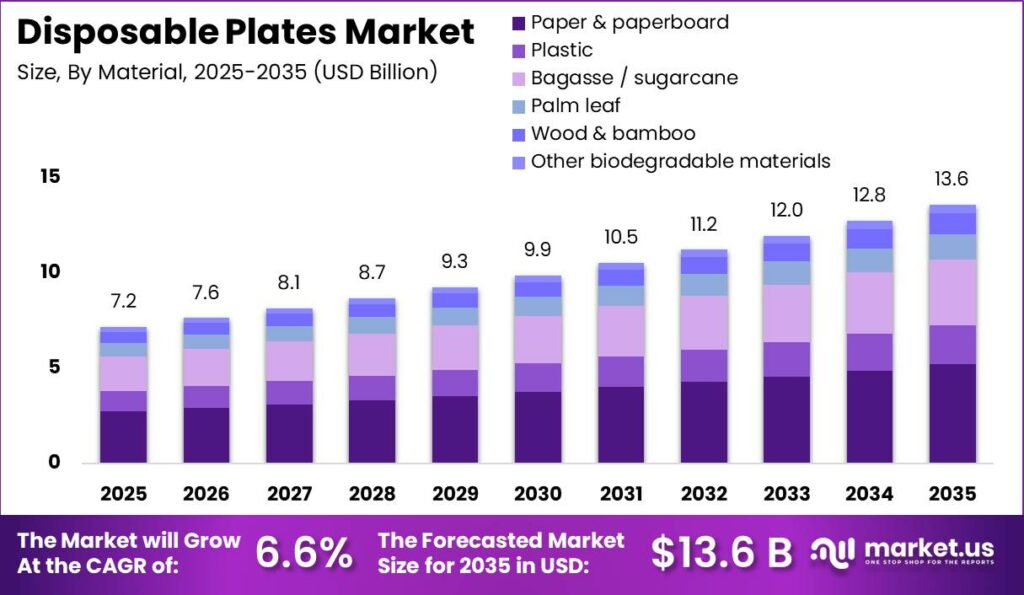
Global Disposable Plates Market size is expected to be worth around USD 13.6 Billion by 2035 from USD 7.2 Billion in 2025, growing at a CAGR of 6.6% during the forecast period 2026 to 2035. This market supplies single-use serving vessels across foodservice, retail, and institutional channels worldwide. Steady volume demand anchors long-term revenue visibility for converters and material suppliers.
The market covers plates made from paper, plastic, bagasse, palm leaf, wood, and other biodegradable fibers. Buyers split across commercial, residential, and institutional users who purchase through B2B distributors, retail, and e-commerce. This structure creates distinct pricing tiers, so material choice and channel access shape competitive position and margin.
Key Takeaways
- Global market reaches USD 13.6 Billion by 2035 from USD 7.2 Billion in 2025 at a CAGR of 6.6%.
- Paper and paperboard lead the material segment with a 38.3% share.
- Non-compartment flat plates dominate product type with a 56.3% share.
- Commercial end-users hold a 52.4% share of demand.
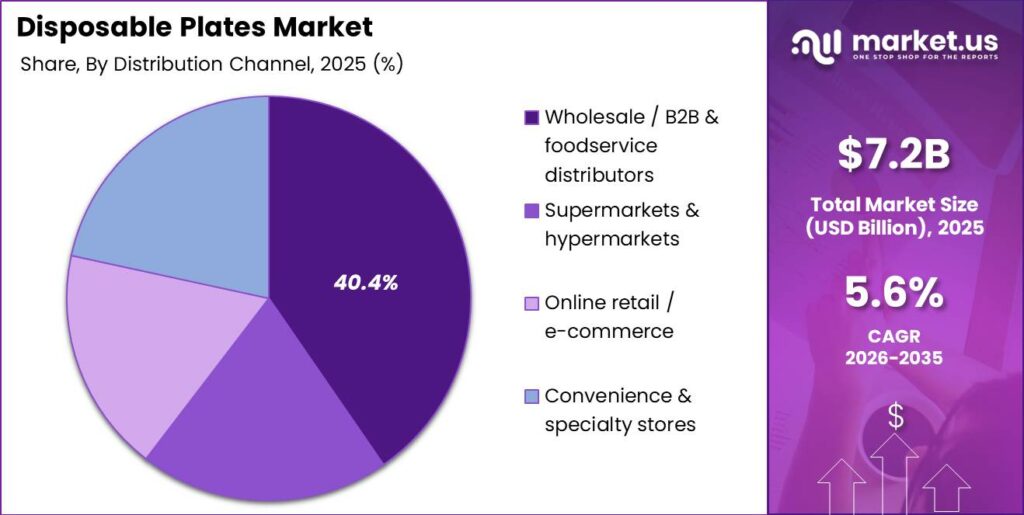
- Wholesale and B2B foodservice distributors control 40.4% of distribution.
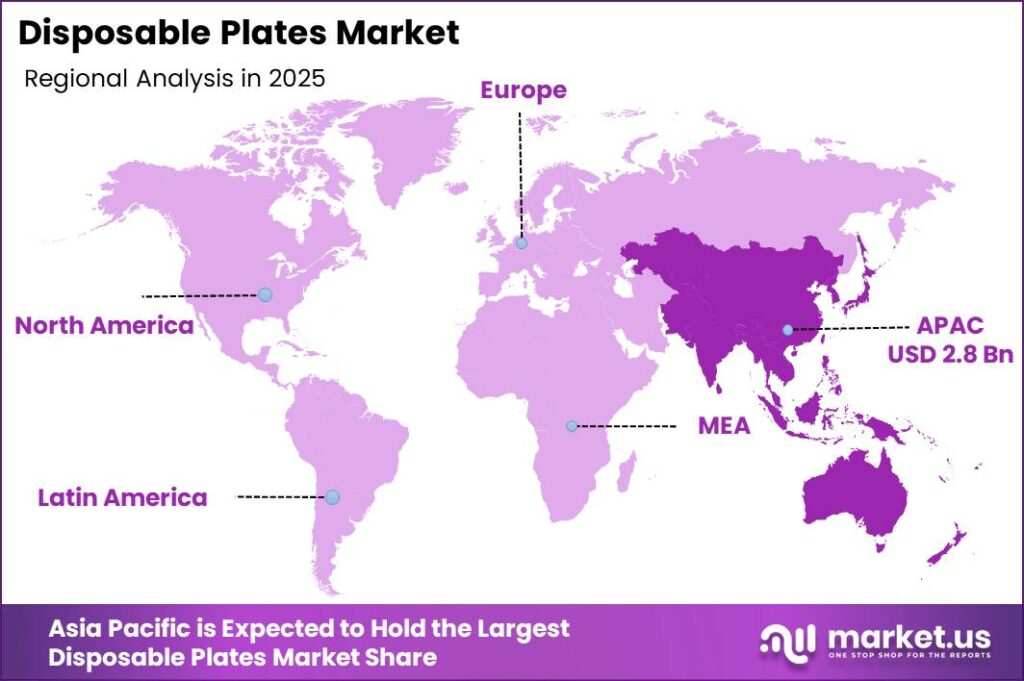
- Asia Pacific leads all regions with a 38.9% share, valued at USD 2.8 Billion.
Government regulation now reshapes procurement across major markets. As reported by UK Government (DEFRA),Biodegradable Tableware rules from 2024 prohibit single-use plastic plates, bowls, and trays, including biodegradable plastic variants. This forces foodservice buyers toward fiber alternatives. Converters with fiber capacity therefore gain first access to compliance-driven contracts before slower rivals adapt.
Material performance data now supports buyer confidence in fiber plates. A 2025 study in RSC found that cellulose-based disposable tableware achieves about 89.4% material weight loss within 120 days under aerobic soil conditions. This proves strong real-world biodegradation. Consequently, manufacturers can market verified end-of-life claims and win ESG-focused institutional accounts that reject unproven products.
Material Analysis
Paper and paperboard dominates with 38.3% due to low cost and recyclability.
In 2025, Paper and paperboard held a dominant market position in the By Material segment of Disposable Plates Market, with a 38.3% share. As per our research, FAO data on global paper and paperboard output exceeding 420 million tonnes yearly gives converters stable, low-cost feedstock. This scale keeps unit prices competitive. Manufacturers using paperboard can therefore protect margins while meeting plastic-ban compliance across regulated markets.
Plastic plates still serve price-sensitive buyers where bans have not taken effect. As reported by ITC Trade Map, global trade in plastic tableware and kitchenware under HS 3924 exceeds USD 15 Billion annually. This reflects deep entrenchment in developing markets. However, converters relying on plastic face shrinking demand as more countries adopt restrictions, creating clear reinvestment pressure.
Bagasse and sugarcane plates draw demand from delivery and QSR channels seeking compostable options. Data from FAO shows global sugarcane production above 1.9 billion tonnes yearly, supplying abundant bagasse residue. This creates a low-cost fiber base. As a result, Asian converters can scale bagasse output faster than rivals dependent on virgin pulp imports. In June 2025, Naturale introduced a bio-based range including sugarcane bagasse plates and containers.
Palm leaf, wood and bamboo, and other biodegradable materials serve premium and niche event catering. UN Comtrade data records rising exports of vegetable-based tableware from India and Southeast Asia under HS 4602. This signals growing supply capacity for natural-fiber plates. These three sub-segments collectively hold the remaining share, giving specialist converters defensible high-margin positions in wedding and event markets.
Product Type Analysis
Non-compartment flat plates dominate with 56.3% due to universal meal-serving versatility.
In 2025, Non-compartment flat plates held a dominant market position in the By Product Type segment of Disposable Plates Market, with a 56.3% share. As per our research, national statistical offices report flat plates as over 60% of foodservice disposable plate shipments by unit count. This reflects broad menu compatibility. Converters gain volume efficiency by standardizing tooling around flat formats, lowering per-unit production cost.
Compartment and sectional plates serve buffet, canteen, and institutional catering where portion separation matters. World Bank foodservice indicators link institutional catering growth to demand for multi-section trays in schools and hospitals. This creates steady bulk contracts. Manufacturers offering compartment molds can lock in recurring institutional supply that resists price-only competition.
Bowls and deep plates support soups, curries, and liquid-heavy meals common in delivery. UN Comtrade shipment data shows deep-format fiber tableware rising in Asian export flows. This tracks food delivery expansion. Converters adding deep-mold capacity capture the fastest-growing meal category, so early tooling investment secures channel share before competitors respond.
End-user Analysis
Commercial dominates with 52.4% due to high-volume foodservice procurement cycles.
In 2025, Commercial held a dominant market position in the By End-user segment of Disposable Plates Market, with a 52.4% share. As per our research, UNIDO data ties foodservice output growth to rising disposable tableware use across restaurants and QSR chains. This drives repeat bulk orders. Suppliers securing commercial contracts gain predictable volume that supports capacity planning and financing.
Residential and household buyers purchase smaller packs for home events and convenience. World Bank consumption data shows urban household spending on convenience goods rising across emerging economies. This lifts retail-pack demand. Manufacturers targeting retail SKUs benefit from higher per-unit margins than bulk B2B, offsetting lower volume.
Institutional buyers such as hospitals, schools, and airlines procure under compliance and hygiene mandates. As reported by World Bank, public institutional catering represents a large, contract-driven demand base worldwide. This favors certified suppliers. Converters holding compostability certifications therefore win multi-year institutional tenders that exclude non-compliant competitors.
Distribution Channel Analysis
Wholesale and B2B distributors dominate with 40.4% due to bulk foodservice supply contracts.
In 2025, Wholesale and B2B foodservice distributors held a dominant market position in the By Distribution Channel segment of Disposable Plates Market, with a 40.4% share. As per our research, UNIDO data links foodservice distribution networks to over half of packaged tableware flow. This concentrates volume in few large buyers. Converters winning distributor listings gain scale access that direct sales cannot match.
Supermarkets and hypermarkets serve household buyers seeking branded retail packs. World Bank retail data shows modern grocery formats expanding across Asia and Latin America. This widens shelf access for disposable plates. Brands securing retail placement capture higher-margin consumer sales and build recognition that supports premium pricing.
Online retail and e-commerce grow fastest among smaller buyers and event planners. ITU digital economy data shows e-commerce penetration rising sharply in emerging markets. This opens direct-to-buyer channels. Meanwhile, convenience and specialty stores hold the remaining share, serving impulse and last-minute purchases. Sellers combining online reach with specialty presence capture fragmented but resilient demand.
Key Market Segments
By Material
- Paper & paperboard
- Plastic
- Bagasse / sugarcane
- Palm leaf
- Wood & bamboo
- Other biodegradable materials
By Product Type
- Non-compartment / flat plates
- Compartment / sectional plates
- Bowls & deep plates
By End-user
- Commercial
- Residential / household
- Institutional
By Distribution Channel
- Wholesale / B2B & foodservice distributors
- Supermarkets & hypermarkets
- Online retail / e-commerce
- Convenience & specialty stores
Regional Analysis
Asia Pacific Dominates the Disposable Plates Market with a Market Share of 38.9%, Valued at USD 2.8 Billion
Asia Pacific leads the market with a 38.9% share, valued at USD 2.8 Billion in 2025. Rapid urbanization and food delivery growth drive high-volume adoption of paper, bagasse, and molded fiber plates across street food and QSR ecosystems. This creates dense, recurring demand. Converters based in the region gain feedstock proximity and cost advantages that support export expansion. In October 2025, KDP Impex launched a paper-based disposable plate line targeting catering and event demand in India and export markets.
Europe ranks as a fast-growing region driven by regulation. The EU Single-Use Plastics Directive accelerates fiber-based plate substitution across foodservice procurement. Paper-based tableware accounts for over 51% of European consumption mix. This mandatory shift rewards compliant converters. Suppliers with certified fiber capacity therefore capture displaced plastic volume across regulated institutional catering.
North America, Latin America, and the Middle East and Africa hold the remaining regional share. Foodservice establishments across Europe exceed 1.2 million outlets, deepening structured commercial demand nearby. This signals broad global runway. Manufacturers entering underpenetrated regions early can establish local supply before competition intensifies.
Key Regions and Countries
North America
- US
- Canada
Europe
- Germany
- France
- The UK
- Spain
- Italy
- Rest of Europe
Asia Pacific
- China
- Japan
- South Korea
- India
- Australia
- Rest of APAC
Latin America
- Brazil
- Mexico
- Rest of Latin America
Middle East and Africa
- GCC
- South Africa
- Rest of MEA
Market Dynamics
Market Opportunity Analysis - Underserved regions and premium certified segments offer entry points for new players
The institutional end-user segment remains underexploited despite its 52.4% commercial dominance nearby. Institutional buyers such as hospitals and airlines demand certified compostable supply that few converters can deliver at scale. This gap favors certified entrants. New players securing compostability credentials can win multi-year tenders that legacy plastic-era suppliers cannot access.
Palm leaf and other biodegradable materials hold the smallest material share, yet they command premium event pricing. This leaves specialist supply thin against rising demand. By contrast, mainstream paperboard is crowded. New entrants targeting natural-fiber premium formats can defend high margins where large converters avoid low-volume, high-mix production.
Online retail and e-commerce remain the least-penetrated distribution channel against wholesale’s 40.4% lead. This creates direct-to-buyer access for smaller brands lacking distributor listings. Therefore, digital-first sellers can reach event planners and households without heavy channel investment, building brand equity ahead of slower incumbents.
Latin America and the Middle East and Africa sit outside Asia Pacific’s 38.9% regional lead, leaving open runway. Local converting capacity remains thin against rising foodservice demand. As a result, early entrants building regional bagasse or leaf plate manufacturing can capture import-substitution share before global players commit local capacity.
Technology and Innovation Landscape - Coating breakthroughs and material science redefine compostable plate performance
Coating innovation now closes the grease-resistance gap in fiber plates. In October 2025, FLO Group introduced its Alpha paper tableware line using a silica-based coating developed with Qwarzo, replacing polyethylene plastic linings. This removes plastic while keeping performance. Converters adopting non-plastic barriers can meet bans without sacrificing food-contact durability, protecting delivery-channel contracts.
PLA coating science shapes end-of-life claims. A 2025 study from Uniroma1 recorded PLA-based products reaching 80.5% to 88.9% biodegradation over a 155-day test under mesophilic anaerobic conditions at 38°C. The same study found breakdown depends heavily on temperature and microbial activity. This means buyers must match PLA products to available composting infrastructure, guiding smarter procurement.
Standardized testing now validates cellulose plate durability claims. A 2025 MDPI study measured biodegradation over a 182-day incubation using ASTM D5988 soil respirometry at 27°C. This creates credible, repeatable benchmarks. Manufacturers citing standardized results gain buyer trust in ESG tenders where unverified claims face rejection.
Polymer composition drives performance variation across similar products. A 2025 ScienceDirect study found cellulose-PLA coated food trays show significant biodegradability differences even when chemically similar. This exposes formulation risk. Consequently, converters investing in precise material control can differentiate on verified consistency, a growing edge in certification-driven institutional buying.
Drivers
Food delivery platforms now anchor demand for disposable plates. By 2024 to 2025, app-based delivery became a permanent consumption channel, not a pandemic substitute. Global delivery platform gross merchandise value reached an estimated USD 400 to 450 billion annually by 2024. Each order generates demand for 1 to 4 plate or container units, so converters gain recurring, high-volume B2B supply contracts.
Emerging-market foodservice growth deepens this pull. China’s Meituan and Ele.me alone process roughly 80 to 90 million orders daily at peak, driving Chinese consumption near 35 to 45 billion units yearly. Dark kitchens buy in lots of 500,000 to 5,000,000 units. This lets bagasse and pulp converters reach gross margins of 38 to 52% on delivery-channel supply.
| Driver | (~) % Impact on CAGR Forecast | Geographic Relevance | Impact Timeline |
|---|---|---|---|
| Food Delivery & Online Ordering Platform Expansion Driving Takeaway Packaging Volume Growth | +2.20% | Global — led by China, United States, India, Southeast Asia, Europe, Latin America | Short term (≤ 2 years) |
| Quick Service Restaurant & Street Food Sector Growth in Emerging Markets Increasing Plate Consumption | +1.40% | India, China, Southeast Asia, Sub-Saharan Africa, Latin America, Middle East | Short term (≤ 2 years) |
| Catering, Events & Large-Scale Social Gathering Recovery Post-Pandemic Driving Bulk Institutional Demand | +0.95% | United States, Europe, GCC, India, Southeast Asia, Australia | Short term (≤ 2 years) |
| Rising Convenience Culture & Time-Constrained Meal Occasions Among Urban Working Populations | +0.72% | China, India, United States, Europe, Brazil, Southeast Asia | Medium term (2–4 years) |
| Expanding Modern Retail & Organised Grocery Trade Increasing Consumer Disposable Plate Accessibility | +0.48% | India, Southeast Asia, Sub-Saharan Africa, Latin America, Eastern Europe | Medium term (2–4 years) |
Restraints
Plastic plate bans force costly substitution across major markets. The EU Single-Use Plastics Directive took effect on 3 July 2021, banning plastic plates that once made up 55 to 65% of global volume at just USD 0.003 to 0.006 per unit. India, the UK, Canada, and Thailand added equivalent rules. Enforcement now covers markets holding roughly 35 to 42% of global consumption by value.
Compliant fiber substitutes cost far more to make. Bagasse and pulp plates carry ex-factory prices of USD 0.012 to 0.035 each, a 2 to 5x premium over banned plastic. At procurement scale, buyers face annual cost increases of USD 15,000 to 500,000. This squeezes foodservice margins by 0.3 to 1.2 percentage points, slowing adoption among price-sensitive operators.
| Restraint | (~) % Impact on CAGR Forecast | Geographic Relevance | Impact Timeline |
|---|---|---|---|
| Polystyrene & Single-Use Plastic Plate Bans Under EU SUP Directive & National Equivalents | -1.60% | European Union, United Kingdom, India, Canada, Australia, New Zealand, Thailand | Short term (≤ 2 years) |
| Raw Material Cost Inflation in Paper, Sugarcane Bagasse & Moulded Pulp Substrates | -0.80% | Global — most acute for European & North American converters | Short term (≤ 2 years) |
| Consumer Backlash & ESG-Driven Reusable Dishware Preference Among Environmentally Conscious Segments | -0.55% | Europe, North America, Australia, Japan, South Korea, urban China | Short term (≤ 2 years) |
| Reusable Plate & Washing Station Models in Festival & Institutional Catering Replacing Disposable Volume | -0.38% | Germany, France, Netherlands, Scandinavian countries, Australia | Medium term (2–4 years) |
Challenges
Bagasse feedstock supply cannot yet match converting demand. Sugarcane bagasse is a seasonal by-product with milling seasons of 5 to 7 months, forcing converters to hold 6 to 9 months of inventory. That inventory costs USD 800,000 to 3,500,000 per mid-scale plant at bagasse prices of USD 40 to 85 per tonne. This ties up working capital that plastic producers never needed.
Rising competition for residue widens the gap. Bagasse spot prices climbed 22 to 35% from 2021 to 2024 as plate converters, board makers, and biomass users competed for supply. This compressed converting margins from 42 to 52% down to 32 to 44%. Diversifying into wheat straw or bamboo needs new tooling at USD 25,000 to 120,000 per shape, creating a real revenue barrier for smaller players.
| Challenge | (~) % CAGR Friction Drag | Geographic Relevance | Mitigation Horizon |
|---|---|---|---|
| Sugarcane Bagasse & Moulded Pulp Feedstock Supply Volatility | -0.90% | Global — most acute for Chinese, Indian & Southeast Asian converters | Medium term (2–4 years) |
| Compostability Certification & Industrial Infrastructure Gap | -0.72% | Global — infrastructure gap most acute in Asia Pacific, Africa, Latin America | Long term (≥ 4 years) |
| Chinese OEM Export Price Pressure Eroding Branded Converter Margins | -0.55% | Global — most acute in United States, Europe, Australia, Southeast Asia import markets | Long term (≥ 4 years) |
| Moisture & Grease Resistance Performance Gap in Paper-Based Substitutes | -0.42% | Global — affects all markets transitioning from plastic to paper-based formats | Long term (≥ 4 years) |
| Informal Sector & Non-Compliant Product Circulation Undermining Regulation Enforcement | -0.28% | India, Southeast Asia, Sub-Saharan Africa, Latin America | Long term (≥ 4 years) |
Opportunities
Home-compostable certified plates open clear white space. Through 2025 to 2026, the plastic transition relied on industrially compostable bagasse and paperboard meeting EN 13432 but lacking home-compostable certification. This leaves an institutional gap where buyers require OK Compost Home certification for waste diversion. EU Green Public Procurement criteria now cover an estimated 15 to 20% of European institutional volume by value.
The margin reward justifies the investment. Home-compostable formulations cost 25 to 40% more to make but command tender pricing premiums of 40 to 65%, expanding gross margins by 10 to 18 percentage points. Certification and R&D run EUR 1,500,000 to 5,000,000 per format over 18 to 30 months. This creates a defensible barrier that rewards early movers with multi-year sole-source positions.
| Opportunity | (~) % Potential CAGR Upside | Geographic Relevance | Execution Window |
|---|---|---|---|
| Premium Compostable & Home-Compostable Certified Plate Category Development for ESG Procurement Mandates | +1.50% | European Union, United States, United Kingdom, Germany, Australia, Canada | Medium term (2–4 years) |
| Edible & Seed-Embedded Plate Innovation Capturing Novelty & Zero-Waste Event Premium Segment | +0.90% | Europe, North America, Japan, South Korea, GCC, Australia | Long term (≥ 4 years) |
| Printed & Branded Custom Plate Supply for Corporate, QSR & Catering Identity Marketing | +0.72% | United States, Europe, GCC, China, India, Southeast Asia | Short term (≤ 2 years) |
| Sub-Saharan Africa & South Asia Local Bagasse & Leaf Plate Manufacturing for Import Substitution | +0.55% | Nigeria, Kenya, Ethiopia, India, Bangladesh, Pakistan, Tanzania | Medium term (2–4 years) |
| Airline, Railway & Institutional Tray & Compartment Plate Premium Supply Contracts | +0.38% | Global — concentrated in Asia Pacific, Middle East, Europe airline & rail catering | Medium term (2–4 years) |
Key Company Insights
Huhtamaki Oyj holds a structural advantage through its global fiber and paperboard manufacturing footprint across multiple regions. This scale lets it serve large foodservice accounts with consistent compliant supply. A 2025 RSC study found cellulose materials reach about 80% marine biodegradation within 30 days, strengthening its fiber-first pitch. However, heavy fixed-asset exposure creates risk if regional demand shifts faster than capacity can adjust.
Dart Container Corporation built its position on high-volume foodservice supply and deep US distribution reach. This scale limits smaller entrants competing on delivery speed and price. Cellulose materials achieving about 95% weight loss within 45 to 49 days under anaerobic conditions raise buyer expectations for compostable claims. In November 2025, Dtocs launched a bamboo fiber tableware series, signaling rising challenger pressure on legacy converters.
Key Players
- Huhtamaki Oyj
- Dart Container Corporation
- Georgia-Pacific LLC
- Pactiv Evergreen Inc.
- Genpak LLC
- D&W Fine Pack LLC
- Solia AB
- Vegware Ltd.
- Eco-Products Inc.
- Biopak Pty Ltd.
- Duni Group
- Stora Enso Oyj
- Hotpack Group
- Sabert Corporation
- Detmold Group
- Others
Recent Developments
- February 2025: Better Earth launched its Farmer’s Fiber Retail Collection, a line of US-made molded fiber plates and bowls using regenerative agricultural fibers and BPI-certified compostable materials.
- May 2025: Sanitary Care Products Asia launched its Naturale Takeaway Essentials range, introducing sugarcane bagasse plates, clamshell boxes, and bio-based tableware for food delivery and everyday use.
- March 2026: Sunnap, a Toyo Seikan Group subsidiary, launched Wind-Resistant Paper Plates designed for outdoor use with improved structural stability and coating resistance against wind displacement.
Geopolitical Impact Analysis
Trade tensions now reshape disposable plate supply chains that depend on Asian converting hubs. According to WTO, global merchandise trade growth slowed to around 2.7% in recent years as tariff barriers rose. US tariffs on Chinese paper and packaging goods reached up to 25% under existing measures. This raises landed costs for importers, pushing North American buyers toward domestic or nearshore fiber converters to protect margins.
Shipping disruption compounds the pressure on fiber plate logistics. As reported by IMF, Red Sea rerouting added roughly 10 to 14 days to Asia-Europe transit and lifted container rates sharply in 2024. Sugarcane and bagasse shipments face similar delays. This means European converters holding larger local inventory buffers gain reliability advantages over rivals dependent on long, exposed ocean routes.
Report Scope
| Report Features | Description |
|---|---|
| Market Value (2025) | USD 7.2 Billion |
| Forecast Revenue (2035) | USD 13.6 Billion |
| CAGR (2026-2035) | 6.6% |
| Base Year for Estimation | 2025 |
| Historic Period | 2020-2024 |
| Forecast Period | 2026-2035 |
| Report Coverage | Revenue Forecast, Market Dynamics, Market Opportunity Analysis, Technology and Innovation Landscape, Competitive Landscape, Recent Developments |
| Segments Covered | By Material (Paper & paperboard, Plastic, Bagasse / sugarcane, Palm leaf, Wood & bamboo, Other biodegradable materials), By Product Type (Non-compartment / flat plates, Compartment / sectional plates, Bowls & deep plates), By End-user (Commercial, Residential / household, Institutional), By Distribution Channel (Wholesale / B2B & foodservice distributors, Supermarkets & hypermarkets, Online retail / e-commerce, Convenience & specialty stores) |
| Regional Analysis | North America (US and Canada), Europe (Germany, France, The UK, Spain, Italy, and Rest of Europe), Asia Pacific (China, Japan, South Korea, India, Australia, and Rest of APAC), Latin America (Brazil, Mexico, and Rest of Latin America), Middle East and Africa (GCC, South Africa, and Rest of MEA) |
| Competitive Landscape | Huhtamaki Oyj, Dart Container Corporation, Georgia-Pacific LLC, Pactiv Evergreen Inc., Genpak LLC, D&W Fine Pack LLC, Solia AB, Vegware Ltd., Eco-Products Inc., Biopak Pty Ltd., Duni Group, Stora Enso Oyj, Hotpack Group, Sabert Corporation, Detmold Group |
| Customization Scope | Customization for segments, region / country-level will be provided. Additional customization can be done based on requirements. |
| Purchase Options | We have three licenses to opt for: Single User License | Multi-User License (Up to 5 Users) | Corporate Use License (Unlimited User and Printable PDF) |





































