


Report Overview
Global Dual-Clutch Transmission Market size is expected to be worth around USD 45.6 Billion by 2035 from USD 24.7 Billion in 2025, growing at a CAGR of 6.3% during the forecast period 2026 to 2035. This growth reflects sustained fitment of DCT systems across mid-size and premium passenger cars. Suppliers who lock in long-term OEM platform contracts now will capture the largest share of this expansion.
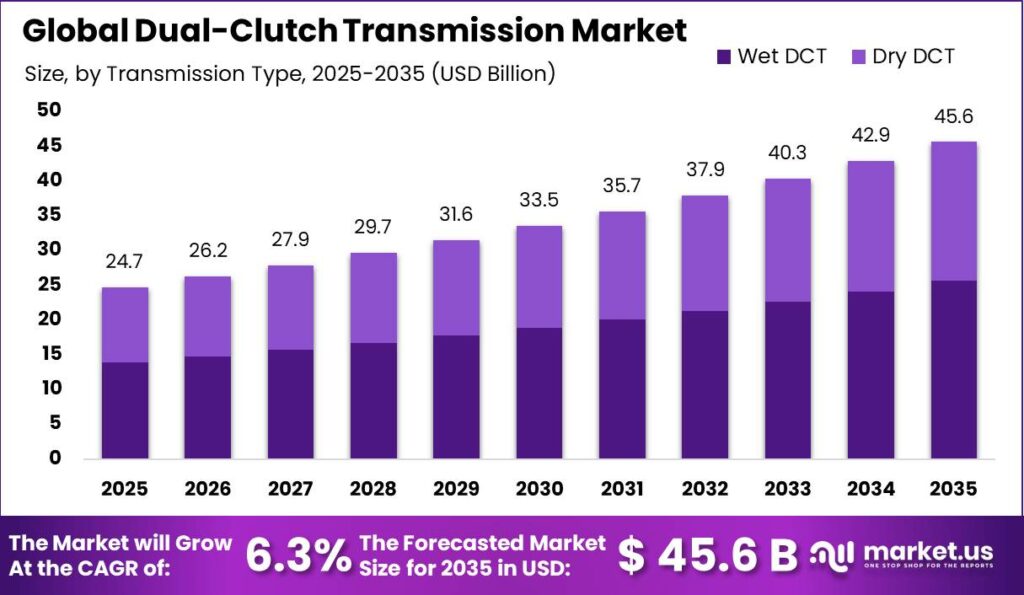
A dual-clutch transmission uses two separate clutch assemblies to pre-select gears, enabling faster shifts than conventional automatics. The market splits across transmission type, vehicle type, powertrain type, and sales channel. Wet and dry DCT variants serve different torque bands. This structure means suppliers must build distinct product lines for high-torque performance cars and cost-sensitive mass-market vehicles.
Government emission rules shape demand across every major region. The European Union enforces fleet CO₂ targets under Regulation (EU) 2019/631, and China applies CAFC fuel consumption limits. These rules push OEMs toward efficient drivelines. Therefore, DCT suppliers benefit directly from tightening compliance economics that make each gram of efficiency commercially valuable at fleet scale.
As per our research, modern dual-clutch transmissions reduce drivetrain losses and deliver better fuel economy than conventional automatics on certification cycles. This efficiency edge lowers OEM penalty exposure under emission rules. As a result, procurement teams treat DCT fitment as a compliance tool rather than a comfort feature, which secures stable long-term supplier volumes.
Key Takeaways
- Global market reaches USD 45.6 Billion by 2035 from USD 24.7 Billion in 2025 at a CAGR of 6.3%.
- Wet DCT leads By Transmission Type with a 56.2% share.
- Passenger Cars dominate By Vehicle Type with a 76.3% share.
- ICE Vehicles hold By Powertrain Type with an 81.1% share.
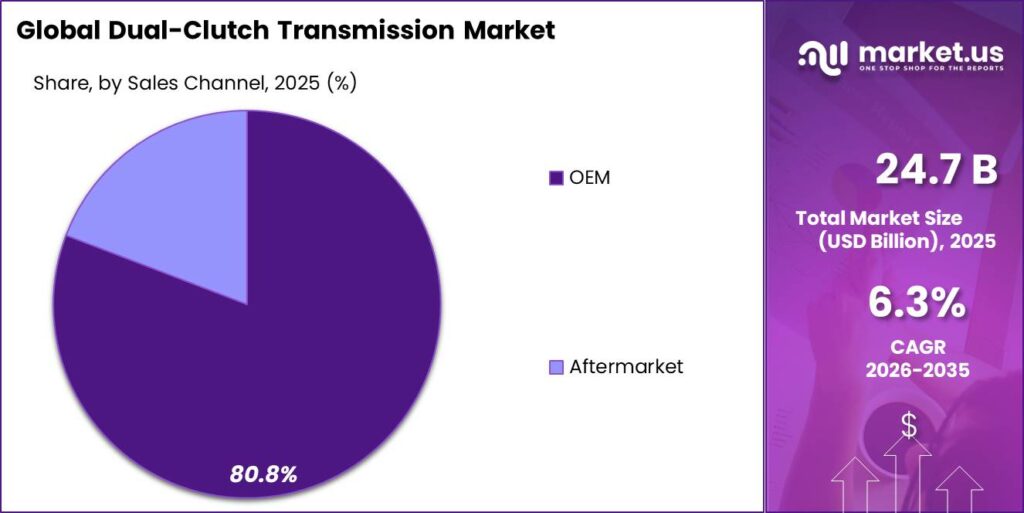
- OEM channel commands By Sales Channel with an 80.8% share.
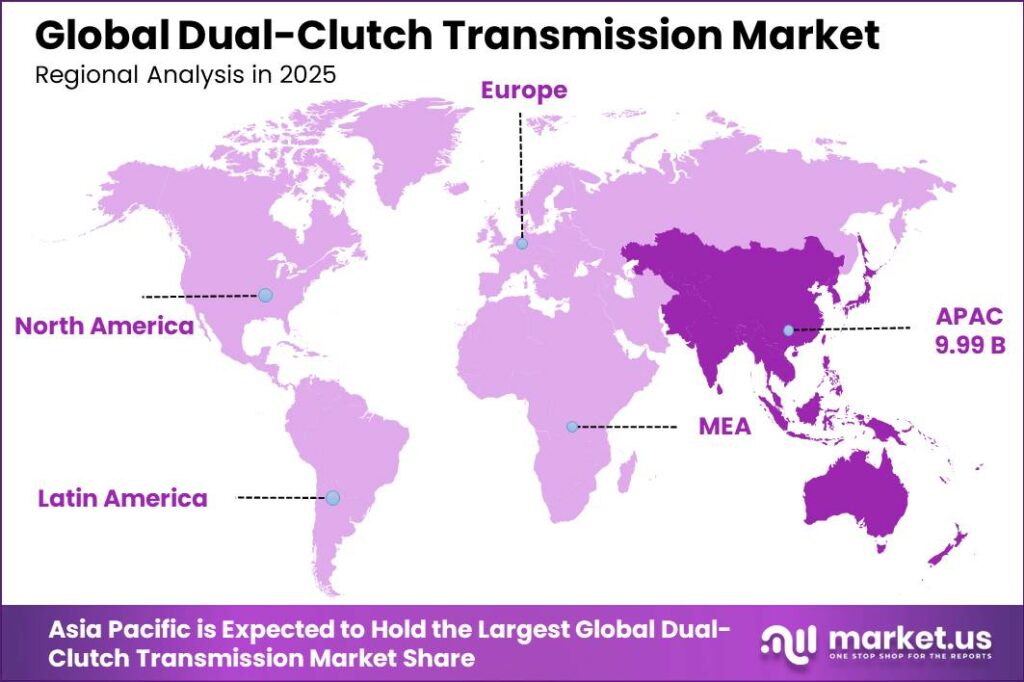
- Asia Pacific leads all regions with a 40.5% share, valued at USD 9.99 Billion.
Transmission Type Analysis
Wet DCT dominates with 56.2% due to superior high-torque heat management.
In 2025, Wet DCT held a dominant market position in the By Transmission Type segment of Dual-Clutch Transmission Market, with a 56.2% share. Porsche fits its 8-speed PDK wet dual-clutch unit to the 2025 911 Carrera GTS, which reaches 0 to 100 km/h in 3.0 seconds. This performance credibility drives OEM preference. This means wet DCT suppliers can command premium pricing in sports and high-torque vehicle programs.
Dry DCT serves lower torque applications below 250 Nm and targets compact and mid-size cars. Audi confirmed its 2025 RS 3 uses a 7-speed S tronic dual-clutch unit producing 394 hp. Dry variants cut cost and weight for mass-market fitment. Therefore, suppliers who optimize dry DCT for emerging markets can unlock volume where wet units price out buyers.
China produced over 24 million vehicles in recent quarters, up 13% year on year, making it the central growth arena for both DCT types. This scale rewards local capacity investment. Consequently, suppliers with Chinese manufacturing footprints gain a structural cost advantage that import-dependent rivals cannot match on delivery speed.
Vehicle Type Analysis
Passenger Cars dominate with 76.3% due to mass fitment across sedans and SUVs.
In 2025, Passenger Cars held a dominant market position in the By Vehicle Type segment of Dual-Clutch Transmission Market, with a 76.3% share. OICA data shows China alone produced 30.3 million passenger cars in 2025, the largest single-country output globally. This volume anchors DCT demand. This means suppliers concentrating on passenger car platforms access the deepest and most stable order pipelines.
Commercial Vehicles rank as the fastest-growing sub-segment, driven by fleet operators seeking smoother automated shifting. Global car manufacturing totaled 75.5 million units in 2024, giving commercial fitment room to expand from a small base. This creates a niche entry point. Therefore, suppliers can test high-durability DCT designs in commercial fleets before scaling to broader use.
Buyer behavior in passenger cars favors seamless gear changes and fuel savings. Audi equips all 2025 Q5 and SQ5 models with a 7-speed S tronic dual-clutch unit paired with quattro drive. This standardization signals default adoption. As a result, DCT becomes an expected feature rather than an upgrade, locking in recurring supplier revenue across model refresh cycles.
Powertrain Type Analysis
ICE Vehicles dominate with 81.1% due to established combustion drivetrain compatibility.
In 2025, ICE Vehicles held a dominant market position in the By Powertrain Type segment of Dual-Clutch Transmission Market, with an 81.1% share. ACEA reported global car manufacturing of 75.5 million units in 2024, the majority still combustion powered. This installed base sustains DCT demand. This means suppliers retain a large addressable market even as electrification advances in leading regions.
Hybrid Vehicles form the fastest-growing sub-segment as OEMs blend combustion and electric propulsion. Stellantis will offer 30 hybrid passenger models in Europe, with 6 more planned by 2026, many using its electrified dual-clutch unit. This shift extends DCT relevance. Therefore, suppliers investing in hybrid-ready DCT architectures secure demand beyond the pure combustion decline.
Hybrid integration places an electric motor inside the transmission housing to save packaging space. This design supports electric launch and cuts low-speed shudder. This signals a technical bridge between eras. Consequently, early movers in hybrid DCT capture programs that competitors serving only combustion drivelines will lose as OEM lineups electrify.
Sales Channel Analysis
OEM dominates with 80.8% due to factory-fitted transmission supply contracts.
In 2025, OEM held a dominant market position in the By Sales Channel segment of Dual-Clutch Transmission Market, with an 80.8% share. China produced over 24 million vehicles in recent quarters, nearly all fitted with transmissions at the factory line. This volume flows through OEM channels. This means DCT suppliers depend on securing platform awards rather than retail sales for their core revenue.
Aftermarket ranks as the fastest-growing sub-segment, driven by aging DCT fleets needing repair and replacement. The US NHTSA recalled 12,349 Hyundai Santa Fe vehicles for a DCT software defect, showing service demand. This creates a support revenue stream. Therefore, suppliers who build service networks and remanufacturing programs can monetize the installed base long after initial sale.
OEM buyers commit to multi-year take-or-pay volume agreements that underwrite supplier capacity. These contracts provide revenue visibility across model cycles. This reflects deep buyer lock-in. As a result, new entrants struggle to break into OEM channels, giving incumbents a defensible position that protects long-term margins.
Key Market Segments
By Transmission Type
- Wet DCT
- Dry DCT
By Vehicle Type
- Passenger Cars
- Commercial Vehicles
By Powertrain Type
- ICE Vehicles
- Hybrid Vehicles
By Sales Channel
- OEM
- Aftermarket
Regional Analysis
Asia Pacific Dominates the Dual-Clutch Transmission Market with a Market Share of 40.5%, Valued at USD 9.99 Billion
Asia Pacific led all regions in 2025 with a 40.5% share, valued at USD 9.99 Billion. China anchors this lead through massive passenger car output and rapid DCT localization in turbocharged engine segments. This scale lowers unit cost. This means suppliers with regional manufacturing capture the strongest volume base and the best cost position in the global market.
China stands as the fastest-growing regional market, driven by localized DCT production that reduces cost barriers for mass-market fitment. Rising consumer preference for automated transmission accelerates adoption in the country’s compact car segments. This creates rapid volume gains. Therefore, suppliers who expand Chinese capacity early will outpace rivals reliant on imports as demand climbs.
North America, Europe, Latin America, and the Middle East and Africa hold the remaining regional share collectively. Europe sustains demand through strict CO₂ rules and premium performance vehicles. This spreads risk across markets. Consequently, suppliers with diversified regional footprints protect revenue against any single market slowdown or regulatory shift.
Key Regions and Countries
North America
- US
- Canada
Europe
- Germany
- France
- The UK
- Spain
- Italy
- Rest of Europe
Asia Pacific
- China
- Japan
- South Korea
- India
- Australia
- Rest of APAC
Latin America
- Brazil
- Mexico
- Rest of Latin America
Middle East and Africa
- GCC
- South Africa
- Rest of MEA
Market Dynamics
Market Opportunity Analysis - Hybrid powertrains and emerging Asian markets open the clearest entry paths
Hybrid Vehicles remain the underexploited powertrain sub-segment despite ranking as fastest-growing. ICE Vehicles still hold 81.1% of the powertrain split, leaving hybrid fitment thin relative to demand. This gap reflects slow supplier response, not weak buyer interest. Therefore, new entrants who launch hybrid-ready DCT lines now can claim share before incumbents fully pivot their product portfolios.
Commercial Vehicles form an underexploited vehicle sub-segment, overshadowed by the 76.3% passenger car share. Fleet operators increasingly value automated shifting for driver comfort and fuel savings. This creates open space in a fragmented niche. Consequently, suppliers who tailor durable DCT designs to commercial duty cycles can build a defensible position ahead of larger rivals.
The Aftermarket channel stays underexploited against the 80.8% OEM share. Aging DCT fleets need repair, software updates, and remanufactured units. This demand builds steadily as installed bases mature. Instead of chasing only OEM awards, suppliers who invest in service networks and parts supply unlock a recurring revenue stream that competitors overlook.
Technology and Innovation Landscape - Motor integration and software calibration define the next competitive edge
Electrified DCT designs embed an electric motor inside the transmission housing. Stellantis applies this eDCT approach across 30 hybrid models in Europe, with 6 more by 2026. This integration saves packaging space and enables electric launch. Therefore, manufacturers who master motor integration win hybrid programs that pure combustion suppliers cannot serve.
Transmission Control Unit software governs shift quality and reliability. Hyundai issued a TCU software update for affected 2024 Santa Fe vehicles, replacing the DCT where inspection found damage. This shows calibration as a core value driver. Consequently, suppliers with strong software teams reduce warranty exposure and turn shift refinement into a selling advantage.
High-speed dual-clutch designs deliver elite performance. Audi’s 2025 RS 3 uses a 7-speed S tronic producing 394 hp and 369 lb-ft of torque, reaching 0 to 60 mph in 3.6 seconds. This proves DCT capability at the performance edge. As a result, suppliers who push torque limits secure premium contracts in the sports vehicle segment.
Drivers
Escalating regulatory pressure on vehicle CO₂ emissions creates a direct procurement mandate for efficient transmissions. The EU targets under Regulation (EU) 2019/631 required a fleet average of 95 g CO₂/km by 2021, tightening -15% by 2025 and -37.5% by 2030. Penalty exposure runs at EUR 95 per gram above target per vehicle. This makes every efficiency gain commercially valuable at fleet scale.
Wet DCT delivers a fuel efficiency advantage of 4 to 8% over a 6-speed torque-converter automatic in WLTP testing, and dry DCT delivers 6 to 10%. This cuts CO₂ by roughly 5 to 9 g/km on compact cars. At 500,000 annual registrations, this lowers OEM penalty exposure by EUR 200 to 400 million. Therefore, suppliers gain durable, compliance-driven demand.
| Driver | (~) % Impact on CAGR Forecast | Geographic Relevance | Impact Timeline |
|---|---|---|---|
| Stringent CO₂ & Fuel Economy Regulations Mandating Powertrain Efficiency Improvements | +2.00% | European Union, China, Japan, South Korea, India | Short term (≤ 2 years) |
| Rising Consumer Preference for Automated Transmission in Emerging Market Passenger Cars | +1.55% | China, India, Southeast Asia, Latin America | Short term (≤ 2 years) |
| DCT Adoption in Hybrid Powertrain Architectures Extending Relevance Beyond Pure ICE Vehicles | +1.10% | China, Europe, Japan, South Korea | Medium term (2–4 years) |
| OEM Model Proliferation in C & D Segment Vehicles Standardising DCT as Default Transmission | +0.85% | China, Europe, North America | Short term (≤ 2 years) |
| Performance & Sports Vehicle Segment Sustained Demand for Wet DCT High-Torque Applications | +0.55% | Europe, North America, Japan, South Korea | Medium term (2–4 years) |
| Localisation of DCT Manufacturing in China & India Reducing Cost Barriers for Mass-Market Fitment | +0.42% | China, India | Medium term (2–4 years) |
Restraints
Battery electric vehicles use single-speed fixed-ratio gearboxes in over 95% of current platform designs, because the wide torque range of electric motors from 0 to 8,000 rpm removes the need for gear changes. Each BEV displaces a DCT and the full multi-speed driveline. This causes a per-vehicle revenue loss of USD 300 to 900 for suppliers versus an equivalent ICE fitment.
China’s new energy vehicle penetration crossed 50% of monthly new car sales in mid-2024 and reached 53 to 55% by early 2025. This erodes the addressable ICE fitment base by roughly 3 to 5% annually. This forces dual-track R&D spending. As a result, suppliers without EV driveline positions face EBITDA margin compression toward 10 to 16%.
| Restraint | (~) % Impact on CAGR Forecast | Geographic Relevance | Impact Timeline |
|---|---|---|---|
| Battery EV Adoption Eliminating Multi-Speed Transmission Requirement in New Platform Architectures | -1.80% | China, Europe, North America | Medium term (2–4 years) |
| Dry DCT Low-Speed Shudder & Reliability Warranty Claims Suppressing Mass-Market Consumer Confidence | -1.10% | China, Europe, North America | Short term (≤ 2 years) |
| High Unit Cost of DCT Versus AMT & CVT Restricting Penetration in Sub-Compact & Entry Segments | -0.75% | India, Southeast Asia, Latin America, Africa | Short term (≤ 2 years) |
| OEM ICE Platform Freeze & Deferred New Model Investment Due to Electrification Transition | -0.55% | Europe, North America, Japan | Short term (≤ 2 years) |
| Chinese OEM DCT In-House Integration Reducing Tier-1 Supplier Addressable Volume | -0.38% | China | Medium term (2–4 years) |
Challenges
DCT precision gear manufacturing concentrates within a small supplier tier producing components to tolerances of ±2 to 5 microns and hardness of 58 to 62 HRC. Fewer than 15 to 20 Tier-2 suppliers globally can produce volume automotive helical gear sets. This concentration creates fragility. This means a single facility disruption can delay lead times by 16 to 24 weeks across many DCT assemblers at once.
DCT assembly plants hold buffer stocks covering 4 to 8 weeks of production, and a longer disruption triggers line stoppage costing USD 1 to 3 million per day at plants making 2,000 to 3,500 units daily. Dual-sourcing qualification takes 12 to 24 months per component. Therefore, suppliers who invest early in diversified sourcing turn resilience into a competitive selling point.
| Challenge | (~) % CAGR Friction Drag | Geographic Relevance | Mitigation Horizon |
|---|---|---|---|
| Precision Component Supply Chain Concentration | -0.85% | Global — gear steel & bearing sourcing concentrated in Germany, Japan, China | Long term (≥ 4 years) |
| TCU Software Calibration Complexity & OTA Update Burden | -0.70% | Global — most acute for OEMs managing large installed bases | Medium term (2–4 years) |
| Skilled Mechatronics Workforce Deficit | -0.55% | Europe, Japan, India, Southeast Asia | Long term (≥ 4 years) |
| Aftermarket Service Training & Tooling Gap | -0.42% | India, Southeast Asia, Latin America, Middle East, Africa | Long term (≥ 4 years) |
| Raw Material Cost Volatility in Specialty Steel & Friction Materials | -0.32% | Global — most acute for import-dependent Asian manufacturers | Medium term (2–4 years) |
Opportunities
Hybrid DCT integration for PHEV and 48V mild-hybrid architectures remains white space, with fewer than 8 to 12 volume-production hybrid DCT programs globally versus hundreds of conventional programs. A P2 hybrid DCT with a 15 to 25 kW motor cuts fuel use by 18 to 28% in WLTP testing. This addresses efficiency and shudder at once. This means early movers capture a high-value new product category.
Hybrid DCT enables electric-only range of 30 to 60 km, qualifying for NEV status in China and ZLEV credits in the EU, worth an estimated USD 800 to 2,500 per vehicle. Development costs USD 150 to 400 million across 4 to 6 years. Therefore, suppliers committing R&D now secure a first-mover window before margin premiums of 35 to 50% commoditize.
| Opportunity | (~) % Potential CAGR Upside | Geographic Relevance | Execution Window |
|---|---|---|---|
| P2 & P3 Hybrid DCT Integration for PHEV & 48V Mild-Hybrid Architectures | +1.60% | China, Europe, Japan, South Korea | Medium term (2–4 years) |
| India & ASEAN Mass-Market Automated Transmission Premiumization via Cost-Optimised Dry DCT | +1.10% | India, Indonesia, Thailand, Vietnam | Medium term (2–4 years) |
| Multi-Speed DCT for Performance BEV & High-Torque Electric Axle Applications | +0.80% | Europe, North America, China | Long term (≥ 4 years) |
| DCT Aftermarket Remanufacturing & Extended Service Life Programs | +0.52% | Europe, North America, China | Medium term (2–4 years) |
| Software-Defined Shift Strategy Licensing & OTA Monetisation | +0.38% | Europe, North America, China, South Korea | Long term (≥ 4 years) |
Key Company Insights
Magna International Inc. secured a Hybrid Dual-Clutch Transmission production award from Mercedes-Benz for next-generation compact and mid-size hybrid vehicles. Its HDT integrates an electric motor within the transmission to cut packaging space versus conventional hybrid systems. This positioning aligns Magna with the fastest-growing hybrid powertrain segment. However, dependence on a single flagship program concentrates risk if that platform underperforms.
BorgWarner Inc. secured two new Dual-Clutch Transmission programs in China in May 2025, including a contract with a major Chinese transmission maker and a 7-year extension with a German OEM in China. Production begins by the end of 2025. This deepens BorgWarner’s foothold in the world’s largest market. However, rising in-house DCT integration by Chinese OEMs could erode its addressable volume over time.
Key Players
- ZF Friedrichshafen AG
- BorgWarner Inc.
- Magna International Inc.
- Aisin Corporation
- Jatco Ltd.
- Schaeffler AG
- Continental AG
- Punch Powertrain NV
- GKN Automotive (GKN Driveline)
- Allison Transmission, Inc.
- Ricardo plc
- Eaton Corporation plc
- Hyundai Transys
- Volkswagen AG
- Daimler/Mercedes-Benz Group AG
- Others
Geopolitical Impact Analysis
According to the US administration, Section 232 imposed a 25% tariff on imported automobiles from April 3, 2025, extending to automotive parts including transmissions by May 3, 2025. This raises landed costs for DCT units shipped into the US market. This creates a sourcing dilemma. Therefore, suppliers reliant on German or Japanese DCT imports face pressure to localize North American assembly to protect margins.
As reported by ACEA, global car manufacturing totaled 75.5 million units in 2024, while EU car production fell 6.2% amid weak industry confidence and supply chain strain. This softening squeezes European DCT volumes and gear steel sourcing concentrated in Germany. This signals regional risk. Consequently, suppliers spread precision component procurement across Asia and Europe to buffer against tariff shocks and regional production declines.
Recent Developments
- July 2025: Stellantis expanded production of its electrified Dual-Clutch Transmission (eDCT) technology at its Termoli, Italy facility, targeting annual capacity of up to 300,000 eDCT units to support growing European hybrid vehicle demand.
- March 2025: Mercedes-Benz introduced the all-new CLA equipped with an 8-speed electrified Dual-Clutch Transmission (8F-eDCT) for its hybrid variants, marking the first production use of this transmission on the new MMA platform.
Report Scope
| Report Features | Description |
|---|---|
| Market Value (2025) | USD 24.7 Billion |
| Forecast Revenue (2035) | USD 45.6 Billion |
| CAGR (2026-2035) | 6.3% |
| Base Year for Estimation | 2025 |
| Historic Period | 2020-2024 |
| Forecast Period | 2026-2035 |
| Report Coverage | Revenue Forecast, Market Dynamics, Market Opportunity Analysis, Technology and Innovation Landscape, Competitive Landscape, Recent Developments |
| Segments Covered | By Transmission Type (Wet DCT, Dry DCT), By Vehicle Type (Passenger Cars, Commercial Vehicles), By Powertrain Type (ICE Vehicles, Hybrid Vehicles), By Sales Channel (OEM, Aftermarket) |
| Regional Analysis | North America (US and Canada), Europe (Germany, France, The UK, Spain, Italy, and Rest of Europe), Asia Pacific (China, Japan, South Korea, India, Australia, and Rest of APAC), Latin America (Brazil, Mexico, and Rest of Latin America), Middle East and Africa (GCC, South Africa, and Rest of MEA) |
| Competitive Landscape | ZF Friedrichshafen AG, BorgWarner Inc., Magna International Inc., Aisin Corporation, Jatco Ltd., Schaeffler AG, Continental AG, Punch Powertrain NV, GKN Automotive, Allison Transmission Inc., Ricardo plc, Eaton Corporation plc, Hyundai Transys, Volkswagen AG, Daimler/Mercedes-Benz Group AG, Others |
| Customization Scope | Customization for segments, region / country-level will be provided. Additional customization can be done based on requirements. |
| Purchase Options | We have three licenses to opt for: Single User License | Multi-User License (Up to 5 Users) | Corporate Use License (Unlimited User and Printable PDF) |





































