


Report Overview
Global Automotive Silicone Market size is expected to be worth around USD 7.1 Billion by 2035 from USD 3.2 Billion in 2025, growing at a CAGR of 8.3% during the forecast period 2026 to 2035. This growth reflects rising silicone content per vehicle as automakers shift toward electrified platforms. Suppliers who secure early qualification will lock in long-term margin advantages across the coming decade.
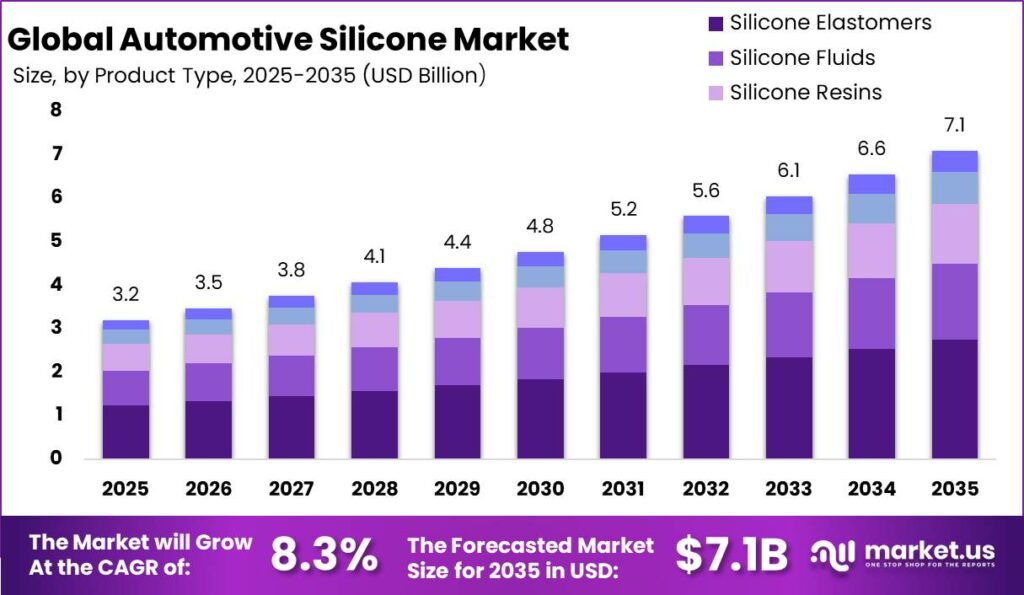
The Automotive Silicone Market covers automotive interior materials and functional polymers used in sealing, insulation, and thermal control across vehicle systems. This market splits by product type, application, vehicle type, form type, function, sales channel, and end use. Each layer serves a distinct engineering need. Therefore vendors must map product portfolios to specific application demands rather than compete on broad commodity volume alone.
Key Takeaways
- Global market size reached USD 3.2 Billion in 2025 and will hit USD 7.1 Billion by 2035 at a CAGR of 8.3%.
- Silicone Elastomers led By Product Type with a 38.60% share.
- Seals and Gaskets led By Application with a 29.70% share.
- Passenger Cars led By Vehicle Type with a 64.80% share.
- Liquid Silicone Rubber led By Form Type with a 36.20% share.
- Insulation and Protection led By Function with a 31.60% share.
- OEM led By Sales Channel with a 78.30% share.
- Automotive Manufacturing led By End Use with a 72.10% share.
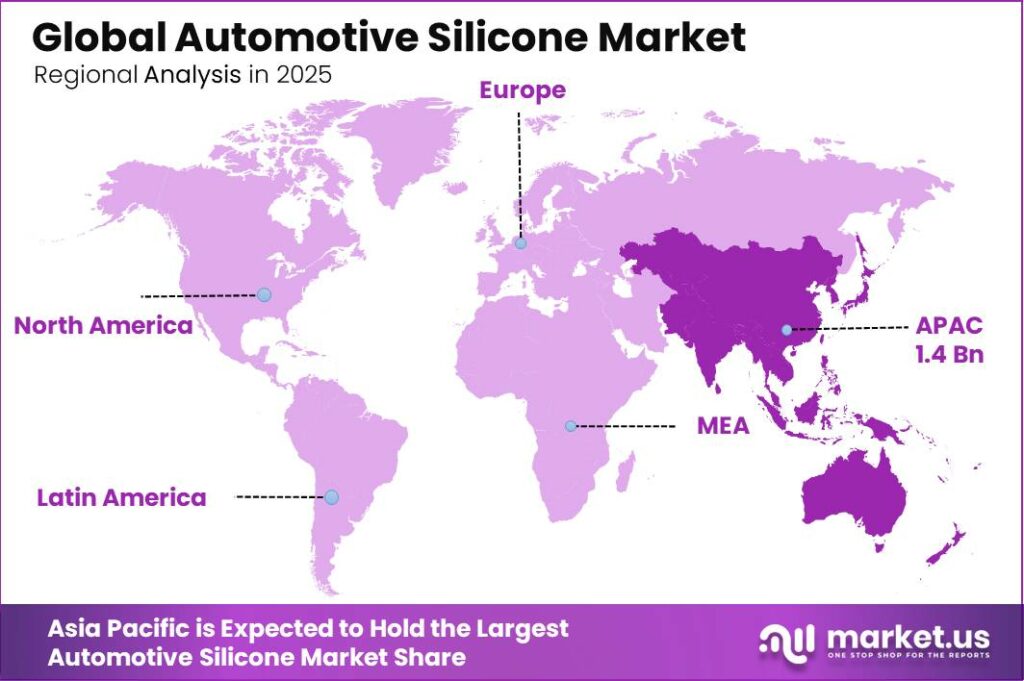
- Asia-Pacific dominated with a 43.80% share, valued at USD 1.4 Billion.
Government electrification policy now shapes silicone demand across major auto markets. Regulators in Europe and China mandate stricter battery safety and emissions rules, pushing OEMs toward higher-specification sealing and thermal materials. This creates steady pull-through demand for engineered silicone grades. Suppliers who align formulations with regulatory test standards will win preferred supplier status before rivals qualify.
Rising electric vehicle adoption directly lifts silicone use per car. As per our research, EVs reached about 45% of total new car sales in China in 2024, expanding the installed base that requires thermal gels and pack sealing. This shift converts EV volume growth into recurring silicone demand. Consequently producers tied to Chinese OEM programs gain the largest structural volume advantage.
End-use expansion in automotive manufacturing feeds product demand at scale. Growing vehicle output raises the need for seals, encapsulants, and insulation materials fitted on every assembly line. This cause-and-effect link means factory throughput sets the pace for silicone consumption. Therefore vendors should track OEM production schedules to time supply commitments and pricing.
Product Type Analysis
Silicone Elastomers dominates with 38.60% due to versatile sealing and gasket use.
In 2025, Silicone Elastomers held a dominant market position in the By Product Type segment of Automotive Silicone Market, with a 38.60% share. Research measuring silicone-on-silicone film behavior found spreading rate deviations from Tanner’s law near a power-law exponent of 0.1, showing stiffness affects sealing layer performance. This means elastomer formulation directly shapes seal reliability. Producers who tune stiffness for vibration environments will defend premium automotive positions.
Silicone Fluids serve lubrication, damping, and heat transfer roles across drivetrain and electronic modules. These fluids hold a 24.80% share by product type. Their liquid form allows precise dosing in confined spaces. This flexibility lets suppliers target compact EV power electronics where fluid delivery beats solid alternatives, opening a defensible niche for specialty fluid makers.
Silicone Resins provide high-temperature coatings and binder functions in demanding under-hood zones, holding a 19.40% share. Their thermal stability suits exhaust-adjacent and powertrain surfaces. This durability supports longer service intervals. Vendors marketing resin heat resistance to Euro 7 compliant platforms will capture replacement demand as metal coatings lose ground.
Silicone Gels, the fastest growing product type, deliver soft thermal interface performance and hold a 10.20% share. Silicone Resins and remaining categories fill the balance. Gels absorb mechanical stress in battery packs. This cushioning role ties gel growth to EV output, while Silicone Gels and Others collectively hold the remaining 17.20% across smaller applications.
Application Analysis
Seals and Gaskets dominates with 29.70% due to leak prevention across vehicle systems.
In 2025, Seals and Gaskets held a dominant market position in the By Application segment of Automotive Silicone Market, with a 29.70% share. Modern EV systems operate up to 800V and 350A charging currents, raising sealing demands to prevent moisture ingress. This means higher voltages force tighter seal specifications. Suppliers meeting high-voltage sealing standards will command pricing power in EV programs.
Electrical and Electronics, the fastest growing application, uses silicone encapsulants to protect sensitive modules and holds a 24.30% share. Rising electronic content per vehicle drives this demand. Encapsulants shield circuits from heat and vibration. This protective role scales with ADAS adoption, giving encapsulant specialists a fast-expanding revenue base.
Interior Components rely on silicone for soft-touch surfaces and durable trim, holding a 17.60% share. Buyers value tactile quality and resistance to wear. This preference supports premium cabin materials. Vendors linking silicone finishes to interior comfort claims will gain traction with OEM design teams.
Exterior Components and Powertrain Systems cover weather sealing and high-heat zones, holding 14.20% and 9.10% shares. Both demand thermal and UV resistance. This durability requirement rewards proven grades, while Powertrain Systems and Others together hold the remaining 14.20% across specialized uses.
Vehicle Type Analysis
Passenger Cars dominates with 64.80% due to high global production volume base.
In 2025, Passenger Cars held a dominant market position in the By Vehicle Type segment of Automotive Silicone Market, with a 64.80% share. As reported by Zap-Map, the UK registered 473,348 battery electric vehicles in 2025, representing 23.4% of new car registrations. This means passenger EV volume now drives silicone content per car. Suppliers serving passenger platforms gain the widest demand base.
Commercial Vehicles carry silicone in heavy-duty sealing and thermal roles across trucks and buses. Their durability needs exceed passenger norms. This structural difference favors high-temperature grades. Vendors offering ruggedized silicone can defend margins in fleet applications where failure costs run high.
Electric Vehicles, the fastest growing vehicle type, require silicone in battery packs, thermal interfaces, and high-voltage insulation. Rising EV registrations expand this demand pool directly. Each EV needs more silicone than a comparable combustion model. This content premium makes EV-focused suppliers the primary growth beneficiaries in the segment.
Form Type Analysis
Liquid Silicone Rubber dominates with 36.20% due to precise high-volume molding output.
In 2025, Liquid Silicone Rubber held a dominant market position in the By Form Type segment of Automotive Silicone Market, with a 36.20% share. Silicone thermal gels used in EV batteries typically range from 0.4 to 3 W/m·K conductivity, guiding LSR formulation for heat paths. This means conductivity targets shape LSR design. Producers hitting precise conductivity specs will win battery thermal contracts.
High Consistency Rubber serves extrusion and calendering for hoses and profiles. Its firm texture suits shaped parts. This structural fit favors continuous production lines. Vendors supplying HCR to hose makers can lock in steady volume tied to under-hood assemblies.
Room Temperature Vulcanizing Silicone, the fastest growing form, cures without heat and suits field sealing and repair. Its easy application lowers processing cost. This convenience expands aftermarket and assembly use. RTV specialists can target both plant sealing and service repair channels for dual revenue streams.
Others cover specialty forms used in niche automotive parts. These formats fill gaps left by mainstream grades. Their tailored properties serve narrow needs, holding the remaining share collectively across minor applications.
Function Analysis
Insulation and Protection dominates with 31.60% due to electrical safety across systems.
In 2025, Insulation and Protection held a dominant market position in the By Function segment of Automotive Silicone Market, with a 31.60% share. Lithium-ion batteries perform optimally at 15°C to 35°C, requiring precise thermal regulation systems that silicone supports. This means insulation function ties directly to battery safety. Suppliers proving thermal stability will secure safety-critical specifications.
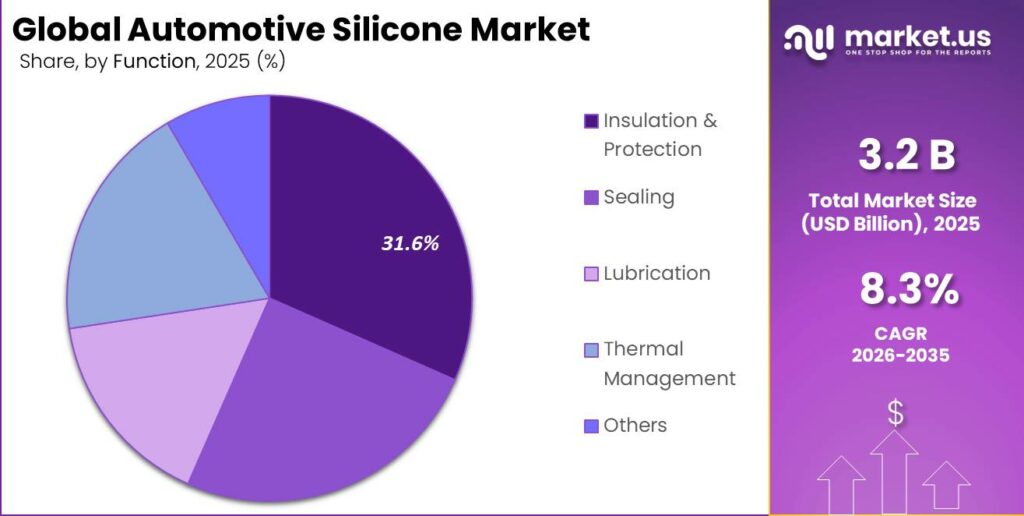
Sealing keeps fluids and contaminants out of critical assemblies across the vehicle. This role protects components from moisture and dust. Reliable sealing extends part life. Vendors demonstrating long-term seal integrity will retain OEM trust in warranty-sensitive systems.
Lubrication reduces friction in moving assemblies and connectors. Silicone lubricants resist temperature swings well. This stability suits demanding automotive cycles. Producers marketing low-friction durability can win connector and slide applications where wear drives failures.
Thermal Management, the fastest growing function, moves heat from batteries and electronics to keep systems within safe limits. Rising EV power density lifts this demand. Effective heat transfer prevents thermal runaway, while Thermal Management and Others hold the remaining share across supporting roles.
Sales Channel Analysis
OEM dominates with 78.30% due to factory-fit integration in new vehicles.
In 2025, OEM held a dominant market position in the By Sales Channel segment of Automotive Silicone Market, with a 78.30% share. As reported by J.D. Power, 24% of vehicle shoppers were very likely and 35% somewhat likely to consider an EV, signaling strong future OEM fit demand. This means factory installation captures most silicone volume. Suppliers embedded in OEM lines hold durable revenue.
Aftermarket supplies replacement seals, gels, and sealants for repair and maintenance. Buyers seek durable, easy-apply products. This behavior favors accessible RTV and repair grades. Vendors building distributor networks can capture recurring service demand outside factory contracts.
End Use Analysis
Automotive Manufacturing dominates with 72.10% due to line-fit production across plants.
In 2025, Automotive Manufacturing held a dominant market position in the By End Use segment of Automotive Silicone Market, with a 72.10% share. Data from AAA shows 16% of U.S. adults were likely to purchase a fully electric vehicle as their next car, signaling rising factory silicone demand. This means production volume anchors silicone consumption. Suppliers tied to plant schedules gain volume stability.
Automotive Repair and Maintenance, the fastest growing end use, consumes silicone in service sealing and part replacement. Aging vehicle fleets lift this demand. Repair work needs reliable, quick-cure materials. This role expands the aftermarket base, giving service-focused suppliers a growing and recession-resistant revenue stream.
Key Market Segments
By Product Type
- Silicone Elastomers
- Silicone Fluids
- Silicone Resins
- Silicone Gels
- Others
By Application
- Seals and Gaskets
- Electrical and Electronics
- Interior Components
- Exterior Components
- Powertrain Systems
- Others
By Vehicle Type
- Passenger Cars
- Commercial Vehicles
- Electric Vehicles (EVs)
By Form Type
- Liquid Silicone Rubber (LSR)
- High Consistency Rubber (HCR)
- Room Temperature Vulcanizing (RTV) Silicone
- Others
By Function
- Insulation and Protection
- Sealing
- Lubrication
- Thermal Management
- Others
By Sales Channel
- OEM
- Aftermarket
By End Use
- Automotive Manufacturing
- Automotive Repair and Maintenance
Regional Analysis
Asia-Pacific Dominates the Automotive Silicone Market with a Market Share of 43.80%, Valued at USD 1.4 Billion
Asia-Pacific led the Automotive Silicone Market with a 43.80% share worth USD 1.4 Billion in 2025. The region hosts the largest vehicle production and EV output base globally. This concentration pulls silicone demand toward regional suppliers. Consequently vendors with Asia-Pacific manufacturing gain cost and delivery advantages over distant competitors.
Asia-Pacific also ranks as the fastest-growing region, driven by rising EV production in China and expanding auto output across India and Southeast Asia. This growth links directly to electrification volume. In May 2026, Momentive Performance Materials strengthened collaborations with automotive OEMs to develop customized silicone sealing systems for EV battery housings. This move positions suppliers to capture regional EV sealing demand early.
Key Regions and Countries
North America
- US
- Canada
Europe
- Germany
- France
- The UK
- Spain
- Italy
- Rest of Europe
Asia Pacific
- China
- Japan
- South Korea
- India
- Australia
- Rest of APAC
Latin America
- Brazil
- Mexico
- Rest of Latin America
Middle East and Africa
- GCC
- South Africa
- Rest of MEA
Market Dynamics
Market Opportunity Analysis - Underserved EV segments and Asian localisation offer entry points for new players
Electric Vehicles remain underexploited despite fastest-growing status in the By Vehicle Type segment. Most silicone supply still targets Passenger Cars at 64.80% share, leaving EV-specific pack and insulation grades open. This gap favors specialist entrants. By contrast, incumbents focused on legacy platforms may miss the EV content premium unless they retool formulations quickly.
Silicone Gels stay underserved at just 10.20% of the By Product Type segment despite fastest-growth momentum. Gel demand tracks EV thermal management directly. This creates room for focused gel producers. Therefore new entrants can build defensible niches in battery cushioning before larger elastomer suppliers pivot toward soft thermal formats.
Room Temperature Vulcanizing Silicone holds fastest-growth status yet trails Liquid Silicone Rubber at 36.20% in the By Form Type segment. RTV suits both plant sealing and aftermarket repair. This dual-channel fit widens the addressable base. Consequently RTV-focused vendors can serve service demand that OEM-only competitors leave uncovered.
Automotive Repair and Maintenance remains underexploited against Automotive Manufacturing at 72.10% in the By End Use segment. Aftermarket demand rises as vehicle fleets age. This creates recurring, cycle-resistant revenue. Instead of competing only for OEM contracts, new entrants can capture steady service-channel volume with easy-apply repair grades.
Technology and Innovation Landscape - High-voltage architecture and thermal conductivity drive silicone material advances
High-voltage EV architecture reshapes silicone insulation design. As reported by Wacker Chemie, modern EV systems operate up to 800V and 350A charging currents, raising insulation and sealing demands. This means dielectric strength becomes a core specification. Manufacturers proving high-voltage insulation performance will win preferred positions on next-generation powertrain programs.
Thermal conductivity tuning defines competitive edge in battery interfaces. Data from Elkem shows silicone thermal gels typically range from 0.4 to 3 W/m·K conductivity. This range guides gap-filler engineering for cell cooling. Consequently producers who hit precise conductivity targets can differentiate on heat dissipation and secure long-term battery supply contracts.
Precise thermal regulation sits at the center of battery material innovation. Elkem indicates that lithium-ion batteries perform optimally at 15°C to 35°C, requiring engineered thermal control systems. This narrow window rewards accurate silicone thermal design. Therefore suppliers investing in temperature-stable formulations gain an edge in safety-critical battery applications.
Drivers
The primary driver is the structural shift of global automotive production toward battery electric vehicle platforms, which need far more silicone per vehicle than combustion models. A typical BEV consumes an estimated 3.5 to 5.5 kg of silicone versus 1.8 to 2.8 kg for an equivalent ICE platform. This gap comes from thermal management, pack sealing, and high-voltage jacketing. Therefore EV growth converts directly into higher silicone volume per car.
Battery thermal interface materials form the largest incremental opportunity per vehicle. A 75 to 100 kWh pack needs roughly 1.2 to 2.5 kg of silicone TIM, worth about USD 18 to 55 per vehicle. China’s NEV output crossed 9.4 million units in 2023, making it the top demand driver. As a result, BEV-grade silicones carry gross margins of 48 to 62% versus 28 to 38% on standard grades, rewarding early qualified suppliers.
| Driver | (~) % Impact on CAGR Forecast | Geographic Relevance | Impact Timeline |
|---|---|---|---|
| Electric Vehicle Powertrain & Battery Thermal Management Systems Demanding High-Performance Silicone Materials | +2.80% | China, United States, Germany, South Korea, Japan, France, United Kingdom | Short term (≤ 2 years) |
| Advanced Driver Assistance Systems (ADAS) & Automotive Electronics Proliferation Requiring Silicone Encapsulants & Gels | +1.60% | Global — led by Germany, Japan, South Korea, United States, China | Short term (≤ 2 years) |
| Lightweighting Imperatives Driving Silicone Rubber Gasket & Seal Replacement of Metal & EPDM Components | +1.10% | Europe, United States, Japan, South Korea, China | Medium term (2–4 years) |
| Stringent Euro 7 & US EPA Emissions Standards Requiring Higher-Temperature-Resistant Silicone Sealing Solutions | +0.80% | European Union, United States, India, China, Canada, Australia | Short term (≤ 2 years) |
| Global Vehicle Production Recovery & Rising Automotive Output in Asia Pacific & India Driving Volume Demand | +0.62% | India, China, Southeast Asia, Mexico, Brazil | Short term (≤ 2 years) |
| Autonomous Vehicle Sensor Housing & LiDAR Optical Component Silicone Encapsulation Demand | +0.45% | United States, Germany, Japan, China, South Korea | Medium term (2–4 years) |
Restraints
The root cause is the structural concentration of global silicon metal production in China, which accounts for roughly 68 to 72% of global output per UN Comtrade and USGS data. This concentration exposes non-Chinese producers to export policy shifts and price spikes. During 2021, spot prices surged from about USD 2,200 per tonne to peaks near USD 9,500 per tonne. This 240 to 340% jump compressed margins by 8 to 15 percentage points.
Non-Chinese producers depend on limited supply from Norway, Brazil, and France, which hold under 30% of global capacity. This buffer cannot absorb disruption beyond 3 to 6 months. Backward integration costs USD 200,000,000 to 800,000,000 per facility. As a result, mid-tier formulators face working capital strain and slow 6 to 18 month cost pass-through cycles with OEMs.
| Restraint | (~) % Impact on CAGR Forecast | Geographic Relevance | Impact Timeline |
|---|---|---|---|
| Silicon Metal & Siloxane Intermediate Feedstock Price Volatility & China Supply Concentration Risk | -1.40% | Global — silicon metal production concentrated in China (~70% of global output) | Short term (≤ 2 years) |
| REACH & RoHS Restrictions on Silicone Additive Chemistry Constraining Formulation Flexibility | -0.75% | European Union, United Kingdom, South Korea, Japan | Short term (≤ 2 years) |
| High Capital Cost of Silicone Production Infrastructure Limiting New Entrant Competitive Supply | -0.55% | Global — affects non-Chinese producers in United States, Europe, India | Medium term (2–4 years) |
| Global Automotive Production Uncertainty & ICE Phase-Out Timelines Creating CapEx Hesitancy | -0.38% | Europe, United States, Japan — mature ICE-heavy automotive markets | Short term (≤ 2 years) |
Challenges
The structural vulnerability is the long OEM and Tier-1 qualification process needed before any new silicone formulation enters production vehicles. A full qualification at a German Tier-1 supplier requires 18 to 36 months and testing spend of USD 250,000 to 1,200,000 per formulation. Testing spans thermal cycling from -40°C to +150°C and vibration endurance. This delay slows revenue recognition on R&D investment.
EV platforms add new test environments such as 800V insulation needs and immersion cooling contact. Existing ICE-era protocols cannot fully cover them, and industry standards remain unsettled through 2024 and 2025. This gap favors incumbents with approved positions. Therefore producers must sign co-development deals 3 to 4 years early and invest USD 5,000,000 to 20,000,000 per platform to defend share against lower-priced Chinese entrants.
| Challenge | (~) % CAGR Friction Drag | Geographic Relevance | Mitigation Horizon |
|---|---|---|---|
| OEM Qualification & Tier-1 Approval Cycle Length | -0.95% | Global — most acute for new formulations in German, Japanese & Korean OEM supply chains | Long term (≥ 4 years) |
| Cyclic Siloxane (D4, D5, D6) Environmental Restriction Compliance | -0.72% | European Union, United Kingdom, Canada, Norway | Medium term (2–4 years) |
| Thermally Conductive Filler Integration & Dispersion Process Complexity | -0.55% | Global — affects all BEV TIM & thermal pad producers | Long term (≥ 4 years) |
| Silicone-to-Substrate Adhesion Failure Risk in High-Vibration EV Environments | -0.40% | Global — most acute in BEV battery & power electronics applications | Long term (≥ 4 years) |
| Skilled Formulation & Application Engineering Talent Scarcity | -0.28% | Europe, United States, Japan — advanced silicone application markets | Long term (≥ 4 years) |
Opportunities
This opportunity is untapped white space, since as of 2025 and 2026 direct immersion cooling appeared in fewer than 2 to 4% of BEV platform designs. Most packs still use indirect cooling with silicone TIMs and aluminium plates. Dielectric silicone fluids deliver cell-level uniformity of ±1 to 2°C versus ±5 to 8°C. This enables faster charge rates and longer battery life.
Automotive-grade dielectric fluid qualification demands electrochemical stability and 150,000 km lifecycle testing, requiring USD 15,000,000 to 50,000,000 per platform. First movers can command fluid ASPs of USD 35 to 90 per kg. This yields gross margins of 58 to 72%. Consequently early qualified producers capture the highest unit-value silicone application in the entire automotive segment.
| Opportunity | (~) % Potential CAGR Upside | Geographic Relevance | Execution Window |
|---|---|---|---|
| Immersion Cooling Dielectric Silicone Fluid Development for Next-Generation Battery & Power Electronics | +1.80% | United States, Germany, Japan, South Korea, China | Medium term (2–4 years) |
| Self-Healing & Damage-Tolerant Silicone Sealant Platform for EV Battery Pack Structural Integrity | +1.20% | Germany, Japan, United States, South Korea, China | Long term (≥ 4 years) |
| Silicone Aerogel Thermal Insulation Blankets for Battery Thermal Runaway Propagation Prevention | +0.90% | Global — mandated by UN ECE R100 Rev.3 & GB/T 31485 in China | Medium term (2–4 years) |
| India & Southeast Asia Automotive Silicone Localisation for Domestic OEM Supply Chain Indigenisation | +0.65% | India, Thailand, Indonesia, Vietnam, Malaysia | Medium term (2–4 years) |
| Conductive Silicone for Flexible In-Cabin Display & Haptic Interface Integration | +0.42% | South Korea, Japan, Germany, United States, China | Long term (≥ 4 years) |
Geopolitical Impact Analysis
Trade friction over silicon metal directly threatens automotive silicone supply chains. According to UNCTAD, global shipping disruptions and rerouting around the Red Sea added transit times of 10 to 14 days on key Asia-Europe lanes during 2024. Silicon metal shipments from Norway and Brazil face similar delays. This means non-Chinese producers must hold larger buffer stocks. Consequently working capital costs rise across the supply chain.
Tariff escalation raises input costs for silicone feedstocks and finished grades. As reported by the WTO, average applied tariffs on chemical intermediates ranged near 4 to 6.5% across major economies through 2024, with select bilateral measures pushing rates higher. These duties hit siloxane imports feeding automotive silicone plants. Therefore producers with localized feedstock sourcing gain a clear cost and stability advantage over import-dependent rivals.
Key Company Insights
Dow Inc. holds a structural advantage through its broad silicone portfolio spanning thermal interface materials and sealing grades for EV platforms. This breadth lets Dow serve multiple application layers per vehicle. China’s NEV output crossed 9.4 million units in 2023, expanding the demand base Dow can address. However, heavy exposure to feedstock price swings creates margin risk if silicon metal costs spike again.
Wacker Chemie AG positions on high-specification silicone for electromobility, targeting 800V insulation and sealing needs. This focus aligns the company with premium EV programs demanding qualified grades. In May 2024, KCC Corporation introduced upgraded automotive silicone formulations for higher thermal resistance, intensifying competition. Consequently Wacker must sustain R&D investment to defend its specification lead against fast-moving rivals in thermal management.
Key Players
- Dow Inc.
- Wacker Chemie AG
- Shin-Etsu Chemical Co., Ltd.
- Momentive Performance Materials
- Elkem ASA
- KCC Corporation
- Evonik Industries AG
- Henkel AG & Co. KGaA
- 3M Company
- DuPont
- Arkema S.A.
- H.B. Fuller Company
- CHT Group
- Reiss Manufacturing Inc.
- Siltech Corporation
Recent Developments
- March 2025: Sika AG launched a new eco-friendly, high-temperature silicone sealant for EV battery enclosures focused on low-VOC emissions and durability improvements.
- June 2026: Dow advanced its silicone-based thermal interface materials (TIMs) portfolio for EV battery packs and automotive electronics to improve heat dissipation efficiency.
Report Scope
| Report Features | Description |
|---|---|
| Market Value (2025) | USD 3.2 Billion |
| Forecast Revenue (2035) | USD 7.1 Billion |
| CAGR (2026-2035) | 8.3% |
| Base Year for Estimation | 2025 |
| Historic Period | 2020-2024 |
| Forecast Period | 2026-2035 |
| Report Coverage | Revenue Forecast, Market Dynamics, Market Opportunity Analysis, Technology and Innovation Landscape, Competitive Landscape, Recent Developments |
| Segments Covered | By Product Type (Silicone Elastomers, Silicone Fluids, Silicone Resins, Silicone Gels, Others), By Application (Seals and Gaskets, Electrical and Electronics, Interior Components, Exterior Components, Powertrain Systems, Others), By Vehicle Type (Passenger Cars, Commercial Vehicles, Electric Vehicles), By Form Type (Liquid Silicone Rubber, High Consistency Rubber, Room Temperature Vulcanizing Silicone, Others), By Function (Insulation and Protection, Sealing, Lubrication, Thermal Management, Others), By Sales Channel (OEM, Aftermarket), By End Use (Automotive Manufacturing, Automotive Repair and Maintenance) |
| Regional Analysis | North America (US and Canada), Europe (Germany, France, The UK, Spain, Italy, and Rest of Europe), Asia Pacific (China, Japan, South Korea, India, Australia, and Rest of APAC), Latin America (Brazil, Mexico, and Rest of Latin America), Middle East and Africa (GCC, South Africa, and Rest of MEA) |
| Competitive Landscape | Dow Inc., Wacker Chemie AG, Shin-Etsu Chemical Co. Ltd., Momentive Performance Materials, Elkem ASA, KCC Corporation, Evonik Industries AG, Henkel AG & Co. KGaA, 3M Company, DuPont, Arkema S.A., H.B. Fuller Company, CHT Group, Reiss Manufacturing Inc., Siltech Corporation |
| Customization Scope | Customization for segments, region / country-level will be provided. Additional customization can be done based on requirements. |
| Purchase Options | We have three licenses to opt for: Single User License | Multi-User License (Up to 5 Users) | Corporate Use License (Unlimited User and Printable PDF) |





































