


Report Overview
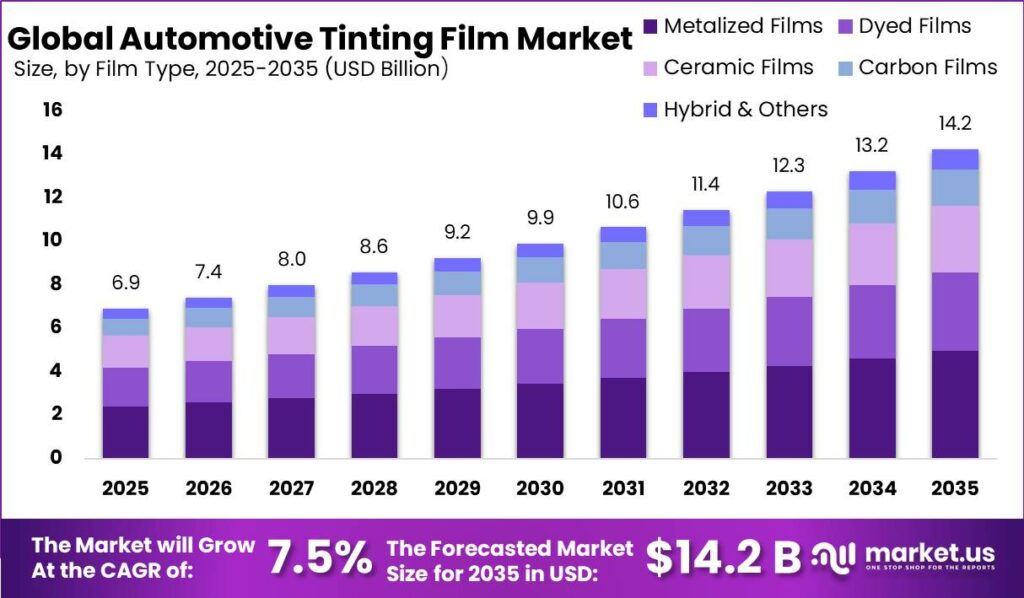
Global Automotive Tinting Film Market size is expected to be worth around USD 14.2 Billion by 2035 from USD 6.9 Billion in 2025, growing at a CAGR of 7.5% during the forecast period 2026 to 2035. This value reflects steady replacement demand and rising premium film adoption. Investors gain a decade of visible, compounding revenue supported by a large installed vehicle base.
The market covers films applied to vehicle glass for heat, glare, privacy, and UV control. Manufacturers sell through aftermarket installers, OEM channels, and dealership networks. Therefore product structure splits between commodity dyed films and higher-value ceramic grades. This layered structure lets sellers target both price-sensitive volume buyers and margin-rich premium buyers within one supply chain.
Key Takeaways
- Global market reaches USD 14.2 Billion by 2035 from USD 6.9 Billion in 2025 at a CAGR of 7.5%.
- Metalized Films lead the Film Type segment with a 34.80% share.
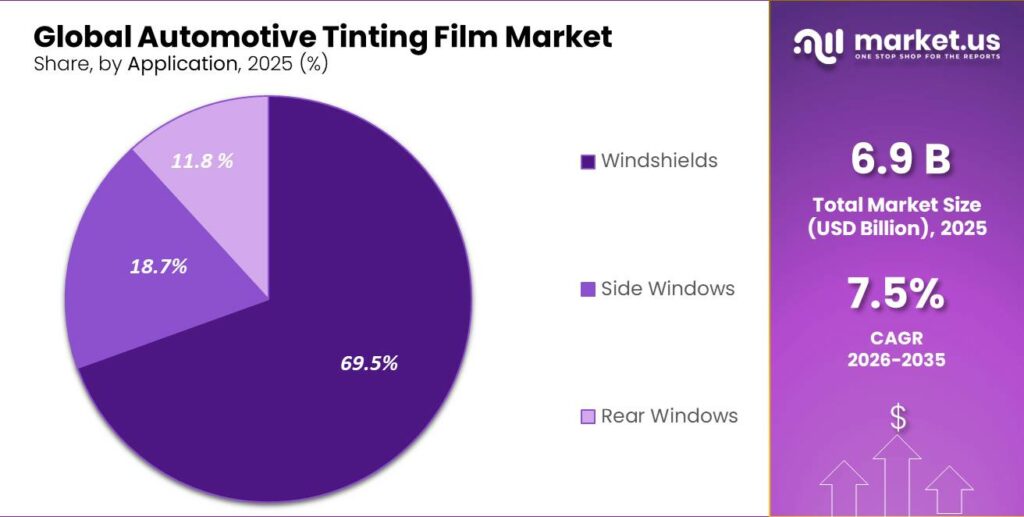
- Windshields dominate applications with a 69.50% share.
- Passenger Cars hold the Vehicle Type segment with a 65.70% share.
- UV Protection Films lead the Technology segment with a 36.40% share.
- Aftermarket Installers control the End User segment with a 58.20% share.
- Solar Control and Heat Reduction leads Functionality with a 41.80% share.
- Independent Installers lead the Sales Channel with a 46.50% share.
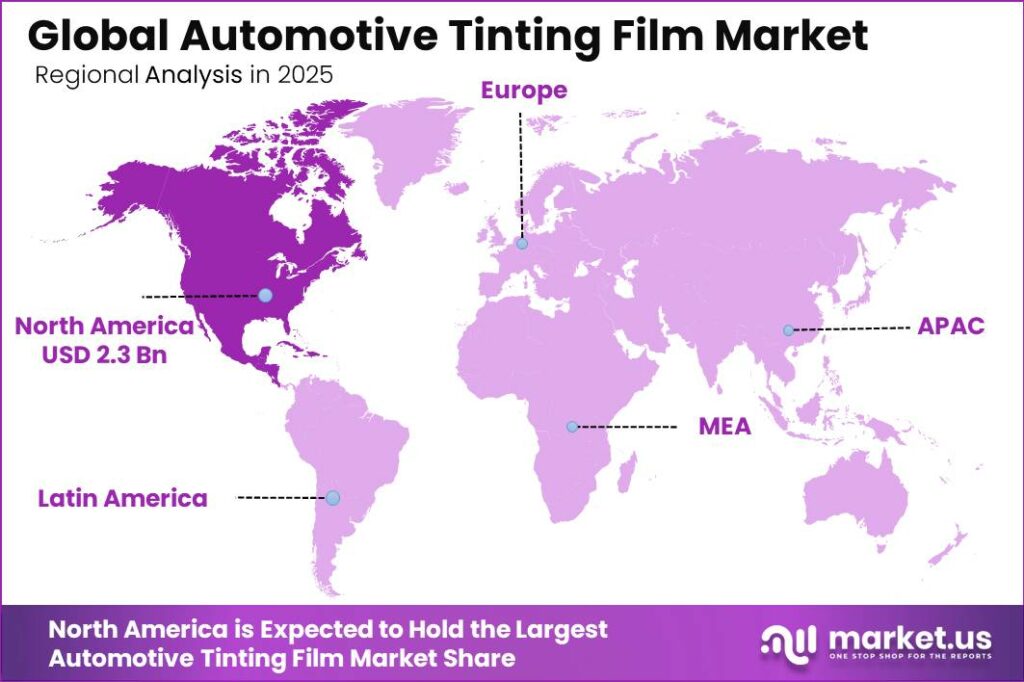
- North America dominates regionally with a 33.40% share, valued at USD 2.3 Billion.
Government rules shape which films sell legally in each region. Many US states enforce a 35% minimum visible light transmission on front side windows. This standard forces installers toward performance films that block heat without darkening glass. Vendors who build compliant ceramic portfolios avoid enforcement risk and protect long-term aftermarket revenue.
Vehicle glazing rules also set a clear technical ceiling for product design. Federal FMVSS 205 safety requirements demand that passenger glazing transmit at least 70% of visible light. This means manufacturers must engineer heat rejection into low-opacity films. As a result, buyers increasingly pay for spectrally selective technology rather than simple darkening.
Consolidation is reshaping who controls regional installation demand. In January 2025, American Window Film acquired the residential and commercial divisions of The Tint Guy. This move expands its regional footprint and signals a broader roll-up trend. Investors should expect stronger multi-site operators to capture pricing power across fragmented installer networks.
Film Type Analysis
Metalized Films dominate with 34.80% due to strong heat and glare control.
In 2025, Metalized Films held a dominant market position in the By Film Type segment of Automotive Tinting Film Market, with a 34.80% share. Global car manufacturing reached 75.5 million units in 2024, per ACEA data. This large output feeds a steady base of vehicles suited to durable metalized layers. Suppliers gain reliable volume demand across both new and existing car fleets.
Dyed Films serve the entry price tier that buyers choose for basic shade and cosmetic appeal. As reported by ACEA, EU car production fell 6.2% in 2024. This means budget films must chase aftermarket refresh demand rather than new builds. Installers stocking dyed films protect turnover by targeting older cars needing cheap replacement tint.
Ceramic Films act as the fastest growing premium tier, prized for signal-safe heat rejection. Data from IEA shows 17 million electric cars sold globally in 2024. This rise pushes buyers toward films that shield cabins without blocking connectivity. Manufacturers scaling ceramic supply capture the margin-rich upgrade path emerging across EV owners.
Carbon Films hold 11.70% and Hybrid and Others hold 6.50% of the segment collectively. Figures from OICA show global vehicle production reached 92.7 million units in 2024. This broad base sustains demand for mid-tier fade-resistant carbon options. Vendors bridging carbon and ceramic lines can upsell buyers stepping up from commodity film.
Application Analysis
Windshields dominate with 69.50% due to large glazing surface heat exposure.
In 2025, Windshields held a dominant market position in the By Application segment of Automotive Tinting Film Market, with a 69.50% share. The US aftermarket served 290 million vehicles in 2024, per the Auto Care Association. This vast in-service fleet drives repeated windshield film demand. Installers gain steady, high-frequency work from the segment carrying the most solar load.
Side Windows serve buyers seeking privacy and side-glare control across daily commuting conditions. The Auto Care Association reports over 535,000 aftermarket businesses operate in the US. This dense network makes side-window film widely accessible to consumers. Vendors supplying these outlets secure broad distribution reach into everyday retail demand.
Rear Windows hold 11.80% of the application segment, completing the vehicle glazing set. As per our research, rear film demand tracks total glazing area per vehicle body style. This means SUVs and larger cars lift per-unit film consumption. Manufacturers pricing by coverage area can raise revenue as buyers shift toward bigger vehicles.
Vehicle Type Analysis
Passenger Cars dominate with 65.70% due to high private ownership tinting demand.
In 2025, Passenger Cars held a dominant market position in the By Vehicle Type segment of Automotive Tinting Film Market, with a 65.70% share. OICA figures show global passenger car production totaled roughly 92.5 million vehicles in 2024. This scale anchors the largest tinting film demand pool. Suppliers focusing on passenger cars capture the deepest and most consistent buyer base.
Light Commercial Vehicles carry film demand tied to fleet comfort and driver protection needs. Data from OICA shows global vehicle output grew to 96.4 million units in 2025. This growth widens the LCV base requiring durable functional film. Vendors offering fleet-grade warranties can win recurring contracts across delivery operators.
Heavy Commercial Vehicles use film mainly for cabin heat control on long-haul routes. As per our research, HCV tinting favors high infrared rejection over cosmetic shade. This means suppliers must lead with thermal performance data. Manufacturers proving cabin cooling gains can justify premium pricing to logistics fleet buyers.
Technology Analysis
UV Protection Films dominate with 36.40% due to rising health-driven cabin demand.
In 2025, UV Protection Films held a dominant market position in the By Technology segment of Automotive Tinting Film Market, with a 36.40% share. A 2024 study across 34 vehicles measured real-world UV transmission, per Springer research. This evidence base strengthens health-led marketing claims. Vendors citing tested UV data convert safety awareness into premium film sales.
Heat Rejection Films serve buyers focused on cabin comfort and fuel or battery efficiency. As per our research, heat control ranks highest among tropical-market buyer priorities. This means suppliers must publish clear infrared rejection specifications. Manufacturers leading on measured heat performance win share in high-temperature regions.
Privacy and Security Films target fleet, VIP, and commercial operators needing discretion and glass strength. The US aftermarket reached nearly USD 535 Billion in 2024, per the Auto Care Association. This spending pool supports specialized security film upsells. Vendors bundling privacy and safety features capture higher-value institutional orders.
Smart and Nano-Ceramic Films form the fastest growing technology tier for connected vehicles. Figures from Springer research show film combinations blocked 99.25% of front-windshield UV-A in testing. This validated performance justifies top-tier pricing. Manufacturers scaling nano-ceramic output secure the market’s fastest expanding revenue stream.
End User Analysis
Aftermarket Installers dominate with 58.20% due to broad retrofit installation demand.
In 2025, Aftermarket Installers held a dominant market position in the By End User segment of Automotive Tinting Film Market, with a 58.20% share. The US aftermarket served 290 million vehicles in 2024, per Auto Care Association data. This installed base fuels continuous retrofit installation work. Film makers supplying installers reach the widest and most active buyer channel.
OEM factory-fitted film represents the fastest growing end-user path as automakers embed film at build. In September 2025, Garware Hi-Tech Films opened a new PPF line in Maharashtra with a 300 lakh sq ft annual capacity. This investment expands supply for factory and OEM-grade demand. Suppliers securing OEM contracts lock in predictable long-run volume.
Automotive Dealerships and Fleet Operators buy film as a bundled value-add during vehicle handover. As per our research, dealership tint attach rates rise with accessory package promotion. This means film vendors gain from co-marketing with sales teams. Manufacturers training dealer staff convert new-car sales into steady film revenue.
Functionality Analysis
Solar Control and Heat Reduction dominates with 41.80% due to cabin cooling priority.
In 2025, Solar Control and Heat Reduction held a dominant market position in the By Functionality segment of Automotive Tinting Film Market, with a 41.80% share. Global vehicle production reached 96.4 million units in 2025, per ICAEW figures citing OICA. This output base widens demand for heat-cutting film. Vendors leading on solar control capture the largest functional buyer group.
UV Protection functionality serves buyers treating film as a preventive health product for skin safety. As per our research, high-UV regions show the strongest health-led film demand. This means suppliers must localize marketing to sun-intense markets. Manufacturers targeting these regions convert awareness into durable repeat sales.
Glare Reduction addresses driver safety by cutting harsh light during dawn and dusk driving. Global car manufacturing totaled 75.5 million units in 2024, per ACEA data. This large fleet sustains steady glare-control film demand. Vendors positioning glare films around safety benefits reach cautious everyday drivers.
Safety and Security functionality forms the fastest growing functional tier for glass reinforcement. As per our research, security film demand rises with fleet and commercial theft concerns. This means suppliers can price on protective value. Manufacturers proving impact resistance win institutional and fleet contracts.
Sales Channel Analysis
Independent Installers dominate with 46.50% due to wide local service coverage.
In 2025, Independent Installers held a dominant market position in the By Sales Channel segment of Automotive Tinting Film Market, with a 46.50% share. Over 535,000 aftermarket businesses operate in the US, per Auto Care Association data. This dense base explains the channel’s leading reach. Film suppliers courting independents access the broadest installation footprint.
Automotive Accessory Retailers sell film alongside related upgrade products for convenience-driven buyers. The US aftermarket reached nearly USD 535 Billion in 2024, per Auto Care Association figures. This spending supports strong retail accessory attachment. Vendors merchandising film with accessories lift basket size per customer.
OEM Sales form the fastest growing channel as automakers integrate film into vehicle specifications. Global passenger car production hit 92.5 million units in 2024, per OICA data. This scale rewards early OEM channel positioning. Suppliers winning factory specifications secure high-volume, low-churn revenue.
Online Channels round out the segment by serving DIY and price-comparison buyers directly. As per our research, online film demand favors clear performance labeling and reviews. This means brands must standardize digital product data. Manufacturers optimizing online listings reach cost-conscious self-install buyers.
Key Market Segments
By Film Type
- Metalized Films
- Dyed Films
- Ceramic Films
- Carbon Films
- Hybrid & Others
By Application
- Windshields
- Side Windows
- Rear Windows
By Vehicle Type
- Passenger Cars
- Light Commercial Vehicles (LCVs)
- Heavy Commercial Vehicles (HCVs)
By Technology
- UV Protection Films
- Heat Rejection Films
- Privacy & Security Films
- Smart/Nano-Ceramic Films
By End User
- Aftermarket Installers
- OEM (Factory-Fitted)
- Automotive Dealerships & Fleet Operators
By Functionality
- Solar Control & Heat Reduction
- UV Protection
- Glare Reduction
- Safety & Security
By Sales Channel
- Independent Installers
- Automotive Accessory Retailers
- OEM Sales
- Online Channels
Regional Analysis
North America Dominates the Automotive Tinting Film Market with a Market Share of 33.40%, Valued at USD 2.3 Billion
North America leads the market with a 33.40% share worth USD 2.3 Billion in 2025. Strict state VLT rules push buyers toward compliant performance films. This drives strong ceramic and UV film demand across the region. Suppliers offering law-compliant premium portfolios protect revenue and reduce enforcement-linked returns.
Asia Pacific stands as the fastest growing region on rising vehicle ownership and high heat exposure. Emerging markets add large volumes of price-sensitive first-time film buyers. This creates a two-tier demand for both commodity and premium films. Vendors building local supply and installer networks capture this expanding demand early.
Key Regions and Countries
North America
- US
- Canada
Europe
- Germany
- France
- The UK
- Spain
- Italy
- Rest of Europe
Asia Pacific
- China
- Japan
- South Korea
- India
- Australia
- Rest of APAC
Latin America
- Brazil
- Mexico
- Rest of Latin America
Middle East and Africa
- GCC
- South Africa
- Rest of MEA
Market Dynamics
Market Opportunity Analysis - Underserved premium tiers and factory channels offer entry points for new players
Ceramic Films remain underexploited beyond tier-1 cities despite their fastest-growing status. The segment sits below Metalized Films at 34.80% and holds room in tier-2 and tier-3 markets. This gap lets new entrants target price-easing premium demand outside crowded metros. Investors backing regional ceramic supply can win share before incumbents expand distribution.
OEM factory-fitted film stays underused relative to the 65.70% Passenger Car base. Automakers still fit little film at build despite this fast-growing end-user path. This means suppliers who secure factory specifications lock in stable, high-volume contracts. Early movers gain pricing power that fragmented aftermarket channels cannot match.
Asia Pacific stays underpenetrated against North America’s leading 33.40% regional share. Rising ownership and heat exposure create demand that current supply does not fully serve. Consequently vendors building local installer networks capture first-mover advantage. This positions early entrants to hold share as the region scales toward maturity.
Rear Window film remains a quiet opportunity at just 11.80% of applications. Larger vehicle bodies lift per-unit glazing area and rear coverage needs. This means area-based pricing can unlock incremental revenue per installation. New players emphasizing full-vehicle coverage can differentiate against windshield-only competitors.
Technology and Innovation Landscape - Nano-ceramic performance and material recycling redefine competitive edges
Nano-ceramic film sets the performance benchmark for the premium tier. A 2025 datasheet shows nano-ceramic film delivering up to 99.9% UV light blocking. The same film rejects up to 68% of infrared energy through vehicle windows. This lets manufacturers justify premium pricing and win connectivity-sensitive EV buyers.
Ceramic grades widen the performance gap over commodity film chemistry. Ceramic tint achieves 60 to 70% heat rejection and 90 to 98% infrared rejection by grade. By contrast, dyed films deliver only 25 to 35% heat rejection and 15 to 25% infrared blocking. This means suppliers leading on measured specifications capture the high-margin upgrade market.
Carbon film offers a durable mid-tier bridge between dyed and ceramic products. Carbon-based tint provides 45 to 55% heat rejection and 70 to 80% infrared blocking. This positions carbon as a fade-resistant step-up for value-conscious buyers. Manufacturers offering carbon lines convert budget buyers toward higher-margin tiers.
Photochromic and recycled materials point to the next innovation frontier. Flexible photochromic glazing films showed dynamic solar modulation triggered by UV exposure in 2023 to 2024 studies. LINTEC’s 100% recycled PET film cut CO2 emissions by about 17.5%. This signals that adaptive and sustainable materials will shape future competitive advantage.
Drivers
Rising solar heat and UV awareness push buyers from commodity dyed film toward ceramic and nano-ceramic grades. Parked cabins reach 60 to 80°C in direct sun when ambient temperatures hit 38 to 45°C. Premium films block 96 to 99% of infrared and up to 99.9% of UV while keeping 50 to 70% visible light. This shift lifts installer margins and rewards vendors leading the premium tier.
Falling premium prices widen this driver’s reach across high-heat markets. Nano-ceramic retail pricing dropped roughly 22 to 30% in real terms from 2021 levels. Ceramic now drives 35 to 48% of premium install revenue in tier-1 cities, up from 15 to 22% in 2019. This means certified installers earn 55 to 68% gross margins and build defensible Automotive Film distribution networks.
| Driver | (~) % Impact on CAGR Forecast | Geographic Relevance | Impact Timeline |
|---|---|---|---|
| Rising Solar Heat & UV Radiation Awareness Driving Ceramic & Nano-Ceramic Film Adoption for Cabin Thermal Management | +2.30% | Middle East, South Asia, Southeast Asia, China, Australia, United States (Sun Belt states) | Short term (≤ 2 years) |
| EV Range Optimisation Demand Creating OEM & Aftermarket Interest in Solar-Reflective Window Films | +1.40% | China, United States, Europe, South Korea, Japan | Short term (≤ 2 years) |
| Expanding Global Vehicle Parc & Rising Aftermarket Accessory Spend in Emerging Markets | +1.00% | India, Southeast Asia, Latin America, Middle East, Sub-Saharan Africa | Short term (≤ 2 years) |
| Privacy & Security Film Demand from Fleet, VIP & Commercial Vehicle Operators | +0.72% | GCC, India, China, United States, Sub-Saharan Africa | Medium term (2–4 years) |
| OEM Factory-Fit Window Film Integration by Premium & Luxury Automakers | +0.55% | Germany, Japan, South Korea, United States, China | Medium term (2–4 years) |
| Escalating UV-Linked Skin Cancer Awareness Campaigns Supporting Automotive Film as Preventive Health Product | +0.38% | Australia, United States, Europe, GCC, South Africa | Short term (≤ 2 years) |
Restraints
Strict VLT limits block dark films on front and side glass across major markets. Rules typically set 70 to 75% VLT for front side glass and 70 to 80% for windshields. All 50 US states enforce limits ranging from 28% in California to 35% in Texas and Florida. This confines the legal market to performance films and exposes violators to fines of USD 100 to 500.
India’s rules deepen this restraint and split the market into formal and informal channels. A Supreme Court ruling bars film below 70% VLT on windshields and 50% on side and rear glass. This pushes formal Automotive Glass sellers toward compliant film at USD 280 to 650 per vehicle. Consequently an estimated 30 to 45% of volume leaks to illegal installs at USD 40 to 120 per vehicle.
| Restraint | (~) % Impact on CAGR Forecast | Geographic Relevance | Impact Timeline |
|---|---|---|---|
| Strict Visible Light Transmission (VLT) Legal Limits Banning High-Opacity Films on Front & Side Windows | -1.60% | United States, European Union, India, Australia, China, Canada, Singapore | Short term (≤ 2 years) |
| Unorganised & Low-Cost Installer Competition Commoditising the Mid-Tier Market & Suppressing ASPs | -0.80% | India, Southeast Asia, Sub-Saharan Africa, Latin America, Middle East | Short term (≤ 2 years) |
| Consumer DIY Film Installation Kits Substituting Professional Installation Revenue | -0.45% | United States, Europe, Australia, South Korea, China | Short term (≤ 2 years) |
| OEM Factory-Tinted Glass Reducing Aftermarket Film Installation Need on New Vehicles | -0.35% | Europe, United States, Japan, South Korea — OEM factory-glass intensive markets | Medium term (2–4 years) |
Challenges
Counterfeit film infiltrates fragmented installer networks and erodes trust in genuine brands. Fake single-layer dyed PET costs USD 0.08 to 0.25 per square metre versus USD 1.50 to 4.50 for real nano-ceramic. These imitations undercut genuine product by 60 to 80% while installers still charge USD 150 to 300. This lets bad actors capture full margin and damages the premium brands whose names appear on fake packaging.
Early failure of counterfeit film compounds the damage to legitimate players. Fake film discolours and delaminates within 6 to 18 months in regions facing a UV Index of 9 to 12 for 200+ days yearly. This kills repeat purchases and referral sales, the main Automotive Aftermarket growth channel. Therefore brands must spend USD 500,000 to 2,500,000 on authentication systems over 3 to 5 years.
| Challenge | (~) % CAGR Friction Drag | Geographic Relevance | Mitigation Horizon |
|---|---|---|---|
| Counterfeit & Sub-Standard Film Market Infiltration | -0.95% | India, Southeast Asia, Sub-Saharan Africa, Latin America, Middle East | Long term (≥ 4 years) |
| Installer Skill Gap & Bubble-Free Application Quality Consistency | -0.70% | Global — most acute in India, Africa, Latin America, Southeast Asia | Long term (≥ 4 years) |
| PET Substrate & Coating Input Cost Volatility | -0.48% | Global — PET resin pricing linked to crude oil & PTA feedstock | Medium term (2–4 years) |
| Film Delamination & Discolouration Warranty Claims Compressing Distributor Margins | -0.35% | High-UV markets — GCC, South Asia, Southeast Asia, Australia | Long term (≥ 4 years) |
| ADAS Camera & Sensor Optical Interference from Film Coatings | -0.28% | Europe, United States, Japan, South Korea — high ADAS penetration markets | Long term (≥ 4 years) |
Opportunities
Photovoltaic window film opens clear white space for energy-harvesting glazing. Organic and perovskite thin-film cells reach 15 to 19% lab efficiency at 200 to 500 nm thickness, matching film laminates. Semi-transparent versions hit 10 to 13% efficiency at 25 to 40% VLT. This proves the technical base for automotive film that also generates power.
The revenue case rewards the first movers to clear durability qualification. A 1.5 to 2.0 m² glazing area can generate 8 to 15 Wh daily, adding 3 to 6 km of EV range. This justifies an install premium of USD 800 to 1,800 per vehicle at 60 to 72% margins. However, reaching this needs USD 20,000,000 to 75,000,000 in R&D over a 4 to 7 year window.
| Opportunity | (~) % Potential CAGR Upside | Geographic Relevance | Execution Window |
|---|---|---|---|
| Photovoltaic & Energy-Harvesting Window Film for EV Solar Range Extension | +1.80% | China, Japan, South Korea, Germany, United States, Australia | Long term (≥ 4 years) |
| Electrochromic & Switchable Smart Film Integration in Premium & Autonomous Vehicle Glazing | +1.20% | Germany, United States, Japan, South Korea, China | Long term (≥ 4 years) |
| OEM Pre-Applied Factory Film Specification Programmes for Tropical & High-UV Market Vehicles | +0.85% | India, Southeast Asia, GCC, Australia, Sub-Saharan Africa | Medium term (2–4 years) |
| Paint Protection Film (PPF) Cross-Sell Bundling with Window Tint at Authorised Installer Networks | +0.62% | United States, Europe, GCC, China, Australia | Short term (≤ 2 years) |
| Subscription-Based Film Replacement & Warranty Service Model for Fleet & Corporate Vehicle Operators | +0.42% | United States, Europe, GCC, India, Australia | Medium term (2–4 years) |
Key Company Insights
Cosmo First holds a strong position through nanotechnology film that blocks up to 90% infrared and 99% UV rays. This performance meets strict transmission rules where clear glass passes about 90% of visible light. Its dual automotive and architectural focus spreads risk across demand cycles. However, brand recognition against entrenched premium players remains a competitive hurdle in export markets.
Cosmo Consumer builds advantage through bundled window film and PPF systems backed by warranties up to 7 years. In February 2026, the company showcased these solutions at Automechanika 2026. This warranty depth suits markets like the UK, which requires 75% windscreen light transmission. Consequently the firm converts trade-show visibility into installer trust, though long warranties raise claim-cost exposure.
Key Players
- Cosmo First
- Cosmo Consumer
- Avery Dennison
- LINTEC
- Garware Hi-Tech Films
- American Window Film
Recent Developments
- February 2025: Avery Dennison launched the Encore automotive window film portfolio, a three-tier system delivering up to 93% infrared heat rejection and 65% total solar energy rejection.
- July 2025: LINTEC launched the BR-50UH RECYCLE 100 solar control film made with 100% recycled PET resin, cutting CO2 emissions by about 17.5% versus conventional films.
- May 2025: Cosmo First began commercial production of Cosmo Sunshield films using nanotechnology that blocks up to 90% infrared rays and 99% UV rays.
Geopolitical Impact Analysis
Trade tensions raise input costs for PET-based film supply chains. According to the WTO, world merchandise trade volume grew only 2.7% in 2024 amid rising restrictions. Data from the IEA shows crude oil averaged near USD 80 per barrel through 2024, lifting PET feedstock costs. This means film makers face margin pressure and must hedge resin sourcing across regions.
Shipping disruption lengthens delivery times for globally sourced film rolls. As reported by UNCTAD, Red Sea rerouting added roughly 10 to 14 days to Asia-Europe transit in 2024. Figures from the World Bank show global logistics costs rose sharply as container rates climbed. Consequently distributors carry larger buffer inventory, tying up capital and raising landed film prices.
Report Scope
| Report Features | Description |
|---|---|
| Market Value (2025) | USD 6.9 Billion |
| Forecast Revenue (2035) | USD 14.2 Billion |
| CAGR (2026-2035) | 7.5% |
| Base Year for Estimation | 2025 |
| Historic Period | 2020-2024 |
| Forecast Period | 2026-2035 |
| Report Coverage | Revenue Forecast, Market Dynamics, Market Opportunity Analysis, Technology and Innovation Landscape, Competitive Landscape, Recent Developments |
| Segments Covered | By Film Type (Metalized Films, Dyed Films, Ceramic Films, Carbon Films, Hybrid & Others), By Application (Windshields, Side Windows, Rear Windows), By Vehicle Type (Passenger Cars, LCVs, HCVs), By Technology (UV Protection Films, Heat Rejection Films, Privacy & Security Films, Smart/Nano-Ceramic Films), By End User (Aftermarket Installers, OEM, Automotive Dealerships & Fleet Operators), By Functionality (Solar Control & Heat Reduction, UV Protection, Glare Reduction, Safety & Security), By Sales Channel (Independent Installers, Automotive Accessory Retailers, OEM Sales, Online Channels) |
| Regional Analysis | North America (US and Canada), Europe (Germany, France, The UK, Spain, Italy, and Rest of Europe), Asia Pacific (China, Japan, South Korea, India, Australia, and Rest of APAC), Latin America (Brazil, Mexico, and Rest of Latin America), Middle East and Africa (GCC, South Africa, and Rest of MEA) |
| Competitive Landscape | Cosmo First, Cosmo Consumer, Avery Dennison, LINTEC, Garware Hi-Tech Films, American Window Film |
| Customization Scope | Customization for segments, region / country-level will be provided. Additional customization can be done based on requirements. |
| Purchase Options | We have three licenses to opt for: Single User License | Multi-User License (Up to 5 Users) | Corporate Use License (Unlimited User and Printable PDF) |





































