


Report Overview
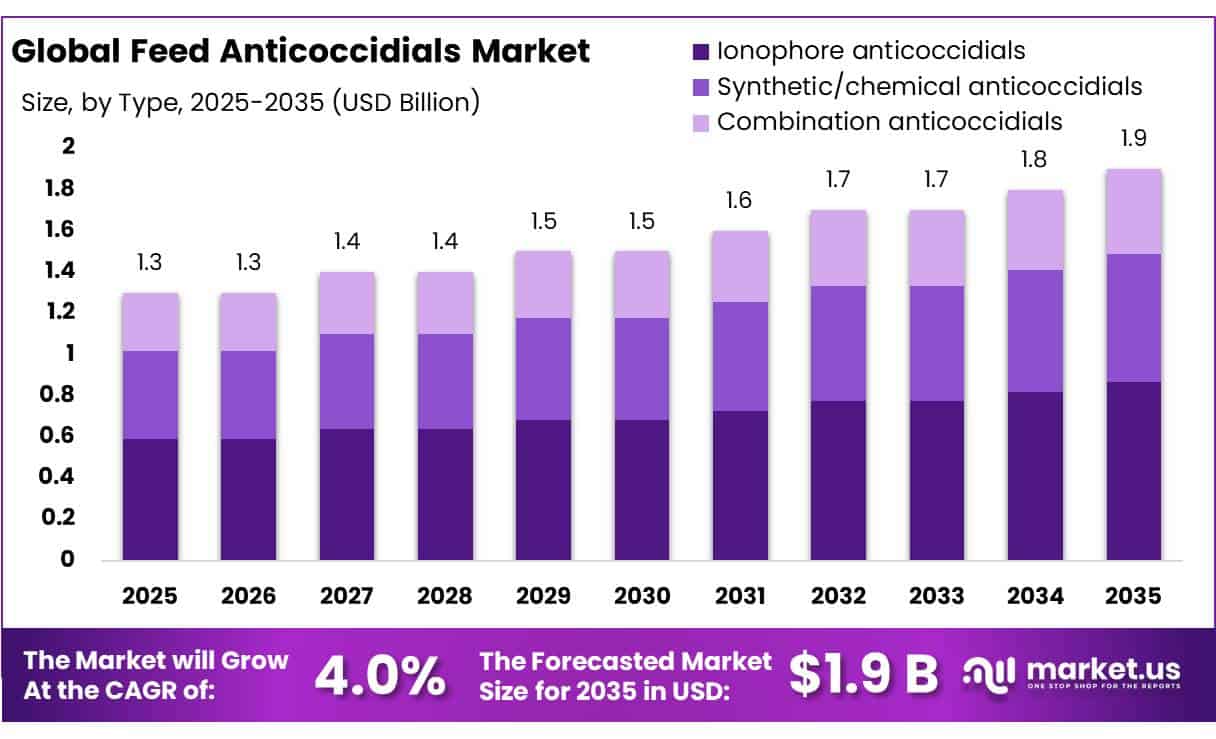
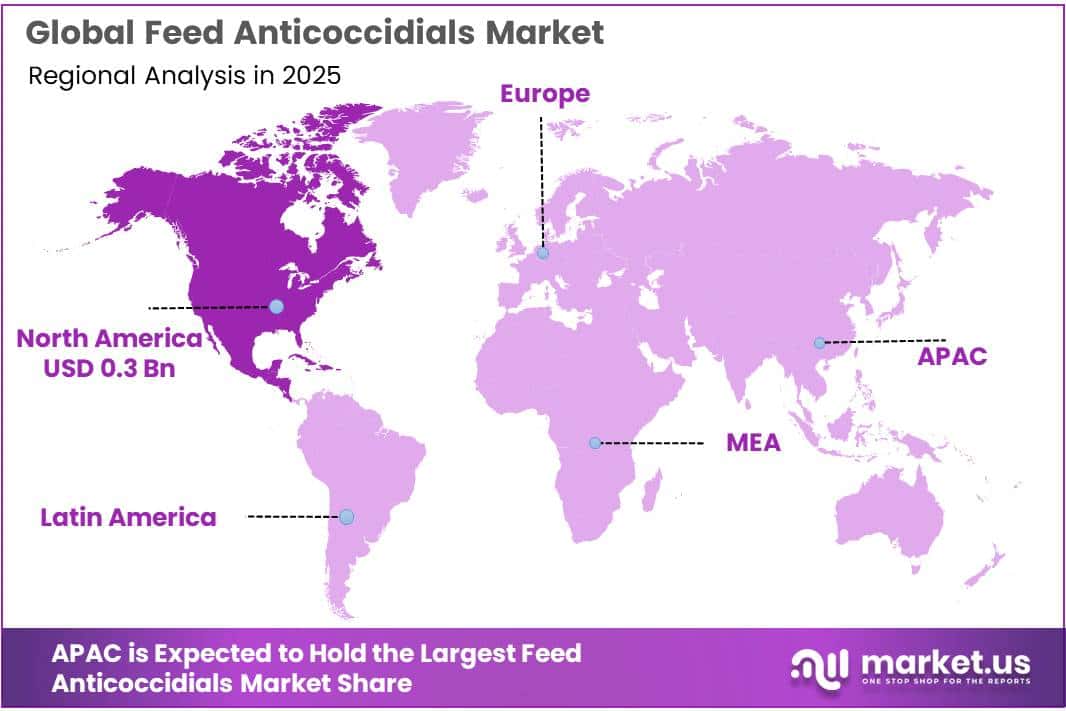
The Global Feed Anticoccidials Market size is expected to be worth around USD 1.9 Billion by 2035, from USD 1.3 Billion in 2025, growing at a CAGR of 4.0% during the forecast period from 2026 to 2035. In 2025, North America held a dominant market position, capturing more than a 30.2% share, holding USD 0.3 Billion revenue.
Feed anticoccidials are specialized feed additives used mainly in poultry and other livestock to prevent or control coccidiosis, an intestinal disease caused largely by Eimeria parasites. Major products include ionophores such as monensin, salinomycin, lasalocid and narasin, along with synthetic compounds such as nicarbazin and decoquinate.
- A peer-reviewed global assessment estimated the economic burden of chicken coccidiosis at around £10.4 billion, equivalent to nearly £0.16 per chicken produced, highlighting the economic value of preventive programs.
Key Takeaways
- Feed Anticoccidials Market size is expected to be worth around USD 1.9 Billion by 2035, from USD 1.3 Billion in 2025, growing at a CAGR of 4.0%.
- Ionophore anticoccidials held a dominant market position, capturing more than a 45.50% share.
- Poultry held a dominant market position, capturing more than a 44.90% share of the Feed Anticoccidials Market.
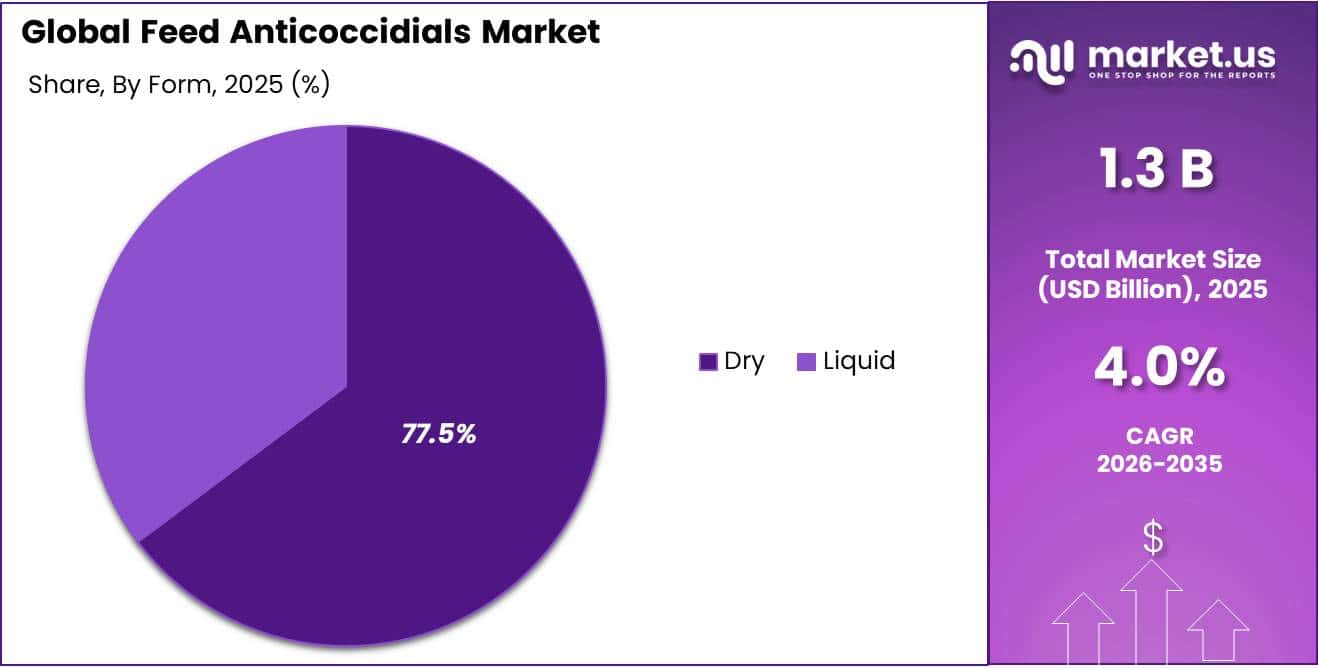
- Dry held a dominant market position, capturing more than a 77.50% share of the Feed Anticoccidials Market.
- North America held a dominant market position, capturing more than a 30.20% share and reaching USD 0.38 billion in the Feed Anticoccidials Market.
The industrial scenario is supported by the large global animal-feed base. Alltech estimated worldwide feed production at approximately 1.396 billion metric tonnes, representing an annual increase of 1.2%, FEFAC forecast poultry feed production at 50.653 million tonnes, rising 1.5%, indicating continued demand for health-protection additives in commercial feed formulations.
Government regulation remains an important part of the industry structure. The European Commission treats coccidiostats and histomonostats as a dedicated category of regulated feed additives, requiring scientific authorization before commercialization. EU authorizations are generally valid for 10 years and can subsequently be renewed for another 10-year period, encouraging suppliers to maintain safety, efficacy and environmental documentation throughout the product lifecycle.
A major demand driver is the continued expansion of poultry production and consumption. OECD-FAO projects global poultry meat consumption to reach about 173 million tonnes by 2034, with poultry accounting for approximately 62% of additional global meat consumption over the outlook period. Higher commercial bird populations and intensive production systems increase exposure to parasite challenges, supporting regular use of preventive feed solutions. WOAH also recognizes several ionophores as important tools for controlling intestinal coccidiosis, particularly in poultry.
Resistance management is also shaping product demand. The Merck Veterinary Manual notes that poultry producers may rotate anticoccidial compounds every 4–6 months, while commercial broiler production commonly involves grow-out periods of around 37–44 days. This creates opportunities for rotation programs, combination products, precision premixes and integrated vaccination strategies.
Future growth opportunities are expected in safer formulations, precise dosing, residue management, resistance-monitoring programs and combinations of anticoccidials with vaccines and gut-health technologies. OECD-FAO expects global meat, dairy and egg production to increase by 17% over the coming decade, while worldwide livestock inventories are projected to expand by 7%.
By Type Analysis
Ionophore anticoccidials dominate the Feed Anticoccidials Market with more than a 45.50% share
In 2025, Ionophore anticoccidials held a dominant market position, capturing more than a 45.50% share of the Feed Anticoccidials Market. The segment maintains its leading position because ionophores such as monensin and narasin are widely used in commercial poultry feed to prevent coccidiosis while supporting consistent flock performance.
Synthetic/chemical anticoccidials form an important part of the Feed Anticoccidials Market because poultry producers use them as alternatives or rotation partners to ionophore products.
In 2026, the European Food Safety Authority evaluated diclazuril for chickens for fattening and chickens reared for laying and concluded that its use at a maximum level of 1 mg/kg of complete feed did not pose an identified risk to terrestrial or aquatic environments, groundwater, or through secondary poisoning.
By Livestock Analysis
Poultry dominates the Feed Anticoccidials Market with more than a 44.90% share, supported by large-scale broiler production.
In 2025, Poultry held a dominant market position, capturing more than a 44.90% share of the Feed Anticoccidials Market. Poultry remains the leading livestock segment because intensive broiler and layer farming creates a strong need to control coccidiosis through routine feed-management programs.
- According to the U.S. Department of Agriculture, U.S. farms produced 9.40 billion broilers in 2025, while total broiler live-weight production reached 62.2 billion pounds. This large commercial poultry base supports steady consumption of anticoccidial feed products across broiler production systems.
Swine represents an important application area for feed anticoccidials, particularly where producers focus on protecting young animals from intestinal parasite challenges and maintaining consistent growth. The segment benefits from large commercial pig populations, higher-density farming and greater attention to preventive animal-health programs.
In June 2026, the U.S. Department of Agriculture reported 73.7 million hogs and pigs on U.S. farms, including 67.8 million market hogs. During March–May 2026, producers also weaned 33.5 million pigs, showing the large number of young animals moving through commercial production systems.
By Form Analysis
Dry dominates the Feed Anticoccidials Market with more than a 77.50% share, supported by its easy mixing and large-scale feed use.
In 2025, Dry held a dominant market position, capturing more than a 77.50% share of the Feed Anticoccidials Market. Dry anticoccidials are widely preferred because they can be incorporated directly into premixes, mash and pelleted feed, allowing feed manufacturers to maintain uniform dosing across large poultry flocks.
- In 2025, the United States produced 9.40 billion broilers, while total broiler live-weight production reached 62.2 billion pounds, showing the large volume of poultry feed required by intensive production systems.
Liquid anticoccidials represent an important form within the Feed Anticoccidials Market, particularly where producers require easier dispersion, flexible dosing and controlled incorporation into feeding systems. Liquid formulations can support operations that need rapid preparation and consistent distribution of medicated ingredients, although handling and storage requirements can be more demanding than for dry products.
Key Market Segments
By Type
- Ionophore anticoccidials
- Synthetic/chemical anticoccidials
- Combination anticoccidials
By Livestock
- Poultry
- Swine
- Ruminants
- Aquaculture
- Other livestock
By Form
- Dry
- Liquid
Driver Analysis
Structural Rise in Global Poultry Output
Global meat production is on track to expand roughly 13%, or about 46 million tons carcass-weight, by the mid-2030s, with poultry alone contributing over half of that incremental volume and China, India, the United States, and Vietnam together accounting for roughly a third of the added output.
As Asia-Pacific broiler integration deepens and feed-mill capacity utilization rises in line with the region’s 15-million-ton poultry production increase projected through the next decade, anticoccidial manufacturers with regional formulation and blending plants are structurally positioned to capture disproportionate share versus import-dependent competitors.
The commercial implication is a gradual shift from single-SKU chemical sales toward bundled feed-additive-plus-technical-service contracts, mirroring how integrators now demand performance guarantees tied to feed-conversion benchmarks rather than raw drug volume.
Drivers Impact Analysis
| Driver | (~) % Impact on CAGR Forecast | Geographic Relevance | Impact Timeline |
|---|---|---|---|
| Structural rise in global poultry meat output lifting medicated-feed volumes | +1.6% | APAC core (China, India, Vietnam), North America, EU spill-over | Long term (≥4 years) |
| Regulatory tightening on ionophore/antibiotic residues forcing reformulation | +1.1% | EU core, UK, South Korea, North America corridors | Medium term (2-4 years) |
| Consumer-driven shift to “raised without antibiotics” and natural anticoccidials | +0.9% | North America core, Western Europe, APAC premium urban segments | Medium term (2-4 years) |
| Persistently high disease-burden economics from Eimeria/coccidiosis outbreaks | +0.8% | Global, concentrated in intensive-farming APAC and South America corridors | Short term (≤2 years) |
| Precision livestock nutrition and AI-enabled dosage optimization | +0.6% | North America, EU, APAC innovation hubs (China, India) | Long term (≥4 years) |
| Vaccine substitution and bio-shuttle program adoption reshaping product mix | -0.4% | North America, Western Europe core; APAC early adoption | Medium term (2-4 years) |
Restraint Analysis
Widening Eimeria Drug Resistance Eroding Product Efficacy
Longitudinal field sensitivity data spanning 1980-2024 documents a persistent annual sensitivity decline of approximately 1.23% across commercial anticoccidial compounds, with recent multi-farm surveys finding resistance prevalence exceeding 75% for older ionophores such as narasin/nicarbazin blends and salinomycin-class products, and multi-medication resistance detected in roughly 7% of sampled Eimeria isolates across turkey and broiler operations.
This erosion forces integrators into faster drug-rotation cycles, typically compressing the effective commercial lifespan of a given anticoccidial SKU from an historical 8-10 year window to closer to 4-6 years before efficacy-driven delisting, which directly inflates R&D amortization burden per approved molecule and forces suppliers to run parallel four-to-five-compound rotation portfolios rather than monetizing a single blockbuster chemistry.
Because resistance accumulates fastest under continuous, non-rotated dosing a practice still common across cost-sensitive APAC feed mills regional efficacy decay rates are uneven, creating a bifurcated market where APAC volume growth is offset by accelerating repurchase-cycle disruption, net compressing the category’s CAGR outlook by an estimated 1.4 percentage points over the medium term.
Restraint Impact Analysis
| Restraint | (~) % Impact on CAGR Forecast | Geographic Relevance | Impact Timeline |
|---|---|---|---|
| Widening Eimeria drug resistance eroding product efficacy | -1.4% | Global, acute in APAC intensive corridors, North America | Medium term (2-4 years) |
| EU 2026 antimicrobial-import certification mandate restricting third-country trade | -1.0% | EU core, exporting corridors (South America, APAC) | Short term (≤2 years) |
| API/KSM supply-chain concentration in China raising input costs | -0.9% | Global, transmitted via India, APAC manufacturing hubs | Short term (≤2 years) |
| Regulatory divergence and ionophore prescription-only reclassification risk | -0.7% | EU, UK core; North America spill-over risk | Medium term (2-4 years) |
| Vaccine and natural-alternative substitution cannibalizing chemical volumes | -0.6% | North America core, Western Europe, APAC premium segments | Long term (≥4 years) |
| Feed-mill margin compression from volatile grain and energy costs | -0.5% | Global, pronounced in South America, EU energy-exposed corridors | Short term (≤2 years) |
Opportunity Analysis
Africa Poultry-Belt Greenfield Expansion and Localized Formulation Entry
Africa’s poultry sector remains structurally under-penetrated by global anticoccidial suppliers despite double-digit historical broiler growth in markets such as Zambia, where output expanded 8-10% annually since 2000, and Egypt, which produced 1.8 million metric tons in 2025 while targeting 1.9 million by 2028 through desert-farm expansion and exports to over 20 countries; because current supply into these corridors is dominated by imported, non-localized chemical formulations sold through thin distribution networks, this represents genuine untapped TAM rather than a current driver, since existing baseline forecasts assume continuation of import-dependent trade rather than the accelerated in-region manufacturing investment now underway, evidenced by South Africa’s ZAR 2.1 billion poultry-facility investment between 2019-2023 that added 19 million broilers of annual capacity.
A first-mover strategy establishing local blending and formulation plants in Egypt, Nigeria, or South Africa could reduce landed-cost premiums by an estimated 20-25% versus imported product, compress customer-acquisition costs by embedding technical-service teams directly with regional integrators, and capture incremental margin as African compound feed demand valued at roughly USD 14.5-15 billion in 2025-2026 continues double-digit expansion in select corridors, translating into an estimated 1.8 percentage point CAGR upside for suppliers who commit to localized manufacturing within the next two-to-four years rather than continuing pure-export models.
Opportunity Impact Analysis
| Opportunity | (~) % Potential CAGR Upside | Geographic Relevance | Execution Window |
|---|---|---|---|
| Africa poultry-belt greenfield expansion and localized formulation entry | +1.8% | Egypt, Nigeria, South Africa, Zambia, broader Sub-Saharan Africa | Medium term (2-4 years) |
| Swine and ruminant coccidiosis TAM expansion beyond poultry-centric portfolios | +1.3% | APAC swine corridors (China, Vietnam), EU ruminant belts, North America | Medium term (2-4 years) |
| Postbiotic/microbiome-based anticoccidial adjacency monetization | +1.1% | North America, EU premium segments, APAC innovation hubs | Long term (≥4 years) |
| Outcome-based subscription contracting replacing per-ton drug sales | +0.9% | North America core, EU integrator networks | Medium term (2-4 years) |
| M&A roll-up of fragmented regional formulators into scaled platforms | +0.8% | APAC (India, Southeast Asia), Latin America fragmented markets | Short term (≤2 years) |
| EU non-ionophore compliance-chemistry first-mover licensing arbitrage | +0.6% | EU core, UK, spill-over into North America pre-emptive registration | Short term (≤2 years) |
Challenges Analysis
Stalled Novel-Molecule R&D Pipeline
No fundamentally new anticoccidial chemical class has reached commercial approval in poultry for several decades, leaving the industry reliant on the same core ionophore and synthetic scaffolds first commercialized in the 1970s-1990s, even as documented resistance now spans essentially all currently approved compounds; bringing a genuinely novel animal-health molecule to market carries an average developmental cost exceeding USD 100 million and requires distinct preclinical, safety, and efficacy dossiers across jurisdictions such as China, Japan, and Australia, while the commercial payback window is simultaneously compressed by resistance onset that can erode a molecule’s field efficacy within a handful of years post-launch.
This creates a persistent innovation-versus-return mismatch that does not halt current sales generic rotation-based formulations continue to move volume but structurally caps the category’s long-run growth ceiling, pushing an estimated 1.2 percentage point continuous drag on maximum achievable CAGR as R&D budgets get redirected toward incremental combination products and regional low-cost synthetic analogs rather than genuinely new modes of action.
Challenges Impact Analysis
| Challenge | (~) % CAGR Friction Drag | Geographic Relevance | Mitigation Horizon |
|---|---|---|---|
| Stalled novel-molecule R&D pipeline | -1.2% | Global, acute in APAC generic-heavy markets | Long term (≥4 years) |
| Food-animal veterinary talent deficit | -0.8% | North America core, EU rural corridors | Long term (≥4 years) |
| Counterfeit and substandard drug penetration | -1.0% | Sub-Saharan Africa, South/Southeast Asia | Medium term (2-4 years) |
| Multi-jurisdiction registration complexity | -0.7% | APAC (China, Japan, Australia), EU-UK divergence | Medium term (2-4 years) |
| Climate-driven disease-pattern volatility | -0.6% | South Asia, Sub-Saharan Africa, tropical APAC | Long term (≥4 years) |
| Rotation-program logistics and cold-chain friction | -0.5% | APAC smallholder corridors, South America | Short term (≤2 years) |
Geopolitical Impact Analysis
Russia–Ukraine and Middle East Conflicts Increase Supply and Cost Pressure on Feed Anticoccidials
Ongoing geopolitical tensions, especially the Russia–Ukraine war and conflict in the Middle East, continue to influence the Feed Anticoccidials Market through higher energy, transport, feed and chemical-input costs.
UNCTAD reported that disruptions around the Strait of Hormuz affected a route carrying around 25% of global seaborne oil trade, increasing pressure on fuel, freight and insurance costs.
- The Russia–Ukraine war also remains important because the Black Sea region is a major source of grains used in animal feed. FAO reported that Russia introduced a 20 million-tonne grain export quota from February to June 2026, highlighting continued policy and trade uncertainty around cereal supplies.
At the same time, the European Commission reported that EU poultry meat production increased by 5.7% during January–March 2026. Rising poultry output supports underlying demand for coccidiosis-control products, even when input costs remain volatile.
Regional Insights
North America leads the Feed Anticoccidials Market with a 30.20% share valued at USD 0.38 billion, while Asia Pacific shows strong growth potential.
In 2025, North America held a dominant market position, capturing more than a 30.20% share and reaching USD 0.38 billion in the Feed Anticoccidials Market. The region benefits from large commercial poultry farms, established animal-feed manufacturing, strict disease-control practices, and widespread use of medicated feed.
- In the United States, 9.40 billion broilers were produced in 2025, generating 62.2 billion pounds of live weight. Canada also produced 1.4 billion kilograms of chicken in 2025, representing an increase of 2.1% from the previous year. Chicken represented more than 90% of total Canadian poultry production, creating a large addressable base for preventive coccidiosis-control products.
Asia Pacific is expected to emerge as the fastest-growing region as poultry farming expands and producers place greater emphasis on disease prevention, feed efficiency, and intensive flock management. China provides a strong production base for this growth.
In 2025, the country produced 28.37 million tonnes of poultry meat, increasing 6.7% from the previous year. Poultry slaughter reached 18.32 billion birds, representing growth of 5.6%, while the year-end poultry population stood at 6.27 billion birds.
Key Regions and Countries Insights
- North America
- US
- Canada
- Europe
- Germany
- France
- The UK
- Spain
- Italy
- Rest of Europe
- Asia Pacific
- China
- Japan
- South Korea
- India
- Australia
- Rest of APAC
- Latin America
- Brazil
- Mexico
- Rest of Latin America
- Middle East & Africa
- GCC
- South Africa
- Rest of MEA
Key Players Analysis
Elanco Animal Health Incorporated holds a strong position in feed anticoccidials through poultry products such as Monteban and Maxiban. In 2025, Elanco generated about USD 4.7 billion in annual revenue and served more than 90 countries. Monteban, based on narasin, is used in broiler feed at 54–90 g/ton for coccidiosis prevention, while Maxiban combines narasin and nicarbazin in a 1:1 mixture.
Zoetis Inc. remains an important animal-health supplier with broad livestock and parasite-control capabilities. In 2025, the company generated USD 9.467 billion in total revenue, including USD 2.764 billion from livestock products. Zoetis supported 8 core animal species, operated 21 manufacturing facilities, and maintained approximately 300 product lines worldwide.
Huvepharma EOOD has a focused position in coccidiosis management through a broad portfolio of feed and animal-health products. Its distribution network covers more than 90 countries across 6 continents. In its U.S. portfolio, the company lists 6 coccidiostats, while its poultry offering includes ionophores, chemical anticoccidials and vaccines.
Top Key Players Outlook
- Elanco Animal Health Incorporated
- Zoetis Inc.
- Huvepharma EOOD
- Phibro Animal Health Corporation
- Ceva Santé Animale
- Merck Animal Health/MSD Animal Health
- Boehringer Ingelheim Animal Health
- Kemin Industries, Inc.
- Impextraco N.V.
- Virbac S.A.
- Vetoquinol S.A.
- Qilu Animal Health Products Co., Ltd.
- Bioproperties Pty Ltd.
- Laboratorios HIPRA, S.A.
- Zenex Animal Health India Pvt. Ltd.
Recent Developments
- In June 2026, Phibro Animal Health Corporation acquired Aquilón to expand intestinal-health expertise and vaccine development. Ceva reported €1.92 billion in 2025 turnover, more than 7,200 employees, and operations across 47 countries, giving it the scale to expand poultry disease-prevention solutions globally.
- In February 2026 hibro Animal Health Corporation, quarterly sales reached USD 373.9 million, while MFA and other sales grew 34%.
Report Scope
| Report Features | Description |
|---|---|
| Market Value (2025) | USD 1.3 Bn |
| Forecast Revenue (2035) | USD 1.9 Bn |
| CAGR (2026-2035) | 4.0% |
| Base Year for Estimation | 2025 |
| Historic Period | 2020-2024 |
| Forecast Period | 2026-2035 |
| Report Coverage | Revenue Forecast, Market Dynamics, Competitive Landscape, Recent Developments |
| Segments Covered | By Type (Ionophore anticoccidials, Synthetic/chemical anticoccidials, Combination anticoccidials), By Livestock (Poultry, Swine, Ruminants, Aquaculture, Other livestock), By Form (Dry, Liquid) |
| Regional Analysis | North America – US, Canada; Europe – Germany, France, The UK, Spain, Italy, Rest of Europe; Asia Pacific – China, Japan, South Korea, India, Australia, Singapore, Rest of APAC; Latin America – Brazil, Mexico, Rest of Latin America; Middle East & Africa – GCC, South Africa, Rest of MEA |
| Competitive Landscape | Elanco Animal Health Incorporated, Zoetis Inc., Huvepharma EOOD, Phibro Animal Health Corporation, Ceva Santé Animale, Merck Animal Health/MSD Animal Health, Boehringer Ingelheim Animal Health, Kemin Industries, Inc., Impextraco N.V., Virbac S.A., Vetoquinol S.A., Qilu Animal Health Products Co., Ltd., Bioproperties Pty Ltd., Laboratorios HIPRA, S.A., Zenex Animal Health India Pvt. Ltd. |
| Customization Scope | Customization for segments, region/country-level will be provided. Moreover, additional customization can be done based on the requirements. |
| Purchase Options | We have three licenses to opt for: Single User License, Multi-User License (Up to 5 Users), Corporate Use License (Unlimited User and Printable PDF) |





































