


Report Overview
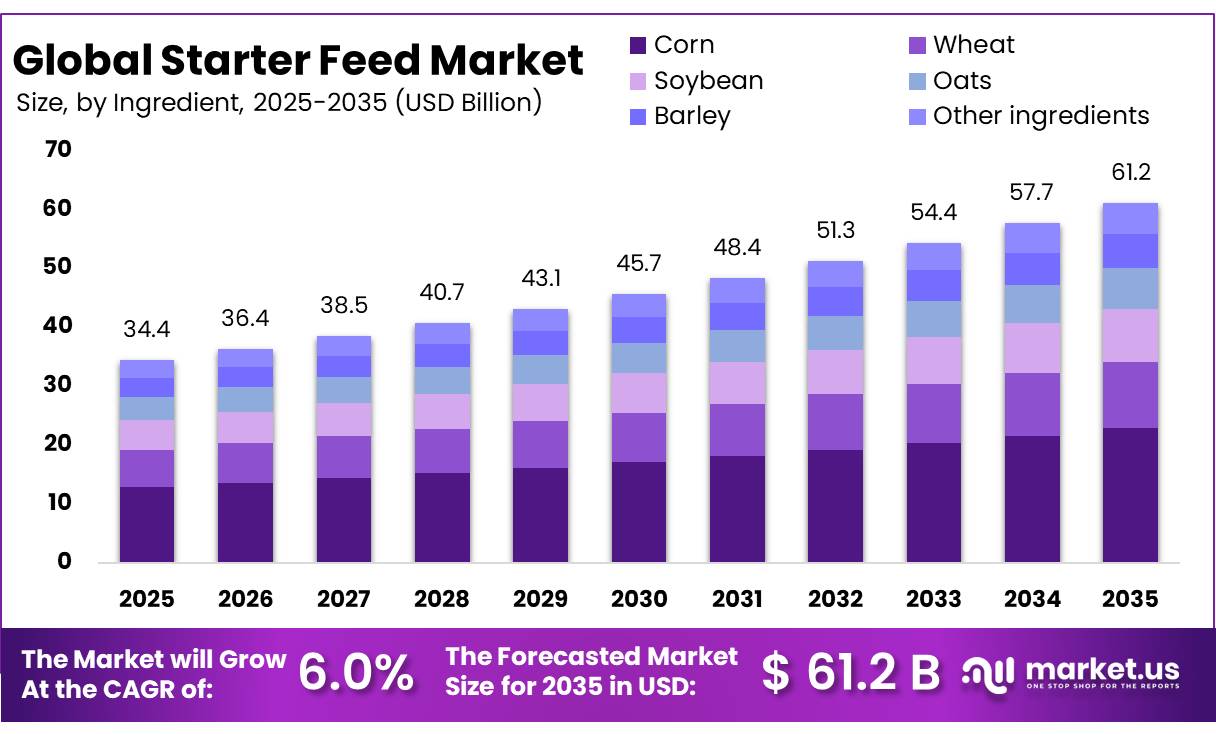
The Global Starter Feed Market size is expected to be worth around USD 61.2 Billion by 2035, from USD 34.4 Billion in 2025, growing at a CAGR of 6.0% during the forecast period from 2026 to 2035. In 2025, North America held a dominant market position, capturing more than a 38.00% share, holding USD 13.07 Billion revenue.
The Starter Feed industry forms an important part of commercial animal nutrition, supplying specially formulated diets for young poultry, piglets, calves, lambs, and juvenile aquaculture species during their early growth stages. Starter formulations generally contain highly digestible protein, energy sources, amino acids, vitamins, minerals, enzymes, and other nutritional additives. Their main purpose is to support early weight gain, digestive development, immunity, and feed efficiency before animals move to grower or finishing diets.
- The International Feed Industry Federation estimated that global compound feed production could reach around 1.4 billion tonnes in 2025, with commercial feed manufacturing generating more than USD 500 billion in annual turnover.
The industrial environment remains supported by large poultry and livestock populations. USDA reported that U.S. producers raised 9.40 billion broilers in 2025, an increase of 1%, while live-weight broiler production reached 62.2 billion pounds, up 2%. The overall value of U.S. poultry production and sales reached USD 81.7 billion. Large chick placements and commercial poultry operations create recurring demand for starter diets designed to promote rapid early development and uniform flock performance.
- In June 2026, USDA recorded 73.7 million hogs and pigs on U.S. farms. Between March and May 2026, producers weaned 33.5 million pigs, with an average of 11.87 pigs per litter. These large numbers of newly weaned animals support demand for nutrient-dense starter feeds that can ease the transition from milk to solid feed while maintaining growth and digestive health.
Calf nutrition also contributes to industry demand. USDA estimated the U.S. 2025 calf crop at 32.9 million head, while total cattle and calf inventory stood at 86.2 million head on January 1, 2026. Starter feeds for calves are increasingly formulated to encourage early rumen development and efficient nutrient intake during the transition from liquid feeding to forage and concentrate diets.
Europe provides a large commercial feed-manufacturing base. FEFAC forecast EU compound feed production at 147.5 million tonnes in 2025. Poultry feed production was expected to reach 50.653 million tonnes, increasing 1.5%, while pig feed production was estimated at 47.339 million tonnes. These volumes provide a substantial manufacturing platform for specialized starter, pre-starter, grower, and functional feed formulations.
Aquaculture represents another future growth area. FAO forecast global fisheries and aquaculture production at 197 million tonnes in 2025, including 104.2 million tonnes from aquaculture. In 2024, aquaculture animal production had already exceeded 100 million tonnes for the first time, valued at USD 371 billion at farm-gate level. Growth in hatcheries and intensive aquaculture production supports demand for highly digestible starter feeds designed for juvenile fish and shrimp.
Key Takeaways
- Starter Feed Market size is expected to be worth around USD 61.2 Billion by 2035, from USD 34.4 Billion in 2025, growing at a CAGR of 6.0.
- Non-medicated held a dominant market position, capturing more than a 56.40% share.
- Corn held a dominant market position, capturing more than a 37.00% share.
- Pellets held a dominant market position, capturing more than a 60.00% share.
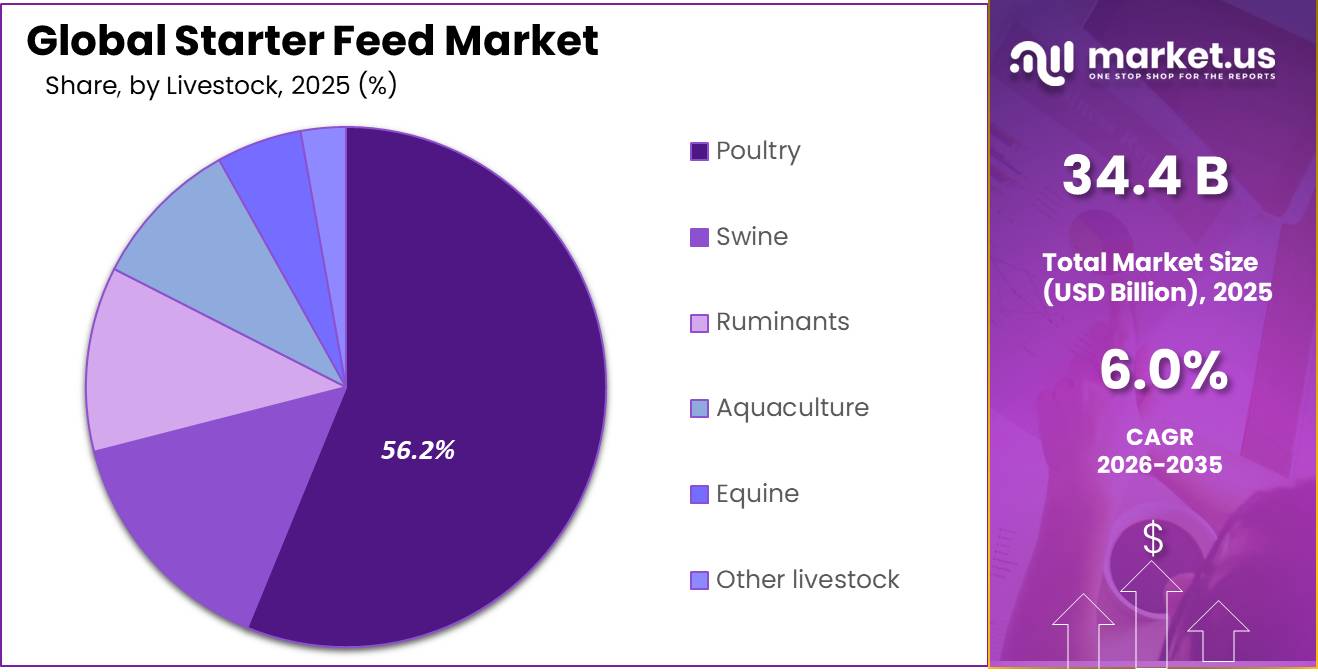
- Poultry held a dominant market position, capturing more than a 56.00% share.
- Direct sales held a dominant market position, capturing more than a 48.00% share.
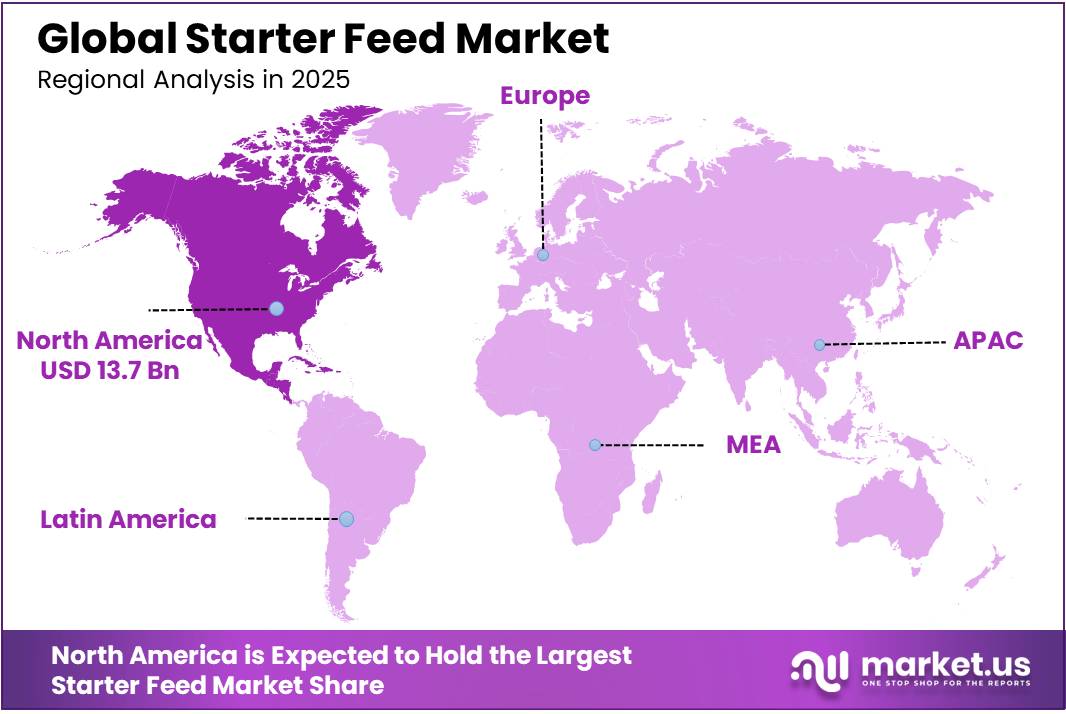
- North America dominated the Starter Feed Market in 2025, capturing more than a 38.00% share and generating about USD 13.07 billion.
By Type Analysis
Non-medicated starter feed dominates with more than a 56.40% share, supported by routine nutrition and antimicrobial stewardship
In 2025, “Non-medicated” held a dominant market position, capturing more than a 56.40% share. Non-medicated starter feed is widely used to provide young animals with protein, energy, amino acids, vitamins, and minerals without routinely incorporating medicinal ingredients. Its position is supported by large commercial poultry and livestock populations and greater attention to responsible antimicrobial use.
USDA reported in April 2026 that U.S. producers raised 9.40 billion broilers during 2025, while broiler live-weight production reached 62.2 billion pounds. The total value of U.S. poultry production and sales reached USD 81.7 billion. This large young-animal population creates recurring demand for balanced starter diets used during early growth.
Medicated starter feed remained an important type in the Starter Feed Market in 2025. These formulations may contain approved animal drugs for specific disease-control or treatment purposes and are particularly relevant during sensitive early-growth and post-weaning periods. In the United States, medically important antimicrobial drugs delivered through feed are subject to veterinary oversight under FDA requirements.
By Ingredient Analysis
Corn dominates with more than a 37.00% share, supported by its high energy value and large feed supply
In 2025, “Corn” held a dominant market position, capturing more than a 37.00% share. Corn remained a major starter-feed ingredient because it provides readily available energy and blends easily with proteins, vitamins, minerals, and amino acids used in young-animal diets. Its broad supply also supports consistent formulation across poultry, swine, and other livestock feed.
USDA reported in January 2026 that U.S. corn production reached a record 17.0 billion bushels in 2025, increasing 14% from 2024. The crop was harvested from 91.3 million acres, with a record average yield of 186.5 bushels per acre. USDA also projected U.S. corn feed and residual use at 6.2 billion bushels for the 2025/26 marketing year, showing corn’s major role in animal nutrition.
Wheat remained an important ingredient in the Starter Feed Market in 2025. It provides energy and protein while supporting pellet quality and feed texture, making it useful in poultry and swine starter formulations. Feed manufacturers can use wheat alongside corn, soybean meal, minerals, and specialty additives to adjust nutrient density and feed characteristics.
By Form Analysis
Pellets dominate with more than a 60.00% share, supported by efficient handling and consistent nutrient delivery
In 2025, “Pellets” held a dominant market position, capturing more than a 60.00% share. Pelleted starter feed remained widely used because it provides uniform nutrient intake, produces less feed separation, and is easier to store, transport, and dispense through commercial feeding systems. The form is particularly suitable for intensive poultry and livestock operations where consistent feed quality is important during early growth.
Government livestock data shows the large feeding base supporting pellet demand. USDA reported that U.S. producers raised 9.40 billion broilers in 2025, with live-weight production reaching 62.2 billion pounds. The combined value of U.S. poultry production and sales reached USD 81.7 billion during the year. These large commercial flocks require regular starter-feed supply during early production stages, supporting efficient pelletized feeding systems.
Crumbles remained an important form in the Starter Feed Market in 2025. Crumbled feed is produced by breaking pellets into smaller, relatively uniform particles, making it easier for chicks and newly weaned animals to consume. The form combines many handling advantages of pellets with a particle size better suited to animals during sensitive early-growth stages.
By Livestock Analysis
Poultry dominates with more than a 56.00% share, supported by large commercial broiler production
In 2025, “Poultry” held a dominant market position, capturing more than a 56.00% share. Poultry remained the largest livestock user of starter feed because chicks require nutrient-dense diets during their early growth period to support body development, immunity, and feed efficiency. Large commercial broiler operations create continuous demand for consistent starter formulations containing energy, protein, amino acids, vitamins, and minerals.
USDA reported in April 2026 that U.S. producers raised 9.40 billion broilers during 2025, increasing 1% from the previous year. Broiler live-weight production reached 62.2 billion pounds, up 2%, while the value of broiler production totaled USD 44.6 billion. Total U.S. poultry production and sales were valued at USD 81.7 billion. These production levels provide a substantial demand base for poultry starter feeds used during the first stages of commercial bird development.
Ruminants remained an important livestock segment in the Starter Feed Market in 2025. Calf starter feeds are used during the transition from milk toward solid diets and are formulated to encourage feed intake, rumen development, and steady early growth. Their use is especially relevant in commercial dairy and beef operations seeking consistent young-animal performance.
By Distribution Channel Analysis
Direct sales dominate with more than a 48.00% share, supported by large commercial livestock operations
In 2025, “Direct sales” held a dominant market position, capturing more than a 48.00% share. Direct sales remain important in the starter feed business because large poultry, swine, dairy, and integrated livestock operations often purchase feed in bulk and require stable formulations, scheduled deliveries, and technical nutrition support. The scale of commercial agriculture strengthens this channel.
USDA reported in February 2026 that farms with annual sales of USD 500,000 or more operated 50.1% of all U.S. farmland in 2025. The country had 1.865 million farms covering 873.95 million acres, showing a sizeable commercial customer base for direct feed supply arrangements.
Distributors and retailers remained an important distribution channel in the Starter Feed Market in 2025. Feed dealers, agricultural retailers, cooperatives, and regional distributors help manufacturers serve farms that require smaller quantities, multiple feed types, or frequent local deliveries. This channel is particularly useful where livestock producers are spread across wide agricultural areas and direct bulk purchasing is less practical.
Key Market Segments
By Type
- Medicated
- Non-medicated
By Ingredient
- Corn
- Wheat
- Soybean
- Oats
- Barley
- Other ingredients
By Form
- Pellets
- Crumbles
- Mash
- Other forms
By Livestock
- Poultry
- Swine
- Ruminants
- Aquaculture
- Equine
- Other livestock
By Distribution Channel
- Direct sales
- Distributors and retailers
- Online sales
Driver Analysis
Poultry and Aquaculture Output Expansion
Young-animal throughput is the largest direct volume lever because every additional broiler placement, piglet crop, calf cohort or stocked juvenile fish creates an early-life feeding event, while poultry and aquaculture have short production cycles that convert end-demand growth into repeat starter-feed purchases faster than cattle. World meat production reached 374 million tonnes in 2024, 7 million tonnes above 2023, while milk and egg output reached 985 million and 100 million tonnes, respectively. Looking forward, OECD–FAO projects meat output to rise 13%, or 46 million tonnes, to 406 million tonnes by 2034; Asia is expected to generate 55% of the increase and poultry 62% of incremental meat production.
Aquaculture provides a second high-frequency demand pool: FAO expects farmed aquatic-animal output to exceed 100 million tonnes in 2027 and reach 111 million tonnes by 2032, up 17% from 2022. The installed feed base is already large—global feed production rose 1.2% to approximately 1.396 billion tonnes in 2024, poultry represented 42.7%, and broiler feed alone reached about 385.4 million tonnes. The estimated +1.5 percentage-point CAGR uplift therefore reflects expanding animal placements plus a favorable species mix: poultry starters and micro-pelleted aquafeed have higher formulation intensity and faster inventory turns than mature-animal rations.
Value capture should concentrate with hatchery-integrated poultry groups, shrimp and finfish feed specialists, and suppliers able to manufacture high-protein crumble or micro-pellet products at consistent particle size; however, the uplift is moderated by mature EU livestock herds, volatile aquaculture economics and disease-related stocking interruptions.
Drivers Impact Analysis
| Driver(~) | % Impact on CAGR Forecast | Geographic Relevance | Impact Timeline |
|---|---|---|---|
| Poultry and aquaculture output expansion | +1.5 pp | APAC core; Latin America; Africa; North America | Medium term (2–4 years) |
| Early-life nutrition and FCR economics | +1.3 pp | Global intensive-farming hubs | Short term (≤2 years) |
| Antibiotic and ZnO substitution | +1.1 pp | EU core; North America; APAC spill-over | Short term (≤2 years) |
| Commercial-feed formalization | +0.9 pp | India; China; Southeast Asia; Latin America; Africa | Medium term (2–4 years) |
| Disease-resilience nutrition | +0.7 pp | Global poultry and swine corridors | Short term (≤2 years) |
| Traceable, resource-efficient formulation | +0.5 pp | EU core; China; export-linked supply chains | Long term (≥4 years) |
Restraint Analysis
Premium-Input Volatility
Starter formulations are disproportionately exposed to raw-material shocks because young animals require highly digestible protein, energy, minerals and micro-ingredients, leaving less room than grower feed for aggressive least-cost substitution without impairing intake or gut development. Feed already represents roughly 60–70% of the cost of producing meat, milk and eggs, so even modest ingredient inflation materially tightens farm purchasing power. The World Bank’s April 2026 baseline placed maize at about $211 per tonne, soybeans at $441, soybean meal at $359 and soybean oil at $1,233, implying annual movements of approximately +4%, +6%, -2% and +8%, respectively; it also expected the broader food index to rise 2% and oils-and-meals prices 4% in 2026.
Near-term volatility then intensified: FAO’s cereal index reached 116.3 points in August 2026, 2.2% above July, while maize rose 2.5%, sorghum 3.9% and barley 2.6% in one month amid U.S./EU weather concerns, Black Sea uncertainty and energy-market disruption. Specialist inputs amplify exposure—U.S. feed-grade dry whey averaged about €937 per tonne in January 2025, 47.1% above January 2024, and remained 12.4% higher year on year in June; meanwhile FAO expected lower fishmeal and fish-oil supply in the first half of 2026 after Peru reduced the North-Centre fishing quota, despite Peruvian fishmeal exports rising 67% to 421,000 tonnes in early 2025.
The modeled -1.6 percentage-point CAGR effect reflects both volume destruction and mix dilution: mills either pass increases through, prompting farmers to shorten pre-starter duration or switch to farm-mixed feed, or absorb them and compress gross margin; hedging, reformulation and local sourcing reduce the shock but cannot fully offset abrupt changes in marine proteins, dairy derivatives, amino acids, vitamins, freight and energy.
Restraint Impact Analysis
| Restraint(~) | % Impact on CAGR | Geographic Relevance | Impact Timeline |
|---|---|---|---|
| Premium-input volatility | -1.6 pp | Global; import-dependent APAC, Africa | Short term (≤2 years) |
| Smallholder affordability gap | -1.3 pp | South Asia; Africa; Southeast Asia | Long term (≥4 years) |
| Disease-led herd losses | -1.1 pp | Americas; Europe; APAC pig corridors | Short term (≤2 years) |
| Regulatory and plant burden | -0.8 pp | EU; North America; export-linked APAC | Medium term (2–4 years) |
| Uneven performance payback | -0.7 pp | Global fragmented farms | Medium term (2–4 years) |
| Logistics and shelf-life friction | -0.5 pp | Africa; South Asia; remote aquaculture hubs | Medium term (2–4 years) |
Opportunity Analysis
Hatchery Nutrition Platforms
In-ovo delivery is generally performed on embryonic days 17–19, when the gastrointestinal tract can absorb targeted carbohydrates, amino acids, vitamins, minerals and bioactive compounds; recent reviews report improvements in gastrointestinal maturation, immune function, early body-weight gain and feed conversion, while also emphasizing unresolved variation in dose, injection site and absorption.
Early post-hatch feeding also improved seven-day body weight and breast-muscle development in controlled research, indicating that value can be created before standard farm feeding begins. Under an analyst scenario, pricing a combined hatchery-nutrition pack at $0.004–$0.015 per chick across 5 billion treated chicks would create $20–$75 million of annual product revenue; attaching the pack to the first 0.20–0.35 kg of pre-starter feed could lift revenue per placement by another $0.08–$0.20 and reduce customer-acquisition cost by 15–30% because one hatchery agreement can cover hundreds of downstream farms.
The +1.4-point upside assumes suppliers co-develop dosing equipment, validate hatchability and seven-day weight across at least three breeder ages, and price against preserved chicks or improved FCR rather than kilograms sold; the strategy is above baseline because most feed companies still begin commercial engagement after hatch, leaving embryo-to-farm nutrition ownership fragmented among hatcheries, vaccine-equipment vendors and feed suppliers.
Opportunity Impact Analysis
| Opportunity(~) | % Potential CAGR Upside | Geographic Relevance | Execution Window |
|---|---|---|---|
| Hatchery nutrition platforms | +1.4 pp | North America; EU; China; Brazil | Medium term (2–4 years) |
| Feed-as-a-service contracts | +1.2 pp | North America; EU; China; advanced APAC | Short term (≤2 years) |
| Smallholder access bundles | +1.1 pp | India; Southeast Asia; Africa | Medium term (2–4 years) |
| Aquatic larval microfeeds | +0.9 pp | China; India; Southeast Asia; Latin America | Medium term (2–4 years) |
| Verified low-carbon starters | +0.7 pp | EU; North America; export corridors | Long term (≥4 years) |
| Regional nutrition roll-ups | +0.6 pp | India; Africa; Southeast Asia; Latin America | Medium term (2–4 years) |
Challenges Analysis
Climate-Linked Feed Contamination
The persistent challenge is not simply rejection of a contaminated shipment, which is an immediate restraint, but the growing need to manage location-, season- and toxin-specific variability across maize, wheat, oilseed meals and stored feed while maintaining the tighter safety margin required by young animals. A ten-year dataset covering 74,821 feed and raw-material samples from 100 countries found 88% of samples tested for at least three toxins contained one or more; deoxynivalenol, fumonisins and zearalenone appeared in 64%, 60% and 45% of samples, respectively, while maize showed 80% fumonisin prevalence and a 1,300 microgram-per-kilogram median. More recent evidence indicates that 85% of 2025 survey samples from 78 countries carried multiple mycotoxins, and a 2025 review reported aflatoxin-B1 limits exceeded by 41.1% of samples in Southeast Asia, 38.5% in sub-Saharan Africa and 20.9% in South Asia.
Temperature, humidity and rainfall shifts alter fungal distribution, with EFSA and the European Environment Agency warning that aflatoxins, DON, ZEN and ochratoxin A may become more prevalent or emerge in new temperate areas as climate conditions change. Operationally, a mill receiving 100 ingredient lots annually and testing five toxins in triplicate can generate 1,500 analytical results before confirmatory work; analyst modeling places rapid-screening, segregation, binding or biotransformation and rejected-lot handling at 0.5–1.5% of starter-feed cost, while a missed co-contamination event can erase 2–5% of expected daily gain or FCR value without creating an obvious acute failure.
The -1.2-point friction drag reflects recurrent reformulation, variable binder efficacy, safety-stock requirements and performance disputes rather than frozen demand; sustained mitigation requires harvest-risk mapping, near-infrared and rapid-test screening, silo-level segregation, multi-toxin decision rules and supplier contracts indexed to verified toxin load, with four or more years needed because climate adaptation must extend from crop production through storage and mill quality systems.
Challenges Impact Analysis
| Challenge(~) | % CAGR Friction Drag | Geographic Relevance | Mitigation Horizon |
|---|---|---|---|
| Climate-linked feed contamination | -1.2 pp | Global; tropical APAC, Africa | Long term (≥4 years) |
| Biological response variability | -1.0 pp | Global intensive-farming hubs | Long term (≥4 years) |
| Microdosing and pellet consistency | -0.8 pp | Emerging APAC; Africa; Latin America | Medium term (2–4 years) |
| Technical workforce scarcity | -0.7 pp | North America; EU; Africa; rural APAC | Long term (≥4 years) |
| Traceability data fragmentation | -0.6 pp | EU-linked soy corridors; global exporters | Medium term (2–4 years) |
| Network volatility management | -0.5 pp | Europe–Asia; MENA; import-led markets | Medium term (2–4 years) |
Geopolitical Impact Analysis
Ongoing Wars Increase Feed Grain, Fertilizer, and Logistics Risk
The Russia–Ukraine war and Middle East conflict are affecting the Starter Feed market through grain availability, fertilizer costs, energy prices, freight, and operating expenses. Starter feeds depend on corn, wheat, soybean meal, vitamins, minerals, and reliable transport, so disruptions can raise formulation and delivery costs.
USDA reported in February 2026 that Ukraine’s 2025/26 grain exports were moving more slowly than a year earlier, while future export volumes would depend on the scale of Russian attacks on ports, the energy grid, and inland logistics infrastructure. This uncertainty matters because Ukraine remains an important supplier of feed grains to markets.
Middle East disruption is adding further pressure. UNCTAD reported in March 2026 that around one-third of global seaborne fertilizer trade, about 16 million tonnes, normally passes through the Strait of Hormuz. The U.S. Energy Information Administration also reported that Brent crude averaged USD 91 per barrel in August 2026, USD 7 above July.
Regional Insights
North America Leads the Starter Feed Market with 38.00% Share and USD 13.07 Billion
North America dominated the Starter Feed Market in 2025, capturing more than a 38.00% share and generating about USD 13.07 billion. The region benefits from large commercial poultry, swine, and cattle industries that require regular starter nutrition for young animals.
USDA reported 9.40 billion broilers and 62.2 billion pounds of broiler live-weight production in 2025. By June 2026, U.S. farms also held 73.7 million hogs and pigs, while 33.5 million pigs were weaned between March and May. Canada produced 1.6 billion kilograms of poultry in 2025, further supporting regional feed demand.
Asia Pacific represents the fastest-growing regional opportunity in this analysis, supported by expanding livestock production and a very large compound-feed base. USDA FAS reported that China’s industrial feed production was estimated at 322 million metric tons in 2025, including 151 million metric tons of swine feed, 97 million metric tons of broiler feed, 32 million metric tons of layer feed, and 24 million metric tons of aquaculture feed. For 2026/27, China’s feed and residual use of major grains is forecast at 290.7 million metric tons, supported by stable swine production and stronger poultry output. This scale creates room for specialized starter formulations.
Key Regions and Countries Insights
- North America
- US
- Canada
- Europe
- Germany
- France
- The UK
- Spain
- Italy
- Rest of Europe
- Asia Pacific
- China
- Japan
- South Korea
- India
- Australia
- Rest of APAC
- Latin America
- Brazil
- Mexico
- Rest of Latin America
- Middle East & Africa
- GCC
- South Africa
- Rest of MEA
Key Players Analysis
Cargill holds a strong position in the Starter Feed Market through young-animal nutrition, complete feeds, premixes, concentrates, and feed additives for poultry, swine, cattle, and aquaculture. Its Animal Nutrition business employs around 20,000 people, operates 280 locations across 40 countries, and produces nearly 18 million metric tons of feed annually. Cargill also maintains a nutrition database containing more than 2 million samples across 200 ingredients, supporting precise starter-feed formulation. The company generated USD 154 billion in fiscal 2025 revenue.
ADM participates in the Starter Feed Market through complete feeds, premixes, amino acids, nutritional additives, and specialty ingredients for poultry, swine, cattle, and aquaculture. The company produces around 3 million metric tons of feed annually through more than 50 plants serving 6 continents. In 2025, ADM generated USD 80.27 billion in total revenue, while its Nutrition segment recorded USD 7.51 billion in revenue. Animal Nutrition operating profit reached USD 98 million, increasing 66% year over year.
Nutreco is a major animal-nutrition company operating through Trouw Nutrition and Skretting, supplying starter feeds, premixes, feed additives, and nutritional services for poultry, swine, cattle, and aquaculture. The company employs more than 11,000 people across over 40 countries, while Trouw Nutrition serves customers in 105 countries. In 2025, Nutreco’s connected aquaculture systems handled nearly 480,000 metric tons of feed and supported about 370,000 metric tons of shrimp, valued at approximately USD 1.25 billion, demonstrating its growing precision-nutrition capabilities.
Top Key Players Outlook
- Cargill, Incorporated
- ADM
- Nutreco N.V.
- Charoen Pokphand Foods
- Land O’Lakes/Purina Animal Nutrition
- Alltech, Inc.
- De Heus Animal Nutrition
- ForFarmers N.V.
- New Hope Liuhe
- Evonik Industries
- BASF SE
- dsm-firmenich
- Roquette Frères
- Godrej Agrovet
- Associated British Foods/AB Agri
Recent Developments
- February 2026, when De Heus opened a new Kenyan feed plant with 240,000 metric tonnes of annual capacity following an investment of KES 3 billion (USD 23 million).
- February 2026, when ForFarmers renewed its agreement with ADM to source palm kernel expeller carrying a verified 25% lower CO₂ footprint, improved from 20% previously, supporting lower-emission feed formulations.
Report Scope
| Report Features | Description |
|---|---|
| Market Value (2025) | USD 34.4 Bn |
| Forecast Revenue (2035) | USD 61.2 Bn |
| CAGR (2026-2035) | 6.0% |
| Base Year for Estimation | 2025 |
| Historic Period | 2020-2024 |
| Forecast Period | 2026-2035 |
| Report Coverage | Revenue Forecast, Market Dynamics, Competitive Landscape, Recent Developments |
| Segments Covered | By Type (Medicated, Non-medicated), By Ingredient (Corn, Wheat, Soybean, Oats, Barley, Other ingredients), By Form (Pellets, Crumbles, Mash, Other forms), By Livestock (Poultry, Swine, Ruminants, Aquaculture, Equine, Other livestock), By Distribution Channel (Direct sales, Distributors and retailers, Online sales) |
| Regional Analysis | North America – US, Canada; Europe – Germany, France, The UK, Spain, Italy, Rest of Europe; Asia Pacific – China, Japan, South Korea, India, Australia, Singapore, Rest of APAC; Latin America – Brazil, Mexico, Rest of Latin America; Middle East & Africa – GCC, South Africa, Rest of MEA |
| Competitive Landscape | Cargill, Incorporated, ADM, Nutreco N.V., Charoen Pokphand Foods, Land O’Lakes/Purina Animal Nutrition, Alltech, Inc., De Heus Animal Nutrition, ForFarmers N.V., New Hope Liuhe, Evonik Industries, BASF SE, dsm-firmenich, Roquette Frères, Godrej Agrovet, Associated British Foods/AB Agri |
| Customization Scope | Customization for segments, region/country-level will be provided. Moreover, additional customization can be done based on the requirements. |
| Purchase Options | We have three licenses to opt for: Single User License, Multi-User License (Up to 5 Users), Corporate Use License (Unlimited User and Printable PDF) |





































