Report Overview
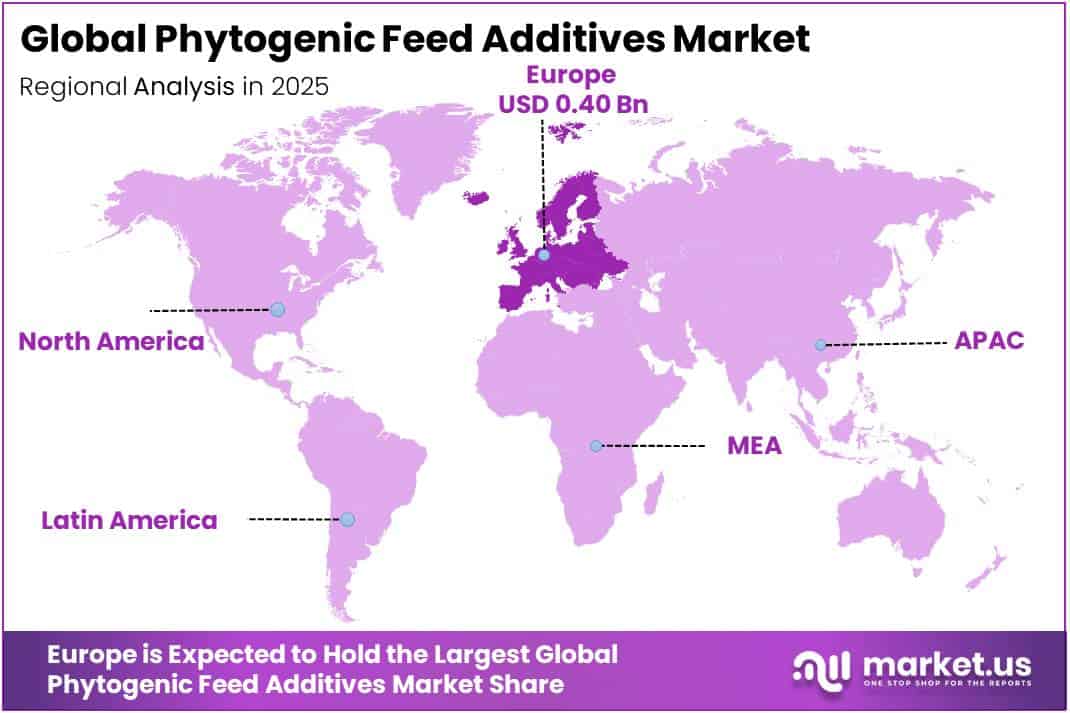
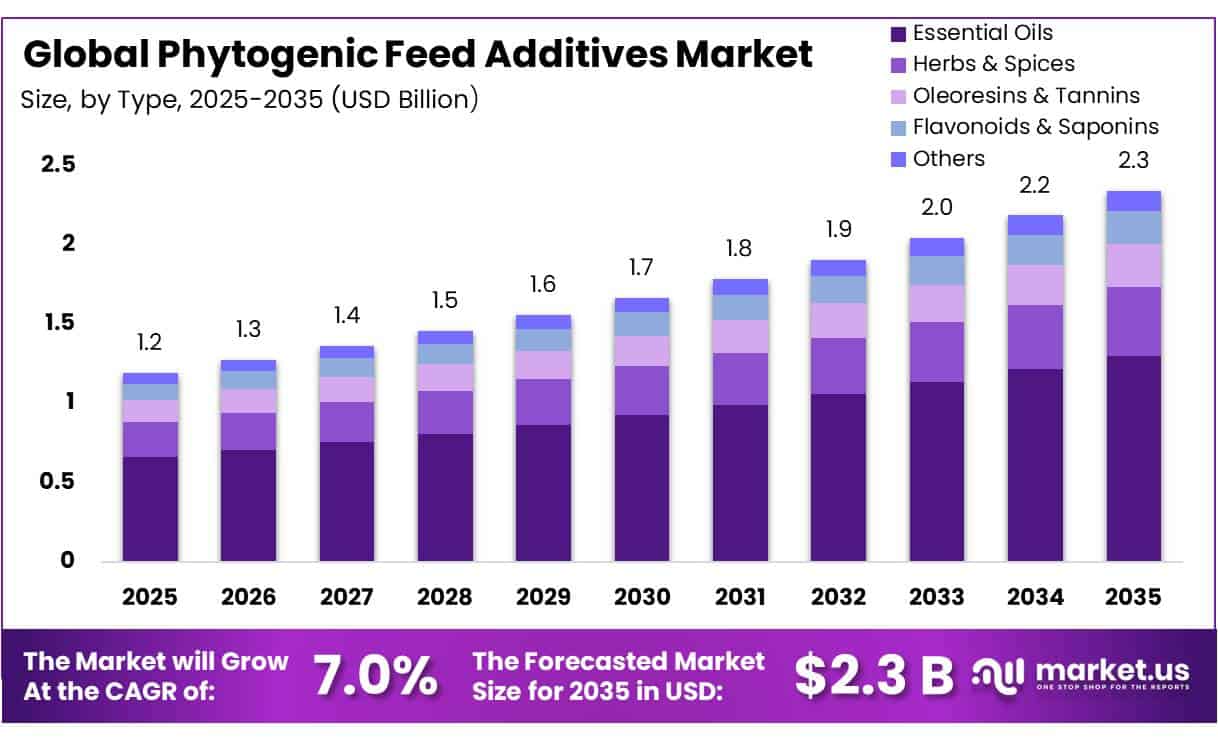
In 2025, the Global Phytogenic Feed Additives Market was valued at USD 1.2 billion, and between 2026 and 2035, this market is estimated to register a CAGR of 7.0%, reaching about USD 2.3 billion by 2035. Europe held a dominant market position, capturing more than a 34.00% share, holding USD 0.40 billion in revenue.
The phytogenic feed additives industry is developing around plant derived ingredients such as essential oils, herbs, spices, tannins, flavonoids and saponins that support digestion, palatability, animal performance and feed quality. Its relevance is reinforced by the scale of animal nutrition.
- The Food and Agriculture Organization of the United Nations reports that the feed sector produces about 1 billion tons annually, generates roughly USD 400 billion in turnover and employs more than 250,000 skilled workers worldwide.
Key Takeaways
- The global phytogenic feed additives market was valued at US$1.2 billion in 2025.
- The global market is projected to grow at a CAGR of 7.0% and is estimated to reach US$2.3 billion by 2035.
- On the basis of type, essential oils dominated the market, constituting 55.60% of the total market share.
- Based on the function, performance enhancers dominated the phytogenic feed additives market, with a substantial market share of around 62.50%.
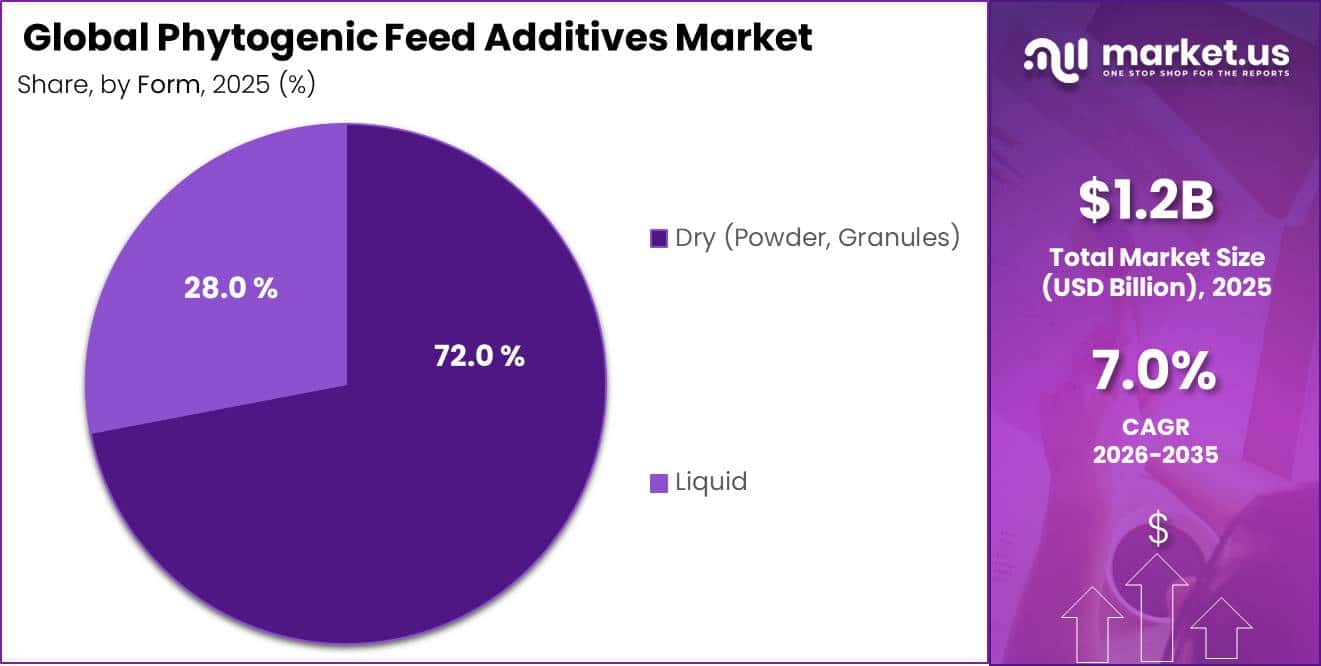
- Based on the form, dry (powder, granules) led the market, comprising 72.00% of the total market.
- Based on the distribution channel, direct sales / B2B held a major share in the phytogenic feed additives market, accounting for 58.20% of the market share.
- In 2025, Europe was the most dominant region in the phytogenic feed additives market, accounting for 34.00% of the total global market.
Industrial activity is supported by compound feed volumes across developed livestock markets, where feed manufacturers increasingly evaluate functional ingredients that can improve efficiency and animal health.
- The European Feed Manufacturers’ Federation expects European Union compound feed production to reach 152 million tonnes, including 45.358 million tonnes of cattle feed and 51.588 million tonnes of poultry feed. These volumes create a broad processing base for integrating standardized phytogenic formulations into commercial feed programs at industrial scale.
Growth opportunities are linked to rising animal protein output, pressure to improve feed utilization and increasing attention to nutrition strategies that can reduce dependence on veterinary interventions.
- Food and Agriculture Organization statistics show world meat production at 374 million tonnes, milk production at 985 million tonnes and egg production at 100 million tonnes. This production intensity encourages commercial formulators to explore botanical additives that can support digestive function, antioxidant protection, palatability and resilient livestock productivity.
Government oversight is shaping product development and commercialization. In the European Union, feed additives require scientific assessment and authorization before market use, creating a pathway for safety and efficacy review. European Commission rules state that authorizations are generally valid for 10 years, the European Food Safety Authority can provide its opinion within 6 months after receiving an application, and renewal applications must be submitted at least 1 year before expiry, supporting regulatory consistency and innovation.
Type Analysis
Essential Oils dominate with 55.60% as standardized botanical solutions gain wider use in animal nutrition.
In 2025, Essential Oils held a dominant market position, capturing more than a 55.60% share. Their leadership reflects use in poultry, swine, ruminant, and aquaculture feed formulations where concentrated plant compounds are valued for flavor, digestive support, feed stability, and antimicrobial properties. Producers favor essential oils because controlled extraction and formulation help deliver consistent active compounds across feed batches.
- In February 2025, according to the European Food Safety Authority, the Feed Flavourings Authorisation Consortium participating in discussions on botanical feed additives represented 22 European Union based companies. The meeting addressed methodological approaches for assessing essential oils and their safety for target animal species.
Herbs & Spices is the growing segment. Feed formulators are exploring oregano, thyme, rosemary, cinnamon, garlic, and similar botanical ingredients because they offer plant based functional compounds. Their availability in powders, extracts, and blended formulations allows manufacturers to develop flexible products for animal diets and feeding systems.
Function Analysis
Performance Enhancers dominate with 62.50% as functional feed strategies gain wider adoption.
In 2025, Performance Enhancers held a dominant market position, capturing more than a 62.50% share. Their strong position reflects demand for phytogenic formulations designed to support feed utilization, animal productivity, resilience, and overall nutritional performance.
- In March 2026, according to the European Food Safety Authority, a digestibility enhancing feed additive for weaned piglets was found efficacious at 20 alpha-galactosidase activity units (GALU) and 25 endo-1,4-beta-xylanase activity units (AXC) per kg of complete feed.
Digestion Enhancers / Digestive Stimulants is the growing segment. This category is gaining attention as feed formulators focus more closely on nutrient availability, digestive function, and efficient diet utilization. Phytogenic ingredients can be incorporated into specialized blends targeting digestive performance, giving manufacturers flexibility across poultry, swine, ruminant, and other animal nutrition applications while supporting broader interest in functional feed formulations.
Form Analysis
Dry (Powder, Granules) dominates with 72.00% due to convenient handling and feed processing suitability.
In 2025, Dry (Powder, Granules) held a dominant market position, capturing more than a 72.00% share. Dry formats remain preferred because they are easier to measure, blend, store, transport, and incorporate into premixes and compound feed. Powder and granule products also support controlled dosing of botanical extracts, herbs, spices, and other active ingredients across livestock diets.
- In April 2026, according to the European Food Safety Authority, cornmint essential oil used as a sensory feed additive was considered safe at up to 8.8 mg/kg of complete feed for all animal species. The assessment also covered its use in feed and drinking water.
Liquid is the growing segment Its adoption is supported by demand for flexible dosing and easier dispersion of essential oils and concentrated botanical extracts. Liquid formulations can be introduced through feed processing systems or drinking water programs, helping producers adjust application according to feeding practices.
Distribution Channel Analysis
Direct Sales / B2B dominates with 58.20% as large feed buyers prefer direct supplier relationships.
In 2025, Direct Sales / B2B held a dominant market position, capturing more than a 58.20% share. This channel remains important because feed manufacturers, livestock integrators, and large commercial buyers often prefer direct supplier relationships for phytogenic formulations. Direct procurement can support closer product selection, technical coordination, order planning, and formulation consistency, particularly when botanical additives are purchased in bulk for compound feed or premix production.
- In November 2025, according to the Veterinary Medicines Directorate, 188 inspections were conducted during October and November across veterinary medicine manufacturers, wholesalers, retailers, and feed business operators, including commercial feed mills and feed distributors.
Distributors & Dealers is the growing segment. This channel is expanding as phytogenic feed additive suppliers seek broader access to regional feed mills, farms, independent nutrition businesses, and smaller commercial buyers. Dealers can help extend product availability beyond large direct accounts and support customers that purchase lower volumes or require mixed product portfolios.
Key Market Segments
By Type
- Essential Oils
- Herbs & Spices
- Oleoresins & Tannins
- Flavonoids & Saponins
- Others
By Function
- Performance Enhancers
- Digestion Enhancers / Digestive Stimulants
- Antimicrobial Agents
- Palatability & Flavoring Enhancers
- Antioxidants
- Anti-inflammatory / Immunity Support
By Form
- Dry (Powder, Granules)
- Liquid
By Distribution Channel
- Direct Sales / B2B
- Distributors & Dealers
- Online Retail