


Report Overview
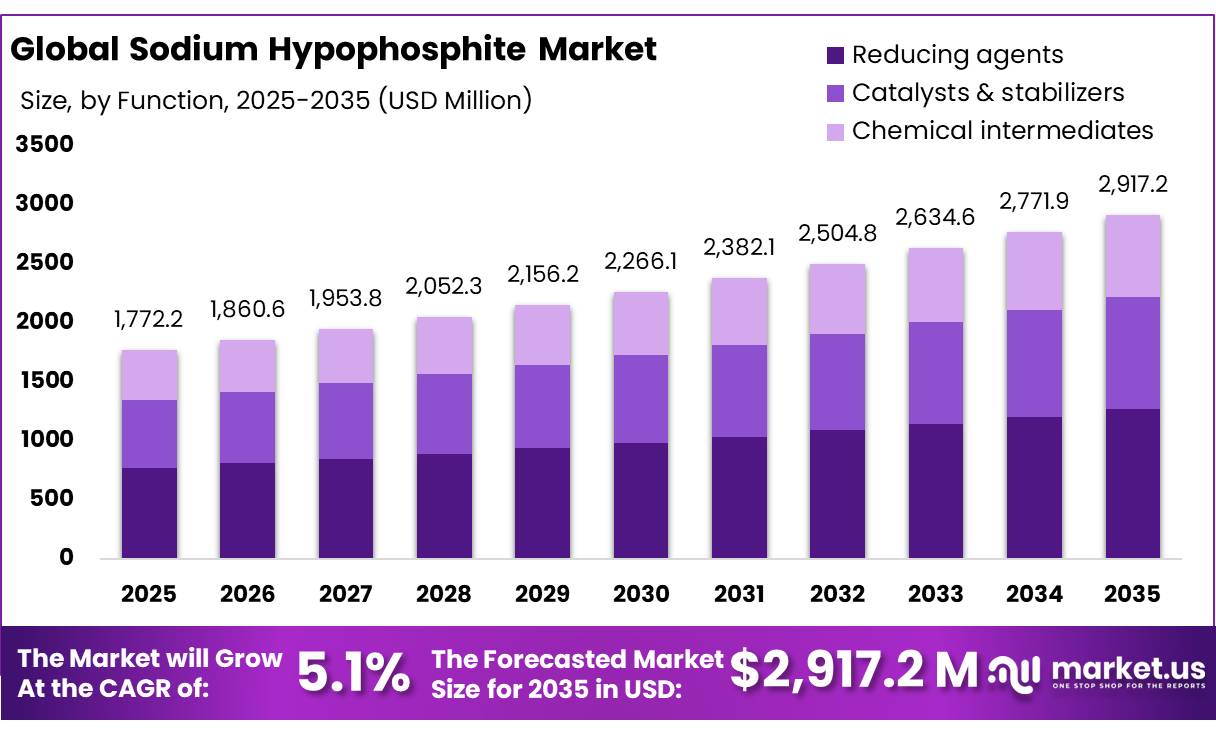
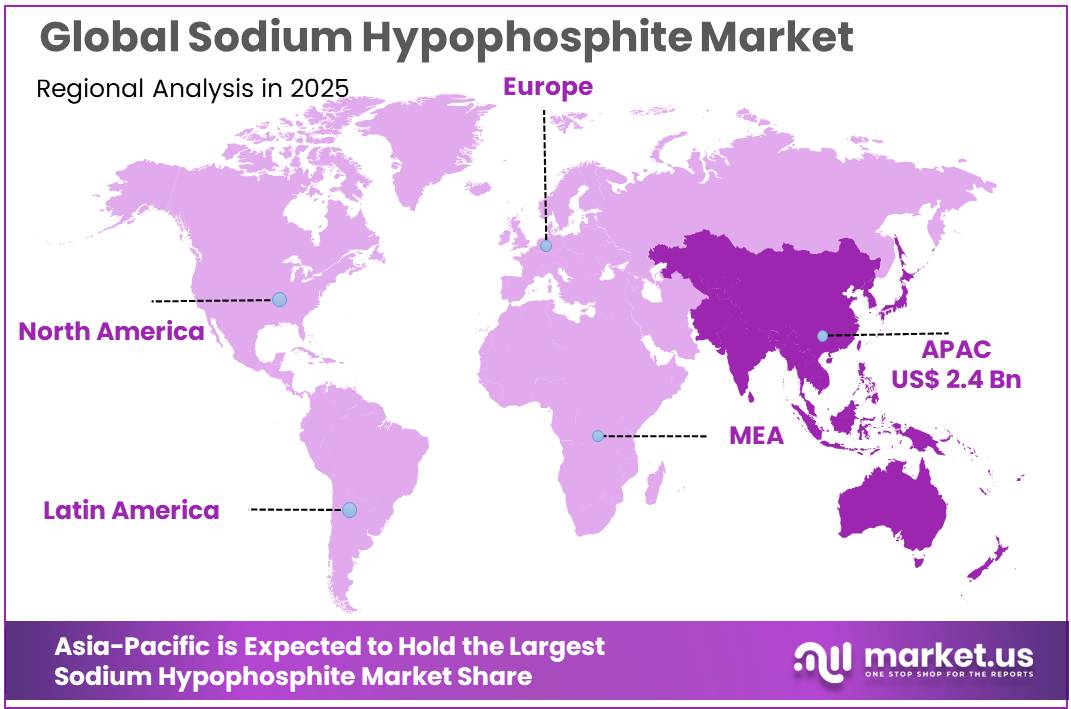
The Global Sodium Hypophosphite Market size is expected to be worth around USD 2,917.2 Million by 2035, from USD 1,772.2 Million in 2025, growing at a CAGR of 5.1% during the forecast period from 2026 to 2035. In 2025, Asia-Pacific held a dominant market position, capturing more than a 43.2% share, holding USD 765.5 Million revenue.
Sodium hypophosphite is an important phosphorus-based specialty chemical widely used as a reducing agent in electroless nickel plating, chemical synthesis, polymer processing, water treatment, and selected pharmaceutical applications. Its strongest industrial position comes from electroless nickel systems, where it enables nickel deposition without an external electrical current.
- According to the U.S. Environmental Protection Agency, sodium hypophosphite helps produce nickel-phosphorus coatings containing around 1%–15% phosphorus by weight, depending on bath chemistry and operating conditions.
The chemical has become particularly relevant to manufacturers requiring uniform corrosion-resistant coatings on complex components. The Nickel Institute notes that a typical electroless nickel deposit produced using sodium hypophosphite may contain about 92% nickel and 8% phosphorus, while commercial coating systems generally operate across roughly 3%–12% phosphorus depending on required hardness and corrosion performance. These properties support applications in automotive components, aerospace equipment, pumps, valves, electronics hardware, and industrial machinery.
- Electronics manufacturing represents an important demand driver. U.S. EPA technical guidance identifies sodium hypophosphite as a reducing agent in electroless nickel processes used for printed wiring boards, where nickel layers commonly measure approximately 3–5 microns. The downstream environment remains supportive: the Semiconductor Industry Association reported global semiconductor sales of USD 791.7 billion in 2025, representing 25.6% annual growth.
Printed circuit board activity also supports consumption of plating chemicals. The Global Electronics Association reported that North American PCB shipments increased 12.8% year over year during 2025, while bookings increased 15.0%, indicating continued manufacturing activity for electronic assemblies and surface-finishing materials.
- Government semiconductor policies provide another long-term industrial stimulus. The U.S. CHIPS and Science Act allocated USD 52.7 billion over five years to strengthen semiconductor manufacturing, research, and development. In Europe, the European Chips Act is expected to support more than EUR 43 billion of policy-driven investment through 2030, strengthening future semiconductor fabrication and associated electronics supply chains.
Future opportunities are therefore expected in high-reliability electronics, semiconductor equipment, automotive electronics, aerospace parts, precision machinery, and advanced corrosion-protection systems. Environmental compliance will also influence product development. The U.S. EPA states that approximately 44,000 facilities performing metal-finishing operations discharge process wastewater and fall within the broader regulatory framework governing this industry.
Key Takeaways
- Sodium Hypophosphite Market size is expected to be worth around USD 2,917.2 Million by 2035, from USD 1,772.2 Million in 2025, growing at a CAGR of 5.1%.
- Reducing agents held a dominant market position, capturing more than a 43.56% share.
- Industrial held a dominant market position, capturing more than a 65.67% share.
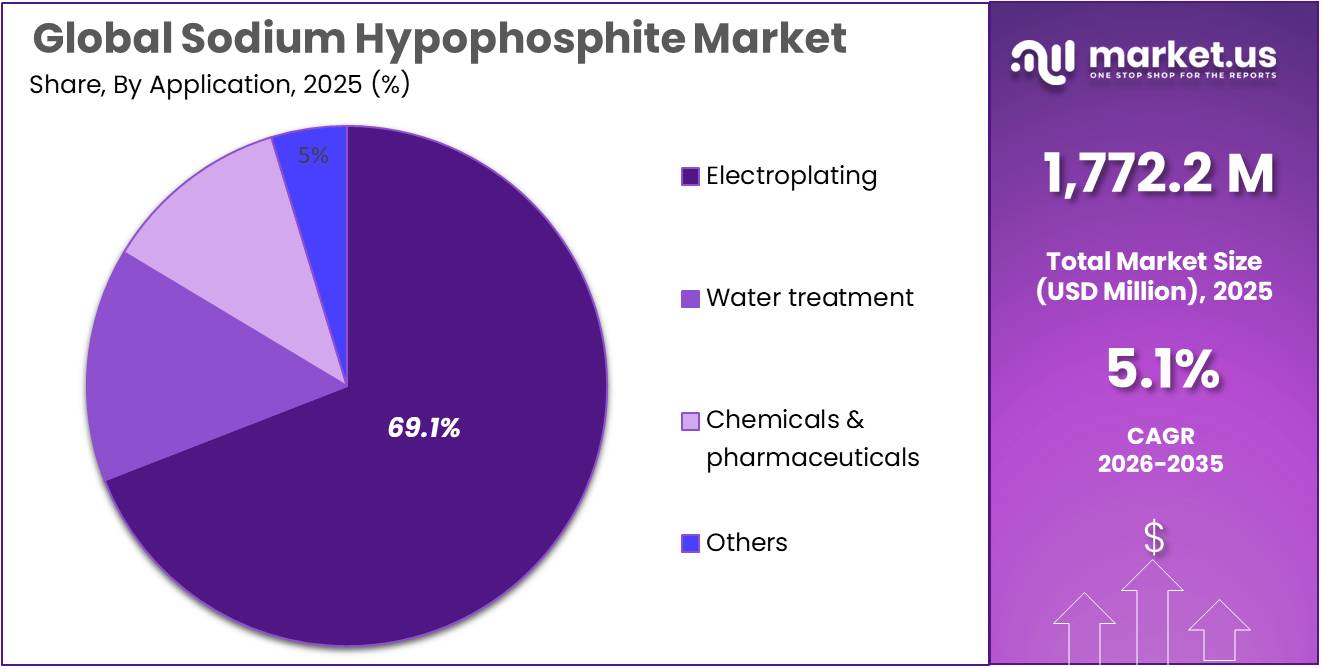
- Electroplating held a dominant market position, capturing more than a 69.12% share.
- Asia-Pacific held the dominant market position in 2025, accounting for 43.22% and USD 765.5 million.
By Function Analysis
Reducing Agents dominate the Sodium Hypophosphite Market with a 43.56% share due to their strong role in electroless nickel plating.
In 2025, Reducing agents held a dominant market position, capturing more than a 43.56% share of the Sodium Hypophosphite Market. This leadership is mainly supported by the chemical’s established use as a reducing agent in electroless nickel plating. The U.S. Environmental Protection Agency states that sodium hypophosphite supplies the electrons required to reduce nickel ions during electroless deposition without an external electric current.
- The resulting nickel-phosphorus coating can contain around 1% to 15% phosphorus by weight, depending on the plating chemistry. This function makes sodium hypophosphite useful in automotive components, electronics, aerospace equipment, machinery, pumps, valves, and other corrosion-resistant metal parts. The industrial base supporting this application is also sizeable.
The U.S. EPA reports that approximately 44,000 facilities perform metal-finishing operations and discharge process wastewater, with covered activities including electroless plating and printed circuit board manufacturing. These established industrial applications continue to support reducing-agent consumption in plating chemicals.
Catalysts & stabilizers represent another functional area for sodium hypophosphite, particularly where manufacturers require controlled reaction conditions, chemical stability, or specialized formulation performance. Its chemistry is closely connected with autocatalytic electroless nickel systems, where the deposited nickel surface acts as the catalyst that enables the reduction reaction to continue. U.S. EPA technical documentation identifies 4 basic components in an electroless plating solution: a metal source, a reducing agent, a complexing agent, and buffers or other chemicals that maintain bath stability and extend operating life.
By Grade Analysis
Industrial Grade dominates the Sodium Hypophosphite Market with a 65.67% share, supported by widespread use in metal finishing and electroless nickel plating.
In 2025, Industrial held a dominant market position, capturing more than a 65.67% share of the Sodium Hypophosphite Market. Industrial-grade material remains widely used in electroless nickel plating, chemical processing, metal finishing, and corrosion-resistant surface treatments because sodium hypophosphite works effectively as the reducing agent in nickel baths. The U.S. Environmental Protection Agency states that electroless nickel plating uses sodium hypophosphite to reduce nickel ions without applying external electrical current.
- EPA technical data show that typical acid electroless nickel baths operate at 77–93°C, while alkaline systems can operate at 26–95°C. The resulting nickel-phosphorus coating can contain around 1–15% phosphorus by weight, helping manufacturers adjust corrosion resistance, hardness, and coating performance for different industrial components.
Electrical grade sodium hypophosphite serves specialized applications where tighter chemical purity and controlled deposition are important, particularly in electronic components, printed circuit boards, connectors, and precision metal surfaces. U.S. EPA documentation identifies printed circuit boards as one of the major applications of electroless plating and confirms sodium hypophosphite as a principal reducing agent used in electroless nickel systems. EPA data also show typical electroless nickel deposition rates of around 12.7–25.4 micrometers per hour in acid baths, highlighting the controlled coating performance required for precision manufacturing.
By Application Analysis
Electroplating dominates the Sodium Hypophosphite Market with a 69.12% share due to its essential reducing role in electroless nickel deposition.
In 2025, Electroplating held a dominant market position, capturing more than a 69.12% share of the Sodium Hypophosphite Market. Its leading position is mainly linked to the widespread use of sodium hypophosphite as a reducing agent in electroless nickel-phosphorus plating. The U.S. Environmental Protection Agency explains that hypophosphite supplies electrons for nickel-ion reduction without requiring an external electrical current. EPA technical information shows that nickel-phosphorus deposits produced through this process can contain approximately 1%–15% phosphorus by weight.
- Acid electroless nickel solutions typically operate at about 77–93°C, while deposition rates can reach approximately 12.7–25.4 micrometers per hour. These coatings are valued for corrosion resistance, wear protection, uniform thickness, and coverage of complex surfaces. A 2025 study indexed by the U.S. EPA also examined high-phosphorus electroless Ni-P coatings for electronics and evaluated additions of up to 1 wt.% rhenium, showing continued technical development in this coating field.
Water treatment is another application area for sodium hypophosphite, particularly in industrial water systems where reducing chemistry, metal control, corrosion management, and specialty treatment formulations are required. Thermo Fisher Scientific identifies sodium hypophosphite monohydrate directly as a water treatment agent alongside its use in electroless nickel plating. Its current product specification lists an assay of at least 97.0% on a dry-weight basis, with approximately 12%–17% water content, supporting controlled use in technical formulations.
Key Market Segments
By Function
- Reducing agents
- Catalysts & stabilizers
- Chemical intermediates
By Grade
- Electrical
- Industrial
By Application
- Electroplating
- Water treatment
- Chemicals & pharmaceuticals
- Others
Driver Analysis
Advanced Semiconductor Packaging
U.S. policy is actively expanding domestic packaging capability: in January 2025, the Department of Commerce finalized USD 1.4 billion of CHIPS National Advanced Packaging Manufacturing Program awards to establish high-volume domestic advanced-packaging capability, while the CHIPS Act dedicates USD 39 billion of its USD 50 billion Department of Commerce allocation to semiconductor fabrication, assembly, testing, advanced packaging, materials, and equipment.
As of July 2025, Commerce had awarded incentives to 19 companies across 40 semiconductor construction, expansion, or modernization projects, widening the potential installed base for plating chemicals, high-purity process chemicals, and electronics finishing capacity. An advanced packaging line can consume 2–10 tonnes of sodium hypophosphite equivalent annually depending on deposition thickness, bath turnover, reclaim efficiency, yield loss, and lead-frame or substrate throughput; at a USD 7–15 per kg high-purity delivered price, a 25-line expansion cycle creates an analyst-modelled USD 3.5–37.5 million annual chemical demand pool before associated nickel salts, stabilizers, analytical services, and bath management.
Commercially, this shifts suppliers from lower-spec bulk material toward electronics-grade low-metal-impurity product, closed-loop bath monitoring, lot traceability, and multi-year qualification supply agreements, which can raise gross margin by 500–1,200 basis points and reduce customer switching once a chemistry is validated. This driver is estimated to add +2.1 percentage points to baseline sodium hypophosphite market CAGR across North America, Taiwan, South Korea, Japan, China, Singapore, and advanced APAC packaging clusters over two to four years.
Drivers Impact Analysis
| Driver | (~) % Impact on CAGR Forecast | Geographic Relevance | Impact Timeline |
|---|---|---|---|
| Advanced semiconductor packaging | +2.1 pp | North America, Taiwan, Korea, Japan | Medium term (2-4 years) |
| Automotive electronics growth | +1.7 pp | China, EU, U.S., Japan, Korea | Short term (≤ 2 years) |
| Lead-free surface finishing | +1.4 pp | EU, North America, developed APAC | Medium term (2-4 years) |
| Aerospace-grade EN plating | +1.2 pp | U.S., EU, Japan, India | Medium term (2-4 years) |
| High-durability industrial coating | +1.0 pp | China, India, ASEAN, LATAM | Short term (≤ 2 years) |
| Localized chemical supply chains | +0.8 pp | North America, EU, India, ASEAN | Long term (≥ 4 years) |
Restraint Analysis
Phosphorus Feedstock Volatility
A 20–40% increase in phosphorus-intermediate pricing, electricity tariffs, sodium hydroxide, transport fuel, or water-treatment input costs can raise a producer’s cash cost by an analyst-modelled 12–25%, while sodium hypophosphite contracts in industrial plating are often fixed for 3–12 months and prevent full pass-through.
For a manufacturer selling 10,000 tonnes annually at USD 4,000–7,000 per tonne, a 15% unhedged input-cost rise can create USD 6–10.5 million of annual gross-margin exposure before working-capital effects; if only 60–70% can be passed through, EBITDA margin may decline by 300–800 basis points. Downstream buyers respond by extending bath life, reducing replenishment rates, increasing drag-out recovery, reformulating lower-phosphorus coatings, or qualifying alternative reducing agents, weakening volume growth even where industrial coating demand remains intact.
Producers need multi-source phosphorus procurement, indexed pricing, 60–120 days of critical raw-material inventory, energy hedges, process-yield upgrades, and regional tolling arrangements, but these measures tie up 5–12% more working capital and cannot completely neutralize upstream commodity and energy swings. This input-cost restraint is estimated to deduct -1.9 percentage points from baseline sodium hypophosphite CAGR across China, India, Europe, North America, and export-dependent markets through 2028.
Restraint Impact Analysis
| Restraint | (~) % Impact on CAGR Forecast | Geographic Relevance | Impact Timeline |
|---|---|---|---|
| Phosphorus feedstock volatility | -1.9 pp | China, India, EU, North America | Short term (≤ 2 years) |
| Electroless plating waste cost | -1.6 pp | North America, EU, Japan, Korea | Medium term (2-4 years) |
| China supply concentration | -1.4 pp | Global import markets | Medium term (2-4 years) |
| Nickel-bath substitution risk | -1.2 pp | EU, North America, developed APAC | Medium term (2-4 years) |
| High-purity qualification barriers | -1.0 pp | Semiconductor hubs, aerospace markets | Long term (≥ 4 years) |
| Hazardous-logistics cost inflation | -0.8 pp | Europe, India, ASEAN, LATAM | Short term (≤ 2 years) |
Opportunity Analysis
Electronics-Grade Localization
The U.S. Department of Commerce finalized USD 1.4 billion of advanced-packaging awards in January 2025, including USD 300 million for materials and substrate research and USD 1.1 billion for an advanced-packaging piloting facility, while the European Chips Act and its 2026 expansion explicitly target semiconductor manufacturing, advanced packaging, assembly, and test capacity.
A regional purification, crystallization, filtration, and clean-bagging unit producing 2,000–5,000 tonnes annually can require USD 8–25 million of capital expenditure but can convert commodity sodium hypophosphite priced near USD 4–7 per kg into electronics-grade material at USD 8–15 per kg, supporting a 15–40% price premium and an analyst-modelled 500–1,000-basis-point gross-margin uplift when customer qualification succeeds. A domestic packaging, substrate, or high-reliability plating cluster with 20–40 qualified users could consume 500–2,000 tonnes annually, representing USD 4–30 million of recurring sales at electronics-grade pricing; lowering lead time from 45–90 days for intercontinental supply to 7–21 days also releases 30–60 days of customer safety-stock capital and reduces line-stoppage exposure.
This is a white-space play because it requires deliberate investment in ICP-MS laboratories, trace-metal specifications, validated cleaning, moisture-controlled packaging, 99%+ on-time delivery, and 12–36-month customer qualification cycles, not merely an increase in routine electroless-nickel demand. Suppliers that secure local offtake agreements, build vendor-managed inventory, and co-develop purity standards with fabs can reduce customer acquisition cost by 20–35% through cluster selling and raise recurring contract renewal rates above 80%. This opportunity could add +2.0 percentage points above baseline market CAGR across North America, Europe, Japan, South Korea, Taiwan, and Singapore within two years.
Opportunity Impact Analysis
| Opportunity | (~) % Potential CAGR Upside | Geographic Relevance | Execution Window |
|---|---|---|---|
| Electronics-grade localization | +2.0 pp | U.S., EU, Japan, Korea, Taiwan | Short term (≤ 2 years) |
| Closed-loop bath services | +1.7 pp | North America, EU, developed APAC | Medium term (2-4 years) |
| Advanced-packaging formulations | +1.5 pp | U.S., EU, Taiwan, Korea, Japan | Medium term (2-4 years) |
| Regional tolling roll-ups | +1.2 pp | India, ASEAN, LATAM, Middle East | Medium term (2-4 years) |
| Low-temperature EN chemistries | +1.0 pp | EU, North America, China, Japan | Long term (≥ 4 years) |
| Digital bath-management SaaS | +0.8 pp | Global industrial hubs | Short term (≤ 2 years) |
Challenges Analysis
Electronics-Grade Process Consistency
The United States is expanding its domestic advanced-packaging base through USD 1.4 billion in finalized National Advanced Packaging Manufacturing Program awards announced in January 2025, including funding to validate materials and equipment at scale, while European policy is simultaneously targeting advanced semiconductor manufacturing and packaging capacity.
A producer manufacturing 5,000–15,000 tonnes per year may need to hold trace metals within low-single-digit or low-double-digit ppm ranges, maintain assay variation inside a roughly 0.2–0.5% operating band, and prevent particle or packaging contamination that can trigger plating nodules, irregular phosphorus content, bath instability, or yield loss; a 0.5–1.0 percentage-point defect increase on a USD 50–250 million packaging line can create USD 0.25–2.5 million of annual customer value leakage and lead to batch quarantines lasting 30–90 days.
The supplier-side penalty is equally material: high-purity filtration, crystallization control, clean-room-adjacent filling, ICP-MS analytics, retained samples, and statistical process control can add USD 1–4 per kg to cost, reduce usable output by 3–10%, and require USD 5–25 million of incremental capex per site, yet price premiums may not be realized until a 12–36-month validation is complete.
This friction does not stop current sales, but it slows suppliers’ ability to capture the fastest-growing premium segment and forces ongoing investment in analytical capability, clean logistics, dual production trains, customer-specific control plans, and batch-release documentation. It is estimated to reduce maximum sodium hypophosphite market CAGR by -1.4 percentage points across North America, Europe, Taiwan, South Korea, Japan, Singapore, and high-end Chinese packaging clusters over two to four years.
Challenges Impact Analysis
| Challenge | (~) % CAGR Friction Drag | Geographic Relevance | Mitigation Horizon |
|---|---|---|---|
| Electronics-Grade Process Consistency | -1.4 pp | U.S., EU, Taiwan, Korea, Japan | Medium term (2-4 years) |
| Phosphorus Supply-Chain Traceability | -1.2 pp | China, India, EU, North America | Long term (≥ 4 years) |
| Plating Talent and Automation | -1.0 pp | North America, EU, Japan, Korea | Long term (≥ 4 years) |
| Evolving Wastewater Compliance | -0.9 pp | U.S., EU, China, developed APAC | Medium term (2-4 years) |
| Customer Qualification Cycle Length | -0.8 pp | Semiconductor and aerospace hubs | Long term (≥ 4 years) |
| Batch-Level Demand Volatility | -0.7 pp | Global export markets | Short term (≤ 2 years) |
Geopolitical Impact Analysis
Ongoing Wars Raise Energy, Freight, and Supply Risks for Sodium Hypophosphite
The ongoing Russia–Ukraine war and continuing Middle East security tensions are influencing the Sodium Hypophosphite Market through higher energy uncertainty, longer shipping routes, and greater pressure on chemical supply chains. Sodium hypophosphite production depends on phosphorus-based raw materials, electricity, process heat, and international freight, making producers sensitive to changes in fuel and logistics costs.
The U.S. Energy Information Administration reported that oil movements through the Strait of Hormuz fell from 21.6 million barrels per day in Q4 2025 to 4.9 million barrels per day in Q2 2026, showing the scale of disruption that geopolitical tensions can create around critical energy routes. At the same time, oil flows around the Cape of Good Hope reached 9.4 million barrels per day in Q2 2026, reflecting greater reliance on alternative shipping routes. These conditions can increase freight, insurance, and production costs for sodium hypophosphite suppliers.
Regional Insights
Asia-Pacific Leads the Sodium Hypophosphite Market with 43.22% Share and USD 765.5 Million Value
Asia-Pacific held the dominant market position in 2025, accounting for 43.22% and USD 765.5 million. China remains a major contributor because of its large chemical, automotive, electronics, and metal-processing industries.
- According to China’s National Bureau of Statistics, manufacturing value added increased 6.4% in 2025, while raw chemical materials and chemical products manufacturing grew 7.8%. Production of computers, communication equipment, and other electronic equipment increased 10.6%, while integrated-circuit output reached 484.28 billion units, up 10.9%. These industries create steady requirements for electroless nickel coatings and related sodium hypophosphite chemistry.
North America is expected to remain among the fastest-growing regional markets, supported by expanding semiconductor and advanced manufacturing capacity. In 2025, the U.S. Department of Commerce reported nearly USD 450 billion in planned electronics-manufacturing investment linked with semiconductor expansion.
The CHIPS Program Office was established to deploy USD 39 billion for domestic semiconductor manufacturing, with around USD 34 billion already awarded by January 2025. Micron also announced plans in June 2025 to invest USD 200 billion in U.S. semiconductor manufacturing and R&D. Growing fabrication, packaging, electronics, and precision-component production should strengthen demand for specialty plating chemicals, including sodium hypophosphite used in electroless nickel processes.
Key Regions and Countries Insights
- North America
- US
- Canada
- Europe
- Germany
- France
- The UK
- Spain
- Italy
- Rest of Europe
- Asia Pacific
- China
- Japan
- South Korea
- India
- Australia
- Rest of APAC
- Latin America
- Brazil
- Mexico
- Rest of Latin America
- Middle East & Africa
- GCC
- South Africa
- Rest of MEA
Key Players Analysis
Arkema maintains a strong position in specialty chemicals and phosphorus-based materials, supporting its presence in sodium hypophosphite and related surface-treatment applications. In 2025, the Group generated €9.1 billion in sales and €1.25 billion in EBITDA, with an EBITDA margin of 13.8%. Arkema employed about 20,700 people, operated 154 production plants across 55 countries, and allocated 3.1% of sales to R&D. Its global manufacturing and technical capabilities strengthen supply to electronics, coatings, automotive, and industrial customers.
Changshu New-Tech Chemicals is an important Chinese producer of phosphorus-based chemicals, including sodium hypophosphite. Company expansion documentation shows that its upgraded production system is designed for 25,500 tonnes per year of sodium hypophosphite, alongside 21,200 tonnes of THPX, 21,500 tonnes of calcium hydrogen phosphite, and 15,000 tonnes of tricalcium phosphate. Regulatory approvals for the expansion were obtained during 2022–2024. The larger production base strengthens its ability to supply metal finishing, chemical processing, flame-retardant, and specialty industrial applications.
Huanggang Quanwang Chemical operates as a specialized phosphorus-chemical manufacturer with a product portfolio directly connected to sodium hypophosphite applications. Available company production information indicates annual capacity of around 5,000 tonnes of sodium hypophosphite, 15,000 tonnes of food-grade phosphoric acid, and 3,000 tonnes of hypophosphorous acid. It also lists capacity of 2,500 tonnes of THPS and 5,000 tonnes of feed-grade tricalcium phosphate. This integrated phosphorus portfolio supports its competitive position in electroplating, specialty chemicals, water treatment, and industrial formulations. made-in-china.com
Top Key Players Outlook
- Arkema Group (France)
- Changshu New-Tech Chemicals Co., Ltd. (China)
- Huanggang Quanwang Chemical Co., Ltd. (China)
- Hubei Sky Lake Chemical Co., Ltd. (China)
- Hubei Xingfa Chemicals Group Co., Ltd. (China)
- Jiangsu Danai Chemical Co., Ltd. (China)
- Jiangsu Kangxiang Industrial Group Co., Ltd. (China)
- Jiangxi Fuerxin Medicine Chemical Co., Ltd. (China)
- Nippon Chemical Industrial Co., Ltd. (Japan)
- Merck KGaA (Germany)
- Solvay (Belgium)
- Febex SA (Switzerland)
- Other Key Players
Recent Developments
- December 2025 Tianmen municipal government notice confirmed that the company had previously been included among 4 chemical enterprises covered by relocation and restructuring measures, with the original closure and relocation acceptance completed by the end of 2020.
- Jiangxi Fuerxin Medicine Chemical Co., Ltd. operates a production base covering about 150 mu, with total investment of roughly RMB 120 million and annual sodium hypophosphite capacity of around 10,000 tonnes. Its broader product portfolio also includes approximately 6,000 tonnes/year of THPS, 3,500 tonnes/year of THPC, 8,000 tonnes/year of THPC-urea condensate, and 5,000 tonnes/year of THPS-urea condensate.
Report Scope
| Report Features | Description |
|---|---|
| Market Value (2025) | USD 1,772.2 Mn |
| Forecast Revenue (2035) | USD 2,917.2 Mn |
| CAGR (2026-2035) | 5.1% |
| Base Year for Estimation | 2025 |
| Historic Period | 2020-2024 |
| Forecast Period | 2026-2035 |
| Report Coverage | Revenue Forecast, Market Dynamics, Competitive Landscape, Recent Developments |
| Segments Covered | By Function (Reducing agents, Catalysts & stabilizers, Chemical intermediates), By Grade (Electrical, Industrial), By Application ( Electroplating, Water treatment, Chemicals & pharmaceuticals, Others) |
| Regional Analysis | North America – US, Canada; Europe – Germany, France, The UK, Spain, Italy, Rest of Europe; Asia Pacific – China, Japan, South Korea, India, Australia, Singapore, Rest of APAC; Latin America – Brazil, Mexico, Rest of Latin America; Middle East & Africa – GCC, South Africa, Rest of MEA |
| Competitive Landscape | Arkema Group, Changshu New-Tech Chemicals Co., Ltd., Huanggang Quanwang Chemical Co., Ltd., Hubei Sky Lake Chemical Co., Ltd., Hubei Xingfa Chemicals Group Co., Ltd., Jiangsu Danai Chemical Co., Ltd., Jiangsu Kangxiang Industrial Group Co., Ltd., Jiangxi Fuerxin Medicine Chemical Co., Ltd., Nippon Chemical Industrial Co., Ltd, Merck KGaA, Solvay, Febex SA, Other Key Players, |
| Customization Scope | Customization for segments, region/country-level will be provided. Moreover, additional customization can be done based on the requirements. |
| Purchase Options | We have three licenses to opt for: Single User License, Multi-User License (Up to 5 Users), Corporate Use License (Unlimited User and Printable PDF) |





































