


Report Overview
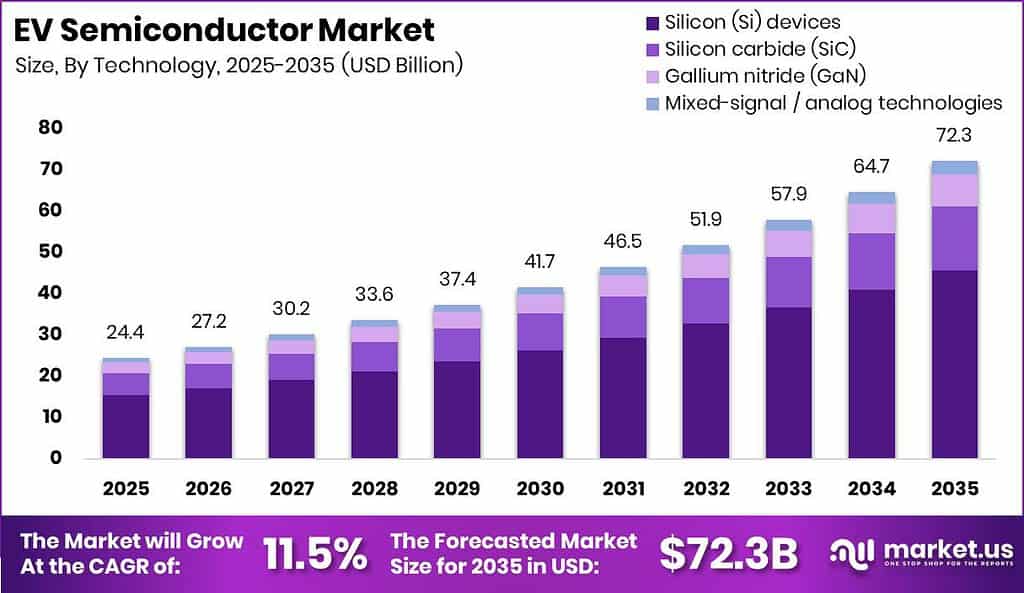
Global EV Semiconductor Market size is expected to be worth around USD 72.30 Billion by 2035 from USD 24.40 Billion in 2025, growing at a CAGR of 11.5% during the forecast period 2026 to 2035. Power devices, control ICs, sensors, and memory form the electronic backbone of electric drivetrains and vehicle systems. Therefore, suppliers who secure multi-year design wins capture recurring content as EV platforms scale.
The EV Semiconductor Market covers chips that convert, control, sense, and store energy inside electric vehicles. Structure spans application domains, device classes, process technologies, and propulsion architectures. Buyers specify parts by voltage class, thermal limit, and functional safety grade. This structure forces vendors to win at the platform level rather than through one-off component bids.
Key Takeaways
- The market is valued at USD 24.40 Billion in 2025 and is set to reach USD 72.30 Billion by 2035 at a CAGR of 11.5%.
- By Application, Powertrain leads with a 48.2% share.
- By Device Type, Power semiconductor devices lead with a 58.9% share.
- By Technology, Silicon (Si) devices lead with a 63.3% share.
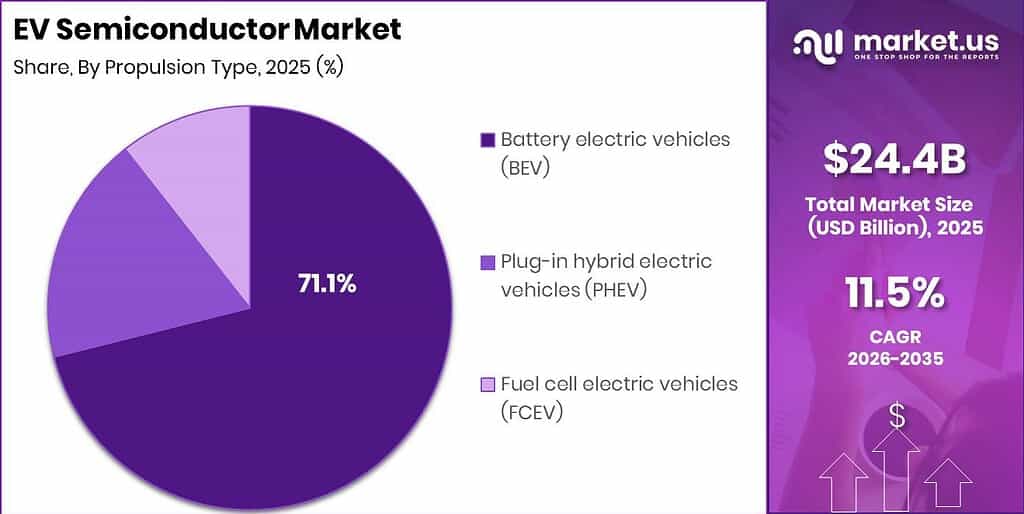
- By Propulsion Type, Battery electric vehicles (BEV) lead with a 71.1% share.
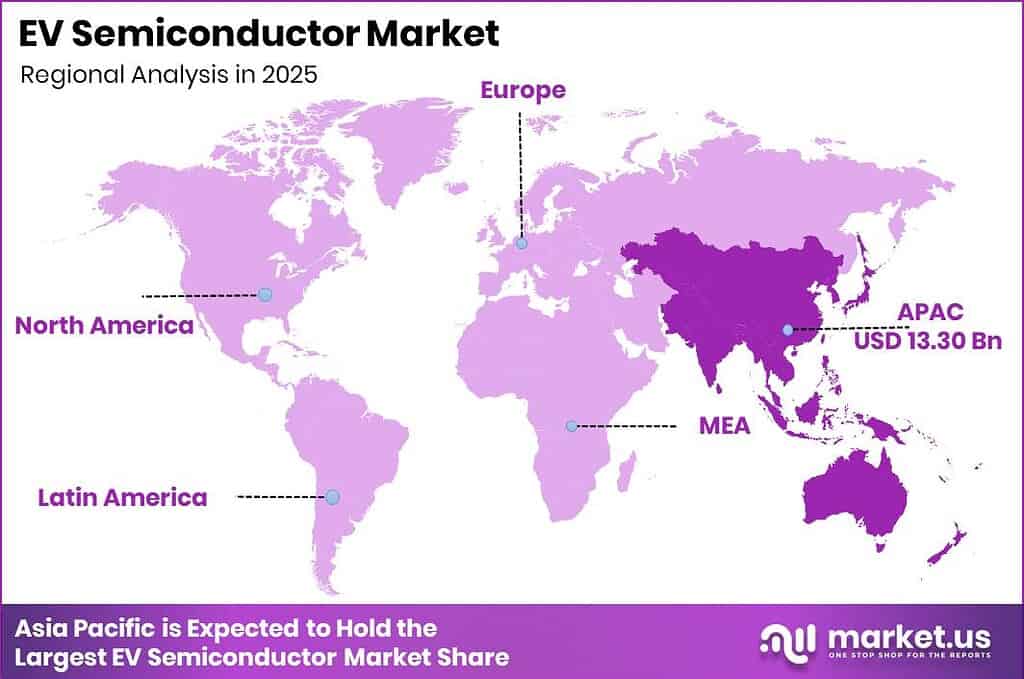
- Asia Pacific dominates with a 54.4% share, valued at USD 13.30 Billion.
Domestic fabrication incentives in the United States, the EU, and India are unlocking capacity for power and logic devices used in EVs. As a result, OEMs gain closer supply options and lower exposure to long-haul import risk. Rising EV output in end-use fleets then lifts semiconductor content per vehicle because each new platform needs inverters, BMS controllers, and safety sensors. Vendors tied to incentive-backed fabs improve delivery certainty for high-volume programs.
According to arXiv research (2508.14224), a three-level TNPC traction inverter used only 30% more SiC chip area and cut drivetrain losses by 0.67 kWh per 100 km versus a two-level SiC design. This efficiency gain extends usable range without a larger battery pack. Automakers that lock multi-level SiC inverter roadmaps reduce battery cost pressure and raise semiconductor value per vehicle.
As reported by the same arXiv study, average BEV driving range reached 455 km through model year 2025 under semiconductor-enabled drivetrain evaluation. This range level raises buyer confidence and supports higher EV take rates. Consequently, power and control chip demand scales with every incremental BEV sold. In December 2025, Qualcomm acquired Ventana Micro Systems to deepen RISC-V CPU technology for high-performance automotive platforms, reinforcing compute content inside next EV architectures.
Application Analysis
Powertrain dominates with 48.2% due to high inverter and traction content.
In 2025, Powertrain held a dominant market position in the By Application segment of EV Semiconductor Market, with a 48.2% share. Data from the IEA shows electric car sales were set to surpass 20 million units in 2025, over a quarter of global car sales. Traction inverters and motor drives absorb the largest silicon and SiC bill of materials. Suppliers who win inverter sockets capture the highest dollar content per vehicle and lock multi-year platform revenue.
Battery Management Systems govern cell balancing, isolation monitoring, and charge control across high-voltage packs. IEA tracking shows electric cars already exceeded a 20% share of worldwide car sales in 2024, lifting BMS controller and sensing IC volumes. Accurate state-of-charge estimation depends on precision analog front ends and microcontrollers. Vendors that certify functional-safety BMS chipsets become preferred partners as pack voltages move toward 800 V architectures.
ADAS and Autonomy electronics process camera, radar, and sensor fusion workloads that raise digital and mixed-signal content. Passenger EV sales continued climbing into 2026, with industry outlooks near 23.3 million units globally. Higher autonomy levels multiply sensor interfaces and domain controllers per vehicle. Chip makers with AI accelerators and high-bandwidth memory paths gain share as OEMs push supervised autonomy packages.
Infotainment and cluster systems handle displays, connectivity, and cabin compute, while Body and safety electronics manage lighting, access, and passive safety loops. Both domains add steady microcontroller and analog demand as EV platforms standardize electronic architectures. Suppliers who bundle cockpit and body controllers reduce OEM qualification cycles and defend share against pure power-device specialists.
Device Type Analysis
Power semiconductor devices dominate with 58.9% due to inverter energy conversion needs.
In 2025, Power semiconductor devices held a dominant market position in the By Device Type segment of EV Semiconductor Market, with a 58.9% share. Corporate filings and sustainability reports show all-SiC redesigns of a 22 kW EV fast charger can cut energy losses by up to 40% and double power density. Traction and charging stages therefore concentrate spend on MOSFETs, diodes, and modules. Investors should track SiC and high-voltage silicon capacity as the primary volume driver.
Analog and mixed-signal ICs condition sensor signals, gate drives, and power management rails across the vehicle electrical system. Precision regulation keeps battery packs and actuators within safe operating windows. Design wins here create sticky multi-year sockets because requalification costs deter mid-cycle swaps. Suppliers with automotive-grade analog portfolios capture follow-on content as platforms add channels.
Digital ICs and microcontrollers execute motor control, domain logic, and safety state machines with tight real-time deadlines. STMicroelectronics Stellar-class MCUs illustrate how on-chip accelerators and fine PWM resolution support motor and power-stage control. OEMs favor MCUs that meet ISO 26262 targets without external co-processors. This preference channels design-in toward vendors with proven automotive digital platforms.
Sensors convert current, temperature, position, and motion into data for control loops, while Memory devices store maps, logs, and AI weights and rank as the fastest-growing device class. Rising autonomy and OTA software loads expand non-volatile and DRAM attach rates. Vendors who pair automotive memory with sensor interfaces open a second growth lane beyond pure power silicon.
Technology Analysis
Silicon (Si) devices dominate with 63.3% due to mature cost and supply base.
In 2025, Silicon (Si) devices held a dominant market position in the By Technology segment of EV Semiconductor Market, with a 63.3% share. Si IGBTs and MOSFETs still serve large volumes of traction and auxiliary converters where cost and proven reliability matter most. High-volume Si lines keep bill-of-materials stable for mass-market EV trims. Incumbents with depreciated Si capacity defend share even as wide-bandgap devices expand.
Silicon carbide (SiC) is the fastest-growing technology path for high-voltage traction inverters and fast chargers. Wolfspeed materials show SiC MOSFETs in EV powertrains can cut power loss by up to 80% versus legacy silicon devices. Fuji Electric reports more than a 35% on-resistance cut from third to fourth generation SiC MOSFETs. Early SiC capacity leaders capture premium ASP and multi-year OEM co-design contracts.
Gallium nitride (GaN) targets high-frequency onboard chargers and DC-DC converters where size and switching loss matter. GaN can shrink converter footprint and improve efficiency versus silicon equivalents in charging stages. Design activity remains earlier than SiC inverter adoption, so qualification speed decides who owns the first production sockets. Suppliers that fund automotive GaN reliability data shorten OEM risk timelines.
Mixed-signal and analog process technologies integrate sensing, control, and power management on optimized nodes for automotive environments. These flows support BMS, gate drivers, and interface chips that silicon power stages still need. Vendors with specialty analog fabs protect margins even when discrete power pricing softens. This layer remains essential glue logic across every propulsion architecture.
Propulsion Type Analysis
Battery electric vehicles (BEV) dominate with 71.1% due to full high-voltage semiconductor load.
In 2025, Battery electric vehicles (BEV) held a dominant market position in the By Propulsion Type segment of EV Semiconductor Market, with a 71.1% share. IEA data indicates electric car sales were expected above 20 million in 2025, with BEVs carrying the full traction inverter, onboard charger, and high-voltage BMS stack. Pure battery platforms therefore generate the highest semiconductor content per unit. Suppliers aligned to BEV platforms capture both volume and ASP upside.
Plug-in hybrid electric vehicles (PHEV) still require power electronics for electric drive modes plus control ICs that coordinate engine and motor operation. Dual-powertrain complexity sustains demand for power modules and mixed-signal controllers even as pure BEV share rises. Tier-one buyers keep dual-source strategies for PHEV programs in regions with slower charging infrastructure. Chip makers that support both BEV and PHEV pin-compatible families reduce OEM inventory risk.
Fuel cell electric vehicles (FCEV) add power conditioning between the fuel cell stack, battery buffer, and traction inverter. Semiconductor needs center on DC-DC conversion, hydrogen-system sensing, and high-reliability controllers. Volumes remain smaller than BEV lines, yet specialized high-voltage content stays attractive for niche fleet and heavy-duty programs. Vendors with rugged power and sensing portfolios can seed long-cycle FCEV design wins without competing only on BEV scale.
Key Market Segments
By Application
- Powertrain
- Battery Management Systems
- ADAS / Autonomy
- Infotainment & cluster
- Body & safety electronics
By Device Type
- Power semiconductor devices
- Analog & mixed-signal ICs
- Digital ICs & microcontrollers
- Sensors
- Memory devices
By Technology
- Silicon (Si) devices
- Silicon carbide (SiC)
- Gallium nitride (GaN)
- Mixed-signal / analog technologies
By Propulsion Type
- Battery electric vehicles (BEV)
- Plug-in hybrid electric vehicles (PHEV)
- Fuel cell electric vehicles (FCEV)
Regional Analysis
Asia Pacific Dominates the EV Semiconductor Market with a Market Share of 54.4%, Valued at USD 13.30 Billion
Asia Pacific leads EV semiconductor demand through dense EV assembly bases in China, Japan, South Korea, and India. As per our research, the region held a 54.4% share valued at USD 13.30 Billion. Local power device and microcontroller supply chains shorten lead times for regional OEMs. Investors should treat Asia Pacific capacity and design-win density as the primary volume anchor for the forecast period.
North America is advancing through onshore SiC and automotive fab investments that pull semiconductor spend closer to US EV plants. Bosch announced in July 2026 that it completed a USD 2 billion conversion of its Roseville, California facility and began SiC sample production for EVs. This move supports domestic content goals and reduces tariff exposure on critical power devices. Suppliers with US-qualified SiC lines gain preferred status on North American platforms.
Europe and other regions combine strong OEM engineering bases with policy-backed electrification targets that sustain inverter, BMS, and ADAS chip demand. European and remaining regional programs still require multi-source power and control silicon even when absolute share trails Asia Pacific. Vendors that dual-source across EU and Asian fabs protect continuity when trade rules shift. This geographic balance lowers single-region disruption risk for global EV programs.
Key Regions and Countries
North America
- US
- Canada
Europe
- Germany
- France
- The UK
- Spain
- Italy
- Rest of Europe
Asia Pacific
- China
- Japan
- South Korea
- India
- Australia
- Rest of APAC
Latin America
- Brazil
- Mexico
- Rest of Latin America
Middle East and Africa
- GCC
- South Africa
- Rest of MEA
Market Dynamics
Market Opportunity Analysis - GaN charging, memory attach, and FCEV niches still leave open entry lanes.
Gallium nitride in onboard chargers and DC-DC stages remains earlier than mainstream SiC inverter adoption. Most production still favors silicon or SiC in high-volume trims. This leaves charging electronics underpenetrated relative to traction power. New entrants that fund automotive GaN reliability kits can win first sockets before large incumbents fully productize the line.
Memory devices rank as the fastest-growing device class yet still trail power semiconductors in absolute share. Autonomy software and OTA stacks raise non-volatile and DRAM content per EV. Many platforms under-spec memory headroom at launch. Suppliers who co-design memory with domain controllers capture attach rates that pure power vendors miss.
Fuel cell electric vehicles hold a smaller propulsion share than BEVs but need specialized DC-DC and sensing silicon. Heavy-duty and selected fleet programs keep FCEV roadmaps alive. Semiconductor vendors rarely prioritize this niche against BEV volume. Focused FCEV power and sensor kits give specialists a protected beachhead with less direct price war risk.
Regions outside core Asia Pacific assembly hubs still depend on imported power modules and controllers. Local packaging and test capacity often lags vehicle assembly growth. This gap creates room for regional joint ventures and OSAT partners. Investors who fund local backend capacity shorten lead times and win preference under localization rules.
Technology and Innovation Landscape - SiC efficiency leaps and AI MCUs redefine EV power and control.
Fuji Electric fourth-generation SiC MOSFETs cut on-resistance by more than 35% versus third-generation parts, after about a 25% cut from second to third generation. Lower resistance raises inverter efficiency and shrinks cooling needs. Traction suppliers who adopt newer generations improve range claims without larger packs. This cycle pressures lagging SiC roadmaps on both performance and cost.
All-SiC redesign of a conventional 22 kW EV fast charger reduces energy losses by up to 40% and doubles system power density per Wolfspeed reporting. SiC MOSFETs in powertrains can cut power loss by up to 80% versus legacy silicon. Charging and drivetrain OEMs gain smaller, cooler hardware. Investors should favor vendors shipping production SiC at scale rather than sample-only lines.
STMicroelectronics Stellar P3E automotive MCU integrates an NPU that delivers greater than 20× speedup for real-time AI inference with sub-millisecond execution. PWM resolution of 102 picoseconds enables fine digital control of power stages and motor actuators. Domain controllers can run smarter torque and thermal algorithms on-chip. MCU vendors without AI offload risk socket loss on next software-defined EV platforms.
Optical control research on SiC MOS transistors shows switching at optical power density above 0.1 W/cm² and rise time of 1.44 ns, with photogenerated current at 0.031 W/cm² exceeding a conventional 15 V gate bias case. Nanosecond-class optical gating points to future gate-drive architectures. Manufacturers who track this path early can pilot high-speed isolation concepts ahead of rivals.
Drivers
Silicon carbide holds a clear efficiency edge over legacy silicon IGBTs in traction inverters. SEMI shipment tracking shows SiC penetration past a majority of new EV platforms entering production between 2024 and 2026. Documented inverter-stage energy-loss cuts of 5% to 7% translate into 4% to 6% more range without added battery cost. This lifts the 11.5% baseline CAGR by about 2.8% and shifts suppliers toward multi-year platform co-design deals.
Wafer-level cost per unit for 150 mm SiC substrates has fallen roughly 15% since 2024 per Semiconductor Industry Association output figures. Unit volumes scale while near-term device gross margins compress by an estimated 200 to 300 basis points under tiered pricing. Buyers gain range at lower battery cost. Sellers who accept platform contracts first lock volume even as spot margins tighten through 2026 fab buildouts.
| Driver | (~) % Impact on CAGR Forecast | Geographic Relevance | Impact Timeline |
|---|---|---|---|
| Silicon carbide inverter adoption in new EV platforms | +2.8% | China, EU, North America | Short term (2 years or less) |
| 800V architecture shift accelerating power semiconductor bill-of-materials | +1.9% | China, South Korea, EU | Short term (2 years or less) |
| Domestic fabrication incentive disbursements reaching capacity | +1.4% | United States, EU, India | Medium term (2 to 4 years) |
| ADAS and battery management sensor content per vehicle rising | +1.2% | Global | Medium term (2 to 4 years) |
| Rising EV penetration in emerging fleet and two-wheeler segments | +0.9% | India, Southeast Asia | Medium term (2 to 4 years) |
Restraints
Proclamation 11002, effective January 15, 2026, imposes a 25% Section 232 tariff on defined advanced semiconductors unless tied to declared US supply-chain buildout. EV tier-one suppliers face landed-cost jumps of roughly 20% to 25% on affected logic and power line items. Customs disputes add an estimated 15 to 30 day delay on inbound shipments. Import-dependent programs slow until offset rules clear.
Procurement teams await the Department of Commerce update on tariff-offset eligibility due by April 14, 2026. OEMs must absorb a 200 to 400 basis point margin hit or delay trim launches while they re-qualify domestic alternatives. This freezes non-exempt import volumes in the near term. Participants with dual domestic sources keep launch schedules intact while pure importers lose timing advantage.
| Restraint | (~) % Impact on CAGR Forecast | Geographic Relevance | Impact Timeline |
|---|---|---|---|
| Section 232 tariffs on imported logic and power chips | -1.8% | United States | Short term (2 years or less) |
| High domestic interest rates delaying fab CapEx approvals | -1.1% | United States, EU | Short term (2 years or less) |
| Export control restrictions on advanced fabrication equipment | -0.9% | China, Taiwan | Short term (2 years or less) |
| EV subsidy rollback compressing near-term unit demand | -0.7% | United States, EU | Short term (2 years or less) |
Challenges
Planned global SiC substrate capacity exceeds roughly 3 million six-inch-equivalent wafers annually, with China holding an estimated 30% to 40% share. Oversupply has driven wafer average selling prices down 20% to 30% since 2024. Utilization below 70% on several 8-inch transition lines forces write-downs for substrate producers. Price chaos slows stable long-term device costing for EV programs.
Device makers respond by qualifying multiple substrate sources and signing multi-year fixed-price contracts. Consolidation and vertical integration become the corporate adjustment path through 2026. This challenge opens a revenue stream for integrated players who control wafer-to-module chains. Early integrators convert volatility into share gains while pure substrate specialists face margin stress.
| Challenge | (~) % CAGR Friction Drag | Geographic Relevance | Mitigation Horizon |
|---|---|---|---|
| SiC substrate overcapacity and price volatility | -1.3% | China, Global | Medium term (2 to 4 years) |
| Power electronics packaging talent shortage | -0.8% | United States, EU | Long term (4 years or more) |
| Legacy silicon-to-SiC qualification cycle length | -0.6% | Global | Medium term (2 to 4 years) |
| Fragmented regional testing and certification standards | -0.5% | EU, India, Southeast Asia | Long term (4 years or more) |
Opportunities
Gallium nitride penetration in onboard chargers and DC-DC converters remains largely at prototype and low-volume trims today. GaN can cut converter footprint by roughly 40% and switching losses by an estimated 10% to 15% versus silicon equivalents. Suppliers can reposition charging electronics as a premium line with gross margin expansion of about 300 to 500 basis points after qualification. Early design-win capital decides who owns this white space.
Customs shipment patterns still show GaN power device trade as a small fraction of total power semiconductor volumes. Addressable upside sits above baseline only if OEMs fund design-ins ahead of the pack. Early movers capture disproportionate unmet demand in charging electronics. This path differs from already-scaling SiC inverters and rewards focused GaN automotive roadmaps.
| Opportunity | (~) % Potential CAGR Upside | Geographic Relevance | Execution Window |
|---|---|---|---|
| GaN adoption in onboard chargers and DC-DC converters | +1.7% | China, EU, North America | Medium term (2 to 4 years) |
| Chiplet-based domain-controller consolidation for EV compute | +1.3% | Global | Medium term (2 to 4 years) |
| Emerging market two- and three-wheeler EV electrification | +1.1% | India, Southeast Asia, Africa | Long term (4 years or more) |
| Tariff-offset-linked domestic fab joint ventures | +0.9% | United States | Medium term (2 to 4 years) |
| Second-life power module remanufacturing for fleet EVs | +0.6% | EU, North America | Long term (4 years or more) |
Key Company Insights
Infineon Technologies AG strengthens EV power distribution with Power PROFET + 24/48V smart switches that deliver 1.5 mΩ on-resistance and over 1,000,000 switching cycles. That cycle life far exceeds the 200,000-cycle bar of mechanical relays. This durability cuts maintenance risk in zonal architectures. Infineon converts relay replacement programs into sticky semiconductor sockets across next-generation EV electrical systems.
STMicroelectronics N.V. expands automotive sensing depth after agreeing in July 2025 to acquire NXP Semiconductors MEMS sensor business for EV safety and motion applications. Bosch has delivered over 60 million SiC chips globally, yet ST focuses on MCU and MEMS breadth. Stellar-class control plus added MEMS content deepens ST system coverage. This mix raises switching costs for OEMs already designed into ST automotive platforms.
Key Players
- Infineon Technologies AG
- STMicroelectronics N.V
- NXP Semiconductors N.V.
- Texas Instruments Incorporated
- Renesas Electronics Corporation
- onsemi
- Wolfspeed, Inc
- ROHM Semiconductor
- Toshiba Corporation
- Mitsubishi Electric Corporation
- Microchip Technology Inc.
- Analog Devices, Inc
- Micron Technology, Inc.
- Bosch
- Nexperia B.V.
Recent Developments
- June 2025: Qualcomm completed its acquisition of Autotalks, adding V2X semiconductor technology to strengthen its automotive and EV chipset portfolio.
- September 2025: STMicroelectronics invested USD 60 million to establish a Panel-Level Packaging pilot line at its Tours facility for next-generation automotive and power semiconductor products.
- 7 October 2025: Qualcomm acquired Arduino, expanding its embedded AI hardware ecosystem that supports intelligent automotive and electric vehicle platforms.
Geopolitical Impact Analysis
According to WTO-linked trade outlook materials, tariff-adjusted merchandise trade growth was revised around 2.4% for 2025 after sharp policy swings. Figures from recent US trade actions show baseline duties near 10% on many imports and far higher China-linked rates on non-exempt electronics classes. EV power modules and logic ICs face landed-cost spikes when shipments cross restricted lanes. Procurement teams reroute SiC and MCU supply toward domestic or allied fabs to protect vehicle launch dates.
Data from UNCTAD Review of Maritime Transport 2025 shows longer routes have raised delays, costs, and emissions across global shipping. As reported by UNCTAD briefings, freight rates stay elevated and volatile while disruption becomes more frequent. Semiconductor wafers and power modules bound for EV plants absorb these transit shocks through higher safety stock. This means regional backend packaging near OEM clusters becomes a strategic hedge against ocean-lane risk.
Report Scope
| Report Features | Description |
|---|---|
| Market Value (2025) | USD 24.40 Billion |
| Forecast Revenue (2035) | USD 72.30 Billion |
| CAGR (2026-2035) | 11.5% |
| Base Year for Estimation | 2025 |
| Historic Period | 2020-2024 |
| Forecast Period | 2026-2035 |
| Report Coverage | Revenue Forecast, Market Dynamics, Market Opportunity Analysis, Technology and Innovation Landscape, Competitive Landscape, Recent Developments |
| Segments Covered | By Application (Powertrain, Battery Management Systems, ADAS / Autonomy, Infotainment & cluster, Body & safety electronics), By Device Type (Power semiconductor devices, Analog & mixed-signal ICs, Digital ICs & microcontrollers, Sensors, Memory devices), By Technology (Silicon (Si) devices, Silicon carbide (SiC), Gallium nitride (GaN), Mixed-signal / analog technologies), By Propulsion Type (Battery electric vehicles (BEV), Plug-in hybrid electric vehicles (PHEV), Fuel cell electric vehicles (FCEV)) |
| Regional Analysis | North America (US and Canada), Europe (Germany, France, The UK, Spain, Italy, and Rest of Europe), Asia Pacific (China, Japan, South Korea, India, Australia, and Rest of APAC), Latin America (Brazil, Mexico, and Rest of Latin America), Middle East and Africa (GCC, South Africa, and Rest of MEA) |
| Competitive Landscape | Infineon Technologies AG, STMicroelectronics N.V, NXP Semiconductors N.V., Texas Instruments Incorporated, Renesas Electronics Corporation, onsemi, Wolfspeed, Inc, ROHM Semiconductor, Toshiba Corporation, Mitsubishi Electric Corporation, Microchip Technology Inc., Analog Devices, Inc, Micron Technology, Inc., Bosch, Nexperia B.V. |
| Customization Scope | Customization for segments, region / country-level will be provided. Additional customization can be done based on requirements. |
| Purchase Options | We have three licenses to opt for: Single User License | Multi-User License (Up to 5 Users) | Corporate Use License (Unlimited User and Printable PDF) |





































