


Report Overview
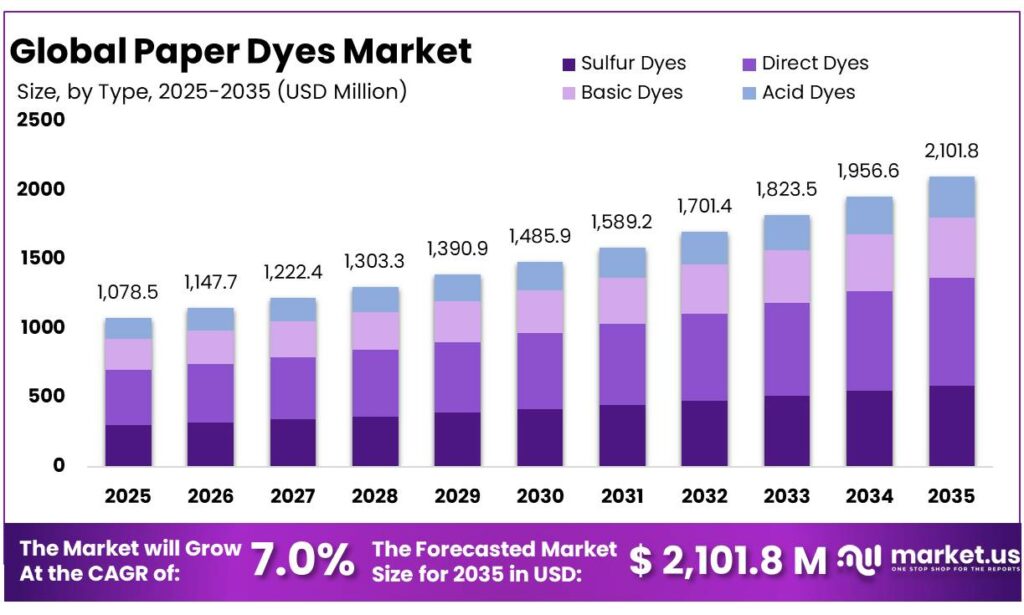
The Global Paper Dyes Market size is expected to be worth around USD 2,101.8 Million by 2035, from USD 1,078.5 Million in 2025, growing at a CAGR of 7.0% during the forecast period from 2026 to 2035. In 2025, Asia-Pacific held a dominant market position, capturing more than a 51.2% share, holding USD 551.9 Million revenue.
Paper dyes are specialty colorants used to impart shade, brightness, brand identity, and grade differentiation across packaging papers, tissue, decorative papers, labels, and selected printing and writing grades. The industry sits at the intersection of pulp and paper manufacturing, specialty chemicals, packaging conversion, and sustainability compliance. Its demand profile is therefore tied less to discretionary color consumption alone and more to the underlying output of paper and board.
The sector remains industrially relevant: global paper and paperboard production reached 401 million tonnes in 2023, even after a 3% decline year on year, while global trade fell 7% to 104 million tonnes. Asia-Pacific was the only major region to record growth in paper and paperboard production in 2023, indicating where incremental colorant demand is likely to remain strongest.
In Europe, CEPI reported that paper and board production in member countries rebounded by 5.2% in 2024 after the steep contraction of 2023, signaling a normalization in mill operating conditions and a better environment for dye consumption in board, container, and specialty paper applications. In the United States, AF&PA reported that 2024 packaging papers and specialty packaging shipments were up 11% against 2023, confirming that packaging remains the healthiest downstream demand pocket for paper colorants.
A major demand driver comes from food systems, where packaging performance, safety, and waste reduction have become strategic priorities. UNEP reported that the world wasted 1.05 billion tonnes of food in 2022, equal to roughly one-fifth of food available to consumers, while FAO and UNEP indicate that 13% of food is lost after harvest and before retail and a further 19% is wasted at retail, food service, and household level.
This raises the value of paper packaging that protects shelf life and supports branding, thereby indirectly strengthening demand for compliant dye chemistries. On the regulatory side, the U.S. FDA states that food-contact substances include packaging components and can include colorants, while the EU’s Packaging and Packaging Waste Regulation (EU) 2025/40 entered into force on 11 February 2025 and will generally apply from 12 August 2026, pushing suppliers toward safer, recyclable, and lower-impact formulations.
BASF and DyStar remain relevant reference points for the industry’s technology direction. BASF’s 2025 report showed €59.657 billion in group sales, including €4.801 billion from Dispersions & Resins, a business tied closely to printing, packaging, paper, and related color-performance applications.
Key Takeaways
- Paper Dyes Market size is expected to be worth around USD 2,101.8 Million by 2035, from USD 1,078.5 Million in 2025, growing at a CAGR of 7.0%.
- Direct Dyes held a dominant market position, capturing more than a 37.9% share.
- Powder held a dominant market position, capturing more than a 62.5% share.
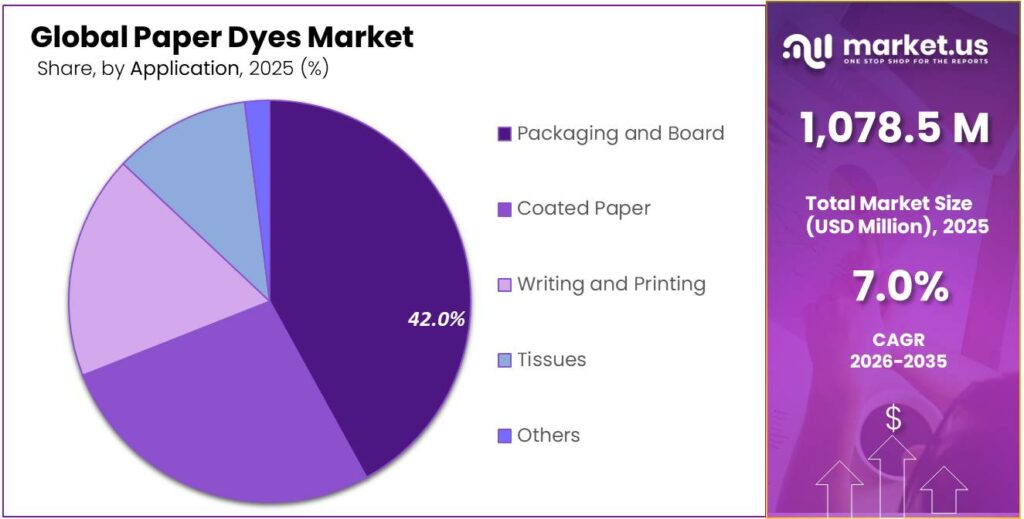
- Packaging and Board held a dominant market position, capturing more than a 42.6% share.
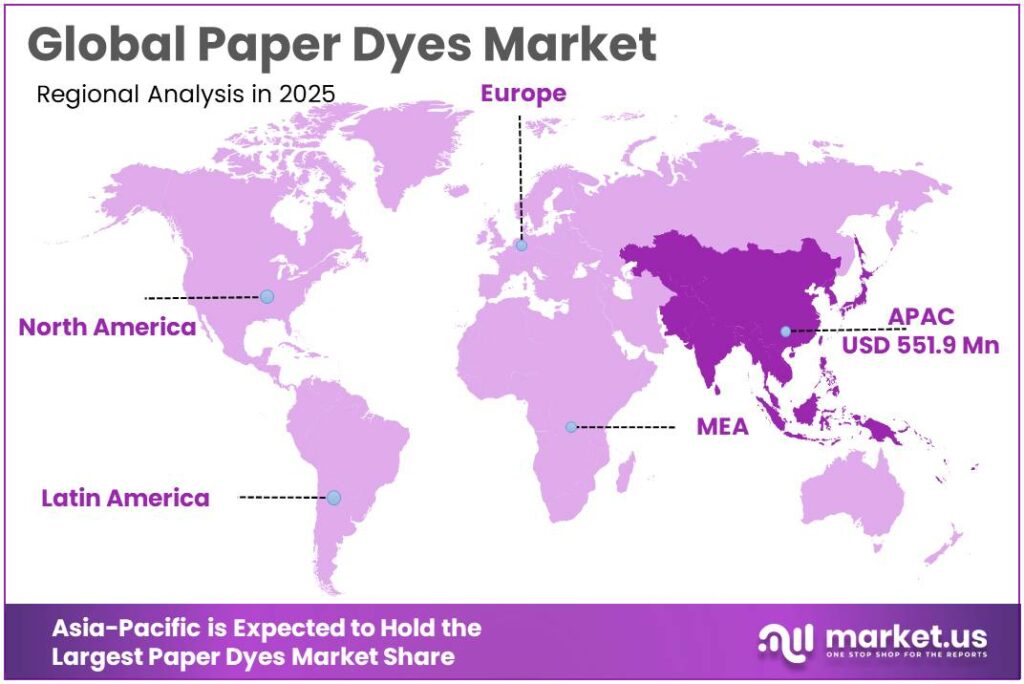
- Asia-Pacific holds the dominant position in the paper dyes market, accounting for 51.2% share with a value of USD 551.9 Mn.
By Type Analysis
Direct Dyes dominate with 37.9% driven by strong demand in paper coloring applications
In 2025, Direct Dyes held a dominant market position, capturing more than a 37.9% share. This leadership is mainly supported by their easy application process and strong affinity toward cellulose fibers, making them highly suitable for paper dyeing. Manufacturers continue to prefer direct dyes because they can be applied directly without the need for complex chemical treatments, which helps reduce production time and overall costs. In 2026, the segment maintained its momentum as demand from packaging and printing paper increased steadily, especially with the rise of eco-friendly and recyclable paper products.
By Form Analysis
Powder form leads with 62.5% thanks to easy handling and longer shelf life
In 2025, Powder held a dominant market position, capturing more than a 62.5% share. This strong position is largely due to its practical advantages in storage, transportation, and usage across paper manufacturing units. Powder dyes are easier to handle in bulk and offer better stability over time, which makes them a preferred choice for large-scale operations. Many paper producers rely on this form because it allows flexible dosing and consistent color output during production. Moving into 2026, the segment continued to see stable demand as manufacturers focused on cost efficiency and operational convenience.
By Application Analysis
Packaging and Board takes the lead with 42.6% as demand for sustainable packaging rises
In 2025, Packaging and Board held a dominant market position, capturing more than a 42.6% share. This growth is closely linked to the increasing use of paper-based packaging across industries like food, retail, and e-commerce. As businesses shift away from plastic, the need for strong and visually appealing paper packaging has increased, driving the use of dyes in this segment. Manufacturers prefer dyes that offer consistent color quality for branding and printing purposes on boards and cartons. In 2026, the segment continued to expand steadily as demand for corrugated boxes and folding cartons remained high. The rise in online shopping and eco-friendly packaging trends further supported this growth.
Key Market Segments
By Type
- Sulfur Dyes
- Direct Dyes
- Basic Dyes
- Acid Dyes
By Form
- Powder
- Liquid
By Application
- Packaging and Board
- Coated Paper
- Writing and Printing
- Tissues
- Others
Emerging Trends
Shift Toward Sustainable and Bio-Based Dyes in Paper Packaging
One of the most visible trends in the paper dyes market is the growing shift toward sustainable and bio-based dyes, mainly driven by changes in food packaging. In 2025, the eco-friendly food packaging market reached around USD 213.93 billion, and it continued rising in 2026 as industries actively replaced plastic with paper-based solutions. This shift is not just about materials, but also about the chemicals used in those materials, including dyes.
The food industry is playing a big role here. With more attention on environmental impact, brands want packaging that is recyclable and free from harmful substances. Research shows that demand for sustainable packaging solutions has increased rapidly due to environmental concerns and consumer preference for eco-friendly products.
Paperization and Smart Packaging Design Driving Dye Innovation
Another major trend is what the industry calls “paperization,” where brands are rapidly shifting from plastic packaging to paper-based alternatives. In 2025, reports highlighted that paper-based packaging is becoming a central strategy for companies aiming to meet sustainability targets and reduce environmental impact. This shift is increasing the need for high-quality dyes that can deliver strong color performance on paper surfaces while still meeting eco-friendly standards.
At the same time, packaging design is also changing. Modern food packaging now focuses on clean visuals, bold colors, and better labeling to attract customers and share product information clearly. As brands compete for attention on store shelves and online platforms, the role of dyes becomes more important in achieving the right look and feel.
Drivers
Rising Need for Food Preservation and Waste Reduction
One of the strongest driving factors for paper dyes comes from the growing global focus on reducing food loss and improving packaging efficiency. Across the food supply chain, a large portion of food is still lost before it even reaches consumers. According to the Food and Agriculture Organization, about 13.2% of food is lost between harvest and retail, which equals nearly 1.25 billion tonnes globally. On top of that, another 19% of food is wasted at retail, food service, and household levels. These numbers show a serious gap in how food is handled, stored, and protected.
This, governments and international bodies are pushing for better packaging solutions under initiatives like the UN Sustainable Development Goal 12.3, which aims to cut food waste by 2030. Paper-based packaging, especially in food applications, is being used more often because it is recyclable and safer compared to plastics. This shift increases the demand for paper dyes, as they help improve packaging visibility, labeling clarity, and branding while still maintaining food safety standards. In simple terms, better packaging with proper color coding helps prevent confusion, improves shelf life, and reduces unnecessary disposal of food.
Growth of Sustainable Packaging and Regulatory Push
Another key driver is the strong push toward sustainable and recyclable packaging materials. Governments and environmental organizations are encouraging industries to move away from plastic and toward paper-based alternatives. This is directly increasing the use of paper dyes in packaging applications. At the same time, food waste is not just a supply issue—it also impacts the environment. FAO estimates that food loss and waste contribute to around 8% to 10% of global greenhouse gas emissions, making it a major environmental concern.
To address this, many countries are introducing strict packaging and recycling regulations, especially in food and beverage sectors. Paper packaging must now meet both environmental and functional needs, including clear printing, durability, and compliance with food safety rules. This is where paper dyes play a critical role—they allow manufacturers to create eco-friendly packaging without compromising on quality or appearance.
Restraints
Strict Food Safety Regulations and Chemical Migration Concerns
One major restraining factor for paper dyes is the growing concern around chemical migration from packaging into food. In simple terms, some substances used in dyes, inks, or coatings can move from the packaging into the food itself. According to a 2025 food safety review, this migration can introduce harmful compounds and “pose serious health risks,” especially when packaging is in direct contact with food.
Research has also shown that contaminants like plasticizers were found in 56% of tested paper-based food packaging samples, while mineral oil residues were detected in 100% of samples in some studies. Because of such findings, governments and food safety authorities are enforcing tight limits on what chemicals can be used in paper dyes and printing inks. FAO also highlights that packaging materials must be carefully assessed to ensure they “do not pose a health risk,” especially for vulnerable groups like children.
Challenges with Recycled Materials and Contamination Risks
Another important challenge comes from the increasing use of recycled paper in packaging. While recycling is good for the environment, it brings its own complications for paper dyes. Recycled materials can carry unwanted substances, including heavy metals and residues from previous uses. Studies have found that elements like lead (Pb) and cadmium (Cd) in recycled paper sometimes exceed European safety standards. This raises concerns about whether dyed paper packaging is always safe for food contact.
Opportunity
Expansion of Sustainable Food Packaging Solutions
One of the biggest growth opportunities for paper dyes comes from the rising need to improve food packaging in a sustainable way. Across the world, food loss is still a serious issue. The Food and Agriculture Organization states that around 13.2% of food, equal to nearly 1.25 billion tonnes, is lost before it reaches retail, and another 19% is wasted at the consumer level. These numbers clearly show that better packaging is not just helpful, but necessary.
To deal with this, governments and global organizations are promoting stronger packaging systems under initiatives like UN Sustainable Development Goal 12.3, which aims to cut food waste by half by 2030. Paper-based packaging is gaining attention because it is recyclable and safer for the environment compared to plastic. This creates a strong opportunity for paper dyes, as they help improve labeling, visibility, and product identification without harming recyclability. When packaging is clear, readable, and durable, it helps reduce confusion, improves handling, and ultimately prevents food from being thrown away unnecessarily.
Shift Away from Plastic Packaging and Environmental Pressure
Another strong opportunity comes from the global movement to reduce plastic use in food systems. According to FAO, food packaging alone used about 37.3 million tonnes of plastics in 2019, showing how heavily industries relied on plastic materials. However, with rising environmental concerns, many governments are now pushing for alternatives. Food loss and waste are also responsible for 8% to 10% of global greenhouse gas emissions, which adds more pressure to improve packaging systems.
Paper packaging is being seen as a cleaner and more sustainable option. Regulations in many regions now encourage recyclable and biodegradable materials, especially in food applications. This shift naturally increases the use of paper dyes, as they are needed to maintain quality printing, branding, and compliance with food safety standards on paper surfaces.
Regional Insights
Asia-Pacific leads the market with 51.2% share driven by strong packaging and production base
Asia-Pacific holds the dominant position in the paper dyes market, accounting for 51.2% share with a value of USD 551.9 Mn, making it the largest regional contributor. This leadership is mainly supported by the region’s strong paper manufacturing ecosystem and high consumption of packaging materials. Countries like China, India, and Japan play a key role, as they are major producers as well as consumers of paper products.
By 2026, the region maintained steady growth as governments pushed for reduced plastic use and encouraged paper-based alternatives. Policies promoting recyclable and sustainable packaging have increased the use of dyed paper products. In addition, Asia-Pacific remains the fastest-growing and largest regional market in the paper dyes sector, supported by expanding industrial activities and rising consumer demand for packaged goods.
Key Regions and Countries Insights
- North America
- US
- Canada
- Europe
- Germany
- France
- The UK
- Spain
- Italy
- Rest of Europe
- Asia Pacific
- China
- Japan
- South Korea
- India
- Australia
- Rest of APAC
- Latin America
- Brazil
- Mexico
- Rest of Latin America
- Middle East & Africa
- GCC
- South Africa
- Rest of MEA
Key Players Analysis
In 2025, BASF reported total sales of €59.7 billion, maintaining its position as one of the largest chemical producers globally. The company operates across multiple segments including performance chemicals and colorants used in paper dyes. Its large-scale production network and strong R&D spending of nearly €1.9 billion support innovation in sustainable dye solutions. In 2026, BASF continued focusing on cost optimization and eco-friendly products, helping maintain stable growth despite market challenges and regulatory pressures in the chemical industry.
DyStar has built a strong position in the global dyes market with annual revenues historically around USD 1.0 billion and operations in over 50 countries. The company offers a wide portfolio including dyes for textiles, paper, and packaging applications. With around 2,000 employees and 14 production facilities, DyStar supports large-scale supply chains. In 2025–2026, the company continued expanding its specialty dyes and digital solutions, focusing on sustainable dyeing processes and improved efficiency for industrial users.
Thermax, though widely known for energy and environment solutions, also plays a role in water and chemical treatment relevant to dye processing industries. In 2025, the company reported revenues of around ₹9,000 crore, reflecting strong industrial demand. It supports paper dye manufacturers through solutions in wastewater treatment and process efficiency. By 2026, Thermax continued expanding its sustainability-focused technologies, helping industries comply with environmental norms while maintaining production efficiency, making it a supporting player in the paper dyes ecosystem.
Top Key Players Outlook
- BASF
- DyStar
- Archroma
- Synthesia
- Atul
- Thermax
- Axyntis Group
- KEMIRA OYJ
- Organic Dyes and Pigments
- Keystone Aniline
- Vipul Organics
- Cromatos
- Standard Colors
Recent Industry Developments
Archroma is a well-established player in the paper dyes sector, mainly through its Packaging Technologies and Paper Solutions business, where it supplies colorants, optical brighteners, and process chemicals for paper and board applications. In 2025, the company operated with around 4,000–4,500 employees across 42 countries and more than 30 production sites, showing its strong global reach and supply capability.
DyStar plays an important role in the paper dyes segment through its broad portfolio of colorants and specialty chemicals used in paper and packaging applications. As of 2025, the company operates with around 1,400 employees, more than 50 global offices, and close to 10 production sites, giving it a strong international supply network.
Report Scope
| Report Features | Description |
|---|---|
| Market Value (2025) | USD 1,078.5 Mn |
| Forecast Revenue (2035) | USD 2,101.8 Mn |
| CAGR (2026-2035) | 7.0% |
| Base Year for Estimation | 2025 |
| Historic Period | 2020-2024 |
| Forecast Period | 2026-2035 |
| Report Coverage | Revenue Forecast, Market Dynamics, Competitive Landscape, Recent Developments |
| Segments Covered | By Type (Sulfur Dyes, Direct Dyes, Basic Dyes, Acid Dyes), By Form (Powder, Liquid), By Application (Packaging and Board, Coated Paper, Writing and Printing, Tissues, Others) |
| Regional Analysis | North America – US, Canada; Europe – Germany, France, The UK, Spain, Italy, Rest of Europe; Asia Pacific – China, Japan, South Korea, India, Australia, Singapore, Rest of APAC; Latin America – Brazil, Mexico, Rest of Latin America; Middle East & Africa – GCC, South Africa, Rest of MEA |
| Competitive Landscape | BASF, DyStar, Archroma, Synthesia, Atul, Thermax, Axyntis Group, KEMIRA OYJ, Organic Dyes and Pigments, Keystone Aniline, Vipul Organics, Cromatos, Standard Colors |
| Customization Scope | Customization for segments, region/country-level will be provided. Moreover, additional customization can be done based on the requirements. |
| Purchase Options | We have three licenses to opt for: Single User License, Multi-User License (Up to 5 Users), Corporate Use License (Unlimited User and Printable PDF) |





































