


Report Overview
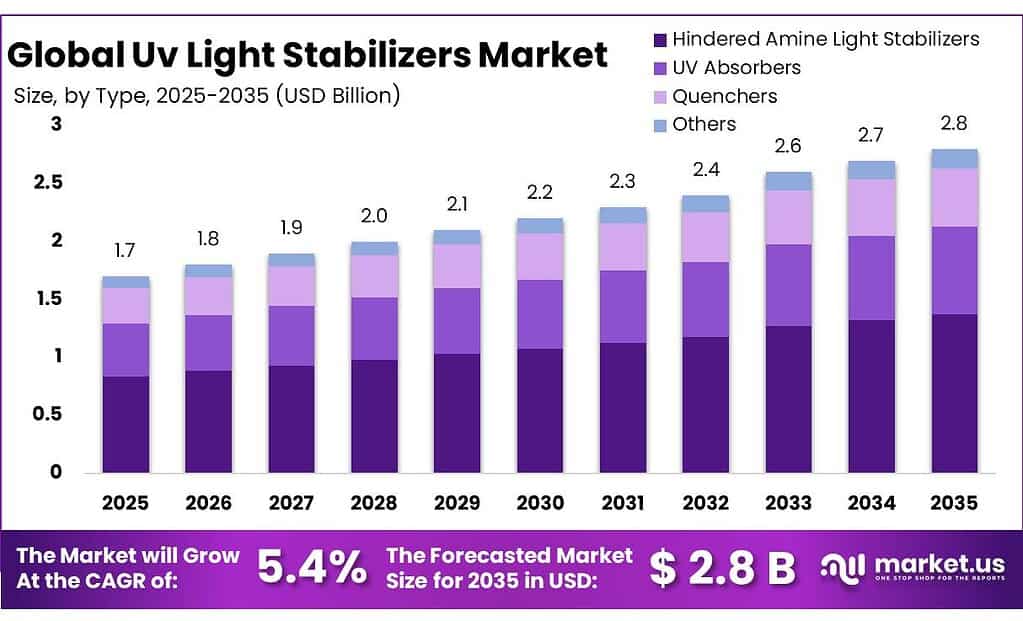
The Global Uv Light Stabilizers Market size is expected to be worth around USD 2.8 Billion by 2035, from USD 1.7 Billion in 2025, growing at a CAGR of 5.4% during the forecast period from 2026 to 2035. In 2025, Asia Pacific held a dominant market position, capturing more than a 45.1% share, holding USD 0.7 Billion revenue.
UV light stabilizers are a critical additive class used to protect polymers, coatings, and packaging from photo-oxidative degradation caused by sunlight and artificial UV exposure. In practical terms, they help preserve gloss, color, tensile strength, impact resistance, and shelf appearance in outdoor plastics, industrial coatings, agricultural films, and food-contact packaging.
Their industrial relevance is rising because the substrate base itself is expanding: the OECD states that global plastics production and use reached 435 million tonnes in 2020, versus 234 million tonnes in 2000, and projects plastics demand to reach 736 million tonnes by 2040 without stronger policy intervention. That scale directly supports continued demand for stabilizer technologies, particularly hindered amine light stabilizers and UV absorbers, in applications where service life and regulatory compliance are commercially decisive.
The current industrial scenario is being shaped by durability requirements in packaging, construction, and coatings, while food-system efficiency is becoming an increasingly important downstream demand driver. FAO reports that 13.2% of food is lost between harvest and retail, while UNEP reports that 19% of food available to consumers was wasted in 2022, equal to 1.05 billion tonnes; UNEP also notes that households accounted for 60%, food service for 28%, and retail for 12% of that waste.
Demand is also being reinforced by tightening regulatory frameworks. In the United States, the FDA states that food-contact substances used in packaging must comply with Title 21 CFR, including Parts 175–178, 179.45, and 180.22, or proceed through an effective Food Contact Notification pathway. In Europe, the European Commission states that all food-contact materials must comply with Regulation (EC) No 1935/2004, while Commission Regulation (EU) No 10/2011 governs plastic food-contact materials specifically.
More recently, the EU Packaging and Packaging Waste Regulation 2025/40 entered into force on 11 February 2025 and will generally apply from 12 August 2026, increasing pressure for packaging that is both durable in use and aligned with circularity expectations.
Akzo Nobel N.V. remains a relevant demand-side reference point because its Report 2025 recorded revenue of €10,158 million, underscoring the scale of industrial coatings and protection markets that rely on weatherability performance. In 2025, AkzoNobel also announced a €500 million bond issue and expanded its relationship with Signify for Interpon powder coatings, highlighting continued investment in advanced coating systems.
Key Takeaways
- Uv Light Stabilizers Market size is expected to be worth around USD 2.8 Billion by 2035, from USD 1.7 Billion in 2025, growing at a CAGR of 5.4%.
- Hindered Amine Light Stabilizers (HALS) held a dominant market position, capturing more than a 49.6% share.
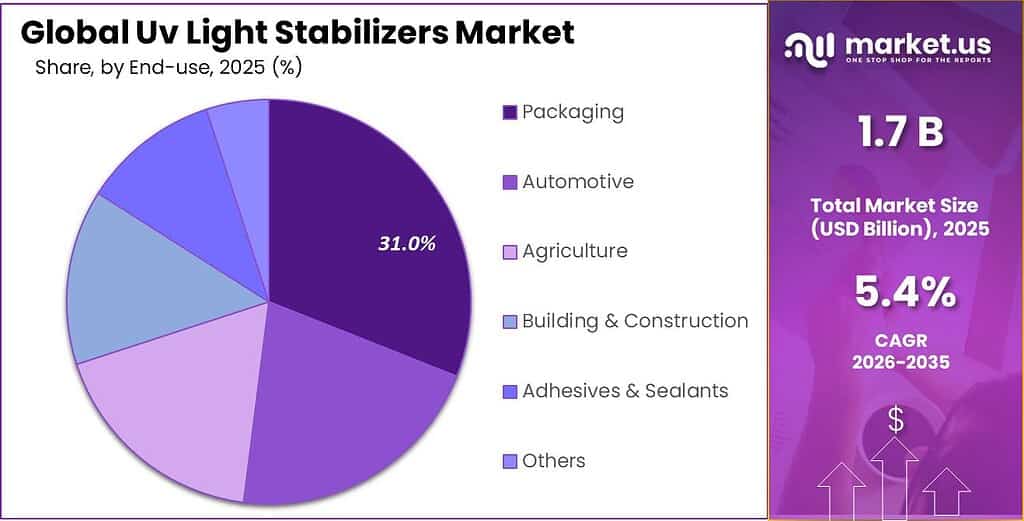
- Packaging held a dominant market position, capturing more than a 31.2% share.
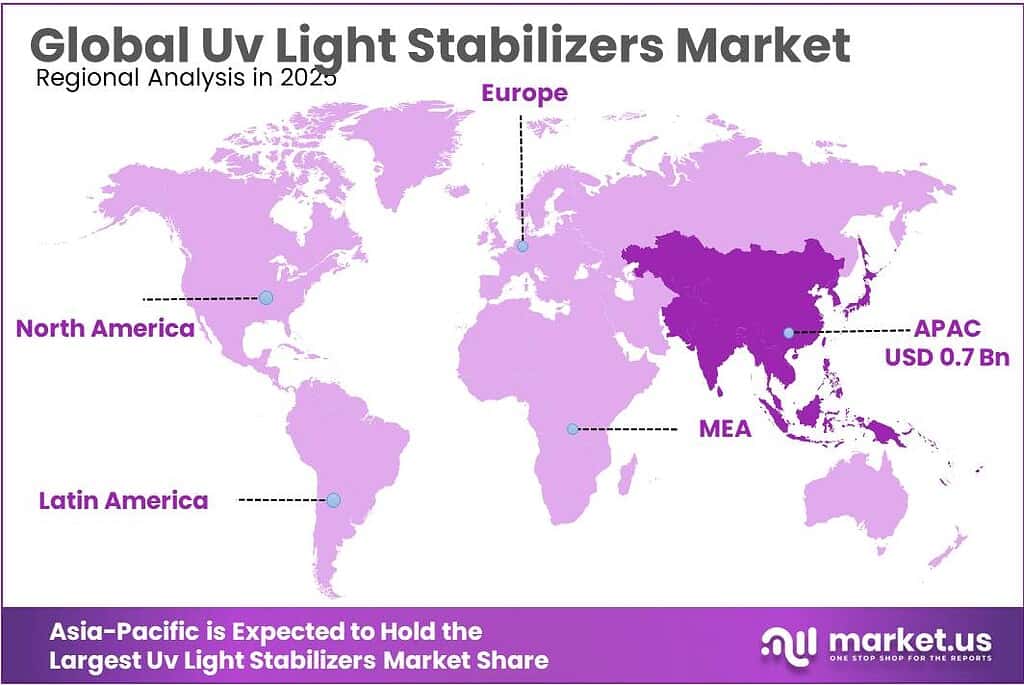
- Asia-Pacific emerged as the dominating region in the UV light stabilizers market, accounting for 45.1% share and reaching a value of nearly USD 0.7 billion.
By Type Analysis
Hindered Amine Light Stabilizers (HALS) dominate with 49.6% driven by strong durability and long-term protection benefits
In 2025, Hindered Amine Light Stabilizers (HALS) held a dominant market position, capturing more than a 49.6% share. This leadership was mainly due to their superior ability to protect polymers from degradation caused by prolonged exposure to UV radiation. HALS are widely preferred because they do not get consumed during the stabilization process, which makes them highly effective over a longer period compared to other stabilizers. Industries such as packaging, automotive, and agriculture continued to rely heavily on HALS-based solutions to enhance product lifespan and maintain material strength under harsh environmental conditions.
By End-use Analysis
Packaging leads with 31.2% as demand for UV-resistant materials continues to rise across industries
In 2025, Packaging held a dominant market position, capturing more than a 31.2% share. This strong position was mainly supported by the growing need to protect products from sunlight exposure during storage and transportation. UV light stabilizers are widely used in packaging materials such as films, containers, and wraps to prevent discoloration, brittleness, and loss of strength. Industries like food and beverages, pharmaceuticals, and consumer goods continued to rely on these solutions to maintain product quality and extend shelf life, especially for items sensitive to light.
Key Market Segments
By Type
- Hindered Amine Light Stabilizers (HALS)
- UV Absorbers
- Quenchers
- Others
By End-use
- Packaging
- Automotive
- Agriculture
- Building & Construction
- Adhesives & Sealants
- Others
Emerging Trends
Shift toward sustainable and recyclable UV-stabilized packaging is shaping the market
One of the most noticeable trends in UV light stabilizers is the growing shift toward sustainable and recyclable packaging. Industries, especially food and beverage, are under pressure to reduce environmental impact while still protecting products from light damage.
This has led to the development of UV stabilizers that can work well with recycled and bio-based plastics instead of traditional materials. Governments across regions are also pushing for circular economy practices, encouraging companies to design packaging that can be reused or recycled easily.
Rise of advanced multifunctional stabilizers improves performance and food safety
Another important trend is the development of multifunctional UV stabilizers that do more than just block sunlight. These new solutions are designed to provide combined benefits like UV protection, thermal stability, and resistance to oxidation, all in one system.
This helps manufacturers reduce the number of additives used while improving overall material performance. In addition, there is growing use of UV-treated and protected packaging in food processing to prevent contamination and extend shelf life. Governments and food safety bodies are encouraging such improvements to ensure safer food distribution.
Drivers
Rising need to protect food quality from UV exposure is driving stabilizer demand
One of the biggest drivers for UV light stabilizers is the growing need to protect food products from damage caused by sunlight. When packaging is exposed to UV light, it does not just affect the plastic—it also impacts the food inside. Studies show that UV exposure can lead to oxidation, nutrient loss, color fading, and even changes in taste and smell of food products.
At the same time, the demand for UV-protected packaging is rising quickly. The global UV and light-sensitive packaging market was valued at around USD 59.3 billion in 2025, showing how important light protection has become in modern food systems.
Government focus on reducing food loss and improving packaging durability supports growth
Another key factor is the increasing push from governments and global food bodies to reduce food waste. According to the Food and Agriculture Organization (FAO), nearly 14% of the world’s food is lost between harvest and retail stages, highlighting a major efficiency problem in the supply chain. This loss is often linked to poor storage and packaging conditions, including exposure to light and heat.
To tackle this, many countries are encouraging better packaging technologies that can protect food for longer periods. UV light stabilizers play a quiet but important role here. By preventing packaging breakdown and shielding food from harmful radiation, they help maintain freshness and reduce early spoilage. Governments are also promoting sustainable packaging solutions, where durability matters even more because materials are reused or recycled.
Restraints
High cost pressure and material limitations slow down wider adoption
One major restraining factor for UV light stabilizers is the added cost they bring to packaging materials, especially in food-related industries. While these stabilizers improve durability and shelf life, they also increase overall production costs, which becomes a concern for manufacturers working on tight margins.
This is particularly important when we consider the scale of food loss globally. According to the Food and Agriculture Organization (FAO), around 13.2% of food is lost between harvest and retail stages, even before reaching consumers.
Strict environmental rules and recycling concerns create challenges
Another key challenge comes from growing environmental regulations and sustainability goals. Governments and global organizations are pushing hard to reduce plastic waste and improve recyclability. However, adding UV stabilizers to plastic packaging can sometimes complicate recycling processes, making it harder to reuse materials efficiently.
This concern becomes more serious when we look at the scale of food waste and environmental impact. Reports show that nearly one-third of all food produced globally is lost or wasted, amounting to about 1.3 billion tonnes every year. At the same time, food loss and waste contribute around 8–10% of global greenhouse gas emissions, which has pushed governments to take stricter actions.
Opportunity
Expansion of global food supply chains creates strong need for UV-protected packaging
One of the biggest growth opportunities for UV light stabilizers is the rapid expansion of global food supply chains. Today, food is no longer consumed close to where it is produced. It travels long distances, often crossing countries and continents, which increases its exposure to sunlight and harsh environmental conditions. According to the Food and Agriculture Organization, around 13.2% of food—equal to nearly 1.25 billion tonnes—is lost between harvest and retail, mainly due to poor storage and transportation conditions.
This is where UV light stabilizers create a real opportunity. By protecting packaging materials from sunlight damage, they help reduce spoilage during long transit periods. Governments and global bodies are also encouraging better cold chain and packaging systems to reduce these losses. In many developing regions, investments are being made to upgrade storage and logistics infrastructure, which directly increases the demand for advanced packaging materials.
Global push to reduce food waste opens new avenues for advanced stabilizer use
Another strong opportunity comes from the global effort to reduce food waste. According to the United Nations Environment Programme, nearly 1.05 billion tonnes of food were wasted in 2022, accounting for about 19% of total food available to consumers. This is a huge concern not only for food security but also for the environment, as wasted food contributes to 8–10% of global greenhouse gas emissions.
To tackle this, governments across the world are working towards Sustainable Development Goal 12.3, which aims to cut food waste by half by 2030. This has led to increased focus on better packaging solutions that can extend shelf life and reduce damage. UV light stabilizers fit well into this goal because they help maintain the quality of food by preventing degradation caused by light exposure.
Regional Insights
Asia-Pacific dominates with 45.1% share valued at around USD 0.7 Bn driven by strong industrial and packaging demand
Asia-Pacific emerged as the dominating region in the UV light stabilizers market, accounting for 45.1% share and reaching a value of nearly USD 0.7 billion. This strong regional presence is mainly supported by rapid industrial growth and increasing use of plastics across key sectors such as packaging, automotive, agriculture, and construction.
Countries like China, India, and Japan continue to lead demand due to expanding manufacturing activities and rising consumption of durable materials. The region benefits from large-scale production capabilities and a strong supply chain network, which makes it a hub for polymer and additive manufacturing. Additionally, Asia-Pacific has witnessed significant growth in agriculture films and outdoor applications, where UV stabilizers are essential to protect materials from degradation caused by sunlight exposure.
Key Regions and Countries Insights
- North America
- US
- Canada
- Europe
- Germany
- France
- The UK
- Spain
- Italy
- Rest of Europe
- Asia Pacific
- China
- Japan
- South Korea
- India
- Australia
- Rest of APAC
- Latin America
- Brazil
- Mexico
- Rest of Latin America
- Middle East & Africa
- GCC
- South Africa
- Rest of MEA
Key Players Analysis
Akzo Nobel N.V. is a major global player with operations in more than 150 countries and a workforce exceeding 34,000 employees. The company integrates UV stabilizers mainly within its coatings and performance materials segment. Its solutions are widely used in protective coatings, especially for outdoor applications where UV resistance is critical.
BASF stands as one of the largest chemical companies globally, with annual revenues exceeding €68 billion and operations in over 90 countries. The company offers a wide portfolio of UV stabilizers under its performance chemicals segment, catering to plastics, automotive, and packaging industries. BASF’s strong R&D investment, which crosses €2 billion annually, allows continuous innovation in stabilizer technologies.
BYK-Chemie GmbH, part of the ALTANA group, specializes in additives and performance solutions, including UV stabilizers. The company operates in over 40 countries and serves industries like coatings, plastics, and printing inks. ALTANA Group generates revenues of around €2.7 billion, with BYK contributing a significant share through specialty additives.
Top Key Players Outlook
- Akcros Chemicals
- Akzo Nobel N.V
- BASF
- BYK-Chemie GmbH
- Chemtura Corporation
- CLARIANT
- Solvay
- Everlight Chemical Industrial Co.
- Lycus Ltd., LLC.
- Mayzo, Inc.
Recent Industry Developments
By 2026, Akzo Nobel continued focusing on high-performance coatings that integrate UV protection features, especially for infrastructure and industrial applications where exposure to sunlight is high. The company generates annual revenues of over €10 billion, and a significant share of its coatings portfolio includes technologies that improve weather resistance and extend product life.
BASF plays a leading role in the UV light stabilizers sector through its strong portfolio of performance additives used in plastics, coatings, and advanced materials. In 2025, the company generated sales of around €59.7 billion and employed about 108,000+ people globally, highlighting its large-scale operational strength.
Report Scope
| Report Features | Description |
|---|---|
| Market Value (2025) | USD 1.7 Bn |
| Forecast Revenue (2035) | USD 2.8 Bn |
| CAGR (2026-2035) | 5.4% |
| Base Year for Estimation | 2025 |
| Historic Period | 2020-2024 |
| Forecast Period | 2026-2035 |
| Report Coverage | Revenue Forecast, Market Dynamics, Competitive Landscape, Recent Developments |
| Segments Covered | By Type (Hindered Amine Light Stabilizers, UV Absorbers, Quenchers, Others), By End-use (Packaging, Automotive, Agriculture, Building And Construction, Adhesives And Sealants, Others) |
| Regional Analysis | North America – US, Canada; Europe – Germany, France, The UK, Spain, Italy, Rest of Europe; Asia Pacific – China, Japan, South Korea, India, Australia, Singapore, Rest of APAC; Latin America – Brazil, Mexico, Rest of Latin America; Middle East & Africa – GCC, South Africa, Rest of MEA |
| Competitive Landscape | Akcros Chemicals, Akzo Nobel N.V, BASF, BYK-Chemie GmbH, Chemtura Corporation, CLARIANT, Solvay, Everlight Chemical Industrial Co., Lycus Ltd., LLC., Mayzo, Inc. |
| Customization Scope | Customization for segments, region/country-level will be provided. Moreover, additional customization can be done based on the requirements. |
| Purchase Options | We have three licenses to opt for: Single User License, Multi-User License (Up to 5 Users), Corporate Use License (Unlimited User and Printable PDF) |





































