


Report Overview
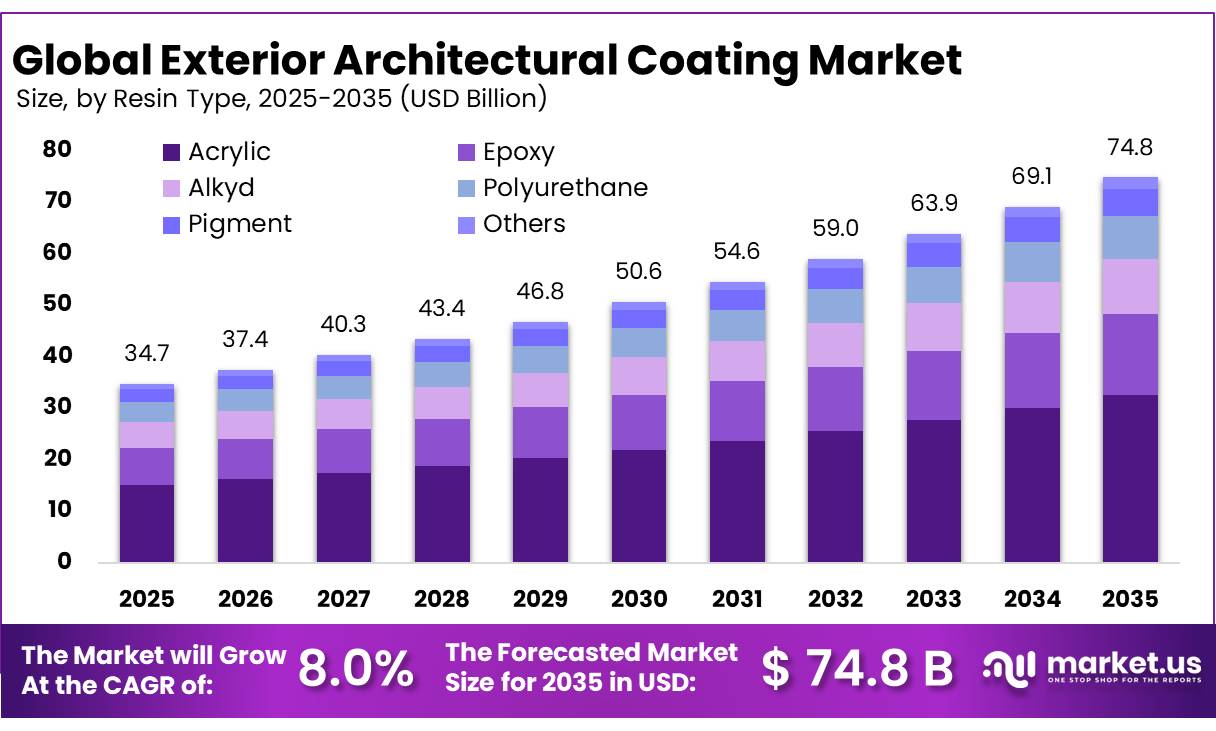
The Global Exterior Architectural Coating Market size is expected to be worth around USD 74.8 Billion by 2035, from USD 34.7 Billion in 2025, growing at a CAGR of 8.0% during the forecast period from 2026 to 2035. In 2025, Asia Pacific held a dominant market position, capturing more than a 42.7% share, holding USD 14.8 Billion revenue.
Exterior architectural coatings are used on walls, façades, roofs, trims, metal panels, concrete, masonry, and exterior wood to protect buildings from UV radiation, rain, humidity, dirt pick-up, cracking, corrosion, and color fading. The industry is increasingly positioned as a performance-led construction materials segment rather than a purely decorative paint category, because buildings account for around 30% of global final energy use and 26% of energy-related emissions, according to the IEA.
UNEP also reported that buildings and construction consume 32% of global energy and contribute 34% of global CO₂ emissions, reinforcing demand for coatings that extend façade life, reduce repainting cycles, and support sustainable construction specifications. In the U.S., residential construction spending was running at an annualized $913.9 billion in October 2025, while non-residential construction stood at $737.4 billion, indicating a large addressable base for exterior repainting and protective coating demand.
Key driving factors include energy-efficiency regulation, low-VOC requirements, longer repainting cycles, climate resilience, and demand for dirt-resistant, UV-stable, and elastomeric finishes. The EU’s building policy is a strong demand signal, as buildings use about 40% of EU energy, account for around 50% of EU gas consumption, and roughly 80% of household energy is used for heating, cooling, and hot water. Cool-roof coatings also have measurable value: the U.S. EPA states that cool roofs can reduce peak cooling demand in air-conditioned residential buildings by 11–27%.
Regulation is a major driver. The U.S. EPA’s national architectural coatings rule is estimated to reduce VOC emissions by 103,000 megagrams per year, equal to 113,500 tons per year, by limiting VOC content in architectural coatings. In Europe, the Energy Performance of Buildings Directive supports an 11.7% energy-consumption reduction goal by 2030, while new public buildings must be zero-emission from January 1, 2028, and all other new buildings from January 1, 2030.
Axalta’s Performance Coatings segment sells into more than 140 countries, showing the broad industrial reach of coatings supply chains. In 2024, Axalta generated total net sales of $5.276 billion, including $1.291 billion from Industrial coatings, although Industrial sales declined 2.4% year over year, indicating near-term softness but continued scale.
In 2025, BASF’s notable coatings development was portfolio restructuring: BASF agreed to sell a majority stake in its coatings business to Carlyle and Qatar Investment Authority at a valuation of €7.7 billion, while retaining a 40% equity stake and expecting approximately €5.8 billion in pre-tax cash proceeds.
Key Takeaways
- Exterior Architectural Coating Market size is expected to be worth around USD 74.8 Billion by 2035, from USD 34.7 Billion in 2025, growing at a CAGR of 8.0%.
- Acrylic held a dominant market position, capturing more than a 43.5% share in the exterior architectural coating market.
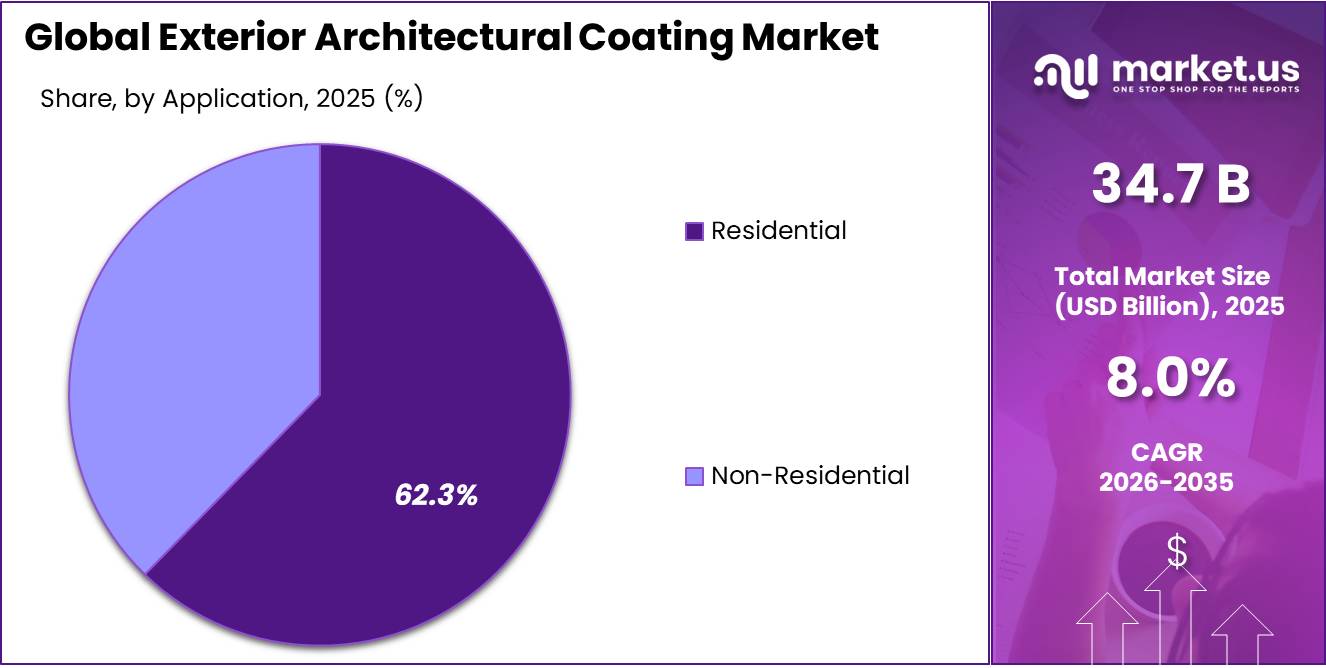
- Residential held a dominant market position, capturing more than a 62.3% share.
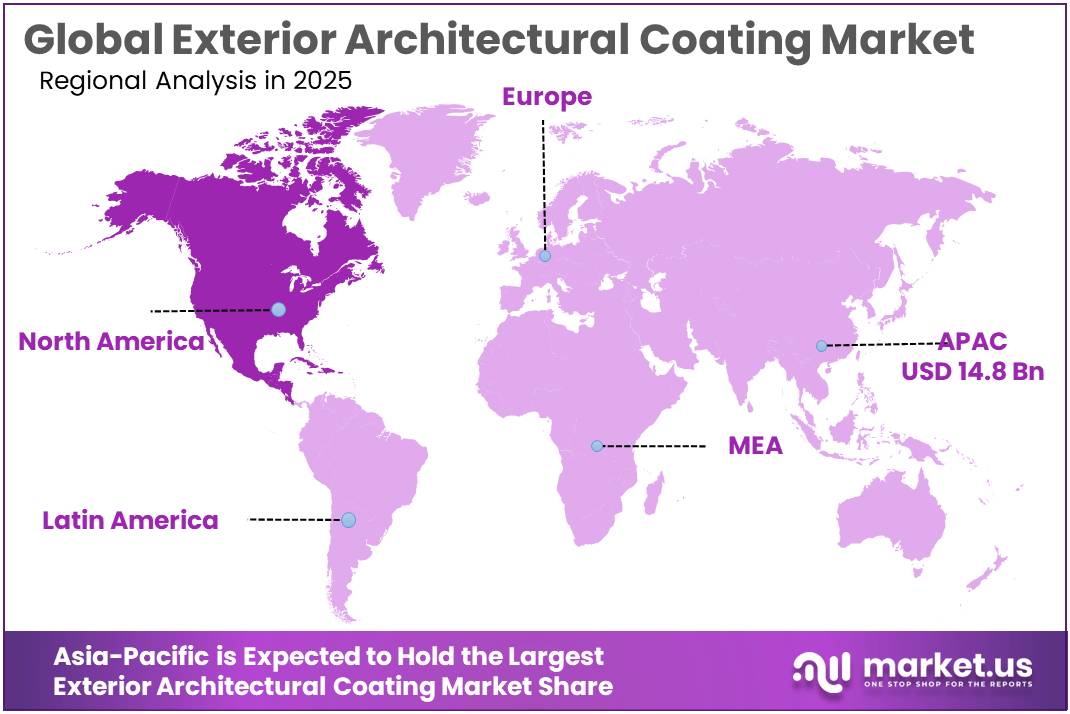
- Asia-Pacific stands as the dominating region in the exterior architectural coatings market, accounting for approximately 42.7% share with a value of USD 14.8 billion.
By Resin Type Analysis
Acrylic dominates with 43.5% share due to its durability and weather resistance
In 2025, Acrylic held a dominant market position, capturing more than a 43.5% share in the exterior architectural coating market by resin type. This strong position is mainly driven by its excellent resistance to harsh weather conditions, including UV exposure, rain, and temperature changes, making it a preferred choice for exterior applications. Acrylic coatings are also known for their flexibility, which helps prevent cracking and peeling over time, especially in regions with fluctuating climates.
By Application Analysis
Residential dominates with 62.3% share driven by steady housing demand and renovation activity
In 2025, Residential held a dominant market position, capturing more than a 62.3% share in the exterior architectural coating market by application. This leading share is mainly supported by continuous growth in housing construction and a strong trend of home improvement projects. Many homeowners are investing in exterior coatings to improve the look of their houses while also protecting surfaces from weather damage. The demand is especially high in urban and semi-urban areas where new housing developments are expanding.
Key Market Segments
By Resin Type
- Acrylic
- Epoxy
- Alkyd
- Polyurethane
- Pigment
- Others
By Application
- Residential
- Non-Residential
Emerging Trends
Cool Roof & Energy-Saving Coatings Gaining Ground
One of the biggest trends in exterior architectural coatings is the growing use of cool roof and energy-saving coatings. These coatings are designed to reflect more sunlight and absorb less heat, helping buildings stay cooler naturally. This trend is closely tied to global sustainability goals and rising temperatures in urban areas. According to the U.S. Environmental Protection Agency, cool roofs can reduce peak cooling demand by 11% to 27% in residential buildings, which directly lowers electricity consumption and costs.
Governments are also pushing this shift. For example, the European Union highlights that buildings account for about 40% of total energy consumption, making energy-efficient coatings an important part of climate policy. These coatings are especially useful in hot climates, where air conditioning demand is high. Over time, building owners are seeing them not just as paint, but as a long-term energy-saving solution.
Shift Toward Low-VOC & Sustainable Coatings
Another major trend is the move toward low-VOC (volatile organic compound) and environmentally friendly coatings. People are becoming more aware of air quality, and governments are setting stricter rules on emissions from paints and coatings. The European Commission notes that buildings are responsible for around 36% of greenhouse gas emissions in the EU, pushing industries to adopt greener materials.
In response, manufacturers are developing water-based coatings and bio-based raw materials that release fewer harmful chemicals. These coatings not only meet regulations but also improve durability and weather resistance. Many new formulations are designed to last longer, reducing the need for frequent repainting, which also cuts down environmental impact over time.
Drivers
Rising Housing and Infrastructure Projects are Driving Coating Demand
One of the biggest reasons behind the growth of the exterior architectural coating market is the strong rise in construction and housing projects. In simple terms, more buildings mean more demand for protective and decorative coatings. In 2026, India’s construction industry alone is expected to reach around INR 25.31 trillion, growing by about 11.2% compared to the previous year, which clearly shows how fast building activity is expanding.
This growth is not just limited to big cities; smaller towns are also seeing new housing developments. Government-backed initiatives like affordable housing programs have already added over 11.86 million homes between 2023 and 2025, and there are plans to build another 10 million homes in the coming years
Government Spending and Urban Growth Supporting Long-Term Demand
Another key driver is the strong push from governments toward infrastructure and urban development. Large-scale investments are creating continuous demand for coatings across residential, commercial, and public projects. For example, India has committed around INR 111 lakh crore (about USD 1.4 trillion) under its National Infrastructure Pipeline, covering thousands of projects like roads, railways, and urban development.
This kind of spending ensures that construction activity stays active for many years, which directly benefits coating demand. At the same time, urbanization is increasing, with more people moving to cities and investing in better housing and living conditions.
Restraints
Strict Environmental Regulations on VOC Emissions are Limiting Market Growth
One of the biggest challenges for the exterior architectural coating market is the increasing pressure from environmental regulations, especially around volatile organic compounds (VOCs). These compounds are commonly found in paints and coatings and are known to cause air pollution and health issues. Governments across regions have introduced strict limits to control their usage. For example, industrial maintenance coatings are often restricted to around 450 grams of VOC per liter, and in some regions, limits go as low as 100 grams per liter.
This means manufacturers have to constantly reformulate products, which increases production costs and slows down innovation. On top of that, global VOC emissions from human activities are estimated at around 142 billion kilograms annually, with coatings and solvents being a major contributor.
Health and Environmental Concerns Reducing Use of Traditional Coatings
Another major restraint comes from growing awareness about the health and environmental impact of traditional coatings. Many solvent-based paints release harmful gases that can affect both workers and end users. Studies show that coating-related processes can produce VOC concentrations as high as 954.17 micrograms per cubic meter in industrial settings.
These emissions are linked to breathing problems, irritation, and even long-term diseases. Because of such risks, governments and environmental bodies have enforced regulations specifically aimed at reducing VOC emissions from paints and varnishes.
Opportunity
Growing Demand for Eco-Friendly Coatings Creating New Opportunities
One of the biggest growth opportunities in the exterior architectural coating market is the rising demand for eco-friendly and low-emission products. People today are more aware of how building materials affect both health and the environment, and this shift is clearly visible in coating choices. In 2025, the global green coatings market is valued at around USD 143.43 billion, showing how quickly this segment is expanding as industries move toward safer alternatives.
These coatings contain low levels of harmful chemicals like VOCs, which helps reduce air pollution and health risks. Governments are also encouraging the use of such materials through environmental regulations and green building standards. For example, many countries now promote water-based coatings because they release fewer emissions compared to traditional solvent-based ones.
Smart Cities and Sustainable Construction Boosting Future Demand
Another major opportunity comes from the rapid growth of smart cities and sustainable construction projects across the world. Governments are investing heavily in modern infrastructure that focuses on energy efficiency, durability, and reduced environmental impact. Exterior coatings play an important role here, as they help buildings last longer and improve thermal performance. The overall architectural coatings market itself is expected to reach around USD 98.57 billion in 2026, showing steady expansion driven by such projects.
Regional Insights
Asia-Pacific Exterior Architectural Coatings Market Dominating Region – 42.7%, USD 14.8 Bn
Asia-Pacific stands as the dominating region in the exterior architectural coatings market, accounting for approximately 42.7% share with a value of USD 14.8 billion, supported by its strong construction base, rapid urbanization, and large population-driven housing demand.
The region benefits from being home to nearly 60% of the global population (around 4.7 billion people), which directly influences residential and infrastructure expansion activities. This high population concentration continues to drive repainting cycles, new housing developments, and façade protection requirements, all of which are key demand drivers for exterior coatings.
Key Regions and Countries Insights
- North America
- US
- Canada
- Europe
- Germany
- France
- The UK
- Spain
- Italy
- Rest of Europe
- Asia Pacific
- China
- Japan
- South Korea
- India
- Australia
- Rest of APAC
- Latin America
- Brazil
- Mexico
- Rest of Latin America
- Middle East & Africa
- GCC
- South Africa
- Rest of MEA
Key Players Analysis
BASF SE is one of the largest chemical and coatings players globally, with total assets of around €77.4 billion and a workforce of over 111,000 employees. The company operates across multiple industries, including performance coatings and construction chemicals. Its coatings division supports automotive and architectural applications, contributing to its diversified revenue base. BASF focuses heavily on sustainability, investing in eco-friendly coating technologies.
AkzoNobel NV reported revenue of approximately €10.668 billion and employs around 35,200 people worldwide. The company operates in more than 150 countries and is one of the leading paint manufacturers globally. Known for brands like Dulux and Sikkens, AkzoNobel has a strong presence in decorative and architectural coatings. The company continues to strengthen its market position through innovation and strategic moves, including a planned merger expected to create a combined entity with around $17 billion in annual revenue.
Valspar Corporation generated revenue of around $4.19 billion and operates across 26 countries with over 11,000 employees. The company has a long history in coatings, dating back to 1806, and is known for its strong product portfolio in paints and varnishes. As part of Sherwin-Williams, Valspar benefits from an expanded global reach and distribution network. Its focus on durable and high-performance coatings supports its role in the architectural segment, particularly in residential and commercial applications.
Top Key Players Outlook
- BASF SE
- Axalta Coatings System
- Nippon Paint (India) Private Limited
- Valspar Corporation
- AkzoNobel NV
- Arkema SA
- Berger Paints
- Cabot Corporation
- Eastman Chemical Company
- Dow Chemical Company
Recent Industry Developments
In 2025, BASF SE continued to play an important role in the exterior architectural coating sector through its dispersions, resins, and surface technologies portfolio, which are widely used in decorative and protective coatings. The company reported total sales of around €59.7 billion in 2025, with its Surface Technologies segment contributing nearly €8.97 billion, reflecting steady demand from coatings-related applications.
Axalta Coatings Systems has maintained a steady role in the exterior architectural coating value chain, mainly through its Performance Coatings segment, which includes products used in building exteriors and protective applications. In 2025, the company reported total net sales of about $5,117 million, with Performance Coatings contributing a significant portion, including $828 million in quarterly sales during Q3 2025, reflecting ongoing demand from construction-related uses.
Report Scope
| Report Features | Description |
|---|---|
| Market Value (2025) | USD 34.7 Bn |
| Forecast Revenue (2035) | USD 74.8 Bn |
| CAGR (2026-2035) | 8.0% |
| Base Year for Estimation | 2025 |
| Historic Period | 2020-2024 |
| Forecast Period | 2026-2035 |
| Report Coverage | Revenue Forecast, Market Dynamics, Competitive Landscape, Recent Developments |
| Segments Covered | By Resin Type (Acrylic, Epoxy, Alkyd, Polyurethane, Pigment, Others), By Application (Residential, Non-Residential) |
| Regional Analysis | North America – US, Canada; Europe – Germany, France, The UK, Spain, Italy, Rest of Europe; Asia Pacific – China, Japan, South Korea, India, Australia, Singapore, Rest of APAC; Latin America – Brazil, Mexico, Rest of Latin America; Middle East & Africa – GCC, South Africa, Rest of MEA |
| Competitive Landscape | BASF SE, Axalta Coatings System, Nippon Paint (India) Private Limited, Valspar Corporation, AkzoNobel NV, Arkema SA, Berger Paints, Cabot Corporation, Eastman Chemical Company, Dow Chemical Company |
| Customization Scope | Customization for segments, region/country-level will be provided. Moreover, additional customization can be done based on the requirements. |
| Purchase Options | We have three licenses to opt for: Single User License, Multi-User License (Up to 5 Users), Corporate Use License (Unlimited User and Printable PDF) |





































