


Report Overview
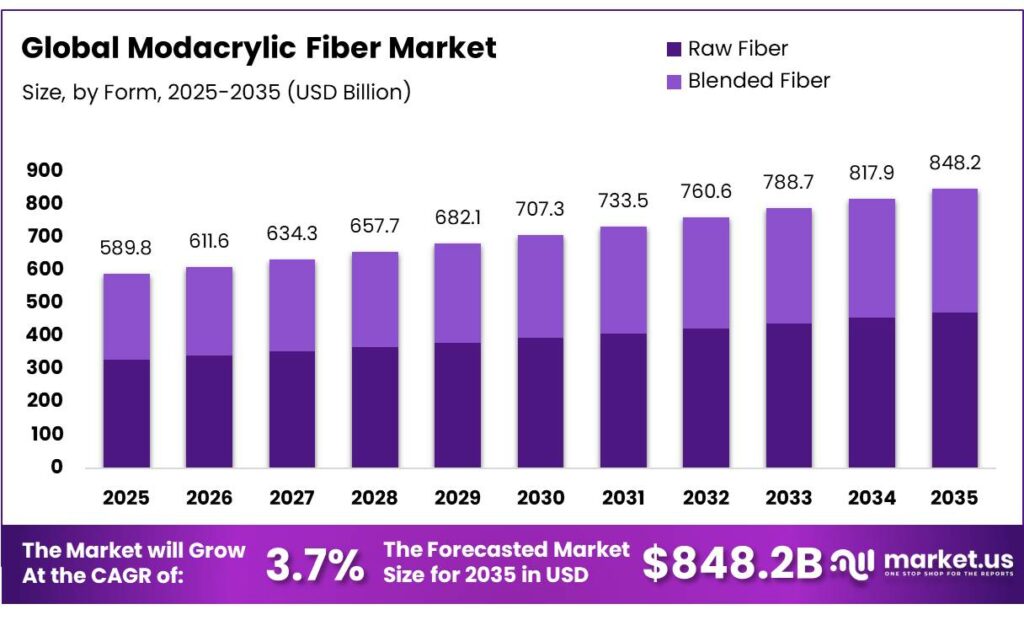
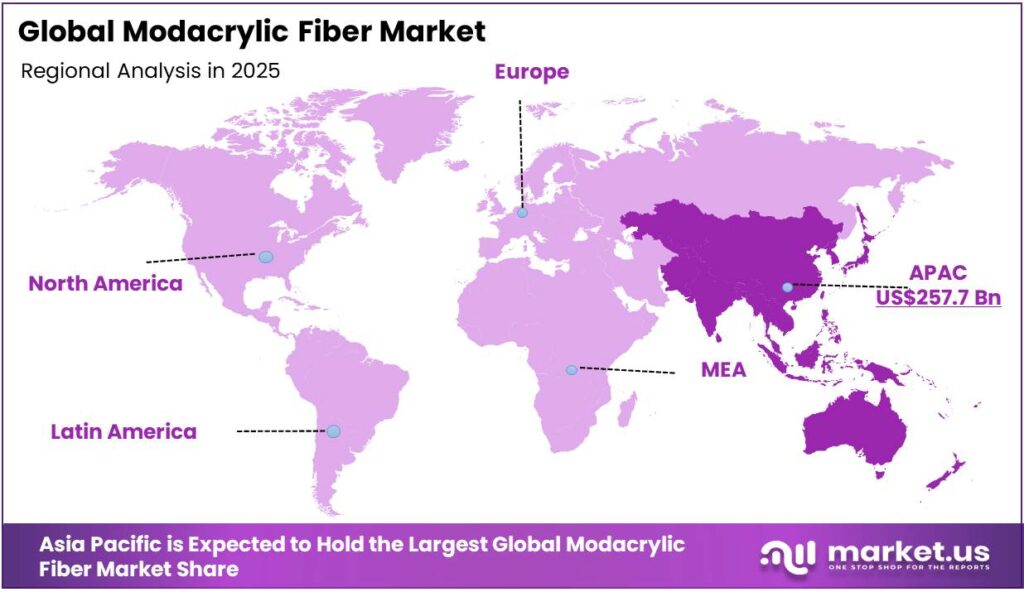
The Global Modacrylic Fiber Market size is expected to be worth around USD 848.2 Billion by 2035, from USD 589.8 Billion in 2025, growing at a CAGR of 3.7% during the forecast period from 2026 to 2035. In 2025, Asia-Pacific held a dominant market position, capturing more than a 43.7% share, holding USD 257.0 Billion revenue.
Modacrylic fiber is a high-performance synthetic copolymer made primarily from acrylonitrile (35% to 85% by weight) mixed with other polymers such as vinyl chloride or vinylidene chloride. The modacrylic fiber market is shaped by its dual positioning as a specialty synthetic fiber with applications in both personal protective equipment (PPE) and hair-fiber products. Its inherent flame resistance and self-extinguishing properties make it suitable for moderate-hazard PPE, while its thermoplastic, fine-diameter structure supports wigs, hairpieces, and extensions, which constitute the largest volume application.
Asia Pacific dominates production and consumption, supported by concentrated acrylonitrile feedstock capacity, labor-intensive textile ecosystems, and specialized wig-manufacturing clusters. Further, the market dynamics are influenced by regulatory and performance factors. The halogen-free and low-emission fibers align with REACH and EU eco-design requirements, while protective apparel applications must comply with NFPA 2112 and EN ISO 11612.
Similarly, competitive pressures arise from alternatives such as aramid and FR-treated cotton fibers, which offer superior thermal and mechanical performance in extreme conditions. Strategic initiatives focus on backward integration, application-specific blends, regulatory compliance, and co-development with textile converters to strengthen positioning. The market is governed by functional alignment, regulatory adherence, and geographic concentration of production and demand.
Key Takeaways
- The global modacrylic fiber market was valued at USD 589.8 billion in 2025.
- The global modacrylic fiber market is projected to grow at a CAGR of 3.7% and is estimated to reach USD 848.2 billion by 2035.
- Based on the form of modacrylic fiber, raw fiber dominated the modacrylic fiber market, with a market share of around 55.8%.
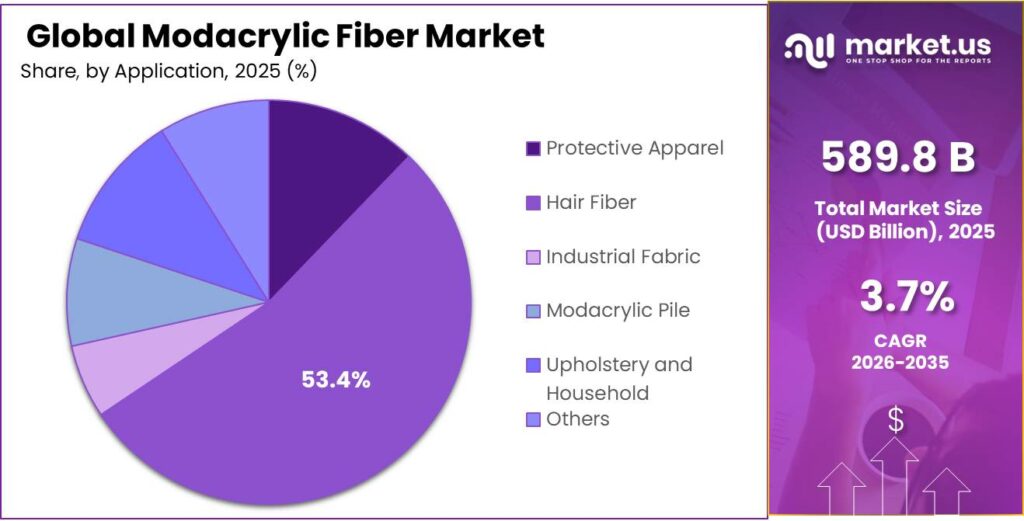
- Among the applications of modacrylic fiber, hair fiber held a major share in the market, 53.4% of the market share.
- In 2025, the Asia Pacific was the most dominant region in the modacrylic fiber market, accounting for around 43.7% of the total global consumption.
Form Analysis
Raw Fiber Held the Largest Share in the Modacrylic Fiber Market.
The modacrylic fiber market is segmented based on form into raw fiber and blended fiber. The raw fiber dominated the modacrylic fiber market, comprising around 55.8% of the market share, as it delivers inherent, uniform flame resistance without reliance on blend ratios or post-treatment. Its self-extinguishing behavior and resistance to ignition are built into the polymer structure, enabling consistent compliance with standards such as those set by the National Fire Protection Association.
In contrast, blended fabrics depend on the proportion and durability of companion fibers, which can introduce variability in performance after repeated laundering or mechanical wear. Similarly, raw fiber can be directly spun and heat-set to achieve stable crimp and shape retention, particularly in applications such as wigs and protective linings. Additionally, modacrylic’s chemical resistance and low moisture absorption support durability in harsh environments, whereas blends may prioritize comfort or strength at the expense of consistent flame-retardant behavior.
Application Analysis
Modacrylic Fiber is Mostly Utilized for Hair Fiber.
Based on the applications of modacrylic fiber, the market is divided into protective apparel, hair fiber, industrial fabric, modacrylic pile, upholstery and household, and others. The hair fiber dominated the modacrylic fiber market, with a market share of 53.4%, as its intrinsic physical properties align closely with the functional requirements of wigs and hairpieces. The fiber can be extruded in fine diameters, typically in the tens of microns, enabling close replication of human hair thickness and texture, while its thermoplastic nature allows stable heat-setting of curls and styles. This shape retention persists through routine handling without additional chemical treatment.
In contrast, protective apparel and industrial fabrics are governed by stringent performance standards, such as those issued by the National Fire Protection Association, that often require higher tensile strength, thermal stability, and durability under extreme conditions, where alternatives such as aramids are frequently preferred. Upholstery and pile fabrics, meanwhile, prioritize abrasion resistance and bulk resilience. Consequently, modacrylic’s combination of aesthetics, processability, and stable styling efficiency makes hair fiber its most naturally aligned, high-volume application.
Key Market Segments
By Form
- Raw Fiber
- Blended Fiber
By Application
- Protective Apparel
- Hair Fiber
- Industrial Fabric
- Modacrylic Pile
- Upholstery and Household
- Others
Drivers
Growth in the Protective Apparel (PPE) Industry Drives the Modacrylic Fiber Market.
The growth of the personal protective equipment (PPE) industry serves as a primary driver for the modacrylic fiber market, underpinned by stringent occupational safety mandates and the expansion of high-risk industrial sectors. Governmental safety standards, such as those from the U.S. Occupational Safety and Health Administration (OSHA), mandate heat- and flame-resistant attire in sectors like oil, gas, and electrical utilities. Modacrylic fibers, defined by the Federal Trade Commission (FTC) as containing 35% to 85% acrylonitrile, are inherently flame-resistant, making them critical for compliance with these safety protocols.
Moreover, the occupational risk exposure sustains PPE demand. The International Labour Organization reports about 2.78 million annual workplace deaths, including fire-related hazards, while U.S. data indicate approximately 154 annual electrical fatalities necessitating arc-rated clothing. These regulatory, risk, and procurement metrics directly expand consumption of modacrylic-based PPE across utilities, hydrocarbons, and industrial manufacturing, embedding PPE growth as a structural demand channel for the fiber.
Restraints
Strong Competition from Effective Alternatives Might Hamper the Demand for Modacrylic Fiber.
Strong competition from functionally superior and application-specific alternatives, particularly aramid fibers and treated cellulosics, constitutes a structural constraint on modacrylic fiber adoption in PPE and technical textiles. Aramid fibers exhibit materially higher mechanical performance, with tensile strength of around 4.0-5.0g/denier, compared to 2.0-2.5g/denier for modacrylic, alongside superior thermal stability and non-melting behavior under extreme heat exposure.
Additionally, standards-based performance further reinforces substitution. Under NFPA 2112 flash-fire testing, compliant materials must limit predicted body burn and exhibit no melting or dripping. The aramid fibers are widely used as the benchmark material meeting these criteria in high-risk PPE such as firefighting ensembles. In contrast, modacrylic fabrics are typically positioned for moderate hazard applications and are explicitly not suitable for extreme heat scenarios such as structural firefighting.
Furthermore, durability differentials compound lifecycle considerations. The aramid garments require less frequent replacement due to higher thermal and mechanical resilience, reducing long-term usage intensity. Additionally, alternative blends, such as FR-treated cotton or viscose, provide moisture regain of about 10-12% and enhanced wearer comfort in hot environments, further diversifying substitution pathways. These performance thresholds, regulatory compliance requirements, and lifecycle efficiency enable effective alternatives to displace modacrylic in high-specification PPE segments.
Opportunity
Sustainability and Halogen-Free Solutions Create Opportunities in the Market.
Sustainability pressures and regulatory constraints on halogenated flame retardants create a structural opportunity for modacrylic fibers, particularly in developing lower-emission or halogen-reduced variants. Halogenated systems, especially brominated flame retardants (BFRs), are widely used in textiles and are associated with persistence, bioaccumulation, and toxicity concerns, prompting regulatory intervention.
The European Union has restricted multiple BFR classes and prohibits their presence above 0.1% by weight in certain applications, while broader frameworks such as REACH promote substitution with safer alternatives. IEC 61249-2-21 defines halogen-free materials as containing less than 900 ppm of chlorine or bromine and less than 1500 ppm total halogens. Concurrently, EU eco-design rules have prohibited halogen-containing flame retardants in specific electronics since 2021, reflecting tightening cross-sector standards.
Furthermore, environmental and health externalities further accelerate substitution. Halogenated compounds can release toxic gases during combustion and persist in environmental media, with documented contamination pathways into air, soil, and food chains. These regulatory limits and hazard profiles incentivize innovation toward halogen-free or reduced-halogen flame-retardant fibers, positioning modacrylic producers to align with evolving compliance and sustainability requirements in PPE and technical textiles.
Trends
Expanding Use in Wigs and Hairpieces.
Expanding use of wigs and hairpieces represents a structurally significant demand trend for modacrylic fibers, anchored in their material properties and scale of industrial utilization. Modacrylic fibers are specifically engineered to mimic natural hair, offering softness, resilience, and shape retention. Notably, their thermoplastic behavior enables heat-setting and stable curl formation in wigs and hairpieces.
Additionally, these fibers are easily dyed and can be heat-shaped to mimic various hair textures. This versatility supports the increasing demand for fashion wigs used for aesthetic enhancement rather than just medical necessity. Performance attributes such as more than 90% curl retention further support their functional suitability in pre-styled products.
Hair fiber applications constitute a major end-use segment, with modacrylic widely used in wigs, extensions, and accessories due to ease of dyeing, dimensional stability, and styling versatility. Geographically, production ecosystems reinforce this trend, with large-scale wig manufacturing clusters, as in East Asia, supplying global demand. These combined material, performance, and consumption characteristics position wigs and hairpieces as a sustained, high-volume application channel for modacrylic fibers.
Geopolitical Impact Analysis
Geopolitical Tensions Are Impacting the Modacrylic Fiber Market Through Disruptions in the Petroleum Industry.
The geopolitical tensions, particularly conflicts affecting energy markets and the fragmentation of global trade, are exerting measurable impacts on the modacrylic fiber value chain through feedstock volatility, trade frictions, and supply-chain restructuring. Modacrylic production depends on petrochemical intermediates such as acrylonitrile, whose supply chains are demonstrably sensitive to geopolitical disruptions.
For instance, the Russia-Ukraine conflict has been associated with trade disruptions and restrictions and reduced production capacity in acrylonitrile markets due to feedstock and logistics constraints of petroleum. This directly affects the availability of key inputs for acrylic and modacrylic fibers.
Additionally, energy-linked cost pressures are evident. Petrochemical price movements have been influenced by crude oil supply tightening linked to geopolitical factors and coordinated production cuts, contributing to an increase in styrene prices in Asia. As modacrylic production is energy- and feedstock-intensive, such volatility transmits into manufacturing costs.
Trade fragmentation further compounds these effects. In 2026, global trade conditions are characterized by the US-Israel-Iran conflict and disruption in logistics through the Strait of Hormuz. These factors increase compliance costs and alter sourcing patterns for chemicals and fibers. Collectively, feedstock disruptions, energy price volatility, and trade realignments are reshaping cost structures and supply reliability in the modacrylic fiber market.
Regional Analysis
Europe Held the Largest Share of the Global Modacrylic Fiber Market.
In 2025, the Asia Pacific dominated the global modacrylic fiber market, holding about 43.7% of the total global consumption, supported by scale in petrochemicals, textiles, and downstream applications. For instance, China accounts for the majority of global acrylonitrile capacity, a key precursor for acrylic and modacrylic fibers. This concentration ensures feedstock proximity and cost advantages for regional fiber producers.
According to the Ministry of Textiles of India, the textile and apparel workforce exceeds 45 million people in the country, indicating large-scale demand for synthetic fibers across apparel and industrial uses. In addition, export-oriented garment production across Bangladesh and Vietnam sustains high-volume fiber consumption under global supply contracts.
Furthermore, East Asia hosts major wig and hairpiece manufacturing hubs, with synthetic fibers, primarily modacrylic, used extensively due to heat-set properties and uniformity requirements in mass production. The feedstock concentration, labor-intensive textile ecosystems, and specialized manufacturing clusters establish Asia Pacific as the principal regional base for modacrylic fiber utilization.
Key Regions and Countries
- North America
- The US
- Canada
- Europe
- Germany
- France
- The UK
- Spain
- Italy
- Russia & CIS
- Rest of Europe
- APAC
- China
- Japan
- South Korea
- India
- ASEAN
- Rest of APAC
- Latin America
- Brazil
- Mexico
- Rest of Latin America
- Middle East & Africa
- GCC
- South Africa
- Rest of MEA
Key Players Analysis
Manufacturers of modacrylic fiber focus on product engineering, compliance alignment, and supply-chain control to strengthen competitiveness. A primary strategy is the development of application-specific blends, such as modacrylic with cotton, polyester, or aramid, to meet certified flame-resistant standards such as National Fire Protection Association (NFPA 2112) and International Organization for Standardization (EN ISO 11612 equivalence), enabling access to regulated PPE markets.
Additionally, firms invest in low-emission and halogen-reduced chemistries to comply with frameworks such as the European Chemicals Agency REACH. Operationally, producers prioritize backward integration into acrylonitrile sourcing and process optimization to stabilize input availability and quality. Collaboration with textile manufacturers for co-development of fabrics, alongside technical service support for end-use certification, further strengthens market positioning.
The Major Players in The Industry
- Aditya Birla
- Aksa Akrilik Kimya Sanayi AŞ
- China Petrochemical Corporation
- CNPC
- Dralon
- FCFA
- Formosa Plastics Corporation
- Fushun Huifu Fire Resistant Fibre Co. Ltd
- Fushun Rayva Fiber Co. Ltd
- Grupo Kaltex SA de CV
- Japan Industrial Co. Ltd
- Jiangsu Jinmao International E-Commerce Co., Ltd
- Kaneka Corporation
- Pasupati Acrylon Ltd
- TenCate Protective Fabrics
- Tianjin GT New Material Technology Co., Ltd
- Toray Industries Inc.
- Other Key Players
Key Development
- In March 2025, Toray Industries, Inc., announced that it would adopt the mass balance approach from April 2025 in manufacturing its TORAYLON acrylic staple fiber.
- In April 2024, Filidea collaborated with Kaneka Corporation, the manufacturer of the Protex flame-retardant modacrylic range from Waxman Fibres LTD, in developing an innovative recycling process that uses textile waste (end-of-life garments) as raw material for chemical recycling.
Report Scope
| Report Features | Description |
|---|---|
| Market Value (2025) | US$589.8 Bn |
| Forecast Revenue (2035) | US$848.2 bn |
| CAGR (2026-2035) | 3.7% |
| Base Year for Estimation | 2025 |
| Historic Period | 2020-2024 |
| Forecast Period | 2026-2035 |
| Report Coverage | Revenue Forecast, Market Dynamics, Competitive Landscape, Recent Developments |
| Segments Covered | By Form (Raw Fiber, and Blended Fiber), By Application (Protective Apparel, Hair Fiber, Industrial Fabric, Modacrylic Pile, Upholstery and Household, and Others) |
| Regional Analysis | North America – The US & Canada; Europe – Germany, France, The UK, Spain, Italy, Russia & CIS, Rest of Europe; APAC– China, Japan, South Korea, India, ASEAN & Rest of APAC; Latin America– Brazil, Mexico & Rest of Latin America; Middle East & Africa– GCC, South Africa, & Rest of MEA |
| Competitive Landscape | Aditya Birla, Aksa Akrilik Kimya Sanayi AŞ, China Petrochemical Corporation, CNPC, Dralon, FCFA, Formosa Plastics Corporation, Fushun Huifu Fire Resistant Fibre Co. Ltd., Fushun Rayva Fiber Co. Ltd., Grupo Kaltex SA de CV, Japan Industrial Co. Ltd., Jiangsu Jinmao International E-Commerce Co. Ltd, Kaneka Corporation, Pasupati Acrylon Ltd, TenCate Protective Fabrics, Tianjin GT New Material Technology Co. Ltd., Toray Industries Inc.s, and Other Players. |
| Customization Scope | Customization for segments, region/country-level will be provided. Moreover, additional customization can be done based on the requirements. |
| Purchase Options | We have three licenses to opt for: Single User License, Multi-User License (Up to 5 Users), Corporate Use License (Unlimited Users and Printable PDF) |





































