


Report Overview
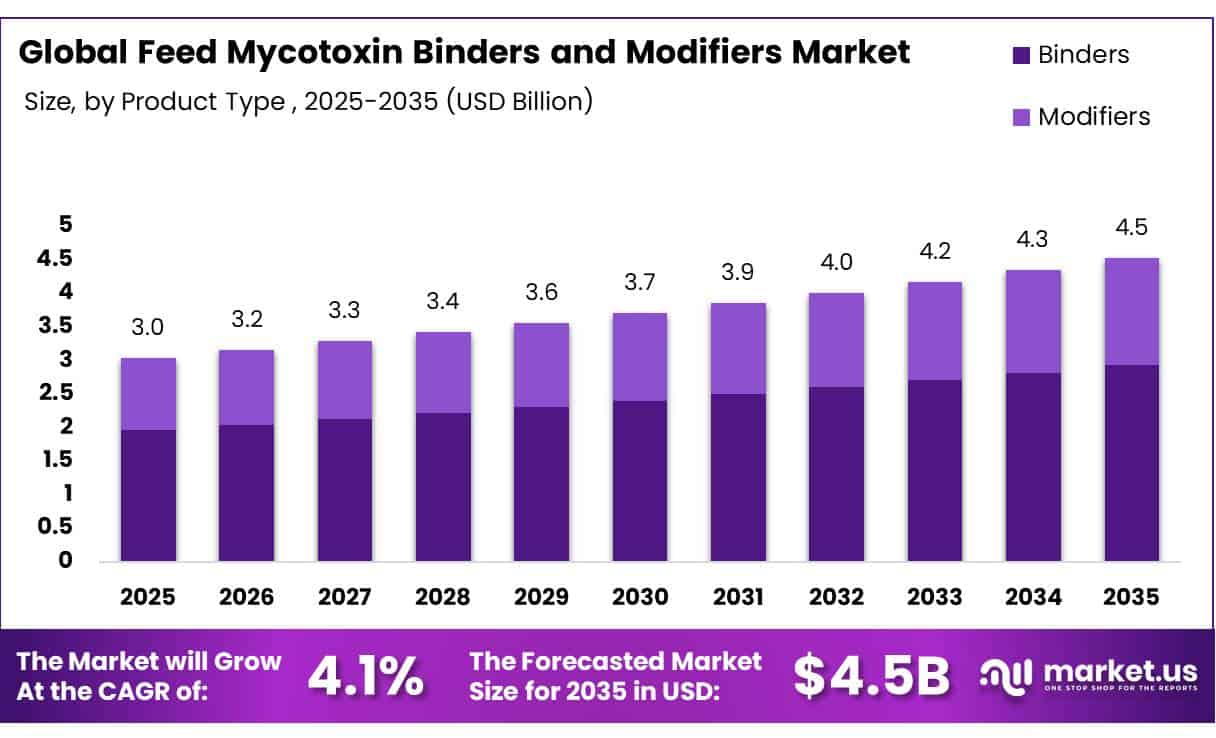
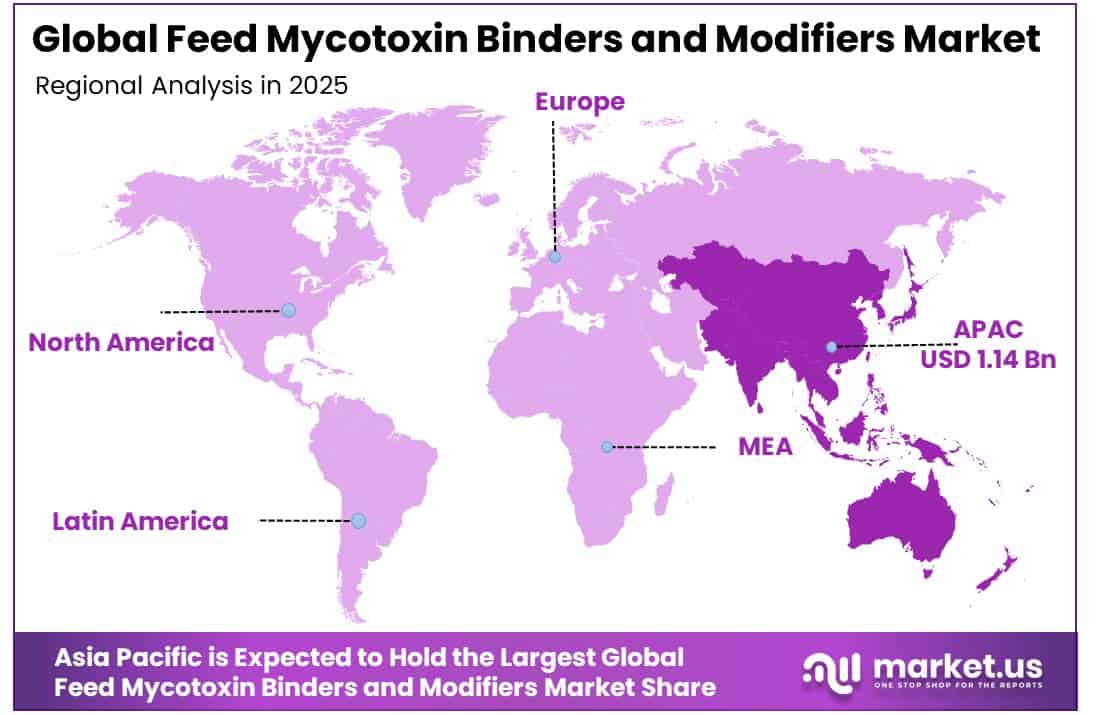
In 2025, the Global Feed Mycotoxin Binders and Modifiers Market was valued at USD 3.0 billion, and between 2026 and 2035, this market is estimated to register a CAGR of 4.1%, reaching about USD 4.5 billion by 2035. Asia Pacific held a dominant market position, capturing more than a 37.7% share, holding USD 1.14 billion in revenue.
The Feed Mycotoxin Binders and Modifiers industry forms a part of animal nutrition and feed safety, as these additives help limit animal exposure to toxins produced by fungi in grains and feed materials. The International Feed Industry Federation estimates that world compound feed production could reach 1.4 billion tonnes in 2025, while commercial feed manufacturing generates annual turnover exceeding US$500 billion. This scale creates an operating base for contamination control solutions across livestock production systems.
- The European Feed Manufacturers’ Federation expects European Union industrial compound feed production to reach 152 million tonnes in 2026. Within this total, poultry feed is forecast at 51.588 million tonnes, pig feed at 48.520 million tonnes, and cattle feed at 45.358 million tonnes. High throughput across feed streams increases the importance of consistent mycotoxin monitoring, adsorption, degradation, and preventive feed management.
Key Takeaways
- The global Feed Mycotoxin Binders and Modifiers Market was valued at USD 3.0 billion in 2025.
- The global Market is projected to grow at a CAGR of 4.1% and is estimated to reach USD 4.5 billion by 2035.
- On the basis of product type, binders dominated the market, constituting 64.8% of the total market share.
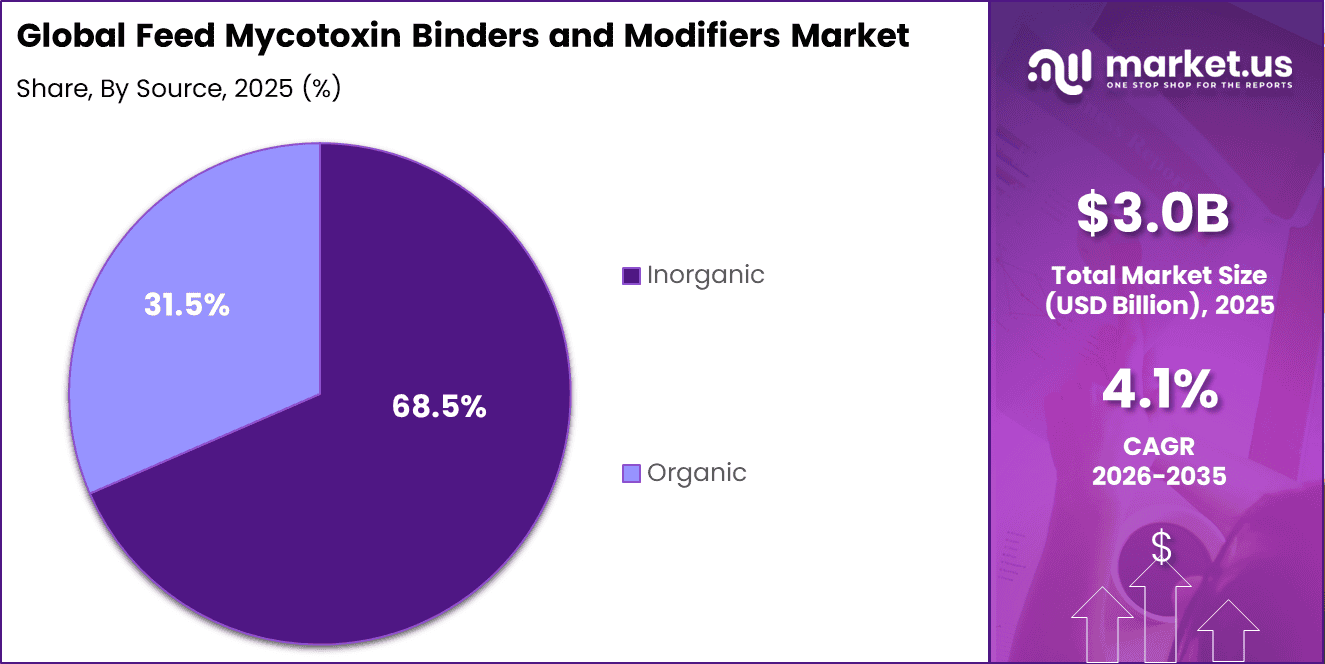
- Based on the source, inorganic dominated the Feed Mycotoxin Binders and Modifiers Market, with a substantial market share of around 68.5%.
- Based on the form, dry led the market, comprising 86.0% of the total market.
- Among the livestock, poultry held a major share in the Feed Mycotoxin Binders and Modifiers Market, accounting for 40.6% of the market share.
- In 2025, Asia Pacific was the most dominant region in the Feed Mycotoxin Binders and Modifiers Market, accounting for 37.7% of the total market.
Regulatory controls remain a demand driver because contaminated ingredients can create animal health and food chain risks. The United States Food and Drug Administration applies aflatoxin action levels ranging from 20 parts per billion for feeds intended for immature animals to 300 parts per billion for specified feeds for finishing beef cattle and cottonseed meal uses. Such thresholds encourage feed manufacturers to strengthen screening and incorporate binders or modifiers where appropriate within validated safety programs.
Growth opportunities are developing around mineral binders, biological modifiers, enzymes, and formulations addressing different toxin profiles. In 2025, the European Food Safety Authority confirmed that bentonite used under authorised conditions must remain within a maximum of 20,000 milligrams per kilogram of complete feedingstuff. Government and intergovernmental initiatives support feed safety capacity building. A 2025 Food and Agriculture Organization and International Feed Industry Federation meeting involved representatives covering more than 80% of global compound feed production.
Product Type Analysis
Binders dominate with 64.8% due to their strong use in controlling mycotoxins in animal feed.
In 2025, Binders held a dominant market position, capturing more than a 64.8% share in the Feed Mycotoxin Binders and Modifiers Market. Their strong position reflects widespread use in compound feed, where mineral-based materials can adsorb selected mycotoxins and reduce their availability in the digestive tract. Binders are commonly incorporated into poultry, swine, and ruminant feed because they are practical to formulate, stable during feed processing, and compatible with routine contamination-control programs.
- In July 2025, according to the European Food Safety Authority, a bentonite assessment examined feed containing 2 g of bentonite per kilogram alongside mycotoxin concentrations of 0.03 mg/kg aflatoxin B1, 5 mg/kg deoxynivalenol, 50 mg/kg fumonisins, and 0.5 mg/kg zearalenone.
Modifiers represent the growing product segment as feed producers increasingly seek solutions that can transform, degrade, or biologically reduce specific mycotoxins rather than only adsorb them. Their development is supported by demand for broader toxin coverage and more targeted feed-safety strategies. Enzyme-based and microbial approaches are gaining attention where multiple contaminants occur together, encouraging suppliers to develop combinations that complement conventional binders and improve formulation flexibility across markets.
Source Analysis
Inorganic sources lead with 68.5% due to their strong adsorption properties and widespread use in feed formulations.
In 2025, Inorganic held a dominant market position, capturing more than a 68.5% share in the Feed Mycotoxin Binders and Modifiers Market. Inorganic sources are widely used because mineral materials such as bentonite can be blended easily into compound feed and remain stable during routine feed processing and storage. Their practical handling, consistent physical properties, and ability to adsorb selected mycotoxins support use across poultry, swine, and ruminant nutrition.
- In January 2026, according to the European Food Safety Authority, its Qualified Presumption of Safety update recorded 340 notifications for biological agents, including 190 microorganisms used for the production of feed additives.
Organic is the growing source segment as feed producers explore yeast derivatives, microorganisms, enzymes, and other biologically based ingredients for targeted mycotoxin management. These products can complement mineral binders by supporting degradation or transformation pathways for contaminants that are not efficiently adsorbed. Growing interest in biological feed solutions, combined with attention to livestock health and feed quality, is encouraging suppliers to expand organic formulations. This development is widening product choice for producers seeking flexible, multi-component approaches to contamination control.
Form Analysis
Dry formulations dominate with 86.0% due to easy handling, storage, and blending with compound feed.
In 2025, Dry held a dominant market position, capturing more than a 86.0% share in the Feed Mycotoxin Binders and Modifiers Market. Dry formulations remain preferred because powders and granular products are easy to blend with compound feed during manufacturing. They support storage, transportation, dosing, and distribution across feed operations. Their compatibility with premixes and feed-processing systems further supports consistent use across poultry, swine, and ruminant applications.
- In March 2026, according to dsm-firmenich, surveillance of the North American corn crop included 242 grain samples, while fumonisin occurrence increased by 11 percentage points compared with the previous crop results.
Liquid is the growing form segment as producers seek flexible application methods for feed treatment and targeted dosing. Liquid products can be incorporated through spraying or mixing systems where uniform distribution across feed materials is required. Their handling flexibility supports use in integrated feed-processing lines and applications where rapid dispersion is useful. As feed producers strengthen contamination-control practices, liquid formulations are gaining attention for their adaptable delivery, compatibility with automated equipment, and ability to complement established dry products in broader mycotoxin-management programs.
Livestock Analysis
Poultry leads with 40.6% due to high consumption of grain-based feed and greater exposure to mycotoxin contamination.
In 2025, Poultry held a dominant market position, capturing more than a 40.6% share in the Feed Mycotoxin Binders and Modifiers Market. Poultry feed is highly exposed to grain-based ingredients such as maize and other cereals that can carry mycotoxins when storage or weather conditions are unfavorable. This encourages feed producers to use binders and modifiers to support feed quality, animal performance, and consistent production across poultry operations.
- In June 2026, according to the Food and Agriculture Organization of the United Nations, global meat production was expected to rise by 1.0% to 391.3 million tonnes, while poultry output was expected to increase by 2.5%.
Swine is the growing livestock segment as producers strengthen feed safety programs for pigs exposed to contaminated cereals and compound feed ingredients. Mycotoxin management is important in swine nutrition because feed quality can influence intake, growth, and herd productivity. Producers are therefore adopting broader control strategies that combine ingredient testing with suitable binders or modifiers. Expansion of commercial pig production and greater attention to feed consistency are supporting demand for targeted mycotoxin-control products across swine operations.
Key Market Segments
By Product Type
- Binders
- Modifiers
By Source
- Inorganic
- Organic
By Form
- Dry
- Liquid
By Livestock
- Poultry
- Swine
- Ruminants
- Aquatic Animals
- Pets
Driver Analysis
Climate-led multi-mycotoxin volatility
Climate instability is the largest near-term demand accelerator because heat stress, drought, delayed harvests, and intermittent rainfall increase fungal pressure across maize, wheat, barley, DDGS, oilseed meals, and stored feed grains. A 2024 global feed-corn survey found multi-mycotoxin occurrence in 71% of samples, while only 19% of samples were free of tested mycotoxins; this materially changes buyer behavior from occasional binder use after a contamination event to routine inclusion of broad-spectrum risk-management products.
Historical European maize monitoring also recorded aflatoxin prevalence as high as 40% in a hot, dry crop year, illustrating why procurement teams increasingly price mycotoxin mitigation into formulations before laboratory confirmation. For suppliers, this raises demand for combination products that address aflatoxins, fumonisins, zearalenone, deoxynivalenol (DON), ochratoxin A, and emerging toxins rather than low-cost single-mineral binders. Value capture shifts toward seasonal contracts, region-specific dose recommendations, and premium formulations combining adsorption, biotransformation, antioxidant, gut-barrier, and liver-support components.
Drivers Impact Analysis
| Driver | (~) % Impact on CAGR | Geographic Relevance | Impact Timeline |
|---|---|---|---|
| Climate-led multi-mycotoxin volatility | +2.1 pp | EU, North America, China, India, Brazil | Short term (≤ 2 years) |
| Stricter dairy and export residue control | +1.6 pp | EU core, U.S., China, Middle East | Short term (≤ 2 years) |
| Poultry and swine feed-volume expansion | +1.4 pp | APAC, Latin America, Africa | Medium term (2–4 years) |
| Shift to multi-toxin modifier systems | +1.8 pp | EU, U.S., Brazil, China, India | Medium term (2–4 years) |
| Precision testing-linked feed programs | +1.2 pp | North America, EU, China, Australia | Medium term (2–4 years) |
| Localized additive supply and premix integration | +0.9 pp | India, Southeast Asia, Brazil, Turkey | Long term (≥ 4 years) |
Restraint Analysis
Regulatory proof burden
Regulatory friction constrains premium modifier commercialization because authorities distinguish between a physical adsorption claim, a reduction-of-contamination claim, and a biological detoxification claim, each requiring different levels of compositional, toxicological, residue, environmental, and efficacy evidence. In the EU, Regulation (EC) No 1831/2003 requires pre-market authorization for feed additives, while EFSA’s 2024 efficacy guidance requires applicants to document identity, characterization, proposed conditions of use, target-animal, consumer, user, and environmental safety alongside efficacy; this increases dossier cost, extends launch planning, and favours incumbents with multi-year trial budgets.
The U.S. presents a different commercial constraint: specific mycotoxin-removal claims have not received FDA approval, so many products are positioned as flow agents, anticaking agents, or digestive aids rather than directly marketed toxin-removal technologies. The July 2026 EU Recommendation 2026/1801, applicable from 1 July 2027, further raises the compliance bar by reducing the DON guidance value for broiler and turkey complete feed from 5 mg/kg to 1 mg/kg and fumonisin guidance for pig feed from 5 mg/kg to 1 mg/kg; demand may rise, but suppliers without species-specific efficacy evidence face relabelling, reformulation, and delayed customer qualification.
Restraint Impact Analysis
| Restraint | (~) % Impact on CAGR Forecast | Geographic Relevance | Impact Timeline |
|---|---|---|---|
| Regulatory proof burden | -1.7 pp | EU, U.S., UK, Australia | Medium term (2–4 years) |
| Uneven modifier efficacy | -1.5 pp | Global; EU, U.S., China | Medium term (2–4 years) |
| Low-cost clay commoditization | -1.4 pp | India, China, SE Asia, Brazil | Short term (≤ 2 years) |
| Testing and attribution gap | -1.1 pp | Africa, India, SE Asia, LatAm | Short term (≤ 2 years) |
| Feed-margin and formulation pressure | -1.3 pp | Global livestock markets | Short term (≤ 2 years) |
| Fragmented farm adoption | -0.9 pp | India, Africa, SE Asia, LatAm | Long term (≥ 4 years) |
Opportunity Analysis
Pet-food safety additives
Premium companion-animal nutrition is an attractive white space because pet-food manufacturers typically demand tighter raw-material traceability, more consistent batch documentation, and higher food-safety assurance than mass-market livestock feed producers, yet most conventional mycotoxin additives are not formulated or branded for pet-food applications. The U.S. Food and Drug Administration maintains a 20 ppb aflatoxin action level for finished pet food, while preventive controls under the Food Safety Modernization Act increase the commercial value of ingredients that support hazard-control plans; this makes a documented, low-inclusion safety additive more commercially viable than in bulk poultry rations.
The addressable premium ecosystem is expanding: U.S. pet-industry expenditure reached USD 158 billion in 2025, up 3.7%, and was projected at USD 165 billion for 2026; China’s pet industry reached USD 43.4 billion in 2025 as spending shifted from volume toward higher-value products. The strategic pivot is to sell validated ingredient assurance, supplier-audit support, and premium product protection—not livestock performance alone—enabling 2x–4x higher revenue per kilogram than generic feed binders, provided suppliers establish companion-animal safety data, palatability neutrality, and claims compliant with pet-food rules.
Opportunity Impact Analysis
| Opportunity | (~) % Potential CAGR Upside | Geographic Relevance | Execution Window |
|---|---|---|---|
| Aquafeed detoxification platforms | +1.9 pp | EU, China, Norway, Chile, Vietnam | Medium term (2–4 years) |
| Pet-food safety additives | +1.5 pp | U.S., China, EU, Thailand | Short term (≤ 2 years) |
| Risk-as-a-service subscriptions | +2.1 pp | North America, EU, Brazil, China | Medium term (2–4 years) |
| Verified low-residue dairy programs | +1.6 pp | EU, U.S., GCC, China | Medium term (2–4 years) |
| Enzyme and microbiome M&A | +1.4 pp | EU, U.S., Japan, China | Long term (≥ 4 years) |
| Emerging-market premix roll-ups | +1.3 pp | India, ASEAN, Africa, LatAm | Medium term (2–4 years) |
Challenges Analysis
Climate-risk forecasting gaps
Mycotoxin risk is increasingly difficult to forecast because the relevant variables—pre-harvest drought, insect damage, late rainfall, harvest timing, storage moisture, local temperature, and feedstock origin—interact non-linearly and vary at sub-regional level, making historic contamination maps insufficient for procurement decisions. Mycotoxigenic fungi can grow across a broad 10–40°C range when water activity exceeds 0.70, while documented climate-related shifts are moving pest and pathogen ranges poleward at roughly 3 km annually; this means established risk geographies for aflatoxins, DON, fumonisins, and zearalenone can change faster than feed mills revise supplier specifications.
FAO estimates that 25%–80% of global crops can be affected by mycotoxins, but such a wide range reflects inconsistent surveillance and prevents precise demand planning for binders and modifiers. The operational consequence is cyclical inventory error: manufacturers risk stock-outs in severe contamination seasons or excess stocks in lower-risk periods, while feed mills may apply the wrong product type or dose. Mitigation requires localized weather-to-toxin models, supplier-lot traceability, seasonal inventory buffers equivalent to 6–12 weeks of regional sales, and pooled datasets linking meteorological signals, crop origin, analytical results, and animal-performance outcomes.
Challenges Impact Analysis
| Challenge | (~) % CAGR Friction Drag | Geographic Relevance | Mitigation Horizon |
|---|---|---|---|
| Climate-risk forecasting gaps | -1.3 pp | EU, North America, Brazil, China | Long term (≥ 4 years) |
| Multi-toxin assay complexity | -1.2 pp | Global; EU, U.S., APAC | Medium term (2–4 years) |
| Feedstock consistency control | -0.9 pp | India, China, Turkey, Brazil | Medium term (2–4 years) |
| Maritime supply volatility | -0.8 pp | EU, MENA, Africa, APAC | Short term (≤ 2 years) |
| Field-evidence talent deficit | -1.0 pp | Emerging APAC, Africa, LatAm | Long term (≥ 4 years) |
| Cross-market claims harmonization | -0.7 pp | EU, U.S., UK, China, ASEAN | Long term (≥ 4 years) |
Geopolitical Impact Analysis
Geopolitical Realignment and Trade Route Fragmentation Reshaping Feed Mycotoxin Control
Geopolitical tensions are reshaping the Feed Mycotoxin Binders and Modifiers Market through grain-trade disruption, energy volatility, and changing sourcing patterns. In July 2026, the Food and Agriculture Organization reported that global wheat prices rose 5.8%, standing 9.9% above the previous year, amid disruption to Black Sea export flows. World maize prices also increased 3.6% from June.
Middle East instability is adding supply risk for feed systems. In March 2026, the World Trade Organization reported that around one-third of global fertilizer exports normally pass through the Strait of Hormuz, while commercial vessel traffic fell from 138 vessels per day to almost zero. Such disruption can affect crop availability, grain costs, and feed procurement.
- Shipping-route fragmentation is increasing logistics exposure for imported additives and raw materials. UN Trade and Development reported in September 2025 that global seaborne trade was expected to grow only 0.5%, while geopolitical rerouting had driven nearly 6% growth in ton-miles. Longer routes can increase freight costs and delivery times for binders, enzymes, and feed inputs.
Trade-policy uncertainty is encouraging feed manufacturers and additive suppliers to diversify procurement. The World Trade Organization reported that 72% of world trade was conducted on a most-favoured-nation basis by the end of February 2026 following major policy shifts. These conditions support regional sourcing, safety stocks, multiple supplier qualification, and localized production to reduce cross-border supply interruptions.
Regional Analysis
Asia Pacific Dominates with 37.70% and USD 1.14 Billion
In 2025, Asia Pacific held a dominant position in the Feed Mycotoxin Binders and Modifiers Market, capturing 37.70% share and reaching USD 1.14 billion. The region benefits from large livestock industries and extensive use of cereal-based feed.
- In December 2025, the National Bureau of Statistics of China reported grain production of 714.88 million tonnes, including 660.21 million tonnes of cereals, supporting a substantial feed ingredient base where mycotoxin control remains important.
Europe is the fastest growing region in the Feed Mycotoxin Binders and Modifiers Market, supported by feed-safety practices, compound-feed production, and livestock demand. In June 2026, Eurostat reported that the European Union had 131.5 million pigs and 71.6 million bovine animals in 2025. These large animal populations sustain demand for feed quality management, while tighter monitoring of contaminated raw materials encourages greater use of binders and modifiers across commercial feed operations. Regulatory oversight supports safer regional cereal handling overall.
Key Regions and Countries Covered
- North America
- The US
- Canada
- Europe
- Germany
- France
- The UK
- Spain
- Italy
- Russia & CIS
- Rest of Europe
- APAC
- China
- Japan
- South Korea
- India
- ASEAN
- Rest of APAC
- Latin America
- Brazil
- Mexico
- Rest of Latin America
- Middle East & Africa
- GCC
- South Africa
- Rest of MEA
Key Players Analysis
Feed Mycotoxin Binders and Modifiers manufacturers compete through product efficacy, toxin coverage, formulation flexibility, technical services, and global distribution. In 2026, dsm-firmenich remained active through its Mycofix portfolio, while Alltech strengthened risk-management positioning through its 2026 Asia Import Risk Analysis covering traded feed ingredients. Cargill also competes through NOTOX solutions and digital mycotoxin-risk tools, helping producers combine feed protection with contamination monitoring. These capabilities support differentiation beyond basic mineral binding and strengthen customer relationships globally today.
Competition is also shaped by research capacity, production reach, and integrated animal-nutrition portfolios. ADM supports mycotoxin management through T5X solutions combining binding, detoxification support, monitoring, and analysis, while Adisseo operates through five research centers and production sites across Europe, the United States, China, and Thailand. In 2026, dsm-firmenich also agreed to divest its Animal Nutrition & Health business to CVC Capital Partners, highlighting continued portfolio realignment among major suppliers.
Market Key Players
- BIOMIN Holding GmbH (dsm-firmenich)
- Cargill, Incorporated
- BASF SE
- Alltech, Inc.
- Kemin Industries, Inc.
- Archer Daniels Midland (ADM)
- Bayer AG
- Impextraco NV
- Perstorp Holding AB
- Novus International, Inc.
- Olmix Group S.A.
- Adisseo (Bluestar)
- Nutreco N.V. (Selko/Trouw)
- Amlan International
- Hansen A/S (Novonesis)
Key Development
- In February 2026, ADM and Alltech officially launched Akralos Animal Nutrition, a new North American animal feed and nutrition company. The joint venture brings together Alltech’s Hubbard Feeds and Masterfeeds businesses with ADM’s feed operations to strengthen feed manufacturing, nutrition expertise, and customer support capabilities across North America.
- In March 2026, Adisseo launched Sanion Tetra 50 and Sanion Tetra 70, protected sodium butyrate feed additives containing 50% and 70% active content, respectively. The products expanded Adisseo’s Animal Resilience portfolio with formulations designed for improved handling and nutritional applications in animal feed.
- In July 2026, Amlan International announced the presentation of its mineral-based feed technologies at SIAVS 2026 in Brazil, including Calibrin-Z, a broad-spectrum mycotoxin binder designed to adsorb multiple mycotoxins in feed management programs, alongside its Varium feed additive technology.
Report Scope
| Report Features | Description |
|---|---|
| Market Value (2025) | USD 3.0 Bn |
| Forecast Revenue (2035) | USD 4.5 Bn |
| CAGR (2026-2035) | 4.1% |
| Base Year for Estimation | 2025 |
| Historic Period | 2020-2024 |
| Forecast Period | 2026-2035 |
| Report Coverage | Revenue Forecast, Market Dynamics, Competitive Landscape, Recent Developments |
| Segments Covered | By Product Type (Binders and Modifiers), By Source (Inorganic and Organic), By Form (Dry and Liquid), By Livestock (Poultry, Swine, Ruminants, Aquatic Animals, and Pets) |
| Regional Analysis | North America – The US & Canada; Europe – Germany, France, The UK, Spain, Italy, Russia & CIS, Rest of Europe; APAC– China, Japan, South Korea, India, ASEAN & Rest of APAC; Latin America– Brazil, Mexico & Rest of Latin America; Middle East & Africa– GCC, South Africa, & Rest of MEA |
| Competitive Landscape | BIOMIN Holding GmbH (dsm-firmenich), Cargill, Incorporated, BASF SE, Alltech, Inc., Kemin Industries, Inc., Archer Daniels Midland (ADM), Bayer AG, Impextraco NV, Perstorp Holding AB, Novus International, Inc., Olmix Group S.A., Adisseo (Bluestar), Nutreco N.V. (Selko/Trouw), Amlan International, and Chr. Hansen A/S (Novonesis). |
| Customization Scope | Customization for segments, region/country-level will be provided. Moreover, additional customization can be done based on the requirements. |
| Purchase Options | We have three licenses to opt for: Single User License, Multi-User License (Up to 5 Users), Corporate Use License (Unlimited Users and Printable PDF) |





































