


Report Overview
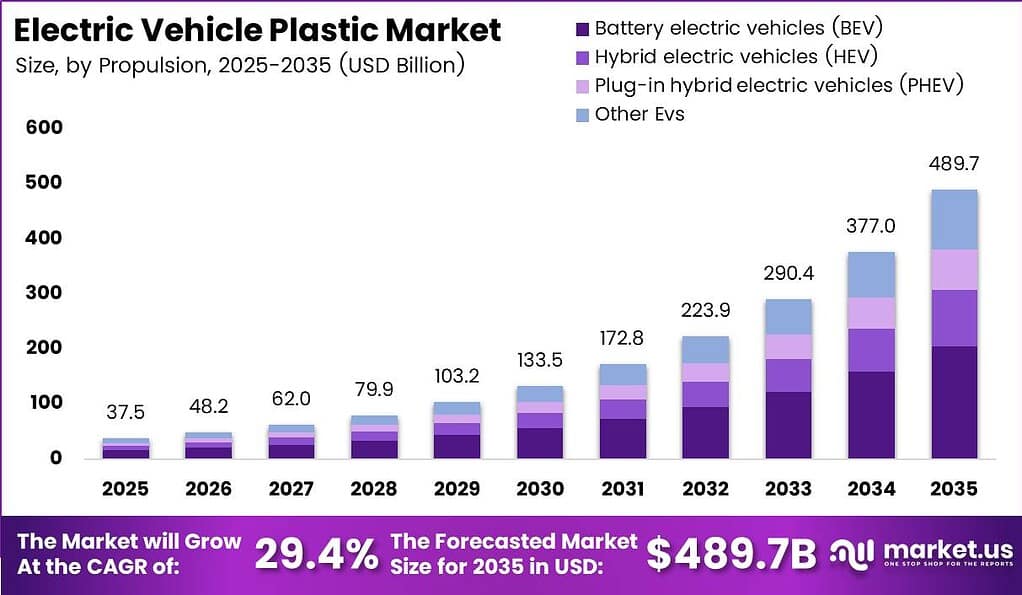
Global Electric Vehicle Plastic Market size is expected to be worth around USD 489.7 Billion by 2035 from USD 133.5 Billion in 2025, growing at a CAGR of 29.4% during the forecast period 2026 to 2035. According to the International Energy Agency, global electric-car sales exceeded 17 million units in 2024, rising by more than 25%. This volume directly translates into polymer demand across molded, extruded, and reinforced components throughout each vehicle platform.
The Electric Vehicle Plastic Market covers engineering and specialty polymers used in battery-electric, hybrid, plug-in hybrid, and other electrified vehicles. Applications span exterior bodywork, interior trim, battery enclosures, powertrain housings, and wiring insulation systems. Passenger cars and SUVs form the largest vehicle class, while commercial trucks, buses, and two- and three-wheelers represent fast-expanding adjacent categories. Polypropylene, polyurethane, polycarbonate, and polyamide are the core material types, each serving distinct structural, thermal, or aesthetic roles across the vehicle.
Key Takeaways
- Global Electric Vehicle Plastic Market size was valued at USD 133.5 Billion in 2025 and is projected to reach USD 489.7 Billion by 2035, growing at a CAGR of 29.4% during the forecast period 2026–2035.
- Polypropylene (PP) led the By Polymer Type segment with a dominant share of 27.5% in 2025, driven by its cost efficiency and broad processing versatility across automotive applications.
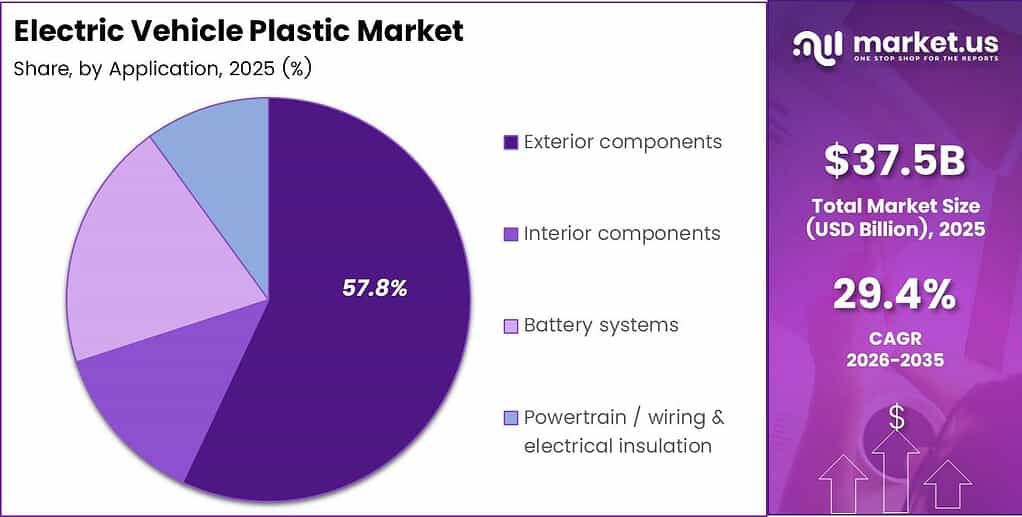
- Exterior Components accounted for the largest share of 57.8% in the By Application segment in 2025, owing to high polymer content per vehicle unit across bumpers, body panels, and aerodynamic modules.
- Battery Electric Vehicles (BEV) held a dominant position in the By Propulsion segment with a 39.7% share in 2025, reflecting the highest polymer content per platform driven by battery enclosures and thermal management systems.
- Passenger EVs (Cars, SUVs, Crossovers) dominated the By Vehicle Class segment with a 74.3% share in 2025, supported by the highest unit production volume globally.
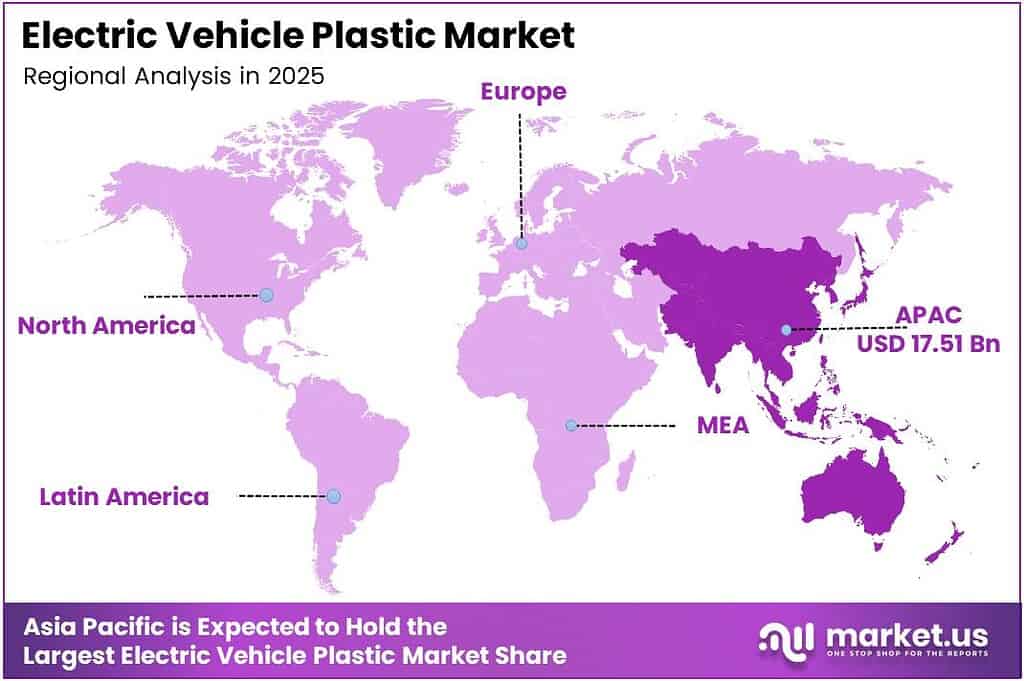
- Asia Pacific emerged as the dominant region with a market share of 46.7%, valued at USD 17.51 Billion in 2025, led by China’s electric-car sales of over 11 million units in 2024.
The International Energy Agency indicates that global electric-car sales were expected to exceed 20 million units in 2025, with electric cars representing more than 1 in 4 cars sold worldwide. This penetration rate confirms a durable demand floor for polymer suppliers serving EV platforms across all major producing regions.
International Energy Agency data shows the global electric-car fleet reached almost 58 million vehicles at the end of 2024, representing about 4% of the total passenger-car fleet. As the installed base grows, demand for replacement and service-grade polymer components creates a secondary revenue layer beyond new-vehicle production runs.
As reported by the International Energy Agency, government spending represented less than 7% of global electric-car spending in 2024, compared with 20% in 2017, while global annual government spending on electric cars remained around US$38 Billion from 2022. China’s government expenditure per electric vehicle fell 25% between 2022 and 2024, and the average European EV subsidy per vehicle declined from more than US$4,500 in 2022 to around US$1,000 in 2024.
These shifts confirm that EV adoption is now consumer-led rather than subsidy-dependent, reducing demand fragility for polymer suppliers. Arkema issued a €500 million green bond with an eight-year maturity and a 3.50% annual coupon in September 2025, signaling that specialty polymer producers are raising dedicated capital to meet EV-driven material requirements.
Polymer Type Analysis
Polypropylene (PP) dominates with 27.5% due to cost efficiency and broad processing versatility.
In 2025, Polypropylene (PP) held a dominant market position in the By Polymer Type segment of the Electric Vehicle Plastic Market, with a 27.5% share. PP offers the widest processing window of any thermoplastic used in automotive applications, making it compatible with injection molding, blow molding, and extrusion across interior and exterior modules. As per our research, electric-car sales in emerging and developing economies increased from a 2.5% sales share to 4% in 2024, expanding the total addressable market for cost-competitive polymers such as PP in price-sensitive platforms. Suppliers that lead with reinforced PP grades for structural and semi-structural applications will capture specification positions before higher-cost alternatives enter these vehicle programs.
Polyurethane (PU) serves a distinct functional role in seating foam, thermal insulation, acoustic damping, and flexible component systems where PP cannot match the required density-to-comfort ratio. PU demand scales directly with interior content value per vehicle, which rises as passenger EV cabins adopt premium material specifications. This positions PU as a margin-accretive segment for compounders that serve premium and mid-range platform programs.
Polycarbonate (PC) addresses optical clarity, impact resistance, and dimensional stability requirements that neither PP nor PU can meet, making it the default material for lighting systems, sensor housings, and transparent panels. Polycarbonate specification is driven by safety regulation rather than cost competition, giving qualified PC compounders pricing authority within their sub-segments. Polyamide (PA) and other polymers including PE and ABS hold the remaining share, serving under-hood thermal management, structural connectors, and wiring harness applications.
Application Analysis
Exterior components dominate with 57.8% due to high polymer content per vehicle unit.
In 2025, Exterior components held a dominant market position in the By Application segment of the Electric Vehicle Plastic Market, with a 57.8% share. Bumpers, fenders, body panels, aerodynamic modules, and charge-port bezels each consume measurable polymer content per vehicle, and the total exterior polymer load per EV platform is structurally larger than on an equivalent internal-combustion vehicle because weight reduction targets are more aggressive. International Energy Agency data shows global consumer spending on electric cars reached US$560 Billion in 2024, reflecting an installed production base large enough to justify sustained tooling and compounding investment in exterior polymer systems.
Interior components represent the second-largest application category, driven by seat systems, dashboard structures, door liners, center consoles, and headliners that collectively define cabin material intensity per vehicle. The value of interior polymer content rises with vehicle tier, meaning premium EV launches disproportionately expand interior segment revenue per unit produced. This creates a clear incentive for suppliers to qualify material grades across multiple interior sub-systems within the same vehicle program.
Battery systems represent a high-specification application where polymer content includes cell module housings, battery pack covers, thermal interface films, and busbar insulation. International Energy Agency data shows the global electric-car stock displaced more than 1 million barrels per day of oil consumption in 2024, confirming that the battery-centric EV architecture driving polymer demand in this sub-segment is commercially established at scale. Powertrain, wiring, and electrical insulation applications hold the remaining share, serving high-temperature and dielectric performance requirements.
Propulsion Analysis
Battery electric vehicles (BEV) dominate with 39.7% due to highest polymer content per platform.
In 2025, Battery electric vehicles (BEV) held a dominant market position in the By Propulsion segment of the Electric Vehicle Plastic Market, with a 39.7% share. OICA data shows global vehicle production increased from 92.7 million units in 2024 to 96.4 million in 2025, a 3.9% increase, while BEV platforms absorbed a disproportionately large share of polymer-intensive component content per unit due to battery enclosures and thermal management systems. International Energy Agency data confirms that more than 90% of electric-car sales in many Southeast Asian countries were battery-electric vehicles, reinforcing BEV as the default architecture across the fastest-growing regional market.
Hybrid electric vehicles (HEV) represent the second propulsion sub-segment by share, supplying polymer demand across both conventional powertrain and partial electrification sub-systems. HEV platforms retain an internal-combustion component, meaning polymer content overlaps with the traditional automotive bill of materials while adding electrical insulation and battery-adjacent thermal materials. This dual-system architecture sustains polymer volume per unit even as pure BEV penetration rises.
Plug-in hybrid electric vehicles (PHEV) occupy a distinct middle position, combining a larger battery pack than an HEV with a retained combustion engine, which increases battery enclosure polymer content relative to standard hybrids. Other EV formats including fuel-cell vehicles hold the remaining propulsion share, with specialized membrane, housing, and fluid-management polymer applications that command specification-grade supply relationships rather than volume-driven contracts.
Vehicle Class Analysis
Passenger EVs (cars, SUVs, crossovers) dominate with 74.3% due to highest unit production volume globally.
In 2025, Passenger EVs (cars, SUVs, crossovers) held a dominant market position in the By Vehicle Class segment of the Electric Vehicle Plastic Market, with a 74.3% share. OICA data shows China’s new-energy-vehicle production reached 16.626 million units in 2025, up 29%, and the majority of this output was passenger cars and SUVs that carry the highest per-vehicle polymer content in the market. The scale of this single national production base means polymer suppliers with established positions in Chinese OEM programs capture recurring, multi-model volume that competitors in other regions cannot easily replicate.
Light commercial EVs including LCVs and vans represent the second vehicle class by share, driven by last-mile delivery electrification where payload efficiency and durability requirements create demand for reinforced structural polymers and impact-resistant exterior systems. International Energy Agency data shows global sales of electric buses exceeded 70,000 in 2024, increasing 30% year on year, confirming that the commercial EV segment absorbs meaningful polymer volume per unit across body, interior, and battery systems.
Medium and heavy commercial EVs including buses and trucks are the fastest-expanding vehicle class by growth rate. International Energy Agency data shows global electric medium- and heavy-duty truck sales exceeded 90,000 units in 2024, increasing almost 80%, with high per-vehicle polymer mass in structural body components, thermal enclosures, and electrical insulation systems. Electric two- and three-wheelers hold the remaining vehicle class share, with compact platforms requiring lower absolute polymer content but offering high unit volumes in South and Southeast Asian markets.
Key Market Segments
By Polymer Type
- Polypropylene (PP)
- Polyurethane (PU)
- Polycarbonate (PC)
- Polyamide (PA)
- Other Polymers
- PE
- ABS
- Others
By Application
- Exterior Components
- Interior Components
- Battery Systems
- Powertrain / Wiring & Electrical Insulation
By Propulsion
- Battery Electric Vehicles (BEV)
- Hybrid Electric Vehicles (HEV)
- Plug-in Hybrid Electric Vehicles (PHEV)
- Other EVs
By Vehicle Class
- Passenger EVs (Cars, SUVs, Crossovers)
- Light Commercial EVs (LCVs, Vans)
- Medium & Heavy Commercial EVs (Buses, Trucks)
- Electric 2- & 3-Wheelers
Regional Analysis
Asia Pacific Dominates the Electric Vehicle Plastic Market with a Market Share of 46.7%, Valued at USD 17.51 Billion
Asia Pacific holds the dominant regional position with a 46.7% share, valued at USD 17.51 Billion. International Energy Agency data shows China’s electric-car sales exceeded 11 million units in 2024, with electric cars accounting for almost 50% of China’s new-car sales and China representing almost two-thirds of global electric-car sales. OICA data confirms Asia-Pacific vehicle production increased 7.6% to around 59.2 million vehicles in 2025, accounting for more than 61% of global output. This production concentration makes Asia Pacific the structurally irreplaceable core of global EV polymer demand. Toray received approval for up to ¥3 Billion in METI financial support for an xEV automotive capacitor-film manufacturing project in May 2025, illustrating active government capital deployment into EV polymer infrastructure across the region.
International Energy Agency data shows electric-car sales in developing Asia excluding China approached 400,000 in 2024, up more than 40%, with India approaching 100,000 electric-car units at around 2% of new-car sales. Thailand’s electric-car sales share increased to 13% in 2024 from 11% in 2023, Indonesia’s share exceeded 7%, and Chinese electric-car imports into Indonesia increased 18-fold to 34,000 units. These sub-markets represent the fastest-growing demand zone in the region, where polymer suppliers that establish local qualification positions now will benefit from compounding volume growth as national EV penetration rates rise.
Europe is the second-largest region, with International Energy Agency data showing the region expected to sell around 4 million electric cars in 2025, representing a sales share of around 25%. Norway achieved an 88% battery-electric share of new-car sales in 2024, Denmark recorded a 56% share with nearly 100,000 sales, and the United Kingdom’s share reached nearly 30% in 2024, up from 24% in 2023. These penetration rates confirm that European OEM programs carry polymer content specifications that reward early-qualified suppliers with multi-year recurring volume.
In North America, International Energy Agency data shows United States electric-car sales reached 1.6 million units in 2024, accounting for more than 10% of new-car sales, with 24 new electric-car models launched in 2024, increasing model availability by 15%, and nearly half of EVs leased. International Energy Agency data also shows more than 80% of electric trucks sold globally in 2024 were sold in China, while electric-car sales outside China, Europe, and the United States were expected to grow by more than 30% to around 1.8 million in 2025.
Brazil recorded nearly 125,000 electric-car sales in 2024 with a 6.5% sales share, with more than 85% of new electric cars sourced from China. China also exported more than 15,000 electric buses in 2024, more than 25% above 2023 levels. Electric-car sales in Africa more than doubled to almost 11,000 units in 2024, with Latin America and Africa representing pre-scale demand zones where early polymer supplier positioning carries low risk and meaningful first-mover potential.
Key Regions and Countries
North America
- US
- Canada
Europe
- Germany
- France
- The UK
- Spain
- Italy
- Rest of Europe
Asia Pacific
- China
- Japan
- South Korea
- India
- Australia
- Rest of APAC
Latin America
- Brazil
- Mexico
- Rest of Latin America
Middle East and Africa
- GCC
- South Africa
- Rest of MEA
Drivers
Rapid expansion of battery-electric vehicle output is the largest active demand engine for EV plastics. Every additional platform requires polymer content across interiors, battery enclosures, charging systems, wire harness protection, cooling circuits, and exterior modules. Higher model volumes improve injection-molding utilization and reduce per-part conversion cost, allowing suppliers to amortize validation spending across more programs. EV production scale-up contributes roughly +5.2% to the 29.4% baseline CAGR.
Beyond production volume, EV platforms generate polymer demand through battery-weight offset requirements, integrated design mandates, elevated cabin material intensity, and thermal-management polymer specifications. Localized supply chains in India and Southeast Asia extend this demand into new geographies. Battery-weight offset demand adds approximately +4.3% to CAGR, while thermal-management polymer demand and localized EV supply chains contribute a combined +3.9% uplift over the medium term.
| Driver | (~) % Impact on CAGR Forecast | Geographic Relevance | Impact Timeline |
|---|---|---|---|
| EV production scale-up | +5.2% | China, Europe, North America | Short term (≤ 2 years) |
| Battery-weight offset demand | +4.3% | Global passenger EV platforms | Short term (≤ 2 years) |
| Integrated polymer component design | +3.1% | China, Japan, South Korea, Europe | Medium term (2–4 years) |
| Electrified cabin material intensity | +2.6% | North America, Europe, China | Short term (≤ 2 years) |
| Thermal-management polymer demand | +2.2% | Global, strongest in Asia-Pacific | Medium term (2–4 years) |
| Localized EV supply chains | +1.7% | India, Southeast Asia, North America | Medium term (2–4 years) |
Restraints
Price volatility in engineering thermoplastics and specialty additives is the strongest immediate restraint on EV plastic market growth. EV-grade polyamide, polycarbonate, and flame-retardant compound costs are exposed to feedstock cycles, energy prices, and freight disruption. A material-cost increase of even 10 to 15% can erase operating margins on molded modules where pass-through mechanisms are absent. This produces an estimated -3.8% drag against the 29.4% baseline CAGR.
Battery-adjacent polymer substitution compounds this restraint because validation cycles for flammability, dielectric performance, and thermal cycling typically run 12 to 24 months. This delays lower-cost material changes and postpones compounding-line expansion decisions. EV demand and price competition adds a further -3.3% impact, while automotive qualification cost barriers, import duties, low-volume platform cancellations, and capital-intensive compounding upgrades contribute a combined -9.1% structural drag on attainable growth.
| Restraint | (~) % Impact on CAGR Forecast | Geographic Relevance | Impact Timeline |
|---|---|---|---|
| High-performance resin price volatility | -3.8% | Global, acute in import-dependent markets | Short term (≤ 2 years) |
| EV demand and price competition | -3.3% | China, Europe, North America | Short term (≤ 2 years) |
| Automotive qualification cost barriers | -2.7% | Global | Medium term (2–4 years) |
| Import duties and trade barriers | -2.1% | North America, Europe, India | Short term (≤ 2 years) |
| Low-volume platform cancellations | -1.8% | Europe, North America | Short term (≤ 2 years) |
| Capital-intensive compounding upgrades | -1.5% | Emerging manufacturing markets | Medium term (2–4 years) |
Challenges
Recycled polymer quality consistency is the largest ongoing friction in this market. Automotive-grade feedstock must meet narrow contamination, melt-flow, flame performance, and dimensional stability requirements, yet end-of-life vehicle streams remain heterogeneous. Recycled-plastic content in vehicles currently ranges from 0% to 15% by vehicle and material stream, while blending virgin resin and stabilizers raises conversion cost by roughly 5 to 20% versus stable virgin-resin formulations.
Battery safety material validation adds a further -3.0% friction drag by extending qualification timelines for battery-adjacent polymer components. Multi-material recycling complexity, regional standards fragmentation, a specialist processing skills gap, and tooling cycle-time optimization challenges contribute an additional combined drag of approximately -8.0%. Together, these structural frictions produce an estimated -3.4% CAGR impact from recycled polymer inconsistency alone, requiring sustained investment in dismantling, sorting, digital material passports, and closed-loop compounding to mitigate.
| Challenge | (~) % CAGR Friction Drag | Geographic Relevance | Mitigation Horizon |
|---|---|---|---|
| Recycled polymer quality consistency | -3.4% | Europe, North America, China | Medium term (2–4 years) |
| Battery safety material validation | -3.0% | Global | Medium term (2–4 years) |
| Multi-material recycling complexity | -2.5% | Europe, Japan, South Korea | Long term (≥ 4 years) |
| Regional standards fragmentation | -2.2% | Global trade corridors | Medium term (2–4 years) |
| Specialist processing skills gap | -1.8% | India, Southeast Asia, North America | Medium term (2–4 years) |
| Tooling cycle-time optimization | -1.5% | Global | Short term (≤ 2 years) |
Opportunities
Closed-loop recycled polymer platforms represent the largest upside opportunity in this market. The European vehicle-circularity framework mandates recycled-plastic content of at least 15% for new vehicle types after 6 years and 25% after 10 years, including a closed-loop component sourced from end-of-life vehicles. A vertically integrated model combining dismantling contracts, advanced sorting, and OEM certification can improve material-system margins by an estimated 3 to 8 percentage points once scrap yield and logistics are optimized.
Processors that convert this gap into multi-year closed-loop supply agreements can capture a potential incremental CAGR upside of roughly +4.1% above the 29.4% baseline through higher-value material sales and traceability services. Structural battery enclosure composites, EV charging hardware polymers, and software-enabled material traceability platforms each offer further upside of +3.5%, +2.8%, and +2.3% respectively. Low-voltage mobility platforms in India and Southeast Asia and modular interior retrofit systems add a combined +3.6% potential CAGR upside over the medium to long term.
| Opportunity | (~) % Potential CAGR Upside | Geographic Relevance | Execution Window |
|---|---|---|---|
| Closed-loop recycled polymer platforms | +4.1% | Europe, North America, Japan, South Korea | Medium term (2–4 years) |
| Structural battery enclosure composites | +3.5% | China, Europe, North America | Medium term (2–4 years) |
| EV charging hardware polymers | +2.8% | Global, especially urbanizing economies | Short term (≤ 2 years) |
| Software-enabled material traceability | +2.3% | Europe, North America, China | Medium term (2–4 years) |
| Low-voltage mobility platforms | +2.0% | India, Southeast Asia, Latin America | Medium term (2–4 years) |
| Modular interior retrofit systems | +1.6% | Europe, North America, China | Long term (≥ 4 years) |
Key Company Insights
BASF SE reported investments including acquisitions totaling €1.201 Billion in the first nine months of 2025, reflecting active capital deployment across its specialty chemical and polymer portfolio. In October 2025, BASF and Carlyle signed a binding agreement for BASF’s automotive OEM coatings, refinish coatings, and surface-treatment businesses at a €7.7 Billion enterprise value, with BASF retaining a 40% stake. This divestiture-and-retain structure signals a strategic refocus toward core engineering polymer materials with higher EV relevance.
SABIC reported net income from continuing operations of US$0.55 Billion in 2025, supported by total assets of US$65.14 Billion, giving it a balance-sheet depth that supports sustained R&D and capacity commitments in EV-grade polymer grades. International Energy Agency data shows electric-car sales in emerging and developing economies increased by more than 60% in 2024, expanding the addressable market for SABIC’s materials across Asia, the Middle East, and Latin America. This geographic breadth positions SABIC to serve high-growth EV programs where local supply relationships matter for qualification speed.
Key Players
- BASF SE
- SABIC (Saudi Basic Industries Corporation)
- Covestro AG
- DuPont de Nemours, Inc.
- LG Chem Ltd.
- LyondellBasell Industries Holdings B.V.
- Solvay S.A.
- Arkema S.A.
- Celanese Corporation
- LANXESS AG
- Mitsubishi Engineering-Plastics Corporation
- Evonik Industries AG
- Toray Industries Inc.
- DSM (Koninklijke DSM)
- INEOS Group Holdings
- Others
Recent Developments
- October 2025 – BASF and Carlyle signed a binding agreement for the transfer of BASF’s automotive OEM coatings, automotive refinish coatings, and surface-treatment businesses at a €7.7 Billion enterprise value, with the transaction expected to provide approximately €5.8 Billion in pre-tax cash proceeds.
- October 2025 – BASF confirmed it will retain a 40% stake in the new automotive-coatings business created through the Carlyle transaction.
- October 2024 – Covestro invested around €100 Million in global R&D infrastructure and assets, reinforcing its material innovation capacity for EV polymer applications.
- April 2026 – DuPont completed the divestiture of its Aramids business in a transaction valued at approximately US$1.8 Billion, with DuPont receiving about US$1.2 Billion in cash proceeds.
- April 2026 – The DuPont Aramids-business divestiture included a US$300 Million note and equity valued at US$325 Million, reflecting a structured exit from a non-core materials segment.
- September 2025 – Arkema issued a €500 Million green bond with an eight-year maturity and a 3.50% annual coupon to fund sustainable specialty materials expansion.
Report Scope
| Report Features | Description |
|---|---|
| Market Value (2025) | USD 133.5 Billion |
| Forecast Revenue (2035) | USD 489.7 Billion |
| CAGR (2026-2035) | 29.4% |
| Base Year for Estimation | 2025 |
| Historic Period | 2020-2024 |
| Forecast Period | 2026-2035 |
| Report Coverage | Revenue Forecast, Market Dynamics, Market Opportunity Analysis, Technology and Innovation Landscape, Competitive Landscape, Recent Developments |
| Segments Covered | By Polymer Type (Polypropylene (PP), Polyurethane (PU), Polycarbonate (PC), Polyamide (PA), Other Polymers (PE, ABS, Others)), By Application (Exterior Components, Interior Components, Battery Systems, Powertrain / Wiring & Electrical Insulation), By Propulsion (Battery Electric Vehicles (BEV), Hybrid Electric Vehicles (HEV), Plug-in Hybrid Electric Vehicles (PHEV), Other EVs), By Vehicle Class (Passenger EVs (Cars, SUVs, Crossovers), Light Commercial EVs (LCVs, Vans), Medium & Heavy Commercial EVs (Buses, Trucks), Electric 2- & 3-Wheelers) |
| Regional Analysis | North America (US and Canada), Europe (Germany, France, The UK, Spain, Italy, and Rest of Europe), Asia Pacific (China, Japan, South Korea, India, Australia, and Rest of APAC), Latin America (Brazil, Mexico, and Rest of Latin America), Middle East and Africa (GCC, South Africa, and Rest of MEA) |
| Competitive Landscape | BASF SE, SABIC (Saudi Basic Industries Corporation), Covestro AG, DuPont de Nemours Inc., LG Chem Ltd., LyondellBasell Industries Holdings B.V., Solvay S.A., Arkema S.A., Celanese Corporation, LANXESS AG, Mitsubishi Engineering-Plastics Corporation, Evonik Industries AG, Toray Industries Inc., DSM (Koninklijke DSM), INEOS Group Holdings, Others |
| Customization Scope | Customization for segments, region/country-level will be provided. Additional customization can be done based on requirements. |
| Purchase Options | We have three licenses to opt for: Single User License, Multi-User License (Up to 5 Users), Corporate Use License (Unlimited User and Printable PDF) |





































