Automotive Sodium Ion Battery Market Size, Share, Growth Analysis By Battery Type (Sodium-Ion Battery, Sodium-Sulfur Battery, Sodium-Salt Battery), By Technology (Aqueous Sodium-Ion Battery, Non-Aqueous Sodium-Ion Battery), By Form Factor (Prismatic, Cylindrical, Pouch), By Vehicle Type (Passenger Cars, Light Commercial Vehicles, Heavy Commercial Vehicles, Two-Wheelers And Three-Wheelers), By Battery Capacity (Below 25 Kwh, 25 to 50 Kwh, Above 50 Kwh), By Region and Companies - Industry Segment Outlook, Market Assessment, Competition Scenario, Statistics, Trends and Forecast 2026-2035
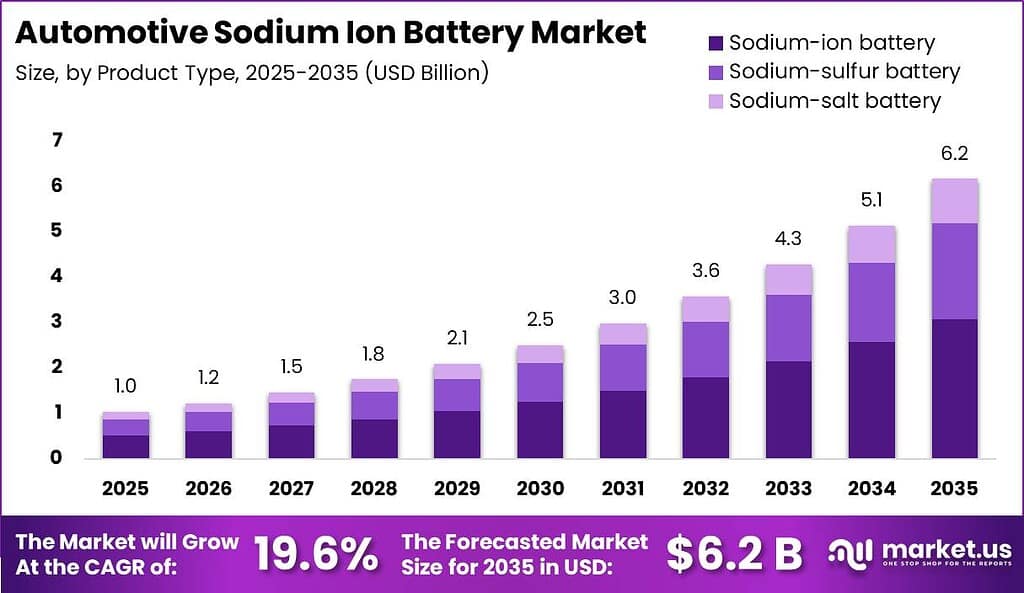
Global Automotive Sodium Ion Battery Market size is expected to be worth around USD 6.2 Billion by 2035 from USD 1.0 Billion in 2025, growing at a CAGR of 19.6% during the forecast period 2026 to 2035. This trajectory concentrates value in suppliers that clear automotive traction certification first. Capital that funds qualified cell lines early captures pack pricing before entry vehicle platforms force deeper cost cuts.
Therefore, the Automotive Sodium Ion Battery Market covers rechargeable sodium based traction cells built for electric road vehicles. The structure spans battery type, electrolyte technology, cell form factor, vehicle class, and pack capacity bands. Buyers treat sodium chemistry as a lithium hedge for cold climate range and lower material cost in compact fleets.
Key Takeaways
The market reaches USD 1.0 Billion in 2025 and USD 6.2 Billion by 2035 at a 19.6% CAGR.
Sodium-Ion Battery leads Battery Type with a 50.00% share.
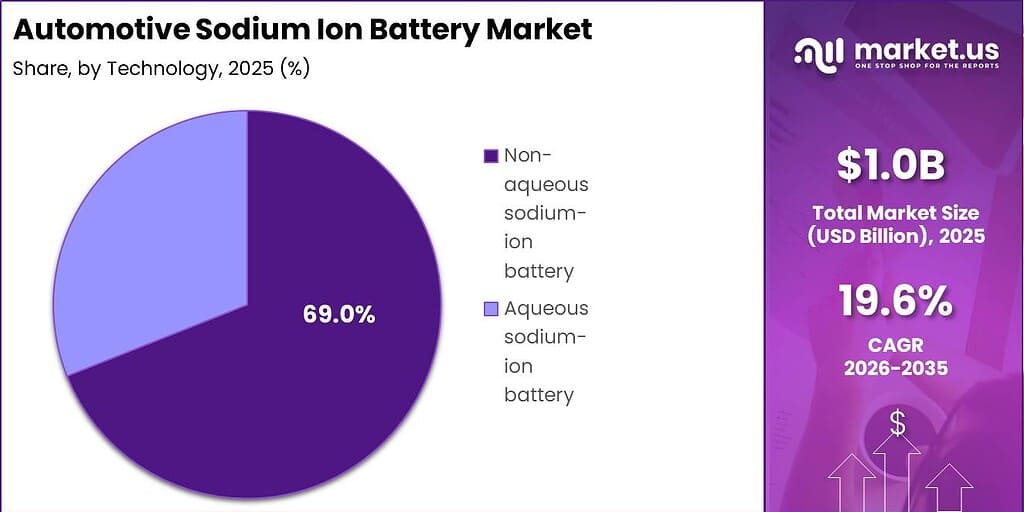
Non-Aqueous Sodium-Ion Battery leads Technology with a 69.00% share.
Prismatic leads Form Factor with a 48.30% share.
Passenger Cars lead Vehicle Type with a 64.00% share.
Below 25 Kwh leads Battery Capacity with a 47.00% share.
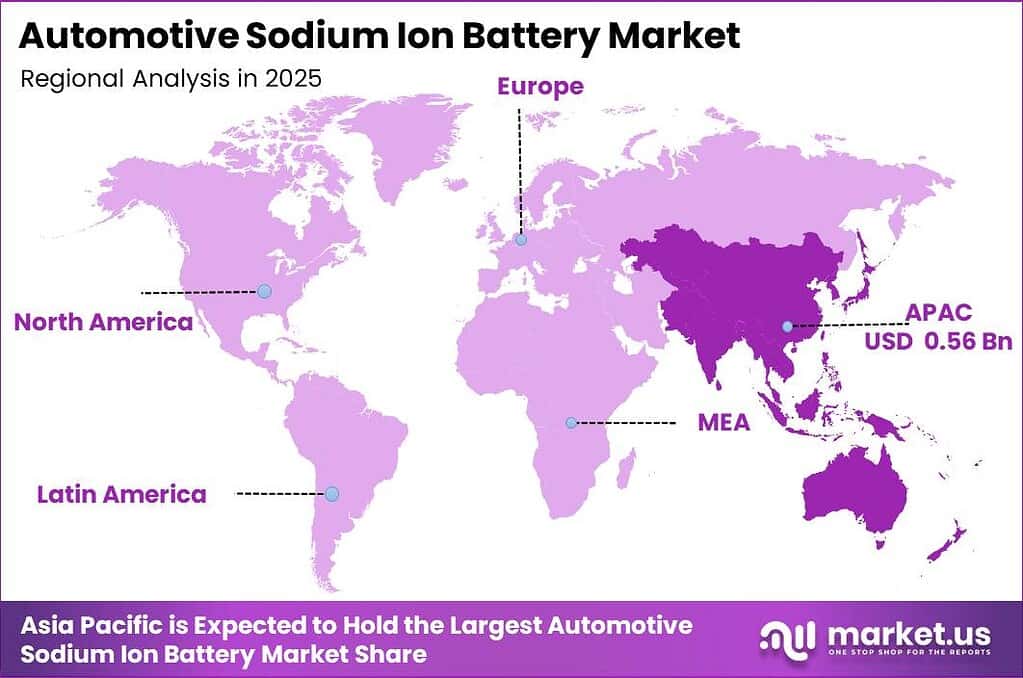
Asia Pacific leads with a 54.00% share valued at USD 0.56 Billion.
As per our research, government backed localization of battery materials is steering OEMs toward sodium chemistries that cut imported lithium exposure. This policy push links directly to higher cell offtake for entry electric models in Asia. As a result, public funding for domestic cathode and anode lines shortens qualification cycles for fleet buyers who need stable pack pricing.
According to CATL, its first generation automotive sodium-ion battery delivers up to 160 Wh/kg, reaches 80% charge in 15 minutes, and keeps over 90% capacity at -20°C. These figures make cold climate commercial routes viable without oversized packs. This means fleet operators can specify sodium packs where winter range loss previously blocked electrification budgets.
The International Energy Agency found that the first sodium-ion battery powered passenger EV entered the market in 2023. That commercial entry proved automotive grade sodium cells could leave pilot lines. In April 2025, CATL introduced a sodium-LFP Dual-Power architecture that pairs both chemistries to lift range and cold weather output, which ties hybrid pack design to rising passenger and light fleet demand.
Battery Type Analysis
Sodium-Ion Battery dominates with 50.00% due to certified automotive traction readiness.
In 2025, Sodium-Ion Battery held a dominant market position in the By Battery Type segment of Automotive Sodium Ion Battery Market, with a 50.00% share. Data from the IEA shows global sodium-ion output stayed below 1% of lithium-ion production in 2025, so early automotive volume still commands scarce qualified supply. Suppliers who hold traction certified sodium lines can set offtake terms before capacity floods the entry vehicle tier.
Sodium-Sulfur Battery serves high temperature stationary heritage chemistries that some commercial platforms still evaluate for predictable duty cycles. Figures from the IEA show global electric car sales were on track to top 20 million units in 2025, expanding the adjacent pool of fleet buyers testing alternative sodium families. Vendors who map Sodium-Sulfur only to niche thermal envelopes avoid head to head losses against traction sodium-ion cells.
Sodium-Salt Battery addresses specialized salt based formulations aimed at cost sensitive energy storage crossovers into low speed vehicles. Official China industry data recorded 15.33 million new energy passenger vehicle wholesale units in 2025, up 25% year on year, which deepens domestic demand for cheaper secondary chemistries. This creates room for Sodium-Salt suppliers that pair automotive pilots with stationary offtake to fill utilization gaps.
Technology Analysis
Non-Aqueous Sodium-Ion Battery dominates with 69.00% due to higher pack energy delivery.
In 2025, Non-Aqueous Sodium-Ion Battery held a dominant market position in the By Technology segment of Automotive Sodium Ion Battery Market, with a 69.00% share. As reported by the IEA, lithium prices stayed about 70% below their 2022 peak yet doubled over the prior year, so OEMs still fund non-aqueous sodium lines as a price hedge. Cell makers that scale organic electrolyte sodium platforms win design slots where energy density must approach LFP without full lithium exposure.
Aqueous Sodium-Ion Battery uses water based electrolytes that favor intrinsic safety and lower material cost in mild duty packs. The IEA indicates China holds more than 95% of installed and announced sodium-ion capacity through 2030, concentrating aqueous process know how in one manufacturing base. This signals Western buyers must dual source or accept longer lead times when specifying aqueous cells for low voltage automotive modules.
Technology selection now hinges on whether fleets prioritize cold power or absolute pack cost in daily routes. IEA tracking places EV battery demand near 1 TWh in 2024 with a path above 3 TWh by 2030 under stated policies. Consequently, electrolyte choice becomes a capacity allocation decision, not only a lab performance debate, for investors funding automotive sodium lines.
Form Factor Analysis
Prismatic dominates with 48.30% due to dense pack space efficiency.
In 2025, Prismatic held a dominant market position in the By Form Factor segment of Automotive Sodium Ion Battery Market, with a 48.30% share. Industry form factor studies show prismatic layouts historically near 40% share among large cell makers, confirming OEM comfort with rectangular hard case packing. Automakers that standardize prismatic sodium modules cut interconnect count and protect margins on compact EV skateboards.
Cylindrical cells bring mature high speed winding lines and strong mechanical abuse tolerance for platforms already tooled around round formats. Global EV battery demand growth above 40% in 2023 per earlier IEA battery tracking still pulls multi format factories to keep lines utilized. This reflects a buyer preference for cylindrical sodium only where existing module tooling would make prismatic redesign too slow.
Pouch cells offer thin flexible packaging that helps lightweight body structures and tight underfloor cavities. UN transport rules added dedicated sodium-ion shipping codes UN 3551 and UN 3552 from 2025, clarifying pack logistics for pouch builds in cross border programs. Suppliers who qualify pouch sodium stacks early reduce compliance friction for export oriented small EV makers.
Vehicle Type Analysis
Passenger Cars dominates with 64.00% due to entry level EV volume pull.
In 2025, Passenger Cars held a dominant market position in the By Vehicle Type segment of Automotive Sodium Ion Battery Market, with a 64.00% share. IEA data show more than 4 million electric cars sold in the first quarter of 2025 alone, up 35% from the same period in 2024. Sodium packs that hit city range targets capture that volume wave before premium long range chemistries reclaim share.
Light Commercial Vehicles need predictable daily kWh use and fast depot charging rather than highway peak range. Electric three wheeler sales surpassed 1 million vehicles globally in 2024 even as the broader three wheeler market shrank about 5%, per the IEA. This means LCV and urban goods platforms can absorb sodium packs where route length is fixed and total cost of ownership leads the bid.
Heavy Commercial Vehicles focus on duty cycle cost, cold start power, and auxiliary loads on long idling routes. India alone recorded 1,149,334 electric two wheeler sales in FY 2024-25 according to the Ministry of Heavy Industries, proving mass electrification outside passenger cars. Sodium chemistry that survives harsh climates gives truck and bus fleets a path to cut lithium spend on vocational platforms.
Two-Wheelers And Three-Wheelers prioritize swap friendly packs, low purchase price, and short charge windows in dense cities. China still sold about 6.9 million electric two wheelers in 2024 despite an 8% decline, keeping the world’s largest low voltage pack arena active. Cell vendors who design sodium modules for swap cabinets lock recurring fleet revenue beyond one time vehicle fitment.
Battery Capacity Analysis
Below 25 Kwh dominates with 47.00% due to compact urban vehicle fit.
In 2025, Below 25 Kwh held a dominant market position in the By Battery Capacity segment of Automotive Sodium Ion Battery Market, with a 47.00% share. Small packs align with city cars and powered two wheelers where sticker price decides adoption. IEA notes sodium-ion cells still trail LFP on density, with latest cells near lower Wh/kg bands than NMC above 250 Wh/kg, so sub 25 kWh packs remain the natural first beachhead.
The 25 to 50 Kwh band targets mainstream compact EVs that need mixed city and suburban range without large underfloor packs. China averaged about 875,000 monthly electric car sales in early 2025 per the IEA, feeding steady demand for mid size affordable batteries. OEMs that reserve 25 to 50 kWh sodium SKUs defend share when lithium spot spikes hit mid trim pricing.
Above 50 Kwh serves longer route passenger and commercial builds that still want sodium cold power or hybrid pack roles. About 60% of first quarter 2025 incremental electric car sales landed in China, concentrating large pack experiments where domestic sodium supply is deepest. This creates selective upside for above 50 kWh sodium only when hybrid architectures offset the density gap versus full lithium packs.
Key Market Segments
By Battery Type
Sodium-Ion Battery
Sodium-Sulfur Battery
Sodium-Salt Battery
By Technology
Aqueous Sodium-Ion Battery
Non-Aqueous Sodium-Ion Battery
By Form Factor
Prismatic
Cylindrical
Pouch
By Vehicle Type
Passenger Cars
Light Commercial Vehicles
Heavy Commercial Vehicles
Two-Wheelers And Three-Wheelers
By Battery Capacity
Below 25 Kwh
25 to 50 Kwh
Above 50 Kwh
Regional Analysis
Asia Pacific Dominates the Automotive Sodium Ion Battery Market with a Market Share of 54.00%, Valued at USD 0.56 Billion
Asia Pacific anchors more than half of global value because cell manufacturing, cathode precursor lines, and entry EV assembly sit in the same corridor. Based on IEA data, dedicated sodium-ion manufacturing capacity has been announced through 2030, and almost all of that pipeline remains Asia centered. Investors funding pack integration near Chinese and East Asian vehicle plants shorten logistics cost and qualification loops.
The International Energy Agency indicates the latest sodium-ion EV batteries retain around 90% of nominal capacity at -40°C and can operate up to 70°C. That climate window supports northern Asia fleet duty and selected European and North American cold routes. In February 2026, Changan Automobile and CATL announced the upcoming launch of the world’s first mass produced passenger vehicle powered by CATL Naxtra sodium-ion cells, pulling regional demand into series production programs.
Key Regions and Countries
North America
US
Canada
Europe
Germany
France
The UK
Spain
Italy
Rest of Europe
Asia Pacific
China
Japan
South Korea
India
Australia
Rest of APAC
Latin America
Brazil
Mexico
Rest of Latin America
Middle East and Africa
GCC
South Africa
Rest of MEA
Market Dynamics
Market Opportunity Analysis - Compact packs, two wheelers, and ex Asia assembly gaps reward focused entrants
Below 25 Kwh remains the clearest beachhead because it already holds 47.00% share inside capacity segmentation. Many global cell brands still aim messaging at large passenger packs where sodium density lags. New entrants that tool only sub 25 kWh prismatic modules can win city EV and neighborhood mobility tenders faster than full portfolio rivals.
Two-Wheelers And Three-Wheelers stay underweighted relative to their swap friendly duty cycles despite deep Asia unit volume. Passenger Cars keep 64.00% of vehicle type value, so smaller mobility platforms receive fewer dedicated sodium SKUs. Therefore, pack designers who certify swap cabinets for sodium secure recurring fleet contracts outside the crowded sedan channel.
Asia Pacific controls 54.00% of market value at USD 0.56 Billion, which leaves local cell supply thin for Indian, European, and North American assembly. Buyers in those regions still import chemistry risk even when vehicle plants sit nearby. This signals greenfield sodium gigafactories outside the dominant corridor can sell sovereignty and shorter lead times as the product, not only kilowatt hours.
Aqueous technology stays secondary while Non-Aqueous holds 69.00% share, yet safety led low voltage truck modules still need simpler electrolytes. Few automotive catalogs promote aqueous sodium as a distinct SKU family. Early specialists that qualify aqueous 24V class products for commercial auxiliaries avoid direct combat with non-aqueous passenger leaders.
Technology and Innovation Landscape - Cathodes, cold power, and pack integration redefine sodium competitiveness
Prussian Blue and layered oxide cathode routes are lifting automotive grade sodium performance beyond early pilot cells. CATL reports Naxtra maintains over 90% capacity at -40°C and stable operation down to -50°C. Cell makers that industrialize these cathode families unlock fleet bids in deep winter regions previously closed to sodium packs.
Cold climate discharge power is becoming a direct sales argument against LFP in northern routes. CATL reports its sodium-ion battery delivers nearly 3× the discharge power of comparable LFP batteries at -30°C. This creates immediate specification wins for logistics vans and buses that fail route schedules when winter power fades.
System integration efficiency decides whether cell gains survive at pack level. CATL’s first generation sodium-ion battery system achieves more than 80% system integration efficiency for automotive use. OEMs that co design cell to pack layouts capture that efficiency as lower structural mass and fewer interconnect failures.
Standards work is catching up with commercial deployment needs in extreme cold. IEEE initiated a dedicated automotive sodium-ion battery standard covering EV operation between -40°C and -20°C. Suppliers who align validation labs to that standard reduce OEM audit time and accelerate multi market homologation.
Drivers
OEM mass production of certified traction cells is the strongest near term growth engine for automotive sodium-ion demand. China GB 38031-2025 traction rules effective mid 2026 confirmed sodium cells can meet thermal runaway and cycle thresholds. Guidance paired with the February 2026 sodium passenger sedan points to 10,000 to 20,000 sodium powered EVs on the road in 2026 alone.
As a result, cell makers shift from licensing prototypes to volume automotive sales at lower pack cost. IEA transport tracking shows sodium production cost can run roughly 30% below LFP at scale. OEMs that lock qualified sodium supply protect entry segment margins while lithium price swings still threaten bill of materials stability.
Incumbent LFP still beats sodium-ion on delivered cost, efficiency, and cycle life at today’s scale. IEA cell manufacturing data place sodium global output under 1% of lithium-ion production in 2025, so learning curve gains remain thin. Chinese LFP near $53/kWh at cell level leaves sodium’s theoretical pack saving near 15% at parity often inverted into a 2026 procurement premium.
However, durability gaps force conservative depth of discharge limits that cut usable pack energy. Customers demand a clear discount before they substitute chemistry on mainstream passenger programs. This means cell makers delay Western volume CapEx and confine near term sodium sales to entry EVs and narrow fleet niches until per kWh economics cross the LFP line.
Restraint
(~) % Impact on CAGR Forecast
Geographic Relevance
Impact Timeline
LFP cost & cycle-life parity gap today
-3.1%
Global
Short term (2 years or less)
Sub-scale cathode & hard-carbon supply
-2.4%
Global ex-China
Short term (2 years or less)
Lower gravimetric energy density ceiling
-2.0%
Global
Medium term (2 to 4 years)
Absence of ex-China certification standards
-1.6%
N. America, EU
Medium term (2 to 4 years)
Capital scarcity & high financing costs
-1.3%
Global
Short term (2 years or less)
Challenges
Hard carbon anode supply is the toughest operational bottleneck because sodium-ion cannot use conventional graphite. Industry association shipment figures put sodium cell demand near 9 GWh in 2025 after about 150% year on year growth. Trajectories toward a 1,000 GWh horizon within four years outrun qualified hard carbon output and extend lead times.
Consequently, inconsistent microstructure caps first cycle efficiency and forces continuous process fixes on the line. Cell makers must vertically integrate precursors or sign multi year offtake deals that absorb long qualification cycles. This challenge opens a revenue path for specialty carbon refiners and equipment vendors that sell automotive grade hard carbon capacity outside single country clusters.
Challenge
(~) % CAGR Friction Drag
Geographic Relevance
Mitigation Horizon
Hard-carbon anode supply chain
-2.3%
Global
Medium term (2 to 4 years)
Specialized electrochemistry talent deficit
-1.7%
Global ex-China
Long term (4 years or more)
Recycling & second-life infrastructure gap
-1.4%
Global
Long term (4 years or more)
Pack-level BMS re-engineering
-1.1%
Global
Medium term (2 to 4 years)
Geographic supply concentration risk
-0.9%
Global ex-China
Long term (4 years or more)
Opportunities
Building sodium-ion cell capacity outside China is the largest uncaptured upside for automotive programs. Production today clusters in one geography, leaving Indian, European, and North American vehicle demand short of local supply. Lithium free cathodes support pack cost cuts on the order of 15% versus LFP while avoiding import tariffs that add several points to landed cost.
By contrast, localized plants can also collect policy linked production subsidies that lift gross margin by an estimated 3 to 5 percentage points. First movers who commit gigafactory capital before foreign certification frameworks fully mature convert a geographic void into durable TAM expansion. Early investors gain pricing power with OEMs that need sovereign supply for entry EV and vocational fleets.
Opportunity
(~) % Potential CAGR Upside
Geographic Relevance
Execution Window
Ex-China localized gigafactory white space
+2.8%
India, EU, N. America
Long term (4 years or more)
Two- & three-wheeler electrification adjacency
+2.2%
South & SE Asia, Africa
Medium term (2 to 4 years)
Vertically integrated recycling monetization
+1.6%
Global
Long term (4 years or more)
Extended-range hybrid powertrain fit
+1.4%
China, emerging markets
Medium term (2 to 4 years)
Cell-to-chassis sodium platform IP licensing
+1.1%
Global
Long term (4 years or more)
Key Company Insights
Contemporary Amperex Technology Co., Limited (CATL) leads automotive sodium execution through its Naxtra platform aimed at mass vehicle programs. CATL states mass production Naxtra cells reach up to 175 Wh/kg and enable passenger EV ranges exceeding 400 km. In May 2026, CATL planned capacity expansion after securing a record 60 GWh sodium-ion order, which tightens offtake control versus smaller cell rivals.
BYD Company Limited holds scale across vehicles and batteries that lets it absorb sodium lines beside existing LFP plants. That vertical model reduces dependence on external cell vendors for entry trims. However, slower public sodium vehicle milestones versus category pioneers leave BYD exposed if rival chemistries lock OEM sockets first in cold climate fleets.
April 2025: CATL launched its Naxtra sodium-ion battery brand and unveiled the world’s first mass producible automotive sodium-ion battery, with mass production scheduled for December 2025.
April 2025: CATL unveiled a 24V Naxtra sodium-ion battery designed for heavy duty trucks, expanding sodium-ion technology into commercial automotive applications.
December 2025: CATL began planned mass production of its Naxtra automotive sodium-ion batteries following the product launch announced in April 2025.
Geopolitical Impact Analysis
According to U.S. trade measures tracked across policy briefs, tariffs on lithium-ion EV batteries rose from 7.5% to 25% while duties on China built EVs moved from 25% to 100%. These barriers raise landed cost for Asia origin packs and push North American buyers to test sodium chemistries that cut lithium import exposure. This means automotive sodium projects gain political cover as supply chain insurance, not only as cost experiments.
Data from the IEA shows China accounts for more than 95% of installed and announced sodium-ion capacity into 2030, while lithium prices doubled over the past year yet stayed about 70% below the 2022 peak. Concentrated cell capacity plus mineral price swings reroute OEM dual sourcing plans toward local sodium lines in India, the EU, and North America. Consequently, trade friction accelerates geographic diversification of hard carbon, cathode, and cell investment outside a single manufacturing hub.
By Battery Type (Sodium-Ion Battery, Sodium-Sulfur Battery, Sodium-Salt Battery), By Technology (Aqueous Sodium-Ion Battery, Non-Aqueous Sodium-Ion Battery), By Form Factor (Prismatic, Cylindrical, Pouch), By Vehicle Type (Passenger Cars, Light Commercial Vehicles, Heavy Commercial Vehicles, Two-Wheelers And Three-Wheelers), By Battery Capacity (Below 25 Kwh, 25 to 50 Kwh, Above 50 Kwh)
Regional Analysis
North America (US and Canada), Europe (Germany, France, The UK, Spain, Italy, and Rest of Europe), Asia Pacific (China, Japan, South Korea, India, Australia, and Rest of APAC), Latin America (Brazil, Mexico, and Rest of Latin America), Middle East and Africa (GCC, South Africa, and Rest of MEA)
Competitive Landscape
Contemporary Amperex Technology Co., Limited (CATL), BYD Company Limited, Hina Battery Technology Co., Ltd., Faradion Limited (Reliance Industries), Tiamat Energy, Altris AB, Jiangsu Zoolnasm Energy Technology Co., Ltd., Li-Fun Technology Corporation Limited, Jiangsu Transimage Technology Co., Ltd., Zhejiang Natrium Energy Co., Ltd., Sodion Energy Pvt. Ltd., Indi Energy, Amte Power Plc, NGK Insulators, Ltd., Farasis Energy
Customization Scope
Customization for segments, region / country-level will be provided. Additional customization can be done based on requirements.
Purchase Options
We have three licenses to opt for: Single User License | Multi-User License (Up to 5 Users) | Corporate Use License (Unlimited User and Printable PDF)