


Report Overview
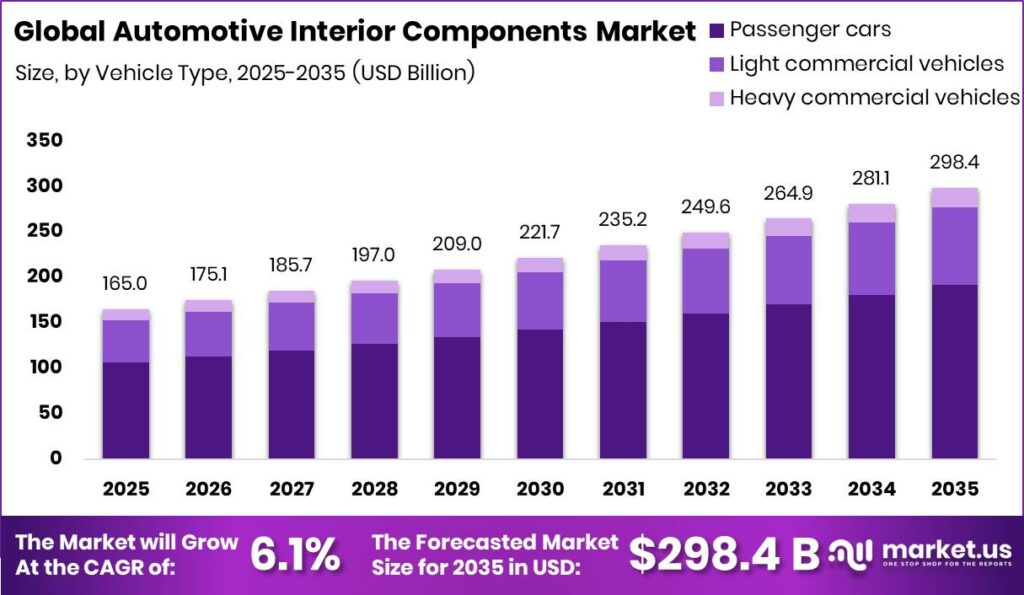
Global Automotive Interior Components Market size is expected to be worth around USD 298.40 Billion by 2035 from USD 165.00 Billion in 2025, growing at a CAGR of 6.1% during the forecast period 2026 to 2035. This trajectory reflects steady vehicle output and rising cabin content per unit. Suppliers that expand integrated module capacity will capture the widening value gap between basic trim and premium cockpit systems.
The automotive interior components market covers seats, door panels, instrument panels, center consoles, headliners, and flooring fitted inside passenger and commercial vehicles. This structure spans raw material producers, Tier 2 part makers, and Tier 1 module integrators who assemble finished cabins. Buyers increasingly award multi year platform contracts to fewer integrators. This means scale and engineering depth now decide which suppliers win long cycle revenue.
Key Takeaways
- Global market size reached USD 165.00 Billion in 2025 and will hit USD 298.40 Billion by 2035 at a CAGR of 6.1%.
- Seats led the component segment with a 28.3% share, the single largest category by value.
- Plastics and polymers dominated the material segment with a 44.1% share.
- Passenger cars held a 64.3% share of the vehicle type segment.
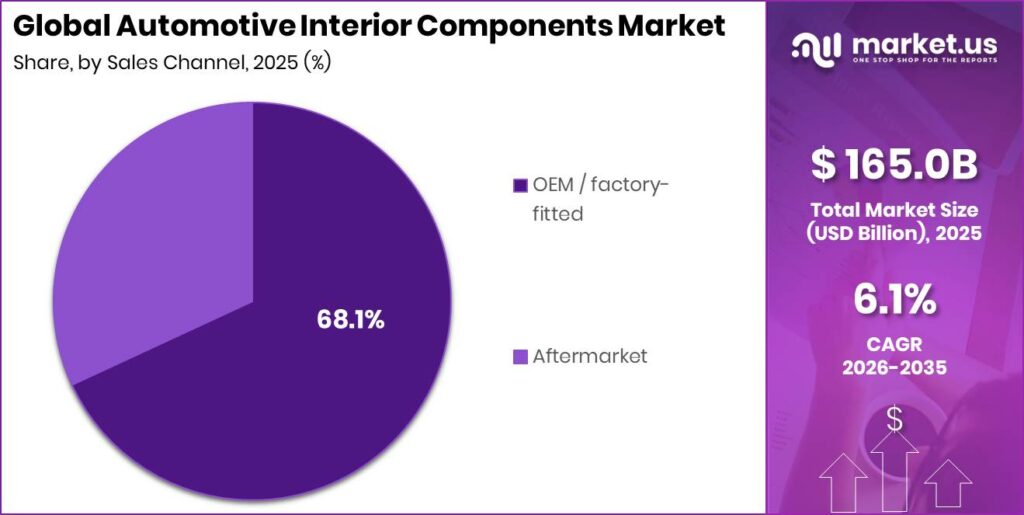
- OEM factory fitted channels controlled 68.1% of sales.
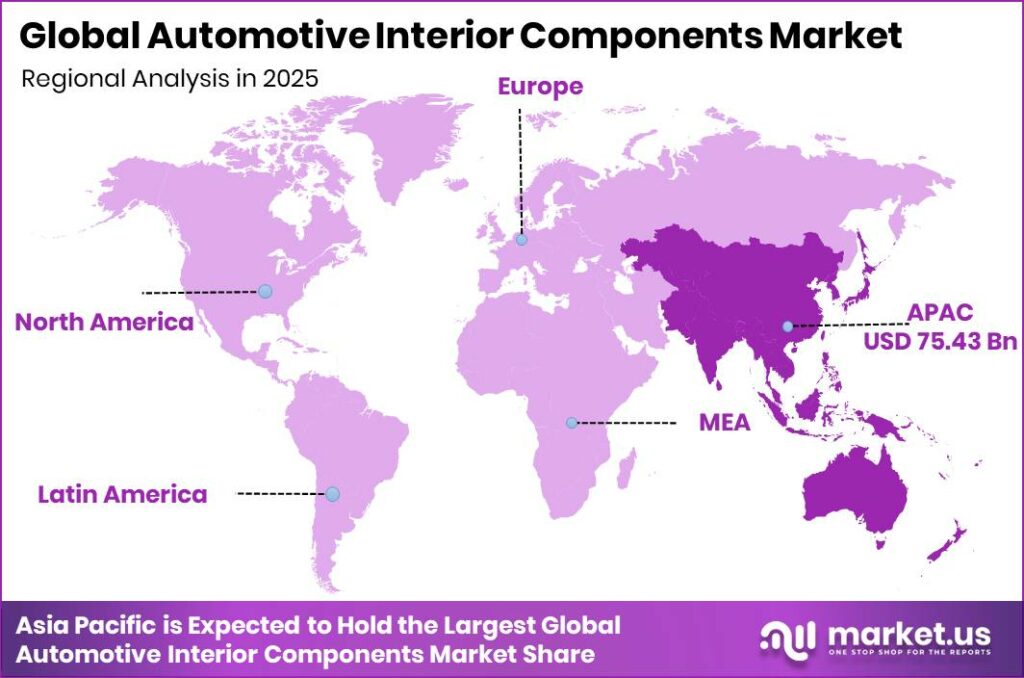
- Asia Pacific led all regions with a 45.7% share, valued at USD 75.43 Billion.
Automotive Interior Materials choices now shape both cost and compliance across every cabin program. Regulators are tightening recycled content rules that touch plastic heavy interiors directly. A 2025 automotive plastics article reported that plastics account for approximately 20% of a modern vehicle’s weight, with dashboards and consoles among their major uses. This concentration means material policy shifts land hardest on interior suppliers, forcing early investment in recycled resin qualification.
Government circularity measures are reshaping sourcing decisions across the market. Proposed EU automotive rules discussed by SGS in April 2026 include a requirement for up to 25% recycled plastic content in new vehicles. This proposal targets exactly the plastic intensive parts interior makers supply. As a result, suppliers that pre qualify recycled streams now will avoid costly last minute reformulation once mandates take force.
Premium sustainability specifications are moving from concept to production models. The seat cover fabric for the new BMW iX3 Econeer interior is made entirely, 100%, from recycled PET. This launch proves recycled content can meet showroom grade quality. Consequently, interior suppliers that master recycled textiles gain access to flagship electric programs where automakers compete on green credentials.
Component Type Analysis
Seats dominate with 28.3% due to highest material and mechanism content.
In 2025, Seats held a dominant market position in the By Component Type segment of Automotive Interior Components Market, with a 28.3% share. UN Comtrade data records global trade in seats and seat parts under HS 9401 exceeding USD 40 Billion annually. Seats carry frames, foam, covers, motors, and electronics in one unit. This means seat suppliers capture the deepest content per vehicle, giving them the strongest revenue leverage as cabins add power and comfort features.
Door panels serve as structural and trim surfaces that house speakers, switches, and armrests inside every vehicle. ITC Trade Map figures show motor vehicle body parts trade under HS 8708 surpassing USD 170 Billion globally in recent years. Automakers bundle door modules into integrated interior contracts. This creates an opening for suppliers who can combine trim, electronics, and safety features into one delivered assembly rather than separate parts.
Instrument panels and dashboards form the fastest growing component category as displays and driver interfaces expand. UNIDO manufacturing data confirms rising automotive electronics output across major production hubs. Dashboards now carry screens, sensors, and ambient lighting integrated into molded surfaces. This shift rewards suppliers who master electronics integration, since a plain molded panel earns far less than a digital cockpit module.
Center consoles, headliners, and flooring and carpets hold the remaining share collectively across the segment. National statistical offices report steady demand for these interior parts alongside vehicle assembly. Center consoles add storage and controls, headliners cover roof structures, and flooring manages noise and comfort. This means suppliers serving these categories compete mainly on weight, acoustics, and cost efficiency rather than electronic content.
Material Analysis
Plastics and polymers dominate with 44.1% due to lightweight molding and cost flexibility.
In 2025, Plastics and polymers held a dominant market position in the By Material segment of Automotive Interior Components Market, with a 44.1% share. Industry data shows plastics account for approximately 20% of a modern vehicle’s total weight. Polymers mold into complex shapes at low cost and reduce mass. This means plastic focused suppliers hold volume advantage but face rising pressure to prove recycled content as circularity rules advance.
Leather and fabric cover seats, door inserts, and headliners where buyers judge cabin quality by touch and look. FAO and national trade offices track large global leather and textile flows into automotive use. Premium buyers pay more for genuine and engineered surface materials. This creates margin opportunity for suppliers who blend recycled textiles with premium feel, matching sustainability demand without sacrificing perceived quality.
Composites form the fastest growing material class as automakers chase weight reduction and stiffness. UNIDO industrial output data shows expanding composite processing capacity worldwide. Composites combine fibers and resins to deliver strength at lower mass than metal. This rewards early movers who can scale composite interior parts, since lighter cabins directly extend electric vehicle range and improve efficiency.
Metals and foam and other soft materials hold the remaining share collectively across the segment. World Bank industrial indicators confirm steady metal input into vehicle structures. Metals reinforce seat frames and brackets, while foam manages comfort and acoustics. This means suppliers of these inputs compete on precision and durability, serving as the structural backbone beneath visible interior surfaces.
Vehicle Type Analysis
Passenger cars dominate with 64.3% due to highest global production and cabin content.
In 2025, Passenger cars held a dominant market position in the By Vehicle Type segment of Automotive Interior Components Market, with a 64.3% share. OICA production statistics record global vehicle output near 96.4 million units in 2025. Passenger cars carry richer interiors than most commercial vehicles. This means interior suppliers earn the bulk of their revenue from car programs, where comfort and infotainment content keep rising.
Light commercial vehicles form the fastest growing vehicle category as last mile delivery fleets expand worldwide. World Bank trade indicators link e commerce growth to rising commercial vehicle registration. Fleet buyers now demand more comfortable, durable cabins for long driver hours. This creates a new opportunity for suppliers to upgrade LCV interiors from bare utility toward car grade comfort and safety features.
Heavy commercial vehicles hold the remaining share of the segment. IEA transport data confirms steady freight vehicle demand across major economies. Heavy trucks require rugged seats, durable panels, and driver focused ergonomics for extended trips. This means suppliers serving this category compete on durability and driver retention features rather than the electronics density seen in passenger cabins.
Sales Channel Analysis
OEM factory fitted dominates with 68.1% due to integrated platform sourcing contracts.
In 2025, OEM factory fitted held a dominant market position in the By Sales Channel segment of Automotive Interior Components Market, with a 68.1% share. OICA data shows most interior content installed during original assembly across 96.4 million vehicles built. Automakers award interiors as multi year platform contracts. This means OEM linked suppliers secure predictable volume, but they must accept OEM price pressure to keep those long cycle programs.
Aftermarket forms the fastest growing sales channel as vehicle owners upgrade and repair cabins over longer ownership periods. ACEA fleet data shows the EU passenger car parc averaged 12.5 years of age. Aging fleets drive replacement demand for seats, trim, and covers. This creates a resilient revenue stream for suppliers who build refurbishment and retrofit product lines beyond first fit OEM supply.
Key Market Segments
By Component Type
- Seats
- Door panels
- Instrument panels / dashboards
- Center consoles
- Headliners
- Flooring and carpets
By Material
- Plastics and polymers
- Leather and fabric
- Metals
- Composites
- Foam and other soft materials
By Vehicle Type
- Passenger cars
- Light commercial vehicles
- Heavy commercial vehicles
By Sales Channel
- OEM / factory-fitted
- Aftermarket
Regional Analysis
Asia Pacific Dominates the Automotive Interior Components Market with a Market Share of 45.7%, Valued at USD 75.43 Billion
Asia Pacific led the market in 2025 with a 45.7% share worth USD 75.43 Billion. The region concentrates the world’s largest vehicle assembly clusters and interior module supply. Localized production meets just in sequence delivery windows for nearby plants. This means suppliers with Asian manufacturing footprints enjoy cost and logistics advantages that distant competitors struggle to match on high volume programs.
Europe stands as a fast moving region driven by strict circularity rules and premium interior demand. Regional consolidation is reshaping supply, as Inteva Products acquired portions of IAC Group’s European business in December 2025, expanding its instrument panel, cockpit, and door portfolio. This deal signals scale hunting among suppliers. Consequently, smaller European part makers face pressure to merge or specialize to survive tightening OEM contracts.
North America and other regions together hold the remaining market share across the global footprint. Tariff exposure and localization investment shape North American sourcing decisions. Suppliers balance reshoring costs against border duties on imported inputs. This means firms operating across these regions must design flexible sourcing networks to absorb trade shocks and protect program margins.
Key Regions and Countries
North America
- US
- Canada
Europe
- Germany
- France
- The UK
- Spain
- Italy
- Rest of Europe
Asia Pacific
- China
- Japan
- South Korea
- India
- Australia
- Rest of APAC
Latin America
- Brazil
- Mexico
- Rest of Latin America
Middle East and Africa
- GCC
- South Africa
- Rest of MEA
Market Dynamics
Market Opportunity Analysis - Underserved regions and premium sub-segments open entry points for focused suppliers
Light commercial vehicles form an underexploited entry point despite being the fastest growing vehicle category. Most LCV cabins still use basic utility interiors far below passenger car standards. This gap exists because fleet buyers historically prioritized price over comfort. However, longer driver hours now shift demand toward car grade seats and trim. New entrants who upgrade LCV interiors first can capture a fast expanding niche before larger suppliers react.
The aftermarket sales channel stays underexploited even as it grows faster than OEM supply. Aging fleets averaging 12.5 years create steady demand for replacement seats and trim. This channel remains fragmented because most large suppliers focus on OEM contracts. As a result, focused firms can build branded refurbishment and retrofit lines with less competition. This creates durable revenue insulated from OEM price pressure.
Composites remain an underexploited material class despite being the fastest growing category. Adoption lags because qualification and cost hurdles slow large scale deployment. This creates room for specialists to lead before volume players enter. By contrast, plastics face crowded competition and margin pressure. Early composite suppliers can lock premium lightweight programs, especially for electric vehicles where reduced mass directly extends driving range and buyer appeal.
Instrument panels and dashboards form an underexploited segment for suppliers with electronics depth. This category grows fastest as screens and sensors replace passive surfaces. Many trim focused suppliers cannot integrate displays and software. Therefore firms that master digital cockpit assembly capture value others cannot reach. This creates a defensible position, since a fully integrated digital panel earns far more than a plain molded dashboard.
Technology and Innovation Landscape - Recycled materials and pillar-to-pillar displays reshape interior competition
Recycled polymer innovation is redefining material competition. Covestro reported in 2025 that its automotive polycarbonate grades made from end of life headlamps contain 50% post consumer recycled material, while its Bayblend T85X R35 CQ material for selected Lexus ES parts holds 35% recycled content. This means material makers can now meet strict recycled targets without quality loss. Suppliers adopting these grades early will win compliance driven contracts as mandates tighten.
Lightweight material engineering is cutting cabin mass and emissions. FORVIA’s NAFILean-R material cut component weight by approximately 20% and could reduce associated CO2 emissions by approximately 50% in 2025. Adient’s 2026 seat architecture incorporates 46% recycled content while trimming seat weight 5 to 10%. This means lighter interiors extend EV range directly. Suppliers combining recycled content with weight savings gain a dual advantage in electric programs.
Display technology is transforming the dashboard into a digital surface. Tianma’s CES 2026 cockpit incorporated a 49.6 inch curved display with 8K resolution spanning 1.25 metres. LG Display identified its 57 inch pillar to pillar panel as the world’s largest single vehicle display. This means screen scale now defines premium cabins. Interior suppliers must partner with display makers to stay relevant in high value cockpit programs.
Wide format display concepts are pushing integration deeper into the cabin. Continental’s CES 2025 dashboard concept used a 1.30 metre wide E Ink Prism display extending across the interior. This signals a shift from single screens toward full width surfaces. Consequently, interior module makers must engineer structures that house large displays while managing glare, heat, and mounting. Firms mastering this integration will capture the fast growing digital cockpit value pool.
Drivers
Vehicle production recovery raises demand for seats, instrument panels, consoles, door modules, headliners, and trim on a near one for one unit basis. OICA statistics show global output rising from 92.7 million vehicles in 2024 to 96.4 million in 2025, a 3.9% expansion. This means suppliers gain volume automatically as assembly grows. Incremental units also shift toward Asian clusters, where localized Automotive Interior Ambient Lighting and module supply meet just in sequence delivery windows.
Electrification adds content per vehicle beyond raw volume. IEA tracking shows electric car sales exceeded 17 million in 2024, represented more than 20% of car sales, and rose over 25% year on year. European Commission records confirm added safety features became compulsory from 7 July 2024, raising sensor and interface content. These effects support an estimated +1.3% incremental CAGR contribution, pushing suppliers toward higher value integrated cockpit and seating modules that lift revenue per vehicle.
| Driver | (~) % Impact on CAGR Forecast | Geographic Relevance | Impact Timeline |
|---|---|---|---|
| Expansion of Global Vehicle Output | +1.3% | Global, led by Asia-Pacific | Short term (2 years or less) |
| Electrification-Led Cabin Redesign | +1.1% | China, Europe, North America | Medium term (2 to 4 years) |
| Cockpit Electronics Proliferation | +0.8% | Global premium and mass-market segments | Medium term (2 to 4 years) |
| Mandatory In-Cabin Safety Systems | +0.6% | Europe, Japan, South Korea | Short term (2 years or less) |
| Premium Comfort Feature Diffusion | +0.5% | China, North America, Gulf states | Medium term (2 to 4 years) |
| Modular Interior Platform Adoption | +0.3% | Global automotive production hubs | Long term (4 years or more) |
Restraints
Trade intervention is an immediate sales and margin barrier because interior assemblies combine imported steel seat structures, aluminum brackets, electronics, textiles, and polymers whose costs cannot always pass through fixed price programs. The White House raised additional US tariffs on covered steel, aluminum, and derivative articles from 25% to 50% effective 4 June 2025. This followed at least 25% duties from 12 March 2025. As a result, metal intensive subassemblies face high single digit cost shocks.
These duties apply upstream of many fabricated interior inputs, per US Commerce Department Section 232 records. Higher financing costs make localization projects more expensive than before tightening. The landed cost shock can delay tooling transfers by 12 to 24 months and compress supplier margins by an estimated 100 to 250 basis points. This supports a -1.0% CAGR deduction through deferred awards and postponed capacity investment.
| Restraint | (~) % Impact on CAGR Forecast | Geographic Relevance | Impact Timeline |
|---|---|---|---|
| Import Tariffs and Trade Barriers | -1.0% | North America and export-linked suppliers | Short term (2 years or less) |
| Weak New-Vehicle Affordability | -0.8% | Europe, North America, emerging markets | Short term (2 years or less) |
| OEM Price-Down Contracting | -0.6% | Global Tier-1 and Tier-2 supply chains | Medium term (2 to 4 years) |
| High Tooling Capital Requirements | -0.5% | Europe, North America, Japan | Medium term (2 to 4 years) |
| Extended Vehicle Replacement Cycles | -0.4% | Europe and mature automotive markets | Long term (4 years or more) |
| Stricter Chemical-Content Restrictions | -0.3% | European Union and aligned jurisdictions | Medium term (2 to 4 years) |
Challenges
The migration from passive trim to display rich consoles, powered seating, and sensor integrated surfaces exposes interior suppliers to semiconductor tiers they do not control. Industry tracking placed typical semiconductor lead times near 12 to 16 weeks for some categories through late 2024 and early 2025. S&P Global monitoring projected automotive semiconductor growth of only 1.5% in 2024. This mismatch forces suppliers to hold costly buffer inventory to protect production.
IEA data showing electric car volumes above 17 million in 2024 indicates electronic content is scaling faster than total vehicle output. UNECE rules require certified cybersecurity processes for connected systems. Buffer inventories of 8 to 16 weeks can raise working capital by an estimated 5 to 10% and prolong component validation by 3 to 9 months. This supports a -0.8% friction drag requiring dual sourcing and deeper software capability.
| Challenge | (~) % CAGR Friction Drag | Geographic Relevance | Mitigation Horizon |
|---|---|---|---|
| Multi-Tier Electronics Exposure | -0.8% | Global connected-cockpit supply chains | Medium term (2 to 4 years) |
| Skilled Labor Scarcity | -0.7% | North America, Europe, Japan | Long term (4 years or more) |
| Variant Complexity Escalation | -0.6% | Global multi-platform manufacturers | Medium term (2 to 4 years) |
| Material Qualification Volatility | -0.5% | Europe and global export programs | Medium term (2 to 4 years) |
| Cybersecurity Compliance Integration | -0.4% | UNECE contracting markets | Short term (2 years or less) |
| Quality Launch Instability | -0.3% | New EV production clusters globally | Short term (2 years or less) |
Opportunities
Closed loop interiors remain an opportunity because compliant resin streams and validated surface processes are not yet available at platform scale. The European Parliament approved lifecycle rules in June 2026 targeting at least 15% recycled plastic per new vehicle type within 6 years and 25% within 10 years. At least 20% must come from end of life vehicles. This means early movers in recycled resin can lock in future compliance demand.
ACEA fleet data shows the EU passenger car parc averaged 12.5 years of age, creating a large future flow of recoverable polypropylene, ABS, and textile feedstock. Suppliers that build take back partnerships and high purity sorting could cut virgin polymer exposure by an estimated 10 to 20%. This lowers component cost by roughly 3 to 8% and expands module margins by 150 to 300 basis points, creating up to +1.0% CAGR upside.
| Opportunity | (~) % Potential CAGR Upside | Geographic Relevance | Execution Window |
|---|---|---|---|
| Circular Closed-Loop Interior Materials | +1.0% | Europe, with global platform spillover | Medium term (2 to 4 years) |
| Software-Enabled Seating Services | +0.8% | China, North America, Europe | Long term (4 years or more) |
| Emerging-Market Content Upgrading | +0.7% | India, Southeast Asia, Latin America | Medium term (2 to 4 years) |
| Autonomous Mobility Cabin Modules | +0.6% | China, United States, selected Asian cities | Long term (4 years or more) |
| Interior Refurbishment Ecosystems | +0.4% | Europe, North America, fleet markets | Medium term (2 to 4 years) |
| Regional Supplier Consolidation | +0.3% | Fragmented global supplier clusters | Short term (2 years or less) |
Key Company Insights
Adient plc anchors its position in seating through weight and sustainability engineering. The company’s Pure Ergonomics seat architecture offered up to a 10% weight reduction, per its February 2026 results release, and added up to 60 mm of second row legroom. This means Adient can win space constrained EV programs where every millimeter and gram matters. Its comfort focused design creates an advantage as automakers court passengers in longer, roomier electric cabins.
FORVIA Faurecia competes on low impact interior materials that meet tightening circularity rules. Its NAFILean-R material for interior modules contained an average of 30% recycled content in 2025. In April 2025, FORVIA unveiled its OPALE concept at Auto Shanghai using MATERI’ACT materials and natural fiber composites. This positioning creates an advantage in Europe, where recycled content mandates advance, though heavy reliance on regulatory tailwinds poses a risk if timelines slip.
Key Players
- Adient plc
- Lear Corporation
- FORVIA Faurecia
- Toyota Boshoku Corporation
- Magna International Inc
- Yanfeng Automotive Interiors
- Johnson Controls International plc
- Continental AG
- Grupo Antolin
- Hyundai Mobis Co
- TS TECH Co
- Toyota Boshoku K.K.
- IAC Group
- Sage Automotive Interiors
- Gentherm Incorporated
Recent Developments
- July 2025: Adient launched a mechanical massage seating solution featuring a 3D massage module with OTA enabled smart controls, multiple massage modes, and enhanced comfort architecture for next generation automotive interiors.
- March 2026: FORVIA HELLA introduced the world’s first Front Phygital Shield for the BMW iX3, integrating lighting, sensors, and design into a single smart front end module that complements next generation intelligent cockpit and interior systems.
Geopolitical Impact Analysis
Trade barriers are reshaping interior component sourcing and pricing directly. According to the WTO, global merchandise trade growth stayed weak near 2.7% in recent tracking, while US tariffs on steel and aluminum derivatives rose from 25% to 50% in mid 2025. These metals form seat frames and brackets central to interiors. This means suppliers face higher landed costs on structural inputs. Firms must localize metal sourcing to protect margins on fixed price programs.
Shipping disruption is lengthening interior supply chains and raising delivery risk. As reported by the World Shipping Council, Red Sea rerouting around Africa added roughly 10 to 14 days to affected voyages, while container freight rates spiked above 200% on some lanes during peak disruption. Interiors depend on imported electronics, textiles, and polymers moving by sea. Therefore suppliers now hold larger buffer stocks and diversify routes to shield just in sequence assembly from delay.
Report Scope
| Report Features | Description |
|---|---|
| Market Value (2025) | USD 165.00 Billion |
| Forecast Revenue (2035) | USD 298.40 Billion |
| CAGR (2026-2035) | 6.1% |
| Base Year for Estimation | 2025 |
| Historic Period | 2020-2024 |
| Forecast Period | 2026-2035 |
| Report Coverage | Revenue Forecast, Market Dynamics, Market Opportunity Analysis, Technology and Innovation Landscape, Competitive Landscape, Recent Developments |
| Segments Covered | By Component Type (Seats, Door panels, Instrument panels / dashboards, Center consoles, Headliners, Flooring and carpets), By Material (Plastics and polymers, Leather and fabric, Metals, Composites, Foam and other soft materials), By Vehicle Type (Passenger cars, Light commercial vehicles, Heavy commercial vehicles), By Sales Channel (OEM / factory-fitted, Aftermarket) |
| Regional Analysis | North America (US and Canada), Europe (Germany, France, The UK, Spain, Italy, and Rest of Europe), Asia Pacific (China, Japan, South Korea, India, Australia, and Rest of APAC), Latin America (Brazil, Mexico, and Rest of Latin America), Middle East and Africa (GCC, South Africa, and Rest of MEA) |
| Competitive Landscape | Adient plc, Lear Corporation, FORVIA Faurecia, Toyota Boshoku Corporation, Magna International Inc, Yanfeng Automotive Interiors, Johnson Controls International plc, Continental AG, Grupo Antolin, Hyundai Mobis Co, TS TECH Co, Toyota Boshoku K.K., IAC Group, Sage Automotive Interiors, Gentherm Incorporated |
| Customization Scope | Customization for segments, region / country-level will be provided. Additional customization can be done based on requirements. |
| Purchase Options | We have three licenses to opt for: Single User License | Multi-User License (Up to 5 Users) | Corporate Use License (Unlimited User and Printable PDF) |





































