


Report Overview
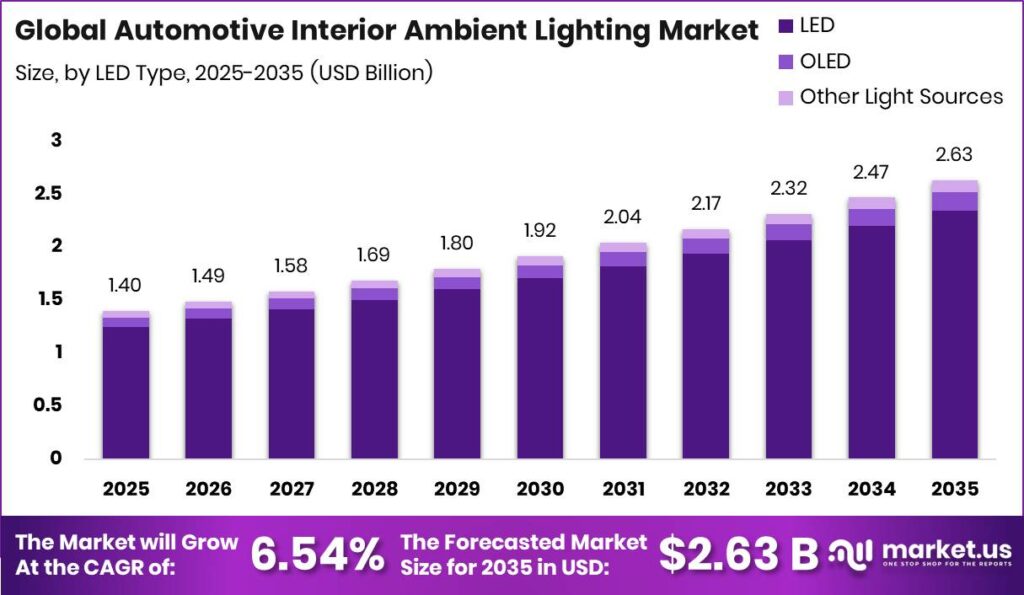
Global Automotive Interior Ambient Lighting Market size is expected to be worth around USD 2.63 Billion by 2035 from USD 1.40 Billion in 2025, growing at a CAGR of 6.54% during the forecast period 2026 to 2035. This market covers decorative and functional lighting fitted inside vehicle cabins. Suppliers who scale integrated systems will capture the largest share of this value expansion.
The market groups lighting by light source, installation area, vehicle class, color type, and sales channel. Each layer defines how OEMs specify cabin illumination across door panels, dashboards, footwells, and consoles. This means suppliers must serve both hardware and software layers to win program nominations. Vendors covering the full stack gain pricing power over single-component competitors.
Key Takeaways
- Global market size reaches USD 2.63 Billion by 2035, up from USD 1.40 Billion in 2025 at a CAGR of 6.54%.
- LED leads the By Light Source segment with a 89.20% share.
- Door Panel Lighting dominates the By Installation Area segment with a 30.40% share.
- Premium Vehicles lead the By Vehicle Class segment with a 39.10% share.
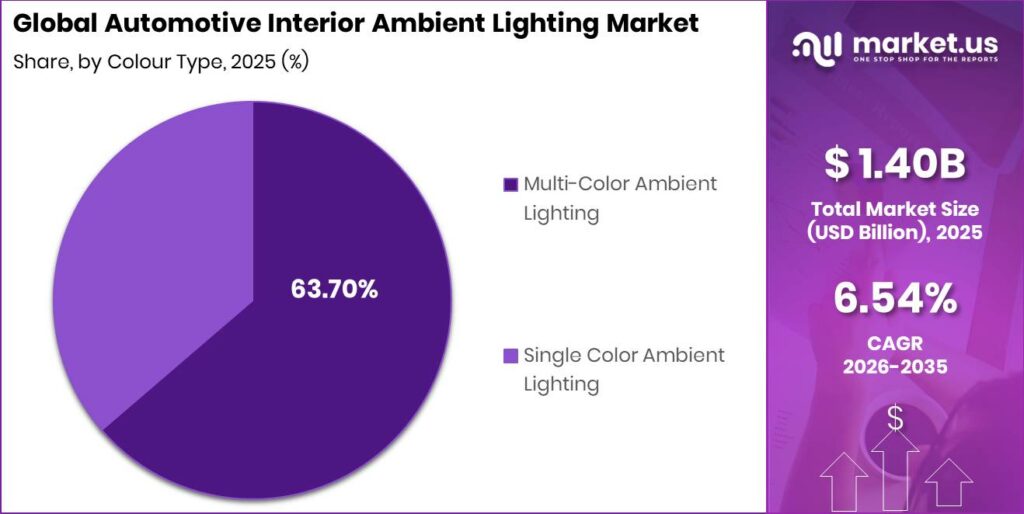
- Multi-Color Ambient Lighting holds a 63.70% share of the By Color Type segment.
- OEM leads the By Sales Channel segment with an 87.30% share.
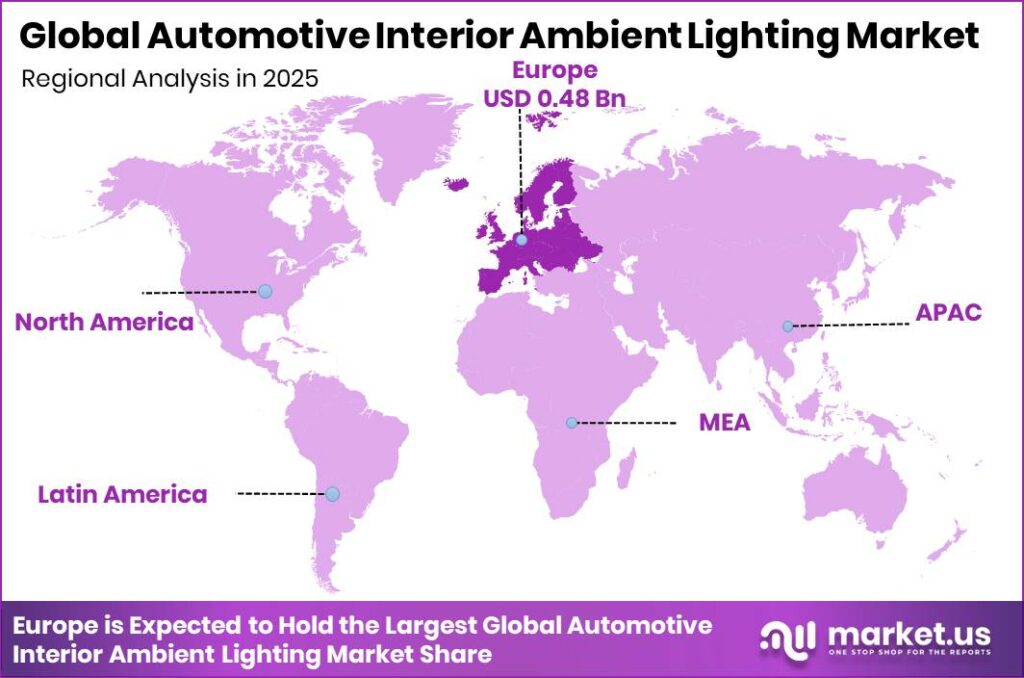
- Europe dominates regionally with a 34.80% share, valued at USD 0.48 Billion.
Government electrification policy reshapes cabin design priorities across major markets. Regulators in the European Union, United States, and Japan now push in-cabin HMI clarity standards that elevate functional lighting specs. This means OEMs must align ambient systems with driver-attention rules. Suppliers who certify against these frameworks early secure a compliance advantage over slower rivals.
Electric platforms are widening the interior canvas that lighting suppliers can address. As per our research, electric cars accounted for 18% of all cars sold globally in 2023. This scale gives suppliers a growing base of redesigned cabins built for personalization. Vendors targeting EV programs first will lock in long content-rich nominations before competitors react.
OEM personalization is turning ambient lighting into a purchase differentiator. Porsche’s 2025 Cayenne Electric offers 13 interior color combinations tied to its interior personalization system. This shows premium brands using color choice to signal cabin quality. Suppliers offering configurable, software-linked color systems will command higher content value per vehicle across future programs.
Light Source Analysis
LED dominates with 89.20% due to low cost, compact size, and reliability.
In 2025, LED held a dominant market position in the By Light Source segment of Automotive Interior Ambient Lighting Market, with a 89.20% share. LED units offer low power draw and long service life across cabin zones. This means OEMs can deploy dense multi-zone systems without straining vehicle electrical budgets. Suppliers scaling LED module output will keep pricing leverage as volume programs expand across mass-market platforms.
OLED serves premium programs seeking thin, uniform light surfaces across cabin trim. This source enables designers to integrate lighting into curved and flush panel geometries. This creates a differentiation path for brands competing on cabin aesthetics. Suppliers investing in OLED capability early can defend margin against commoditized LED strip supply in the luxury tier.
Other Light Sources fill niche roles where LED and OLED cannot reach specific packaging needs. These sources support specialized effects and legacy fitments in select vehicle programs. This means suppliers retain a small but stable base of specialty demand. Vendors maintaining this capability can serve retrofit and heritage applications that volume players overlook.
Installation Area Analysis
Door Panel Lighting dominates with 30.40% due to high visibility and large surface area.
In 2025, Door Panel Lighting held a dominant market position in the By Installation Area segment of Automotive Interior Ambient Lighting Market, with a 30.40% share. Door panels give designers a large, eye-level surface for ambient strips. This means OEMs treat door lighting as the anchor of any multi-zone cabin scheme. Suppliers who master door-mounted fiber-optic distribution will win the highest-content installation slot per vehicle.
Dashboard Lighting frames the driver’s primary field of view and instrument layout. This zone links ambient effects directly to HMI displays and controls. This creates demand for tightly integrated lighting and display firmware. Maruti Suzuki’s 2025 Victoris offers 64 selectable ambient lighting colors as an OEM-installed feature, showing mass-market brands extending color depth across cabin surfaces.
Footwell Lighting adds low-level illumination that improves cabin ambiance and entry safety. This zone carries lower content cost but appears across broad model ranges. This means suppliers gain steady volume even on entry platforms. Vendors bundling footwell units into larger packages can raise total per-vehicle content without heavy engineering effort.
Center Console Lighting highlights control clusters and storage zones between front seats. Headliner and Roof Lighting extends ambiance overhead, while Multi-Zone Ambient Lighting ties all areas into one controlled system, and together these areas hold the remaining installation share collectively. This means suppliers offering unified multi-zone control platforms can consolidate several installation zones under one program nomination.
Vehicle Class Analysis
Premium Vehicles dominate with 39.10% due to strong buyer appetite for cabin personalization.
In 2025, Premium Vehicles held a dominant market position in the By Vehicle Class segment of Automotive Interior Ambient Lighting Market, with a 39.10% share. Premium buyers expect rich, configurable cabin lighting as a standard feature. This means OEMs load these platforms with high-zone-count systems and software personalization. Suppliers targeting premium programs capture the richest content value and longest co-development engagements.
Economy Vehicles adopt ambient lighting as brands chase perceived interior quality at low cost. This class prioritizes affordable single-zone or limited-color strips. This means suppliers must hit aggressive price points to win these high-volume nominations. Vendors with lean LED manufacturing will convert this volume into scale advantages across regions.
Mid-Range Vehicles bridge cost discipline and feature ambition across mainstream buyers. This class increasingly receives multi-zone color systems once reserved for premium tiers. This creates a fast-expanding content opportunity in the largest volume band. Suppliers offering scalable modular systems can upsell mid-range OEMs toward richer configurations over time.
Luxury Vehicles demand the most advanced lighting effects, materials, and integration quality. This class accepts high content cost in exchange for signature cabin experiences, holding the remaining share alongside the classes above. This means suppliers can pilot micro-LED and biodynamic features here first. Vendors proving technology in luxury programs gain credibility to cascade it downmarket.
Color Type Analysis
Multi-Color Ambient Lighting dominates with 63.70% due to strong demand for cabin personalization.
In 2025, Multi-Color Ambient Lighting held a dominant market position in the By Color Type segment of Automotive Interior Ambient Lighting Market, with a 63.70% share. Multi-color systems let drivers match cabin mood to preference and context. This means OEMs use color range as a visible upsell lever at point of sale. Suppliers delivering wide-gamut RGB systems capture higher content value than single-color rivals.
Single Color Ambient Lighting serves cost-focused platforms needing basic cabin ambiance. This type offers simple, reliable illumination at minimal component cost, holding the remaining share of the segment. This means suppliers keep a dependable entry-level product line. Vendors using single-color systems as an entry point can later upsell buyers toward multi-color upgrades.
Sales Channel Analysis
OEM dominates with 87.30% due to factory integration and warranty alignment.
In 2025, OEM held a dominant market position in the By Sales Channel segment of Automotive Interior Ambient Lighting Market, with an 87.30% share. OEM fitment ensures lighting integrates with vehicle wiring, software, and warranty. This means suppliers must win factory nominations to access the bulk of market volume. Vendors with deep OEM co-development capability control the dominant channel and its long program cycles.
Aftermarket supplies retrofit lighting for owners upgrading existing vehicles. This channel serves personalization demand outside factory-fitted options and holds the remaining share. This means suppliers can reach a large installed base of older cars. Vendors building organized aftermarket distribution can convert retrofit demand into a steady secondary revenue stream.
Key Market Segments
By Light Source
- LED
- OLED
- Other Light Sources
By Installation Area
- Door Panel Lighting
- Dashboard Lighting
- Footwell Lighting
- Center Console Lighting
- Headliner/Roof Lighting
- Multi-Zone Ambient Lighting
By Vehicle Class
- Premium Vehicles
- Economy Vehicles
- Mid-Range Vehicles
- Luxury Vehicles
By Color Type
- Multi-Color Ambient Lighting
- Single Color Ambient Lighting
By Sales Channel
- OEM
- Aftermarket
Regional Analysis
Europe Dominates the Automotive Interior Ambient Lighting Market with a Market Share of 34.80%, Valued at USD 0.48 Billion
Europe led the market in 2025 with a 34.80% share, valued at USD 0.48 Billion. The region hosts leading premium OEMs and Tier-1 lighting suppliers using Automotive Interior Materials that pair with advanced cabin illumination. This means European programs set the specification benchmark for global cabin lighting. Suppliers anchored in Europe gain early access to the richest content and standards leadership.
Asia Pacific ranks as the fastest-growing region as domestic OEMs load ambient lighting across mass-market cars. The region combines high vehicle volume with rapid feature democratization. This means suppliers can scale content value quickly across a huge production base. Vendors building local manufacturing and cost-competitive modules will capture the steepest regional growth curve.
North America adopts ambient lighting across SUVs, crossovers, and EV platforms with expanding interior surfaces. Latin America and Middle East and Africa add incremental demand through premium imports and retrofit channels. This means suppliers can layer secondary volume onto core programs. Vendors serving these regions through flexible distribution can extend reach without heavy fixed investment.
Key Regions and Countries
North America
- US
- Canada
Europe
- Germany
- France
- The UK
- Spain
- Italy
- Rest of Europe
Asia Pacific
- China
- Japan
- South Korea
- India
- Australia
- Rest of APAC
Latin America
- Brazil
- Mexico
- Rest of Latin America
Middle East and Africa
- GCC
- South Africa
- Rest of MEA
Market Dynamics
Market Opportunity Analysis - Premium technology segments and Asia Pacific localization open the clearest entry points for new players
Mid-Range Vehicles remain underexploited despite sitting between the 39.10% Premium share and cost-focused economy demand. This class receives multi-zone systems later than premium tiers, leaving content value uncaptured. This means new entrants can win volume by offering scalable modular systems here. Vendors seeding mid-range programs early can upsell richer configurations as buyer expectations rise.
The Aftermarket channel is underexploited against OEM’s dominant 87.30% share. Retrofit demand reaches a large installed base of older vehicles outside factory fitment. This means suppliers can build a secondary revenue stream independent of program nominations. Vendors creating organized aftermarket distribution can serve personalization demand that OEM channels leave open.
Asia Pacific holds room beyond Europe’s dominant 34.80% regional share. The region pairs high vehicle volume with fast feature democratization across mass-market cars. This creates an entry point for suppliers with cost-competitive local manufacturing. New players building regional plants can capture growth before incumbents fully localize supply.
Other Light Sources and Single Color Ambient Lighting stay underexploited beside LED’s 89.20% and Multi-Color’s 63.70% leads. These categories serve niche and entry-level demand that larger players deprioritize. This means focused suppliers can own specialty and low-cost slots. Vendors dominating these niches secure stable demand that volume competitors overlook.
Technology and Innovation Landscape - Compact RGB LEDs and color-accuracy algorithms redefine cabin lighting design
The OSIRE E3731i RGB LED delivers a typical luminous flux of 1.77 lm, intensity of 0.61 cd, radiant flux of 9.59 mW, and a 120° beam angle. Its tiny footprint suits dense multi-zone cabin installations. This means designers can pack more addressable zones into tight trim spaces. Suppliers adopting compact RGB LEDs gain design freedom that supports higher-content lighting programs.
The OSIRE E3030 RGB LED features a low component height of 0.6 mm and a compact footprint of 3.0 mm by 3.0 mm, using a delta chip arrangement. This layout improves color-over-angle performance in light-guide coupling. This means ambient strips deliver consistent color across viewing angles. Suppliers using this design reduce visible color shift, a quality edge in premium cabin programs.
The RGBW temperature compensation algorithm improves the Color Rendering Index by up to 58.9 points, rising from 19.7 to 78.6. This gain preserves accurate color under varying cabin temperatures. This means lighting stays true across seasons and driving conditions. Suppliers embedding this firmware differentiate on color fidelity, supporting the shift toward software-integrated lighting platforms.
Continental’s Emotional Cockpit, shown at CES 2025, integrates a 1.30-meter-long E Ink Prism display across the dashboard. The system enables customizable interior lighting and display effects, drawing on a Next-Generation Digital Cockpit approach. This means lighting and display now merge into one experience layer. Suppliers combining these functions capture higher integrated content value per vehicle.
Drivers
Ambient lighting has moved from luxury exclusivity into mass-market cabins. Through 2020 to 2023, these features sat almost only in vehicles priced above USD 45,000. Chinese and European volume brands then deployed multi-zone RGB systems in cars priced between USD 18,000 and USD 35,000. This means OEMs now compete on interior quality without raising powertrain cost.
By 2024, ambient lighting reached over 65% of new passenger cars sold in China, up from under 30% in 2021. Buyers aged 25 to 40 rank interior lighting among the top 3 purchase factors. As a result, OEM content value per vehicle jumped from USD 8 to 15 toward USD 55 to 120. Suppliers offering integrated lighting and software now earn 18 to 28% gross margins on richer programs.
| Driver | (~) % Impact on CAGR Forecast | Geographic Relevance | Impact Timeline |
|---|---|---|---|
| Premiumization & Experience-Driven Cabin Design Cascading into Mass-Market Segments | +1.80% | Global — led by China, Europe, North America | Short term (≤ 2 years) |
| EV & Hybrid Platform Expansion Creating Larger, Redesigned Interior Canvases | +1.35% | China, Europe, North America, South Korea | Short term (≤ 2 years) |
| OEM Personalization & Configurable Lighting Feature Upsell Penetration | +1.00% | Germany, United States, China, South Korea | Medium term (2–4 years) |
| Rising Consumer Demand for Wellness & Biodynamic Lighting in Cabins | +0.75% | Europe, North America, GCC | Medium term (2–4 years) |
| Increasing SUV, Crossover & MPV Production Expanding Illuminable Interior Surface | +0.62% | Global — China, North America, Middle East | Short term (≤ 2 years) |
| Regulatory Push for In-Cabin HMI Clarity Elevating Functional Lighting Specs | +0.42% | European Union, United States, Japan | Medium term (2–4 years) |
Restraints
Chinese OEM price competition is compressing ambient lighting prices worldwide. More than 50 active automotive brands competed for share across China in 2024 to 2025. This forced Tier-1 and Tier-2 suppliers to absorb unit cost pressure to keep program nominations. Multi-zone RGB module prices fell by 18 to 26% between 2022 and 2025 as domestic makers scaled output.
Tier-1 supplier gross margins slid from about 18 to 24% down to 11 to 16% on comparable systems. Chinese modules carry cost structures 25 to 35% below European and North American rivals. This means non-Chinese suppliers face margin erosion of 5 to 9 percentage points per generation. Instead, some defend margin through software integration, though qualification lags 12 to 18 months before premium programs pay more.
| Restraint | (~) % Impact on CAGR Forecast | Geographic Relevance | Impact Timeline |
|---|---|---|---|
| Chinese OEM Price War Compressing Ambient Lighting ASPs Across Global Supply Chains | -1.25% | Global — originating in China, radiating to Europe & Southeast Asia | Short term (≤ 2 years) |
| Semiconductor & Micro-LED Component Supply Constraints Limiting Module Output | -0.70% | Global — concentrated in East Asia supply chains | Short term (≤ 2 years) |
| OEM Cost Reduction Mandates Downgrading Ambient Lighting Specs on Entry Platforms | -0.55% | Europe, India, Latin America | Short term (≤ 2 years) |
| Trade Tariff Barriers Increasing LED & Driver IC Import Costs | -0.42% | United States, European Union, India | Short term (≤ 2 years) |
| Consumer Distraction Regulation Restricting Dynamic & Animated Lighting Features | -0.30% | European Union, United Kingdom, Germany | Medium term (2–4 years) |
Challenges
Certification complexity is widening as cabins add dense lighting zones. Some premium EV platforms now deploy 64 to 128 individually addressable light zones per cabin. Each controller must comply with CISPR 25, ISO 11452, and ISO 26262 ASIL assessments. This means unintended flicker could compromise driver attention monitoring and block production release.
A full EMC test campaign costs USD 80,000 to 180,000 and consumes 6 to 10 weeks per event. A first-article failure adds 10 to 18 weeks of redesign and retest time. As a result, annual certification burden reaches USD 4 to 9 Million, or 4 to 8% of segment revenue. Suppliers building in-house simulation cut test iterations from 3.2 to under 1.5 per program.
| Challenge | (~) % CAGR Friction Drag | Geographic Relevance | Mitigation Horizon |
|---|---|---|---|
| EMC & Automotive-Grade Certification Complexity | -0.72% | Global — most stringent in EU, Japan, North America | Medium term (2–4 years) |
| Lighting Software Integration & OTA Compatibility Gaps | -0.60% | Global — concentrated in multi-brand OEM platform programs | Medium term (2–4 years) |
| Fibre-Optic & Light-Guide Tooling Lead-Time Drag | -0.50% | Europe, North America, Japan | Long term (≥ 4 years) |
| Colour Consistency & Long-Term LED Lumen Degradation | -0.38% | Global — premium OEM programs in Germany, Japan, USA | Long term (≥ 4 years) |
| Thermal Management in Dense Multi-Zone Installations | -0.30% | Global — acute in high-zone-count EV interior programs | Medium term (2–4 years) |
Opportunities
Lighting-as-a-feature subscription is open white space today. Most ambient lighting sells once as hardware at point of sale, with no recurring software revenue attached. Over-the-air platforms, already enabled in leading EV architectures by 2024, can unlock extra color zones and biodynamic programs post-sale. This means OEMs and suppliers can convert installed hardware into a recurring revenue asset.
OEMs launching software subscriptions in 2022 to 2024 earned USD 150 to 600 in per-vehicle lifetime software revenue. Lighting royalties of USD 2 to 6 per vehicle could add 12 to 20% incremental revenue at 55 to 70% software margins. However, fewer than 15% of volume platforms support this today. Early movers building OTA lighting SDKs capture the mass-market window opening through 2027 to 2029.
| Opportunity | (~) % Potential CAGR Upside | Geographic Relevance | Execution Window |
|---|---|---|---|
| Lighting-as-a-Feature Subscription & OTA Monetisation Model | +1.55% | North America, Europe, China, South Korea | Medium term (2–4 years) |
| Micro-LED & Pixel-Addressable Surface Lighting Integration | +1.05% | Europe, North America, Japan, South Korea | Long term (≥ 4 years) |
| Autonomous & Robo-Taxi Cabin Mood & Occupant Communication Lighting | +0.80% | United States, China, Germany, Japan | Long term (≥ 4 years) |
| Untapped Mass-Market Retrofitting via Organised Aftermarket Channels | +0.65% | India, Southeast Asia, Latin America, Middle East | Short term (≤ 2 years) |
| Integrated Ambient-Acoustic Sensory Cabin Experience Platforms | +0.45% | Europe, China, North America, GCC | Long term (≥ 4 years) |
Key Company Insights
HELLA GmbH & Co. KGaA positions itself through advanced, sustainable lighting technology and compact LED solutions for cabin interiors. In April 2025, FORVIA presented these concepts through FORVIA HELLA at Auto Shanghai 2025 for next-generation vehicle interiors. This means the company competes on design integration rather than price alone. Its focus on customizable concepts creates an advantage in premium and personalization-led OEM programs.
Valeo SA anchors its position in integrated cabin systems that link lighting with sensing and comfort features, drawing on Automotive HMI expertise. As per our research, machine learning models parsing bio-electric sensor data under dynamic lighting reached 78.9% accuracy for emotional valence and 68.7% for arousal. This means wellness-linked lighting can adapt to occupant state. Suppliers pairing sensing with lighting gain an edge in biodynamic cabin programs.
Key Players
- HELLA GmbH & Co. KGaA
- Valeo SA
- Osram Licht AG
- Koito Manufacturing Co., Ltd.
- Denso Corporation
- ams OSRAM AG
- Continental AG
- Robert Bosch GmbH
- Gentherm Incorporated
- Grupo Antolin
- Faurecia SE
- Dräxlmaier Group
Recent Developments
- April 2025 – Marelli showcased its next-generation automotive lighting technologies at Auto Shanghai 2025, including the world’s first OLED-TFT Pixel Rear Lamp, Near-Field Ground Projection technology, and Thin Lit Line Headlamp, supporting future intelligent and personalized vehicle lighting solutions.
- October 2025 – FORVIA HELLA announced the market launch of its FlatLight technology for daytime running lights, extending its ultra-thin micro-optics platform after successful series production for rear lighting. The technology supports future vehicle lighting designs with reduced installation space and improved efficiency.
Report Scope
| Report Features | Description |
|---|---|
| Market Value (2025) | USD 1.40 Billion |
| Forecast Revenue (2035) | USD 2.63 Billion |
| CAGR (2026-2035) | 6.54% |
| Base Year for Estimation | 2025 |
| Historic Period | 2020-2024 |
| Forecast Period | 2026-2035 |
| Report Coverage | Revenue Forecast, Market Dynamics, Market Opportunity Analysis, Technology and Innovation Landscape, Competitive Landscape, Recent Developments |
| Segments Covered | By Light Source (LED, OLED, Other Light Sources), By Installation Area (Door Panel Lighting, Dashboard Lighting, Footwell Lighting, Center Console Lighting, Headliner/Roof Lighting, Multi-Zone Ambient Lighting), By Vehicle Class (Premium Vehicles, Economy Vehicles, Mid-Range Vehicles, Luxury Vehicles), By Color Type (Multi-Color Ambient Lighting, Single Color Ambient Lighting), By Sales Channel (OEM, Aftermarket) |
| Regional Analysis | North America (US and Canada), Europe (Germany, France, The UK, Spain, Italy, and Rest of Europe), Asia Pacific (China, Japan, South Korea, India, Australia, and Rest of APAC), Latin America (Brazil, Mexico, and Rest of Latin America), Middle East and Africa (GCC, South Africa, and Rest of MEA) |
| Competitive Landscape | HELLA GmbH & Co. KGaA, Valeo SA, Osram Licht AG, Koito Manufacturing Co., Ltd., Denso Corporation, ams OSRAM AG, Continental AG, Robert Bosch GmbH, Gentherm Incorporated, Grupo Antolin, Faurecia SE, Dräxlmaier Group |
| Customization Scope | Customization for segments, region/country-level will be provided. Additional customization can be done based on requirements. |
| Purchase Options | We have three licenses to opt for: Single User License, Multi-User License (Up to 5 Users), Corporate Use License (Unlimited User and Printable PDF) |





































