


Report Overview
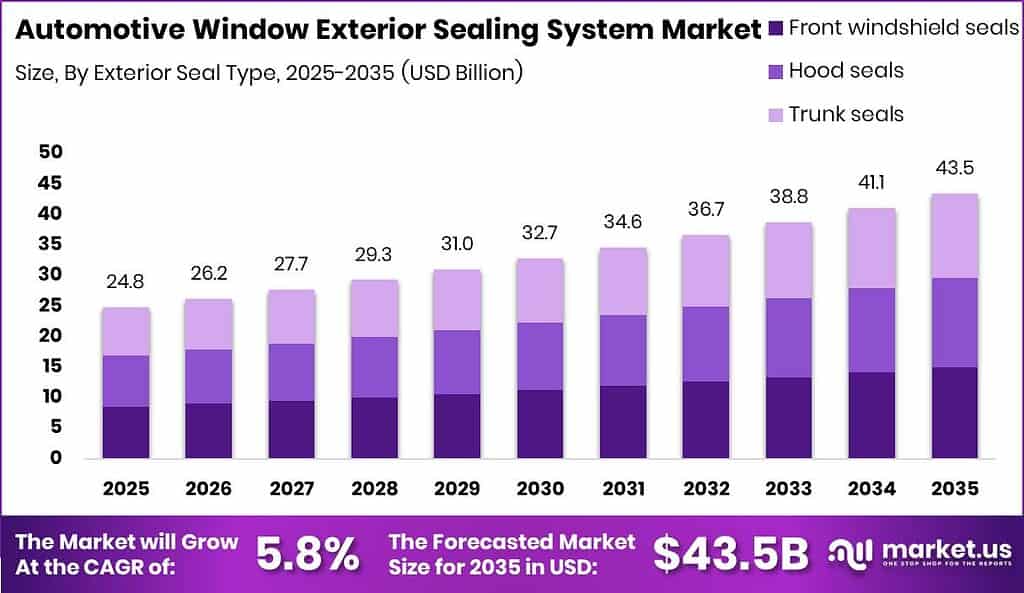
Global Automotive Window Exterior Sealing System Market size is expected to be worth around USD 43.50 Billion by 2035 from USD 24.80 Billion in 2025, growing at a CAGR of 5.8% during the forecast period 2026 to 2035. This expansion reflects higher sealing content per vehicle as platforms shift toward quieter cabins and tighter weather protection. Investors should treat exterior sealing as a rising bill-of-materials line, not a fixed commodity spend.
Therefore, the market covers components that close gaps around doors, glass, roofs, hoods, and trunks on passenger and commercial vehicles. Products include door seals, glass run channels, roof ditch moldings, and rear windshield seals made mainly from rubber, EPDM, PVC, TPE, and related polymers. Structure splits by component, exterior seal type, material process, and vehicle type, so suppliers win through platform-specific design wins rather than pure volume alone.
Key Takeaways
- The Automotive Window Exterior Sealing System market reaches USD 24.80 Billion in 2025 and USD 43.50 Billion by 2035 at a 5.8% CAGR.
- Door seals lead the By Component segment with a 45.6% share.
- Front windshield seals lead By Exterior Seal Type with a 34.4% share.
- Rubber / EPDM weatherstrips lead By Material with a 56.7% share.
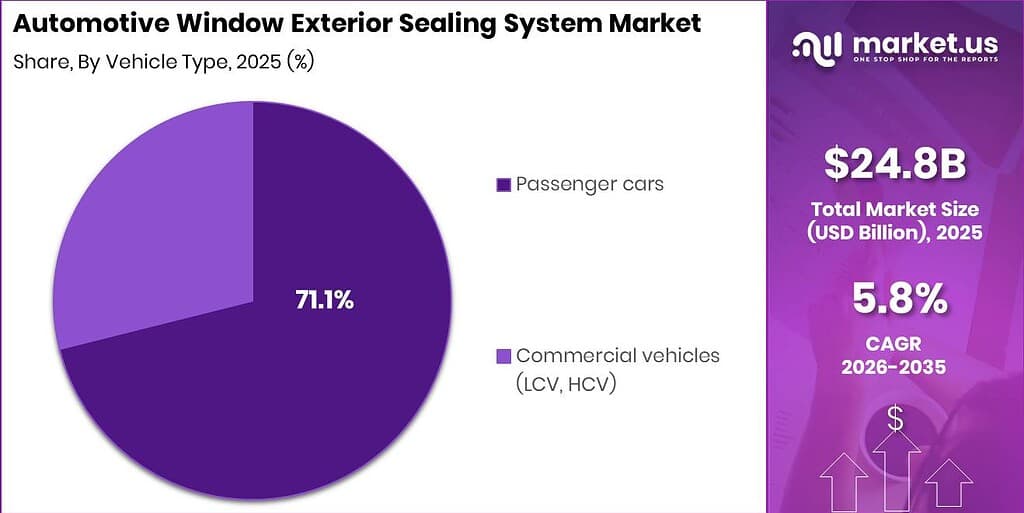
- Passenger cars lead By Vehicle Type with a 71.1% share.
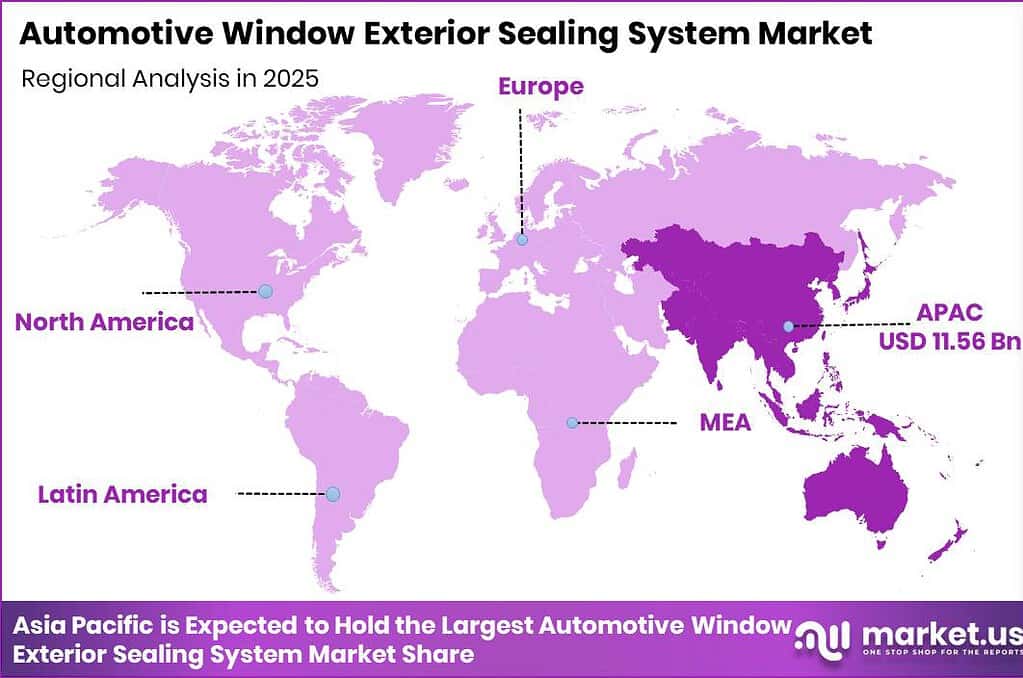
- Asia Pacific anchors global vehicle output and sealing demand concentration.
- Glass run channels, trunk seals, PVC / TPE polymers, and commercial vehicles are the fastest growing lines.
As per our research, closed-cell polyurethane foam sealing cut total vehicle air leakage by 20% versus conventional solutions on electric vehicles in a 2025 SAE International study. This leakage cut raises cabin comfort expectations on silent EV platforms. Suppliers who qualify foam-enhanced modules early lock multi-year encapsulation contracts before legacy channel designs lose share.
Consequently, the same SAE work showed about a 2.4% gain in on-road NVH performance in the airborne band after PU foam sealing adoption. Quieter cabins turn sealing from a weather part into a comfort differentiator for OEMs. Buyers will pay for validated acoustic packages, which lifts content value per vehicle even when unit production grows only modestly.
However, rising global light-vehicle output still underpins base demand for every exterior seal SKU. OICA data show world production moved from 92.7 million units in 2024 to 96.4 million in 2025. Each incremental vehicle multiplies door, glass, and body seal sets, so capacity planners who align extrusion lines with Asia-led builds capture the steadiest volume upside.
Component Analysis
Door seals dominates with 45.6% due to multi-door seal sets per vehicle.
In 2025, Door seals held a dominant market position in the By Component segment of Automotive Window Exterior Sealing System Market, with a 45.6% share. OICA reported global vehicle production of 96.4 million units in 2025, each typically carrying multiple door perimeter seals. High door count multiplies part demand on every assembly line. Suppliers with robotic fit accuracy and low leak rates win long platform life contracts.
Glass run channels are the fastest growing component line as frameless and large-glass designs spread. Channels guide moving glass and must hold tight tolerances under repeated cycles. Asia-Pacific built about 59.2 million vehicles in 2025, concentrating channel volume where glass area is rising. Vendors who co-design channels with glazing partners reduce warranty claims and secure EV module packages.
Roof ditch moldings close the roof-to-body joint and support water management plus styling continuity. They face UV, wash chemicals, and wind load over the full vehicle life. OEMs specify consistent gloss and gap control because roof lines define brand aesthetics. Molding specialists who combine extrusion stability with color-match capability protect premium trim margins.
Rear windshield seals complete the glazing envelope and must manage thermal expansion at the backlite. Bonded glass modules raise the need for compatible seal chemistries and adhesives. Remaining component demand sits with these rear and specialty lines alongside primary door and channel sets. Firms that offer full glazing-seal kits simplify OEM sourcing and raise switching costs.
Exterior Seal Type Analysis
Front windshield seals dominates with 34.4% due to mandatory forward glazing on every vehicle.
In 2025, Front windshield seals held a dominant market position in the By Exterior Seal Type segment of Automotive Window Exterior Sealing System Market, with a 34.4% share. Every produced vehicle requires a primary windscreen interface, so seal demand tracks build rates one-for-one. Global sales reached 99.8 million units in 2025 per OICA. Encapsulated windshield modules raise seal complexity and unit value for qualified Tier-1s.
Trunk seals are the fastest growing exterior seal type as hatch and liftgate designs multiply sealing length. E-commerce delivery vans and crossovers add rear opening cycles that stress seal fatigue life. Commercial and crossover mixes are rising inside the 96.4 million unit global build base. Suppliers offering low-compression-set compounds cut water ingress claims on high-cycle rear openings.
Hood seals manage under-hood spray, dust, and acoustic paths at the front closure. They must tolerate heat near powertrains and still seat cleanly after service opens. EV front trunks change load cases but keep the need for reliable perimeter sealing. Material labs that balance heat aging with soft touch win under-hood specifications.
Front windshield leadership plus trunk growth leave hood and related body seals as the balance of exterior type demand. Integrated front-end modules increasingly pull seal design into early studio gates. Early involvement in styling freezes protects tooling amortization across multi-year programs.
Material Analysis
Rubber / EPDM weatherstrips dominates with 56.7% due to proven weather and ozone resistance.
In 2025, Rubber / EPDM weatherstrips held a dominant market position in the By Material segment of Automotive Window Exterior Sealing System Market, with a 56.7% share. EPDM remains the default for door and body weatherstrips because it resists ozone, UV, and temperature swings. China alone produced 34.53 million vehicles in 2025, anchoring EPDM seal tonnage in Asia. Compounders who stabilize carbon-black masterbatches keep cost and durability preferred on high-volume platforms.
PVC / TPE / other polymer seals are the fastest growing material group as recyclability and color styling rise. Thermoplastic systems support closed-loop scrap reuse that thermoset EPDM cannot match easily. Europe produced 17.2 million vehicles in 2025 while tightening end-of-life rules. Early TPV and TPE converters capture OEM sustainability scorecards and premium interior-exterior color match work.
Extrusion-based seals deliver continuous profiles for long door and glass runs at high line speed. Die design quality sets cross-section stability and corner join performance. High-volume plants favor extrusion for cost per meter on standard weatherstrips. Investors should watch die-change automation because it cuts changeover time on multi-SKU lines.
Molding-based seals and adhesive systems handle corners, end caps, and glass bonding where geometry is complex. Injection and compression molding create features extrusion cannot form in one pass. Adhesives complete structural glazing packs on windshields and backlites. Full-system vendors who pair profiles with molded corners and bond lines reduce OEM multi-supplier risk.
Vehicle Type Analysis
Passenger cars dominates with 71.1% due to high global car build share.
In 2025, Passenger cars held a dominant market position in the By Vehicle Type segment of Automotive Window Exterior Sealing System Market, with a 71.1% share. Cars carry multiple doors, large glass areas, and strict NVH targets that multiply seal content. India produced 6.49 million vehicles with record passenger sales above 4.6 million in FY 2025-26. Car-focused seal makers scale best where hatch and sedan glass encapsulation is standard.
Commercial vehicles spanning LCV and HCV are the fastest growing vehicle type for exterior sealing demand. Delivery vans and trucks add tall door openings, rear cargo seals, and harsher duty cycles. The United States sold 16.7 million vehicles in 2025 while Mexico and Brazil supported regional truck and LCV builds. Seal grades with higher abrasion and oil resistance win fleet and OEM vocational specs.
Passenger dominance means most R&D still targets car acoustic and styling seals first. Commercial growth then pulls heavier compounds and larger profiles from the same material science base. Dual-track product roadmaps let suppliers amortize polymer research across both fleets. Firms missing LCV qualification risk ceding the faster unit-growth pocket after 2026.
Key Market Segments
By Component
- Roof ditch moldings
- Door seals
- Glass run channels
- Rear windshield seals
By Exterior Seal Type
- Trunk seals
- Hood seals
- Front windshield seals
By Material
- Rubber / EPDM weatherstrips
- PVC / TPE / other polymer seals
- Extrusion-based seals
- Molding-based seals
- Adhesive
By Vehicle Type
- Passenger cars
- Commercial vehicles (LCV, HCV)
Regional Analysis
Asia Pacific Dominates the Automotive Window Exterior Sealing System Market as the Primary Vehicle Production Hub, Anchored by High Regional Output
Asia Pacific concentrates sealing demand because the region produced about 59.2 million vehicles in 2025, over 61% of world output. China alone reached 34.53 million units while Japan and India added deep supplier ecosystems. Local extrusion and molding capacity follows OEM clusters, shortening logistics for just-in-time door and glass seals. Global seal makers without Asia tooling face freight and tariff disadvantages on high-volume programs.
North America remains a high-value engineering and pickup-truck seal market even as Americas production eased 2.1% to 18.74 million vehicles in 2025. The United States built 10.24 million units and sold 16.7 million, keeping premium NVH content attractive. On 1 December 2025, Inteva Products completed acquisition of selected IAC Group European operations, reinforcing exterior systems capacity tied to global OEM networks. Nearshore Mexico plants help balance tariff risk for North American seal flow.
Europe produced 17.2 million vehicles in 2025, down 0.8%, while sales slipped 0.4% to 18.63 million. Flat builds push European programs toward recyclable TPE seals and acoustic upgrades rather than pure volume. Latin America and Middle East and Africa add smaller but rising fleets, with Brazil at 2.64 million units and Africa sales up 22%. Diversified regional tooling protects suppliers when one continent slows.
Key Regions and Countries
North America
- US
- Canada
Europe
- Germany
- France
- The UK
- Spain
- Italy
- Rest of Europe
Asia Pacific
- China
- Japan
- South Korea
- India
- Australia
- Rest of APAC
Latin America
- Brazil
- Mexico
- Rest of Latin America
Middle East and Africa
- GCC
- South Africa
- Rest of MEA
Market Dynamics
Market Opportunity Analysis - Commercial seals, polymer shifts, and lighter materials open white space beyond door-EPDM defaults.
Commercial vehicles remain the fastest growing vehicle type while passenger cars still hold 71.1% share, so LCV and HCV sealing is relatively under-served by car-centric tool libraries. Tall cargo doors and high open-close cycles need abrasion-ready compounds many passenger lines omit. Entrants who qualify vocational door and rear seals early ride fleet electrification without fighting saturated sedan RFQs. This pocket rewards application engineering more than pure price.
PVC / TPE and other polymer seals are the fastest material growth path while Rubber / EPDM still holds 56.7%. Recyclable thermoplastics stay under-penetrated on legacy EPDM platforms. New players can target color-matched exterior trims and closed-loop scrap programs that thermoset lines struggle to match. Early TPE capacity in Europe and North America aligns with end-of-life rules.
Trunk seals are the fastest exterior seal type while front windshield seals lead at 34.4%. Crossover and delivery hatch growth lengthens rear sealing without proportional windshield complexity. Specialists focused on liftgate fatigue life avoid head-to-head windshield encapsulation battles. That focus shortens tooling payback on high-cycle rear openings.
As a result, lightweight sealing materials that support up to 10% overall vehicle weight reduction remain an open design lever for efficiency programs. Weight-aware seal stacks help EV range and ICE fuel targets without redesigning body-in-white. Investors funding low-density thermoplastic cores capture content growth even when vehicle units flatten. Underexploited lightweight grades pair well with Asia production scale and Western premium NVH specs.
Technology and Innovation Landscape - Foam acoustics, radar glass, and smart thermal layers redefine seal value.
According to SAE International, improved sealing raised airborne noise sensitivity by up to 1 dB in 2025 vehicle tests using closed-cell PU foam solutions. Acoustic gains matter most on EVs where tire and wind noise dominate. Foam-ready seal architectures become a ticket to comfort brand claims. Manufacturers who validate dB deltas in OEM wind tunnels convert materials science into awarded BOM lines.
Data from a 2026 arXiv automotive study shows a transparent rear-windshield meta-grating near 90% optical transparency with radar function in the 77–81 GHz band. Sub-millimetre wire placement on a 10 × 10 cm silver-nanoparticle prototype sets the manufacturing bar. Seal and glazing partners must hold that precision at corners and edges. Investors should track who industrializes conductive transparent stacks first.
Figures from a 2026 weather-protection hardware study show AI pedestrian detection in rain rising from 8.3% to 41.6% when exterior glazing and sensor zones stay clear. Seals and shields that keep cameras and glass dry become safety enablers, not trim. ADAS-linked seal kits open a higher-margin adjacency beside classic weatherstrips. Suppliers tied only to passive rubber risk missing sensor-fusion RFQs.
Based on 2025 smart-window research, a transparent hydrogel system reached about 92% visible-light transmittance with roughly 22°C thermal insulation over 168 hours and about 11°C intrinsic insulation. Thermal glazing raises cabin load management needs at the seal interface. Seal makers who co-engineer edge bonds for hydrogel stacks enter climate-control value chains. That path extends sealing revenue beyond dust and water stoppage alone.
Drivers
Dedicated EV skateboard platforms force a redesign of window sealing bills of materials toward encapsulated glass with thermal and acoustic barriers. ICCT-linked fleet data show battery electric vehicles near 18% of global light-vehicle output in 2025, up from about 14% in 2024. Sealing content per vehicle rises an estimated 12% to 15% when engine noise no longer masks leaks. Suppliers co-developing EV modules gain roughly 150 to 200 basis points of gross margin versus legacy channel contracts.
Consequently, delayed retooling of injection lines stretches CapEx recovery by 18 to 24 months for slow movers. NVH mandates in North America and Europe, TPV substitution for EPDM, higher vehicle builds in Asia, robotic assembly precision, and premium fenestration styling add further CAGR support. Buyers should prioritize partners already on EV glass modules. Investors can treat encapsulation capability as a screening filter for Tier-1 durability.
| Driver | (~) % Impact on CAGR Forecast | Geographic Relevance | Impact Timeline |
|---|---|---|---|
| EV Platform Encapsulation Shift | +1.4% | Global, led by China and Europe | Short term (2 years or less) |
| NVH and Acoustic Comfort Mandates | +0.9% | North America, Europe | Short term (2 years or less) |
| TPV Substitution for EPDM | +0.7% | Asia-Pacific, North America | Short term (2 years or less) |
| Rising Global Vehicle Production | +0.6% | Asia-Pacific | Short term (2 years or less) |
| Robotic Assembly Precision Adoption | +0.4% | Global | Medium term (2 to 4 years) |
| Premiumization of Fenestration Aesthetics | +0.3% | North America, Europe | Medium term (2 to 4 years) |
Restraints
Section-232-linked and reciprocal tariff schedules through 2025 raised landed costs on Asia-sourced EPDM profiles by an estimated 15% to 25% on North American entries. Tier-1 and Tier-2 plants paused roughly 8 to 10 new sealing tooling qualification programs while duty rates stayed unclear. Delivered unit margins compressed about 200 to 300 basis points on affected parts. Domestic extrusion expansion CapEx slipped an estimated 12 to 18 months as buyers froze awards.
As a result, rubber feedstock swings, high interest rates that defer CapEx, European OEM build cuts, and strict VOC rules in China and the EU further slow order timing. Procurement teams dual-source regions to limit tariff spikes. Suppliers with local compounding in the USMCA zone protect share. Investors should stress-test North America margins against duty scenarios before funding new presses.
| Restraint | (~) % Impact on CAGR Forecast | Geographic Relevance | Impact Timeline |
|---|---|---|---|
| US Tariff-Driven Procurement Freeze | -1.1% | North America | Short term (2 years or less) |
| Rubber Feedstock Price Volatility | -0.6% | Global | Short term (2 years or less) |
| High Interest Rate CapEx Deferral | -0.5% | Europe, North America | Short term (2 years or less) |
| OEM Vehicle Production Cuts | -0.4% | Europe | Short term (2 years or less) |
| Stringent VOC Emission Bans | -0.3% | China, European Union | Short term (2 years or less) |
Challenges
An aging precision-tooling workforce leaves more than 1.9 million skilled manufacturing roles at risk of going unfilled across auto-parts chains by 2028, per National Association of Manufacturers-linked apprenticeship signals. Extrusion die and injection-mold changeovers for new sealing profiles run 20% to 30% longer than a decade ago. Fewer certified tool-and-die technicians stretch launch calendars. OEMs feel this as delayed PPAP and slower refresh cycles on weatherstrip tools.
This creates pressure to fund robotic die-setting and apprenticeships at roughly 3% to 5% of annual operating spend. Multi-tier supply fragmentation, lightweighting trade-offs, recyclable elastomer cost gaps, and cross-regional homologation variance add parallel friction. Firms that automate tool changeovers free capacity without waiting for scarce journeymen. That investment becomes a competitive moat through 2030 rather than a pure cost line.
| Challenge | (~) % CAGR Friction Drag | Geographic Relevance | Mitigation Horizon |
|---|---|---|---|
| Skilled Tooling Talent Shortage | -0.5% | North America, Europe | Medium term (2 to 4 years) |
| Multi-Tier Supply Chain Fragmentation | -0.4% | Global | Medium term (2 to 4 years) |
| Lightweighting Design Trade-offs | -0.3% | Global | Medium term (2 to 4 years) |
| Recyclable Elastomer Cost Gap | -0.3% | Europe, Asia-Pacific | Long term (4 years or more) |
| Cross-Regional Homologation Variance | -0.2% | Global | Long term (4 years or more) |
Opportunities
Bio-based and recyclable elastomer seals still sit below about 5% of sealing volume in European Chemicals Agency registration trails through 2026, so revenue remains largely untapped. Sustainability-certified seals can support an 8% to 12% unit price premium while easing EU End-of-Life Vehicle recyclability compliance. OEM qualification often needs 24 to 36 months, rewarding early joint development. Gross margins could expand 250 to 350 basis points versus standard EPDM once scale arrives.
Therefore, aftermarket retrofit sealing, hydrophobic smart membranes, autonomous sensor-seal fusion, nearshore tooling roll-ups, and additive custom profiles form the next wave of upside. Europe and North America lead bio-elastomer monetization windows over the next two to four years. Early movers who lock pilot OEM gates before 2028 shape the certified-materials standard. Late entrants will buy share at higher customer acquisition cost.
| Opportunity | (~) % Potential CAGR Upside | Geographic Relevance | Execution Window |
|---|---|---|---|
| Bio-Based Elastomer Monetization | +1.2% | Europe, North America | Medium term (2 to 4 years) |
| Aftermarket Retrofit Sealing Services | +0.7% | Asia-Pacific, Latin America | Medium term (2 to 4 years) |
| Hydrophobic Smart-Membrane Integration | +0.6% | Global | Long term (4 years or more) |
| Autonomous Vehicle Sensor-Seal Fusion | +0.5% | North America, China | Long term (4 years or more) |
| Localized Nearshore Tooling Roll-ups | +0.4% | North America, Mexico | Medium term (2 to 4 years) |
| Additive-Manufactured Custom Profiles | +0.3% | Global | Long term (4 years or more) |
Key Company Insights
Cooper Standard Automotive Inc. runs a deep sealing portfolio with 35 active innovation projects across its automotive lines. About 75% of those projects target improved sustainability outcomes in materials and manufacturing. This mix positions the firm for OEM recyclability scorecards and thermoplastic body seal shifts. Continuity of i3 pipeline funding protects first-mover status on lightweight exterior seals.
Hutchinson Sealing Systems strengthens advanced engineering after its 3 February 2026 acquisition of Cox and Company and Prime Technology. The deal extends vibration control and mobility know-how that pairs with exterior sealing on next-generation platforms. Broader systems capability raises cross-sell into NVH packages beyond stand-alone weatherstrips. Integration risk stays the watch item until program awards convert the new assets.
Key Players
- Cooper Standard Automotive Inc.
- Hutchinson Sealing Systems
- Toyoda Gosei Co., Ltd.
- Henniges Automotive Holdings Inc.
- REHAU Group
- Magna International Inc
- Sumitomo Riko Company Limited
- Trelleborg AB
- Standard Profil A.S.
- Lauren Plastics LLC
- Minth Group Limited
- SaarGummi Group
- PPAP Automotive Ltd.
- JK Fenner
- Continental AG
Recent Developments
- July 2025: Cooper Standard introduced its FlexiCore Thermoplastic Body Seal on the Renault Emblème demonstration vehicle, a recyclable lightweight exterior body sealing solution designed to replace conventional EPDM rubber seals.
- October 2025: Toyoda Gosei developed Japan first in-mold coating technology for large automotive exterior resin components, improving manufacturing efficiency and surface quality for exterior trim and sealing-related parts.
Geopolitical Impact Analysis
According to Auto Care Association trade tracking, a March 2025 US proclamation set a 25% tariff on imported automobiles from April 2025 and on certain auto parts from May 2025. EPDM profiles and molded sealing assemblies sourced from Asia face higher landed cost into North American plants. This means Tier-1s reroute compounding toward USMCA zones to protect door-seal margins. Procurement freezes on new tools follow until duty paths stabilize.
Data from OICA shows Americas production fell 2.1% to 18.74 million vehicles in 2025 while Asia-Pacific output rose 7.6% to about 59.2 million. Trade friction and tariff risk around the United States push sealing capacity toward Mexico and Asian hubs. Consequently, dual-region extrusion footprints become a hedge against duty spikes and shipping delays. Investors funding single-region EPDM plants carry elevated policy risk through 2026.
Report Scope
| Report Features | Description |
|---|---|
| Market Value (2025) | USD 24.80 Billion |
| Forecast Revenue (2035) | USD 43.50 Billion |
| CAGR (2026-2035) | 5.8% |
| Base Year for Estimation | 2025 |
| Historic Period | 2020-2024 |
| Forecast Period | 2026-2035 |
| Report Coverage | Revenue Forecast, Market Dynamics, Market Opportunity Analysis, Technology and Innovation Landscape, Competitive Landscape, Recent Developments |
| Segments Covered | By Component (Roof ditch moldings, Door seals, Glass run channels, Rear windshield seals), By Exterior Seal Type (Trunk seals, Hood seals, Front windshield seals), By Material (Rubber / EPDM weatherstrips, PVC / TPE / other polymer seals, Extrusion-based seals, Molding-based seals, Adhesive), By Vehicle Type (Passenger cars, Commercial vehicles (LCV, HCV)) |
| Regional Analysis | North America (US and Canada), Europe (Germany, France, The UK, Spain, Italy, and Rest of Europe), Asia Pacific (China, Japan, South Korea, India, Australia, and Rest of APAC), Latin America (Brazil, Mexico, and Rest of Latin America), Middle East and Africa (GCC, South Africa, and Rest of MEA) |
| Competitive Landscape | Cooper Standard Automotive Inc., Hutchinson Sealing Systems, Toyoda Gosei Co., Ltd., Henniges Automotive Holdings Inc., REHAU Group, Magna International Inc, Sumitomo Riko Company Limited, Trelleborg AB, Standard Profil A.S., Lauren Plastics LLC, Minth Group Limited, SaarGummi Group, PPAP Automotive Ltd., JK Fenner, Continental AG |
| Customization Scope | Customization for segments, region / country-level will be provided. Additional customization can be done based on requirements. |
| Purchase Options | We have three licenses to opt for: Single User License | Multi-User License (Up to 5 Users) | Corporate Use License (Unlimited User and Printable PDF) |





































