


Report Overview
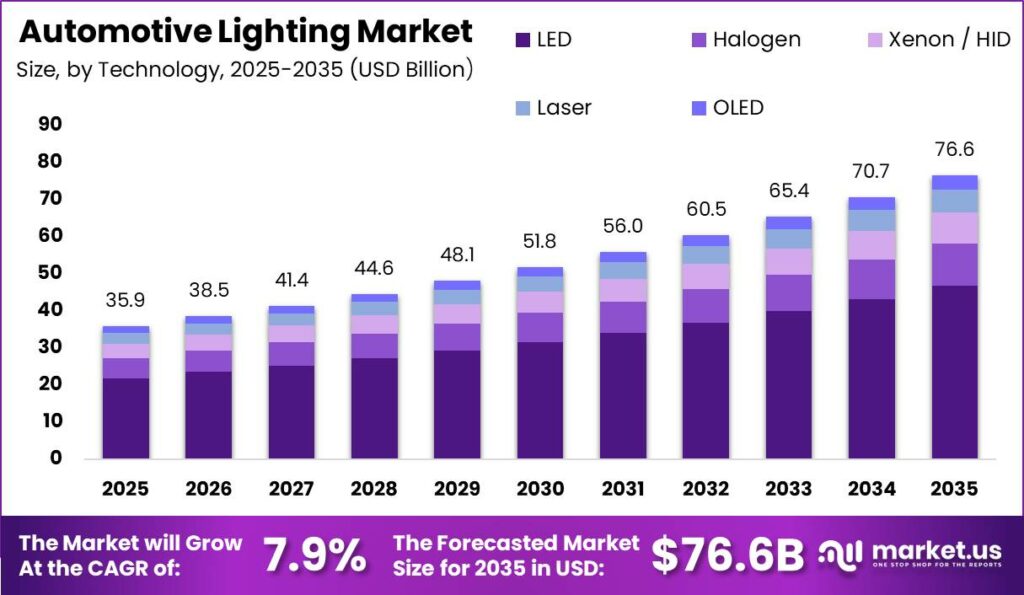
Global Automotive Lighting Market size is expected to be worth around USD 76.6 Billion by 2035 from USD 35.9 Billion in 2025, growing at a CAGR of 7.9% during the forecast period 2026 to 2035. This trajectory reflects a structural content upgrade cycle rather than simple volume expansion across global vehicle production.
The automotive lighting market covers all light-emitting systems fitted to vehicles at the point of manufacture and through the aftermarket channel. It spans exterior systems such as headlamps, tail lamps, fog lamps, daytime running lights, turn signals, and side markers, as well as interior and ambient cabin lighting. Products are segmented by technology, application, product type, vehicle type, and sales channel, serving passenger cars, commercial vehicles, two-wheelers, and electric vehicles across global regions.
Key Takeaways
- The global automotive lighting market is valued at USD 35.9 Billion in 2025 and is forecast to reach USD 76.6 Billion by 2035.
- The market grows at a CAGR of 7.9% during the forecast period 2026 to 2035.
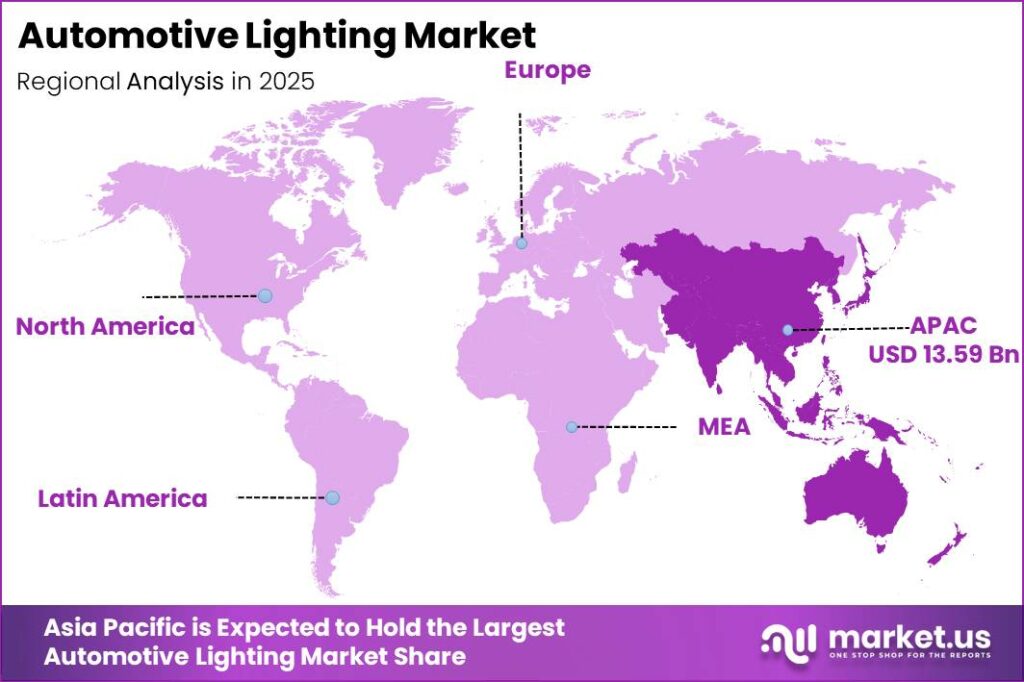
- Asia Pacific dominates with a market share of 37.90%, valued at USD 13.59 Billion in 2025.
- By Technology, LED leads with a 61.00% share, driven by regulatory mandates and cost parity with halogen systems.
- By Application, Headlamps hold a 38.00% share as the highest-value and most regulated lamp category.
- By Product Type, Exterior Lighting commands a 70.00% share, reflecting safety regulation requirements on all road-facing surfaces.
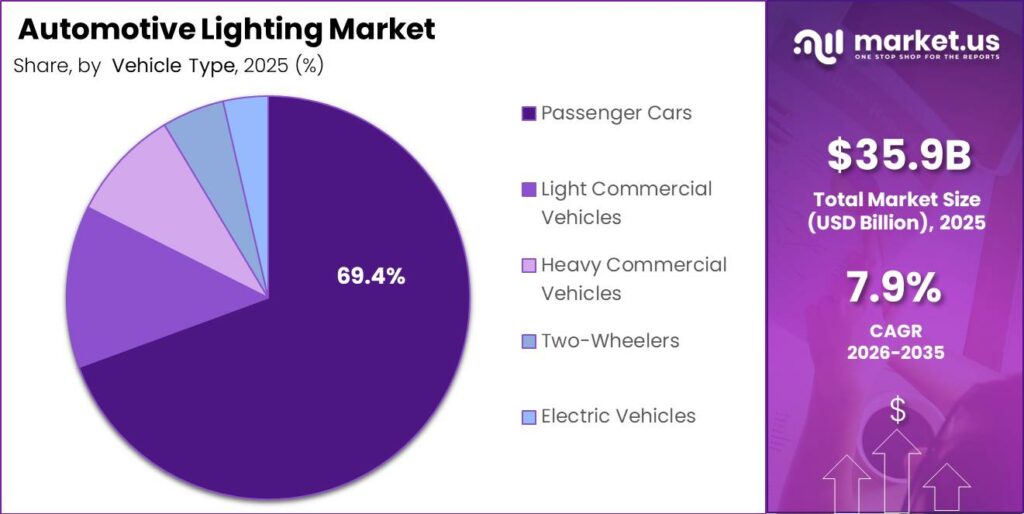
- By Vehicle Type, Passenger Cars account for a 69.40% share as the largest production volume segment globally.
- By Sales Channel, OEM holds an 83.00% share as multi-year platform awards replace consumable bulb purchases.
As per our research, LED attach rates on front lighting in China moved past 85% during 2024 to 2025, confirming that growth in this market is content-driven rather than dependent on broader vehicle production volumes. Suppliers without in-house driver-IC and optical simulation capability face exclusion from OEM award lists, since engineering release gates now require photometric validation at the module level. This consolidates platform awards among a shrinking set of qualified Tier-1 suppliers.
According to the Insurance Institute for Highway Safety, only 5% of headlight systems tested for model-year 2026 vehicles produced excessive glare, compared with 21% of model-year 2017 systems. This improvement reflects a decade of regulatory and supplier-side photometric engineering. Buyers and fleet operators benefit directly from lower collision risk and reduced insurance exposure, while suppliers who led the glare-reduction effort gain measurable differentiation in OEM procurement scoring.
Technology Analysis
LED dominates with 61.00% due to cost parity eliminating halogen preference.
In 2025, LED held a dominant market position in the By Technology segment of the Automotive Lighting Market, with a 61.00% share. LED die and driver-IC prices have declined by roughly 6% to 9% annually, bringing solid-state lighting to default fitment status on new type-approvals across UNECE-aligned markets. Each halogen reflector pair displaced by a sealed LED module represents a content-per-vehicle increase of 2.2x to 2.8x, which directly expands supplier revenue per vehicle without requiring production volume growth.
Halogen remains the technology of record in entry-segment and replacement applications where bill-of-materials ceilings restrict LED fitment. Aftermarket halogen bulb volumes remain significant in markets such as India, ASEAN, Latin America, and Africa, where average vehicle age and price sensitivity sustain legacy filament demand. The ACEA member assembly data for Europe shows halogen’s exit from new type-approvals accelerating, which structurally narrows the aftermarket bulb revenue line for distributors dependent on high-frequency consumable replacement cycles.
Xenon and HID technology occupies a declining mid-tier position, retaining relevance in certain commercial vehicle and upper-segment applications where light output requirements exceed conventional LED module ratings. As LED thermal management and driver-IC capability advance, HID’s cost and warm-up-time disadvantages continue to erode its share in new platform awards. Suppliers holding HID tooling face stranded CapEx risk as OEM programs migrate to LED across all vehicle classes over the forecast period.
Laser and OLED represent the technology frontier, with laser headlamps offering extreme luminous intensity at distance and OLED enabling thin, uniform rear-surface lighting with design flexibility unavailable in point-source configurations. Marelli’s Pixel Rear Lamp with OLED-TFT technology, unveiled at Auto Shanghai in April 2025, confirmed readiness for production-scale deployment. These two sub-segments collectively hold the remaining share and are positioned as premium differentiation tools rather than volume replacement technologies within the current forecast window.
Application Analysis
Headlamps dominate with 38.00% due to highest photometric compliance complexity per unit.
In 2025, Headlamps held a dominant market position in the By Application segment of the Automotive Lighting Market, with a 38.00% share. Headlamps carry the highest regulatory burden of any lamp category, requiring photometric compliance with both low-beam and high-beam envelopes under UNECE Regulation No. 112 and its equivalents, alongside increasingly complex adaptive-driving-beam certification requirements now entering the North American market. This compliance complexity elevates unit content value, concentrating OEM platform investment and Tier-1 engineering resource in this sub-segment above all others.
Tail Lamps and Rear Combination Lamps form the second-largest application group, benefiting from OLED surface-area adoption and pixel-based dynamic signalling functions that add content value beyond simple stop and tail functions. European General Safety Regulation mandates for emergency-stop signalling and adaptive hazard functions are extending rear lamp system complexity into the medium-term. Suppliers able to integrate OLED and micro-LED rear surfaces into certified rear combination units will capture a disproportionate share of rear-lamp program awards over the forecast period.
Fog Lamps and Daytime Running Lights account for stable secondary volumes. DRLs have become standard fitment across most new passenger car platforms in UNECE markets and China, establishing a recurring content line with moderate per-unit value. Fog lamp volumes are under moderate pressure as front-camera and sensor-fusion systems reduce their standalone safety justification on higher-specification vehicles, though they remain mandatory fitment under multiple national regulations in Asia and Latin America.
Turn Signals and Side Markers and Ambient and Cabin Lighting hold the remaining application share collectively. Ambient lighting is the fastest-expanding sub-segment by content value per vehicle, as OEMs in China, the EU, and ASEAN standardise multi-zone RGB cabin illumination across volume trims. Interior ambient lighting standardisation carries a medium-term CAGR contribution and is reshaping supplier qualification requirements toward addressable LED driver and colour-management firmware capability rather than simple lamp-assembly skill.
Product Type Analysis
Exterior Lighting dominates with 70.00% due to mandatory safety regulation on all road-facing surfaces.
In 2025, Exterior Lighting held a dominant market position in the By Product Type segment of the Automotive Lighting Market, with a 70.00% share. Regulatory frameworks across UNECE, FMVSS, and China GB standards mandate photometric performance specifications for every road-facing lamp, making exterior fitment non-negotiable regardless of vehicle price point. This regulatory floor protects exterior lighting revenue from discretionary budget cuts during automotive demand downturns, giving the sub-segment structural demand resilience that interior lighting cannot match in a tightening vehicle margin environment.
Interior Lighting holds the remaining 30.00% share and is the faster-growing product type by content-value appreciation rather than unit count. Ambient, reading, and functional interior lamps have migrated from single-colour fixed-brightness assemblies to addressable multi-zone RGB systems with OTA-adjustable profiles, particularly on Chinese and European volume platforms. Valeo’s January 2026 interior-lighting program win using TactoTek In-Mold Structural Electronics technology to integrate lighting and electronics into smart interior surfaces illustrates how suppliers embedding software and structural electronics into interior lamp systems create switching costs that protect long-cycle program revenue.
Vehicle Type Analysis
Passenger Cars dominate with 69.4% due to highest global production volume and per-unit content spend.
In 2025, Passenger Cars held a dominant market position in the By Vehicle Type segment of the Automotive Lighting Market, with a 69.4% share. Passenger cars combine the largest global production volumes with the highest average lighting content spend per vehicle, particularly as premium and upper-mid segments absorb matrix LED, OLED, and pixel projection systems. OICA global production data shows passenger cars accounting for the overwhelming majority of light vehicle output, and content growth per unit is accelerating faster than headcount, meaning lighting revenue from this sub-segment expands even when total vehicle production volumes remain flat.
Light Commercial Vehicles represent the most accessible near-term growth opportunity beyond passenger cars. Fleet electrification programs in the EU and North America are pulling LED fitment onto commercial van platforms at an accelerating pace, driven by total-cost-of-ownership logic rather than regulatory mandate alone. The longer service life of LED modules relative to halogen is particularly valuable in high-annual-mileage fleet applications, where lamp replacement labour costs are a recurring operational expense that LED adoption eliminates across the vehicle life cycle.
Heavy Commercial Vehicles and Two-Wheelers hold distinct but structurally different positions. Heavy commercial vehicle lighting is driven by mandatory rear conspicuity and side-marker regulations across freight corridors in the EU and North America, creating a replacement-cycle aftermarket alongside OEM fitment. Two-wheelers carry strong volume upside in South Asia, ASEAN, and Africa, where two- and three-wheeler lighting upgrade potential represents a medium-to-long-term CAGR contribution, though average selling prices remain constrained by entry-segment bill-of-materials ceilings in these geographies.
Electric Vehicles are the structurally distinct sub-segment within vehicle type because EV OEMs treat signature lighting as a primary brand identity tool rather than a safety compliance item. The absence of a grille on most EV platforms transfers visual design emphasis entirely to the lamp surface, incentivising deep content investment in pixel-resolution front and rear systems. Suppliers that establish lighting platform relationships with leading EV brands in China, the EU, and North America will benefit from the strongest per-vehicle content uplift available across any vehicle type segment in the forecast period.
Sales Channel Analysis
OEM dominates with 83.00% due to multi-year platform awards replacing consumable purchase cycles.
In 2025, OEM held a dominant market position in the By Sales Channel segment of the Automotive Lighting Market, with an 83.00% share. OEM lighting awards are structured as multi-year platform contracts bundling optics, electronics, and software calibration into a single sourcing decision, rather than commodity purchase orders renewable at annual intervals. This shift concentrates revenue in the OEM channel and raises the qualification threshold for suppliers, as photometric validation and functional-safety documentation at the module level are now standard engineering release requirements that exclude under-capitalised entrants from the award list entirely.
The Aftermarket channel holds the remaining 17.00% share and faces a structural headwind from the same LED transition driving OEM growth. The consumable halogen bulb annuity, historically a high-turn revenue stream for independent distributors, collapses as LED module service life extends well beyond the three-to-five-year replacement interval assumed in legacy aftermarket planning. Distributors that reposition toward retrofit LED upgrade kits for older halogen-fitted vehicles, and toward commercial vehicle and trailer fleet lamp replacement, will find more durable revenue than those defending the declining OEM-equivalent bulb replacement business.
Key Market Segments
By Technology
- LED
- Halogen
- Xenon / HID
- Laser
- OLED
By Application
- Headlamps
- Tail Lamps / Rear Combination Lamps
- Fog Lamps
- Daytime Running Lights (DRLs)
- Turn Signals & Side Markers
- Ambient & Cabin Lighting
By Product Type
- Exterior Lighting
- Interior Lighting
By Vehicle Type
- Passenger Cars
- Light Commercial Vehicles
- Heavy Commercial Vehicles
- Two-Wheelers
- Electric Vehicles
By Sales Channel
- OEM
- Aftermarket
Regional Analysis
Asia Pacific Dominates the Automotive Lighting Market with a Market Share of 37.90%, Valued at USD 13.59 Billion
Asia Pacific commands the largest regional share at 37.90%, valued at USD 13.59 Billion in 2025. China drives this dominance through both vehicle production scale and the speed of LED content adoption, with LED attach rates on front lighting moving past 85% during 2024 to 2025 per MIIT output filings. Chinese domestic OEM platforms increasingly treat lighting as a brand identity tool, accelerating investment in pixel-resolution front systems and OLED rear lamps at volume trim levels previously reserved for European premium segments. In September 2025, Valeo and Ennostar launched their first Mini LED high-definition automotive exterior display in the region, integrating Mini LED technology into Valeo’s digital signalling system for vehicle-to-everything communication, signalling that Asia Pacific is now the launch region of choice for next-generation lamp technologies.
North America is the fastest-growing region within the forecast period, driven by the rollout of Adaptive Driving Beam certification following NHTSA’s rule change permitting ADB systems on US vehicles. This regulatory shift unlocks a premium content upgrade cycle on a vehicle parc that previously prohibited the technology, creating first-mover advantages for suppliers already certified under UNECE frameworks. The Section 232 auto-parts tariff imposing a 25% duty on listed automotive components effective May 2025 introduces near-term margin pressure on lamp imports, but suppliers establishing US-domestic assembly or USMCA-compliant sourcing will neutralise this cost headwind and gain procurement preference from North American OEMs under content-localisation pressure.
Europe retains a structurally important position as the regulatory origination region for lighting standards that subsequently propagate globally through UNECE harmonisation. The EU General Safety Regulation mandates for emergency stop signalling and adaptive functions are extending rear lamp complexity on all new platforms homologated in the region. Latin America and the Middle East and Africa collectively represent underserved but volume-accretive markets, particularly for two-wheeler and commercial vehicle lamp upgrades, where regulatory harmonisation toward UNECE standards is gradually pulling fitment requirements upward from the entry-level baseline.
Key Regions and Countries
North America
- US
- Canada
Europe
- Germany
- France
- The UK
- Spain
- Italy
- Rest of Europe
Asia Pacific
- China
- Japan
- South Korea
- India
- Australia
- Rest of APAC
Latin America
- Brazil
- Mexico
- Rest of Latin America
Middle East and Africa
- GCC
- South Africa
- Rest of MEA
Market Dynamics
Market Opportunity Analysis - Underserved vehicle types and emerging regional markets offer entry points for lighting suppliers beyond the passenger car OEM channel.
Electric vehicles represent the most underexploited content-value opportunity within the vehicle type segment. Despite EV OEMs treating signature lighting as a primary brand identity tool, micro-LED headlamps appeared on only about 10 production nameplates entering 2026. The overwhelming majority of the EV parc runs on conventional LED systems with no pixel projection capability. Suppliers that establish EV lighting platform relationships now, before program award cycles lock in the next generation of architectures, will secure the strongest per-vehicle content uplift available across any vehicle type segment.
The two-wheeler and three-wheeler sub-segment in South Asia, ASEAN, and Africa is structurally underserved by qualified Tier-1 lighting suppliers. High vehicle volumes in these geographies are served predominantly by unbranded local assemblers operating below the photometric and functional-safety documentation threshold required for OEM awards in regulated markets. As regulatory harmonisation toward UNECE standards gradually raises minimum fitment requirements in India and ASEAN, this creates a first-mover opportunity for mid-tier suppliers able to offer certified LED lamp assemblies at entry-segment bill-of-materials price points.
The commercial vehicle and trailer retrofit channel in North America and the EU remains underpenetrated relative to the passenger car OEM and aftermarket segments. Fleet operators running high-annual-mileage mixed-age assets have strong economic incentive to retrofit LED rear combination, side-marker, and conspicuity lamp systems given the labour-cost elimination from halogen replacement cycles. Suppliers that package certified retrofit kits with fleet-scale installation programmes and long-warranty commitments can capture this channel without competing directly against the established OEM supply chain where Tier-1 incumbents hold entrenched platform positions.
Latin America and the Middle East and Africa collectively represent the most geographically underserved regional markets by qualified automotive lighting supply. Both regions rely heavily on imported lamp assemblies for vehicle assembly and aftermarket replacement, creating exposure to currency volatility and import tariff changes. Regional lamp remanufacturer roll-up strategies, aggregating small local distributors and light assemblers into consolidated supply networks, offer private equity and mid-tier industrial players an entry path into these markets without the capital intensity of greenfield Tier-1 manufacturing investment.
Technology and Innovation Landscape - Pixel-density, driver-IC efficiency, and embedded sensor integration define the next competitive threshold in automotive lighting.
As reported by ams OSRAM, the 2025 OSRAM NIGHT BREAKER LED SPEED H7 and H4 retrofit lamps deliver up to 450% more brightness than the ECE R112 minimum requirements while producing glare up to 50% below the maximum permitted level under the same standard. This combination demonstrates that photometric headroom and glare control are no longer in tension at the module level. Suppliers able to replicate this performance envelope in OEM-integrated systems hold a direct advantage in regulatory compliance scoring and OEM procurement evaluation criteria.
FORVIA HELLA’s ALE 2025 disclosure presented scalable automotive headlamp modules only 15 mm thick, with adaptive-driving-beam configurations offering 12 to 16, 24, or 48 pixels per module. The same company’s SSL|HD matrix-LED technology controls up to 25,000 LED pixels per chip, enabling intelligent glare suppression at the chip level. Audi’s 2025 digital matrix LED module for the new Q3 carries 25,600 individually controllable micro-LEDs within a module approximately 13 mm wide, with each micro-LED measuring around 40 micrometers. These disclosures establish the pixel-density and physical-miniaturisation benchmark that competing suppliers must match to remain on premium OEM award shortlists.
Nexperia’s March 2025 AEC-Q100-qualified automotive lighting IC provides 12 independently controlled channels at up to 100 mA each, communicates at up to 2 Mb/s, and accommodates as many as 27 node addresses per bus. Its dropout voltage of 600 mV at 100 mA runs 200 mV lower than comparable drivers under identical conditions, saving 15 mW per channel and reducing operating temperature by 5°C. This thermal and efficiency gain is directly relevant to pixel-dense headlamp modules where junction temperature management limits addressable pixel count and long-term photometric stability.
Koito Manufacturing’s January 2025 acquisition of Cepton signals that sensor-lighting integration is advancing from a concept to a production-engineering priority. Combining LiDAR sensing with lamp housing in a unified front-end module reduces the number of apertures required in vehicle body structures and simplifies OEM homologation by reducing the count of independent type-approved components. Stanley Electric’s October 2025 ASTUV UV-curable coating technology reduces headlamp coating-process energy consumption by more than 70%, addressing the manufacturing sustainability pressure that OEMs are increasingly embedding into supplier selection scorecards alongside photometric performance criteria.
Drivers
LED die and driver-IC prices have declined by roughly 6% to 9% annually, pushing solid-state front lighting from an option-package feature to default fitment on new type-approvals across UNECE-aligned markets. Per MIIT output filings, LED attach rates on Chinese front lighting moved past 85% during 2024 to 2025. Each halogen reflector pair displaced by a sealed LED module delivers a content-per-vehicle step of 2.2x to 2.8x, directly expanding supplier revenue without requiring production volume growth.
OEM gross margins on sealed LED modules run 400 to 700 basis points higher than on halogen consumables. The sourcing decision has migrated from a commodity purchase order to a multi-year platform award bundling optics, electronics, and software calibration. Suppliers without in-house driver-IC and optical simulation capability face exclusion from award lists, since engineering release gates now require photometric validation at the module level. This capability threshold has concentrated front-lighting awards among a shrinking set of qualified Tier-1 suppliers.
| Driver | (~) % Impact on CAGR Forecast | Geographic Relevance | Impact Timeline |
|---|---|---|---|
| Halogen-to-LED Module Substitution | +2.1% | Global, led by China, EU, Japan | Short term (2 years or less) |
| Adaptive Driving Beam Certification Rollout | +1.5% | North America, with EU/Japan carry-over | Short term (2 years or less) |
| EV Signature Lighting Differentiation | +1.2% | China, EU, North America premium segments | Medium term (2 to 4 years) |
| Adaptive Brake & Hazard Signalling Mandates | +0.9% | EU, EFTA, UNECE-aligned markets | Short term (2 years or less) |
| Interior Ambient Lighting Standardisation | +0.7% | China, ASEAN, EU volume segments | Medium term (2 to 4 years) |
| Zonal E/E Architecture Lamp Integration | +0.5% | Global Tier-1 supply base | Medium term (2 to 4 years) |
Restraints
The presidential proclamation issued 26 March 2025 under Section 232 of the Trade Expansion Act imposed a 25% ad valorem duty on listed automobile parts effective 3 May 2025, layered on existing most-favoured-nation rates across HTS subheadings covering lighting and signalling equipment. Lighting modules are among the most import-exposed content lines on a North American vehicle, with lamp assembly flowing from Mexico, China, and Eastern Europe. A 25% duty on landed value translates to a delivered-cost increase of roughly 8% to 14% of a typical front-lighting module’s transfer price.
Because purchase orders carry fixed prices and force-majeure clauses rarely cover tariff actions, suppliers absorb the first tranche, compressing lighting-segment EBIT margins by an observable 150 to 350 basis points in post-implementation quarters. OEMs respond by de-contenting or deleting premium lamp options on price-sensitive North American trims. Suppliers defer greenfield injection-moulding and optics CapEx as payback models cannot clear internal hurdle rates when duty treatment could change through inclusion or offset mechanisms, with announced US capacity decisions slipping 9 to 24 months.
| Restraint | (~) % Impact on CAGR Forecast | Geographic Relevance | Impact Timeline |
|---|---|---|---|
| Section 232 Auto-Parts Tariff Load | -1.5% | North America, exporters into the US | Short term (2 years or less) |
| Elevated Policy Rates on Fleet Finance | -1.1% | Emerging markets, EU commercial fleets | Short term (2 years or less) |
| Entry-Segment Bill-of-Materials Ceiling | -0.8% | India, ASEAN, Latin America, Africa | Medium term (2 to 4 years) |
| Contractual Annual Price Give-Backs | -0.6% | Global OEM supply agreements | Short term (2 years or less) |
| Rare-Earth Export Licensing Curbs | -0.5% | China outbound, EU/Japan/US inbound | Short term (2 years or less) |
| OEM Vertical Insourcing of Lamps | -0.4% | China domestic OEMs | Medium term (2 to 4 years) |
Challenges
Lighting control units depend on commodity discretes, diodes, MOSFETs, and small logic devices sourced from a handful of legacy-node suppliers inside contested jurisdictions. Export restrictions on one Dutch-headquartered supplier’s China-packaged output triggered force-majeure notices to Tier-1s on 10 October 2025 and produced assembly-line cuts within weeks, including a roughly 50% output reduction at a major Japanese OEM’s Ontario plant. A device representing about 0.10% of a vehicle’s semiconductor content can render an entire electrical architecture inoperable.
AEC-Q100 and Q101 requalification of a substitute part typically consumes 26 to 52 weeks including PPAP resubmission, preventing lighting suppliers from arbitraging spot availability. Safety-stock policies have moved from roughly 4 weeks of cover toward 10 to 14 weeks on flagged discretes, consuming 40 to 90 basis points of lighting-segment operating margin at prevailing carrying costs of 8% to 12% annually. Dual-sourcing raises unit piece-price by 3% to 7% because second sources lack scale comparable to the primary supplier.
| Challenge | (~) % CAGR Friction Drag | Geographic Relevance | Mitigation Horizon |
|---|---|---|---|
| Foundational Semiconductor Supply Fragility | -0.8% | Global, acute in EU and North America | Medium term (2 to 4 years) |
| Multi-Region Homologation Fragmentation | -0.6% | US versus UNECE markets | Medium term (2 to 4 years) |
| Optical And Embedded Talent Deficit | -0.5% | Germany, Japan, North America | Long term (4 years or more) |
| Thermal Management In Pixel Modules | -0.4% | Global, worst in hot-climate markets | Medium term (2 to 4 years) |
| Polycarbonate And Resin Volatility | -0.3% | Global, EU energy-linked exposure | Short term (2 years or less) |
| Cybersecurity Compliance For Lighting ECUs | -0.3% | EU, Japan, Korea | Medium term (2 to 4 years) |
Opportunities
High-resolution pixel projection modules represent the most significant near-term white space in the automotive lighting market. Micro-LED headlamps appeared on only about 10 production nameplates entering 2026, leaving the overwhelming majority of the premium and upper-mid vehicle parc uncaptured. A pixel projection module carries a bill-of-materials premium of roughly 2.5x to 4x over a matrix LED unit but removes 15 to 25 moving parts, cutting field-failure exposure on electromechanical actuation. Gross margin on the module expands an estimated 500 to 900 basis points versus the incumbent architecture.
Over-the-air light function monetisation and V2X communicative lamp signalling together represent the software revenue layer that will define which suppliers sustain pricing power beyond the hardware commodity cycle. Suppliers that price pixel modules as platforms rather than parts retain the software-attached value that drives recurring revenue through OTA subscription and function unlock models. Capturing this opportunity requires seeding regulatory pilots with national type-approval authorities to convert projection functions from prototype demonstrations into approvable, monetisable vehicle features ahead of competitors.
| Opportunity | (~) % Potential CAGR Upside | Geographic Relevance | Execution Window |
|---|---|---|---|
| High-Resolution Pixel Projection Modules | +1.8% | EU, China, North America premium | Medium term (2 to 4 years) |
| Over-The-Air Light Function Monetisation | +1.2% | Global connected-vehicle parc | Medium term (2 to 4 years) |
| V2X Communicative Lamp Signalling | +0.9% | Japan, EU, Korea pilot corridors | Long term (4 years or more) |
| Two- And Three-Wheeler Lighting Upgrade | +0.8% | South Asia, Africa, ASEAN | Long term (4 years or more) |
| Commercial Vehicle And Trailer Retrofit | +0.6% | North America, EU logistics fleets | Medium term (2 to 4 years) |
| Regional Lamp Remanufacturer Roll-Ups | +0.5% | EU, Latin America, ASEAN aftermarket | Medium term (2 to 4 years) |
Key Company Insights
Koito Manufacturing Co., Ltd. holds the largest global market share in automotive exterior lighting through its dominant OEM supply relationships across Japanese, North American, and European vehicle platforms. Its January 2025 acquisition of Cepton integrates automotive LiDAR sensor capability directly into Koito’s lighting systems portfolio, positioning the company to offer fused lamp-and-sensor modules as ADAS content requirements deepen. Suppliers unable to offer sensor-integrated lamp assemblies risk displacement from platform awards where OEMs are consolidating lighting and sensing into unified front-end modules.
FORVIA HELLA differentiates through pixel-resolution lighting technology disclosed publicly in 2025, including scalable headlamp modules only 15 mm thick and SSL|HD matrix-LED technology controlling up to 25,000 LED pixels per chip. In October 2025, FORVIA HELLA launched its FlatLight technology for front daytime running lights, delivering approximately 40% higher energy efficiency and an 80% lower installation-space requirement than conventional light-guide solutions. Competitors without equivalent pixel-density and miniaturisation capability cannot match HELLA’s content-value proposition on premium platform award lists where design-freeze gates now require pixel-level photometric simulation.
Key Players
- Koito Manufacturing Co., Ltd.
- Valeo S.A.
- FORVIA HELLA
- Stanley Electric Co., Ltd.
- Marelli Automotive Lighting
- ams OSRAM AG
- Hyundai Mobis Co., Ltd.
- ZKW Group GmbH
- Varroc Lighting Systems
- Ichikoh Industries Ltd.
- Robert Bosch GmbH
- DENSO Corporation
- Koninklijke Philips N.V.
- Lumax Industries Ltd.
- Nichia Corporation
Recent Developments
- January 2025: Koito Manufacturing completed its acquisition of Cepton, making the automotive LiDAR specialist a fully owned subsidiary to combine sensor technology with Koito’s automotive lighting systems portfolio.
- February 2025: ams OSRAM launched the OSRAM XLS LR6 plug-and-play red LED light source for automotive rear signal lamps, confirming its readiness for series production.
- April 2025: Valeo formed a strategic partnership with Appotronics to develop next-generation automotive front-lighting systems integrating ALL-in-ONE full-color laser headlights, adaptive driving beams, and road-surface projection.
- April 2025: Marelli unveiled its Pixel Rear Lamp with OLED-TFT technology, Near-Field Ground Projection module, and 5-millimeter Thin Lit Line Headlamp at Auto Shanghai 2025, with the latter two technologies confirmed ready for mass production.
- January 2026: Valeo secured a major interior-lighting program from a premium global automaker and introduced an automated high-volume production solution using TactoTek’s In-Mold Structural Electronics technology to integrate lighting and electronics into smart interior surfaces.
Geopolitical Impact Analysis
The Section 232 auto-parts tariff, imposing a 25% ad valorem duty on listed automotive components effective 3 May 2025, directly raises the landed cost of lighting modules imported into the US from Mexico, China, and Eastern Europe by an estimated 8% to 14% of transfer price once duty drawback limits and working-capital costs are included. According to World Trade Organization trade flow data, the US is among the largest importers of finished automotive lamp assemblies globally, making the tariff’s pass-through effect on North American vehicle content costs disproportionately concentrated in lighting relative to other component categories. Suppliers are deferring US greenfield tooling CapEx by 9 to 24 months as payback models cannot clear internal hurdle rates under current duty treatment.
Based on World Bank commodity price data, polycarbonate and engineering resin prices remain exposed to European energy cost volatility, with natural gas price swings transmitting directly into polymer production margins across EU-based petrochemical suppliers. The IMF World Economic Outlook flags that rare-earth export licensing restrictions from China add a further input-cost uncertainty layer for LED phosphor and magnet-component supply chains serving automotive lighting manufacturers in Japan, the EU, and North America. These converging geopolitical pressures on raw material access, combined with the semiconductor supply fragility demonstrated by the October 2025 force-majeure episode that cut output at a major Japanese OEM’s Ontario plant by roughly 50%, establish a compounding cost and continuity risk that suppliers without dual-geography sourcing and elevated safety-stock buffers of 10 to 14 weeks cannot adequately absorb.
Report Scope
| Report Features | Description |
|---|---|
| Market Value (2025) | USD 35.9 Billion |
| Forecast Revenue (2035) | USD 76.6 Billion |
| CAGR (2026-2035) | 7.9% |
| Base Year for Estimation | 2025 |
| Historic Period | 2020-2024 |
| Forecast Period | 2026-2035 |
| Report Coverage | Revenue Forecast, Market Dynamics, Market Opportunity Analysis, Technology and Innovation Landscape, Competitive Landscape, Recent Developments |
| Segments Covered | By Technology (LED, Halogen, Xenon / HID, Laser, OLED), By Application (Headlamps, Tail Lamps / Rear Combination Lamps, Fog Lamps, Daytime Running Lights (DRLs), Turn Signals & Side Markers, Ambient & Cabin Lighting), By Product Type (Exterior Lighting, Interior Lighting), By Vehicle Type (Passenger Cars, Light Commercial Vehicles, Heavy Commercial Vehicles, Two-Wheelers, Electric Vehicles), By Sales Channel (OEM, Aftermarket) |
| Regional Analysis | North America (US and Canada), Europe (Germany, France, The UK, Spain, Italy, and Rest of Europe), Asia Pacific (China, Japan, South Korea, India, Australia, and Rest of APAC), Latin America (Brazil, Mexico, and Rest of Latin America), Middle East and Africa (GCC, South Africa, and Rest of MEA) |
| Competitive Landscape | Koito Manufacturing Co., Ltd., Valeo S.A., FORVIA HELLA, Stanley Electric Co., Ltd., Marelli Automotive Lighting, ams OSRAM AG, Hyundai Mobis Co., Ltd., ZKW Group GmbH, Varroc Lighting Systems, Ichikoh Industries Ltd., Robert Bosch GmbH, DENSO Corporation, Koninklijke Philips N.V., Lumax Industries Ltd., Nichia Corporation |
| Customization Scope | Customization for segments, region / country-level will be provided. Additional customization can be done based on requirements. |
| Purchase Options | We have three licenses to opt for: Single User License | Multi-User License (Up to 5 Users) | Corporate Use License (Unlimited User and Printable PDF) |





































