


Report Overview
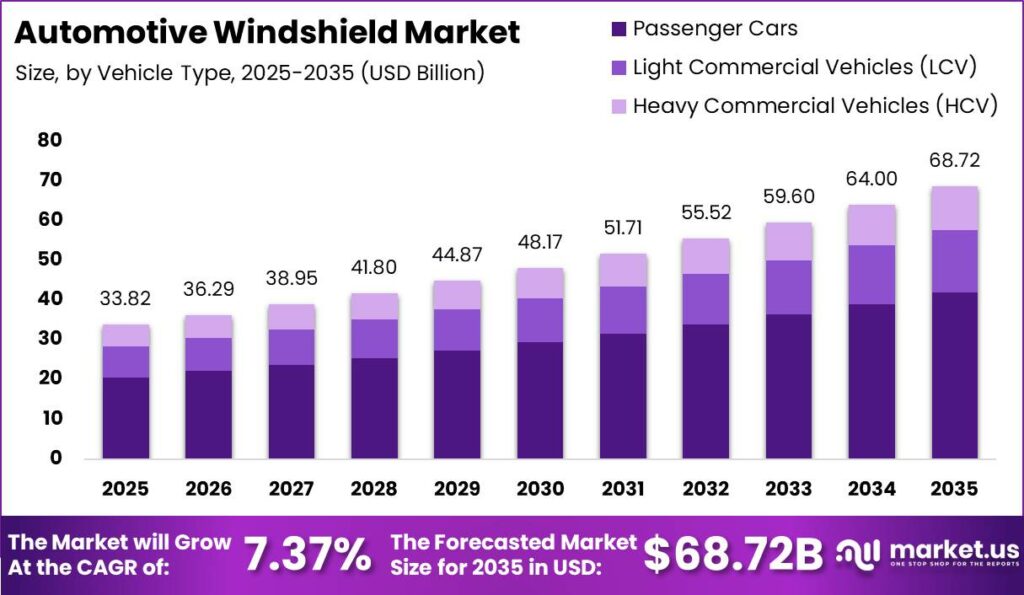
Global Automotive Windshield Market size is expected to be worth around USD 68.72 Billion by 2035 from USD 33.82 Billion in 2025, growing at a CAGR of 7.37% during the forecast period 2026 to 2035. Asia Pacific anchors this expansion with a 49.25% share worth USD 16.66 Billion. Suppliers with regional float and lamination capacity capture this value first.
Therefore buyers should understand how this market is built. Automotive windshields cover front and rear glazing supplied to passenger cars, light commercial vehicles and heavy commercial vehicles. Manufacturers split output between laminated and tempered constructions, then layer technology tiers on top. Those tiers run from conventional clear glass to acoustic, heated, infrared reflective, HUD-compatible and sensor-integrated designs. This structure lets one product line serve both volume fitment and premium content.
Key Takeaways
- Global market value stands at USD 33.82 Billion in 2025 and reaches USD 68.72 Billion by 2035.
- Forecast growth runs at a CAGR of 7.37% between 2026 and 2035.
- Passenger Cars lead the vehicle type segment with a 61.00% share.
- Front windshields hold 51.00% of the position segment.
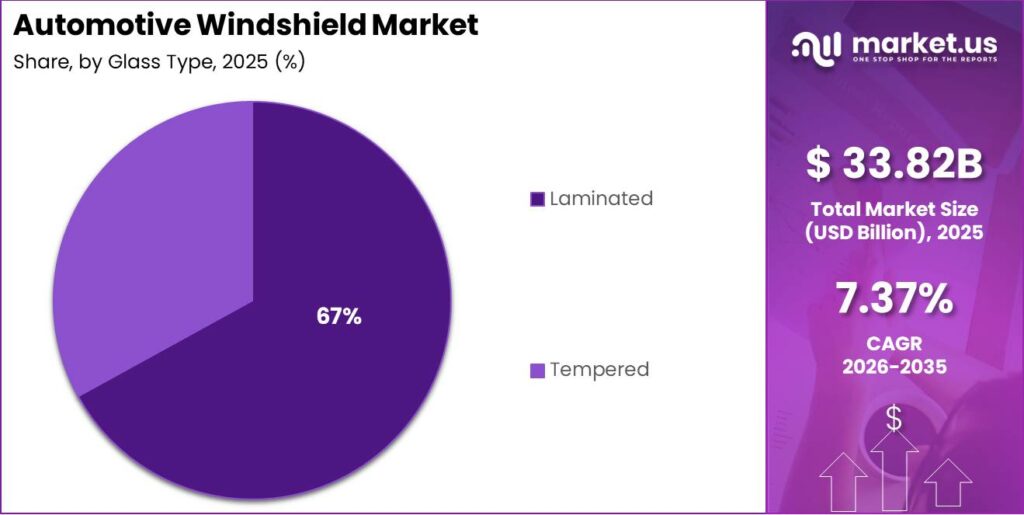
- Laminated glass controls 67.00% of the glass type segment.
- Conventional Clear Windshields lead technology types with 34.18%, while Sensor-Integrated Windshields grow fastest.
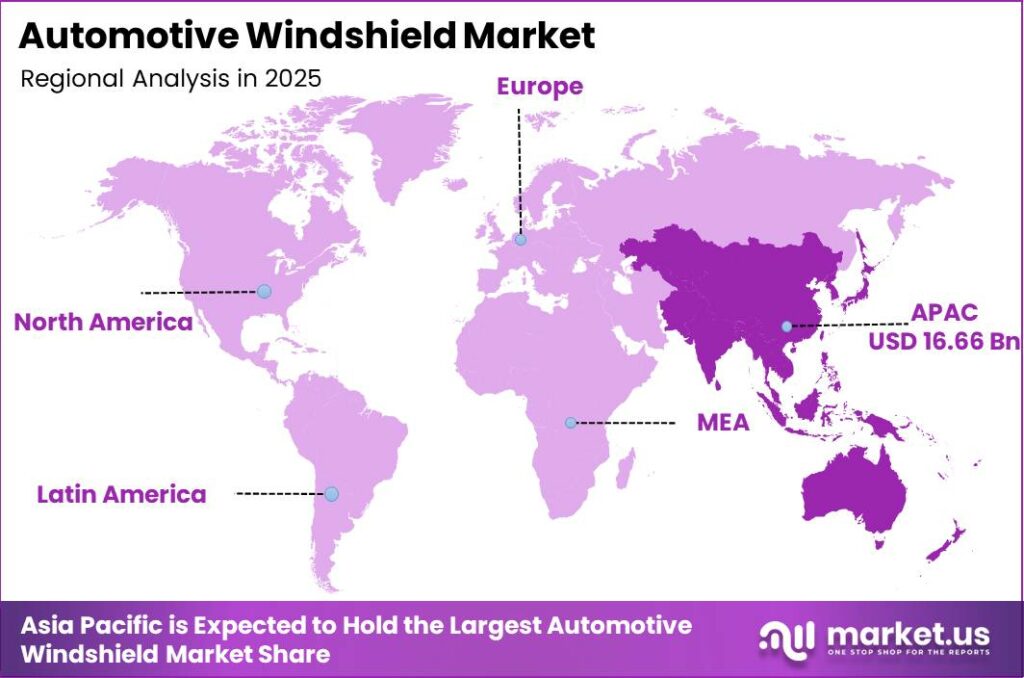
- Asia Pacific dominates with a 49.25% share valued at USD 16.66 Billion.
Safety regulation now decides windshield specification. According to Insurance Institute for Highway Safety data, forward-collision warning paired with automatic emergency braking cuts rear-end crashes by 50%. Those systems depend on windshield-mounted cameras. Consequently regulators and insurers treat the glass as a safety-critical part, which pushes automakers toward higher specification glazing and lifts average selling prices across every vehicle line.
Service rules follow the hardware. National Windscreens’ April 2025 ADAS Report indicates that 75% of ADAS cameras require static in-workshop calibration after windshield replacement. This requirement moves work away from roadside vans and into equipped premises. Aftermarket operators without calibration bays therefore lose jobs to networks that own them, which concentrates replacement revenue among fewer, better capitalised players.
Fitment channels have already shifted. Figures from National Windscreens’ April 2025 report show fixed fitting centre share of replacements doubled from about 15% to nearly 30%. Static calibration rules caused the move. As a result, investors should read physical site density and calibration equipment as the real barrier to entry in this market, not glass supply alone.
Vehicle Type Analysis
Passenger Cars dominates with 61.00% due to highest global car assembly volumes.
In 2025, Passenger Cars held a dominant market position in the By Vehicle Type segment of Automotive Windshield Market, with a 61.00% share. OICA reports global vehicle production rose from 92.7 million units in 2024 to 96.4 million in 2025. Each unit needs a front windshield at build. This means suppliers tied to car platforms gain volume automatically as assembly recovers.
Light commercial vehicles serve fleet buyers who value uptime over cabin refinement. ACEA reports new EU van registrations rose 8.3% in 2024, while global van production fell 4.6%. This gap shows demand outpacing local output. Consequently glazing suppliers with van-specific tooling can win share by shortening lead times for fleet replacement orders across Europe.
Heavy commercial vehicles use large flat glazing with long service lives and high damage exposure. As reported by ACEA, global truck production declined 8.3% in 2024 while world bus output reached 362,005 units, up 10.3%. Bus growth offsets truck weakness. Therefore suppliers should route heavy vehicle capacity toward bus and coach programmes to protect utilisation.
Position Analysis
Front dominates with 51.00% due to mandatory sensor and camera mounting.
In 2025, Front held a dominant market position in the By Position segment of Automotive Windshield Market, with a 51.00% share. Customs data compiled under HS code 700721 for laminated vehicle safety glass records global exports of USD 4.10 Billion. Front glazing drives most of that trade. This creates pricing power for exporters holding OEM homologation approvals.
Rear glazing carries defrost circuits, antennas and brand styling rather than sensor arrays. Comtrade based figures show Germany exported USD 1.13 Billion of safety glass under heading 7007 in 2023. German output skews toward premium rear and side units. As a result, suppliers competing on rear glass must sell embedded electrical function, because plain replacement glass invites low-cost import competition.
Buyers replace front glass far more often than rear because stone impact concentrates forward. Trade association guidance from the National Glass Association classifies front windshields as structural components supporting roof crush and airbag deployment. Rear units carry no such role. Therefore aftermarket networks should stock front SKUs deeply and treat rear glass as an order-in line to protect working capital.
Glass Type Analysis
Laminated dominates with 67.00% due to regulated windshield penetration resistance requirements.
In 2025, Laminated held a dominant market position in the By Glass Type segment of Automotive Windshield Market, with a 67.00% share. OICA data shows China produced 34.53 million vehicles in 2025, with new energy vehicle output at 16.626 million units, up 29%. In April 2026, Fuyao Glass and XPENG introduced AI controlled dimming privacy glass built into laminated vehicle glass. This signals laminated construction becoming the platform for electronic content.
Tempered glass suits side and rear applications where controlled shattering is required and cost pressure is high. OICA figures show India produced 6.49 million vehicles in 2025. Price sensitive small car programmes there favour tempered units outside the windshield. Consequently tempered capacity offers volume growth, but suppliers must accept thinner margins than laminated windshield work delivers.
Regulatory frameworks separate the two constructions permanently. UNECE Regulation No. 43 permits only laminated or plastic glazed panes in the forward vision area of most vehicle categories. Tempered glass cannot substitute there. Therefore investors evaluating capacity additions should treat laminated lines as the defensible asset and tempered lines as cyclical commodity exposure.
Technology Type Analysis
Conventional Clear Windshields dominates with 34.18% due to lowest cost mass fitment.
In 2025, Conventional Clear Windshields held a dominant market position in the By Technology Type segment of Automotive Windshield Market, with a 34.18% share. OICA data shows Japan produced 8.41 million vehicles in 2025. Volume programmes there still specify clear glazing widely. This means suppliers retain a large, stable base that funds investment in higher technology tiers.
Sensor-integrated windshields carry camera brackets, heated view zones and optical tolerance requirements. Figures from OICA show Asia Pacific production rose 7.6% to about 59.2 million vehicles, over 61% of global output. Sensor content is scaling fastest in that base. Therefore suppliers placing optical-grade capacity in Asia Pacific will capture the fastest growing technology tier first.
Premium technology tiers depend on mature, high-content vehicle fleets. OICA reports North American output slipped 0.8% to 17.2 million vehicles, while European regional production fell 2.1% to 18.74 million. Acoustic Windshields, Heated Windshields, HUD-Compatible Windshields and Infrared Reflective Windshields together hold the remaining share. This creates content-led growth even where unit volumes soften.
Key Market Segments
By Vehicle Type
- Passenger Cars
- Light Commercial Vehicles (LCV)
- Heavy Commercial Vehicles (HCV)
By Position
- Front
- Rear
By Glass Type
- Laminated
- Tempered
By Technology Type
- Conventional Clear Windshields
- Sensor-Integrated Windshields
- Acoustic Windshields
- Heated Windshields
- HUD-Compatible Windshields
- Infrared Reflective Windshields
Regional Analysis
Asia Pacific Dominates the Automotive Windshield Market with a Market Share of 49.25%, Valued at USD 16.66 Billion
Asia Pacific holds 49.25% of the global automotive windshield market, worth USD 16.66 Billion. Regional vehicle assembly scale explains this lead, because original equipment glazing demand follows build volume directly. This means suppliers without Asia Pacific float glass and lamination capacity compete for less than half of available revenue. Investors should treat regional plant proximity as the primary cost advantage in this market.
Europe advances through service network consolidation rather than assembly growth. In September 2025, Cary Group acquired Nationwide Windscreens (York) Limited and integrated it into National Windscreens, widening its UK repair and replacement footprint. This consolidation concentrates aftermarket demand within fewer branded networks. Consequently glass makers selling into Europe now negotiate with larger buying groups, which compresses distributor margins and rewards suppliers holding approved fitment status.
Key Regions and Countries
North America
- US
- Canada
Europe
- Germany
- France
- The UK
- Spain
- Italy
- Rest of Europe
Asia Pacific
- China
- Japan
- South Korea
- India
- Australia
- Rest of APAC
Latin America
- Brazil
- Mexico
- Rest of Latin America
Middle East and Africa
- GCC
- South Africa
- Rest of MEA
Market Dynamics
Market Opportunity Analysis - Underweighted positions, constructions and regions leave open entry points for focused suppliers
Rear glazing holds the smaller side of the position segment against Front at 51.00%. Buyers there accept commodity pricing, so few suppliers invest in differentiation. This creates space for entrants selling embedded antennas and defrost circuits as electrical content. New players can win rear programmes without competing against established front windshield homologations.
Tempered glass sits well behind Laminated at 67.00% of the glass type segment, yet it carries the fastest growing label. Volume programmes in price sensitive markets sustain that demand. Therefore investors can enter through tempered capacity at lower capital intensity than optical-grade laminated lines require, then use that cash flow to fund laminated expansion later.
Heavy Commercial Vehicles remain the smallest vehicle type position behind Passenger Cars at 61.00%. Fleet operators replace glass on long service cycles, which discourages generalist suppliers. This means specialists offering large-format flat glazing and on-site fitment face limited competition. Early movers can lock multi-year fleet contracts before larger players redirect capacity there.
Regions outside Asia Pacific share the balance of the 49.25% leader position. Latin America and Middle East and Africa carry thin local lamination capacity. Consequently importers dominate supply and lead times stay long. Entrants building regional finishing plants can undercut import pricing while capturing aftermarket replacement demand that incumbents serve slowly.
Technology and Innovation Landscape - Thermal, optical and lightweight glazing advances reset supplier value per unit
Pulsed heated glazing changes winter performance sharply. A January 2026 report shows a Lexus RX demonstration clearing ice in about 75 seconds against more than 16 minutes for standard HVAC defrost. Drivers gain immediate usability. This creates a premium feature automakers can market directly, so suppliers offering heated windshields move from cost-per-unit bidding into feature-led negotiation.
The same system delivers measurable vehicle economics. Data from the January 2026 report shows up to 38 km of extra EV range per day in winter and roughly USD 600 per vehicle saved in battery costs. Automakers therefore treat heated glazing as a battery offset rather than a comfort option. Suppliers should price against battery savings, not against plain glass.
Optical projection defines the next content tier. Valeo’s 2024 product datasheet indicates its augmented reality head-up display exceeds an 11° × 4° field of view projected onto the windshield. Acoustic laminated designs meanwhile cut cabin noise by up to 6 dB, reaching 15 dB in advanced cases. This signals two separate premium revenue layers on one panel.
Material substitution attacks weight directly. Corning states Gorilla Glass automotive windows weigh 20 to 60% less than conventional glass, with a chemically strengthened inner layer near half a millimetre thick. Corning-sourced reporting shows hybrid windshields cutting weight about 40%, roughly 10 lbs, while tripling optical clarity. Consequently EV programmes chasing range will pay for glazing that removes mass.
Drivers
Windshields now host forward-facing cameras, LiDAR windows and rain-light modules. Every replacement therefore triggers a mandatory static or dynamic recalibration event. Collision-network operational reporting shows post-repair ADAS calibration attach rates reached about 65% across all makes by Q2 2025, above the 60% first projected. Fleet mix shifted toward late-model vehicles with heavier sensor content, which turns a passive part into a sensor-hosting substrate.
A calibrated windshield replacement commands roughly USD 150 to USD 300 more per unit than a legacy swap. Suppliers consequently move from component sales toward bundled part-plus-service revenue. OICA production statistics confirm a widening base of ADAS-equipped vehicles, which anchors an active +2.3% CAGR contribution. Investors should favor players controlling authorized calibration nodes across North America, Europe and China.
| Driver | (~) % Impact on CAGR Forecast | Geographic Relevance | Impact Timeline |
|---|---|---|---|
| ADAS Sensor Integration & Recalibration Mandates | +2.3% | North America, Europe, China | Short term (2 years or less) |
| Rising Laminated & Acoustic Glazing Penetration | +1.6% | Global, premium-led in Europe | Short term (2 years or less) |
| EV Lightweighting & Thermal-Efficient Glazing Demand | +1.4% | China, Europe, North America | Medium term (2 to 4 years) |
| Panoramic & Large-Format Windshield Trend | +1.1% | Asia-Pacific, North America | Medium term (2 to 4 years) |
| Aftermarket Replacement Cycle Expansion | +0.9% | Global, mature fleets in US & EU | Short term (2 years or less) |
| Tightening Occupant-Safety Glazing Standards | +0.7% | Europe, India, North America | Medium term (2 to 4 years) |
Restraints
Original equipment windshield demand derives directly from vehicle assembly volumes. OICA and independent production tracking data show global light-vehicle output falling about 1.6% to roughly 78 million units in 2025, the steepest drop in five years. Company filings deepen the drag, with GM guiding to a 6.4% production cut and Ford to 2.8%. Each unit not built removes one windshield fitment plus its calibration attach.
Market.us characterises medium-term planning across the sector as virtual gridlock. Tariff exposure and soft consumer demand compound at the same time. This creates deferred glazing capital expenditure, underutilised float lines and direct top-line compression. The resulting -1.8% deduction stands as the single largest active drag, so suppliers in North America and Europe should protect cash rather than add capacity now.
| Restraint | (~) % Impact on CAGR Forecast | Geographic Relevance | Impact Timeline |
|---|---|---|---|
| Contracting Global Light-Vehicle Production | -1.8% | Global, sharpest in North America & Europe | Short term (2 years or less) |
| Tariff-Driven Input & Component Cost Inflation | -1.3% | North America, cross-border trade lanes | Short term (2 years or less) |
| Elevated Interest Rates Suppressing Vehicle Demand | -0.9% | Global, credit-sensitive markets | Short term (2 years or less) |
| Energy-Cost-Linked Float Glass Price Volatility | -0.7% | Europe, UK, energy-import regions | Short term (2 years or less) |
| Faltering Near-Term EV Demand | -0.5% | North America, Europe | Short term (2 years or less) |
Challenges
Rising ADAS attach rates have outpaced the certified technician pipeline able to perform OEM-compliant calibration. U.S. Bureau of Labor Statistics workforce data shows technician headcount growth trailing double-digit expansion in ADAS-equipped registrations. Independent shops therefore sublet calibration work, adding roughly 3 to 7 days of lead time per job and eroding net service margins by an estimated 8 to 12 percentage points.
This gap creates a training and equipment revenue stream for whoever closes it. Apprenticeship figures from industry associations show a multi-year ramp before supply matches demand, which anchors the -1.1% friction drag. Companies building certified academies, standardised targets and mobile calibration units can sell capacity to rivals. Early movers in North America and Europe will monetise scarcity rather than suffer it.
| Challenge | (~) % CAGR Friction Drag | Geographic Relevance | Mitigation Horizon |
|---|---|---|---|
| Calibration Technician Talent Deficit | -1.1% | North America, Europe | Medium term (2 to 4 years) |
| Rising Complexity Repair Fragility | -0.8% | Global, mature aftermarket regions | Medium term (2 to 4 years) |
| Raw-Material & Logistics Bottlenecks | -0.7% | Global, cross-border supply lanes | Short term (2 years or less) |
| Recycling & PVB Circularity Gaps | -0.5% | Europe, regulatory-led markets | Long term (4 years or more) |
| OEM Calibration Standard Fragmentation | -0.4% | Global, brand-specific protocols | Medium term (2 to 4 years) |
Opportunities
Augmented-reality head-up display projection remains confined to a narrow premium tier. Suppliers must co-develop wedge-PVB interlayers, low-distortion glass and picture-generation hardware. Windshield-type units already account for about 72.85% of head-up display architecture per 2025 configuration tracking, yet AR-grade windshields reach only a small fraction of production. This leaves genuine white space rather than an active driver.
Unit economics decide the prize. An AR-optimised windshield can command roughly 2x to 4x the price of a conventional laminated unit and lift gross margins by an estimated 10 to 18 percentage points. Intergovernmental transport-electronics tracking puts head-up display growth at 10% to 15% CAGR. Early movers scaling optical-grade interlayer lines capture the +2.1% upside first.
| Opportunity | (~) % Potential CAGR Upside | Geographic Relevance | Execution Window |
|---|---|---|---|
| AR Head-Up Display Windshield Integration | +2.1% | Asia-Pacific, North America, Europe | Medium term (2 to 4 years) |
| Smart Switchable & Solar-Control Glazing | +1.5% | China, Middle East, North America | Medium term (2 to 4 years) |
| Embedded Antenna & Connectivity Glazing | +1.2% | Global, 5G-advanced markets | Long term (4 years or more) |
| Aftermarket Calibration Roll-Up M&A | +1.0% | North America, Europe | Medium term (2 to 4 years) |
| Closed-Loop Glass Recycling Monetization | +0.8% | Europe, regulatory-led regions | Long term (4 years or more) |
| Autonomous-Ready Sensor Windshield Platforms | +0.6% | North America, China | Long term (4 years or more) |
Key Company Insights
AGC Inc. competes as a full-range glazing supplier across laminated and tempered constructions. As per our research, the company ranks among 21 tracked key players in this market, and breadth across every technology tier lets it move customers upward without losing the account. This creates pricing resilience. However, wide product scope spreads engineering resources thinly against focused sensor-glazing specialists.
Saint-Gobain positions around advanced glazing content rather than commodity volume, targeting acoustic, heated and HUD-compatible windshield categories. As per our research, this focus aligns the company with the highest value tiers of the technology segment, where price premiums are widest. This signals strong margin potential. However, dependence on premium vehicle programmes exposes revenue whenever luxury production schedules tighten.
Key Players
- AGC Inc.
- Saint-Gobain
- Nippon Sheet Glass Co., Ltd.
- Şişecam Group
- Central Glass Co., Ltd.
- Guardian Glass
- Fuyao Glass Industry Group
- Vitro Automotive Glass
- Xinyi Glass Holdings Limited
- Gentex Corporation
- Dura Automotive
- Schott Corp.
- Magna International
- 3M Shenzhen Benson Automobile Glass
- Corning Incorporated
- Asahi India Glass Ltd.
- Samvardhana Motherson Automotive Glass
- Olimpia Auto Glass
- PGW Auto Glass
- Safelite Group
- NordGlass
Recent Developments
- May 2025: PGW Auto Glass acquired Dakotaland Autoglass, an automotive replacement glass distributor and installer operating 13 locations across South Dakota, North Dakota, Minnesota and Iowa.
- February 2026: Saint-Gobain Sekurit, ZEISS, tesa and Hyundai Mobis formed QuadAlliance to accelerate development and industrialization of holographic windshield display systems.
- June 2026: PGW Auto Glass acquired Windshield Surgeons, expanding its automotive glass distribution, repair and replacement operations in Alberta, Canada.
Geopolitical Impact Analysis
Trade policy now sets landed windshield costs. According to WTO monitoring, new tariff measures on vehicles and parts reaching 25% raise costs across North American cross-border glazing lanes. Data from UNCTAD shows Red Sea rerouting around the Cape of Good Hope adding roughly 3,500 nautical miles per voyage. Longer transits inflate freight on bulky laminated panels, so buyers must hold more inventory.
Energy prices decide float glass economics. IEA analysis shows European natural gas prices staying multiples above pre-2021 levels, and float furnaces run continuously on gas. World Bank commodity tracking records sustained volatility in industrial energy inputs. Therefore European producers face structurally higher melting costs than Asian rivals. This creates lasting cost advantage for Asia Pacific capacity and pressure on European margins.
Report Scope
| Report Features | Description |
|---|---|
| Market Value (2025) | USD 33.82 Billion |
| Forecast Revenue (2035) | USD 68.72 Billion |
| CAGR (2026-2035) | 7.37% |
| Base Year for Estimation | 2025 |
| Historic Period | 2020-2024 |
| Forecast Period | 2026-2035 |
| Report Coverage | Revenue Forecast, Market Dynamics, Market Opportunity Analysis, Technology and Innovation Landscape, Competitive Landscape, Recent Developments |
| Segments Covered | By Vehicle Type (Passenger Cars, Light Commercial Vehicles (LCV), Heavy Commercial Vehicles (HCV)), By Position (Front, Rear), By Glass Type (Laminated, Tempered), By Technology Type (Conventional Clear Windshields, Sensor-Integrated Windshields, Acoustic Windshields, Heated Windshields, HUD-Compatible Windshields, Infrared Reflective Windshields) |
| Regional Analysis | North America (US and Canada), Europe (Germany, France, The UK, Spain, Italy, and Rest of Europe), Asia Pacific (China, Japan, South Korea, India, Australia, and Rest of APAC), Latin America (Brazil, Mexico, and Rest of Latin America), Middle East and Africa (GCC, South Africa, and Rest of MEA) |
| Competitive Landscape | AGC Inc., Saint-Gobain, Nippon Sheet Glass Co., Ltd., Şişecam Group, Central Glass Co., Ltd., Guardian Glass, Fuyao Glass Industry Group, Vitro Automotive Glass, Xinyi Glass Holdings Limited, Gentex Corporation, Dura Automotive, Schott Corp., Magna International, 3M Shenzhen Benson Automobile Glass, Corning Incorporated, Asahi India Glass Ltd., Samvardhana Motherson Automotive Glass, Olimpia Auto Glass, PGW Auto Glass, Safelite Group, NordGlass |
| Customization Scope | Customization for segments, region / country-level will be provided. Additional customization can be done based on requirements. |
| Purchase Options | We have three licenses to opt for: Single User License | Multi-User License (Up to 5 Users) | Corporate Use License (Unlimited User and Printable PDF) |





































