


Report Overview
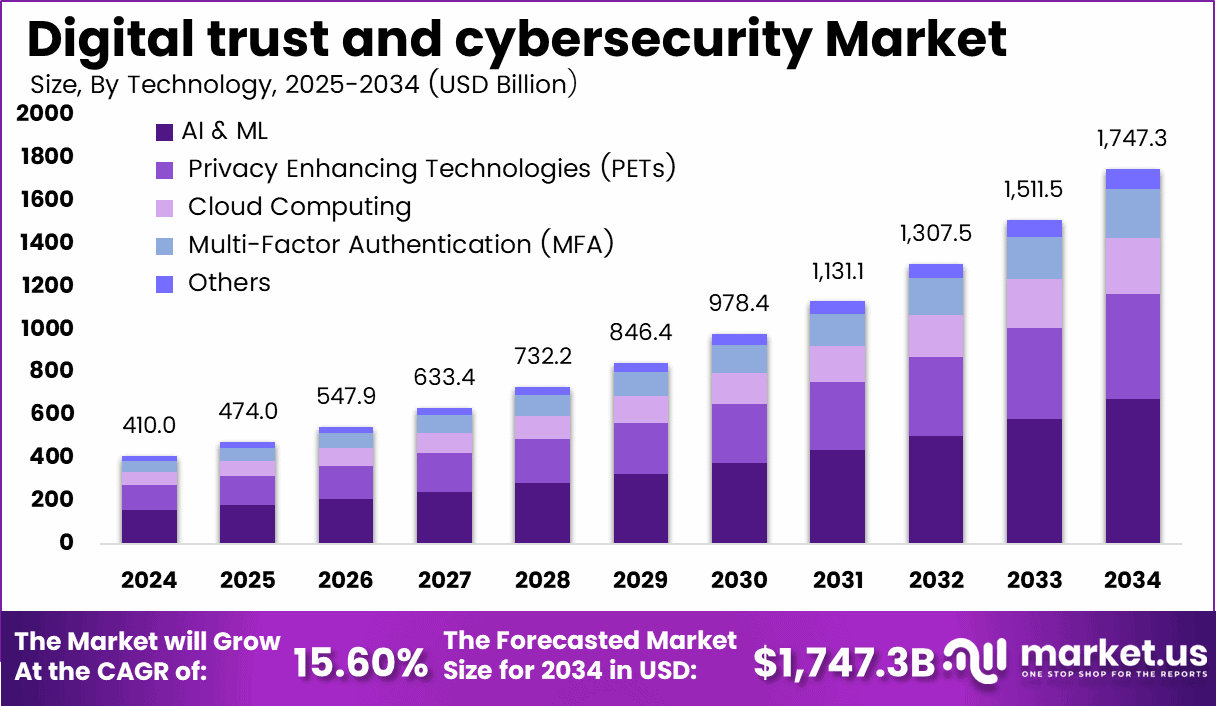
In 2024, the Global Digital Trust and Cybersecurity Market was valued at USD 410.0 billion. The market is projected to grow at a CAGR of 15.6% during 2025–2034, reaching approximately USD 1,747.3 billion by 2034. North America dominated the global market in 2024, accounting for more than 35.3% of the total market share and generating approximately USD 157.4 billion in revenue.
Cloud adoption is creating a larger security requirement across enterprises. In 2025, 52.7% of EU enterprises used paid cloud services, up 7.4 percentage points from 2023. Security software was the most common cloud application, used by 65.5% of these businesses, increasing demand for identity controls, encryption, threat detection, and compliance monitoring.
Cybercrime losses are also pushing organizations to strengthen security spending. The FBI recorded 859,532 suspected cybercrime complaints in 2024, with reported losses exceeding USD 16 billion, representing a 33% increase from 2023. This rising financial exposure is supporting investment in prevention, detection, recovery, and digital identity solutions.
The U.S. digital economy contributed nearly USD 2.6 trillion to national output in 2022, while CISA reported blocking 2.62 billion malicious connections across federal civilian networks and 371 million within critical infrastructure environments during 2025, reinforcing demand for continuous monitoring, zero-trust access, cloud security, and cyber resilience.
Key Takeaways
- The Global Digital Trust and Cybersecurity Market was valued at USD 410.0 billion in 2024 and is projected to reach USD 1,747.3 billion by 2034, growing at a 15.6% CAGR.
- Solutions dominated the component segment with a 75.4% share, driven by demand for integrated security, compliance, automation, and threat detection platforms.
- AI & ML led the technology segment with a 38.7% share, supported by predictive analytics, real-time monitoring, and automated response systems.
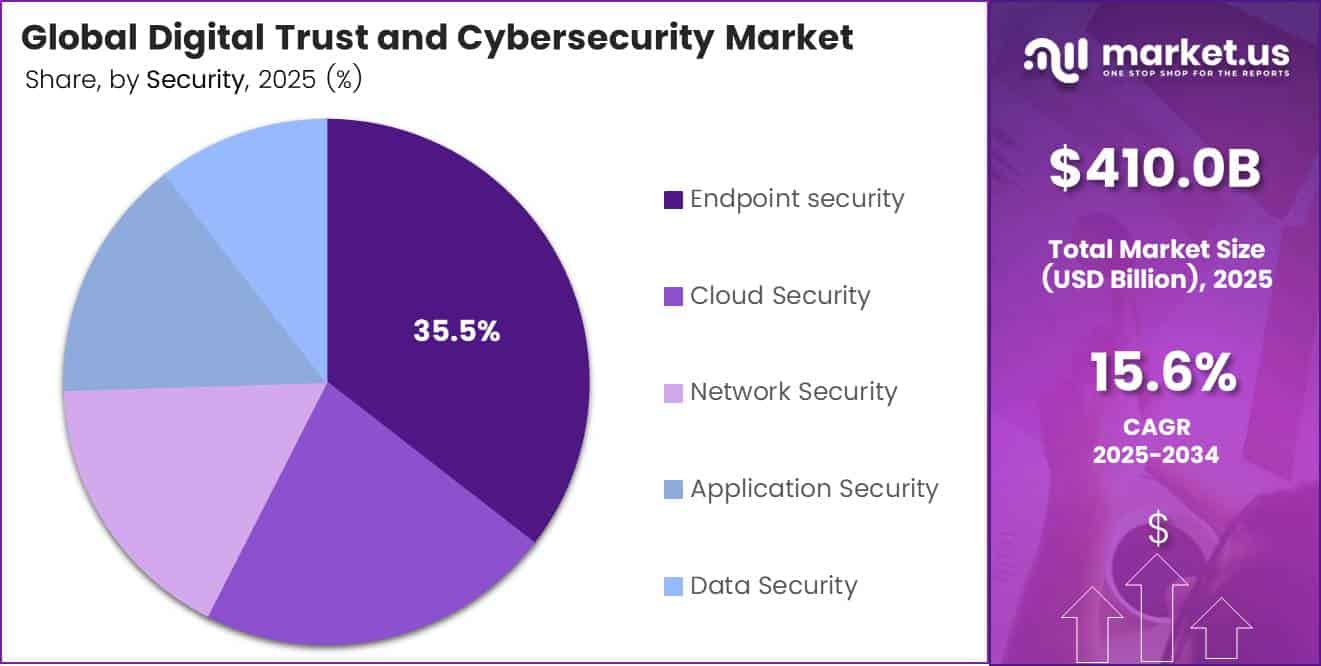
- Endpoint security held the largest security share at 35.5%, driven by growing risks across remote work, mobile devices, and IoT endpoints.
- Large enterprises accounted for a 72.8% share, supported by higher security budgets, regulatory requirements, and complex digital infrastructure.
- BFSI led the end-use segment with a 34.6% share, driven by strong demand for fraud detection, encryption, MFA, and protection of sensitive financial data.
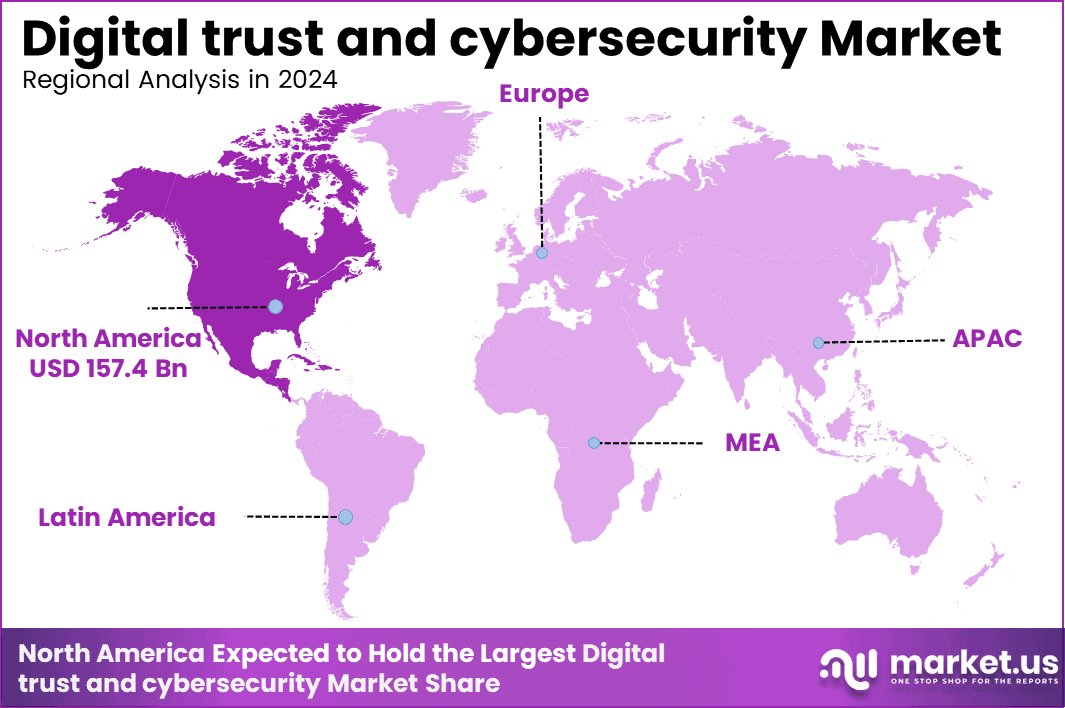
- North America led the market in 2024 with more than 35.3% share, generating approximately USD 157.4 billion in revenue.
By Component
Solutions accounted for a 75.4% share, while services held 24.6%. Solutions dominate as enterprises prioritize integrated security platforms to address complex digital risks. Organizations are increasingly deploying advanced solutions for compliance, automation, and threat detection, which ensures scalability and adaptability across industries.
The rising need for unified defense mechanisms over fragmented tools strengthens adoption. Additionally, digital transformation in BFSI and healthcare emphasizes reliable solutions, pushing vendors to innovate modular platforms. This trend keeps solutions ahead in overall penetration.
By Technology
AI & ML led with 38.7% share, followed by Privacy Enhancing Technologies (PETs) at 22.3%. AI adoption is propelled by predictive analytics, real-time monitoring, and automated response systems. Enterprises leverage AI-enabled models to reduce detection times and manage evolving threats.
Machine learning supports anomaly detection and adaptive authentication, driving consistent uptake. Regulatory backing for AI innovations enhances confidence, while integration across cloud and endpoint environments cements dominance. These advantages reinforce AI & ML’s top position among cybersecurity technologies.
By Security
Endpoint security dominated with a 35.5% share, while Cloud Security captured 21.7%. The widespread use of remote work, mobile devices, and IoT endpoints amplifies vulnerabilities, driving demand for endpoint-focused defenses. Enterprises prioritize protection against malware, ransomware, and phishing attacks.
Policies like BYOD further strengthen reliance on endpoint protection platforms. Regulatory emphasis on endpoint monitoring within compliance frameworks boosts adoption. With hybrid workplaces and edge computing expansion, endpoint security maintains leadership compared to cloud, network, and application security counterparts.
By Enterprise Size
Large enterprises represented a 72.8% share, whereas small & medium enterprises accounted for 27.2%. Larger firms benefit from higher budgets, regulatory obligations, and extensive digital infrastructures requiring layered defenses. They deploy advanced multi-layered architectures across cloud, data, and applications.
Adoption of AI-driven platforms and cyber resilience strategies is stronger here, given exposure to global threats. With increasing compliance audits and reputational risks, large enterprises set standards in cybersecurity spending, maintaining dominance over SMEs that still face budget limitations.
By End Use
BFSI held a 34.6% share, while healthcare & life sciences followed with 21.8%. The sector faces constant attacks due to sensitive, high-value financial data, compelling investments in fraud detection, encryption, and MFA. Regulators enforce stringent cybersecurity upgrades across digital banking and insurance systems.
Fintech expansion and mobile payments further elevate risk exposure. BFSI leads by adopting AI-enabled fraud prevention systems, securing transactions, and safeguarding customer data. Strong regulatory pressure ensures its continued dominance compared to other end-use verticals.
Key Market Segment
By Component
- Solution
- Services
By Technology
- AI & ML
- Privacy Enhancing Technologies (PETs)
- Cloud Computing
- Multi-Factor Authentication (MFA)
- Others
By Security
- Endpoint security
- Cloud Security
- Network Security
- Application Security
- Data Security
By Enterprise Size
- Small & Medium size
- Large Enterprises
By End Use
- Banking, Financial Services, and Insurance (BFSI)
- Healthcare and Life Sciences
- Retail and E-commerce
- IT and Telecommunications
- Government Sector
- Others
Regional Analysis
North America leads the digital trust and cybersecurity market with USD 157.4 billion in 2024, holding over 36% of the global share, driven by robust cloud adoption and AI threat detection, with 40% of firms embracing zero-trust models under NIST guidelines. Europe follows, focusing on GDPR compliance, with 25-30% adopting advanced endpoint tools, though growth is steadier.
APAC is a rising star, capturing a 20-25% share, fueled by e-commerce booms in India and China, where mobile security demand spikes with 13% yearly cyber incidents. Latin America and MEA lag at under 10%, but target 15% + growth via affordable SaaS solutions for emerging markets.
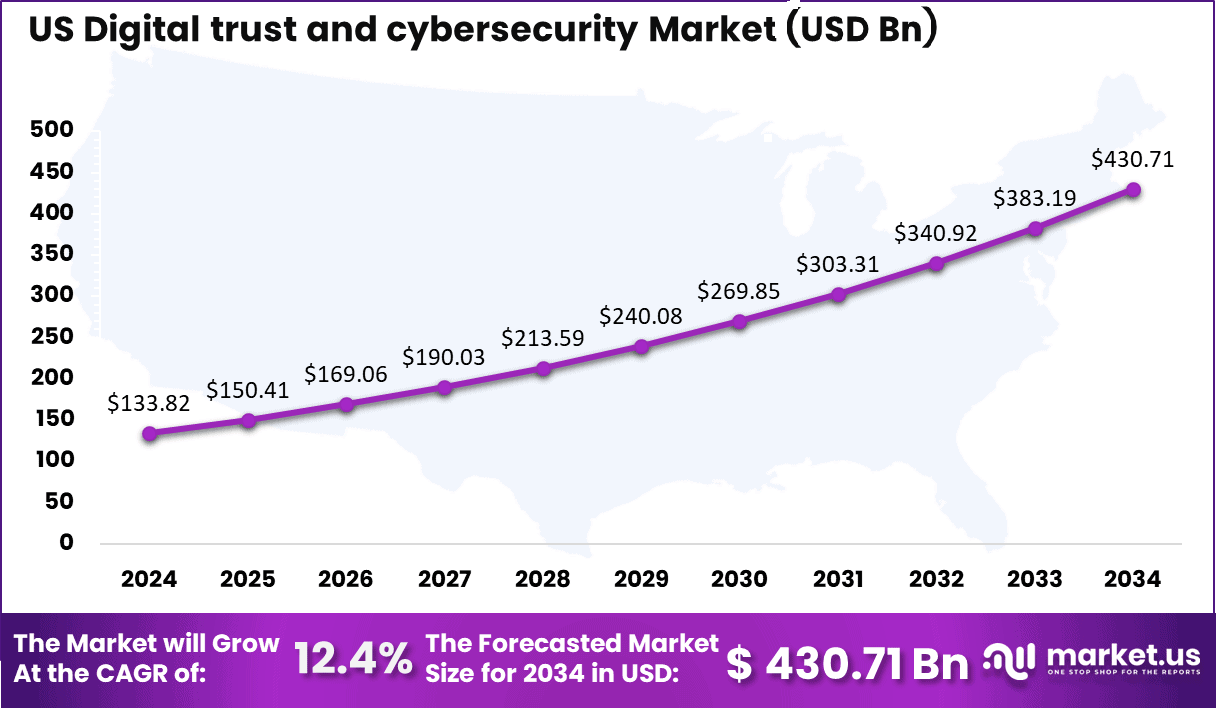
The US digital trust and cybersecurity market is thriving, starting at a robust figure in 2024 and projected to grow significantly by 2034, fueled by a strong annual growth rate. This expansion reflects heightened demand for cutting-edge security solutions amid rising cyber threats, with North America leading the charge due to its advanced technological infrastructure and proactive regulatory environment.
US Market Size
The US digital trust and cybersecurity market is a standout, starting at USD 133.8 billion in 2024 and projected to reach USD 430.7 billion by 2034, driven by a solid 12.4% CAGR. This growth reflects a surge in demand for robust defenses against rising cyber threats, with North America leading at USD 157.4 billion this year, holding over 36% of the global share.
Key drivers include cloud adoption, AI-powered threat detection, and strict regulations like NIST frameworks, pushing 40% of firms toward zero-trust models. The focus on endpoint security, commanding 35.5% of spending, underscores a proactive shift to secure daily operations.
Key Regions and Countries
- North America
- US
- Canada
- Europe
- Germany
- France
- The UK
- Spain
- Italy
- Rest of Europe
- Asia Pacific
- China
- Japan
- South Korea
- India
- Australia
- Singapore
- Rest of Asia Pacific
- Latin America
- Brazil
- Mexico
- Rest of Latin America
- Middle East & Africa
- South Africa
- Saudi Arabia
- UAE
- Rest of MEA
Market Dynamics
Drivers
| Driver | (~) % Impact on CAGR Forecast | Geographic Relevance | Impact Timeline |
|---|---|---|---|
| Mandatory cyber disclosure | +2.4% | North America and Europe | Short term (2 years or less) |
| Cloud workload expansion | +2.1% | Global | Medium term (2 to 4 years) |
| Critical infrastructure protection | +1.8% | North America, Europe and Asia-Pacific | Medium term (2 to 4 years) |
| AI security controls | +1.6% | Global | Short term (2 years or less) |
| Identity security adoption | +1.3% | Global | Medium term (2 to 4 years) |
Mandatory cyber disclosure
Cybersecurity is increasingly treated as a board-level risk and compliance requirement rather than a discretionary IT expense. The U.S. SEC rules adopted on 26 July 2023 require listed companies to disclose material cybersecurity incidents within 4 business days after determining materiality, while the EU requires NIS2 transposition by 17 October 2024.
Rising cyber losses are reinforcing this shift. The FBI recorded 859,532 suspected internet-crime complaints and more than $16 billion in reported losses in 2024. These pressures are increasing demand for continuous monitoring, incident response, identity verification, forensics, and compliance tools, supporting stronger recurring security subscriptions and faster procurement cycles.
Restraints
| Restraint | (~) % Impact on CAGR Forecast | Geographic Relevance | Impact Timeline |
|---|---|---|---|
| Public-sector budget constraints | -1.6% | North America and Europe | Short term (2 years or less) |
| Fragmented NIS2 implementation | -1.2% | Europe | Short term (2 years or less) |
| SME affordability limits | -1.0% | Global | Medium term (2 to 4 years) |
| Data-localization barriers | -0.8% | Asia-Pacific, Europe and Middle East | Medium term (2 to 4 years) |
| Lengthy procurement cycles | -0.7% | Global | Short term (2 years or less) |
Public-sector budget constraints
Public-sector funding constraints remain a major restraint because governments and regulated operators may delay multi-year cybersecurity upgrades when fiscal pressure increases. In 2025, CISA reported blocking 2.62 billion malicious connections across federal civilian networks and 371 million in critical-infrastructure environments, highlighting the scale of security operations that require sustained funding.
The World Economic Forum found that 38% of public-sector respondents reported insufficient cyber resilience in 2025, compared with 10% of medium-to-large private-sector respondents. The European Commission also initiated infringement action involving 23 Member States over NIS2 transposition gaps, contributing to slower contract awards, price pressure, and delayed security modernization.
Challenges
| Challenge | (~) % CAGR Friction Drag | Geographic Relevance | Mitigation Horizon |
|---|---|---|---|
| Cybersecurity talent shortage | -1.9% | Global | Long term (4 years or more) |
| Third-party risk visibility | -1.5% | Global | Medium term (2 to 4 years) |
| AI control maturity | -1.3% | Global | Medium term (2 to 4 years) |
| Tool stack complexity | -1.1% | North America, Europe and Asia-Pacific | Medium term (2 to 4 years) |
| Legacy OT integration | -0.9% | Global industrial markets | Long term (4 years or more) |
Cybersecurity talent shortage
The cybersecurity talent shortage remains a major operational challenge because organizations can buy security tools but may lack enough skilled staff to configure systems, monitor threats, and respond quickly. ISC2 estimated a global workforce gap of about 4.8 million cybersecurity professionals in 2024, while only 37% of organizations had processes to assess AI-tool security before deployment in 2025.
Threat volumes also remain high. ENISA reviewed 4,875 incidents between 1 July 2024 and 30 June 2025, showing the continuing pressure on security teams. This shortage increases managed-service costs, extends implementation timelines, and reduces software effectiveness, making automation, simpler integration, and stronger service-channel capacity increasingly important.
Opportunities
| Opportunity | (~) % Potential CAGR Upside | Geographic Relevance | Execution Window |
|---|---|---|---|
| SME managed security | +2.0% | Global | Medium term (2 to 4 years) |
| AI agent governance | +1.8% | Global | Medium term (2 to 4 years) |
| Machine identity monetization | +1.5% | Global | Medium term (2 to 4 years) |
| Industrial cyber insurance | +1.2% | North America, Europe and Asia-Pacific | Long term (4 years or more) |
| Regional security clouds | +1.0% | Europe, Middle East and Asia-Pacific | Long term (4 years or more) |
SME managed security
SME managed security remains a future growth opportunity because many smaller organizations still lack the staff, predictable budgets, and purchasing capacity needed to operate enterprise-grade cybersecurity tools. In 2025, about 35% of small organizations considered their cyber resilience inadequate, while reported cybercrime losses exceeded $16 billion in 2024, highlighting the need for affordable protection.
Eurostat found that 52.7% of EU enterprises used paid cloud services in 2025, creating a large base for bundled cloud security, identity protection, and backup services. Standardized onboarding and automated monitoring can lower service costs, improve margins, and shift revenue toward recurring subscriptions, potentially adding about 2.0% to CAGR.
Key Player Analysis
Tier-1 leadership is concentrated among hyperscale cloud platforms and large security vendors. Microsoft leads with FY2025 revenue of USD 281.7 billion, Microsoft Cloud revenue of USD 168.9 billion, and R&D spending of USD 32.5 billion, equal to 12% of revenue. Its estimated cybersecurity and digital-trust footprint represents around 20–24% of the named peer group.
AWS is another major platform leader, with revenue reaching USD 129 billion in 2025, up 20%, supported by embedded security, identity, and compliance services. Cisco reported FY2025 revenue of USD 56.7 billion and R&D spending of USD 9.3 billion, while its security business is approximately USD 8 billion, supporting an estimated 5–7% position within the peer group.
Among security-focused vendors, Palo Alto Networks generated about USD 9.2 billion in FY2025 revenue and spent USD 1.98 billion on R&D, or roughly 21.5% of sales. Fortinet reported USD 6.8 billion in FY2025 revenue, while Check Point generated around USD 2.56 billion in the latest tracked year. Together, these three are estimated to represent 11–14% of the named-player pool.
Tier-2 competitors include Proofpoint, DigiCert, OneTrust, RSA, Sophos, and Centrify, which focus on specialized areas such as email security, PKI, privacy, and identity. Proofpoint is estimated at around USD 2.0 billion in annual revenue, although private-company figures are harder to compare directly. Competitive intensity is increasingly shifting toward bundled cloud-security, identity, and compliance platforms, where large vendors benefit from broader distribution and integration.
Top Key Players
- Amazon Web Services, Inc.
- Cisco Systems, Inc.
- DigiCert, Inc.
- IBM Corporation
- Microsoft Corporation
- Oracle
- OneTrust, LLC
- RSA Security USA LLC
- Salesforce, Inc.
- Symantec (by Broadcom)
- Fortinet, Inc.
- BAE Systems Plc
- Centrify Corporation
- Check Point Software Technology Ltd.
- Palo Alto Networks, Inc.
- Proofpoint, Inc.
- Sophos Ltd.
- Others
Recent Development
- In February 2026, Palo Alto Networks completed its acquisition of CyberArk, adding identity security as a core platform pillar. The transaction delivered $45.00 cash plus 2.2005 Palo Alto shares per CyberArk share, based on the merger terms announced with an approximately $25 billion equity value; it brings privileged-access, machine-identity and agentic-AI identity controls into Palo Alto’s network-, cloud- and SOC-security portfolio.
- In March 2026, Google completed its acquisition of Wiz for $32 billion in cash, after announcing the agreement in March 2025. Wiz joined Google Cloud while retaining its brand and multicloud operating model, creating one of the largest cloud-security platform combinations and materially expanding Google Cloud’s CNAPP, posture-management, and cloud workload protection capabilities.
- In May 2025, Proofpoint agreed to acquire Hornetsecurity, a European Microsoft 365-security, compliance, and security-awareness provider with more than $160 million in annual recurring revenue, over 20% year-over-year growth, and more than 700 employees ultimately added to Proofpoint. Proofpoint disclosed total consideration of $1.8 billion when it completed the transaction in December 2025.
Report Scope
| Report Features | Description |
|---|---|
| Market Value (2024) | USD 410.0 Bn |
| Forecast Revenue (2034) | USD 1,747.3 Bn |
| CAGR(2025-2034) | 15.6% |
| Base Year for Estimation | 2024 |
| Historic Period | 2020-2023 |
| Forecast Period | 2025-2034 |
| Report Coverage | Revenue forecast, AI impact on Market trends, Share Insights, Company ranking, competitive landscape, Recent Developments, Market Dynamics, nd Emerging Trends |
| Segments Covered | By Component (Solution, Services), By Technology (AI & ML, Privacy Enhancing Technologies (PETs), Cloud Computing, Multi-Factor Authentication (MFA), Others), By Security (Endpoint security, Cloud Security, Network Security, Application Security, Data Security), By Enterprise Size (Small & Medium size, Large Enterprises), By End Use (Banking, Financial Services, and Insurance (BFSI), Healthcare and Life Sciences, Retail and E-commerce, IT and Telecommunications, Government Sector, Others) |
| Regional Analysis | North America – US, Canada; Europe – Germany, France, The UK, Spain, Italy, Russia, Netherlands, Rest of Europe; Asia Pacific – China, Japan, South Korea, India, New Zealand, Singapore, Thailand, Vietnam, Rest of Latin America; Latin America – Brazil, Mexico, Rest of Latin America; Middle East & Africa – South Africa, Saudi Arabia, UAE, Rest of MEA |
| Competitive Landscape | Amazon Web Services, Inc., Cisco Systems, Inc., DigiCert, Inc., IBM Corporation, Microsoft Corporation, Oracle, OneTrust, LLC, RSA Security USA LLC, Salesforce, Inc., Symantec (by Broadcom), Fortinet, Inc., BAE Systems Plc, Centrify Corporation, Check Point Software Technology Ltd., Palo Alto Networks, Inc., Proofpoint, Inc., Sophos Ltd., Other |
| Customization Scope | Customization for segments, region/country-level will be provided. Moreover, additional customization can be done based on the requirements. |
| Purchase Options | We have three licenses to choose from: Single User License, Multi-User License (Up to 5 Users), Corporate Use License (Unlimited Users, Printable PDF) |





































