


Report Overview
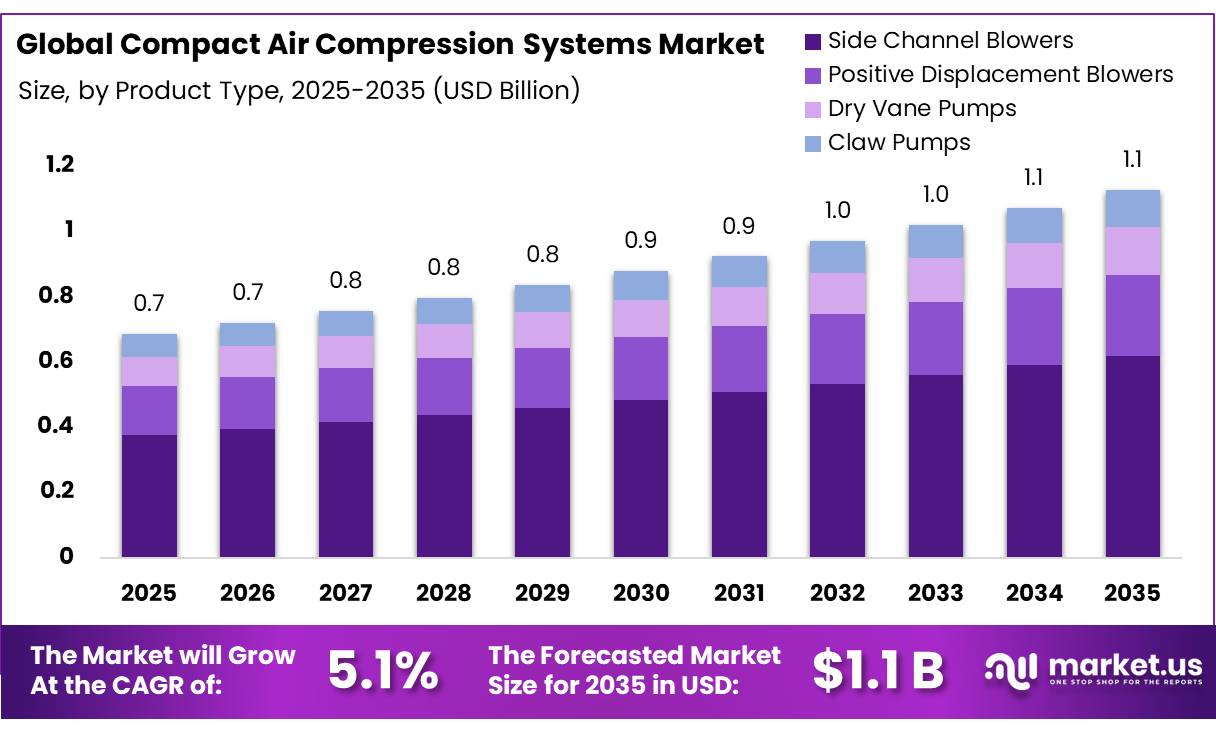
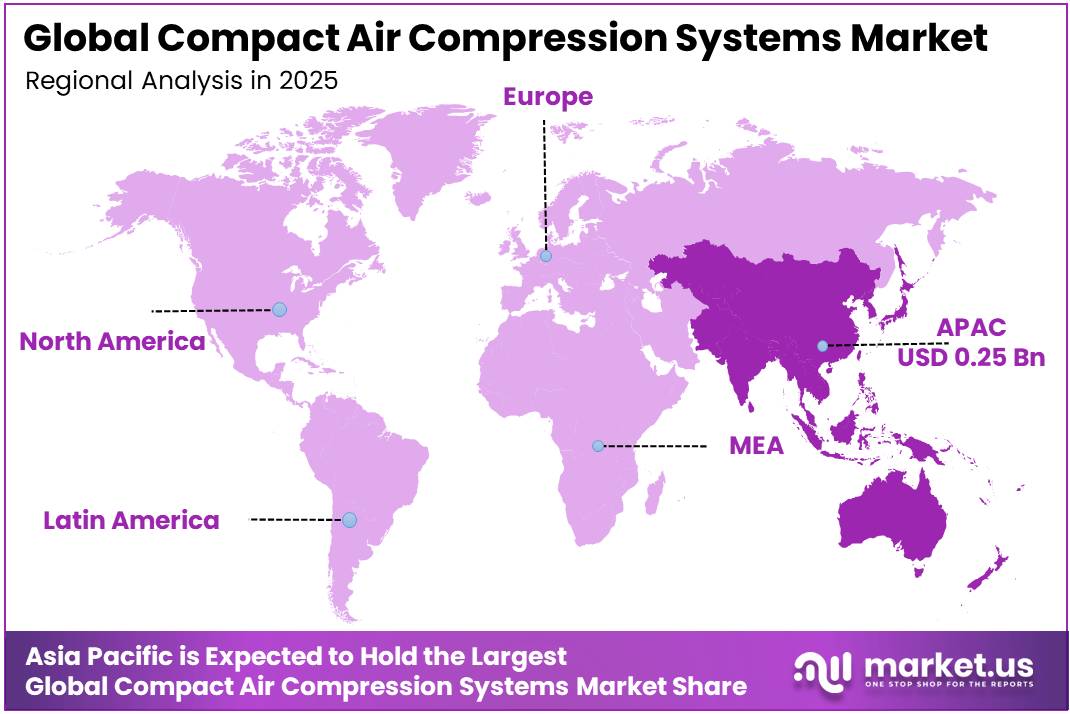
In 2025, the Global Compact Air Compression Systems Market was valued at USD 0.7 Billion, and between 2026 and 2035, this market is estimated to register a CAGR of 5.1%, reaching about USD 1.1 Billion by 2035. Asia Pacific held a dominant market position, capturing more than a 37.0% share, holding USD 0.25 Billion in revenue.
The Compact Air Compression Systems Market covers space-efficient blowers and vacuum pumps used where low-pressure airflow, clean operation, and installation space are important. Positive displacement blowers, side channel blowers, dry vane pumps, and claw pumps support aeration, pneumatic conveying, packaging, laboratory suction, material handling, and process ventilation. Demand is increasingly shaped by oil-free designs, lower noise, modular construction, variable-speed control, and reduced maintenance across regulated industrial facilities.
- The United States Environmental Protection Agency reports that facilities process approximately 34 billion gallons of wastewater each day, while about 16,000 municipal treatment facilities serve more than 75% of the population. In the European Union, 30,354 urban wastewater treatment plants are operating. These installed networks require reliable aeration and gas-handling equipment, supporting replacement demand for compact blowers with improved efficiency, monitoring, and smaller footprints.
Key Takeaways
- The global compact air compression systems market was valued at USD 0.7 billion in 2025.
- The global compact air compression systems market is projected to grow at a CAGR of 5.1% and is estimated to reach USD 1.1 billion by 2035.
- Based on product type, side channel blowers dominated the market, accounting for 55.0% of the total market share.
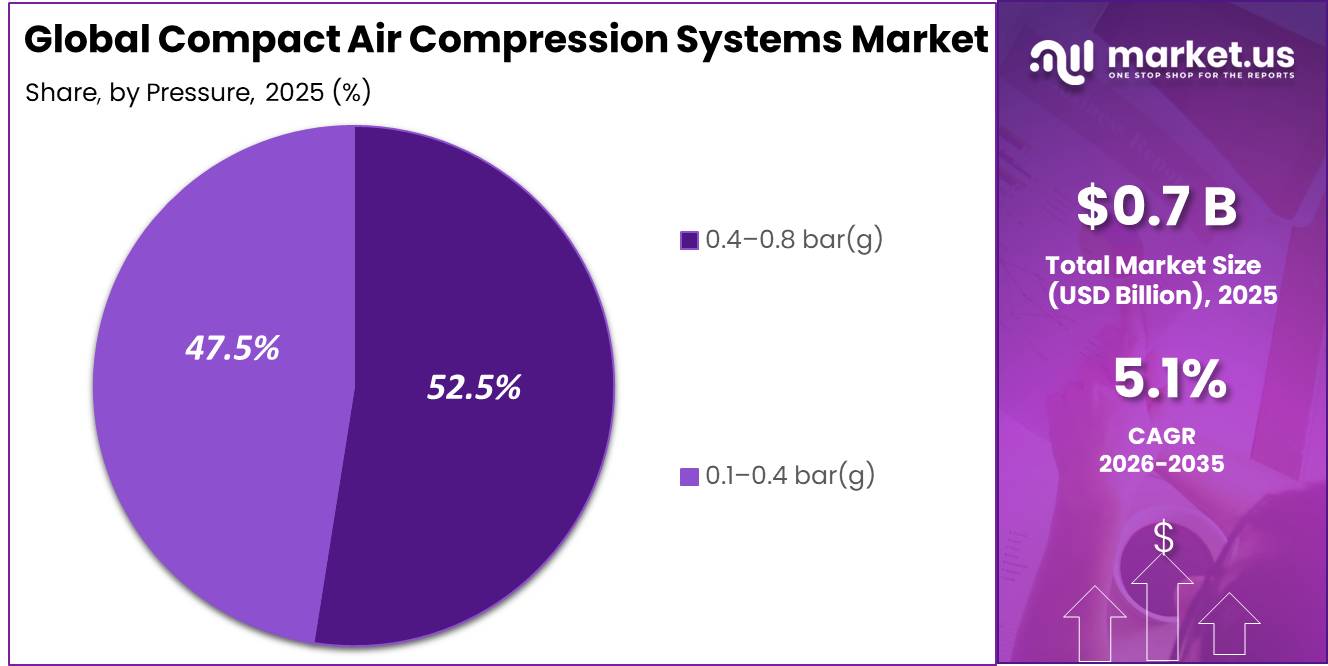
- Based on pressure, the 4–0.8 bar(g) segment dominated the market, accounting for 52.5% of the total market share.
- Among end users, wastewater treatment held a major share in the compact air compression systems market, accounting for 31.0% of the market share.
- In 2025, Asia Pacific was the most dominant region in the compact air compression systems market, accounting for 37.0% of the total market share.
Energy cost reduction is another central purchasing factor. A United States Department of Energy Better Plants case study found that compressed air represented 10% of annual electricity use at one foundry. System optimization improved energy efficiency by 13.5%, reduced electricity consumption by approximately 1.1 million kilowatt-hours, and saved $185,000 annually. Such results strengthen the business case for efficient motors, intelligent controls, leak management, and correctly sized compression equipment in food, electronics, pharmaceutical, and general manufacturing plants.
Government programs create further growth opportunities. The United States Infrastructure Investment and Jobs Act provides more than $50 billion for water infrastructure, including $11.7 billion for the Clean Water State Revolving Fund and $1 billion for emerging contaminants. In Europe, the revised Urban Wastewater Treatment Directive entered into force on January 1, 2025, covers urban areas above 1,000 inhabitants, and targets energy-neutral treatment plants by 2045. Semiconductor expansion also supports oil-free systems, with the federal program administering $50 billion for advanced domestic research and manufacturing facilities
Product Type Analysis
Side Channel Blowers Lead the Product Landscape with a 55.00% Share
In 2025, Side Channel Blowers held a dominant market position, capturing more than a 55.00% share of the Compact Air Compression Systems Market. Their leadership was supported by compact construction, quiet operation, oil-free airflow, and limited maintenance needs. These features made them suitable for wastewater aeration, pneumatic conveying, packaging, laboratory suction, electronics handling, and food processing. Their ability to provide steady airflow at low pressure helped users reduce installation complexity and maintain clean operations. Demand remained strong among facilities seeking dependable equipment for restricted production areas.
- For instance, in July 2025, according to AERZEN, the company presented a new positive displacement blower in an ATEX design for underpressure applications at POWTECH 2025.
Positive Displacement Blowers are the growing segment because they deliver consistent airflow under changing conditions. Their robust design, oil-free conveying capability, durability, and suitability for continuous duty support adoption in wastewater treatment, bulk material transport, filtration, and industrial gas handling. Manufacturers are improving controls, noise reduction, service access, and energy performance, making these systems practical for installations.
Pressure Analysis
0.4–0.8 bar(g) Leads with a 52.50% Share Through Reliable Industrial Air Delivery
In 2025, 0.4–0.8 bar(g) held a dominant market position, capturing more than a 52.50% share of the Compact Air Compression Systems Market. This pressure range remained preferred because it provides stable airflow for aeration, pneumatic conveying, fermentation, drying, filtration, and material handling. It supports compact equipment layouts while maintaining dependable operation across process loads. Manufacturers and plant operators select this range where continuous airflow, clean operation, controlled pressure, and energy use are important purchasing factors.
- For instance, in June 2026, according to Atlas Copco, the company launched an oil-free screw blower range designed to improve pressure performance, efficiency, reliability, and lifecycle costs across wastewater applications.
The 0.1–0.4 bar(g) segment is growing as industries adopt lower-pressure systems for gentle aeration, cooling, ventilation, drying, and lightweight material movement. These systems can match applications that do not require higher discharge pressure, helping facilities limit unnecessary compression. Their compact footprint, simpler integration, lower operating intensity, and suitability for variable airflow requirements are supporting wider use in smaller processing lines and decentralized installations.
End User Analysis
Wastewater Treatment Leads with a 31.00% Share Through Continuous Aeration Demand
In 2025, Wastewater Treatment held a dominant market position, capturing more than a 31.00% share of the Compact Air Compression Systems Market. Treatment plants depend on compact blowers and pumps to supply steady airflow for aeration, mixing, sludge handling, filtration, and biological processing. Their smaller footprint supports installation in crowded facilities, while oil-free operation helps protect water quality. Reliable airflow also allows operators to maintain treatment stability across changing loads and reduce interruptions during continuous plant operation.
- For instance, in May 2026, according to Atlas Copco, the company presented expanded high-speed turbo and screw blower solutions at the Water Equipment Show to support greater efficiency across water and wastewater treatment applications.
Food & Beverage is the growing segment as processors require clean, controlled air for fermentation, packaging, conveying, drying, cooling, and product handling. Compact systems suit facilities where space, hygiene, and dependable airflow remain important. Wider adoption of oil-free equipment, flexible controls, quieter operation, and easier maintenance is supporting use across breweries, dairies, bakeries, beverage plants, and packaged-food production lines.
Key Market Segments
By Product Type
- Positive Displacement Blowers
- Side Channel Blowers
- Dry Vane Pumps
- Claw Pumps
By Pressure
- 0.1–0.4 bar(g)
- 0.4–0.8 bar(g)
By End User
- Wastewater Treatment
- Food & Beverage
- Pharmaceuticals & Biotechnology
- Medical Devices & Laboratory Equipment
- Electronics & Semiconductor
- Others
Driver Analysis
Energy-cost pressure driving compact VSD upgrades
Compressed air is still treated as a plant utility, but purchasing behavior in 2026 is increasingly being set by electricity economics rather than by upfront equipment price because compressors can be among the largest electricity users in industrial sites and improvement potential is frequently large enough to justify replacement ahead of normal end-of-life. DOE-linked guidance states that applying energy-management practices and efficient equipment can deliver significant savings, while the DOE sourcebook notes system improvements can reduce electricity consumption by 20% to 50% or more; industry material also indicates VSD compressors can cut energy use by as much as 60% in suitable variable-load profiles.
That changes unit economics for compact systems in two ways: first, smaller packaged VSD units become attractive for load-matching in satellite lines and multi-shift plants; second, buyers shift from simple capex comparison to lifecycle-cost screening where power cost can dominate total cost of ownership over a few years.
Drivers Impact Analysis
| Driver | (~) % Impact on CAGR | Geographic Relevance | Impact Timeline |
|---|---|---|---|
| Energy-cost pressure driving compact VSD upgrades | +1.6% | North America core, EU, India, China, Japan | Short term |
| Oil-free compliance pull in food, pharma, electronics | +1.2% | EU, North America core, Japan, South Korea, China coastal, India pharma clusters | Medium term |
| Factory automation favoring decentralized point-of-use air | +0.9% | North America, EU, China, ASEAN, India | Medium term |
| Aging fixed-speed fleet replacement with smart compact packages | +1.0% | EU, North America, Japan | Short term |
| Waste-heat recovery improving compressor project payback | +0.7% | EU, Nordics, Germany, Benelux, North America, Japan | Medium term |
| Asia manufacturing expansion lifting OEM and aftermarket demand | +1.3% | China, India, ASEAN corridors, Middle East spill-over | Medium term |
Restraint Analysis
Lack of compact efficiency certification
Market commentary on compact air compression systems explicitly points to “lack of recognized energy‑efficiency certification and testing frameworks for low‑pressure compact air compression systems” as a core restraint, even as EU and other jurisdictions roll out ecodesign requirements for standard rotary compressor packages with minimum efficiency performance standards; in practice, this leaves a regulatory and standards gap where compact packages, especially in wastewater aeration and low‑pressure operations, are not covered by the same clear metrics used for larger industrial compressors.
Strategically, the bottleneck suppresses value‑based pricing and slows adoption of more efficient compact units, compressing the achievable mix uplift and project pipeline growth, and is reasonably modeled as a 0.8 percentage point CAGR drag over the next 2–4 years until harmonized test protocols and labels become broadly accepted.
Restraint Impact Analysis
| Restraint | (~) % Impact on CAGR Forecast | Geographic Relevance | Impact Timeline |
|---|---|---|---|
| Steel & electronics cost volatility | -1.3% | EU, North America core, Japan, South Korea | Short term |
| Extended compressor & parts lead times | -1.1% | North America, EU, global OEM chains | Short term |
| Lack of compact efficiency certification | -0.8% | EU, North America, APAC corridors | Medium term |
| Grey-market low-cost units | -0.7% | APAC, Middle East, Latin America | Medium term |
| Underinvestment in system optimization | -0.9% | Global industrial base | Long term |
| CapEx caution from energy & geopolitical risk | -1.0% | EU, North America, global export hubs | Medium term |
Opportunity Analysis
SaaS monitoring & efficiency services
SaaS monitoring and efficiency services represent a distinct upside opportunity because most compact air compression systems today are still sold as hardware with limited digital attachment, even though industrial automation trends for 2026 highlight advanced monitoring, predictive maintenance, and data analytics as key priorities for plant modernization.
The white space lies in converting compressed air from a capex‑only sale to a recurring “air performance” subscription where OEMs bundle sensors, connectivity, and cloud analytics to track kWh per Nm³, leak rates, pressure deviations, and utilization across dozens of compact nodes, charging monthly fees that can reach 10–20% of the original equipment cost per year in high‑value applications while simultaneously reducing unplanned downtime and energy waste.
If only 15–20% of the installed compact base in Europe, North America, Japan, and South Korea were enrolled in such service platforms by 2030, with average revenue uplift of 20–30% per unit and improved customer stickiness, this could realistically add around 1.4 percentage points to market CAGR above the baseline forecast by shifting the revenue mix towards high‑margin software and data‑driven services, a dynamic not yet fully baked into current hardware-centric projections.
Opportunity Impact Analysis
| Opportunity | (~) % Potential CAGR Upside | Geographic Relevance | Execution Window |
|---|---|---|---|
| SaaS monitoring & efficiency services | +1.4% | North America core, EU, Japan, South Korea | Short term |
| Wastewater & low-pressure aeration ecosystems | +1.6% | EU, APAC emerging, Middle East, Latin America | Medium term |
| Compact systems for small-format automation & robotics | +1.2% | North America, EU, China, ASEAN, India | Medium term |
| Distributed utilities for MSMEs & light industry | +1.3% | India, ASEAN, Africa, Latin America | Long term |
| Portable & prosumer compact air platforms | +0.9% | North America, EU, urban APAC corridors | Medium term |
| M&A roll-ups and platform consolidation | +1.1% | Global OEMs with EU/US listing | Medium term |
Challenges Analysis
Brownfield integration complexity
Brownfield integration complexity is a structural challenge because most compact air compression systems are being installed into existing facilities whose layouts, electrical capacity, and ventilation were not designed around modern compact packages, creating long‑term friction rather than a simple on/off restraint.
In quantitative terms, suboptimal placement can raise specific energy consumption by 5–15% through longer piping runs and higher pressure drops, under‑ventilated rooms can raise operating temperatures by 5–10°C above design, reducing compressor life and increasing service intervals, and constrained electrical capacity can force operation below ideal load profiles, undercutting variable‑speed efficiency benefits.
Strategically, OEMs and end-users must invest in multi‑year plant reconfiguration, phased pipework redesign, and modular utility rooms to normalize these effects, implying capex programs spread over 2–4 years; during that mitigation horizon, the brownfield complexity drags achievable CAGR by an estimated 1.2 percentage points relative to a theoretical scenario where all compact systems were deployed in purpose-built compressor rooms with optimal layouts.
Challenges Impact Analysis
| Challenge | (~) % CAGR Friction Drag | Geographic Relevance | Mitigation Horizon |
|---|---|---|---|
| Brownfield integration complexity | -1.2% | EU industrial hubs, North America core, Japan | Medium term |
| Advanced compressor skills gap | -1.1% | Global industrial base | Long term |
| Distribution & piping inefficiencies | -0.9% | EU, North America, APAC logistics corridors | Long term |
| High-spec air quality management | -0.8% | Pharma/food clusters in EU, US, Japan, China | Medium term |
| Ongoing supply-chain variability | -1.0% | North America, EU, APAC manufacturing | Short term |
| Evolving efficiency & safety regulation | -0.7% | EU regulatory hubs, US states, developed APAC | Medium term |
Geopolitical Impact Analysis
Geopolitical Fragmentation and Industrial Localization Reshape Compact Air Compression Systems Manufacturing
Geopolitical tensions raise transport risk for air compression systems relying on motors, bearings, controllers, castings, and parts. United Nations Trade and Development reported Suez Canal tonnage remained 70% below 2023 levels in May 2025, while rerouting raised ton-miles 5.9% in 2024 and threatened the 11% of global trade through Hormuz.
Trade barriers are affecting production costs. From March 12, 2025, the United States applied a 25% duty to covered steel and aluminium imports, raising the previous aluminium rate from 10%. These metals are used in blower housings, rotors, frames, piping, and mounting systems, making regional sourcing and supplier qualification important.
- On January 17, 2025, the United States Department of Commerce finalized up to $18 million for an Edwards Vacuum facility producing dry vacuum pumps. The project could create up to 500 production jobs and establish output for equipment previously unavailable from United States manufacturing sites.
European protection measures are fragmenting material procurement. In March 2025, the European Commission reduced its safeguard liberalisation rate from 1% to 0.1%, with changes beginning April 1. This environment encourages manufacturers to diversify steel suppliers, redesign components, hold inventories, and expand assembly closer to wastewater, food, laboratory, and semiconductor customers.
Regional Analysis
Asia Pacific Dominates with a 37.00% Share, While Europe Records the Fastest Growth
In 2025, Asia Pacific held a dominant position in the Compact Air Compression Systems Market, accounting for 37.00% of global revenue, equal to USD 0.25 billion. The region benefits from broad electronics, semiconductor, wastewater, food-processing, and general manufacturing activity, which creates steady demand for compact blowers and oil-free vacuum systems.
- In February 2026, the Semiconductor Industry Association reported that 2025 semiconductor sales in Asia Pacific and other markets increased by 45.0%, supporting equipment demand across clean manufacturing environments.
Europe is the fastest-growing region as industries modernize wastewater treatment, food production, pharmaceutical processing, and energy-efficient manufacturing facilities. The European Commission states that 30,354 urban wastewater treatment plants operate across the European Union. Its revised Urban Wastewater Treatment Directive entered into force on January 1, 2025, covering urban areas with more than 1,000 inhabitants and requiring treatment plants to move toward energy neutrality by 2045, encouraging adoption of efficient compact air systems.
Key Regions and Countries Covered
- North America
- The US
- Canada
- Europe
- Germany
- France
- The UK
- Spain
- Italy
- Russia & CIS
- Rest of Europe
- APAC
- China
- Japan
- South Korea
- India
- ASEAN
- Rest of APAC
- Latin America
- Brazil
- Mexico
- Rest of Latin America
- Middle East & Africa
- GCC
- South Africa
- Rest of MEA
Key Players Analysis
Compact air compression system manufacturers compete through energy efficiency, compact design, oil-free performance, digital controls, and service support. In 2026, leading suppliers strengthened product differentiation for wastewater treatment, food processing, laboratories, pharmaceuticals, and electronics. Atlas Copco focused on innovation, customer partnerships, local production, and lifecycle efficiency, while Ingersoll Rand advanced oil-free compressor technology through its strategic partnership with Garrett Motion.
Production scale, distribution reach, and aftermarket service also shape competitive positioning. KAESER KOMPRESSOREN expanded its product and service presence through new compressor introductions and factory-direct branches during 2026. Companies such as Busch Vacuum Solutions further compete through broad vacuum, blower, and compressor portfolios suited to industrial processes.
Market Key Players
- Atlas Copco AB
- Ingersoll Rand Inc.
- KAESER KOMPRESSOREN SE
- KUBÍČEK VHS, s.r.o.
- Busch Vacuum Solutions
- Becker GmbH
- Goorui Technology Co., Ltd.
- Usha Neuros Turbo LLP
- Fans and Blowers Ltd.
- Elektror airsystems GmbH
- Rexblower
- RICO Druckluftanlagenbau GmbH
- Induvac B.V.
- SEKO S.p.A.
- ELGi Equipments Limited
Key Development
- In May 2026, Atlas Copco AB completed the acquisition of LACO Technologies, adding vacuum solutions, vacuum chambers, and advanced leak-detection systems to its Scientific Vacuum division.
- In March 2026, KAESER KOMPRESSOREN SE introduced the MOBILAIR M76 portable compressor, designed with adjustable pressure control, energy-efficient operation, and improved flexibility for industrial and construction applications.
- In January 2026, ELGi Equipments Limited inaugurated a new vacuum pump assembly line, expanding its industrial air and vacuum portfolio through automated assembly, product testing, and locally supported manufacturing capabilities.
Report Scope
| Report Features | Description |
|---|---|
| Market Value (2025) | USD 0.7 Bn |
| Forecast Revenue (2035) | USD 1.1 Bn |
| CAGR (2026-2035) | 5.1% |
| Base Year for Estimation | 2025 |
| Historic Period | 2020-2024 |
| Forecast Period | 2026-2035 |
| Report Coverage | Revenue Forecast, Market Dynamics, Competitive Landscape, Recent Developments |
| Segments Covered | By Product Type (Positive Displacement Blowers, Side Channel Blowers, Dry Vane Pumps, and Claw Pumps), By Pressure (0.1–0.4 bar(g) and 0.4–0.8 bar(g)), By End User (Wastewater Treatment, Food & Beverage, Pharmaceuticals & Biotechnology, Medical Devices & Laboratory Equipment, Electronics & Semiconductor, and Others) |
| Regional Analysis | North America – The US & Canada; Europe – Germany, France, The UK, Spain, Italy, Russia & CIS, Rest of Europe; APAC– China, Japan, South Korea, India, ASEAN & Rest of APAC; Latin America– Brazil, Mexico & Rest of Latin America; Middle East & Africa– GCC, South Africa, & Rest of MEA |
| Competitive Landscape | Atlas Copco AB, Ingersoll Rand Inc., KAESER KOMPRESSOREN SE, KUBÍČEK VHS, s.r.o., Busch Vacuum Solutions, Gebr. Becker GmbH, Goorui Technology Co., Ltd., Usha Neuros Turbo LLP, Fans and Blowers Ltd., Elektror airsystems GmbH, Rexblower, RICO Druckluftanlagenbau GmbH, Induvac B.V., SEKO S.p.A., and ELGi Equipments Limited. |
| Customization Scope | Customization for segments, region/country-level will be provided. Moreover, additional customization can be done based on the requirements. |
| Purchase Options | We have three licenses to opt for: Single User License, Multi-User License (Up to 5 Users), Corporate Use License (Unlimited Users and Printable PDF) |





































