Report Overview
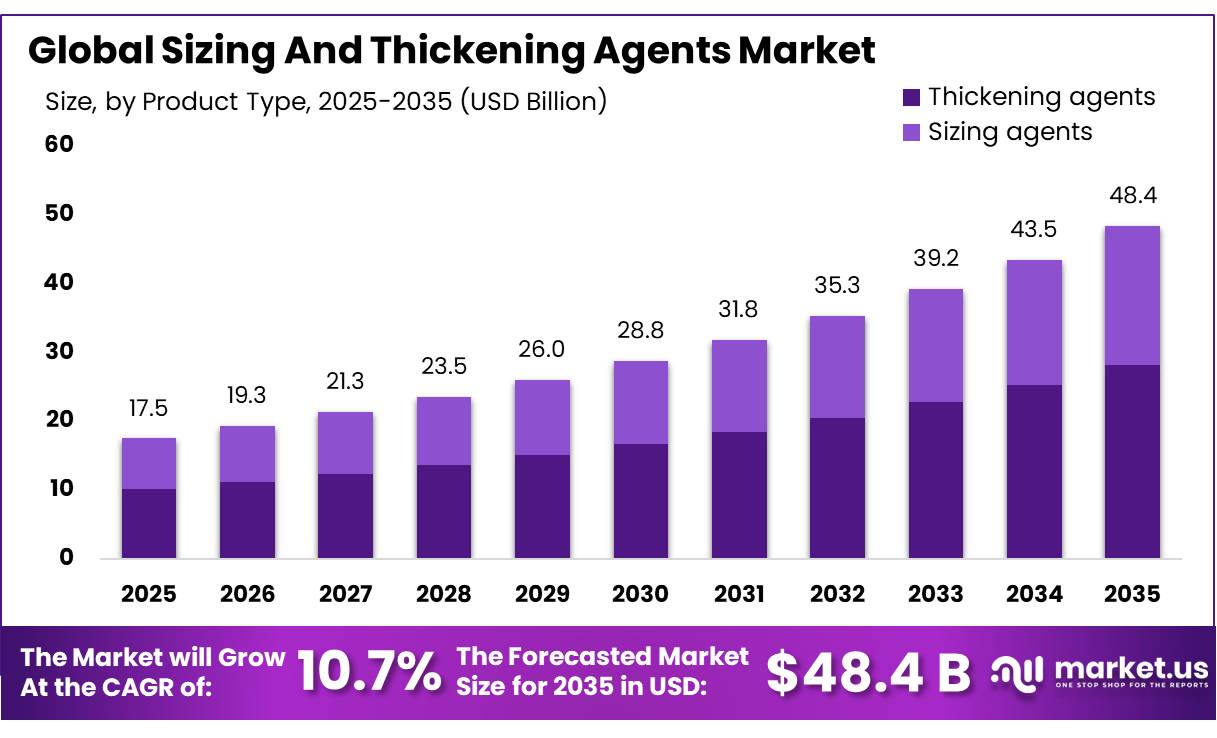
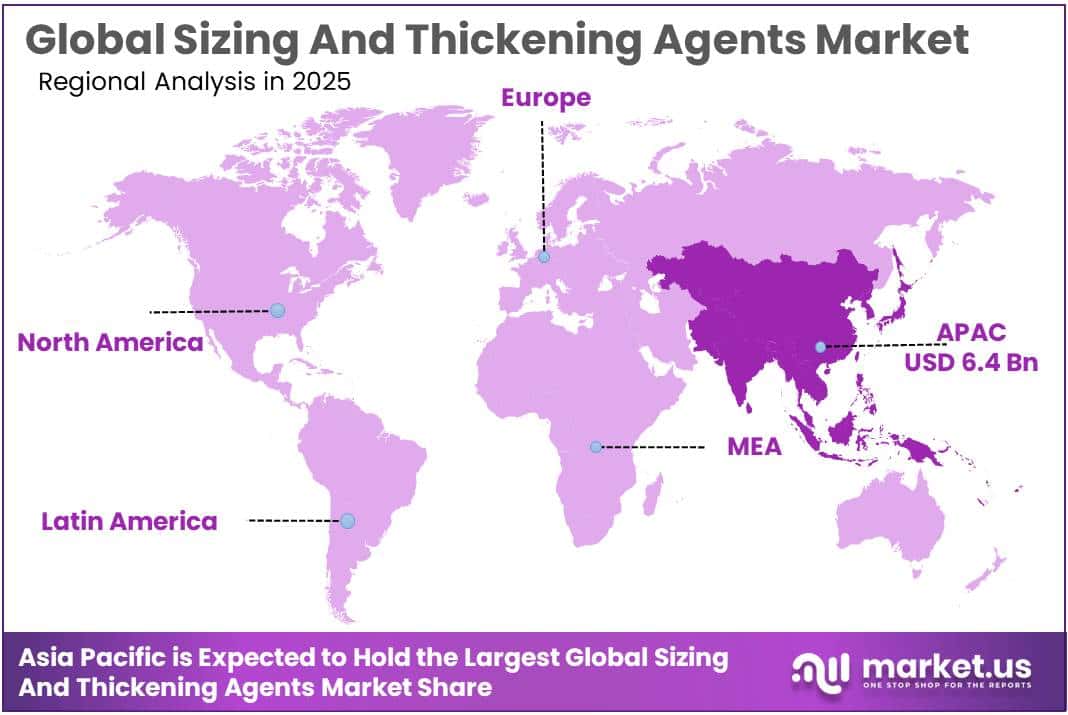
The Global Sizing And Thickening Agents Market size is expected to be worth around USD 48.4 Billion by 2035, from USD 17.5 Billion in 2025, growing at a CAGR of 10.7% during the forecast period from 2026 to 2035. In 2025, Asia Pacific held a dominant market position, capturing more than a 37.00% share, holding USD 6.4 Billion revenue.
Sizing and thickening agents are important specialty chemicals used across textile, paper, food and beverage, paints and coatings, construction, pharmaceuticals, and personal care industries. These chemicals improve the physical properties, consistency, strength, texture, and processing performance of industrial and consumer products. Sizing agents are mainly used to improve the strength and surface characteristics of textile yarns and paper products, while thickening agents control viscosity, stabilize formulations, and improve product texture.
- The textile industry represents an important application area for sizing agents, particularly in weaving operations, where yarns require protective coatings to reduce friction, improve tensile strength, and minimize breakage during processing. According to the European Commission, the European textile industrial ecosystem generated approximately EUR 163 billion in turnover and included more than 267,000 enterprises. The ecosystem also employed approximately 4 million people across its broader value chain.
This established industrial base supports demand for textile processing chemicals, including starch-based and synthetic sizing formulations. Additionally, the Food and Agriculture Organization (FAO) explains that approximately 80% of starch used in textile applications is consumed in sizing operations, highlighting the importance of starch derivatives in textile manufacturing.
The food and beverage industry is another major growth contributor, where thickening agents are used in sauces, dairy products, bakery products, beverages, soups, confectionery, and processed foods. Ingredients such as xanthan gum, guar gum, pectin, carrageenan, modified starch, and cellulose derivatives help maintain product consistency, prevent separation, improve mouthfeel, and extend physical stability during storage. Research published in the International Journal of Gastronomy and Food Science in March 2022 identifies plant-based, seaweed-derived, protein-based, and microbial hydrocolloids as important sources of food thickening agents.
Several factors are driving the industrial development of sizing and thickening agents, including expanding textile production, increasing demand for paper-based packaging, rising consumption of processed foods, and growing requirements for high-performance industrial formulations. Chemical manufacturers are also focusing on product consistency, raw material efficiency, and formulation improvements to meet changing customer requirements.
- For instance, Ashland’s 2025 annual filing reported approximately 2,900 employees and operations serving customers in more than 100 countries, demonstrating the international industrial presence of specialty ingredient suppliers serving multiple application sectors.
The strategy also highlights that approximately 5 million tonnes of clothing are discarded annually in the European Union. Consequently, chemical producers have opportunities to develop sizing formulations that support efficient processing, improved fabric quality, and easier material recovery. Overall, innovation in bio-based ingredients, customized viscosity solutions, and sustainable industrial processing is expected to strengthen the long-term growth potential of the sizing and thickening agents industry.
Key Takeaways
- Sizing And Thickening Agents Market size is expected to be worth around USD 48.4 Billion by 2035, from USD 17.5 Billion in 2025, growing at a CAGR of 10.7%.
- Thickening agents held a dominant market position, capturing more than a 58.00% share.
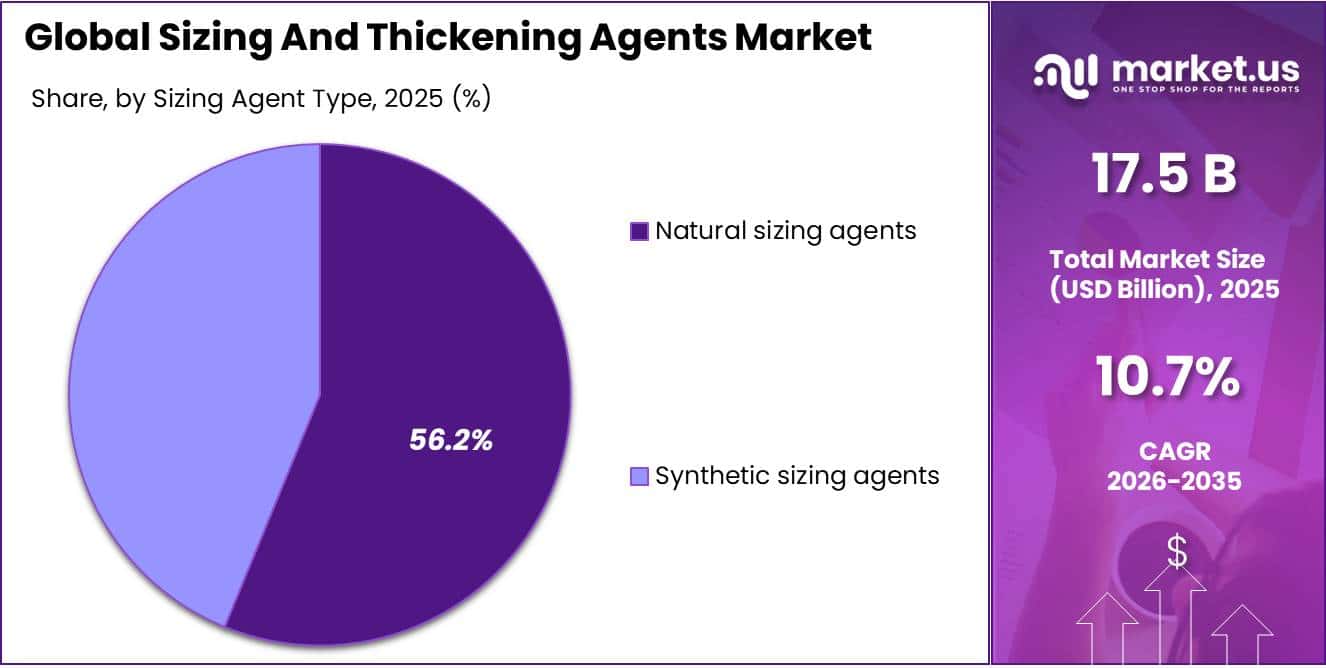
- Natural sizing agents held a dominant market position, capturing more than a 56.00% share.
- Powder held a dominant market position, capturing more than a 55.00% share.
- Food and beverages held a dominant market position, capturing more than a 27.00% share.
- Food-processing industry held a dominant market position, capturing more than a 28.00% share.
- Asia-Pacific dominated the Sizing and Thickening Agents Market in 2025, accounting for 37.00% of the global market, valued at USD 6.4 billion.
By Product Type Analysis
Thickening Agents dominate due to their wide application in food processing, pharmaceuticals, personal care, paints, and industrial formulations.
In 2025, “Thickening agents” held a dominant market position, capturing more than a 58.00% share of the Sizing and Thickening Agents Market. Their leading position is supported by their ability to improve viscosity, maintain product consistency, and enhance formulation stability across different industries. Thickening agents such as xanthan gum, guar gum, modified starch, cellulose derivatives, and other hydrocolloids are widely used in food products, cosmetics, pharmaceuticals, and paints and coatings.
In the food industry, these ingredients help improve texture, prevent ingredient separation, and maintain product quality during storage. Their use in personal care products also supports the production of creams, lotions, gels, and shampoos with consistent thickness. In 2025, increasing demand for processed foods, specialty formulations, and high-performance industrial products continued to support the strong position of thickening agents. Manufacturers are also focusing on bio-based ingredients and improved formulation technologies to meet changing industrial requirements.
By Sizing Agent Type Analysis
Natural sizing agents dominate due to their renewable origin, cost-effectiveness, and strong use in cotton and other textile manufacturing processes.
In 2025, “Natural sizing agents” held a dominant market position, capturing more than a 56.00% share of the Sizing and Thickening Agents Market. Their leading position is supported by the widespread use of starch, modified starch, and natural gums in textile processing. These materials form a protective coating around yarns, improve yarn strength, reduce friction, and minimize fibre breakage during weaving.
According to the Food and Agriculture Organization (FAO), approximately 80% of the starch used in textile applications is consumed in sizing operations. This highlights the importance of natural starch-based materials in textile manufacturing. In 2025, growing interest in biodegradable raw materials and environmentally compatible textile chemicals further supported the demand for natural sizing agents.
According to the Swedish Environmental Protection Agency, polyvinyl alcohol (PVA) is the most important synthetic sizing agent in the textile sector and is increasingly used in high-speed weaving looms. However, the removal of synthetic sizing chemicals during desizing requires proper wastewater treatment because certain materials can increase the pollution load. The European Commission’s textile industry best available techniques guidelines also recommend improved chemical selection, recovery, and reuse of water-soluble sizing materials such as PVA.
By Form Analysis
Powder dominates due to its longer shelf life, easy storage, convenient transportation, and suitability for different industrial formulations.
In 2025, “Powder” held a dominant market position, capturing more than a 55.00% share of the Sizing and Thickening Agents Market. Its leading position is supported by its ease of handling, storage stability, and suitability for large-scale industrial applications. Powder-based sizing and thickening agents are widely used in textile processing, paper manufacturing, food production, pharmaceuticals, and personal care products.
They also allow manufacturers to control concentration and prepare solutions according to specific production requirements. Starch, modified starch, guar gum, xanthan gum, and cellulose derivatives are commonly supplied in powder form. In 2025, demand for powder formulations remained strong as industrial users continued to prioritize convenient handling, flexible dosing, and efficient inventory management.
According to the United States Environmental Protection Agency (EPA), its textile industry study estimated historical wet-processing water consumption at approximately 500–600 million gallons per day. This highlights the considerable scale of water-intensive textile processing, where liquid chemical formulations and wastewater management remain important operational considerations.
By Application Analysis
Food and beverages dominate due to the widespread use of thickening agents in processed foods, dairy products, sauces, bakery items, and beverages.
In 2025, “Food and beverages” held a dominant market position, capturing more than a 27.00% share of the Sizing and Thickening Agents Market. The segment’s leading position is supported by the increasing use of thickening agents to improve food texture, maintain consistency, prevent ingredient separation, and enhance product stability. Ingredients such as xanthan gum, guar gum, modified starch, pectin, and cellulose derivatives are commonly used in sauces, soups, dairy products, confectionery, and ready-to-eat foods.
According to the Food and Agriculture Organization (FAO), its global statistical database covers food and agricultural production across more than 245 countries and territories, providing a broad official data framework for monitoring food production and processing activities. In 2025, the continued development of packaged foods, convenient meal products, and plant-based food formulations supported the industrial importance of thickening agents.
The scale of this application is reflected in the 2025 German pulp and paper industry data published by the United Nations Economic Commission for Europe (UNECE). Germany produced approximately 18.7 million tonnes of paper and paperboard in 2025, representing a 2.5% decline compared with the previous year.
This production volume demonstrates the continued industrial importance of paper and paperboard manufacturing and the need for functional additives that support paper quality, production efficiency, and material performance. In 2025, demand for sizing and thickening agents in this application was supported by packaging requirements, recycled paper processing, and the development of improved paper coating technologies.
By End-Use Industry Analysis
Food-processing industry dominates due to the extensive use of thickening and sizing ingredients in processed foods, dairy products, sauces, bakery products, and ready-to-eat meals.
In 2025, “Food-processing industry” held a dominant market position, capturing more than a 28.00% share of the Sizing and Thickening Agents Market. Its leading position is supported by the growing need for ingredients that improve food texture, consistency, stability, and overall product quality. Thickening agents such as modified starch, xanthan gum, guar gum, pectin, and cellulose derivatives are widely used in food manufacturing to control viscosity, prevent ingredient separation, and maintain uniform texture.
According to the United Kingdom Government’s Food Statistics Pocketbook 2026, food and drink manufacturing generated approximately GBP 39.3 billion in gross value added in 2024, representing 24.2% of the total agri-food chain’s gross value added. This reflects the considerable industrial scale of food manufacturing and its importance as an end-use sector for functional ingredients.
According to the United Kingdom Office for National Statistics (ONS), the total output value of the paper and paper products manufacturing industry reached approximately GBP 13.52 billion in 2025, compared with GBP 14.02 billion in 2024. This indicates the continued industrial scale of paper manufacturing and its importance to packaging material supply chains.
Key Market Segments
By Product Type
- Sizing agents
- Thickening agents
By Sizing Agent Type
- Natural sizing agents
- Synthetic sizing agents
By Form
- Powder
- Liquid
- Granules
- Other forms
By Application
- Food and beverages
- Paper and paperboard
- Paints and coatings
- Textile and fibre
- Pharmaceuticals
- Adhesives and sealants
- Construction
- Other applications
By End-Use Industry
- Food-processing industry
- Paper and packaging industry
- Textile industry
- Paints and coatings industry
- Pharmaceutical industry
- Construction industry
- Other industries
Driver Analysis
Paperboard Sizing Demand
Higher paper and paperboard output expands the production base requiring qualified internal or surface sizing, while recycled-fibre use increases the importance of formulation consistency and end-product performance. FAO’s 2024 forest-products statistics show a recovery of approximately 4–5% in paper and paperboard production following the preceding downturn and recovered-paper consumption reaching 243 million tonnes, up 1%.
The EU Packaging and Packaging Waste Regulation also sets a paper-and-cardboard packaging recycling target of 85% by 2030, but this is a material-recovery obligation, not a mandate to replace all plastic packaging with paper or increase chemical dosage.
In an illustrative mill producing 500,000 tonnes annually, an eligible surface-sizing application of 40 kg of dry agent per tonne requires 20,000 tonnes of agent; 5% additional output creates 1,000 tonnes of incremental demand if dosage remains unchanged. At an assumed constant $700/tonne, that represents $700,000 of additional ingredient revenue. Suppliers capture value through mill-specific qualification, runnability and consistent surface properties, but multifunctional starch sold primarily for other purposes must not be counted automatically.
Drivers Impact Analysis
| Driver | (~) % Impact on CAGR | Geographic Relevance | Impact Timeline |
|---|---|---|---|
| Paperboard sizing demand | +0.9 pp | China, India, EU, US | Medium term (2–4 years) |
| Woven-textile production growth | +0.7 pp | China, India, Bangladesh, Vietnam | Short term (≤ 2 years) |
| Food texture reformulation | +0.6 pp | US, EU, China, India | Short term (≤ 2 years) |
| Waterborne formulation conversion | +0.6 pp | EU, US, China, India | Medium term (2–4 years) |
| Specialty personal-care rheology | +0.4 pp | US, EU, Japan, South Korea | Short term (≤ 2 years) |
Restraint Analysis
Weak Coatings Consumption
Rheology-modifier demand is constrained when subdued architectural activity limits paint production, because conversion toward waterborne formulations does not guarantee growth in the total volume requiring thickening. Ashland’s fiscal second-quarter 2026 disclosure describes generally flat underlying coatings conditions, softer North American architectural activity and demand volatility in China and parts of the Middle East, Africa and India.
Its reported coatings-volume growth reflected share gains and customer-program execution, illustrating why supplier performance must not be mistaken for market expansion. Earlier, fiscal fourth-quarter 2025 Specialty Additives sales fell 9%, or 6% excluding portfolio actions, with weaker Chinese coatings sales and softer North American conditions among the causes. These segments include products beyond sizing and thickening agents and therefore serve as directional evidence rather than market-size proxies.
In an illustrative paint portfolio producing 200,000 tonnes annually at 0.4% eligible dry-active thickener content, a 5% output reduction removes 40 tonnes of ingredient demand. At an assumed constant $6,000/tonne, that equals $240,000 of foregone ingredient revenue before formulation changes. Suppliers can offset individual losses through share gains, but those transfers do not increase the global market. The −0.5 pp contribution assumes 20% revenue exposure grows 2.5 percentage points more slowly through weaker coatings consumption; lower dosage and price reductions are assigned separately rather than embedded in this volume adjustment.
Restraint Impact Analysis
| Restraint | (~) % Impact on CAGR Forecast | Geographic Relevance | Impact Timeline |
|---|---|---|---|
| Weak coatings consumption | −0.5 pp | China, US, Middle East, Africa | Short term (≤ 2 years) |
| Graphic-paper contraction | −0.4 pp | EU, US, Japan, Canada | Medium term (2–4 years) |
| Standard-grade price erosion | −0.4 pp | China, India, Middle East, Africa | Short term (≤ 2 years) |
| Lower application dosage | −0.3 pp | EU, US, China, Japan | Medium term (2–4 years) |
| Rejected specialty premiums | −0.2 pp | India, Southeast Asia, Latin America | Short term (≤ 2 years) |
Opportunity Analysis
Battery-Slurry Rheology Qualification
Battery-electrode manufacturing offers an adjacent route to market for rheology agents that maintain suspension, enable controlled coating and reduce formulation sensitivity, provided electrochemical performance remains acceptable. Borregaard’s current battery guidance identifies microfibrillated cellulose as a shear-thinning additive for electrode formulations and reports demonstrated partial replacement of carboxymethyl cellulose up to approximately 50% in aqueous anode preparation; it explicitly states that this is not generally a complete one-to-one replacement.
The opportunity is qualification in additional electrode platforms and previously unserved slurry systems—not applying a battery-production growth rate to the entire sizing and thickening market. In an illustrative annual program using 100,000 tonnes of dry electrode solids, a qualified rheology-active dosage of 0.3% implies 300 tonnes of additive solids. At an assumed $8,000/tonne, gross revenue is $2.4 million; if the new material displaces $1.5 million of existing included thickener expenditure, net market expansion is only $900,000.
Supplier expenditure of $600,000 on application development and qualification would require approximately $2 million of additional sales to recover at an assumed 30% contribution margin, before financing and overhead. Suppliers need slurry, coating, drying and cell-level validation; reinforcement-only separator applications remain excluded. The +0.35 pp contribution assumes 7% revenue exposure grows 5 percentage points faster through additional qualified rheology purchases, not gross battery investment or supplier-share gains.
Opportunity Impact Analysis
| Opportunity | (~) % Potential CAGR Upside | Geographic Relevance | Execution Window |
|---|---|---|---|
| Battery-slurry rheology qualification | +0.35 pp | China, South Korea, Japan, US, EU | Medium term (2–4 years) |
| Electrolyte-tolerant agrochemical systems | +0.30 pp | Brazil, US, India, EU | Medium term (2–4 years) |
| Concentrated-cleaner structuring platforms | +0.25 pp | EU, US, Japan, South Korea | Short term (≤ 2 years) |
| High-solids ceramic extrusion | +0.20 pp | India, China, Türkiye, EU | Medium term (2–4 years) |
| Outcome-priced formulation programs | +0.20 pp | India, Southeast Asia, Latin America | Short term (≤ 2 years) |
Challenges Analysis
Hydration and Dispersion Consistency
Rapid surface hydration can encapsulate undispersed powder, while insufficient mixing leaves incomplete polymer development, creating recurring differences between the quantity added and the functional viscosity achieved. Ashland’s hydroxypropylcellulose guidance explains that faster surface hydration increases lumping tendency and requires controlled addition procedures; its HEC portfolio distinguishes retarded-hydration grades and dispersion-modified grades intended to simplify incorporation.
In an illustrative ten-tonne batch targeting 0.5% dry thickener, the required addition is 50 kg. If 5 kg remains trapped in unresolved agglomerates, only 45 kg is effectively distributed—a 10% shortfall relative to target addition, though viscosity will not necessarily decline proportionally because concentration–viscosity relationships are nonlinear. Across 200 batches, that scenario leaves one tonne requiring recovery, rework or disposition; at an assumed $5,000/tonne ingredient value, direct material exposure is $5,000 before much larger potential batch-handling costs.
Adding one hour of corrective mixing to each batch consumes 200 equipment-hours, or $30,000 at an assumed $150/hour incremental operating cost. Suppliers need product-specific addition order, wetting, hydration-endpoint and scale-up instructions. The −0.30 pp contribution assumes 15% revenue exposure grows two percentage points more slowly through rework and delayed application acceptance, excluding intentional dosage optimization already classified as a restraint.
Challenges Impact Analysis
| Challenge | (~) % CAGR Friction Drag | Geographic Relevance | Mitigation Horizon |
|---|---|---|---|
| Hydration and dispersion consistency | −0.30 pp | India, China, Southeast Asia, Latin America | Medium term (2–4 years) |
| Cross-laboratory rheology reproducibility | −0.25 pp | US, EU, China, Japan | Medium term (2–4 years) |
| Formulation compatibility variability | −0.25 pp | EU, US, India, Brazil | Long term (≥ 4 years) |
| Biological viscosity degradation | −0.25 pp | South Asia, Southeast Asia, Gulf, Africa | Medium term (2–4 years) |
| Active-solids dosing normalization | −0.20 pp | EU, US, China, Southeast Asia | Medium term (2–4 years) |
Geopolitical Impact Analysis
Impact of Ongoing Middle East Conflict and Russia–Ukraine War on the Sizing and Thickening Agents Market
The ongoing geopolitical conflicts, particularly the Middle East conflict and Russia–Ukraine war, are creating cost and supply chain pressures for the global sizing and thickening agents industry. These disruptions affect the availability and transportation of petrochemical-based raw materials, natural gas, energy, and industrial chemicals used in manufacturing synthetic sizing agents, modified starches, and specialty thickeners.
The United Nations reported in May 2026 that Middle East oil production declined by at least 9 million barrels per day in March 2026 compared with February, creating significant pressure on global industrial supply chains.
Higher energy and transportation costs are increasing manufacturing expenses for chemical producers, while shipping delays are affecting the delivery of raw materials to textile, paper, and food-processing manufacturers. According to UNCTAD, approximately 25% of global seaborne oil trade passes through the Strait of Hormuz, making disruptions in this route particularly important for chemical supply chains. Consequently, manufacturers are facing greater pressure to manage procurement costs, maintain inventories, and secure alternative suppliers.
However, these challenges are also encouraging investment in regional sourcing, bio-based sizing materials, natural thickeners, and energy-efficient production technologies. Companies with diversified suppliers and flexible manufacturing operations are better positioned to manage geopolitical uncertainty and maintain consistent product availability.
Regional Insights
Asia-Pacific – Dominating Region (37.00% Share, USD 6.4 Billion)
Asia-Pacific dominated the Sizing and Thickening Agents Market in 2025, accounting for 37.00% of the global market, valued at USD 6.4 billion. The region’s leading position is supported by its strong textile manufacturing base, expanding food-processing industry, growing paper and packaging production, and increasing demand for specialty chemicals.
China, Japan, South Korea, and Southeast Asian economies contribute to regional industrial demand through textile processing, paper manufacturing, and food production. According to China’s National Bureau of Statistics, manufacturing value added increased by 6.4% in 2025, while the textile industry’s value added grew by 3.0%. Chemical raw material and chemical product manufacturing recorded growth of 7.8% during the same year.
Within Asia-Pacific, food processing and specialty chemical manufacturing are creating additional growth opportunities for sizing and thickening agents. China’s official industrial statistics show that food processing from agricultural products increased by 5.6% in 2025, while food manufacturing grew by 5.3%. Chemical raw material and chemical product manufacturing also recorded 7.8% growth. These developments support the use of xanthan gum, guar gum, modified starch, and cellulose-based thickeners in food formulations and industrial applications.
Growing demand for packaged foods, processed ingredients, textile chemicals, and paper coatings is encouraging regional manufacturers to expand their product portfolios. Bio-based ingredients and improved formulation technologies are also creating opportunities for specialty chemical suppliers.
Key Regions and Countries Insights
- North America
- US
- Canada
- Europe
- Germany
- France
- The UK
- Spain
- Italy
- Rest of Europe
- Asia Pacific
- China
- Japan
- South Korea
- India
- Australia
- Rest of APAC
- Latin America
- Brazil
- Mexico
- Rest of Latin America
- Middle East & Africa
- GCC
- South Africa
- Rest of MEA
Key Players Analysis
BASF SE maintains a strong position in the specialty chemicals industry through its broad portfolio of performance chemicals, additives, and formulation solutions. In 2025, the company reported global sales of EUR 59.7 billion, with approximately 108,251 employees and operations across 93 countries. Its specialty chemical solutions support textile processing, paper manufacturing, coatings, and industrial formulations.
Dow Inc. is a major supplier of specialty materials and chemical solutions used in industrial coatings, paper, packaging, and textile applications. In 2025, the company recorded net sales of approximately USD 39.97 billion. Its product portfolio includes cellulose-based materials, specialty polymers, and formulation technologies that support viscosity control, surface performance, and product stability.
Ashland Inc. is an established specialty ingredients manufacturer supplying cellulose derivatives, polymers, and functional additives for food, pharmaceuticals, personal care, coatings, and industrial applications. In fiscal 2025, the company generated sales of approximately USD 1.824 billion, employed around 2,900 people, and served customers in more than 100 countries. Its Specialty Additives business generated USD 511 million in sales, supporting its presence in industrial formulation markets.
Top Key Players Outlook
- BASF SE
- Dow Inc.
- Ashland Inc.
- DuPont de Nemours, Inc.
- Cargill, Incorporated
- Ingredion Incorporated
- CP Kelco
- Tate & Lyle PLC
- Archer Daniels Midland Company (ADM)
- Kemira Oyj
- Nouryon
- Akzo Nobel N.V.
- Clariant AG
- Solvay S.A.
- FMC Corporation
Recent Developments
- In March 2026, Cargill showcased Protex SFR 101, a value-engineered thickener and stabilizer system for sausage and meatball manufacturers, supporting cost-effective food formulation. In June 2026, it announced approximately EUR 56 million in investments across Belgian food manufacturing and research facilities, including a new extrusion pilot plant to strengthen ingredient testing and product development.
- In September 2025, ADM entered into an agreement with Alltech to establish a North American animal feed joint venture, combining ADM’s 11 US feed mills with Alltech’s 17 US and 15 Canadian feed mills.
Report Scope
| Report Features | Description |
|---|---|
| Market Value (2025) | USD 17.5 Bn |
| Forecast Revenue (2035) | USD 48.4 Bn |
| CAGR (2026-2035) | 10.7% |
| Base Year for Estimation | 2025 |
| Historic Period | 2020-2024 |
| Forecast Period | 2026-2035 |
| Report Coverage | Revenue Forecast, Market Dynamics, Competitive Landscape, Recent Developments |
| Segments Covered | By Product Type (Sizing agents, Thickening agents), By Sizing Agent Type (Natural sizing agents, Synthetic sizing agents), By Form (Powder, Liquid, Granules, Other forms), By Application (Food and beverages, Paper and paperboard, Paints and coatings, Textile and fibre, Pharmaceuticals, Adhesives and sealants, Construction, Other applications), By End-Use Industry (Food-processing industry, Paper and packaging industry, Textile industry, Paints and coatings industry, Pharmaceutical industry, Construction industry, Other industries) |
| Regional Analysis | North America – US, Canada; Europe – Germany, France, The UK, Spain, Italy, Rest of Europe; Asia Pacific – China, Japan, South Korea, India, Australia, Singapore, Rest of APAC; Latin America – Brazil, Mexico, Rest of Latin America; Middle East & Africa – GCC, South Africa, Rest of MEA |
| Competitive Landscape | BASF SE, Dow Inc., Ashland Inc., DuPont de Nemours, Inc., Cargill, Incorporated, Ingredion Incorporated, CP Kelco, Tate & Lyle PLC, Archer Daniels Midland Company (ADM), Kemira Oyj, Nouryon, Akzo Nobel N.V., Clariant AG, Solvay S.A., FMC Corporation |
| Customization Scope | Customization for segments, region/country-level will be provided. Moreover, additional customization can be done based on the requirements. |
| Purchase Options | We have three licenses to opt for: Single User License, Multi-User License (Up to 5 Users), Corporate Use License (Unlimited User and Printable PDF) |