Report Overview
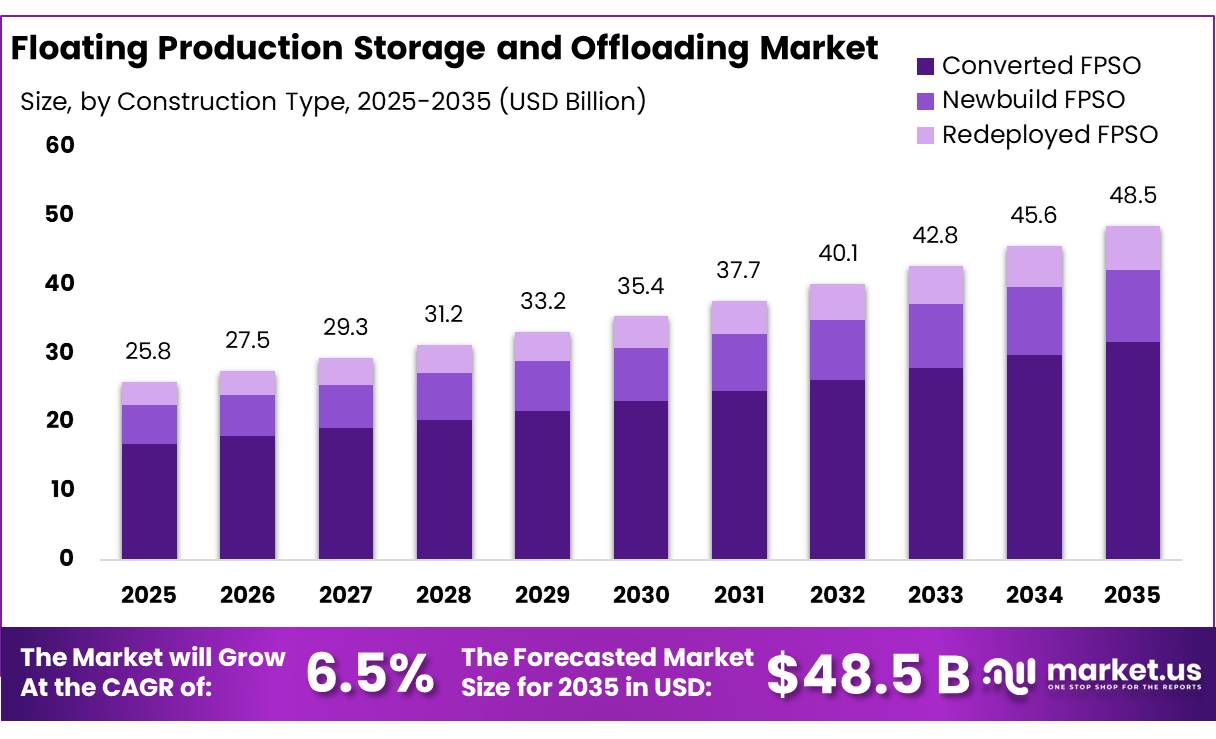
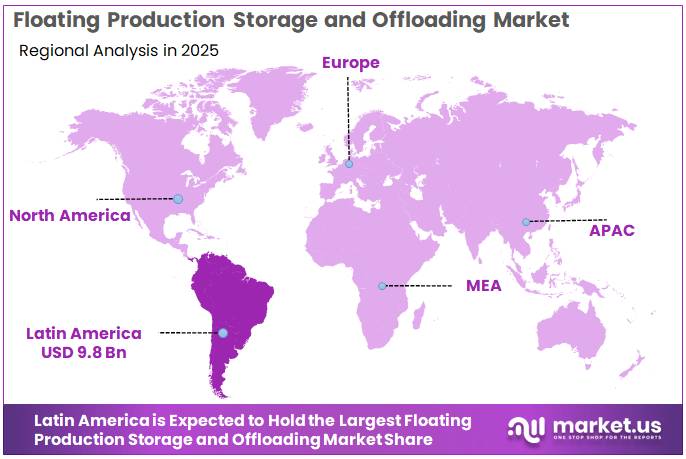
The Global Floating Production Storage and Offloading Market size is expected to be worth around USD 48.5 Billion by 2035, from USD 25.8 Billion in 2025, growing at a CAGR of 6.5% during the forecast period from 2026 to 2035. In 2025, Latin America held a dominant market position, capturing more than a 38.00% share, holding USD 9.8 Billion revenue.
Floating Production Storage and Offloading (FPSO) vessels are offshore facilities designed to process crude oil and natural gas, store produced oil, and transfer it to shuttle tankers for transportation. They are widely used in deepwater and ultra-deepwater fields where fixed platforms and long-distance pipeline infrastructure may be costly or difficult to install. FPSOs combine production equipment, storage capacity, and export systems on a single floating unit, giving operators flexibility to develop offshore reserves.
The industry scenario remains closely linked to new offshore oil developments, particularly in deepwater basins where FPSOs can support large production volumes without requiring extensive fixed infrastructure. A 2025 review of offshore floating production systems identified 185 installed FPSOs, 23 under construction, and 12 available for redeployment worldwide, illustrating the scale of the operating fleet and project pipeline.
- The United States Energy Information Administration (EIA) reported that new FPSO start-ups helped Brazil’s crude oil production exceed 4.0 million barrels per day in October 2025. The agency also forecast average production of 4.0 million barrels per day in 2026, supported by additional offshore capacity.
The main driving factors include the development of deepwater oil reserves, the need to replace declining production from mature fields, and the demand for flexible offshore infrastructure. The International Energy Agency (IEA) estimated that global upstream oil and gas investment would reach approximately USD 570 billion in 2025, reflecting continued spending on exploration, field development, and production facilities.
Future growth opportunities include larger-capacity vessels, subsea tiebacks, digital monitoring, improved energy efficiency, and carbon capture technologies. New projects in Brazil and Guyana are expected to support demand for FPSO engineering, construction, equipment, and maintenance services.
The Brazilian Ministry of Mines and Energy reported anticipated investments of approximately USD 100 billion in offshore exploration and production during 2024–2026, highlighting the scale of planned industry activity. Suppliers that improve vessel reliability, shorten construction schedules, and reduce operating emissions may be well positioned to benefit from upcoming projects.
Key Takeaways
- Floating Production Storage and Offloading Market size is expected to be worth around USD 48.5 Billion by 2035, from USD 25.8 Billion in 2025, growing at a CAGR of 6.5%.
- Converted FPSO held a dominant market position, capturing more than a 65.00% share.
- Double-Hull FPSO held a dominant market position, capturing more than a 69.00% share.
- Turret Mooring FPSO held a dominant market position, capturing more than a 42.00% share.
- 1–2 Million Barrels held a dominant market position, capturing more than a 57.00% share.
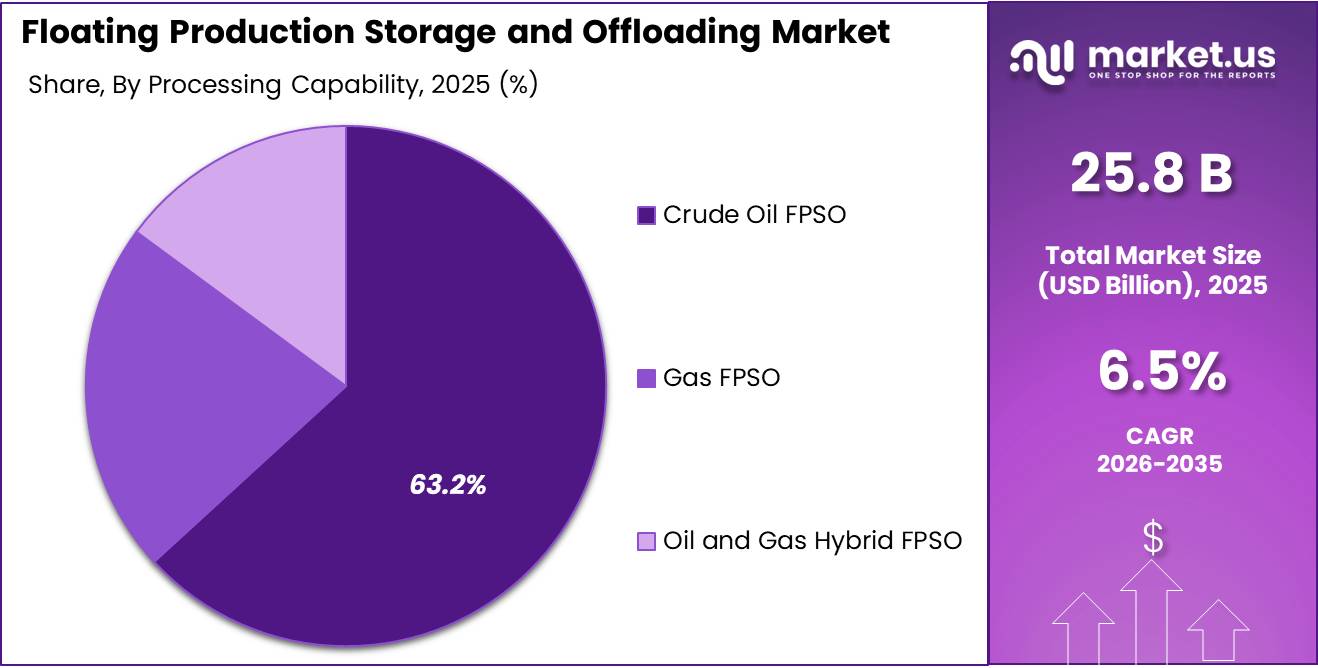
- Crude Oil FPSO held a dominant market position, capturing more than a 63.00% share.
- National Oil Companies held a dominant market position, capturing more than a 37.00% share.
- Latin America held a dominant position with a 38.00% share, valued at USD 9.8 billion.
By Construction Type Analysis
Converted FPSO dominates due to lower development costs and the reuse of existing vessels
In 2025, “Converted FPSO” held a dominant market position, capturing more than a 65.00% share of the Floating Production Storage and Offloading Market by Construction Type. Converted FPSOs are developed by modifying existing oil tankers to accommodate offshore oil processing, storage, and offloading equipment. This approach can reduce construction costs and make use of existing vessel structures, depending on their condition and the project’s technical requirements. According to industry fleet data published by Offshore Magazine in May 2025, 96 of 166 active FPSOs, or approximately 58%, were converted vessels.
Newbuild FPSO vessels are designed and constructed specifically for offshore oil and gas fields. They allow operators to tailor storage capacity, processing systems, safety features, and mooring arrangements to project requirements. Although newbuilds generally require greater initial investment and longer construction periods, they are suitable for large deepwater developments that need high production capacity and long operating lives.
In 2025, the US Energy Information Administration reported that Brazil’s monthly crude oil production exceeded 4.0 million barrels per day for the first time in October, supported by new FPSO start-ups. The agency forecast average production of 4.0 million barrels per day in 2026, with additional FPSO capacity contributing to growth. These developments support demand for purpose-built vessels and advanced offshore production systems.
By Hull Type Analysis
Double-Hull FPSO leads through improved protection against oil leakage
In 2025, “Double-Hull FPSO” held a dominant market position, capturing more than a 69.00% share of the Floating Production Storage and Offloading Market by Hull Type. Double-hull vessels have an additional structural layer between the cargo tanks and the surrounding sea, helping reduce the risk of oil spills if the outer hull is damaged. This design is particularly important for offshore projects that handle large volumes of crude oil in challenging marine environments.
Operators also consider environmental protection, vessel safety, and regulatory compliance when selecting FPSO hull designs. The International Maritime Organization (IMO) provides international requirements for tanker construction and pollution prevention, supporting the wider adoption of protective vessel designs.
Single-Hull FPSO vessels have a single primary hull structure surrounding their storage tanks. They may remain relevant in certain existing offshore projects, particularly where operators assess vessel condition, conversion costs, and the economics of extending service life. However, their use faces greater environmental and structural concerns because they lack the additional protective barrier provided by a double hull.
The International Maritime Organization (IMO) amended the MARPOL convention in 1992, requiring oil tankers of 5,000 deadweight tonnes or more ordered after July 6, 1993, to have double hulls or an approved alternative design. The phase-out rules were subsequently accelerated, with the final phase-out dates for most single-hull tanker categories falling between 2005 and 2010, subject to specified conditions. These regulations influence vessel selection and make double-hull designs preferable for many offshore projects.
By Mooring System Analysis
Turret Mooring FPSO leads through flexible positioning in changing sea conditions
In 2025, “Turret Mooring FPSO” held a dominant market position, capturing more than a 42.00% share of the Floating Production Storage and Offloading Market by Mooring System. Turret mooring allows an FPSO to rotate around a fixed mooring point in response to wind, waves, and ocean currents. This helps the vessel align with prevailing environmental conditions and can reduce operational stress in challenging offshore locations. The system is particularly suitable for deepwater fields exposed to changing weather conditions.
Spread Mooring FPSO systems secure the vessel using multiple mooring lines connected to anchors on the seabed. Unlike turret systems, they generally keep the vessel in a fixed heading, making them suitable for offshore fields where wind and wave directions are relatively predictable. This arrangement can reduce system complexity in suitable environments and support projects with specific seabed and field layouts.
In 2026, Brazil’s National Agency of Petroleum, Natural Gas and Biofuels (ANP) continued publishing official offshore platform data, including FPSO operating status, water depth, production capacity, and start-up year. For example, the agency lists the FPSO Alexandre de Gusmão with a crude oil production capacity of 225,000 barrels per day and a water depth of 1,890 metres.
By Storage Capacity Analysis
1–2 Million Barrels leads through balanced storage and production requirements
In 2025, “1–2 Million Barrels” held a dominant market position, capturing more than a 57.00% share of the Floating Production Storage and Offloading Market by Storage Capacity. FPSOs in this capacity range provide a balance between oil storage, production requirements, vessel size, and operating costs. They allow offshore operators to store crude oil between tanker offloading operations, particularly in remote fields where pipeline connections are limited.
FPSOs with storage capacity below 1 million barrels can suit smaller offshore fields, marginal discoveries, and projects where production volumes do not justify a larger vessel. Their smaller storage requirements may help operators manage vessel size and investment costs, depending on the field’s technical and commercial conditions. They can also support early production systems and selected redevelopment projects. In 2025, the United States Energy Information Administration reported that Brazil’s crude oil production exceeded 4.0 million barrels per day in October, supported by new offshore FPSO start-ups.
This demonstrates the importance of offshore production infrastructure, although the national production figure does not identify demand for any particular storage-capacity category. Smaller FPSOs remain an option where field output, tanker scheduling, and export logistics support a lower storage requirement.
By Processing Capability Analysis
Crude Oil FPSO leads due to strong demand for offshore oil production
In 2025, “Crude Oil FPSO” held a dominant market position, capturing more than a 63.00% share of the Floating Production Storage and Offloading Market by Processing Capability. Crude oil FPSOs are designed to separate oil, gas, and water from well fluids, treat the crude oil, and store it before transfer to shuttle tankers. They are widely used in deepwater and ultra-deepwater fields where pipeline infrastructure may be costly or unavailable. Their ability to combine processing, storage, and export functions in one vessel makes them suitable for large offshore developments.
Gas FPSOs are designed to process natural gas produced from offshore reservoirs, including the separation of gas, liquids, and water. Depending on their design, these facilities can support gas treatment, compression, and the handling of associated gas alongside oil production. They are relevant to offshore fields where subsea pipelines and onshore processing infrastructure are limited or costly to develop.
By End User Analysis
National Oil Companies lead through large offshore development programs
In 2025, “National Oil Companies” held a dominant market position, capturing more than a 37.00% share of the Floating Production Storage and Offloading Market by End User. National oil companies invest in FPSOs to develop offshore reserves, increase domestic energy production, and maintain long-term control over strategic oil and gas resources.
Brazil’s Petrobras provides a clear example of this demand. In 2025, Petrobras reported total oil and gas production of 2.99 million barrels of oil equivalent per day, an increase of 10.8% compared with 2024. The company also brought new FPSOs into operation, including Almirante Tamandaré and Alexandre de Gusmão, supporting higher production from deepwater fields. These projects highlight the role of national oil companies in driving demand for offshore production, storage, and export infrastructure.
International Oil Companies (IOCs) use FPSOs to develop offshore reserves in regions such as Guyana, Brazil, and the United Kingdom. Their participation is supported by global project management experience, access to capital, and partnerships with offshore engineering and vessel operators.
In February 2025, Shell restarted production at the Penguins field in the United Kingdom using a modern FPSO, with estimated peak production of 45,000 barrels of oil equivalent per day and recoverable resources of approximately 100 million barrels of oil equivalent. In 2025, ExxonMobil also advanced the FPSO Jaguar project in Guyana, designed for a production capacity of 250,000 barrels per day, with first oil expected in 2027.
Key Market Segments
By Construction Type
- Converted FPSO
- Newbuild FPSO
- Redeployed FPSO
By Hull Type
- Single-Hull FPSO
- Double-Hull FPSO
By Mooring System
- Turret Mooring FPSO
- Spread Mooring FPSO
- Single-Point Mooring FPSO
- Dynamic Positioning / Hybrid Mooring FPSO
By Storage Capacity
- Below 1 Million Barrels
- 1–2 Million Barrels
- Above 2 Million Barrels
By Processing Capability
- Crude Oil FPSO
- Gas FPSO
- Oil and Gas Hybrid FPSO
By End User
- National Oil Companies
- International Oil Companies
- Independent Exploration and Production Companies
- Offshore Field Operators
Driver Analysis
Brazil pre-salt build-out
Brazil receives the largest modeled contribution, +1.4 percentage points, because its identified production-system pipeline provides comparatively strong near-term procurement and commissioning visibility. Petrobras’ 2026–2030 business plan specifies US$109 billion of total investment, including US$91 billion in its implementation portfolio and US$18 billion under evaluation; implementation-target exploration and production investment totals US$69.2 billion.
The plan identifies eight new production systems through 2030, seven already contracted, and targets 11 FPSOs operating at Búzios by 2027, including the contracted P-78, P-79, P-80, P-82 and P-83 units; a twelfth unit, P-91, was in bidding when the plan was released.
These categories should not be conflated: neither every production system nor all E&P spending represents an FPSO award. Commercially, successive field developments create repeat demand for topsides, compression, water injection, marine systems and operating support, allowing suppliers to spread engineering costs across multiple units rather than recover them from isolated projects.
SBM’s August 2026 reporting also identifies Petrobras’ SEAP I and SEAP II FPSO contract awards, extending commercial activity beyond the original plan disclosures. The incremental growth allocation therefore emphasizes conversion of contracted projects into recognized revenue, with additional tenders offering upside; it discounts unsanctioned opportunities and does not assume that construction progress translates immediately into operating lease income.
Drivers Impact Analysis
| Driver | (~) % Impact on CAGR Forecast | Geographic Relevance | Impact Timeline |
|---|---|---|---|
| Brazil pre-salt build-out | +1.4 pp | Brazil: Santos and Campos basins | Short term (≤ 2 years) |
| Guyana–Suriname project pipeline | +1.1 pp | Guyana: Stabroek; Suriname: Block 58 | Medium term (2–4 years) |
| Standardized hulls and modular delivery | +0.6 pp | Brazil, Guyana, Suriname; Asian fabrication hubs | Short term (≤ 2 years) |
| Project finance and flexible ownership | +0.5 pp | Guyana, Brazil; international lending hubs | Short term (≤ 2 years) |
| Low-emission deepwater development | +0.5 pp | Angola: Kwanza basin; Brazil and Suriname | Medium term (2–4 years) |
| Debottlenecking and lifecycle services | +0.4 pp | Guyana, Brazil, Angola | Short term (≤ 2 years) |
Restraint Analysis
Oil-price approval risk
Lower oil-price assumptions constrain FPSO demand primarily by delaying investment approvals rather than immediately terminating producing-vessel contracts. Petrobras’ 2026–2030 planning materials identify a US$109 billion opportunity portfolio, comprising US$91 billion in the implementation portfolio and US$18 billion under evaluation; within the implementation portfolio, US$10 billion is subject to quarterly financial-viability assessment, making approximately 11% of that portfolio explicitly conditional on cash-flow and capital-structure considerations.
Its estimated Brent price required to meet financial obligations without increasing net debt is US$59 per barrel in 2026, declining to US$48 in 2030; this is a corporate cash-flow threshold, not an individual field’s production breakeven. The same presentation estimates that a R$0.50 exchange-rate change alters the 2026 Brent threshold by approximately US$5 per barrel, illustrating how currency movements can tighten capital allocation even without changes in reservoir performance. MODEC independently warns that a prolonged crude-price slump could postpone oil-major projects and temporarily reduce FPSO orders.
The commercial transmission is sequential: operators reassess discretionary developments, delay final investment decisions, defer engineering commitments and push construction revenue beyond the forecast window; suppliers then carry bid-development and engineering costs for longer without equivalent order conversion. Existing charter income is less immediately exposed because MODEC describes contracts lasting 10–25 years with fixed US-dollar day rates payable subject to vessel availability, irrespective of actual production or oil prices. The modeled −0.8-point deduction therefore falls predominantly on prospective awards and project timing, not on an assumed collapse in contracted fleet revenue.
Restraint Impact Analysis
| Restraint | (~) % Impact on CAGR Forecast | Geographic Relevance | Impact Timeline |
|---|---|---|---|
| Oil-price approval risk | −0.8 pp | Brazil, Guyana, West Africa | Short term (≤ 2 years) |
| Yard and equipment constraints | −0.6 pp | China, Singapore; Atlantic projects | Medium term (2–4 years) |
| Financing and cash-flow pressure | −0.5 pp | Brazil, Guyana, West Africa | Short term (≤ 2 years) |
| Local-content procurement friction | −0.4 pp | Brazil: offshore basins | Medium term (2–4 years) |
| Lump-sum execution exposure | −0.4 pp | Asian yards; global projects | Short term (≤ 2 years) |
| Customer and project concentration | −0.3 pp | Brazil, Guyana | Long term (≥ 4 years) |
Opportunity Analysis
Carbon-capture retrofit services
The white space is a commercially repeatable retrofit-and-service offering for operating FPSOs, rather than another low-emission specification on already-sanctioned newbuilds. MODEC’s February 2025 agreement initiated front-end engineering for a first-of-a-kind onboard CycloneCC retrofit, followed by a June 2025 development framework; Carbon Clean described a pilot targeted for installation in 2026, an initial commercial-scale system capturing up to 100,000 tonnes of CO₂ annually and subsequent scaling toward approximately 300,000 tonnes annually. These are development targets, not evidence of completed installations or sustained offshore capture performance.
An illustrative serviceable obtainable market of five installations at an assumed US$30 million equipment-and-integration price would generate US$150 million of deployment revenue; an additional assumed US$10 per tonne for monitoring, solvent management and maintenance at 100,000 tonnes per installation would generate US$5 million annually. Neither price is a disclosed vendor quotation. Commercial viability requires more than capture: at an assumed US$100-per-tonne avoided emissions cost, a 100,000-tonne system creates US$10 million of gross annual value before energy consumption, transport, storage and operating expenditure, so equipment payback cannot be inferred from that figure alone.
Suppliers could combine modular equipment, availability guarantees and verified-capture fees, with contracts conditioned on a viable CO₂ disposal route. The +0.5-point upside concerns scaling beyond pilots into previously uncontracted retrofit revenue; qualification, deck weight, heat availability and storage access remain the execution gates.
Opportunity Impact Analysis
| Opportunity | (~) % Potential CAGR Upside | Geographic Relevance | Execution Window |
|---|---|---|---|
| Carbon-capture retrofit services | +0.5 pp | Brazil; Guyana–Suriname | Medium term (2–4 years) |
| Third-party digital subscriptions | +0.4 pp | Brazil, Angola, Côte d’Ivoire | Short term (≤ 2 years) |
| Redeployment-as-a-service | +0.4 pp | West Africa; Southeast Asia | Medium term (2–4 years) |
| Satellite processing access | +0.4 pp | Suriname; Brazil; West Africa | Medium term (2–4 years) |
| Circular decommissioning platforms | +0.3 pp | Brazil; Denmark; West Africa | Short term (≤ 2 years) |
| Modular fuel-cell power services | +0.3 pp | Brazil first; Atlantic basins | Long term (≥ 4 years) |
Challenges Analysis
Aging asset integrity management
Aging FPSOs require progressively more inspection and repair while continuing production, creating a persistent maintenance-productivity challenge rather than an automatic prohibition on operation. SBM’s 2025 reporting explicitly identifies deterioration of original coating systems, rising integrity workloads and limited accommodation for offshore personnel; it increased persons-on-board capacity on Cidade de Anchieta and was pursuing similar measures on Cidade de Paraty and Cidade de Ilhabela to support long-term integrity work. Its reported combined fleet uptime was 99.1% in 2025, compared with 96.0% in 2024, illustrating that high availability is achievable but requires sustained intervention; the company separately reports adjusted uptime measures, which should not be substituted for actual combined performance.
DNV identifies thousands of structural details susceptible to fatigue cracking and emphasizes that remaining life depends on actual cyclic loading, welding characteristics, stress levels and inspection evidence—not vessel age alone. In an analyst sensitivity, a one-percentage-point availability loss on a vessel otherwise producing 150,000 barrels per day corresponds to approximately 548,000 barrels annually; at an assumed US$25-per-barrel incremental contribution, operator exposure approaches US$13.7 million before repair costs, although this is not equivalent to lost FPSO supplier revenue.
Corporate mitigation requires condition-based inspection, corrosion-work prioritization, validated fatigue models and accommodation/logistics planning integrated with production schedules. The −0.5-point allocation reflects the risk that integrity expenditure and downtime absorb resources that would otherwise support fleet expansion; increased maintenance revenue only partly offsets that drag.
Challenges Impact Analysis
| Challenge | (~) % CAGR Friction Drag | Geographic Relevance | Mitigation Horizon |
|---|---|---|---|
| Aging asset integrity management | −0.5 pp | Brazil; Angola; Malaysia | Long term (≥ 4 years) |
| Commissioning and ramp-up variability | −0.4 pp | Brazil; Guyana; Suriname | Medium term (2–4 years) |
| Specialist workforce competency scaling | −0.3 pp | Brazil; Guyana; Asian yards | Long term (≥ 4 years) |
| Brownfield modification interface complexity | −0.3 pp | Brazil; Angola; Guyana | Medium term (2–4 years) |
| Digital reliability assurance gaps | −0.2 pp | Brazil; West Africa; Guyana | Medium term (2–4 years) |
| Lifecycle emissions performance management | −0.3 pp | Brazil; Guyana; Angola | Long term (≥ 4 years) |
Geopolitical Impact Analysis
Geopolitical Impact of the 2026 Middle East War on the Floating Production Storage and Offloading Market
The ongoing war in the Middle East is increasing uncertainty across the Floating Production Storage and Offloading (FPSO) market by raising oil prices, shipping costs, insurance premiums, and project risks. Although FPSOs operate offshore and can support production away from land-based facilities, projects may still face higher costs for equipment, steel, subsea components, and transportation. Delays to vessel movements and supply chains can also affect construction schedules, commissioning, and the delivery of critical equipment.
- According to the International Energy Agency (IEA), around 20 million barrels of oil per day passed through the Strait of Hormuz in 2025, representing approximately 25% of global seaborne oil trade. The International Maritime Organization reported on August 28, 2026, that at least 70 attacks on international shipping had been verified since the conflict began on February 28, 2026.
These conditions may encourage oil producers to invest in offshore projects that diversify production and export routes. However, higher financing, security, and logistics costs could delay final investment decisions, especially for capital-intensive deepwater developments. FPSO operators may also need stronger emergency planning, supplier diversification, and maritime risk controls. The market’s near-term outlook will therefore depend on regional security, reliable shipping access, and the stability of energy investment.
Regional Insights
Dominant Region: Latin America
In the Floating Production Storage and Offloading (FPSO) market, Latin America held a dominant position with a 38.00% share, valued at USD 9.8 billion, according to the provided market estimates. The region benefits from extensive deepwater reserves, large offshore projects, and continued investment in floating production infrastructure, particularly in Brazil and Guyana. Brazil’s offshore pre-salt fields are a major source of demand for FPSOs because these vessels can process and store crude oil in deepwater locations without requiring extensive onshore infrastructure.
The U.S. Energy Information Administration reported that Brazil’s crude oil production exceeded 4.0 million barrels per day in October 2025, supported by new FPSO start-ups. In Guyana, the government announced in August 2026 that the arrival of its fifth FPSO, Errea Wittu, was expected to help lift national oil production above 1 million barrels per day. These developments reinforce Latin America’s importance for new vessel contracts and offshore production expansion.
Latin America is also positioned for further growth as operators advance new deepwater developments and expand existing production hubs. Brazil remains a significant investment destination, while Guyana is adding capacity through successive offshore projects. According to the Energy Maritime Associates’ Global Floating Production Industry Survey 2025, 19 potential projects in Brazil could require up to 32 floating production units. This project pipeline indicates continued opportunities for FPSO engineering, construction, leasing, installation, and maintenance providers. Growth will depend on project approvals, financing, vessel availability, and offshore infrastructure readiness.
Key Regions and Countries Insights
- North America
- US
- Canada
- Europe
- Germany
- France
- The UK
- Spain
- Italy
- Rest of Europe
- Asia Pacific
- China
- Japan
- South Korea
- India
- Australia
- Rest of APAC
- Latin America
- Brazil
- Mexico
- Rest of Latin America
- Middle East & Africa
- GCC
- South Africa
- Rest of MEA
Key Players Analysis
SBM Offshore N.V. is a major FPSO provider offering engineering, construction, leasing, and operational services. In 2025, the company reported US$5.1 billion in directional revenue and US$1.7 billion in directional earnings before interest, taxes, depreciation, and amortization. Its fleet increased to 16 FPSOs following the addition of 3 units during the year. Key projects included Almirante Tamandaré in Brazil and ONE GUYANA, strengthening its position in deepwater production.
MODEC, Inc. designs, builds, leases, and operates floating production systems for offshore oil and gas projects. Its 2025 annual report recorded approximately US$2.89 billion in completed construction revenue, while new orders reached approximately US$9.26 billion, an increase of 646.6% year over year. Its order backlog stood at approximately US$18.59 billion, up 43.6%. These figures demonstrate a strong project pipeline and continued demand for its FPSO-related engineering and construction capabilities.
BW Offshore Limited provides FPSO ownership, engineering, and offshore production services. The company has completed more than 40 FPSO and floating storage and offloading projects and has 5 FPSOs under ownership or operational responsibility. It has approximately 40 years of offshore experience and around 900 employees. In 2025, its BW Opal FPSO achieved first gas at Australia’s Barossa field, marking a major project milestone. The contract includes a 15-year firm period, with options for an additional 10 years.
Top Key Players Outlook
- SBM Offshore N.V.
- MODEC, Inc.
- BW Offshore Limited
- Yinson Holdings Berhad
- Bumi Armada Berhad
- MISC Berhad
- Altera Infrastructure L.P.
- Bluewater Energy Services B.V.
- Teekay Corporation / Teekay Petrojarl
- Mitsui O.S.K. Lines, Ltd. (MOL)
- Petrovietnam Technical Services Corporation
- HD Hyundai Heavy Industries Co., Ltd.
- China State Shipbuilding Corporation
- TechnipFMC plc
- Saipem S.p.A.
Recent Developments
- In October 2026, Yinson Production signed a contract amendment with Eni to upgrade gas processing on the FPSO John Agyekum Kufuor in Ghana, increasing planned gas export capacity from 210–220 million standard cubic feet per day to 355 million and adding approximately USD 600 million to its firm contract backlog.
- In August 2026, Bumi Armada reported RM149.8 million in net cash flow from operating activities and RM71.0 million in net profit for the second quarter.
Report Scope
| Report Features | Description |
|---|---|
| Market Value (2025) | USD 25.8 Bn |
| Forecast Revenue (2035) | USD 48.5 Bn |
| CAGR (2026-2035) | 6.5% |
| Base Year for Estimation | 2025 |
| Historic Period | 2020-2024 |
| Forecast Period | 2026-2035 |
| Report Coverage | Revenue Forecast, Market Dynamics, Competitive Landscape, Recent Developments |
| Segments Covered | By Construction Type (Converted FPSO, Newbuild FPSO, Redeployed FPSO), By Hull Type (Single-Hull FPSO, Double-Hull FPSO), By Mooring System (Turret Mooring FPSO, Spread Mooring FPSO, Single-Point Mooring FPSO, Dynamic Positioning / Hybrid Mooring FPSO), By Storage Capacity (Below 1 Million Barrels, 1–2 Million Barrels, Above 2 Million Barrels), By Processing Capability (Crude Oil FPSO, Gas FPSO, Oil and Gas Hybrid FPSO), By End User (National Oil Companies, International Oil Companies, Independent Exploration and Production Companies, Offshore Field Operators) |
| Regional Analysis | North America – US, Canada; Europe – Germany, France, The UK, Spain, Italy, Rest of Europe; Asia Pacific – China, Japan, South Korea, India, Australia, Singapore, Rest of APAC; Latin America – Brazil, Mexico, Rest of Latin America; Middle East & Africa – GCC, South Africa, Rest of MEA |
| Competitive Landscape | SBM Offshore N.V., MODEC, Inc., BW Offshore Limited, Yinson Holdings Berhad, Bumi Armada Berhad, MISC Berhad, Altera Infrastructure L.P., Bluewater Energy Services B.V., Teekay Corporation / Teekay Petrojarl, Mitsui O.S.K. Lines, Ltd. (MOL), Petrovietnam Technical Services Corporation, HD Hyundai Heavy Industries Co., Ltd., China State Shipbuilding Corporation, TechnipFMC plc, Saipem S.p.A. |
| Customization Scope | Customization for segments, region/country-level will be provided. Moreover, additional customization can be done based on the requirements. |
| Purchase Options | We have three licenses to opt for: Single User License, Multi-User License (Up to 5 Users), Corporate Use License (Unlimited User and Printable PDF) |