Report Overview
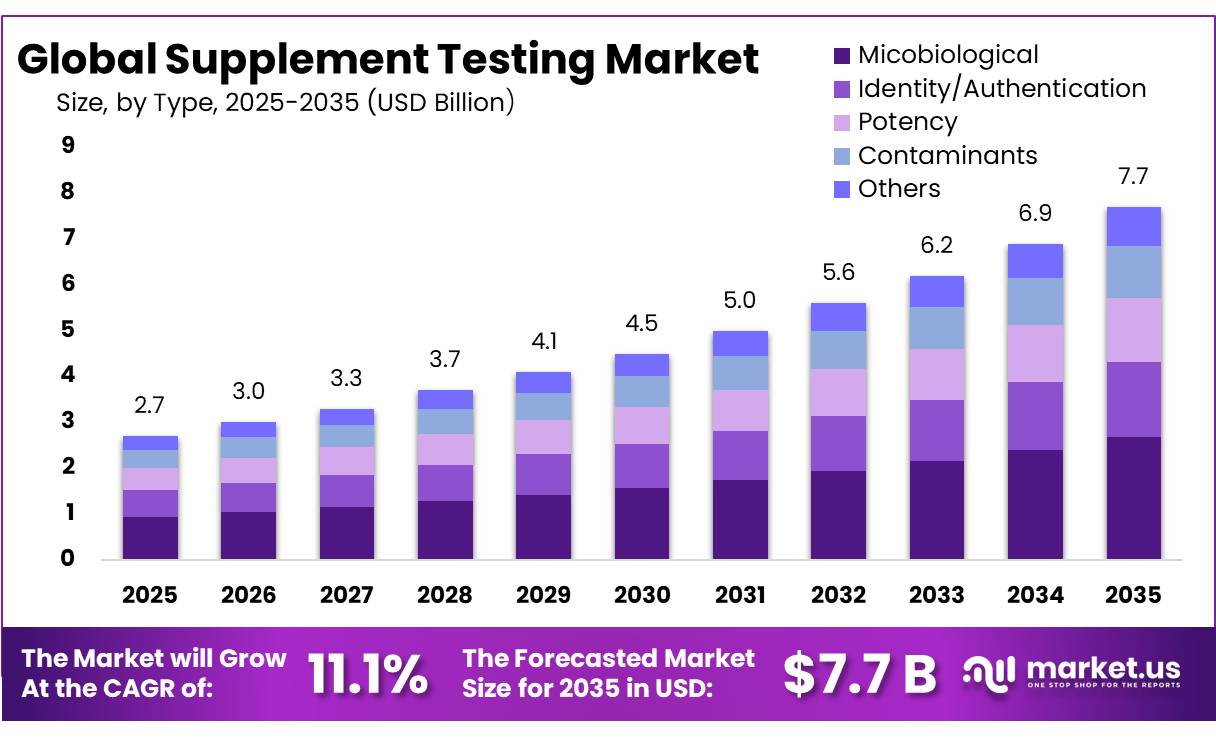
The Global Supplement Testing Market size is expected to be worth around USD 7.7 Billion by 2035, from USD 2.7 Billion in 2025, growing at a CAGR of 11.1% during the forecast period from 2026 to 2035. In 2025, North America held a dominant market position, capturing more than a 32.78% share, holding USD 0.8 Billion revenue.
The supplement testing industry plays an important role in ensuring the safety, quality, purity, and effectiveness of dietary supplements, including vitamins, minerals, herbal extracts, amino acids, probiotics, and sports nutrition products. Testing laboratories support manufacturers, ingredient suppliers, contract development and manufacturing organizations, and distributors by verifying ingredient identity, active compound concentration, product composition, and compliance with quality specifications.
- In the United States, the Food and Drug Administration (FDA) established dietary supplement current good manufacturing practice requirements under 21 CFR Part 111 in 2007. These rules require manufacturers to establish specifications for identity, purity, strength, composition, and contamination limits. Manufacturers must also conduct appropriate testing or examinations and maintain supporting records before releasing products for distribution.
Demand is further supported by supplement consumption and the growing need for independent quality verification. The National Institutes of Health (NIH) Office of Dietary Supplements reports in its 2025–2029 strategic plan that approximately one-half of adults and one-third of children and adolescents in the United States consume dietary supplements. This broad consumer base supports recurring requirements for ingredient authentication, potency testing, microbial analysis, and contaminant screening.
Key driving factors include stricter quality expectations, complex global ingredient supply chains, increasing use of botanical ingredients, and the risk of adulteration or inaccurate labeling. The European Commission’s supplement framework under Directive 2002/46/EC establishes rules for vitamins and minerals used in food supplements, while European contaminant legislation sets maximum levels for specified substances, including lead, cadmium, mercury, and arsenic in relevant food categories.
Key Takeaways
- Supplement Testing Market size is expected to be worth around USD 7.7 Billion by 2035, from USD 2.7 Billion in 2025, growing at a CAGR of 11.1%.
- Microbiological held a dominant market position, capturing more than a 34.78% share.
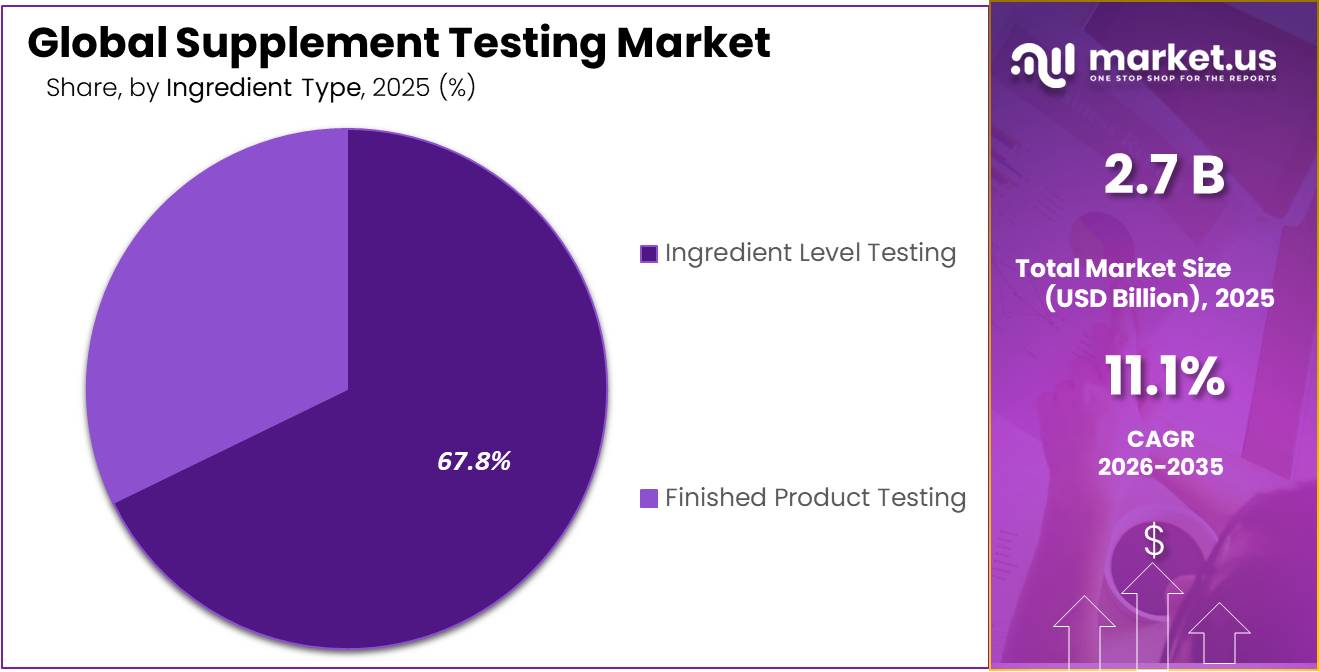
- Ingredient Level Testing held a dominant market position, capturing more than a 67.89% share.
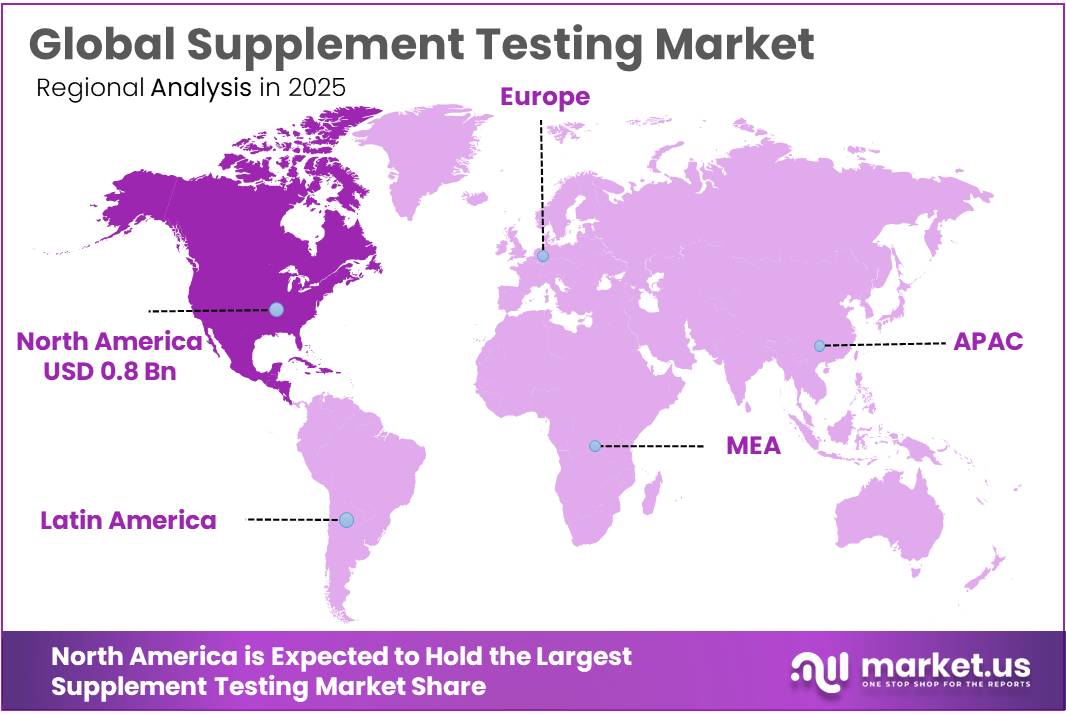
- North America held a dominant position in the Supplement Testing Market, capturing 32.78% share, equivalent to USD 0.8 billion.
By Type Analysis
Microbiological testing leads with a 34.78% share in 2025, supported by its role in supplement safety and contamination control.
In 2025, “Microbiological” held a dominant market position, capturing more than a 34.78% share of the Supplement Testing Market by Type. This segment is important because it helps manufacturers assess microbial contamination and verify the quality of finished supplements and their ingredients. Testing can identify harmful microorganisms and support compliance with manufacturing quality requirements. The United States Food and Drug Administration establishes dietary supplement manufacturing requirements under 21 CFR Part 111, including appropriate specifications and testing procedures.
Identity/Authentication testing is an important segment of the Supplement Testing Market because it verifies whether the ingredients used in a supplement match the manufacturer’s specifications and product label. In 2025, demand for these services was supported by the need to verify botanical extracts, vitamins, minerals, and other dietary ingredients before production. The United States Food and Drug Administration requires manufacturers to conduct at least one appropriate test or examination to verify the identity of each dietary ingredient, unless an approved exemption applies.
By Ingredient Type Analysis
Ingredient Level Testing leads with a 67.89% share in 2025, supported by its role in verifying raw material quality.
In 2025, “Ingredient Level Testing” held a dominant market position, capturing more than a 67.89% share of the Supplement Testing Market by Ingredient Type. This segment supports manufacturers in checking the identity, purity, strength, and quality of individual ingredients before they enter the production process. Testing is particularly important for vitamins, minerals, botanical extracts, and other active ingredients, as variations in raw material quality can affect the final supplement.
Finished Product Testing is an important part of the Supplement Testing Market because it helps manufacturers confirm that completed products meet established quality specifications before release. In 2025, this testing category supported checks for ingredient strength, composition, purity, and potential contamination in finished capsules, tablets, powders, and liquid supplements. Under 21 CFR Part 111, the United States Food and Drug Administration requires manufacturers to establish specifications for finished dietary supplements and determine whether those specifications are met.
Key Market Segments
By Type
- Identity/Authentication
- Potency
- Contaminants
- Micobiological
- Others
By Ingredient Type
- Ingredient Level Testing
- Finished Product Testing
Driver Analysis
Marketplace TIC Verification Mandates
Marketplaces and retailers have become a testing requirement in their own right, separate from FDA. Amazon now requires dietary supplement sellers to work with an authorized third-party testing, inspection and certification (TIC) provider to verify every notified product listing (ASIN). The TIC provider submits documents directly instead of the seller (Amazon Seller Central; Amazon UK). Walmart applies health and wellness product safety requirements to all vitamin and supplement suppliers.
Intertek lists 11 major retailers, including Costco, Target, CVS Health, Walgreens and Kroger, that accept its supplement GMP certifications. This changes how testing is bought. Instead of buying certificates of analysis lot by lot, brands sign annual verification contracts per SKU, with TIC firms integrated into marketplace systems.
We estimate testing for identity, potency, contaminants and label claims costs $1,500 to $5,000 per SKU a year. A brand with 50 to 200 marketplace SKUs therefore spends $0.1M to $1.0M a year on testing it cannot avoid. TIC providers authorized by marketplaces gain a captive client base at near-zero customer acquisition cost and renewal rates above 85%.
Drivers Impact Analysis
| Driver | (~) % Impact on CAGR Forecast | Geographic Relevance | Impact Timeline |
|---|---|---|---|
| Marketplace TIC Verification Mandates | +1.2% | North America core, EU, Japan | Short term (≤ 2 years) |
| Heavy Metal Contaminant Scrutiny | +1.1% | U.S. core (California, Texas), EU | Short term (≤ 2 years) |
| 7-OH and NDI Regulatory Actions | +0.9% | U.S. core | Medium term (2-4 years) |
| Multi-Supplement Consumer Base | +0.8% | U.S., EU, APAC urban | Long term (≥ 4 years) |
| APAC Contaminant Rule Tightening | +0.7% | India, China, ASEAN | Medium term (2-4 years) |
| PFAS and DNA Method Expansion | +0.6% | U.S., EU | Medium term (2-4 years) |
Restraint Analysis
FDA Capacity Cuts
Weaker federal enforcement reduces the regulatory pressure that pushes brands to test beyond the minimum. HHS cut 3,500 FDA staff on April 1, 2025, as part of reducing its workforce from 82,000 to 62,000 (SupplySide SJ; Skadden). FDA inspections of foreign food sites are down nearly 35% since 2019. FDA inspected 800 supplement facilities in FY2025 and found 49.1% non-compliant, which shows how large the industry is relative to the number of inspections.
We estimate that with roughly 800 inspections a year across a base of several thousand facilities, a U.S. manufacturer is inspected only once every 5 to 8 years. Smaller brands therefore test identity and contaminants every 2 to 4 lots rather than every lot. That removes an estimated 10% to 20% of potential testing volume, which shifts from compliance demand to optional quality-assurance spend.
Restraint Impact Analysis
| Restraint | (~) % Impact on CAGR | Geographic Relevance | Impact Timeline |
|---|---|---|---|
| FDA Capacity Cuts | -0.9% | U.S. core, import corridors | Short term (≤ 2 years) |
| Tariff-Driven Brand Margin Squeeze | -0.9% | U.S. core, China and India supply | Short term (≤ 2 years) |
| No Federal Contaminant Limits | -0.7% | U.S. core | Long term (≥ 4 years) |
| Soft TIC Demand and Pricing | -0.5% | Europe, North America | Short term (≤ 2 years) |
| Loosely Policed Social Commerce | -0.5% | U.S., UK, SE Asia | Medium term (2-4 years) |
| Instrument Price Inflation | -0.4% | Global labs | Short term (≤ 2 years) |
Opportunity Analysis
Independent Lab Roll-Ups
U.S. supplement testing is still spread across many small independent labs. Consolidating them is an M&A opportunity, separate from the growth in test volumes. Mérieux NutriSciences agreed on August 18, 2026 to acquire Certified Group, adding 31 North American labs that cover OTC products, supplements and cosmetics (Chain Drug Review; Dairy Foods). NSF bought Cambium Analytica, a 69-person batch-release testing firm, in October 2025. Eurofins closed 22 acquisitions in the first nine months of 2026.
Instrument price inflation is pushing small labs to sell. We estimate independent labs with $5M to $30M of revenue can be bought at 8 to 11 times EBITDA. Combining them under shared LIMS, purchasing and marketplace TIC accreditation could raise EBITDA margins from 15% to 18% up to 24% to 28%. Being authorized to verify Amazon listings also adds an existing client base at almost no acquisition cost.
Opportunity Impact Analysis
| Opportunity | (~) % Potential CAGR Upside | Geographic Relevance | Execution Window |
|---|---|---|---|
| Independent Lab Roll-Ups | +0.7% | North America core | Short term (≤ 2 years) |
| Foreign Facility cGMP Readiness | +0.7% | India, Japan, Brazil, China | Medium term (2-4 years) |
| Origin and UFLPA Isotope Testing | +0.6% | U.S. import corridors, China | Medium term (2-4 years) |
| GLP-1 Companion Product Verification | +0.6% | U.S. core, UK | Short term (≤ 2 years) |
| Consumer Batch Transparency Platforms | +0.5% | U.S., EU | Medium term (2-4 years) |
| Pet Supplement Testing Adjacency | +0.4% | U.S., EU | Long term (≥ 4 years) |
Challenges Analysis
Botanical Method and Reference Gaps
Many botanical supplements have no validated test methods or reference materials, so labs cannot fully confirm identity or potency. By 2000, more than 29,000 supplement products were on the U.S. market, but few documented methods or reference materials existed. For many botanicals, the active compounds are still unknown, and reference materials for comparing results between labs are often unavailable. AOAC launched its Botanical Ingredients and Dietary Supplement Integrity program in 2023 to develop method standards (SMPRs) and guidance on validating identity tests.
Gaps are being filled one ingredient at a time. USP published its first monograph for nicotinamide riboside chloride only recently. Where no commercial standard exists, custom-synthesized standards cost 10 to 100 times more. We estimate that 30% to 50% of botanical SKUs depend on methods validated in one lab only. Each new method takes 6 to 12 months and $50,000 to $150,000 to validate, which limits labs’ ability to scale botanical testing. Labs will need jointly funded AOAC and USP method programs, shared reference material libraries, and fingerprinting methods combining HPTLC, NMR and DNA.
Challenges Impact Analysis
| Challenge | (~) % CAGR Friction Drag | Geographic Relevance | Mitigation Horizon |
|---|---|---|---|
| Botanical Method and Reference Gaps | -0.7% | Global, U.S., EU, India | Long term (≥ 4 years) |
| Adulterant Analog Churn | -0.7% | U.S. core, EU, SE Asia | Long term (≥ 4 years) |
| Analytical Talent Supply Gap | -0.6% | U.S., Western Europe | Long term (≥ 4 years) |
| Inter-Lab Result Variability | -0.6% | U.S., EU | Medium term (2-4 years) |
| COA Reliability and Data Integrity | -0.5% | Global supply chains, Asia origin | Medium term (2-4 years) |
| Controlled-Substance Handling for 7-OH | -0.5% | U.S. core | Medium term (2-4 years) |
Geopolitical Impact Analysis
Geopolitical Impact of the Middle East War on the Supplement Testing Market
The ongoing Middle East conflict in 2026 is putting pressure on the Supplement Testing Market through higher energy costs, shipping delays, and uncertainty in global ingredient supply chains. Disruptions around the Strait of Hormuz and renewed security risks affecting Red Sea shipping can increase transportation and storage costs for vitamins, minerals, botanical extracts, laboratory chemicals, and testing equipment.
- According to the United Nations, Middle East oil output fell by at least 9 million barrels per day in March 2026, compared with an estimated 26 million barrels per day in February 2026. These disruptions can raise operating costs for supplement manufacturers and testing laboratories.
Higher costs and delayed shipments may encourage manufacturers to qualify alternative suppliers and conduct additional ingredient authentication, purity, and contamination checks. Laboratories may also face longer delivery times for analytical reagents, reference materials, and replacement parts.
However, the conflict does not automatically increase testing demand across all regions, as reduced production and tighter budgets may delay some testing activities. The United States National Institute of Standards and Technology supports laboratory reliability through its dietary supplement quality assurance program, which helps laboratories improve measurement accuracy for nutrients, toxic elements, and contaminants. Source: NIST.
Regional Insights
North America: Dominant Region
In 2025, North America held a dominant position in the Supplement Testing Market, capturing 32.78% share, equivalent to USD 0.8 billion. The region benefits from established testing laboratories, advanced analytical technologies, strong quality-control practices, and demand for verified supplement ingredients. The United States is an important contributor, supported by consumer demand and regulatory oversight.
According to the National Institutes of Health Office of Dietary Supplements, approximately half of U.S. adults use dietary supplements, creating a substantial need for ingredient authentication, potency analysis, microbial testing, and contaminant screening. The FDA’s current good manufacturing practice requirements further support testing throughout supplement production. These factors help North American laboratories serve manufacturers seeking reliable analytical results and documented product quality.
Asia-Pacific is positioned as an important growth opportunity for supplement testing, supported by expanding supplement manufacturing, diverse ingredient sourcing, and increasing attention to product quality. Manufacturers serving international markets must demonstrate that their products meet destination-country requirements for ingredient identity, purity, composition, and safety.
As supplement portfolios expand to include botanical extracts, probiotics, amino acids, and specialized nutritional formulations, demand for advanced analytical services is expected to strengthen. Testing laboratories can benefit by investing in chromatography, mass spectrometry, microbial analysis, and botanical authentication. However, regional growth rates and market shares require independent market data and should not be treated as confirmed government statistics.
Key Regions and Countries Insights
- North America
- US
- Canada
- Europe
- Germany
- France
- The UK
- Spain
- Italy
- Rest of Europe
- Asia Pacific
- China
- Japan
- South Korea
- India
- Australia
- Rest of APAC
- Latin America
- Brazil
- Mexico
- Rest of Latin America
- Middle East & Africa
- GCC
- South Africa
- Rest of MEA
Key Players Analysis
Eurofins Scientific is a major laboratory testing provider supporting food safety, nutritional analysis, ingredient verification, and contaminant testing. In 2025, the company reported revenue of €7.296 billion, representing 5.0% reported growth compared with 2024. Its testing network supports manufacturers requiring analytical services for supplement ingredients and finished products. Its capabilities in chromatography, microbiology, and chemical analysis are relevant to supplement quality assurance. Eurofins also reported 3.7% organic revenue growth in 2025, reflecting growth across its laboratory services.
Mérieux NutriSciences provides food safety, microbiological, nutritional, chemical, and contaminant testing services relevant to dietary supplement manufacturers. In September 2025, the company completed its acquisition of Bureau Veritas’ food testing activities across 15 countries, strengthening its international laboratory network. The transaction brought nearly 2,000 employees into its operations and expanded its analytical capabilities. These services support supplement producers in ingredient verification, heavy metal analysis, and contamination control. Its broader laboratory footprint helps serve customers seeking consistent testing and quality assurance across international supply chains.
Intertek Group PLC provides testing, inspection, and certification services across food, chemicals, pharmaceuticals, and consumer products. In 2025, the company recorded revenue of £3.4316 billion, while its Health and Safety division generated £347.1 million, representing approximately 10% of group revenue. Its food testing business achieved double-digit like-for-like revenue growth at constant currency during the year. These capabilities are relevant to supplement manufacturers requiring chemical analysis, ingredient quality checks, contamination screening, and regulatory assurance before products reach consumers.
Top Key Players Outlook
- Eurofins Scientific
- Mrieux Nutri Sciences
- Intertek Group PLC
- Bureau Veritas
- SGS SA
- ALSLimited
- TVSD
- Neogen Corporation
- BSCG Banned Substances Control GROUP
- Other Key Players
Recent Developments
- In April 2026, Bureau Veritas signed an agreement to acquire Lotusworks for an enterprise value of €375 million, adding expertise in quality assurance, calibration, and mission-critical facilities.
- In February 2026, SGS reported full-year 2025 sales of CHF 6.945 billion, organic sales growth of 5.6%, and adjusted operating income of CHF 1.108 billion.
Report Scope
| Report Features | Description |
|---|---|
| Market Value (2025) | USD 2.7 Bn |
| Forecast Revenue (2035) | USD 7.7 Bn |
| CAGR (2026-2035) | 11.1% |
| Base Year for Estimation | 2025 |
| Historic Period | 2020-2024 |
| Forecast Period | 2026-2035 |
| Report Coverage | Revenue Forecast, Market Dynamics, Competitive Landscape, Recent Developments |
| Segments Covered | By Type (Identity/Authentication, Potency, Contaminants, Micobiological, Others), By Ingredient Type (Ingredient Level Testing, Finished Product Testing) |
| Regional Analysis | North America – US, Canada; Europe – Germany, France, The UK, Spain, Italy, Rest of Europe; Asia Pacific – China, Japan, South Korea, India, Australia, Singapore, Rest of APAC; Latin America – Brazil, Mexico, Rest of Latin America; Middle East & Africa – GCC, South Africa, Rest of MEA |
| Competitive Landscape | Eurofins Scientific, Mrieux Nutri Sciences, Intertek Group PLC, Bureau Veritas, SGS SA, ALSLimited, TVSD, Neogen Corporation, BSCG Banned Substances Control GROUP, Other Key Players |
| Customization Scope | Customization for segments, region/country-level will be provided. Moreover, additional customization can be done based on the requirements. |
| Purchase Options | We have three licenses to opt for: Single User License, Multi-User License (Up to 5 Users), Corporate Use License (Unlimited User and Printable PDF) |