Report Overview
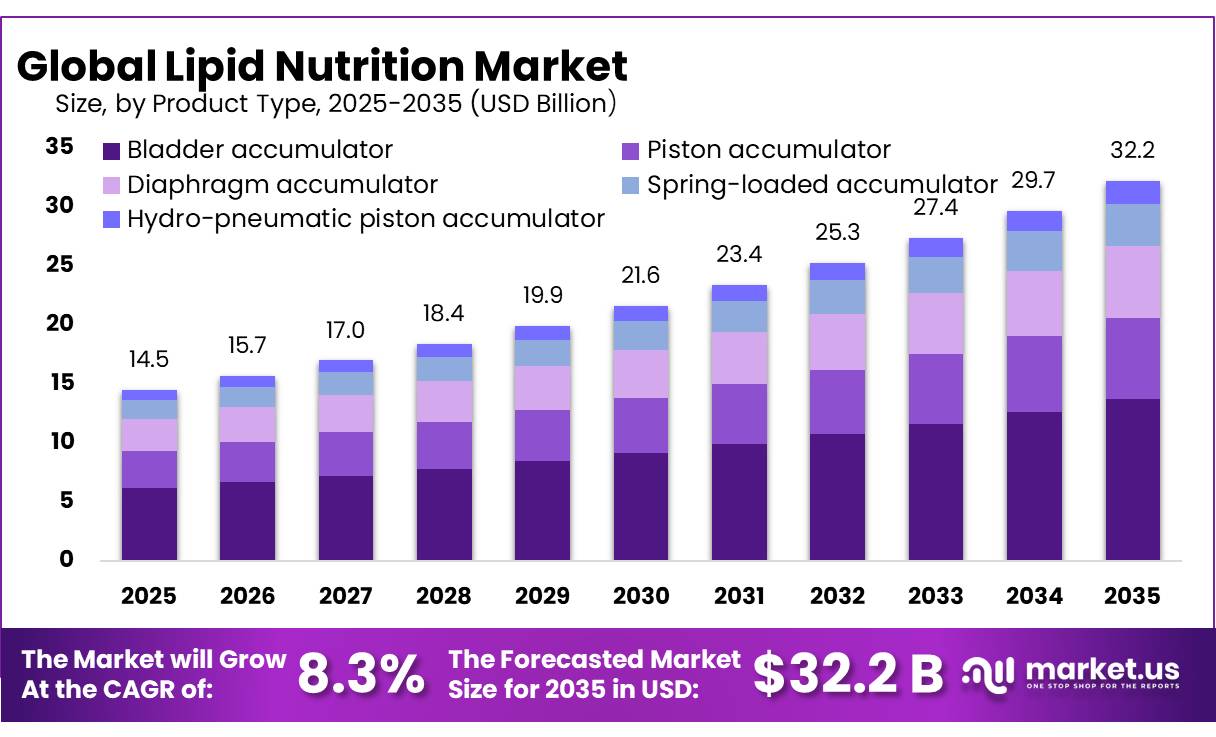
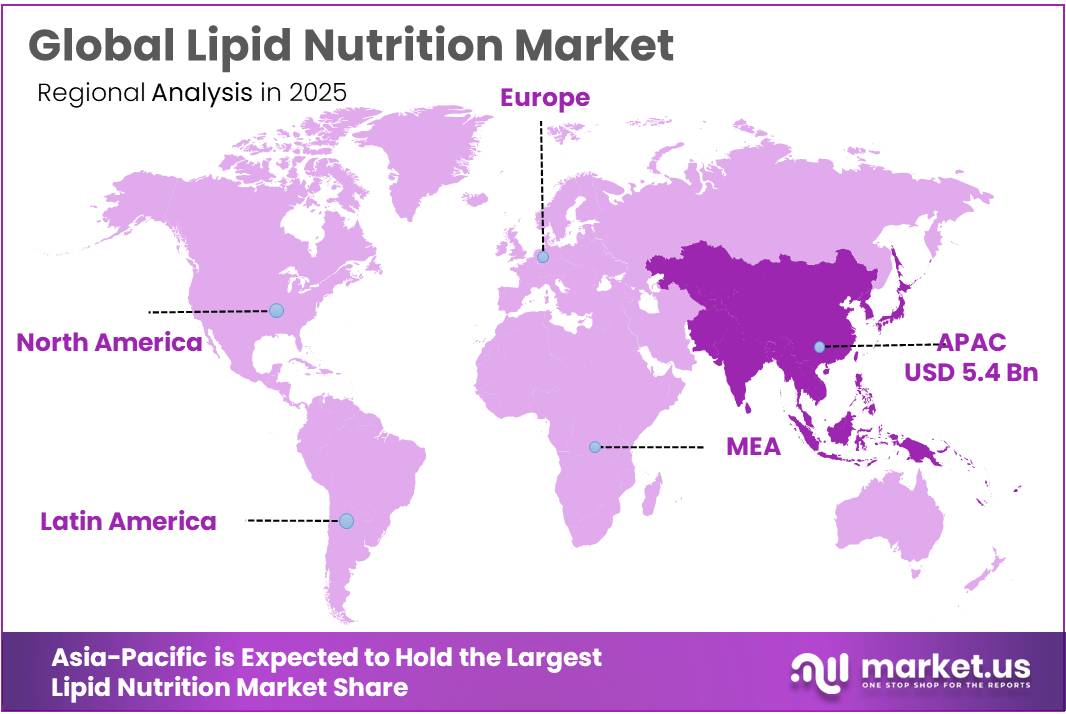
The Global Lipid Nutrition Market size is expected to be worth around USD 32.2 Billion by 2035, from USD 14.5 Billion in 2025, growing at a CAGR of 8.3% during the forecast period from 2026 to 2035. In 2025, Asia-Pacific held a dominant market position, capturing more than a 37.50% share, holding USD 5.4 Billion revenue.
- These ingredients are obtained from fish oil, algae, vegetable oils, and other biological sources. Demand is supported by the growing use of functional foods, nutritional supplements, fortified beverages, and specialized clinical nutrition products. The United States National Institutes of Health identifies alpha-linolenic acid (ALA), EPA, and DHA as 3 major omega-3 fatty acids receiving significant scientific attention.
Key Takeaways
- Lipid Nutrition Market size is expected to be worth around USD 32.2 Billion by 2035, from USD 14.5 Billion in 2025, growing at a CAGR of 8.3%.
- Bladder Accumulator dominates with a 42.00% share in 2025.
- 3,001–6,000 psi leads with a stated 43.00% share in 2025.
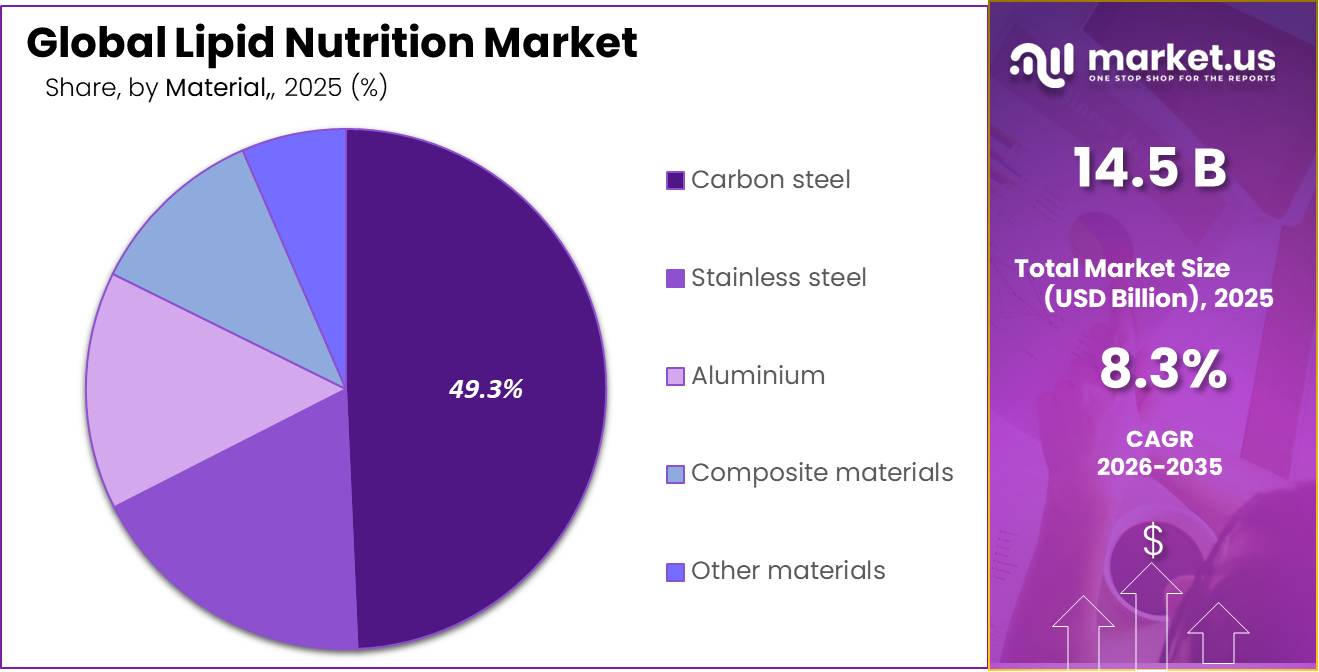
- Carbon steel held a dominant market position, capturing more than a 49.00% share.
- Blowout preventer and wellhead control held a dominant market position, capturing more than a 24.00% share.
- Onshore held a dominant market position, capturing more than a 63.00% share.
- Asia-Pacific represented the dominant region in the Lipid Nutrition Market, with a stated 37.50% share and a market value of USD 5.4 billion.
By Product Type Analysis
By Pressure Rating Analysis
By Material Analysis
By Application Analysis
By Installation Location Analysis
Key Market Segments
By Product Type
- Bladder accumulator
- Piston accumulator
- Diaphragm accumulator
- Spring-loaded accumulator
- Hydro-pneumatic piston accumulator
By Pressure Rating
- Up to 3,000 psi
- 3,001–6,000 psi
- Above 6,000 psi
By Material
- Carbon steel
- Stainless steel
- Aluminium
- Composite materials
- Other materials
By Application
- Blowout preventer and wellhead control
- Hydraulic power units
- Drilling equipment
- Pipeline and process-control systems
- Industrial hydraulic systems
- Marine applications
- Other applications
By Installation Location
- Onshore
- Offshore
Driver Analysis
Drivers Impact Analysis
| Driver | (~) % Impact on CAGR Forecast | Geographic Relevance | Impact Timeline |
|---|---|---|---|
| Cardiovascular nutrition adoption | +1.0 pp | North America; EU; Japan | Short term (≤ 2 years) |
| Commercial algal-oil expansion | +0.8 pp | North America; EU; China | Short term (≤ 2 years) |
| DHA-standardized early-life nutrition | +0.6 pp | EU; UK; export-oriented APAC | Medium term (2–4 years) |
| Medical nutrition expansion | +0.7 pp | North America; EU | Short term (≤ 2 years) |
| Higher-potency lipid formulations | +0.5 pp | North America; EU; China | Short term (≤ 2 years) |
| Phytosterol functional-food adoption | +0.4 pp | EU; Canada; United States | Medium term (2–4 years) |
Restraint Analysis
Marine-oil supply contraction
Reduced marine-oil availability directly limits the raw-material pool from which human-nutrition EPA/DHA ingredients can be refined, increasing procurement competition and making customer supply commitments harder to support. IFFO’s September 14, 2026 update reported cumulative fish-oil output through July approximately 30% below the corresponding 2025 period, with Peru and Chile the largest contributors to the shortfall and weaker catches elsewhere compounding the decline; this is IFFO’s monitored production series, not a verified 30% contraction in all global human-nutrition-grade oil.
The contrast with IFFO’s November 2025 update—which showed cumulative fish-oil output through September about 6% above the prior-year period—illustrates the danger of extrapolating one season’s availability into stable procurement assumptions. In an analyst stress test, a formulator requiring 1,000 tonnes annually would face a 200-tonne gap if its contracted supplier could deliver only 80%; replacing that volume at an assumed US$3-per-kilogram premium would add US$600,000 of cost before additional qualification and logistics expenses.
The practical restraint is narrower product availability or weaker margins where contracts cannot be repriced, rather than a uniform shutdown across all nutritional lipids. Suppliers must hold qualified alternatives and allocate constrained oils carefully, but algal substitution does not automatically remove the restriction because application suitability, approval and customer acceptance still matter. The −0.6-point allocation is the largest because a physical raw-material shortfall can affect multiple downstream channels simultaneously; MCTs and phytosterols are not assumed to share the same marine-supply exposure.
Restraint Impact Analysis
| Restraint | (~) % Impact on CAGR Forecast | Geographic Relevance | Impact Timeline |
|---|---|---|---|
| Marine-oil supply contraction | −0.6 pp | Peru–Chile; EU; North America | Short term (≤ 2 years) |
| Cardiovascular efficacy uncertainty | −0.4 pp | North America; EU | Medium term (2–4 years) |
| High-dose safety concerns | −0.2 pp | North America; EU | Medium term (2–4 years) |
| Health-claim restrictions | −0.3 pp | United States; EU | Medium term (2–4 years) |
| Smaller infant cohorts | −0.3 pp | China; China-facing exporters | Long term (≥ 4 years) |
| Phytosterol audience limitations | −0.2 pp | EU functional-food markets | Long term (≥ 4 years) |
Opportunity Analysis
Biomarker-linked replenishment
The opportunity is to convert episodic supplement purchases into independently monitored replenishment programs that improve retention among previously inconsistent users—not to present omega-3 testing or subscriptions as new inventions. OmegaQuant already offers a basic Omega-3 Index test at US$54.95 and a comprehensive test at US$109.95; its comprehensive service measures 24 fatty acids and reports a typical results turnaround of 2–4 weeks. Existing commercial programs also bundle supplements with repeat testing, demonstrating operational feasibility rather than an untouched market.
The additional opportunity is broader distribution through pharmacies, nutrition practices and employer programs, with ingredient suppliers providing standardized formulations and batch traceability while laboratories retain responsibility for analytical services. In an illustrative 100,000-member program, improving full-year retention from 60% to 75% creates 15,000 additional annual user-equivalents; at an assumed 500 milligrams of EPA/DHA daily, incremental demand is approximately 2.74 tonnes of active, equivalent to 4.56 tonnes of a 60%-active oil.
At US$54.95 per test, two retail-priced tests would cost US$109.90 annually before supplement expense, illustrating why negotiated testing economics matter; that diagnostic revenue is outside this market. The +0.3-point upside requires demonstrably incremental adherence or customer acquisition, not higher dosing by default, and biomarker improvement must not be marketed as proof of reduced cardiovascular events or universally optimal health outcomes.
Opportunity Impact Analysis
| Opportunity | (~) % Potential CAGR Upside | Geographic Relevance | Execution Window |
|---|---|---|---|
| Biomarker-linked replenishment | +0.3 pp | US; UK; Australia | Short term (≤ 2 years) |
| Targeted phospholipid applications | +0.4 pp | US; EU; Japan | Medium term (2–4 years) |
| Non-lipid delivery platforms | +0.3 pp | US; EU; South Korea | Medium term (2–4 years) |
| New-user chewable platforms | +0.3 pp | US; EU; Southeast Asia | Short term (≤ 2 years) |
| By-product nutrition upgrading | +0.3 pp | Norway; Chile; EU | Medium term (2–4 years) |
| GLP-1 companion formulations | +0.2 pp | US; UK; EU | Medium term (2–4 years) |
Challenges Analysis
Oxidative stability across lifecycle
Highly unsaturated nutritional oils require protection from oxidation throughout refining, storage, formulation and distribution, making quality at factory release insufficient to establish performance through the finished product’s shelf life. These are voluntary specifications with a defined scope, not universal legal limits for all lipid-containing products. For illustration, an oil at PV 4 and pAV 17 has TOTOX 25, leaving little headroom despite meeting the individual limits; increasing PV to 5 with unchanged pAV raises TOTOX to 27.
This demonstrates why compliance cannot be judged from peroxide value alone or why a single measurement cannot reconstruct an oil’s entire history. In an analyst scenario, 2% rework or write-down on 1,000 tonnes valued at US$20 per kilogram exposes US$400,000 of inventory before replacement freight and customer claims. The −0.4-point friction reflects the sustained cost of oxygen management, antioxidant selection, suitable packaging, matrix-appropriate testing and real-time stability programs—not an assumed market-wide failure rate. Manufacturers must set internal release margins against expected downstream exposure rather than routinely ship at specification ceilings.
Challenges Impact Analysis
| Challenge | (~) % CAGR Friction Drag | Geographic Relevance | Mitigation Horizon |
|---|---|---|---|
| Oxidative stability across lifecycle | −0.4 pp | EU; US; Asian distribution | Long term (≥ 4 years) |
| Algal bioprocess scale-up consistency | −0.3 pp | US; EU; China | Long term (≥ 4 years) |
| Sensory performance across formats | −0.3 pp | US; EU; Southeast Asia | Medium term (2–4 years) |
| Contaminant removal yield balance | −0.2 pp | Peru–Chile; EU; North America | Medium term (2–4 years) |
| Bioavailability evidence transfer gaps | −0.2 pp | US; EU; Japan | Long term (≥ 4 years) |
| Multi-source traceability assurance | −0.2 pp | Norway; Chile; EU; US | Medium term (2–4 years) |
Geopolitical Impact Analysis
Geopolitical Impact of Ongoing Wars on the Lipid Nutrition Market
Ongoing conflicts in the Middle East and the Russia–Ukraine region are creating uncertainty for the global lipid nutrition market by disrupting energy supplies, shipping routes, and vegetable oil trade. These disruptions affect the sourcing and transportation of fish oils, plant-based oils, omega-3 fatty acids, and other nutritional lipids.
Higher fuel prices and freight costs can increase expenses for ingredient producers, processors, and supplement manufacturers. According to the United Nations Trade and Development (UNCTAD), the Strait of Hormuz carries around one-quarter of global seaborne oil trade, making disruptions in this corridor a major risk for energy-dependent industries.
The conflict-related effects on agricultural commodities also influence the availability and cost of vegetable oils used in nutrition products. Shipping delays, higher insurance premiums, and rerouted cargoes can lengthen delivery schedules and increase inventory costs. The World Bank reported that, during the first month of the 2026 Middle East conflict, vegetable oil prices increased alongside broader agricultural commodity pressures.
These conditions may encourage lipid nutrition companies to diversify suppliers, strengthen inventories, and expand algae-based alternatives to marine oils. In the near term, higher operating costs and supply uncertainty may pressure profit margins. Over the longer term, investment in regional processing, traceable sourcing, and resilient logistics could help the industry maintain stable supplies and meet demand for nutritional ingredients.
Regional Insights
Asia-Pacific: Dominant Region
In 2025, Asia-Pacific represented the dominant region in the Lipid Nutrition Market, with a stated 37.50% share and a market value of USD 5.4 billion, based on the supplied market figures. Regional demand is supported by the use of nutritional oils, omega-3 fatty acids, fortified foods, dietary supplements, and specialized nutrition products. The region also benefits from established seafood processing, aquaculture, and edible oil supply chains.
According to the OECD and Food and Agriculture Organization (FAO), Asia is projected to account for 75% of global apparent consumption of aquatic products by 2035, supporting its importance in seafood-related supply chains.
The fastest-growing regional opportunities are associated with algae-derived omega-3 oils, concentrated EPA and DHA ingredients, and fortified nutrition products. Rising interest in preventive healthcare and specialized dietary formulations is encouraging manufacturers to develop products with improved purity, stability, and traceability. The OECD-FAO projects that Asia will remain a major source of additional aquatic food demand, while the region is expected to account for 29% of global fish oil exports by 2035.
Key Regions and Countries Insights
- North America
- US
- Canada
- Europe
- Germany
- France
- The UK
- Spain
- Italy
- Rest of Europe
- Asia Pacific
- China
- Japan
- South Korea
- India
- Australia
- Rest of APAC
- Latin America
- Brazil
- Mexico
- Rest of Latin America
- Middle East & Africa
- GCC
- South Africa
- Rest of MEA
Key Players Analysis
Archer Daniels Midland Company (ADM) is a global agricultural processing and nutrition company with activities across food ingredients, dietary supplements, animal nutrition, and specialty ingredients. Its work is relevant to the lipid nutrition sector through its oilseed processing capabilities, edible oils, and broader nutrition ingredient portfolio. In 2025, ADM reported USD 7.512 billion in Nutrition segment revenue, up from USD 7.349 billion in 2024, while segment operating profit increased to USD 417 million, an 8% rise year over year. These figures cover the wider Nutrition segment and should not be interpreted as lipid nutrition revenue alone.
In January 2026, ADM announced a USD 26 million investment in its Erlanger, Kentucky, facility to expand ingredient innovation, improve raw material handling, and strengthen its naturally derived flavor and color capabilities. The project included a 3,600-square-foot expansion and a 40% increase in raw material handling capabilities, following a separate USD 15 million investment in 2025. Although these investments support the wider nutrition business rather than lipid production specifically, ADM also identifies optimized fats and oils as an area of food reformulation.
ADM’s earlier agreement with Synthetic Genomics, announced in May 2014, focused on commercializing algae-derived omega-3 docosahexaenoic acid (DHA) for human and animal nutrition. Source: ADM and Synthetic Genomics No new lipid-specific merger or acquisition from 2025 to 2026 was confirmed in the reviewed sources. Overall, ADM’s oilseed processing base, nutrition research, and investment in ingredient capabilities support its position in the wider lipid nutrition supply chain, although the company’s reported financial results do not disclose a separate lipid nutrition revenue figure.
Top Key Players Outlook
- dsm-firmenich
- BASF SE
- Cargill, Incorporated
- Archer Daniels Midland Company (ADM)
- Croda International Plc
- Kerry Group plc
- Aker BioMarine ASA
- KD Pharma Group SA
- FrieslandCampina Ingredients
- Polaris Nutritional Lipids
- Epax Norway AS
- GC Rieber VivoMega AS
- Solutex GC S.L.
- Clover Corporation Limited
- Cabio Biotech (Wuhan) Co., Ltd.
Recent Developments
- In February 2026, Croda reported full-year 2025 sales of £1,699.4 million, an increase of 4.4% from £1,628.1 million in 2024. Its 2025 results also recorded £44.6 million in impairment charges related to optimising lipid capacity, reflecting the need to align production with customer demand.
- In February 2026, Kerry reported full-year 2025 revenue of €6.758 billion, EBITDA of €1.208 billion, and 3.0% volume growth. Its 2025 nutrition solutions reached 1.46 billion consumers, while the group continued investing in biotechnology, product innovation, and manufacturing capacity.
Report Scope
| Report Features | Description |
|---|---|
| Market Value (2025) | USD 14.5 Bn |
| Forecast Revenue (2035) | USD 32.2 Bn |
| CAGR (2026-2035) | 8.3% |
| Base Year for Estimation | 2025 |
| Historic Period | 2020-2024 |
| Forecast Period | 2026-2035 |
| Report Coverage | Revenue Forecast, Market Dynamics, Competitive Landscape, Recent Developments |
| Segments Covered | By Product Type (Bladder accumulator, Piston accumulator, Diaphragm accumulator, Spring-loaded accumulator, Hydro-pneumatic piston accumulator), By Pressure Rating (Up to 3,000 psi, 3,001–6,000 psi, Above 6,000 psi), By Material (Carbon steel, Stainless steel, Aluminium, Composite materials, Other materials), By Application (Blowout preventer and wellhead control, Hydraulic power units, Drilling equipment, Pipeline and process-control systems, Industrial hydraulic systems, Marine applications, Other applications), By Installation Location (Onshore, Offshore) |
| Regional Analysis | North America – US, Canada; Europe – Germany, France, The UK, Spain, Italy, Rest of Europe; Asia Pacific – China, Japan, South Korea, India, Australia, Singapore, Rest of APAC; Latin America – Brazil, Mexico, Rest of Latin America; Middle East & Africa – GCC, South Africa, Rest of MEA |
| Competitive Landscape | dsm-firmenich, BASF SE, Cargill, Incorporated, Archer Daniels Midland Company (ADM), Croda International Plc, Kerry Group plc, Aker BioMarine ASA, KD Pharma Group SA, FrieslandCampina Ingredients, Polaris Nutritional Lipids, Epax Norway AS, GC Rieber VivoMega AS, Solutex GC S.L., Clover Corporation Limited, Cabio Biotech (Wuhan) Co., Ltd. |
| Customization Scope | Customization for segments, region/country-level will be provided. Moreover, additional customization can be done based on the requirements. |
| Purchase Options | We have three licenses to opt for: Single User License, Multi-User License (Up to 5 Users), Corporate Use License (Unlimited User and Printable PDF) |