Report Overview
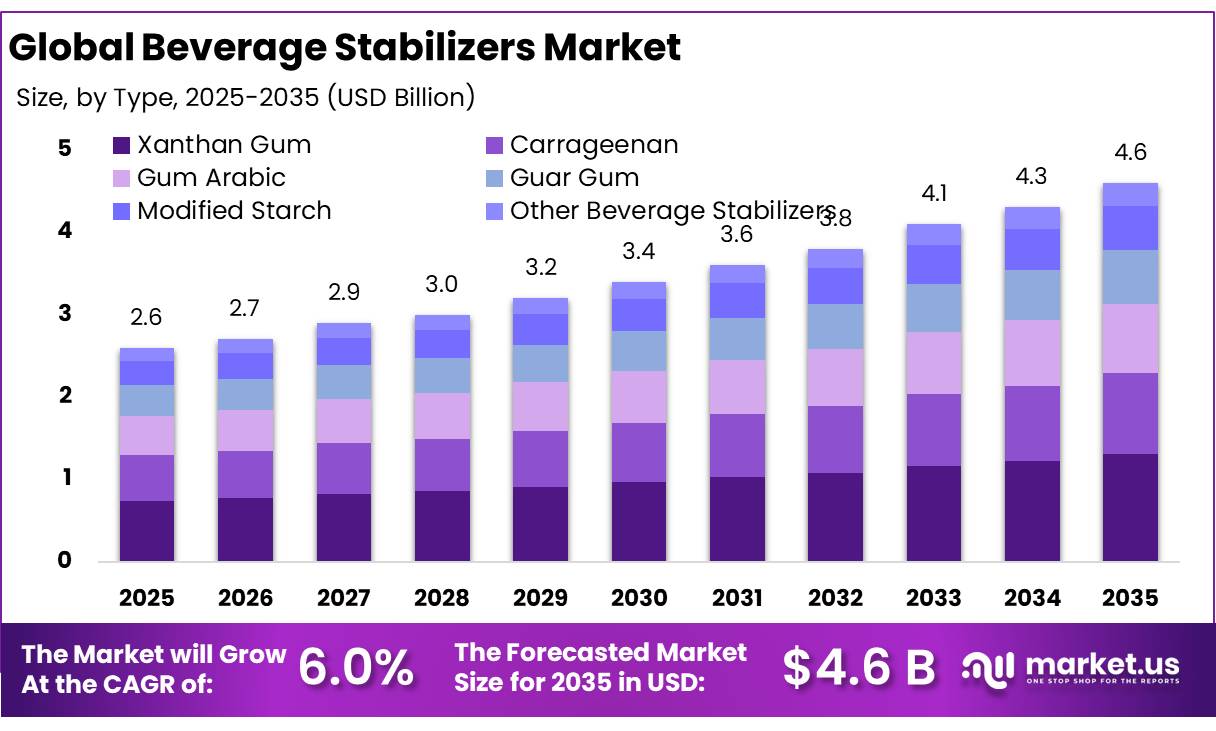
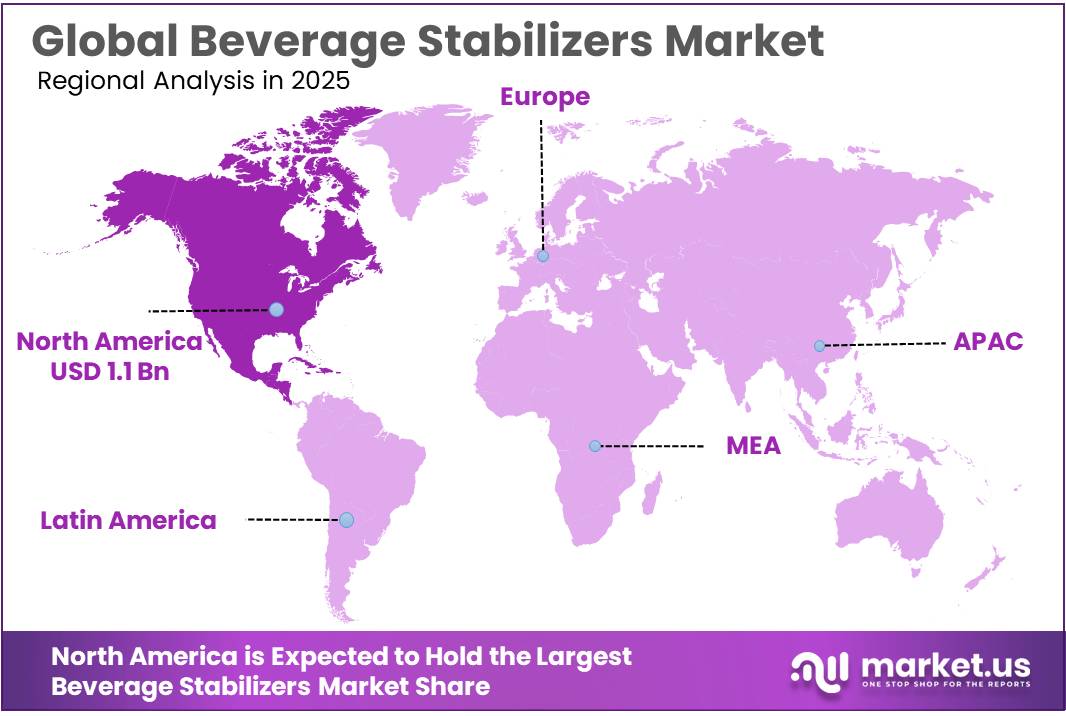
The Global Beverage Stabilizers Market size is expected to be worth around USD 4.6 Billion by 2035, from USD 2.6 Billion in 2025, growing at a CAGR of 6.0% during the forecast period from 2026 to 2035. In 2025, North America held a dominant market position, capturing more than a 45.00% share, holding USD 1.1 Billion revenue.
The beverage stabilizers industry plays an important role in the production of consistent, attractive, and longer-lasting drinks. Beverage stabilizers are ingredients used to maintain texture, prevent ingredient separation, control sediment formation, and improve the distribution of suspended particles in liquid products. Common ingredients include pectin, xanthan gum, guar gum, carrageenan, gum arabic, and cellulose-based stabilizers. These ingredients are used in fruit juices, flavored drinks, dairy beverages, plant-based drinks, sports drinks, and ready-to-drink formulations.
The industrial scenario is shaped by the growing need for beverage manufacturers to deliver stable products during processing, transportation, storage, and retail distribution. Stabilizers help reduce visible separation, maintain mouthfeel, and support consistent product quality across production batches.
- The United States Department of Agriculture (USDA) reported that food and beverage manufacturing accounted for 16.8% of sales across all U.S. manufacturing establishments in 2021. Beverage manufacturing alone represented 11.3% of food and beverage manufacturing sales in the same year, demonstrating the importance of this processing sector to the wider manufacturing industry.
Demand is being driven by changing beverage formulations, the expansion of plant-based drinks, the development of functional beverages, and the need for improved shelf stability. Plant-derived proteins, minerals, fruit pulp, and other suspended ingredients can settle or separate during storage, creating challenges for manufacturers. Research indexed by the Food and Agriculture Organization’s AGRIS database explains that plant-based drinks require careful physical stability assessment and identifies techniques such as ultraviolet-visible spectroscopy, Fourier-transform infrared spectroscopy, and near-infrared spectroscopy for studying beverage properties.
Future growth opportunities are likely to come from clean-label formulations, natural hydrocolloids, low-sugar beverages, fruit-based drinks, and plant-based alternatives. Manufacturers can also develop stabilizer blends that improve mouthfeel while reducing sedimentation and maintaining product consistency. A 2025 scientific review of fruit-based beverages discusses the use of hydrocolloids to limit unwanted sedimentation and maintain beverage quality during storage.
Key Takeaways
- Beverage Stabilizers Market size is expected to be worth around USD 4.6 Billion by 2035, from USD 2.6 Billion in 2025, growing at a CAGR of 6.0%.
- Xanthan Gum held a dominant market position, capturing more than a 28.00% share.
- Stabilization held a dominant market position, capturing more than a 31.00% share.
- Powder held a dominant market position, capturing more than a 68.00% share.
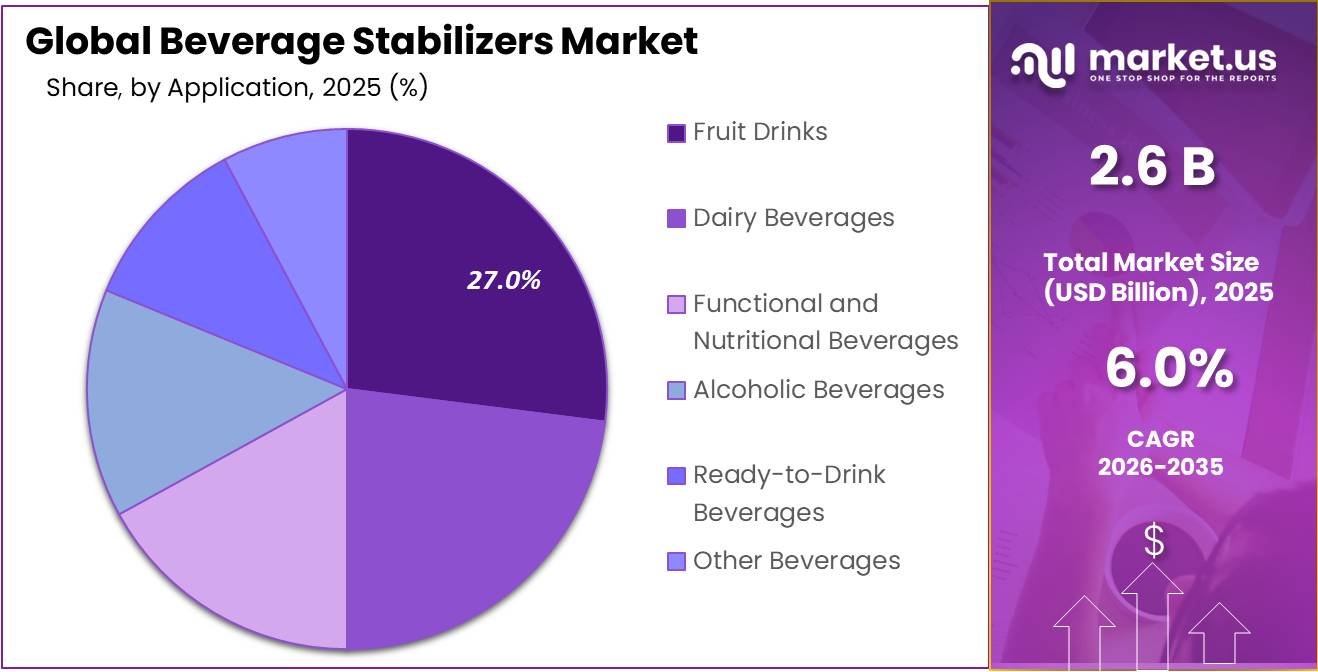
- Fruit Drinks held a dominant market position, capturing more than a 27.00% share.
- North America held a dominant position in the beverage stabilizers market, accounting for 45.00% of the market, with an estimated value of USD 1.1 billion.
By Type Analysis
Xanthan Gum maintains a strong position due to its thickening ability and effectiveness in stabilizing beverage formulations.
In 2025, “Xanthan Gum” held a dominant market position, capturing more than a 28.00% share. Its use in beverage formulations is supported by its ability to improve viscosity, suspend particles, and maintain a uniform texture during storage. Beverage manufacturers can use xanthan gum in fruit drinks, flavored beverages, and other formulations where consistent appearance and mouthfeel are important.
The segment’s continued use depends on formulation compatibility, regulatory compliance, and manufacturers’ need for consistent product quality. The U.S. Food and Drug Administration provides official information on food ingredients and their permitted uses.
Carrageenan is a seaweed-derived hydrocolloid used as a stabilizer, thickener, and emulsifier in food applications. In beverage manufacturing, it can help control ingredient separation and improve texture, particularly in formulations containing milk proteins or suspended ingredients. In 2025, demand for carrageenan-based stabilizing solutions was supported by manufacturers’ focus on consistent product quality and formulation performance.
The U.S. Food and Drug Administration identifies carrageenan as a food ingredient with stabilizing and thickening functions. Under 21 CFR § 172.620, its sulfate content must fall within 20% to 40% on a dry-weight basis, and its use must follow the applicable regulatory conditions. This government specification supports quality control and ingredient compliance, but it does not establish carrageenan’s market share or prove that it is the leading segment.
By Function Analysis
Stabilization leads through its role in maintaining beverage consistency and reducing unwanted ingredient separation.
In 2025, “Stabilization” held a dominant market position, capturing more than a 31.00% share. This segment supports beverage manufacturers by helping maintain uniform composition, control sedimentation, and preserve product appearance during storage and distribution. Stabilizers such as xanthan gum, pectin, and carrageenan can be selected according to the beverage’s ingredients and processing requirements.
Stabilization is particularly important for fruit-based drinks, dairy beverages, and formulations containing suspended particles, where separation can affect consumer acceptance. The U.S. Food and Drug Administration provides guidance on food ingredients used for functions such as stabilizing, thickening, and maintaining product consistency. These applications support the importance of stabilization in beverage formulation, although government sources do not independently verify the stated market share.
Texturization is an important function in the beverage stabilizers market because it helps manufacturers achieve the desired texture and drinking experience. Ingredients such as xanthan gum, pectin, and carrageenan can help adjust viscosity and create a smoother feel, depending on the beverage formulation. In 2025, demand for texturizing solutions was linked to the development of fruit drinks, dairy beverages, and plant-based products that require consistent texture and appearance.
The U.S. Food and Drug Administration identifies xanthan gum as an ingredient used for stabilizing, thickening, and texturizing, and lists it under 21 CFR § 172.695. This official classification supports its industrial relevance, although it does not provide a market-share figure for texturization.
By Form Analysis
Powder stabilizers lead due to their convenient storage, longer shelf life, and suitability for large-scale beverage production.
In 2025, “Powder” held a dominant market position, capturing more than a 68.00% share. Powder-based beverage stabilizers are widely suited to industrial processing because they can be weighed accurately, blended with other dry ingredients, and incorporated into beverage formulations according to production needs. Their concentrated form can also reduce storage and transportation requirements compared with ready-to-use liquid preparations.
Beverage manufacturers use powdered hydrocolloids to help control viscosity, maintain uniform texture, and reduce ingredient separation. The U.S. Food and Drug Administration provides information on the functions and regulatory use of food ingredients, supporting the importance of selecting stabilizers according to their intended applications. However, the stated market share is not independently confirmed by government statistics.
Liquid beverage stabilizers are used by manufacturers seeking convenient handling and rapid incorporation into liquid formulations. They can help improve texture, maintain product consistency, and reduce separation, depending on the stabilizer and beverage type. In 2025, demand for liquid forms was supported by their suitability for production processes that use liquid ingredient dosing and continuous blending. They can be useful in dairy drinks, fruit beverages, and other formulations where uniform dispersion is important.
However, their suitability depends on concentration, storage stability, compatibility with other ingredients, and processing conditions. The U.S. Food and Drug Administration provides official information on food ingredients and their technical functions, but it does not publish a verified market share comparing powder and liquid beverage stabilizers.
By Application Analysis
Fruit drinks lead through the need to maintain consistent texture, suspend pulp, and reduce visible separation during storage.
In 2025, “Fruit Drinks” held a dominant market position, capturing more than a 27.00% share. Beverage stabilizers are important in fruit drinks because pulp, fruit particles, and other ingredients can settle or separate over time. Ingredients such as pectin and xanthan gum help manufacturers control viscosity and maintain a more uniform appearance, depending on the formulation. Their use supports consistent product quality during processing, packaging, transportation, and retail storage.
Demand is also supported by manufacturers’ focus on improving the drinking experience and maintaining the appearance of fruit-based beverages. The U.S. Food and Drug Administration provides official information on the technical functions of food ingredients, including stabilizers and thickeners, although it does not independently confirm the stated market share.
Dairy beverages use stabilizers to improve texture, limit unwanted separation, and maintain consistency during processing and storage. Ingredients such as carrageenan, xanthan gum, and pectin may be selected according to the product’s protein content, acidity, and processing requirements. In 2025, the United States produced approximately 231.658 billion pounds of milk, providing a substantial raw-material base for dairy processing and beverage production.
The United States Department of Agriculture reported average milk composition of 86.56% water, 4.32% milk fat, and 9.12% skim solids in 2025. This composition highlights the importance of managing texture and ingredient interactions in dairy-based formulations. These figures provide industry context and do not directly measure stabilizer demand or establish the dairy beverage segment’s market share.
Key Market Segments
By Type
- Xanthan Gum
- Carrageenan
- Gum Arabic
- Guar Gum
- Modified Starch
- Other Beverage Stabilizers
By Function
- Stabilization
- Texturization
- Viscosification
- Emulsification
- Suspension
- Foam Stabilization
- Other Functions
By Form
- Powder
- Liquid
- Granules
- Blends and Systems
By Application
- Fruit Drinks
- Dairy Beverages
- Functional and Nutritional Beverages
- Alcoholic Beverages
- Ready-to-Drink Beverages
- Other Beverages
Driver Analysis
High-Protein RTD Dairy Scale-Up
High-protein ready-to-drink (RTD) dairy is the fastest-growing user of beverage stabilizers. These drinks need carrageenan to keep milk proteins stable during heat treatment and gellan to keep protein and particles suspended over long ambient shelf lives (Palsgaard; Google Patents). Coca-Cola told investors that Fairlife grew from $10 million in retail sales in 2014 to nearly $4 billion in 2024. Coca-Cola then built a $650 million plant in Webster, New York, which New York State described as ramping up in August 2026.
Fairlife grew 18% in Q2 2026 as that capacity came online. Coca-Cola also links its protein and zero-sugar growth to GLP-1 users changing what they drink. We estimate stabilizer systems are used at 0.02% to 0.05% of the drink in protein RTDs and cost $0.004 to $0.010 per 340 ml bottle. Each new high-protein plant adds about 150 to 400 tonnes a year of carrageenan, gellan and cellulose gum demand. Suppliers are moving from selling single gums to co-developing tailored stabilizer blends, which earn 8 to 12 points more gross margin than commodity xanthan or CMC.
Drivers Impact Analysis
| Driver | (~) % Impact on CAGR Forecast | Geographic Relevance | Impact Timeline |
|---|---|---|---|
| High-Protein RTD Dairy Scale-Up | +1.1% | North America core, EU | Short term (≤ 2 years) |
| Sugar Levy Reformulation | +1.0% | UK, EU, India, LATAM | Medium term (2-4 years) |
| Emerging Asia Bottling Capacity | +0.9% | India, Southeast Asia | Medium term (2-4 years) |
| Prebiotic and Fiber Soda Growth | +0.8% | North America core | Short term (≤ 2 years) |
| Clean-Label Hydrocolloid Portfolios | +0.7% | Global, EU and U.S. hubs | Medium term (2-4 years) |
| BVO Ban Emulsion Replacement | +0.6% | U.S., spill-over to exporters | Short term (≤ 2 years) |
Restraint Analysis
Sudan Gum Arabic Disruption
Gum arabic is the main emulsifier for flavor oils in sodas and the main replacement for BVO, and its supply is concentrated in a war zone. Before the war began in April 2023, Sudan supplied about 70% to 80% of global crude gum arabic exports, worth up to $183 million a year (UN News; OHCHR). The paramilitary Rapid Support Forces (RSF) and allied militias now control most of the gum-producing areas in Kordofan and Darfur. Nexira suspended imports of Sudanese gum for four months in 2023 and planned a three-week halt in 2025.
One trade commentator puts Sudan’s pre-war exports at 100,000 to 150,000 tonnes, falling to about 48,000 tonnes before recovering to about 70,000 tonnes in 2024. We estimate this disruption adds 15% to 30% to the cost of beverage-grade emulsion gum. Lead times stretch by 4 to 8 weeks, and supply checks to rule out conflict-linked sourcing add 2% to 4% to buyer costs. Brands are partly switching to OSA starch or gum blends from Chad and Nigeria, but this needs 6 to 9 months of emulsion stability tests and slows the gains from the BVO driver.
Restraint Impact Analysis
| Restraint | (~) % Impact on CAGR Forecast | Geographic Relevance | Impact Timeline |
|---|---|---|---|
| Sudan Gum Arabic Disruption | -0.9% | Global, EU and U.S. bottlers | Medium term (2-4 years) |
| Additive and UPF Scrutiny | -0.8% | U.S., EU | Long term (≥ 4 years) |
| Weak Beverage Category Demand | -0.6% | North America core, EU | Short term (≤ 2 years) |
| Seaweed Feedstock Decline | -0.6% | Philippines, Indonesia, global carrageenan | Medium term (2-4 years) |
| Citrus Peel Pectin Shortfall | -0.6% | Brazil, U.S., EU pectin hubs | Medium term (2-4 years) |
| Xanthan Anti-Dumping Duties | -0.5% | U.S., China supply | Short term (≤ 2 years) |
Opportunity Analysis
Non-Alcoholic Beer Body Systems
Non-alcoholic beer loses body and foam when the alcohol is removed, but brewers mostly use malt and maltodextrin to make up for it rather than hydrocolloids. That makes this an untapped opportunity rather than a current driver. Propylene glycol alginate, made from seaweed, stabilizes foam and adds mouthfeel, but it is rarely used outside some mainstream lagers. Heineken’s low and no-alcohol range grew by double digits in 18 markets in 2025, with Heineken 0.0 growing by double digits in 20 markets, including the U.S., Canada and Spain.
Athletic Brewing was on track to pass 500,000 barrels in 2025 and has added a 750,000-barrel facility in San Diego. We estimate that if 25% of North American and EU non-alcoholic beer and spirit alternatives (about 30 to 40 million hectoliters) used PGA, beta-glucan or gum arabic body systems at 50 to 100 ppm, that would create 150 to 400 tonnes of demand. Specialty pricing of $15 to $30 per kg makes this a $5M to $12M opportunity. Gross margins would be 45% to 55%, because these systems are sold with foam and mouthfeel development support rather than as a plain gum.
Opportunity Impact Analysis
| Opportunity | (~) % Potential CAGR Upside | Geographic Relevance | Execution Window |
|---|---|---|---|
| Non-Alcoholic Beer Body Systems | +0.7% | North America core, EU | Medium term (2-4 years) |
| Ready-to-Drink Dysphagia Beverages | +0.6% | EU, Japan, North America | Medium term (2-4 years) |
| India Ambient Dairy Drinks | +0.6% | India, South Asia | Medium term (2-4 years) |
| Upcycled Fiber Stabilizer Systems | +0.5% | U.S., EU | Medium term (2-4 years) |
| Traceable Non-Sudan Acacia | +0.5% | Chad, Nigeria, Senegal sourcing; EU, U.S. buyers | Long term (≥ 4 years) |
| Mid-Size Blender Roll-Ups | +0.4% | North America, Japan, EU | Short term (≤ 2 years) |
Challenges Analysis
High-Protein Heat Stability Limits
Stabilizer chemistry struggles to keep high-protein drinks stable through heat treatment and long shelf lives. Milk protein concentrate drinks need emulsifying salts such as sodium hexametaphosphate, and they must be heated by UHT (at least 138 °C for 2 seconds) or retorted (115 to 120 °C for 5 to 15 minutes). In storage, UHT milk can set into a gel or form heavy sediment. Pea-based drinks lost protein solubility over storage in a peer-reviewed study. FDA enforcement records list Class II spoilage recalls for limited-edition Premier Protein shakes.
We estimate that drinks with 20 to 30 g of protein per serving have 2% to 5% stability failures in the first 6 to 9 months of shelf life. Each new reformulation needs 6 to 12 months of shelf-life testing at a cost of $50,000 to $150,000. Plant-protein systems need 20% to 40% more stabilizer than dairy systems. Suppliers are developing stabilizer blends for specific proteins and using accelerated stability modeling. However, every change of protein source or heat process restarts the testing cycle, which slows the speed at which new protein drinks can launch.
Challenges Impact Analysis
| Challenge | (~) % CAGR Friction Drag | Geographic Relevance | Mitigation Horizon |
|---|---|---|---|
| High-Protein Heat Stability Limits | -0.7% | North America core, EU | Medium term (2-4 years) |
| Natural Lot-to-Lot Variability | -0.6% | Global, Africa and Asia origins | Medium term (2-4 years) |
| Contaminant Testing Burden | -0.6% | EU regulatory hubs, U.S. | Medium term (2-4 years) |
| Guar and Carob Crop Volatility | -0.6% | India, Mediterranean | Long term (≥ 4 years) |
| Application Scientist Talent Gap | -0.5% | U.S., EU | Long term (≥ 4 years) |
| Merger Integration Service Friction | -0.5% | North America, EU, Japan | Short term (≤ 2 years) |
Geopolitical Impact Analysis
Geopolitical Impact of Ongoing Wars on the Beverage Stabilizers Market
The ongoing conflicts in the Middle East, the Russia-Ukraine war, and disruptions around the Red Sea, Strait of Hormuz, and Black Sea are putting pressure on the beverage stabilizers market in 2026. These conflicts affect shipping routes, energy supplies, freight costs, and the availability of raw materials used to produce stabilizers such as xanthan gum, pectin, and carrageenan. Longer shipping routes and higher insurance charges can increase import costs and delay deliveries for ingredient manufacturers and beverage producers.
According to the United Nations Trade and Development (UNCTAD), more than 80% of global merchandise trade by volume moves by sea, making maritime disruptions a significant risk for international supply chains. Source: UNCTAD. The Food and Agriculture Organization (FAO) reported that its Food Price Index reached 136.0 points in September 2026, increasing 1.5% from August, with transport disruptions contributing to pressure on food commodity prices.
These cost pressures may encourage beverage manufacturers to optimize stabilizer use, diversify suppliers, and maintain additional inventories. However, the actual impact varies by ingredient origin, shipping route, and contract terms. Companies with flexible sourcing and reliable logistics are better positioned to manage supply uncertainty and protect production schedules.
Regional Insights
Dominating Region: North America
In 2025, North America held a dominant position in the beverage stabilizers market, accounting for 45.00% of the market, with an estimated value of USD 1.1 billion. The region benefits from an established beverage manufacturing industry, strong demand for packaged drinks, and the presence of food ingredient suppliers serving juice, dairy, and functional beverage producers. The United States and Canada provide a broad industrial base for stabilizer applications, including texture control and product consistency.
According to Agriculture and Agri-Food Canada, the country’s food and beverage processing industry recorded CAD 173.4 billion in manufactured goods sales in 2024, representing 20.3% of total manufacturing sales. Beverage manufacturing contributed CAD 15.7 billion. These figures demonstrate the strength of the regional processing industry, although they do not directly measure stabilizer sales.
Asia-Pacific offers opportunities for beverage stabilizer suppliers as beverage producers expand packaged drinks, dairy-based beverages, fruit drinks, and plant-based formulations. Demand for consistent texture and stability is relevant to manufacturers developing new recipes and extending distribution across urban and regional markets. Growth opportunities also come from the development of functional beverages and products requiring improved suspension of proteins, pulp, and other ingredients.
Suppliers that provide cost-effective stabilizer blends, reliable technical support, and formulations suited to local processing conditions can strengthen their position. However, a verified government statistic directly comparing regional beverage stabilizer growth rates was not identified, so Asia-Pacific’s fastest-growing status should be treated as a market assessment rather than an independently confirmed government finding.
Key Regions and Countries Insights
- North America
- US
- Canada
- Europe
- Germany
- France
- The UK
- Spain
- Italy
- Rest of Europe
- Asia Pacific
- China
- Japan
- South Korea
- India
- Australia
- Rest of APAC
- Latin America
- Brazil
- Mexico
- Rest of Latin America
- Middle East & Africa
- GCC
- South Africa
- Rest of MEA
Key Players Analysis
Cargill is a major supplier of food ingredients, including solutions used to improve beverage texture, stability, and consistency. Its ingredient portfolio supports beverage manufacturers developing fruit drinks, dairy beverages, and other processed drinks. The company operates in 70 countries, serves 125 markets, and employs more than 155,000 people worldwide. Its research network includes 1,200 scientists and innovators and 200 research and development locations, supporting ingredient development and customer applications. These capabilities strengthen its position in beverage formulation and stabilizer solutions.
Ingredion develops plant-based ingredient solutions for food and beverage manufacturers, including ingredients that help improve texture, thickness, and product consistency. Its portfolio supports beverage applications such as fruit drinks, dairy beverages, and other formulated products. In 2025, the company reported approximately USD 7.2 billion in annual net sales and employed more than 11,000 people. It serves customers in over 120 countries and operates Ingredion Idea Labs innovation centers to support product development and customer collaboration. These capabilities help beverage producers address formulation and processing requirements.
IFF supplies food ingredients, taste solutions, and texture-related systems for beverage manufacturers. Its solutions support product development across juice drinks, flavored beverages, and dairy applications, where consistent texture and sensory quality are important. In 2025, IFF recorded net sales of USD 10.89 billion, while its Food Ingredients segment generated approximately USD 3.28 billion in sales. The company also reported USD 694 million in research and development expenses, reflecting its investment in innovation across its businesses. These capabilities support its participation in beverage ingredient development and formulation.
Top Key Players Outlook
- Cargill, Incorporated
- Ingredion Incorporated
- International Flavors & Fragrances Inc. (IFF)
- Tate & Lyle PLC
- Kerry Group plc
- CP Kelco U.S., Inc.
- Archer Daniels Midland Company (ADM)
- Palsgaard A/S
- Ashland Global Holdings Inc.
- BASF SE
- DSM-Firmenich
- Glanbia Nutritionals
- Nexira SAS
- Jungbunzlauer Suisse AG
- Chemelco International B.V.
Recent Developments
- In May 2026, Tate & Lyle expanded its collaboration with BioHarvest Sciences to develop plant-based sweetener molecules. For the financial year ended March 2026, it reported £2.0 billion in revenue and invested £86 million in innovation and solution selling.
- In March 2026, Kerry’s annual report highlighted investment in new manufacturing facilities in Egypt and Rwanda, alongside a global network of more than 60 technology and innovation centres and 1,200 scientists.
- In April 2025, CP Kelco began operating as part of the combined business, with a target of US$50 million in annual cost synergies by the end of financial year 2027 and more than 50% of those savings expected by the end of financial year 2026.
Report Scope
| Report Features | Description |
|---|---|
| Market Value (2025) | USD 2.6 Bn |
| Forecast Revenue (2035) | USD 4.6 Bn |
| CAGR (2026-2035) | 6.0% |
| Base Year for Estimation | 2025 |
| Historic Period | 2020-2024 |
| Forecast Period | 2026-2035 |
| Report Coverage | Revenue Forecast, Market Dynamics, Competitive Landscape, Recent Developments |
| Segments Covered | By Type (Xanthan Gum, Carrageenan, Gum Arabic, Guar Gum, Modified Starch, Other Beverage Stabilizers), By Function (Stabilization, Texturization, Viscosification, Emulsification, Suspension, Foam Stabilization, Other Functions), By Form (Powder, Liquid, Granules, Blends and Systems), By Application (Fruit Drinks, Dairy Beverages, Functional and Nutritional Beverages, Alcoholic Beverages, Ready-to-Drink Beverages, Other Beverages) |
| Regional Analysis | North America – US, Canada; Europe – Germany, France, The UK, Spain, Italy, Rest of Europe; Asia Pacific – China, Japan, South Korea, India, Australia, Singapore, Rest of APAC; Latin America – Brazil, Mexico, Rest of Latin America; Middle East & Africa – GCC, South Africa, Rest of MEA |
| Competitive Landscape | Cargill, Incorporated, Ingredion Incorporated, International Flavors & Fragrances Inc. (IFF), Tate & Lyle PLC, Kerry Group plc, CP Kelco U.S., Inc., Archer Daniels Midland Company (ADM), Palsgaard A/S, Ashland Global Holdings Inc., BASF SE, DSM-Firmenich, Glanbia Nutritionals, Nexira SAS, Jungbunzlauer Suisse AG, Chemelco International B.V. |
| Customization Scope | Customization for segments, region/country-level will be provided. Moreover, additional customization can be done based on the requirements. |
| Purchase Options | We have three licenses to opt for: Single User License, Multi-User License (Up to 5 Users), Corporate Use License (Unlimited User and Printable PDF) |