Report Overview
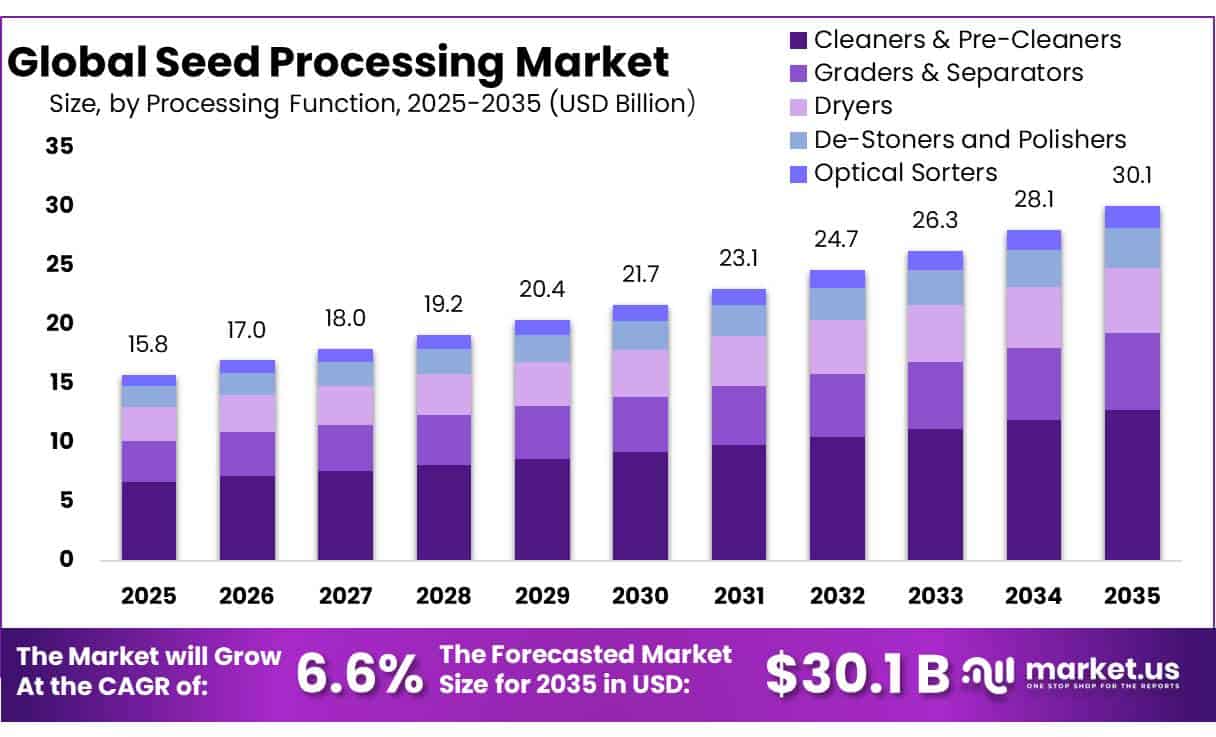
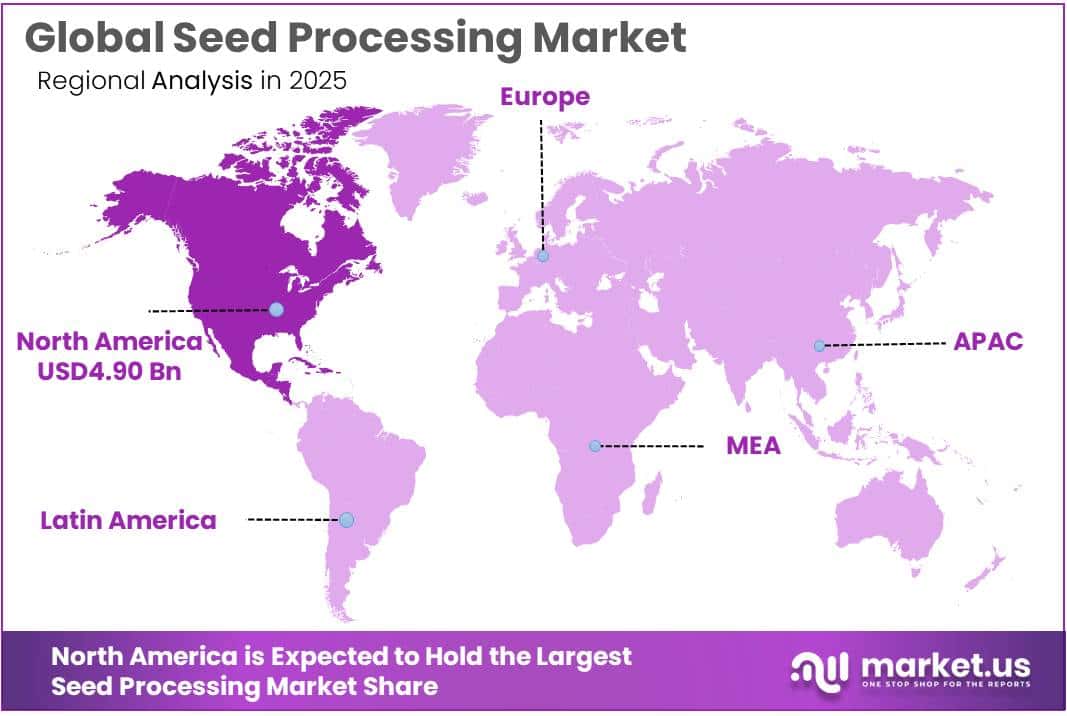
The Global Seed Processing Market size is expected to be worth around USD 30.1 Billion by 2035, from USD 15.8 Billion in 2025, growing at a CAGR of 6.6% during the forecast period from 2026 to 2035. In 2025, North America held a dominant market position, capturing more than a 31.10% share, holding USD 4.9 Billion revenue.
Seed processing is a critical stage between seed production and commercial distribution, covering cleaning, drying, grading, separation, treatment, coating, quality testing, packaging, and storage. The process improves physical purity, removes damaged or undersized seed, and helps maintain germination performance before planting. According to the International Seed Federation (ISF), about 7.6 million metric tons of seed were exported globally in 2022, representing an estimated export value of USD 16.3 billion.
- The OECD Seed Schemes currently involve 64 participating countries, providing internationally recognized procedures for varietal identity and purity in seed moving across borders. In the United States, the Federal Seed Act is implemented with cooperative agreements across all 50 states, creating a national framework for seed sampling, testing, inspection, and labeling.
Seed quality testing remains an important driver for processing facilities. USDA requires interstate seed labels to provide information such as purity percentage, germination percentage, noxious weed seeds per pound, chemical treatment information, and varietal identification. USDA laboratories also evaluate physical purity, germination, viability, moisture, coated seed quality, and 1,000-seed weight.
- Technological development is also being supported by strong research spending across the seed industry. ISF reports that seed companies typically invest around 15%–30% of annual turnover in research and development, while the private sector accounts for approximately 52% of crop-science research in developed countries.
Future growth opportunities are expected to come from automated optical sorting, artificial-intelligence-based quality inspection, low-dust treatment systems, biological coatings, robotics, digital lot traceability, and energy-efficient drying technologies. International certification will remain important as global seed movement expands, while regulatory requirements will continue pushing processors toward cleaner and more controlled production environments.
Key Takeaways
- Seed Processing Market size is expected to be worth around USD 30.1 Billion by 2035, from USD 15.8 Billion in 2025, growing at a CAGR of 6.6%.
- Seed Treatment held a dominant market position, capturing more than a 67.00% share.
- Cleaners & Pre-Cleaners held a dominant market position, capturing more than a 42.50% share.
- Automatic held a dominant market position, capturing more than a 50.10% share.
- Cereals and Grains held a dominant market position, capturing more than a 46.30% share.
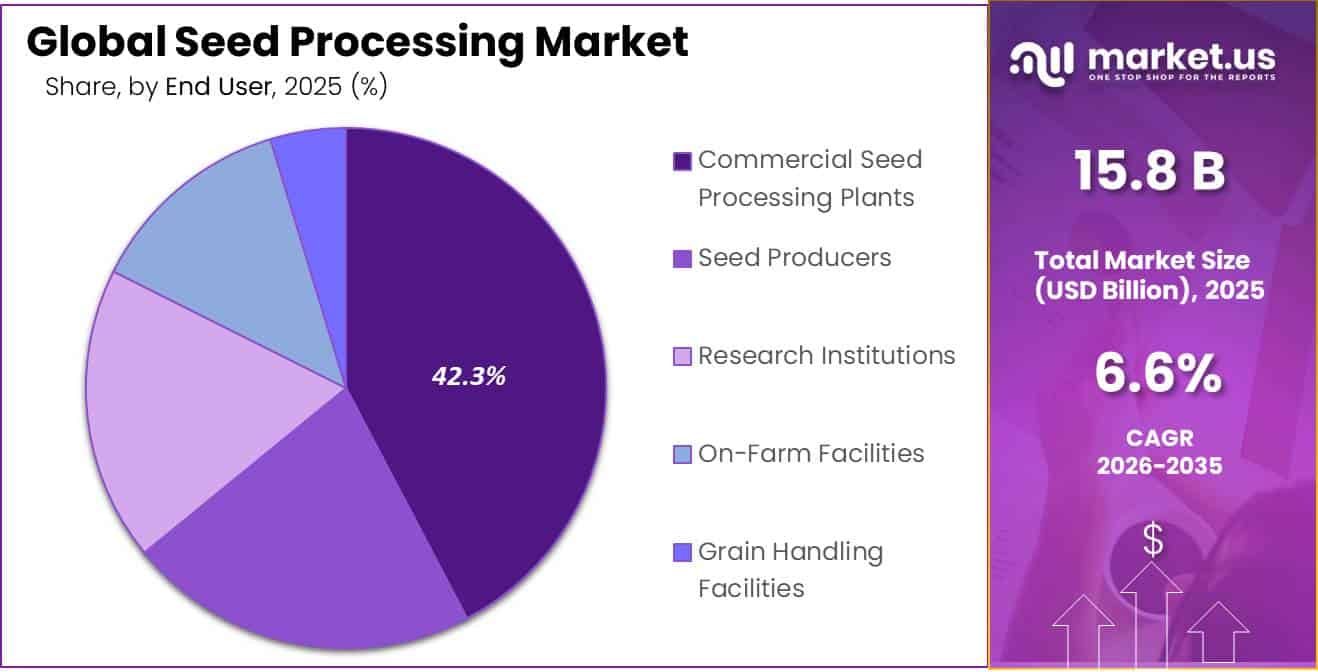
- Commercial Seed Processing Plants held a dominant market position, capturing more than a 42.30% share.
- North America held a dominant Seed Processing Market position, capturing more than a 31.10% share and USD 4.90 billion.
By Type Analysis
Seed Treatment leads the segment with a 67.00% share, supported by its broad use for protecting seed before planting.
In 2025, Seed Treatment held a dominant market position, capturing more than a 67.00% share. The segment maintained its strong position because processed seed increasingly receives protective treatment before packaging and planting. Commercial treatment can include pesticide application, coating, drying, handling, and final packaging, allowing processors to prepare seed with more consistent protection against insects and seed- or soil-borne diseases.
The U.S. Environmental Protection Agency identifies corn, cereals, soybean, sorghum, sugar beet, sunflower, cotton, flax, and vegetable seeds among crops commonly covered by seed-treatment practices. In 2025, regulatory attention to registered seed-treatment products also continued, supporting the use of controlled application equipment and professional treatment facilities. The segment therefore remains important for processors seeking better seed protection, accurate treatment application, safer handling, and reliable planting performance.
In 2025, polymer-based seed coating material remained an important segment in seed processing because polymers can form a uniform film around the seed without significantly changing its original shape. This makes the material suitable for commercial film coating, where processors require even coverage, better treatment retention, smoother seed flow, and easier handling during planting. U.S. EPA technical guidance states that a typical film coating is made from a water-permeable polymer together with a plasticizer and colorant.
The agency reports that film coating can increase seed weight by about 5%, while still maintaining the seed’s original size and general shape. This controlled weight addition is useful for precision processing because it limits excessive material buildup while keeping applied treatments around the seed surface. Polymer coatings also support cleaner commercial treatment operations and can reduce direct handler contact with pesticide material retained on treated seed.
By Processing Function Analysis
Cleaners & Pre-Cleaners dominate the Seed Processing Market with a 42.50% share, supported by their essential role in removing unwanted material before further conditioning.
In 2025, Cleaners & Pre-Cleaners held a dominant market position, capturing more than a 42.50% share. Their strong position is linked to their role as the first major conditioning step in commercial seed processing. These systems remove dust, chaff, broken seed, stones, weed seeds, and other foreign material before seed moves to grading, treatment, coating, or packaging. Clean and uniform seed lots are particularly important because the U.S. Federal Seed Act requires agricultural and vegetable seed sold in interstate commerce to carry information on seed purity, germination, and noxious weed-seed content.
As a result, processors depend on effective pre-cleaning to improve physical purity, reduce unwanted material entering downstream equipment, and prepare seed lots for laboratory testing and final commercial distribution. The segment is also benefiting from greater use of automated air-screen cleaning systems that can handle different crops while maintaining consistent throughput and seed quality.
In 2025, Graders & Separators remained an important processing function because commercial seed lots require greater uniformity before treatment and packaging. These systems separate seed according to characteristics such as size, density, shape, weight, and physical condition, helping processors remove undersized, damaged, light, or unwanted material. USDA’s Seed Regulatory and Testing Division evaluates seed through physical-purity testing and also performs 1,000-seed-weight testing, showing the importance of both purity and weight consistency in commercial seed quality assessment. The USDA physical-purity test separately measures pure seed, inert matter, other crop seed, and weed seed within a seed lot.
By Operation Mode Analysis
Automatic systems dominate the Seed Processing Market with a 50.10% share, supported by faster throughput and consistent seed handling.
In 2025, Automatic held a dominant market position, capturing more than a 50.10% share. Automatic equipment remained widely preferred in commercial seed processing because cleaning, grading, separation, treatment, and conveying can be completed with less manual handling and more consistent process control. FAO technical information shows that specialized motorized cleaning equipment can deliver processing capacities ranging from 1 to 4 tonnes per hour, while basic manually powered cleaning systems generally handle around 150 to 300 kg per hour.
This large difference in operating capacity supports the shift toward automated machinery at facilities handling commercial seed volumes. Automatic lines also make it easier to maintain uniform flow through cleaners, graders and treatment equipment while reducing labor-intensive material movement. In 2025, quality requirements continued to support this approach, as USDA’s Federal Seed Act framework requires accurate information on purity, germination and undesirable weed seeds for agricultural and vegetable seed moving through interstate commerce.
In 2025, Semi-Automatic remained an important operation mode in the Seed Processing Market, particularly for processors seeking a balance between mechanized production and operator-controlled handling. These systems can combine powered cleaners, screens, graders and separators while allowing workers to manage feeding, equipment settings, inspections and product transfer between processing stages.
FAO reports that motorized grain and seed cleaners can process around 1 to 4 tonnes per hour using motors of approximately 3 kW, showing the productivity advantage available when mechanical equipment is introduced into seed-cleaning operations. Such configurations can be useful for processors that handle different seed varieties or changing production batches and do not require a completely integrated automatic line. USDA also recognizes seed conditioning as a formal quality activity through its Accredited Seed Conditioning Program, supporting controlled processing and packaging practices for seed supplied to domestic and international markets.
By Crop Type Analysis
Cereals and Grains dominate the Seed Processing Market with a 46.30% share, supported by large-scale cultivation and continuous demand for clean, uniform planting seed.
In 2025, Cereals and Grains held a dominant market position, capturing more than a 46.30% share. The segment remained strong because crops such as wheat, maize, rice, barley, and other grains are cultivated at a very large scale and require continuous supplies of cleaned, graded, treated, and quality-tested seed. FAO estimated that global cereal production reached a record 3,043 million tonnes in the 2025/26 season, reflecting the huge production base supported by cereal seed. In 2026, FAO expects cereal production to remain historically high at around 2,980 million tonnes.
This large planting base supports regular demand for air-screen cleaners, gravity separators, graders, seed treaters, optical sorters, and automated packaging systems. Seed processors also focus closely on germination, physical purity, uniform seed size, and removal of weed seeds because these characteristics directly influence commercial seed quality and field establishment.
- In 2025, Oilseeds and Pulses remained an important crop segment in the Seed Processing Market, supported by the need for uniform seed size, strong germination, physical purity, and careful handling during cleaning and grading. USDA reported in September 2026 that U.S. soybean production for the 2026/27 marketing year was forecast at 4.5 billion bushels, based on 86.9 million planted acres and an average yield of 52.8 bushels per acre. This large production base creates substantial requirements for soybean seed cleaning, sizing, treatment, and handling equipment.
Pulse crops also require careful processing because seed size and density vary across peas, lentils, beans, and chickpeas. USDA reported that total planted area for major U.S. pulse crops declined by 739,000 acres in 2026 compared with the previous year, although these crops continue to represent an established commercial planting base requiring specialized seed conditioning and separation systems.
By End User Analysis
Commercial Seed Processing Plants dominate the Seed Processing Market with a 42.30% share
In 2025, Commercial Seed Processing Plants held a dominant market position, capturing more than a 42.30% share. Their strong position was supported by the need to clean, grade, condition, treat, test, and package large seed volumes under controlled conditions. Commercial plants increasingly combine cleaners, separators, seed treaters, conveyors, laboratory testing, and automated packaging to achieve uniform quality across seed lots. In 2026, the U.S. Department of Agriculture maintained 4 Accredited Seed Programs covering field inspection, seed sampling, seed laboratories, and seed conditioning.
USDA specifically operates the Accredited Seed Conditioning Program for companies carrying out seed conditioning or blending activities. The accreditation process includes a documentation review and an on-site audit, with USDA audit services charged at USD 158 per hour. These structured quality requirements encourage commercial processing plants to invest in reliable machinery, documented procedures, traceability, and consistent seed preparation for domestic and international distribution.
In 2025, Seed Producers remained an important end-user segment in the Seed Processing Market because commercially produced seed must meet defined standards for varietal identity, physical purity, germination, and overall planting quality. Producers use processing equipment after harvesting to remove unwanted material, separate seed according to physical characteristics, apply treatments, and prepare uniform lots for certification and sale.
According to the OECD Seed Schemes 2025 information, 64 countries participate in its international seed certification framework. The organization also reports around USD 5 billion worth of seed trade under the certification system. OECD operates 8 separate seed schemes covering major groups such as cereals, maize, grasses and legumes, vegetables, sugar and fodder beet, and oil or fibre species. This broad certification structure supports continued investment by seed producers in processing, testing, traceability, and quality-management systems capable of preparing seed for both domestic distribution and international trade.
Key Market Segments
By Type
- Seed Treatment
- Seed Coating Material
By Processing Function
- Cleaners & Pre-Cleaners
- Graders & Separators
- Dryers
- De-Stoners and Polishers
- Optical Sorters
By Operation Mode
- Automatic
- Semi-Automatic
- Manual
By Crop Type
- Cereals and Grains
- Oilseeds and Pulses
- Fruits and Vegetables
- Flowers and Ornamentals
- Others
By End User
- Commercial Seed Processing Plants
- Seed Producers
- Research Institutions
- On-Farm Facilities
- Grain Handling Facilities
Driver Analysis
Climate-Resilient Seed Replacement
Climate volatility is increasing annual seed replacement demand and shifting processing requirements toward drought-tolerant, heat-resilient, flood-tolerant, disease-resistant, short-duration, and location-specific varieties, thereby expanding the value of cleaning, grading, seed treatment, quality assurance, and lot-level traceability.
In commercial cereal and oilseed operations, a 3–8 percentage-point improvement in field emergence can add 50,000–150,000 more viable plants per hectare depending on crop and seeding rate; when paired with disease-protective treatment and a climate-adapted variety, even a 2–5% yield improvement can materially increase farmer willingness to pay for certified, processed seed.
This alters processor economics from bulk cleaning toward premium service bundles: calibrated drying, gravity separation, color sorting, pathogen testing, biological or chemical treatment, polymer coating, and digitally recorded lot certification can raise realized processing revenue by 25–70% per tonne versus basic cleaning and bagging.
FAO explicitly frames quality seed as an integrated national supply-chain issue spanning formal and informal sectors, and its seed-processing guidance covers the chain from reception and conditioning to final customer delivery, reinforcing the role of local and scalable processing capacity. Climate-resilient replacement cycles are therefore estimated to add approximately +2.1 percentage points to baseline seed-processing CAGR through the next decade.
Drivers Impact Analysis
| Driver | (~) % Impact on CAGR | Geographic Relevance | Impact Timeline |
|---|---|---|---|
| Climate-resilient seed replacement | +2.1 pp | India, Africa, LATAM, APAC corridors | Long term (≥ 4 years) |
| Certified seed quality mandates | +1.8 pp | EU, North America, India, export markets | Medium term (2–4 years) |
| High-value hybrid seed expansion | +1.6 pp | China, India, Brazil, North America, EU | Medium term (2–4 years) |
| Precision cleaning and optical sorting | +1.4 pp | North America, EU, China, Australia | Short term (≤ 2 years) |
| Integrated treatment and coating | +1.3 pp | North America, EU, India, Brazil | Medium term (2–4 years) |
| Seed traceability and export compliance | +1.0 pp | EU, North America, APAC export hubs | Long term (≥ 4 years) |
Restraint Analysis
Climate-Disrupted Seed Multiplication
Climate disruption restrains seed processing because it undermines the physical availability and quality consistency of seed multiplication crops before they reach conditioning plants, reducing clean-seed recovery, germination, vigor, genetic purity, and usable batch volume even when total agricultural output remains adequate.
A 10–20% yield reduction in a contracted hybrid-seed field can translate into a 15–30% reduction in sellable processed seed if low test weight, mechanical injury, off-types, disease pressure, and failed germination are added to field losses; on a facility conditioning 10,000 tonnes annually, a 5-percentage-point decline in recoverable output can remove 500 tonnes of saleable product, with the revenue impact magnified in high-value corn, vegetable, sunflower, canola, and forage seed.
The commercial effect is lower plant utilization, higher raw-lot rejection, more frequent emergency sourcing, increased laboratory testing, and higher working-capital requirements as companies maintain 12–24 months of safety stock for vulnerable varieties. The restraint is especially pronounced in India, sub-Saharan Africa, Latin America, Europe, and weather-exposed APAC production corridors, producing an estimated -2.0-percentage-point medium-term deduction from seed-processing CAGR.
Restraint Impact Analysis
| Restraint | (~) % Impact on CAGR | Geographic Relevance | Impact Timeline |
|---|---|---|---|
| Climate-disrupted seed multiplication | -2.0 pp | India, Africa, LATAM, EU, APAC corridors | Medium term (2–4 years) |
| High-value equipment CapEx | -1.5 pp | Emerging APAC, LATAM, Africa, Eastern Europe | Medium term (2–4 years) |
| Treated-seed regulatory restrictions | -1.3 pp | EU, North America, Canada, Australia | Medium term (2–4 years) |
| Certification and phytosanitary delays | -1.1 pp | EU, North America, APAC export hubs | Short term (≤ 2 years) |
| Fragmented informal seed channels | -1.0 pp | India, Africa, Southeast Asia, LATAM | Long term (≥ 4 years) |
| Cross-border seed trade friction | -0.9 pp | Global export corridors, import-dependent markets | Medium term (2–4 years) |
Opportunity Analysis
Biological Treatment Platforms
A high-value white space is the creation of integrated biological-treatment platforms that combine seed conditioning, microbial inoculants, biofungicides, biostimulants, micronutrients, biodegradable polymers, precision coating, cold-chain-compatible storage, and application-performance testing into a single premium service offering.
The commercial upside is material: basic cleaning and packaging may generate USD 30–100 per tonne of service value for broad-acre crops, whereas a calibrated biological-plus-protection coating package can add USD 80–300 per tonne for cereals and oilseeds, with much higher value for vegetable, hybrid, and horticultural seed; a 10,000-tonne facility that converts 30% of throughput to premium biological programs could add USD 0.2–0.9 million in annual processing revenue before formulation mark-up and recurring service contracts.
The business model shifts from one-time conditioning toward recurring seasonal formulation revenue, proprietary treatment recipes, field-performance data, and crop-specific distributor partnerships, while precision dosing below ±5% helps protect germination and demonstrates application credibility.
The near-term opportunity is strongest in the EU, North America, Brazil, India, and Australia, where commercial growers can pay for early-season crop protection and regulatory incentives favor lower-residue solutions, supporting an estimated +1.9-percentage-point CAGR upside over two to four years.
Opportunity Impact Analysis
| Opportunity | (~) % Potential CAGR Upside | Geographic Relevance | Execution Window |
|---|---|---|---|
| Biological treatment platforms | +1.9 pp | EU, North America, India, Brazil, Australia | Medium term (2–4 years) |
| Digital seed-passport services | +1.6 pp | Africa, India, EU, APAC export hubs | Short term (≤ 2 years) |
| Shared modular processing hubs | +1.5 pp | Africa, India, Southeast Asia, LATAM | Medium term (2–4 years) |
| AI yield-as-a-service lines | +1.3 pp | North America, EU, China, Brazil, Australia | Short term (≤ 2 years) |
| Climate-resilient local seed networks | +1.2 pp | Africa, South Asia, Southeast Asia, LATAM | Long term (≥ 4 years) |
| Regional integrator M&A roll-ups | +1.0 pp | India, ASEAN, LATAM, Eastern Europe | Medium term (2–4 years) |
Challenges Analysis
Moisture and Viability Control
Maintaining uniform moisture, vigor, and germination through harvest, drying, processing, treatment, packaging, storage, and distribution is the sector’s most persistent technical challenge because seeds remain living biological materials whose shelf life deteriorates rapidly when temperature and relative humidity are poorly controlled.
Freshly harvested vegetable seeds in humid subtropical conditions can contain 18–25% moisture, versus an approximate 3–8% target range for safe storage; research from India found that controlled mechanical drying to 8% moisture maintained 12-month germination at 86.4–92.7%, compared with 64.8–76.3% under sun drying, while fungal incidence declined to 3.2–5.1% versus 11.4–18.7% in sun-dried seed.
The financial sensitivity is substantial: a processor handling 10,000 tonnes annually can lose 2–5% of lot value through moisture-linked decline, and a 1 percentage-point moisture overshoot in storage can approximately halve seed longevity under unfavorable temperature conditions; even a 3% loss of high-value hybrid inventory worth USD 15–50 million can create USD 0.45–1.50 million in direct write-downs before replacement shipments, dealer credits, and reputational effects.
Companies need near-real-time moisture sensing, low-temperature drying, sealed packaging, controlled-atmosphere storage, temperature-mapped warehouses, first-expiry-first-out inventory logic, lot-level germination re-tests, and predictive viability models, but the required cold-chain, power reliability, and trained quality-management capacity take years to establish. This makes moisture-and-viability control a long-term source of approximately -1.3 percentage points of CAGR friction in India, Africa, Southeast Asia, and Latin America.
Challenges Impact Analysis
| Challenge | (~) % CAGR Friction Drag | Geographic Relevance | Mitigation Horizon |
|---|---|---|---|
| Moisture and viability control | -1.3 pp | India, Africa, Southeast Asia, LATAM | Long term (≥ 4 years) |
| Skilled seed-technology shortage | -1.1 pp | India, Africa, LATAM, APAC corridors | Long term (≥ 4 years) |
| Seasonal capacity-utilization imbalance | -1.0 pp | Global, strongest in crop-export hubs | Medium term (2–4 years) |
| Multi-location lot traceability | -0.9 pp | EU, North America, India, APAC export hubs | Medium term (2–4 years) |
| Treatment-formulation compatibility | -0.8 pp | EU, North America, Brazil, India, Australia | Medium term (2–4 years) |
| Small-lot automation economics | -0.7 pp | Africa, India, Southeast Asia, LATAM | Long term (≥ 4 years) |
Geopolitical Impact Analysis
Russia–Ukraine War Disrupts Seed Processing Through Higher Costs and Supply-Chain Pressure
The ongoing Russia–Ukraine war continues to affect the Seed Processing Market by disrupting grain, oilseed, fertilizer, fuel, transport, and storage systems linked to commercial seed production. Ukraine remains an important agricultural producer, but war-related damage, restricted field access, labour shortages, and landmine contamination continue to limit farming activity. FAO reported in March 2026 that Ukraine’s 2025 cereal production reached about 60.8 million tonnes, around 6% below the five-year average. It also noted that approximately 5.4 million hectares of winter cereals were sown for 2026, down 5% from the previous year.
These pressures reduce seed availability and can delay cleaning, grading, treatment, storage, and distribution operations. Black Sea logistics remain another concern. In August 2026, FAO estimated Ukraine’s effective grain storage capacity at 58.97 million tonnes against projected grain and oilseed output of 84.18 million tonnes, creating a possible storage shortfall of up to 11 million tonnes. For seed processors, such disruptions can raise freight, energy, insurance, and raw-material costs while encouraging investment in local storage, flexible processing lines, alternative transport routes, and stronger regional seed supply chains to protect planting schedules and future crop availability.
Regional Insights
Seed Processing Market Regional Landscape – North America Leads with 31.10% Share and USD 4.90 Billion
In 2025, North America held a dominant Seed Processing Market position, capturing more than a 31.10% share and USD 4.90 billion. The region benefits from extensive commercial seed production, advanced farming practices, and high mechanization. USDA estimated that U.S. farmers planted 95.3 million acres of corn and 85.4 million acres of soybeans in 2026. Canada also recorded 23.4 million acres of canola, up 8.4% from 2025, while corn area reached 4.0 million acres. These large planting areas create steady requirements for seed cleaning, grading, coating, treating, testing, and automated packaging equipment.
The regional landscape of the Seed Processing Market is shaped by large crop areas, expansion of certified seed systems, and investment in automated cleaning, grading, treatment, and packaging facilities. Demand is particularly strong in regions with large-scale corn, soybean, wheat, canola, and vegetable production. In 2026, 64 countries participated in the OECD Seed Schemes, supporting internationally recognized standards for varietal identity and seed purity. These certification requirements encourage processors to invest in modern conditioning equipment, laboratory testing, traceability, and controlled seed-treatment systems.
Asia Pacific – Fastest-Growing Region: Asia Pacific is developing rapidly as higher crop production and demand for improved planting material encourage modernization of seed-processing facilities. China provides a strong example, with FAO estimating record cereal production of 657.5 million tonnes in 2025. Maize production reached a record 299 million tonnes, while approximately 80% of the country’s maize crop is produced in the North China Plain. Growing use of high-yielding varieties, better seed-quality controls, and expansion of commercial agriculture are supporting demand for optical sorters, graders, cleaners, coating systems, and precision seed-treatment equipment across the region.
Key Regions and Countries Insights
- North America
- US
- Canada
- Europe
- Germany
- France
- The UK
- Spain
- Italy
- Rest of Europe
- Asia Pacific
- China
- Japan
- South Korea
- India
- Australia
- Rest of APAC
- Latin America
- Brazil
- Mexico
- Rest of Latin America
- Middle East & Africa
- GCC
- South Africa
- Rest of MEA
Key Players Analysis
Bühler AG: In 2025, Bühler remained a major technology supplier to seed and grain processors through optical sorting, cleaning, conveying, and digital processing systems. Its Grains & Food business generated CHF 2.164 billion in turnover and recorded CHF 2.147 billion in orders. The company continued developing advanced sorting equipment, including the AI-enabled SORTEX AI700, supporting processors seeking higher purity, consistency, and automation. Its broad global engineering base strengthens its position across large commercial seed-processing facilities.
Cimbria A/S: Cimbria remained an important supplier of complete seed-processing lines covering cleaning, grading, optical sorting, drying, conveying, and storage. In 2025, the company installed drying technology at a seed-processing project covering 180,000 square feet, demonstrating its capability in large commercial facilities. Cimbria was formerly part of AGCO’s Grain & Protein business; AGCO sold that business, including Cimbria, in November 2024 in a transaction valued at approximately USD 700 million to American Industrial Partners.
PETKUS Technologie GmbH: PETKUS maintains a strong position in seed processing through cleaning, sorting, treatment, drying, conveying, storage, and modular plant systems. The company reports a workforce of more than 350 employees representing over 20 nationalities and an international operating network. Across its development history, PETKUS has installed more than 200,000 cleaning machines and around 2,000 complete seed-processing lines during the past 40 years. This installed base supports its presence in customized commercial seed plants worldwide.
Top Key Players Outlook
- Bühler AG
- Cimbria A/S (AGCO Corporation)
- PETKUS Technologie GmbH
- Satake Corporation
- Westrup A/S
- AG Growth International Inc.
- Lewis M. Carter Manufacturing, Inc.
- Alvan Blanch Development Company Limited
- Akyürek Technology
- Bratney Companies
- Agrosaw Private Limited
- ArrowCorp Inc.
- Crippen Manufacturing
- Seedburo Equipment Company
- Shijiazhuang SYNMEC International Trading Co., Ltd.
Recent Developments
- In June 2026, Satake further launched the SLASH β PLUS EMS-01B, designed for grains, seeds, and beans with a processing capacity of 0.5–2.0 tonnes per hour. Its ejector operates around 1.7 times faster, provides approximately 3 times longer service life,
- In June 2026, AGI announced a multi-million-dollar investment in its Clay Center, Kansas facility to add U.S. production of 4-inch corrugated grain bins and expand regional manufacturing capacity. The company generated USD 396 million in Q4 2025 revenue, up 4% year over year, while its order book stood at USD 543 million at year-end.
Report Scope
| Report Features | Description |
|---|---|
| Market Value (2025) | USD 15.8 Bn |
| Forecast Revenue (2035) | USD 30.1 Bn |
| CAGR (2026-2035) | 6.6% |
| Base Year for Estimation | 2025 |
| Historic Period | 2020-2024 |
| Forecast Period | 2026-2035 |
| Report Coverage | Revenue Forecast, Market Dynamics, Competitive Landscape, Recent Developments |
| Segments Covered | By Type (Seed Treatment, Seed Coating Material), By Processing Function (Cleaners & Pre-Cleaners, Graders & Separators, Dryers, De-Stoners and Polishers, Optical Sorters), By Operation Mode (Automatic, Semi-Automatic, Manual), By Crop Type (Cereals and Grains, Oilseeds and Pulses, Fruits and Vegetables, Flowers and Ornamentals, Others), By End User (Commercial Seed Processing Plants, Seed Producers, Research Institutions, On-Farm Facilities, Grain Handling Facilities) |
| Regional Analysis | North America – US, Canada; Europe – Germany, France, The UK, Spain, Italy, Rest of Europe; Asia Pacific – China, Japan, South Korea, India, Australia, Singapore, Rest of APAC; Latin America – Brazil, Mexico, Rest of Latin America; Middle East & Africa – GCC, South Africa, Rest of MEA |
| Competitive Landscape | Bühler AG, Cimbria A/S (AGCO Corporation), PETKUS Technologie GmbH, Satake Corporation, Westrup A/S, AG Growth International Inc., Lewis M. Carter Manufacturing, Inc., Alvan Blanch Development Company Limited, Akyürek Technology, Bratney Companies, Agrosaw Private Limited, ArrowCorp Inc., Crippen Manufacturing, Seedburo Equipment Company, Shijiazhuang SYNMEC International Trading Co., Ltd. |
| Customization Scope | Customization for segments, region/country-level will be provided. Moreover, additional customization can be done based on the requirements. |
| Purchase Options | We have three licenses to opt for: Single User License, Multi-User License (Up to 5 Users), Corporate Use License (Unlimited User and Printable PDF) |