Report Overview
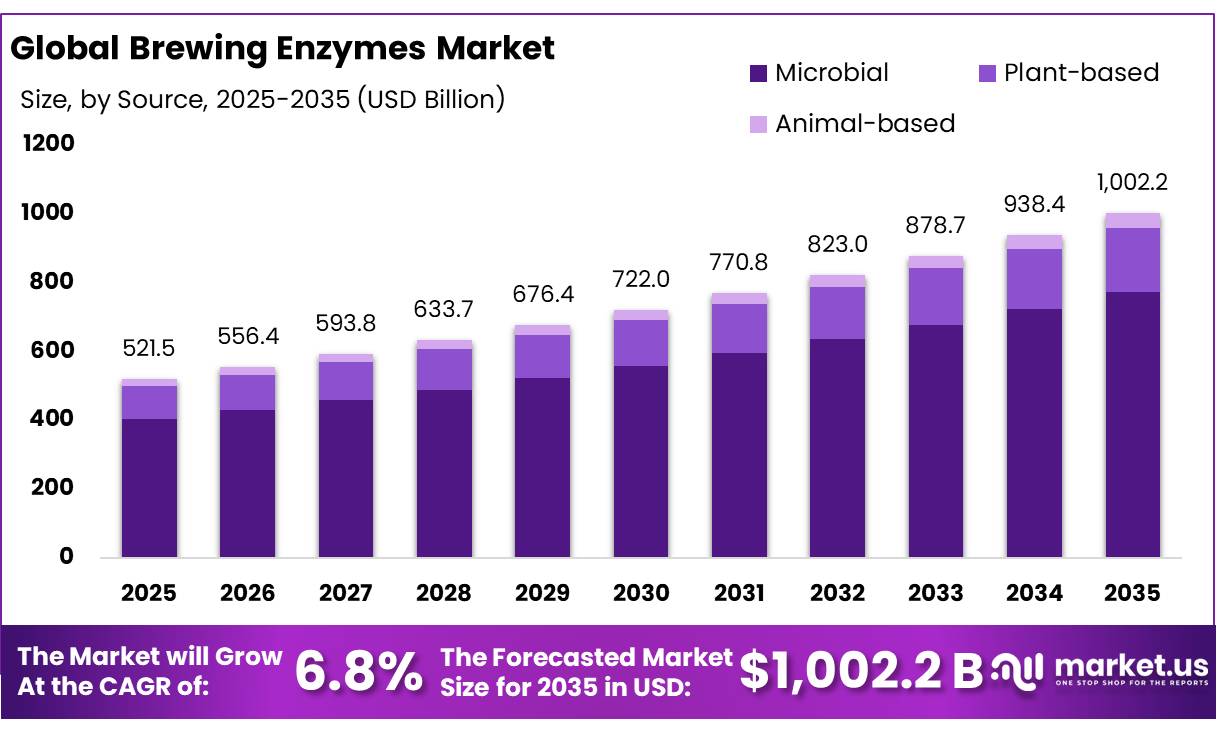
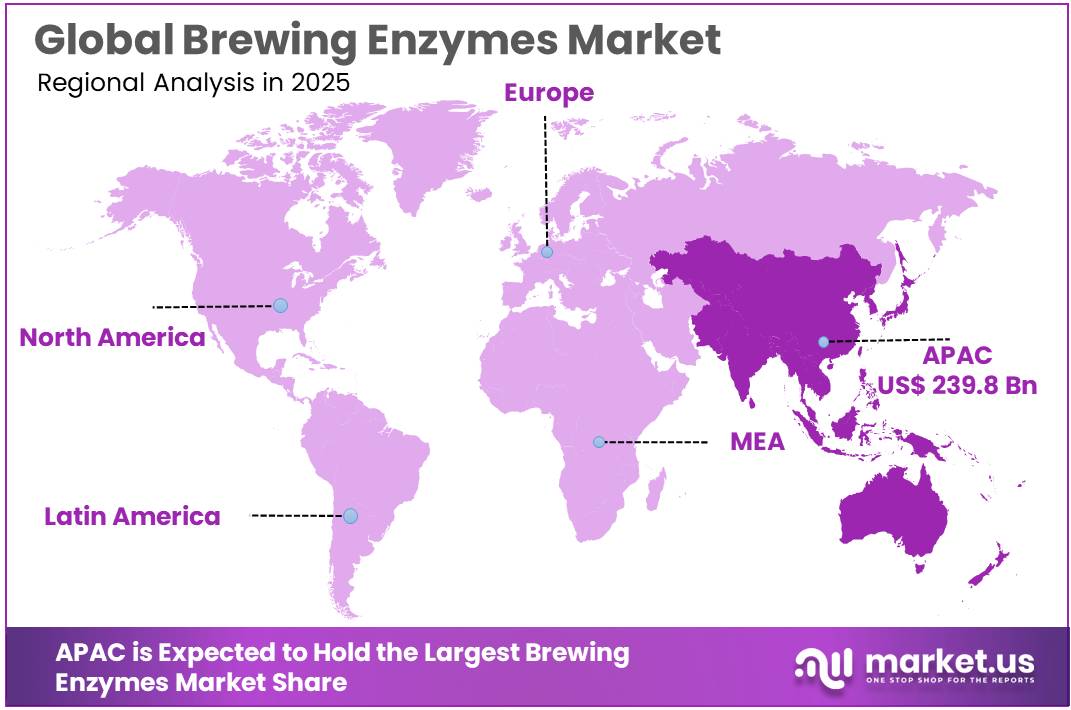
The Global Brewing Enzymes Market size is expected to be worth around USD 1,002.2 Billion by 2035, from USD 521.5 Billion in 2025, growing at a CAGR of 6.8% during the forecast period from 2026 to 2035. In 2025, Asia-Pacific held a dominant market position, capturing more than a 46.00% share, holding USD 239.8 Billion revenue.
The brewing enzymes industry plays an important role in beer manufacturing by improving starch conversion, fermentation efficiency, product consistency, and processing performance. Brewing enzymes are biological catalysts that help convert complex raw materials into simpler compounds required for fermentation. The main enzyme types include amylases, beta-glucanases, proteases, and xylanases, which support starch breakdown, viscosity control, protein modification, and improved filtration.
The industrial scenario is shaped by the need to optimise raw material use, reduce production bottlenecks, and improve processing efficiency. Brewing enzymes help manufacturers process malted barley and alternative grains, including rice, corn, oats, and sorghum. Commercial enzyme formulations can support the use of less-modified malt and unmalted cereals, helping breweries manage ingredient costs and develop different beer styles.
- According to the United States Department of Agriculture (USDA), global barley production reached 143.52 million metric tonnes in the 2023/2024 marketing year and was estimated at 143.47 million metric tonnes in 2024/2025. This large agricultural supply provides an important raw-material base for malt production and brewing.
Driving factors include the need to improve brewing efficiency, reduce raw-material waste, and maintain consistent quality across different batches. Amylases improve the conversion of starch into fermentable sugars, while beta-glucanases help reduce viscosity and support filtration. Proteases can assist with protein modification, and specialised enzymes can help breweries develop low-carbohydrate beers and products using alternative grains. The European Commission identifies improved process efficiency, reduced energy consumption, and fewer unwanted by-products as potential benefits of enzyme use in food manufacturing.
- However, the industry’s growth prospects are closely linked to beer demand and brewery operating conditions. The Brewers Association reported that United States craft breweries produced 22.034 million barrels in 2025, a 4% decline from the previous year, while overall beer production and imports declined 5.7%. The number of operating craft breweries fell to 9,578 in 2025.
Future growth opportunities are expected in enzyme formulations designed for alternative raw materials, low-alcohol and low-carbohydrate beer production, improved filtration, and more efficient processing of high-adjunct recipes. Advances in microbial fermentation and enzyme formulation may also enable more precise performance under different brewing temperatures and pH conditions.
Regulatory compliance will remain important: under European Union Regulation (EC) No. 1332/2008, food enzymes are subject to safety evaluation and approval requirements. Suppliers that combine reliable technical support, documented performance, and appropriate safety information may be better positioned to serve large breweries and smaller craft producers.
Key Takeaways
- Brewing Enzymes Market size is expected to be worth around USD 1,002.2 Billion by 2035, from USD 521.5 Billion in 2025, growing at a CAGR of 6.8%.
- Amylase leads with a 43.00% market share in 2025, supported by its role in breaking down starch into fermentable sugars during brewing.
- Microbial enzymes dominate with a 77.00% market share in 2025.
- Liquid held a dominant market position, capturing more than a 65.00% share.
- Beer held a dominant market position, capturing more than a 77.00% share.
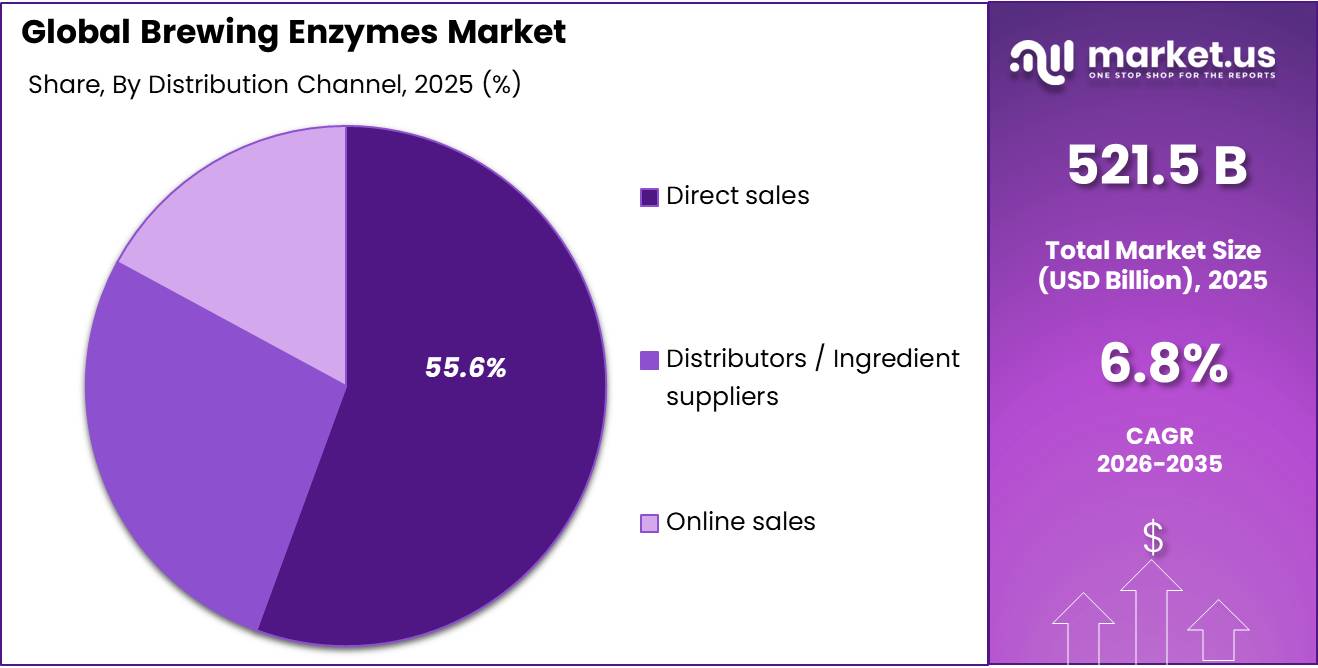
- Direct sales held a dominant market position, capturing more than a 55.00% share.
- Asia-Pacific accounted for a reported 46.00% share, valued at USD 239.8 billion.
By Enzyme Type Analysis
Brewing Enzymes Market by Enzyme Type: Amylase
Amylase leads with a 43.00% market share in 2025, supported by its role in breaking down starch into fermentable sugars during brewing. This process helps breweries improve mashing efficiency and maintain consistent fermentation performance. Amylase is particularly useful when brewing recipes include unmalted grains or other starch-rich ingredients. Its continued use is linked to the need for reliable starch conversion and efficient raw-material utilisation.
Alpha-amylase supports efficient starch conversion in brewing in 2025 and 2026, helping breweries break down starch into dextrins and fermentable sugars during mashing. This function can improve brewing yield, reduce processing time, and allow the use of alternative grains such as corn and rice. The United States Alcohol and Tobacco Tax and Trade Bureau approves a maltogenic alpha-amylase preparation for use in beer and cereal beverage production at up to 49.5 mg of total organic solids per kilogram of starch raw material, subject to the stated conditions.
By Source Analysis
Brewing Enzymes Market by Source: Microbial
Microbial enzymes dominate with a 77.00% market share in 2025, supported by their suitability for large-scale production and consistent performance in brewing applications. These enzymes are commonly produced through controlled microbial fermentation, allowing manufacturers to develop formulations for starch conversion, viscosity control, and improved processing efficiency. Their use helps breweries maintain consistent product quality and manage raw-material variation.
Plant-based enzymes contribute to brewing by providing an alternative to microbial enzyme preparations. Extracted from plant materials, these enzymes can support starch breakdown and other biochemical processes involved in brewing. Their application depends on enzyme activity, raw-material availability, processing conditions, and consistency between batches.
By Form Analysis
Brewing Enzymes Market by Form: Liquid
In 2025, “Liquid” held a dominant market position, capturing more than a 65.00% share, supported by its ease of dosing, convenient handling in automated production systems, and suitability for continuous brewing operations. Liquid enzyme preparations can be mixed directly into processing stages, helping breweries achieve even distribution and consistent enzyme activity. Their use supports starch conversion, viscosity control, and efficient processing of different grain formulations.
Dry / Powder enzyme formulations offer convenient storage, transport, and handling for brewing applications. In 2025 and 2026, these formulations can appeal to breweries seeking products with lower moisture content and flexible dosing during production. Their suitability depends on enzyme stability, solubility, packaging, and the operating conditions of each brewery. Dry formulations can also help reduce the need to transport water as part of the product, although their overall cost advantage depends on concentration and handling requirements.
By Application Analysis
Brewing Enzymes Market by Application: Beer
In 2025, “Beer” held a dominant market position, capturing more than a 77.00% share, supported by the widespread use of enzymes in commercial brewing to improve starch conversion, fermentation performance, and filtration. Enzymes such as amylase and beta-glucanase help breweries process malted barley and alternative grains while maintaining consistent product quality. Their use can also support production efficiency and reduce processing challenges associated with different grain formulations.
Wine applications use enzymes to support juice extraction, clarification, filtration, and aroma development. In 2025 and 2026, pectinases and other specialised enzyme preparations can help wineries improve juice yield and processing efficiency, depending on grape variety and production methods. However, wine production differs from beer brewing, and enzyme requirements depend on the desired wine style and processing conditions.
According to the United States Department of Agriculture’s Economic Research Service, California’s wine-type grape production was forecast at 3 million tons in 2025, an increase of 4% from 2024. This provides a government-reported indicator of the raw-material base relevant to wine processing, rather than a direct measure of wine enzyme demand.
By Distribution Channel Analysis
Brewing Enzymes Market by Distribution Channel: Direct Sales
In 2025, “Direct sales” held a dominant market position, capturing more than a 55.00% share, supported by direct relationships between enzyme manufacturers and breweries. This channel allows suppliers to provide technical guidance, product recommendations, and support for enzyme dosing and process optimisation. Direct sales are particularly useful for large breweries that require consistent product quality, reliable supply, and solutions tailored to specific grain mixtures and brewing conditions.
Distributors and ingredient suppliers support brewing enzyme sales by connecting manufacturers with breweries of different sizes. In 2025 and 2026, these intermediaries can help customers access multiple enzyme products, manage smaller orders, and obtain local inventory and technical assistance. Their established supply networks can be useful for craft breweries and regional producers that may not purchase directly from large enzyme manufacturers.
Key Market Segments
By Enzyme Type
- Amylase
- Alpha-amylase
- Beta-glucanase
- Protease
- Xylanase
- Cellulase
- Other enzymes
By Source
- Microbial
- Plant-based
- Animal-based
By Form
- Liquid
- Dry / Powder
By Application
- Beer
- Wine
- Spirits / Distilling
- Cider
- Other
By Distribution Channel
- Direct sales
- Distributors / Ingredient suppliers
- Online sales
Driver Analysis
Local-grain and unmalted-barley substitution
Replacing part of the malt bill with locally available grains creates a direct economic rationale for purchasing enzyme blends: breweries can substitute externally supplied catalytic activity for functionality otherwise delivered through malt. Novonesis states that Ondea Pro supports barley inclusion up to 100% and combines six enzyme activities—pullulanase, α-amylase, cellulase, xylanase, protease and lipase—with endogenous barley enzymes; this is a technical capability claim, not evidence that every brewery can economically adopt a 100% unmalted-barley recipe. The strategic value lies in expanding the acceptable grain specification and reducing dependence on a single malt supply route, while protecting viscosity, protein breakdown and fermentability.
Commercial relevance is strongest where local-grain availability, import exposure and affordable beer positioning intersect: HEINEKEN reported notable 2025 consolidated-volume growth in Vietnam, Ethiopia and India, despite a 2.1% decline in consolidated volume globally. For illustration, replacing 20% of a grain bill with material priced 25% below the displaced input reduces gross grain expenditure by 5%, before enzyme cost, extraction differences, logistics and quality-control expenses; this is an analyst sensitivity, not a reported brewery saving. The +0.9 pp allocation assumes broader conversion of suitable recipes rather than universal substitution, with suppliers capturing value through application-specific blends and recurring technical support. Adoption remains conditional on sensory validation, local recipe rules and a positive net saving per hectolitre.
Drivers Impact Analysis
| Driver | (~) % Impact on CAGR Forecast | Geographic Relevance | Impact Timeline |
|---|---|---|---|
| Local-grain and unmalted-barley substitution | +0.9 pp | India, Vietnam, Nigeria, Ethiopia, South Africa | Medium term (2–4 years) |
| Energy- and water-efficient processing | +0.7 pp | EU, UK, Mexico, South Africa, India | Short term (≤ 2 years) |
| Low-carb and high-attenuation formulations | +0.6 pp | US, Canada, Brazil, Mexico, EU | Medium term (2–4 years) |
| Enzymatic stabilization and faster throughput | +0.5 pp | EU, UK, North America; Brazil, Vietnam | Short term (≤ 2 years) |
| No-alcohol recipe and process optimization | +0.4 pp | EU, UK, US, Canada; Brazil, Southern Africa | Medium term (2–4 years) |
| Regional enzyme supply and technical support | +0.4 pp | India core; wider APAC opportunity | Long term (≥ 4 years) |
Restraint Analysis
Beer-Volume Contraction
Declining beer output reduces the production base over which brewing enzymes are consumed, forcing suppliers to increase penetration or revenue per hectolitre merely to maintain sales. The Brewers Association’s revised May 2026 release reports US craft production of 22.034 million barrels in 2025, down 4%, against a 5.7% decline in the overall beer category; 60% of surveyed craft breweries reported lower production, 39% reported growth and 1% remained unchanged. These revised figures supersede the association’s earlier preliminary estimates.
Weakness also extends beyond small brewers: HEINEKEN’s total volume fell 1.2% in 2025, consolidated volume declined 2.1%, and growth in Asia Pacific and stable Africa and Middle East volumes did not offset declines in the Americas and Europe. In an illustrative exposure model, if 40% of brewing-enzyme revenue serves markets experiencing a sustained 3% annual production decline, unchanged enzyme dosage and prices would create approximately a 1.2% annual revenue headwind before penetration gains; the assigned −0.8 pp CAGR deduction assumes partial compensation from additional applications and favorable regional mix.
Strategically, weaker throughput reduces repeat-order volumes, increases selling and technical-service costs per customer hectolitre, and can postpone trials when breweries prioritize cash preservation. The restraint is therefore not simply fewer litres brewed: declining utilization can also weaken the value of capacity-expansion claims, shifting enzyme purchasing toward demonstrable cash savings rather than theoretical output gains.
Restraint Impact Analysis
| Restraint | (~) % Impact on CAGR Forecast | Geographic Relevance | Impact Timeline |
|---|---|---|---|
| Beer-volume contraction | −0.8 pp | US, Canada, EU, UK | Short term (≤ 2 years) |
| Fragmented enzyme approvals | −0.4 pp | EU-27; export-linked suppliers | Medium term (2–4 years) |
| Purity-rule exclusions | −0.3 pp | Germany; purity-positioned exports | Long term (≥ 4 years) |
| Validation and process risk | −0.4 pp | EU, North America, India, Southeast Asia | Medium term (2–4 years) |
| Small-brewery adoption costs | −0.4 pp | US, UK, EU; India craft segment | Short term (≤ 2 years) |
| Lower-dose revenue dilution | −0.3 pp | North America, EU, APAC | Long term (≥ 4 years) |
Opportunity Analysis
Verified-Savings Contracts
A future opportunity is to replace selected kilogram-based sales with contracts that charge for independently verified process savings, allowing suppliers to capture economic value that is not reflected in enzyme dosage alone.
The technical foundations already exist: dsm-firmenich states that Brewers Clarex requires no special equipment or capital expenditure for its specified application, while Novonesis offers brewing sustainability and energy-saving calculators; however, these sources do not establish that audited gain-sharing contracts are standard industry practice. The white space is therefore the commercial architecture—measurement, contractual baselines, verification and shared benefits—not the underlying energy-saving application.
In an illustrative 2-million-hectolitre brewery, verified savings of €0.15 per hectolitre create €300,000 annually; a 25% supplier share produces €75,000 of annual compensation, while €15,000 of monitoring and verification costs leave €60,000 before enzyme production, delivery and other service expenses. That compensation must be assessed against the supplier’s existing account revenue: replacing €80,000 of conventional sales with €75,000 of performance fees would destroy value unless additional benefits justify the change.
Contracts should normalize production mix, utility tariffs, grain quality and utilization, with quality-performance exclusions and annual reconciliation. A target of incremental revenue equal to 3% of the 2031 baseline supports approximately +0.6 pp of conditional CAGR upside; successful execution depends on monetizing genuinely additional customer value, not relabeling existing enzyme sales.
Opportunity Impact Analysis
| Opportunity | (~) % Potential CAGR Upside | Geographic Relevance | Execution Window |
|---|---|---|---|
| Verified-savings contracts | +0.6 pp | EU, UK, US, Mexico | Short term (≤ 2 years) |
| OEM-embedded enzyme programs | +0.5 pp | EU, North America, India, Vietnam | Medium term (2–4 years) |
| Pooled craft-brewery services | +0.4 pp | US, UK, Germany, India | Short term (≤ 2 years) |
| Adaptive-recipe subscriptions | +0.4 pp | India, Vietnam, Nigeria, South Africa | Medium term (2–4 years) |
| Spent-grain enzyme platforms | +0.3 pp | France, Benelux, Germany, UK | Long term (≥ 4 years) |
| Regional formulation partnerships | +0.3 pp | India, East Africa, West Africa | Medium term (2–4 years) |
Challenges Analysis
Variable Grain Processability
Climate-sensitive changes in barley composition create a recurring optimization problem because a fixed enzyme recipe may not deliver the same extract recovery, viscosity or fermentation profile across harvests and suppliers. Crisp Malt’s 2025 intake data illustrate the variability: average winter-barley nitrogen increased from 1.40% in 2024 to 1.60% in 2025, approximately 14.3%, while spring-barley nitrogen increased from 1.39% to 1.59%, approximately 14.4%; spring-barley retention above 2.5 mm declined from 95.6% to 92.1%, and screenings below 2.25 mm doubled from 1.6% to 3.2%. These are one maltster’s intake observations, not global barley averages.
AHDB explains that drought, disease and lodging can increase grain nitrogen concentration by reducing starch deposition or yield, while grain skinning can make germination less uniform, linking agronomic variability to downstream process inconsistency. In an illustrative brewery processing 10,000 tonnes of grain annually, a 0.5-percentage-point reduction in recoverable extract represents 50 tonnes of extract-equivalent loss; at an assumed €500 per tonne replacement value, the exposure is €25,000 before additional processing costs.
The −0.5 pp friction allocation reflects repeated recipe adjustment, slower transfer of validated applications between grain lots and occasional deterioration in customer savings—not an assumption that enzymes become unusable. Suppliers and brewers must maintain incoming-grain assays, lot-specific operating envelopes and retained-sample investigations, with contracts distinguishing substrate-driven variability from enzyme underperformance; the long-term challenge is that greater raw-material flexibility expands the range of conditions that technical teams must continuously manage.
Challenges Impact Analysis
| Challenge | (~) % CAGR Friction Drag | Geographic Relevance | Mitigation Horizon |
|---|---|---|---|
| Variable grain processability | −0.5 pp | UK, EU; India, Vietnam, Africa | Long term (≥ 4 years) |
| Enzyme activity preservation | −0.3 pp | India, Southeast Asia, Sub-Saharan Africa | Medium term (2–4 years) |
| Cross-border replenishment volatility | −0.3 pp | EU–APAC, EU–Africa corridors | Medium term (2–4 years) |
| Multi-site performance reproducibility | −0.4 pp | EU, North America, India, Brazil | Medium term (2–4 years) |
| Application expertise scalability | −0.3 pp | India, Southeast Asia, Africa | Long term (≥ 4 years) |
| Occupational exposure management | −0.2 pp | EU, North America, APAC | Short term (≤ 2 years) |
Geopolitical Impact Analysis
Geopolitical Impact of Recent Wars on the Brewing Enzymes Market
The ongoing Russia-Ukraine war and instability in the Middle East can affect the brewing enzymes market through higher energy costs, shipping disruptions, and changes in the supply of agricultural raw materials. Brewing enzyme manufacturers depend on reliable supplies of barley, corn, wheat, and other starch-rich grains, as well as energy for fermentation, processing, and product storage. Disruptions to grain exports from the Black Sea region can increase raw-material price volatility, while shipping risks in the Red Sea can raise freight costs and delay deliveries of enzyme ingredients and finished products.
The Food and Agriculture Organization of the United Nations (FAO) reported on 2 October 2026 that global cereal production in 2026 was forecast at 2,979 million tonnes, while global cereal trade for 2026/2027 was projected at 505.8 million tonnes, down 3.5% from the previous season. The FAO also linked lower trade expectations partly to Black Sea shipping constraints and limited alternative transport capacity. Source: FAO Cereal Supply and Demand Brief. These conditions may encourage brewing enzyme producers to diversify suppliers, maintain safety stocks, and strengthen regional distribution networks.
Regional Insights
Asia-Pacific: Dominating Region
In 2025, Asia-Pacific accounted for a reported 46.00% share, valued at USD 239.8 billion, according to the supplied market figures. The region’s position is supported by its large brewing industry, established beer manufacturers, and demand for efficient processing technologies. China is a major contributor to regional brewing activity. According to the BarthHaas Report 2024/2025, China produced 341 million hectolitres of beer in 2024, representing 18.2% of global production.
Asia’s total beer output reached 565.4 million hectolitres that year, although regional production declined 2.3%. These figures demonstrate the scale of brewing activity that creates demand for enzymes used in starch conversion, filtration, and processing efficiency. The reported USD 239.8 billion value should be checked against the original dataset because it appears unusually large for the brewing enzymes market.
Emerging brewing markets across Southeast Asia offer opportunities for brewing enzyme suppliers as breweries seek better production efficiency, flexible raw-material use, and consistent product quality. Vietnam, Thailand, and the Philippines have established beer industries, creating potential demand for enzyme preparations that support starch conversion, filtration, and processing performance.
The wider agricultural supply environment remains important: the Food and Agriculture Organization reported global cereal production of 2,979 million tonnes forecast for 2026. This supports the importance of grain availability to food and beverage processing, although it is not a direct measure of enzyme demand. Source: FAO Cereal Supply and Demand Brief.
Key Regions and Countries Insights
- North America
- US
- Canada
- Europe
- Germany
- France
- The UK
- Spain
- Italy
- Rest of Europe
- Asia Pacific
- China
- Japan
- South Korea
- India
- Australia
- Rest of APAC
- Latin America
- Brazil
- Mexico
- Rest of Latin America
- Middle East & Africa
- GCC
- South Africa
- Rest of MEA
Key Players Analysis
Novonesis is a key biosolutions supplier with expertise in microbial fermentation and enzyme technologies for food and beverage processing, including brewing. In 2025, the company reported net sales of EUR 4,157.6 million, organic sales growth of 7%, and an adjusted EBITDA margin of 37.1%. It launched 33 new products during the year, supporting its wider innovation strategy. Its enzyme expertise and customer-focused solutions position it to serve breweries seeking improved processing efficiency and consistent product quality. These figures cover the overall company, not brewing enzymes alone.
IFF supplies enzyme and bioscience solutions for food and beverage manufacturers, including brewing applications through its Health and Biosciences business. In 2025, IFF recorded total net sales of USD 10.890 billion, while Health and Biosciences generated USD 2.275 billion in comparable currency-neutral sales. The company focuses on enzyme technologies that support processing performance, product consistency, and fermentation applications. Its established food biotechnology capabilities help breweries explore solutions for starch conversion and production efficiency.
dsm-firmenich has expertise in fermentation, nutritional ingredients, and food science, with capabilities relevant to beverage development and processing. In 2025, the company reported EUR 9.034 billion in sales from continuing operations and an adjusted EBITDA of EUR 1.772 billion. Its activities span almost 60 countries, supporting an international customer base. However, these figures cover the wider business and do not establish brewing enzyme-specific revenue. Its relevance to this market should therefore be assessed through verified brewing-related products and applications rather than total company sales alone.
Top Key Players Outlook
- Novonesis
- IFF – Danisco / DuPont Nutrition & Biosciences heritage
- dsm-firmenich
- AB Enzymes
- Amano Enzyme Inc.
- Kerry Group plc
- BASF SE
- Advanced Enzyme Technologies Ltd.
- Lallemand Inc.
- Lesaffre
Aumgene Biosciences / Aum Enzymes - Biocatalysts Ltd.
- Megazyme Ltd.
- Enzyme Development Corporation (EDC)
- Leveking (Jiangsu) Bio-Engineering Co., Ltd.
Recent Developments
- In April 2026, Kerry opened an expanded biotechnology manufacturing facility in Carrigaline, Ireland, increasing lactase production capacity and strengthening its enzyme manufacturing network. The site supports more than 200 customers across over 80 countries and processes enzymes used in treating more than 2 million tonnes of milk annually.
- In February 2026, Sylvie Van Zandycke became President and General Manager of Lallemand’s Brewing business, effective 1 February, following Brent Jordan’s leadership since 2012.
Report Scope
| Report Features | Description |
|---|---|
| Market Value (2025) | USD 521.5 Bn |
| Forecast Revenue (2035) | USD 1,002.2 Bn |
| CAGR (2026-2035) | 6.8% |
| Base Year for Estimation | 2025 |
| Historic Period | 2020-2024 |
| Forecast Period | 2026-2035 |
| Report Coverage | Revenue Forecast, Market Dynamics, Competitive Landscape, Recent Developments |
| Segments Covered | By Enzyme Type (Amylase, Alpha-amylase, Beta-glucanase, Protease, Xylanase, Cellulase, Other enzymes), By Source (Microbial, Plant-based, Animal-based), By Form (Liquid, Dry / Powder), By Application (Beer, Wine, Spirits / Distilling, Cider, Other), By Distribution Channel (Direct sales, Distributors / Ingredient suppliers, Online sales) |
| Regional Analysis | North America – US, Canada; Europe – Germany, France, The UK, Spain, Italy, Rest of Europe; Asia Pacific – China, Japan, South Korea, India, Australia, Singapore, Rest of APAC; Latin America – Brazil, Mexico, Rest of Latin America; Middle East & Africa – GCC, South Africa, Rest of MEA |
| Competitive Landscape | Novonesis, IFF – Danisco / DuPont Nutrition & Biosciences heritage, dsm-firmenich, AB Enzymes, Amano Enzyme Inc., Kerry Group plc, BASF SE, Advanced Enzyme Technologies Ltd., Lallemand Inc., Lesaffre, Aumgene Biosciences / Aum Enzymes, Biocatalysts Ltd., Megazyme Ltd., Enzyme Development Corporation (EDC), Leveking (Jiangsu) Bio-Engineering Co., Ltd. |
| Customization Scope | Customization for segments, region/country-level will be provided. Moreover, additional customization can be done based on the requirements. |
| Purchase Options | We have three licenses to opt for: Single User License, Multi-User License (Up to 5 Users), Corporate Use License (Unlimited User and Printable PDF) |