


Report Overview
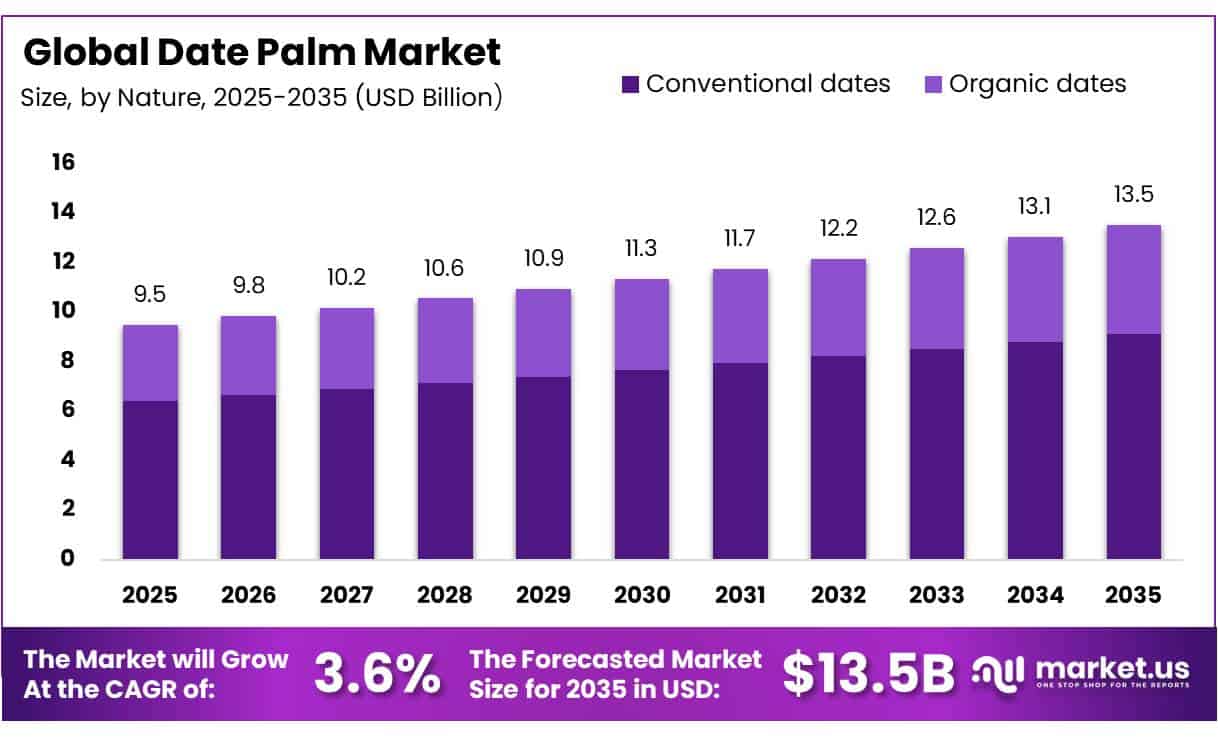
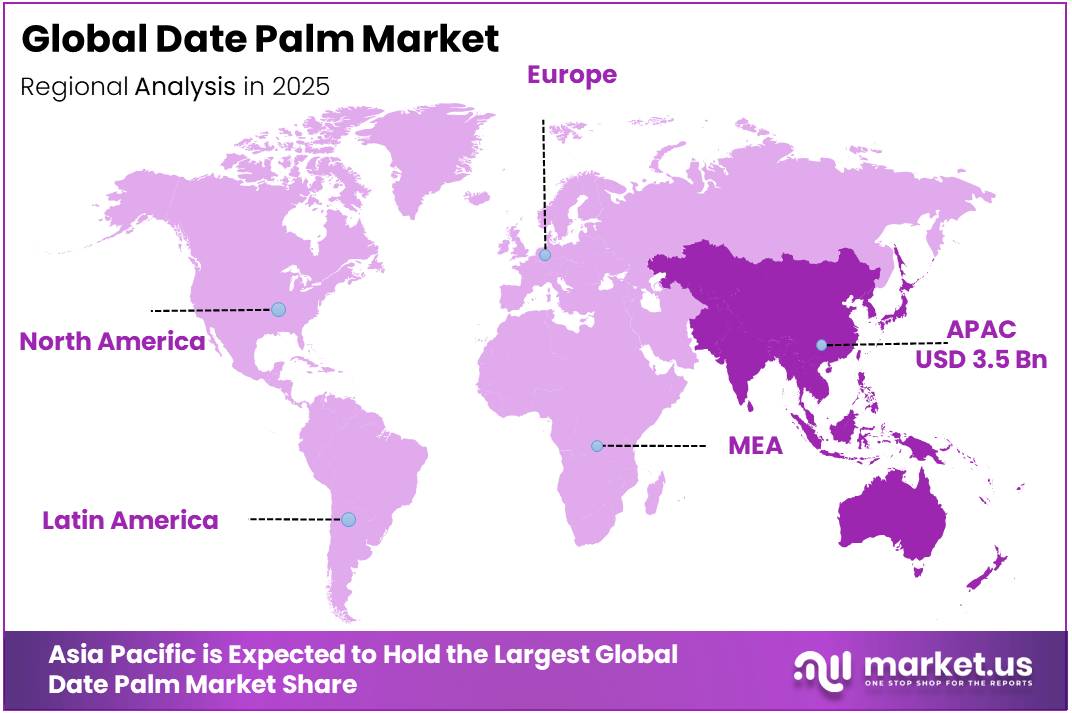
In 2025, the Global Date Palm Market was valued at USD 9.5 billion, and between 2026 and 2035, this market is estimated to register a CAGR of 3.6%, reaching about USD 13.5 billion by 2035. Asia-Pacific held a dominant market position, capturing more than a 36.6% share, holding USD 3.5 billion in revenue.
The date palm market forms part of the global fruit and food processing industry, supplying fresh dates, dried dates, syrups, pastes, powders, and ingredients for packaged foods. Production remains concentrated in arid and semi-arid economies with cultivation and processing networks.
- In 2025, Saudi Arabia produced more than 1.9 million tons of dates from over 37 million palm trees and exported its products to more than 125 countries, indicating strong international market reach.
Key Takeaways
- The global date palm market was valued at USD 9.5 billion in 2025.
- The global date palm market is projected to grow at a CAGR of 3.6% and is estimated to reach USD 13.5 billion by 2035.
- On the basis of product type, dried dates dominated the market, constituting 42.11% of the total market share.
- Based on nature, conventional dates dominated the date palm market, with a substantial market share of around 67.56%.
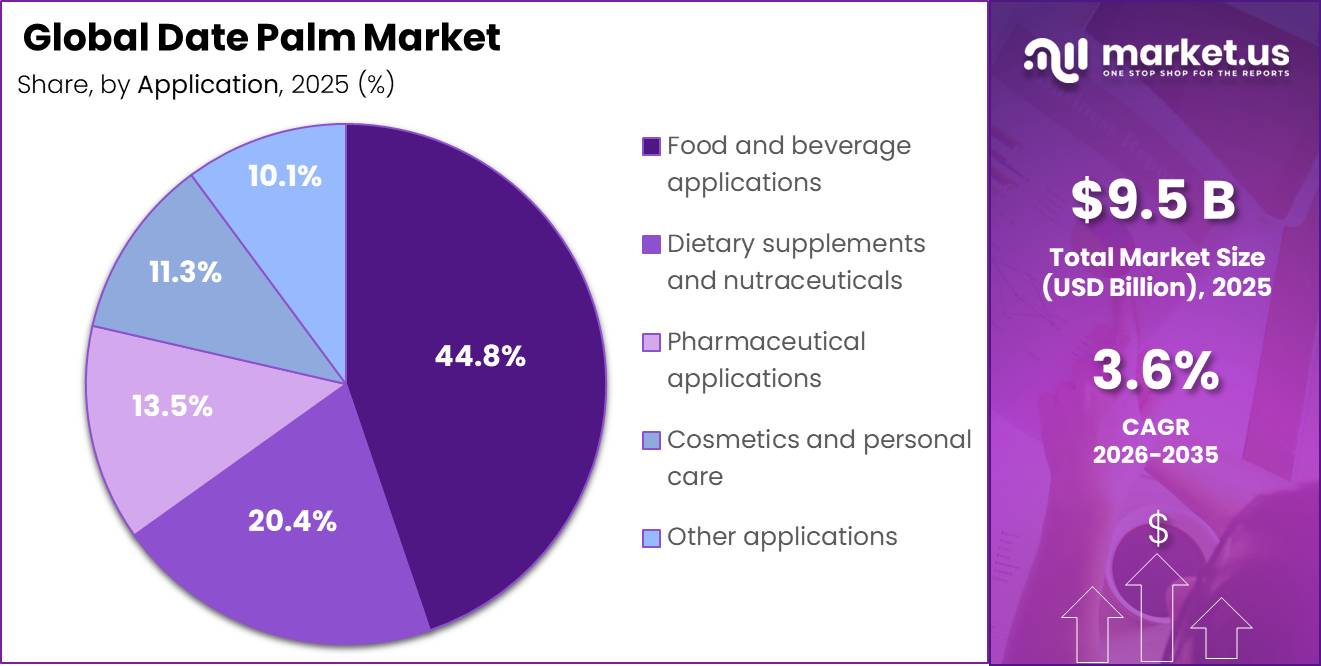
- Among the applications, food and beverage applications held a major share in the date palm market, accounting for 44.78% of the market share.
- In 2025, Asia Pacific was the most dominant region in the date palm market, accounting for 36.6% of the total market share.
The industrial scenario is improving in North Africa as growers invest in better varieties, irrigation, post-harvest handling, and packaging. The Food and Agriculture Organization of the United Nations reported that Morocco’s 2025-2026 date season reached more than 160,000 tons, representing a 55% increase from the previous season. Output strengthens availability for domestic processing, retail distribution, and export channels while encouraging investment in cold storage, grading, packaging, and value-added date products.
- In 2025, Saudi date exports reached Saudi Arabian Riyal (SAR) 1.938 billion, increasing14.3% from 2024. The National Center for Palms and Dates also expanded its export empowerment initiative into 15 international retail markets and more than 1,500 branches worldwide. These developments create growth opportunities for processed dates, branded retail products, premium varieties, and food ingredients as producers seek broader distribution and improved value realization across international markets.
Government and institutional programs are strengthening standards, investment, and market development. Saudi Arabia made an export certificate mandatory for date exporters from October 1, 2025, supporting greater compliance and product traceability. In Morocco, the Agricultural Development Agency used the 2025 International Date Palm Festival to promote investment under the Generation Green 2020-2030 Strategy and brought together 31 cooperatives and producer groups. Such initiatives support organized supply chains, responsible investment, export readiness, and higher-value processing across the date palm industry.
Product Type Analysis
Dried Dates dominate with 42.11% due to strong storage, processing, and retail demand.
In 2025, Dried dates held a dominant market position, capturing more than a 42.11% share. Their leadership is supported by longer shelf life, easy storage, established retail demand, and broad use across household consumption and food processing. Dried dates are widely distributed through supermarkets, specialty stores, foodservice channels, and export networks, while their suitability for confectionery, bakery, snack, and ingredient applications strengthens demand across key markets.
- In June 2026, according to the Saudi Press Agency, Al-Ahsa Oasis produced more than 120,000 tons of dates annually from over 2 million palm trees and cultivated more than 20 date varieties, providing measurable evidence of large-scale regional date production and harvest diversity.
Fresh dates are the fastest growing segment, supported by rising interest in minimally processed fruit, seasonal retail sales, and demand for premium varieties with natural taste and texture. Improved cold-chain handling, packaging, and distribution are helping fresh dates reach wider urban and export markets. Their seasonal availability also supports direct farm sales, specialty retailing, and foodservice demand, creating additional growth opportunities for producers focused on quality, freshness, and shorter supply chains.
Nature Analysis
Conventional Dates dominate with 67.56% due to broad availability and established consumption.
In 2025, Conventional dates held a dominant market position, capturing more than a 67.56% share. Their leadership is supported by broad availability, established farming practices, consistent supply, and strong demand across household consumption, retail, food processing, and export channels. Conventional cultivation also allows producers to serve large-volume markets efficiently, while familiar varieties and established distribution networks help maintain steady demand across major date-producing and consuming countries.
- In June 2026, according to the Saudi Press Agency, Madinah Region produced 344,000 tons of dates annually, representing about 18% of Saudi Arabia’s national date production, while organic date production in the region reached about 4,600 tons annually.
Organic dates are the fastest growing segment, supported by rising consumer preference for certified agricultural products, cleaner-label foods, and environmentally responsible farming practices. Growth is also encouraged by wider organic retail distribution, premium positioning, and stronger interest from specialty food buyers. As certification systems and sustainable cultivation practices expand, organic dates are gaining visibility across premium grocery, health-focused retail, and export channels, creating additional opportunities for producers targeting higher-value consumer segments in international consumer markets today.
Application Analysis
Food and Beverage Applications dominate with 44.78% due to their wide use across processed foods and beverages.
In 2025, Food and beverage applications held a dominant market position, capturing more than a 44.78% share. The segment benefits from the broad use of dates in bakery products, confectionery, beverages, syrups, pastes, snacks, and traditional foods. Their natural sweetness, texture, and suitability for processing support steady demand from food manufacturers, retailers, restaurants, and households. Greater interest in value-added date products is also encouraging processors to diversify formats for wider commercial use.
- In March 2026, according to the National Center for Palms and Dates, Eastern Region annual date production exceeded 261,000 tons, while the region contained more than 26,000 farms and approximately 32 date-processing plants.
Dietary supplements and nutraceuticals are the fastest growing segment, supported by increasing use of date powders, extracts, and concentrated ingredients in health-focused formulations. Producers are exploring dates as an ingredient for nutrition products because they can be processed into convenient formats for supplements and functional foods. Wider consumer interest in naturally sourced ingredients and continued product development are helping this application gain visibility across specialty nutrition, wellness, and functional food channels in several international markets.
Key Market Segments
By Product Type
- Dried dates
- Fresh dates
- Date syrup
- Date paste
- Date powder
- Other date products
By Nature
- Conventional dates
- Organic dates
By Application
- Food and beverage applications
- Dietary supplements and nutraceuticals
- Pharmaceutical applications
- Cosmetics and personal care
- Other applications
Driver Analysis
GCC Government-Backed Diversification Programs
Gulf states have treated date palm cultivation as a food-security and cultural-heritage priority within broader economic diversification agendas, translating into subsidized irrigation water allocations, farmer support payments, and export-promotion bodies such as national date and palm centers that actively track and publicize export performance. Saudi Arabia’s National Center for Palms and Dates reported date export growth ranging between roughly 39% and 67% across key international markets in 2025 versus 2024, alongside harvests exceeding 1.9 million tonnes, signaling an accelerating state-supported export push rather than organic demand-led growth alone.
Because Saudi Arabia and the UAE together represent a large share of global harvested area and gross exports, government procurement guarantees, subsidized cold-chain and packaging infrastructure, and diplomatic trade missions directly lower the effective cost of capital for exporters, compressing payback periods on new orchard and processing-facility investment. This driver has an unusually short realization timeline because subsidy programs and export incentives are policy levers that can be activated within a single fiscal cycle, unlike agronomic drivers that require multi-year tree maturation.
Drivers Impact Analysis
| Driver | (\~) % Impact on CAGR | Geographic Relevance | Impact Timeline |
|---|---|---|---|
| Health-driven substitution of dates for refined sugar and processed sweeteners in bakery, confectionery and sports-nutrition formulations | +1.4% | North America core, EU processed-food corridors, GCC domestic retail | Medium term (2-4 years) |
| Tissue-culture (micropropagation) adoption replacing offshoot propagation, compressing orchard maturity cycles and lifting per-hectare yield consistency | +1.1% | GCC (Saudi Arabia, UAE, Oman core), North Africa spill-over, APAC nursery corridors | Long term (≥4 years) |
| GCC state-backed agricultural diversification and Vision-2030-style food-security programs subsidizing date farming inputs and cold-chain logistics | +1.6% | Saudi Arabia, UAE, Qatar, Oman core; MENA spill-over | Short term (≤2 years) |
| Export diversification and trade-corridor expansion into India, Southeast Asia and Sub-Saharan Africa via preferential tariff and logistics agreements | +1.2% | South Asia (India), APAC corridors, Sub-Saharan Africa spill-over, GCC exporters | Medium term (2-4 years) |
| Value-added downstream processing (date syrup, paste, powder, seed oil, date-based snack bars) shifting revenue mix from raw fruit to branded FMCG SKUs | +0.9% | EU, North America premium retail, GCC domestic branding push | Medium term (2-4 years) |
| Climate-resilient cultivar development and precision-irrigation (drip/fertigation) technology countering water scarcity and heat-stress yield volatility | +0.7% | GCC core, North Africa (Algeria, Tunisia, Egypt), South Asia | Long term (≥4 years) |
Restraint Analysis
Water Stress and Salinity
Water scarcity is the principal structural constraint because date palms remain commercially water-intensive despite their drought-tolerance reputation: FAO irrigation benchmarks indicate annual water requirements ranging from roughly 15,000 cubic metres per hectare in relatively moderate growing zones to about 34,190 cubic metres per hectare in Saharan conditions, making groundwater extraction, pumping energy and irrigation infrastructure material components of orchard cash cost. Salinity adds a second-order loss mechanism: palms can sustain full crop load around 2,000 ppm saline irrigation water, but performance declines significantly near 5,000 ppm, which converts water-quality deterioration into lower bunch weight, reduced fruit size, downgraded export quality and ultimately lower realization per kilogram.
For growers in Saudi Arabia, UAE, Oman, Algeria, Tunisia, Egypt and western India, the economic consequence is not merely lower yield but higher CapEx for drip irrigation, filtration, fertigation, soil amendments and desalinated or blended water; a 10-20% rise in per-hectare water and energy expenditure can erase much of the margin available on bulk-grade dates. The restraint is modeled at a –1.3 percentage-point CAGR effect because production expansion requires 5-8 years before a newly planted orchard reaches economically meaningful yields, so water constraints delay supply response precisely when processors and exporters are adding capacity.
Restraint Impact Analysis
| Restraint | (\~) % Impact on CAGR | Geographic Relevance | Impact Timeline |
|---|---|---|---|
| Water stress & salinity | -1.3% | GCC, North Africa, South Asia | Long term (≥ 4 years) |
| Red palm weevil losses | -0.9% | GCC, MENA, APAC corridors | Medium term (2-4 years) |
| Post-harvest gaps | -1.0% | GCC, India, North Africa | Short term (≤ 2 years) |
| Export compliance burden | -0.7% | EU imports, UK, North America | Short term (≤ 2 years) |
| Orchard payback & labour | -0.8% | India, North Africa, GCC | Long term (≥ 4 years) |
| Commodity price pressure | -0.6% | India, Africa, mass retail | Medium term (2-4 years) |
Opportunity Analysis
B2B Ingredient Platforms
The largest untapped white space is not further retail-date penetration but the creation of standardized B2B ingredient platforms supplying date paste, syrup, powder, fiber concentrates and natural sweetener blends to bakery, dairy-alternative, sports-nutrition and nutraceutical manufacturers under long-term formulation contracts; this is an opportunity rather than a current driver because most date supply is still monetized through whole-fruit, seasonal or trader-led channels rather than specification-led ingredient sales. Date fruit typically contains approximately 62-75% total sugars and 5-8% dietary fiber, allowing processors to engineer functional ingredients for defined Brix, viscosity, particle-size and moisture targets rather than sell variable fruit grades.
A processor converting 20-35% of lower-grade fruit into shelf-stable paste or syrup can reduce seasonal inventory discounting, raise plant utilization beyond the Ramadan cycle and potentially improve gross margin by 8-15 percentage points versus bulk dried-date trading, provided it wins repeat procurement from food manufacturers. The +1.4 percentage-point CAGR upside assumes that integrated processors secure 3-5 year supply agreements, build HACCP/ISO-grade ingredient facilities, and position date-based sweeteners at a competitive delivered cost against honey, agave and refined sugar on a sweetness-adjusted basis; without these customer-qualification investments, growing health-snack demand remains merely a baseline driver rather than incremental value creation.
Opportunity Impact Analysis
| Opportunity | (\~) % Potential CAGR Upside | Geographic Relevance | Execution Window |
|---|---|---|---|
| B2B ingredient platforms | +1.4% | EU, North America, GCC | Medium term (2-4 years) |
| Seed and biomass circularity | +1.0% | GCC, North Africa, EU | Medium term (2-4 years) |
| Traceable D2C diaspora brands | +0.9% | North America, EU, APAC | Short term (≤ 2 years) |
| India orchard-processing clusters | +1.1% | India core, GCC supply link | Long term (≥ 4 years) |
| Farm-service consolidation | +0.7% | GCC, North Africa, India | Medium term (2-4 years) |
| Premium carbon-smart certification | +0.6% | EU, UK, GCC premium retail | Long term (≥ 4 years) |
Challenges Analysis
Seasonal Harvest Concentration
Date-palm supply is inherently concentrated around a short harvest cycle, creating a recurring mismatch between orchard output, labour availability, sorting capacity, warehouse space and buyer demand; this is a challenge rather than a restraint because crop sales continue, but a high proportion of annual fruit volume reaches local markets simultaneously and weakens bargaining power throughout the chain. GCC value-chain research identifies simultaneous market arrivals as a major industry problem, with weak storage, packaging and post-harvest systems amplifying the price and quality impact.
A processor operating near 70-80% annual plant utilization may face 110-140% of normal throughput during the harvest peak and below 40% utilization in the off-season, forcing either overtime and outsourced handling at peak periods or expensive idle-capacity absorption during the rest of the year. This volatility raises working-capital needs because inventory must be bought when cash outflows are highest, then stored, conditioned and sold across 8-12 months; it also causes quality degradation when drying, cooling and grading slots are unavailable. The modeled -0.8 percentage-point friction drag persists until operators combine pre-harvest contracting, staggered variety portfolios, controlled-atmosphere storage, derivative processing and demand-planning systems that can distribute sales across retail, foodservice and industrial-ingredient channels.
Challenges Impact Analysis
| Challenge | (\~) % CAGR Friction | Geographic Relevance | Mitigation Horizon |
|---|---|---|---|
| Seasonal harvest concentration | -0.8% | GCC, North Africa, India | Medium term (2-4 years) |
| Pollination labour dependency | -0.7% | GCC, India, North Africa | Long term (≥ 4 years) |
| Cultivar-quality inconsistency | -0.9% | MENA, APAC production zones | Medium term (2-4 years) |
| Fragmented traceability data | -0.6% | GCC, India, Africa corridors | Medium term (2-4 years) |
| Processing-capacity imbalance | -0.8% | GCC, North Africa, India | Medium term (2-4 years) |
| Climate-yield volatility | -1.0% | GCC, North Africa, South Asia | Long term (≥ 4 years) |
Geopolitical Impact Analysis
Geopolitical Tensions and Maritime Disruptions Reshaping Date Palm Trade
Current geopolitical tensions are reshaping the date palm market through maritime disruption, logistics risk, and less predictable trade conditions. Exporters across the Middle East and North Africa rely on stable sea routes to reach overseas buyers. In March 2026, the World Trade Organization projected global merchandise trade growth at 1.9% for 2026, down from 4.6% in 2025, and warned that Middle East conflict could pressure food supplies and transport services.
Red Sea shipping conditions remain important for date exporters. In February 2026, the Suez Canal Authority reported that vessel traffic during the first half of fiscal year 2025/2026 increased 5.8%, net tonnage rose 16%, and revenues increased 18.5% from the same period a year earlier. The recovery followed severe disruption, showing that freight planning remains sensitive to regional security conditions.
- In July 2026, the World Trade Organization reported that outbound fertilizer-related shipments through the Strait of Hormuz had fallen close to zero after the Gulf conflict began, while 23.3% represented the upper limit of potentially affected fertilizer exports. Disruptions in fertilizer flows can raise cultivation costs and put pressure on margins for agricultural producers, including date growers.
These developments are encouraging date producers and exporters to diversify routes, strengthen storage, and maintain alternative logistics partners. Flexible supply networks can help manage freight volatility, delivery delays, and changing trade conditions. Regional sourcing, inventory planning, and access to alternative ports are therefore becoming increasingly important for maintaining reliable international date distribution when major shipping corridors face geopolitical disruption.
Regional Analysis
Asia Pacific Leads the Date Palm Market with 36.6% Share and USD 3.47 Billion
In 2025, Asia Pacific held the dominant position in the Date Palm Market, accounting for 36.6% of global revenue and generating USD 3.47 billion. Regional demand is supported by expanding consumption, retail availability, and import activity across Asian markets.
- In April 2026, the Saudi Press Agency reported that Saudi date exports to Japan increased 67% in 2025 compared with 2024, highlighting stronger demand in a key Asia Pacific market. Wider retail and online distribution continues to support market penetration.
North America is the fastest-growing region, supported by rising interest in natural sweeteners, dried fruit, functional foods, and convenient snacks. In June 2026, the Saudi National Center for Palms and Dates prepared to showcase premium dates at the Fancy Food Show in New York, an event hosting more than 30,000 visitors, over 2,400 exhibitors, and participants from around 50 countries. Exposure is strengthening supplier access to U.S. buyers and retail channels.
Key Regions and Countries Covered
- North America
- The US
- Canada
- Europe
- Germany
- France
- The UK
- Spain
- Italy
- Russia & CIS
- Rest of Europe
- APAC
- China
- Japan
- South Korea
- India
- ASEAN
- Rest of APAC
- Latin America
- Brazil
- Mexico
- Rest of Latin America
- Middle East & Africa
- GCC
- South Africa
- Rest of MEA
Key Players Analysis
Date palm companies are strengthening their competitive position through processing scale, product diversification, premium branding, and wider international distribution. In 2026, Al Foah remained one of the largest date processors, with annual processing capacity of about 230,000 tons, exports to more than 45 markets, and a network supporting over 20,000 farmers. Al Barakah Dates Factory also competes through large-scale processing of whole dates, paste, syrup, powder, and other ingredients, with capacity exceeding 120,000 metric tonnes annually and exports to more than 90 countries.
Product innovation and value-added positioning are becoming increasingly important. In April 2026, Al Barakah highlighted continued investment in advanced processing and local food production during a high-level factory visit. Bard Valley Natural Delights is also expanding consumer engagement around Medjool and specialty varieties, highlighting Medjool, Khudri, Khalas, Sukkari, and Ajwa dates in February 2026. These strategies show how Al Foah, Al Barakah Dates Factory, and Bard Valley Natural Delights compete through production efficiency, quality control, branded products, specialty varieties, and stronger access to retail and export channels.
Market Key Players
- Al Foah Company
- Bateel International
- Barari Dates Factory
- Datepac LLC
- Bard Valley Natural Delights
- Hadiklaim Date Growers Cooperative
- Emirates Dates Factory
- Al Barakah Dates Factory L.L.C
- Other Key Players
Key Development
- In May 2026, Bateel International launched 2 new Dubai Chocolate flavours, Qahwa Kunafa and Matcha Strawberry, for its travel retail business. The products were introduced around the Tax Free World Association Asia Pacific Exhibition & Conference in Singapore, held from May 11 to May 14, 2026, supporting Bateel’s expansion in premium confectionery and travel retail channels.
- In May 2026, Al Barakah Dates Factory participated in the Make it in the Emirates 2026 event in Abu Dhabi from May 4 to May 7, 2026. The company showcased value-added date ingredients, including date spreads, syrups, powders, pastes, and chopped dates, strengthening its positioning in processed and export-ready date products.
- In February 2026, Hadiklaim Date Growers Cooperative expanded its international buyer outreach by participating in Fruit Logistica 2026 in Berlin from February 4 to February 6, 2026. The cooperative presented its Medjool date portfolio to retailers, buyers, and industry partners, supporting wider international distribution and commercial partnerships.
Report Scope
| Report Features | Description |
|---|---|
| Market Value (2025) | USD 9.5 Bn |
| Forecast Revenue (2035) | USD 13.5 Bn |
| CAGR (2026-2035) | 3.6% |
| Base Year for Estimation | 2025 |
| Historic Period | 2020-2024 |
| Forecast Period | 2026-2035 |
| Report Coverage | Revenue Forecast, Market Dynamics, Competitive Landscape, Recent Developments |
| Segments Covered | By Product Type (Dried Dates, Fresh Dates, Date Syrup, Date Paste, Date Powder, and Other Date Products), By Nature (Conventional Dates and Organic Dates), By Application (Food and Beverage Applications, Dietary Supplements and Nutraceuticals, Pharmaceutical Applications, Cosmetics and Personal Care, and Other Applications) |
| Regional Analysis | North America – The US & Canada; Europe – Germany, France, The UK, Spain, Italy, Russia & CIS, Rest of Europe; APAC– China, Japan, South Korea, India, ASEAN & Rest of APAC; Latin America– Brazil, Mexico & Rest of Latin America; Middle East & Africa– GCC, South Africa, & Rest of MEA |
| Competitive Landscape | Al Foah Company, Bateel International, Barari Dates Factory, Datepac LLC, Bard Valley Natural Delights, Hadiklaim Date Growers Cooperative, Emirates Dates Factory, Al Barakah Dates Factory L.L.C, and Other Key Players. |
| Customization Scope | Customization for segments, region/country-level will be provided. Moreover, additional customization can be done based on the requirements. |
| Purchase Options | We have three licenses to opt for: Single User License, Multi-User License (Up to 5 Users), Corporate Use License (Unlimited Users and Printable PDF) |





































