


Report Overview
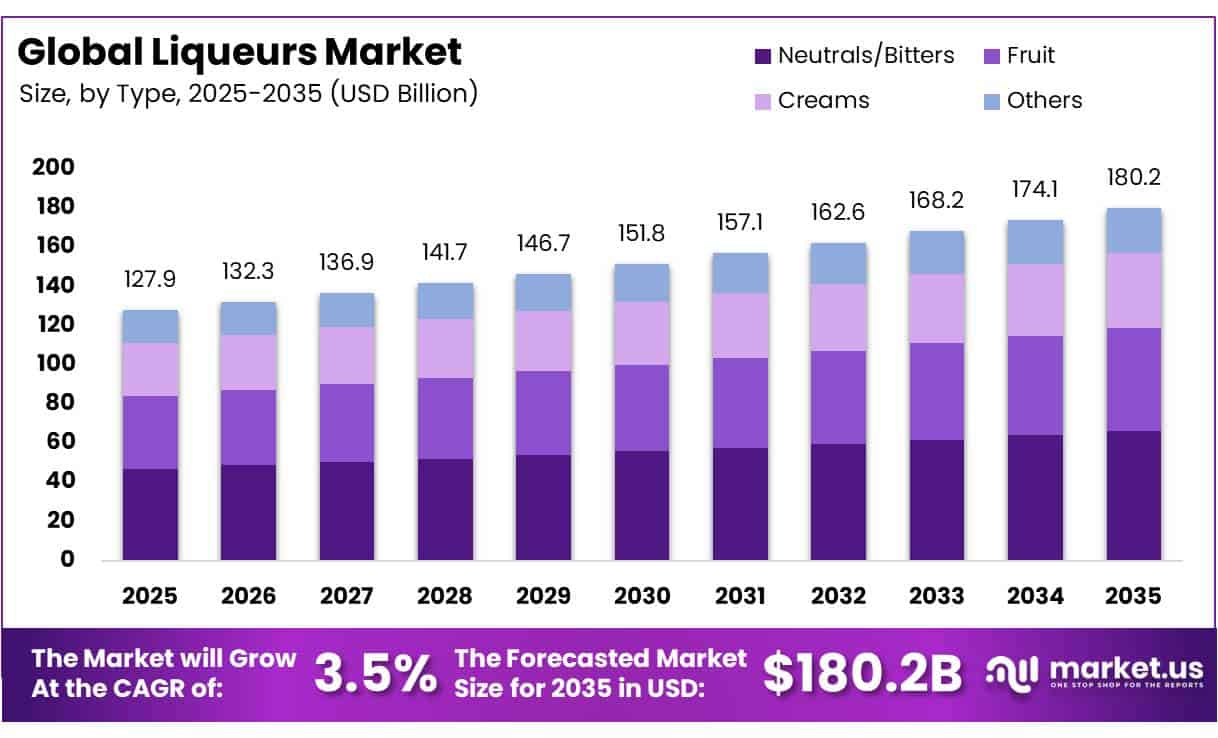
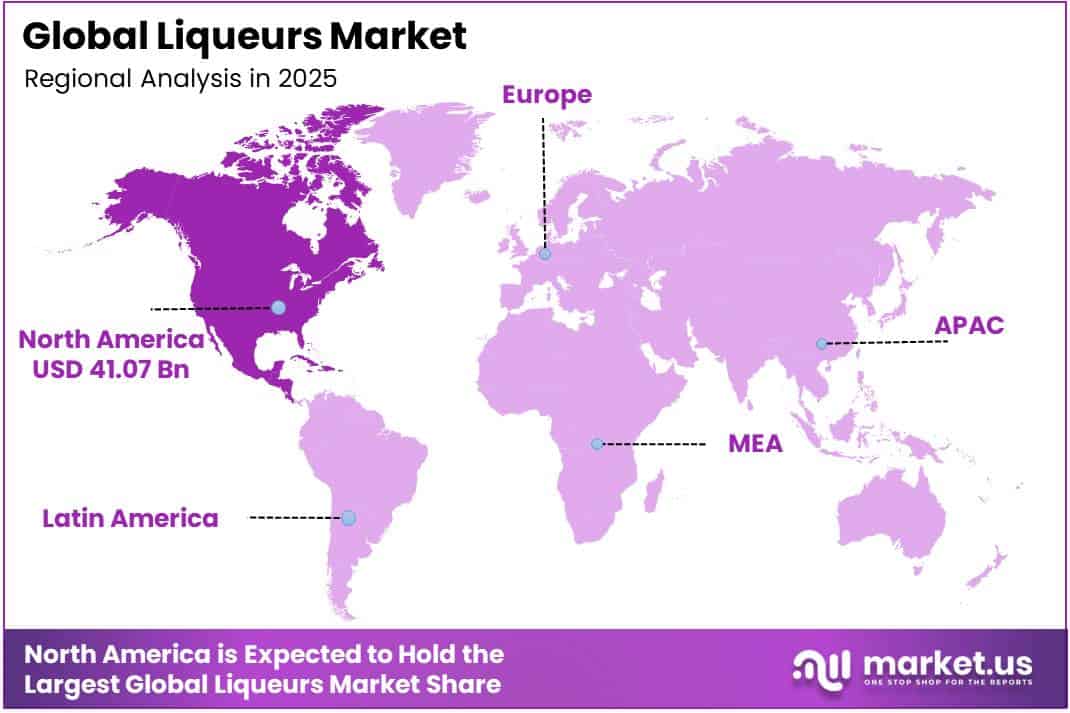
In 2025, the Global Liqueurs Market was valued at USD 127.9 billion, and between 2026 and 2035, this market is estimated to register a CAGR of 3.5%, reaching about USD 180.2 billion by 2035. North America held a dominant market position, capturing more than a 32.12% share, holding USD 41.07 billion in revenue.
The liqueurs industry forms part of the wider distilled spirits economy, covering fruit, cream, bitter, herbal, and neutral products sold through retail and hospitality channels.
- In 2025, United States spirits supplier sales totaled USD 36.4 billion, volumes reached 318.1 million 9-liter cases, and spirits represented 42.4% of beverage alcohol supplier revenue. This commercial base supports established distilling, flavoring, bottling, branding, and distribution networks serving diverse consumer occasions across retail, hospitality, and travel channels.
Key Takeaways
- The global liqueurs market was valued at USD 127.9 billion in 2025.
- The global market is projected to grow at a CAGR of 3.5% and is estimated to reach USD 180.2 billion by 2035.
- On the basis of type, neutrals/bitters dominated the market, constituting 36.78% of the total market share.
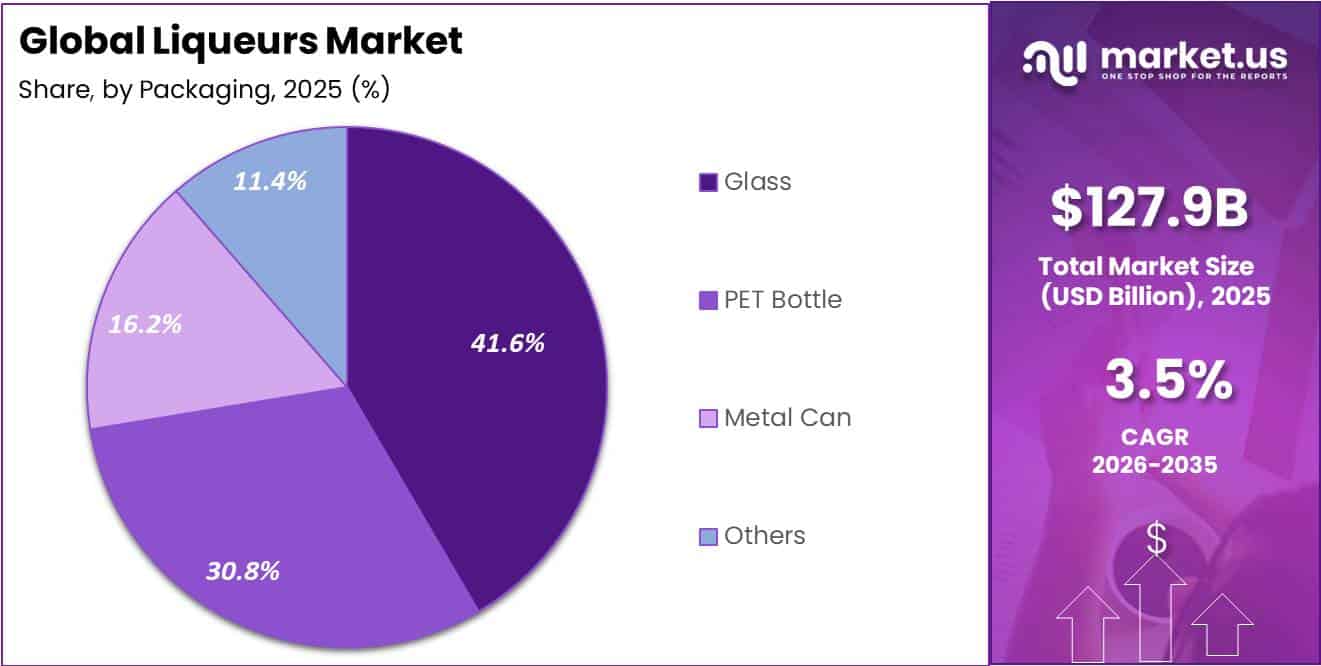
- Based on packaging, glass dominated the liqueurs market, with a substantial market share of around 41.56%.
- Among the distribution channels, supermarkets held a major share in the liqueurs market, accounting for 46.56% of the market share.
- In 2025, North America was the most dominant region in the liqueurs market, accounting for 32.12% of the total market share.
The industrial scenario remained competitive during 2025 as producers faced weaker discretionary spending and trade uncertainty. Cordials, the closest reported category to liqueurs, generated USD 2.7 billion in United States supplier sales, although revenue decreased 3.2%. Premixed spirit cocktails reached USD 3.8 billion and expanded 16.4%, highlighting demand for convenient, flavored formats. Meanwhile, American spirits exports fell 9% year over year during the second quarter, increasing pressure on international sales planning and investment choices.
- In March 2026, spirits EUROPE reported that Australia ranked as the European Union spirits sector’s 12th largest export market, receiving EUR 150.2 million of products during 2025. The European Union and Australia agreement is designed to remove the existing 5% import tariff and protect 231 European spirit geographical indications, supporting premium positioning and cross-border brand development for both established and emerging producers.
Government policy continues to shape pricing, formulation, and packaging decisions. From 1 February 2026, the United Kingdom applied alcohol duty of GBP 30.62 per litre of pure alcohol for products between 8.5% and 22% alcohol by volume, while stronger products attracted GBP 33.99. Small Producer Relief remained available for qualifying products below 8.5% alcohol by volume from producers making under 4,500 hectolitres annually. European packaging policy also retained a 75% glass recycling target for 2030.
Type Analysis
Neutrals/Bitters leads with 36.78% as established cocktail use supports demand, while Fruit records steady growth.
In 2025, Neutrals/Bitters held a dominant market position, capturing more than a 36.78% share. The segment remained widely used in classic cocktails, aperitifs, digestifs, and mixed drinks offered through bars, restaurants, supermarkets, and specialist retailers. Its broad flavour profile, including herbal, citrus, spice, and botanical notes, helped producers serve both traditional drinkers and consumers seeking distinctive premium beverages.
- In March 2026, according to the Distilled Spirits Council of the United States, American exports of liqueurs and cordials reached USD 511 million during 2025, compared with USD 1.08 billion for American whiskey.
Fruit is the growing segment. Demand is supported by approachable flavours, colourful cocktail applications, seasonal launches, and interest in drinks made with citrus, berries, tropical fruits, and stone fruits. Producers are expanding fruit-led ranges across premium, craft, low-alcohol, and ready-to-serve formats, while retailers benefit from products that are easy to understand, mix, gift, and consume across social occasions globally.
Packaging Analysis
Glass leads with 41.56% as presentation supports demand, while PET Bottle records the fastest growth.
In 2025, Glass held a dominant market position, capturing more than a 41.56% share. Liqueur producers favour glass because it protects flavour, supports shapes, and gives bottles a shelf presence. Its compatibility with closures, labels, embossing, and gift packaging helps brands distinguish fruit, cream, herbal, and bitter products across supermarkets, retailers, bars, and hospitality channels.
- In March 2026, according to the European Container Glass Federation, more than 150 decarbonisation and innovation projects were underway across Europe, while manufacturers were investing over EUR 600 million in electrification, hybrid furnaces, hydrogen trials, and circular logistics. Hybrid furnaces were delivering carbon dioxide reductions of up to 64%, and the industry-wide glass collection rate had reached 80.8%.
PET Bottle is the fastest growing segment. Its expansion is supported by lower transport weight, resistance to breakage, easier handling, and suitability for outdoor, travel, and high-volume retail use. Producers can use lightweight PET formats for value-focused liqueurs, smaller serving sizes, and markets where logistics efficiency and packaging durability influence purchasing decisions.
Distribution Channel Analysis
Supermarkets lead with 46.56% through broad product choice, while Convenience Stores record the fastest growth.
In 2025, Supermarkets held a dominant market position, capturing more than a 46.56% share. Their leadership was supported by wide product assortments, shelf placement, promotional activity, and convenient access to liqueur brands. Large stores can present fruit, cream, herbal, and bitter varieties together, helping shoppers compare flavours, bottle sizes, packaging styles, and price points during planned purchases. Supermarkets also benefit from customer traffic and the ability to combine liqueurs with mixers, food, and gifting products.
- In April 2026, according to the National Association of Convenience Stores, United States convenience retail in-store sales reached USD 341.2 billion in 2025, total industry sales reached USD 817.5 billion, and the average store completed 45,160 transactions per month.
Convenience Stores are the fastest growing segment. Their progress is supported by neighbourhood locations, extended operating hours, quick purchasing, and demand for smaller bottles and ready-to-serve formats. Wider alcohol licensing and improved premium selections are helping these stores attract shoppers seeking convenient purchases for informal gatherings, travel, gifting, and home consumption.
Key Market Segments
By Type
- Fruit
- Neutrals/Bitters
- Creams
- Others
By Packaging
- Glass
- PET Bottle
- Metal Can
- Others
By Distribution Channel
- Supermarkets
- Convenience Stores
- On-line
- Retailers
Driver Analysis
Premiumization and Craft/Artisanal Trading-Up
Millennials, now at peak purchasing power, are reallocating discretionary spend toward small-batch, heritage-storied liqueurs rather than trading down, effectively insulating the premium and super-premium tiers from the broader consumption softness affecting standard-tier volumes among older cohorts.
Strategically, this compresses the addressable base of price-sensitive private-label liqueur SKUs while expanding gross margin per case for brands that can credibly claim artisanal production, pushing incumbent multinational portfolios to acquire or incubate craft sub-brands rather than compete purely on shelf-price parity, a dynamic reinforced by the broader premium spirits market’s structural climb through the current decade.
Drivers Impact Analysis
| Driver | (~) % Impact on CAGR Forecast | Geographic Relevance | Impact Timeline |
|---|---|---|---|
| Premiumization and craft/artisanal liqueur trading-up | +1.2% | North America core, EU heritage markets, APAC urban centers | Medium term (2-4 years) |
| RTD cocktail and canned liqueur-based format proliferation | +1.5% | North America core, EU, APAC urban corridors | Short term (≤2 years) |
| Moderation, sober-curious shift and low/no-ABV line extensions | -0.6% | North America core, EU (UK, Nordics), Oceania | Medium term (2-4 years) |
| Direct-to-consumer e-commerce and delivery-platform expansion | +0.9% | North America core, EU, select APAC (China, India online retail) | Short term (≤2 years) |
| Excise duty and fiscal policy tightening | -0.5% | UK, EU, India, Canada, Australia | Short term (≤2 years) |
| Emerging-market middle-class expansion and cocktail-culture diffusion | +0.8% | APAC (China, India, Southeast Asia), Latin America, MEA | Long term (≥4 years) |
Restraint Analysis
Excise-Tax Inflation
Alcohol taxation is the most immediate volume and margin restraint because excise is levied before the producer’s gross margin is realized and therefore cannot be fully neutralized through factory productivity. In the UK, rates effective from 1 February 2026 set duty at £30.62 per litre of pure alcohol for products at 8.5%–22% ABV and £33.99 above 22% ABV; for a 700ml liqueur at 25% ABV, this equates to approximately £5.95 of duty before VAT, packaging, distributor margin, and retailer margin, making price-pack architecture decisive in value-tier retail.
India adds a separate structural barrier because alcohol remains state-regulated: Maharashtra’s 2025 IMFL duty action lifted some indicated retail prices by around 85%, showing how a state-level fiscal change can rapidly erase consumer affordability and trigger downtrading or informal-market substitution. Canada’s proposed 2026–27 federal spirits excise rate of CAD14.117 per litre of absolute alcohol, up from CAD13.840, and Australia’s indexed rate of AUD110.15 per litre of alcohol for relevant excisable beverages from August 2026 demonstrate that cost escalation is geographically broad even where governments cap indexation.
Restraint Impact Analysis
| Restraint | (~) % Impact on CAGR Forecast | Geographic Relevance | Impact Timeline |
|---|---|---|---|
| Excise-tax inflation | -0.9% | UK, India, Australia, Canada | Short term (≤ 2 years) |
| Health-led moderation | -0.8% | North America, EU, Oceania | Medium term (2-4 years) |
| Ingredient-cost volatility | -0.6% | EU, North America, import-dependent APAC | Short term (≤ 2 years) |
| Packaging-compliance burden | -0.5% | EU core, UK, North America | Medium term (2-4 years) |
| Route-to-market fragmentation | -0.7% | India, US states, EU cross-border | Long term (≥ 4 years) |
| Premium-price elasticity | -0.6% | Latin America, APAC, value-tier EU | Medium term (2-4 years) |
Opportunity Analysis
Zero-Proof Flavor Platforms
The largest unmonetized adjacency is to convert liqueur formulation capabilities—botanical extraction, emulsification, natural flavor balancing, sweetness control, and dessert-style sensory profiles into zero-proof adult cordials, cocktail modifiers, and functional aperitif concentrates rather than merely releasing lower-ABV versions of existing bottles; this is an opportunity rather than a present driver because most liqueur producers still treat non-alcoholic products as defensive extensions instead of separately managed brands with their own occasion architecture, retail placement, and repeat-purchase economics.
Alcohol-free products below 0.5% ABV can be positioned as “alcohol free” under the EU’s established labeling framework, allowing producers to access wellness, workplace, daytime-socializing, hospitality, and designated-driver occasions that conventional 15%–30% ABV liqueurs cannot serve.
A scaled platform could use a common botanical base across 4–6 SKUs, reduce formulation-development cost per launch by an estimated 25%–35%, and sell 200–500ml concentrates at a 1:4 to 1:8 dilution ratio, generating 8–16 serves per bottle versus approximately 10–14 serves from a conventional 700ml liqueur; assuming a 55%–65% gross margin, a 10% conversion of existing liqueur households into dual buyers could add approximately 1.1 percentage points to category CAGR.
Opportunity Impact Analysis
| Opportunity | (~) % Potential CAGR Upside | Geographic Relevance | Execution Window |
|---|---|---|---|
| Zero-proof flavor platforms | +1.1% | North America, EU, Oceania | Short term (≤ 2 years) |
| B2B cocktail-system sales | +0.9% | North America, EU, APAC cities | Medium term (2-4 years) |
| Compliant DTC club model | +0.8% | US eligible states, UK, EU | Short term (≤ 2 years) |
| Travel-retail exclusives | +0.7% | EU hubs, Gulf, APAC airports | Medium term (2-4 years) |
| Emerging-market craft roll-ups | +1.0% | India, Southeast Asia, Latin America | Long term (≥ 4 years) |
| Refill-led premium packaging | +0.5% | EU, Japan, South Korea | Long term (≥ 4 years) |
Challenges Analysis
Seasonal Demand Forecasting
Liqueur demand is unusually volatile because it is concentrated in gifting, winter entertaining, holiday cocktails, dessert occasions, and limited-edition launches, creating a forecast-error problem rather than an absolute demand constraint; a brand can sell throughout the year, but a 10%–20% volume miss around a six-to-eight-week peak season can cause either retail stockouts and lost listings or post-season markdowns that dilute brand equity.
For a cream, coffee, egg-based, or limited-edition liqueur, an 8–12 week replenishment cycle spanning liquid preparation, bottling, quality release, distributor allocation, and retailer booking can make demand sensing based only on previous-year shipments obsolete; 15%–25% safety-stock coverage may protect service levels but increases working capital, warehouse cost, and write-off risk.
The estimated -0.7 percentage-point CAGR drag reflects under-optimized promotion allocation and low-fill-rate periods, requiring companies to integrate point-of-sale data, weather signals, event calendars, distributor depletion data, and SKU-level machine-learning forecasting into a weekly sales-and-operations-planning process capable of reducing forecast error by a modeled 20%–30%.
Challenges Impact Analysis
| Challenge | (~) % CAGR Friction Drag | Geographic Relevance | Mitigation Horizon |
|---|---|---|---|
| Seasonal Demand Forecasting | -0.7% | North America, EU, APAC cities | Medium term (2-4 years) |
| Ingredient Traceability Gaps | -0.6% | EU, North America, import-led APAC | Long term (≥ 4 years) |
| Fragile Glass Logistics | -0.5% | Global export routes, APAC corridors | Medium term (2-4 years) |
| Compliance Workflow Complexity | -0.8% | India, US states, EU hubs | Long term (≥ 4 years) |
| Specialist Talent Scarcity | -0.4% | EU heritage markets, North America, APAC | Medium term (2-4 years) |
| Portfolio Innovation Latency | -0.6% | North America, EU, developed APAC | Medium term (2-4 years) |
Geopolitical Impact Analysis
Tariff Escalation and Retail Retaliation Reshaping Global Liqueurs Trade
Geopolitical trade disputes are reshaping the liqueurs market by changing import costs, retail access, inventory planning, and export priorities. From 24 July 2026, a 10% United States Section 301 duty applied to most non-exempt European Union products, including spirits. Liqueur producers therefore face tighter margins and greater pressure to revise pricing, shipment timing, and distributor agreements across major transatlantic sales channels worldwide.
- Political retaliation has also affected physical market access. The Distilled Spirits Council of the United States reported that provincial shelf removals beginning in March 2025 caused United States spirits exports to Canada to fall by more than 70% through December. For liqueur suppliers, such restrictions can reduce store visibility and interrupt established wholesale relationships.
Companies are responding by redirecting sales toward less disrupted markets. Excluding Canada, United States spirits exports increased 2.5% in 2025, while exports to markets outside Canada and the European Union rose 13.2%. This shift encourages liqueur brands to diversify distributors, adapt labels for regional requirements, and expand into alternative destinations.
Government-backed export support is becoming more important as trade conditions fragment. In February 2026, the United States Department of Agriculture awarded USD 1,076,152 through the Market Access Program to support international promotion of American spirits. Such funding can help smaller liqueur producers enter alternative markets, reduce dependence on exposed trade routes, and rebuild export momentum.
Regional Analysis
North America leads with 32.12% and USD 41.07 billion, while Asia-Pacific records the fastest growth.
North America held the dominant position in the liqueurs market, accounting for 32.12% and USD 41.07 billion. The region benefits from established cocktail culture, broad supermarket distribution, premium brand availability, and strong on-trade consumption.
- Statistics Canada reported that liqueurs represented 15.4% of Canadian spirits sales in 2024/2025. Total spirits sales reached CAD 6.7 billion, while volumes stood at 177 million litres, highlighting the region’s substantial retail base.
Asia-Pacific is the fastest-growing region, supported by urbanisation, expanding hospitality activity, rising interest in flavoured spirits, and wider access to imported products. Japan Customs listed liqueurs and cordials under tariff code 2208.70 in 2026, with duty-free treatment available across numerous trade arrangements and a general rate of 126 yen per litre. Stats NZ reported 442 million litres of alcoholic beverages available for consumption in 2025, showing the scale of regional demand and opportunities for fruit, cream, herbal, and bitter liqueurs across retail channels.
Key Regions and Countries Covered
- North America
- The US
- Canada
- Europe
- Germany
- France
- The UK
- Spain
- Italy
- Russia & CIS
- Rest of Europe
- APAC
- China
- Japan
- South Korea
- India
- ASEAN
- Rest of APAC
- Latin America
- Brazil
- Mexico
- Rest of Latin America
- Middle East & Africa
- GCC
- South Africa
- Rest of MEA
Key Players Analysis
Liqueur producers compete through brand strength, flavor innovation, cocktail relevance, distribution reach, and premium packaging. In 2026, Rémy Cointreau launched Cointreau Spicy, while its Liqueurs & Spirits division recorded 2.8% organic sales growth for 2025-26. Campari Group strengthened its aperitif-led position through Aperol and Campari, with the Aperol franchise delivering double-digit growth in the first quarter of 2026. Diageo and Pernod Ricard used broad portfolios and routes to market to protect shelf visibility and on-trade placements.
Competitive positioning increasingly depends on ready-to-drink formats, accessible premium products, localized flavors, and disciplined portfolio management. Brown-Forman reported 11% net sales growth in its ready-to-drink portfolio during fiscal 2026, while Pernod Ricard stated that Kahlúa outperformed its competitive set in the first half. Bacardi continued building cocktail occasions around Martini and St-Germain. Key players also emphasize distributor relationships, digital engagement, packaging innovation, and geographic expansion to strengthen global loyalty across retail and hospitality channels.
Market Key Players
- Bacardi
- Beam Suntory
- Diageo
- Lucas Bols
- Pernod Ricard
- Rémy Cointreau
- Brown-Forman
- Gruppo Campari
- & J. Gallo Winery
- Luxardo
- The Drambuie Liqueur
- Stock Spirits Group
- Other Key Players
Key Development
- In July 2026, Bacardi signed a global agreement with ecoSPIRITS to expand the use of circular packaging technology across its brand portfolio and strengthen reusable spirits-distribution systems worldwide.
- In April 2026, Gruppo Campari announced the establishment of a Dutch branch to directly manage the marketing and distribution of brands including Campari, Aperol, and Grand Marnier in the Netherlands from October 2026.
- In April 2026, Brown-Forman realigned its distribution network across 18 United States control-state markets, selecting four distributor organisations to represent its portfolio in 11 markets from June 2026.
Report Scope
| Report Features | Description |
|---|---|
| Market Value (2025) | USD 127.9 Bn |
| Forecast Revenue (2035) | USD 180.2 Bn |
| CAGR (2026-2035) | 3.5% |
| Base Year for Estimation | 2025 |
| Historic Period | 2020-2024 |
| Forecast Period | 2026-2035 |
| Report Coverage | Revenue Forecast, Market Dynamics, Competitive Landscape, Recent Developments |
| Segments Covered | By Type (Fruit, Neutrals/Bitters, Creams, and Others), By Packaging (Glass, PET Bottle, Metal Can, and Others), By Distribution Channel (Supermarkets, Convenience Stores, On-line, and Retailers) |
| Regional Analysis | North America – The US & Canada; Europe – Germany, France, The UK, Spain, Italy, Russia & CIS, Rest of Europe; APAC– China, Japan, South Korea, India, ASEAN & Rest of APAC; Latin America– Brazil, Mexico & Rest of Latin America; Middle East & Africa– GCC, South Africa, & Rest of MEA |
| Competitive Landscape | Bacardi, Beam Suntory, Diageo, Lucas Bols, Pernod Ricard, Rémy Cointreau, Brown-Forman, Gruppo Campari, E. & J. Gallo Winery, Luxardo, The Drambuie Liqueur, Stock Spirits Group, and Other Key Players. |
| Customization Scope | Customization for segments, region/country-level will be provided. Moreover, additional customization can be done based on the requirements. |
| Purchase Options | We have three licenses to opt for: Single User License, Multi-User License (Up to 5 Users), Corporate Use License (Unlimited Users and Printable PDF) |





































